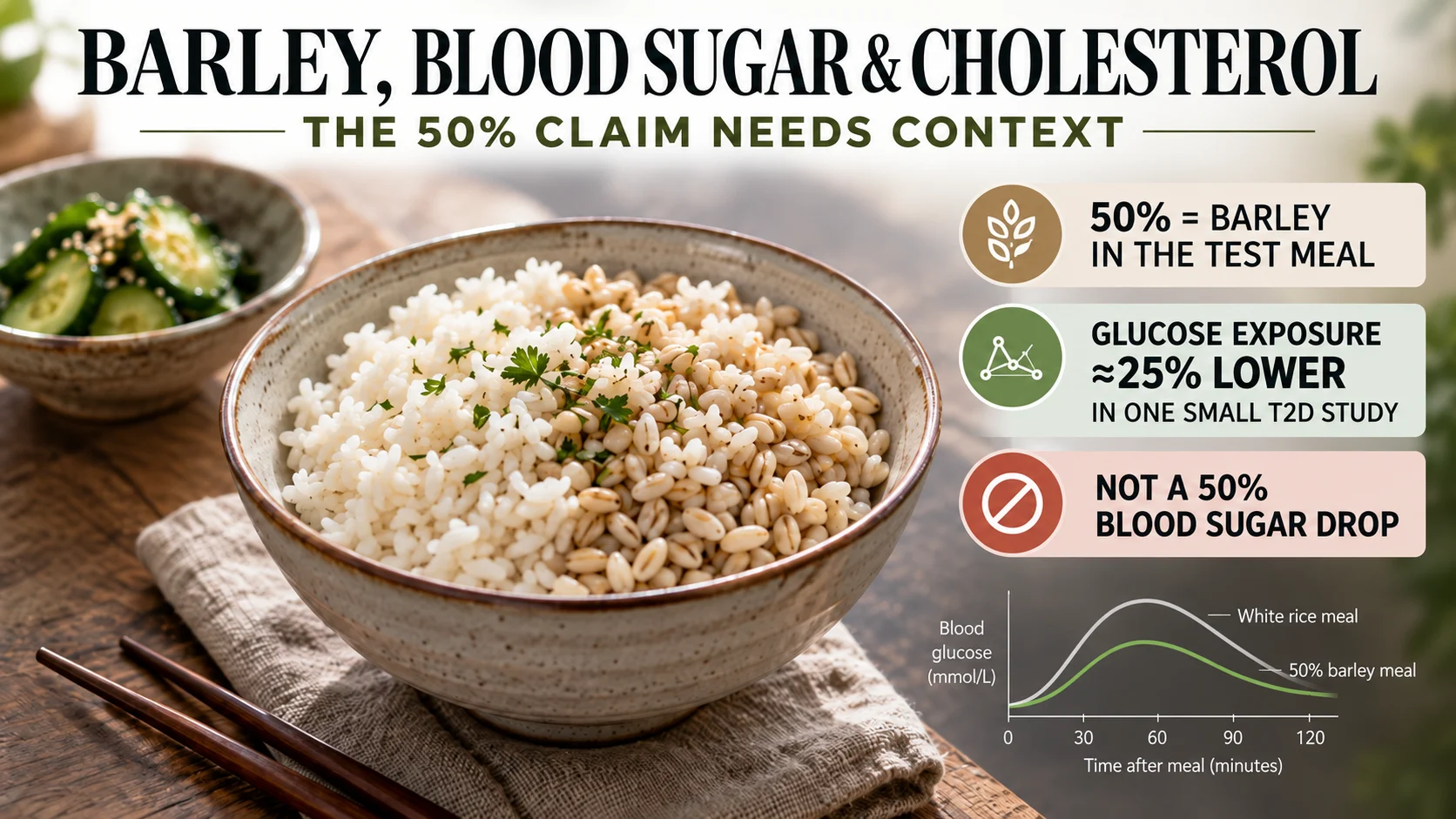

High-beta-glucan barley can reduce the glucose impact of some carbohydrate-heavy meals and beta-glucan from barley or oats can help lower LDL cholesterol, but the widely repeated “50% lower blood sugar” claim overstates what the study actually found. In the small type 2 diabetes trial behind that claim, 50% referred to the proportion of barley mixed with white rice, while the reported 180-minute glucose exposure was about 25% lower and the 60-minute glucose peak was not significantly different. The useful takeaway is a food-swap strategy, not a promise that one food will cut anyone’s blood sugar in half.
That distinction matters because people with type 2 diabetes often need to manage blood glucose and cardiovascular risk at the same time. Barley is interesting because its beta-glucan is a viscous soluble fiber, and that same property is relevant to both post-meal glucose handling and cholesterol metabolism. It can be a practical part of a meal plan, but it should sit alongside portion control, medication management, physical activity, blood-pressure care and the rest of a person’s diabetes plan.
The 50% figure was the barley mix, not the glucose reduction
The study often summarized as a dramatic blood-sugar result enrolled 10 people with type 2 diabetes and compared two 500-calorie test meals. One meal used white rice alone, while the other used a 50:50 mixture of white rice and a high-beta-glucan barley; the side dishes were kept the same. The researchers measured glucose and C-peptide for 180 minutes after eating and reported significantly lower overall glucose exposure with the barley-rice meal.
The actual group means make the scale of the effect clearer. The incremental area under the glucose curve was 4,468.5 mg·min/dL after the white-rice meal and 3,345.0 mg·min/dL after the barley-rice meal, which works out to roughly a 25% reduction in 180-minute glucose exposure. At 60 minutes, however, the average glucose peaks were almost identical, so this was not a 50% fall in peak blood sugar.
The trial is still useful because it shows that replacing part of a refined grain with a high-beta-glucan grain can change the shape and total burden of the post-meal glucose response. It does not prove that ordinary barley, every barley product or every person with diabetes will get the same result. The small sample, short meal-test design and specific high-beta-glucan barley all limit how far the numbers can be generalized.
| Claim or question | What the evidence actually shows | What it means in practice |
|---|---|---|
| “Barley cuts blood sugar by 50%.” | The meal contained 50% high-beta-glucan barley. In the small type 2 diabetes study, 180-minute glucose iAUC was about 25% lower, not 50%. | Treat barley as a potentially useful substitution, not a predictable drug-like effect. |
| “The glucose peak was much lower.” | The 60-minute peaks were not significantly different in that trial. | A flatter or lower total response may occur even when the highest measured point changes little. |
| “Barley lowers cholesterol too.” | Randomized-trial evidence supports LDL lowering from barley beta-glucan, while oat beta-glucan has an especially large evidence base. | The relevant component is beta-glucan intake and food form, not the word “barley” on its own. |
The most useful correction, therefore, is not that the original idea was wrong, but that the headline confused a meal composition with an outcome. A 50:50 grain mix is a concrete dietary intervention; a 50% blood-sugar reduction is a much stronger medical claim. Keeping those separate makes the evidence both more credible and more useful.
Why beta-glucan can change the glucose response
Beta-glucan is a soluble fiber found naturally in oats and barley. In a carbohydrate-containing meal, higher-viscosity beta-glucan can thicken the contents moving through the gastrointestinal tract, which can slow digestion and the rate at which glucose appears in the bloodstream. A large systematic review of controlled feeding trials found that oat beta-glucan reduced post-meal glucose exposure and peak rise on average, with the size of the effect influenced by dose, molecular weight and the comparison meal.
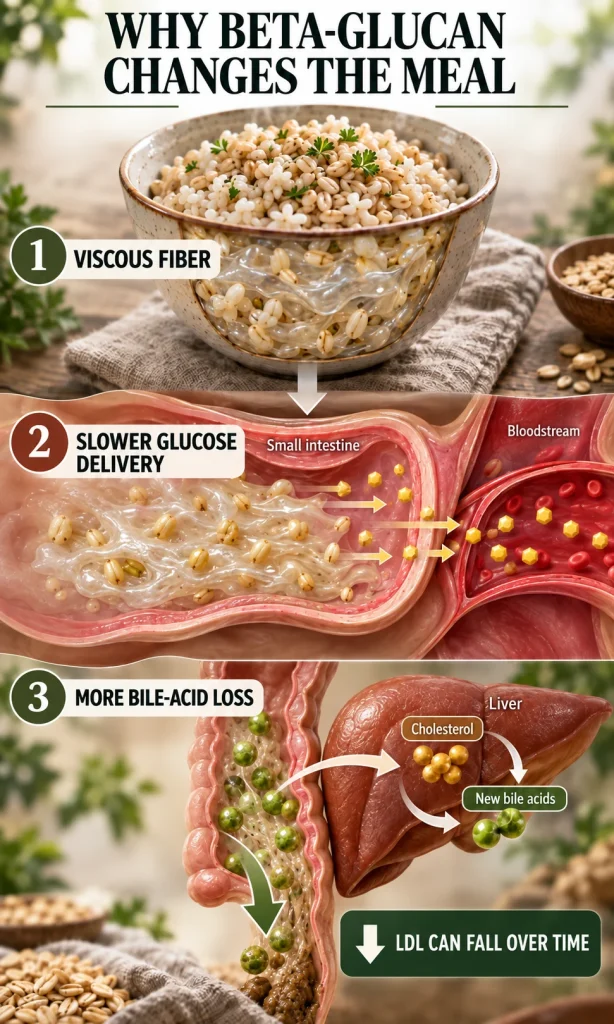
Food structure is one reason the response cannot be reduced to a single percentage. Intact or minimally processed grains can behave differently from finely milled products, and a product with the same total fiber may not provide the same amount or physical properties of beta-glucan. That is why a label that simply says “whole grain” or “high fiber” does not let you predict the same glucose response seen in a tightly controlled trial.
The broader diabetes guidance is also more conservative than a single-food headline. The National Institute of Diabetes and Digestive and Kidney Diseases recommends planning meals around the amount and type of carbohydrate, emphasizing high-fiber carbohydrate foods and working with the diabetes care team on a plan that fits the person’s medicines and health conditions. The American Diabetes Association’s carbohydrate guidance likewise lists barley and oats among whole-grain choices while emphasizing minimally processed carbohydrate sources and portion awareness.
What the small type 2 diabetes study actually measured
The study’s white-rice meal contained about 80 g of carbohydrate and 3.5 g of dietary fiber, while the barley-rice meal contained about 75 g of carbohydrate and 6.3 g of fiber. The glucose values peaked at about 169 mg/dL at 60 minutes after both meals, but the total incremental glucose exposure across 180 minutes was lower after the barley-rice meal. C-peptide exposure was also lower, suggesting less insulin secretion was needed over the test period.
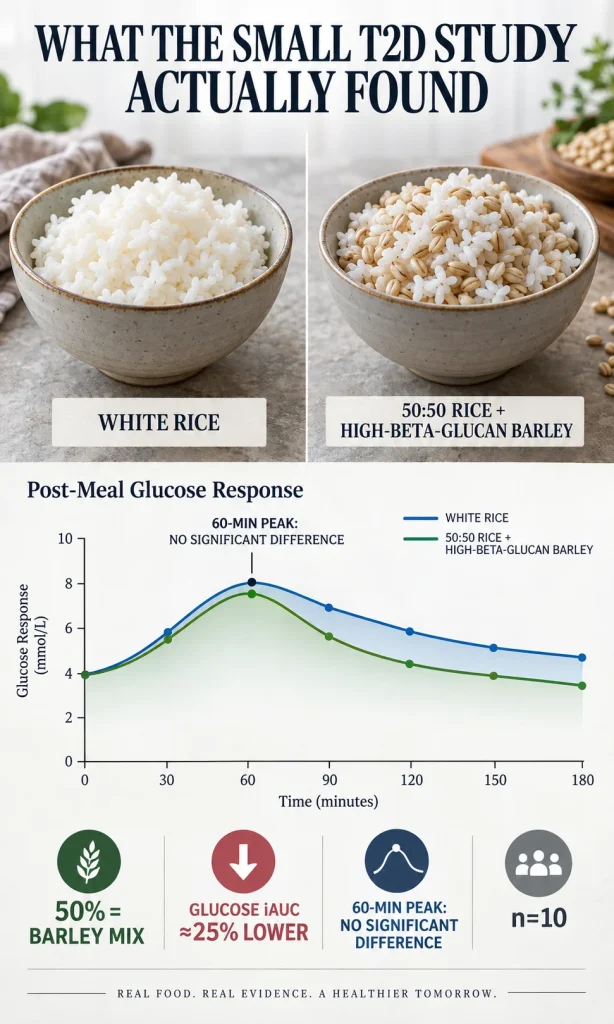
Those details matter because “blood sugar level” can refer to several different outcomes: a single measured value, the highest post-meal value, the rise from baseline or the area under the glucose curve. The barley meal improved one of those outcomes clearly in this trial, but not all of them. A headline that compresses all of those measurements into one “50%” number loses the distinction a reader actually needs.
The original study authors were careful about that limitation. They concluded that high-beta-glucan barley might help suppress post-meal hyperglycemia in people who use white rice as a staple food, while also calling for longer-term research and acknowledging the small sample. That is a much narrower claim than saying barley treats type 2 diabetes or reliably halves blood sugar.
Why the same fiber can help lower LDL cholesterol
Beta-glucan’s cholesterol effect is supported by a separate body of evidence. Viscous soluble fiber can increase bile-acid loss through the gut, which encourages the liver to draw on cholesterol as it replaces those bile acids. Randomized-trial meta-analyses of barley beta-glucan and oat beta-glucan have found reductions in LDL cholesterol, with oat studies commonly using at least 3 g of beta-glucan per day.
That 3 g/day figure is also reflected in the U.S. regulatory framework for certain soluble-fiber heart-health claims. The FDA food-labeling guidance recognizes beta-glucan soluble fiber from eligible whole-oat and barley sources in the coronary-heart-disease health claim, subject to the full food and diet requirements. Reaching that amount still does not guarantee a specific LDL drop for an individual, because baseline LDL, food processing, adherence and the rest of the diet all matter.
For oats, one meta-analysis of randomized trials using at least 3 g/day found average reductions of about 0.25 mmol/L in LDL cholesterol and 0.30 mmol/L in total cholesterol compared with control diets. A newer meta-analysis also found improvements in LDL and total cholesterol with oat or isolated beta-glucan interventions. These are meaningful dietary effects, but they are not a substitute for statins or other lipid-lowering treatment when those medicines are indicated.
Barley is most useful as a substitution, not an add-on
The practical advantage of barley appears when it replaces a more rapidly digested carbohydrate rather than simply adding calories to the same meal. If someone normally eats a large serving of white rice, replacing part of it with barley changes the grain composition, fiber content and usually the rate of carbohydrate delivery. Adding barley on top of the same rice portion would be a different intervention and could raise the total carbohydrate load.
This is also why portion size remains important. A high-fiber grain can still contain a substantial amount of digestible carbohydrate, and people with diabetes may need to coordinate carbohydrate intake with their usual medication or insulin plan. If the goal is to learn how a swap affects glucose, keeping the rest of the meal reasonably similar makes repeated readings easier to interpret.
- Start with a substitution: replace part of a refined grain rather than adding barley on top of the original portion.
- Check the label: total fiber and beta-glucan are not always listed separately, and products vary widely.
- Prefer minimally processed forms: food structure and processing can change the post-meal response.
- Increase fiber gradually: a sudden jump in fiber can cause gas, bloating or constipation.
- Look for a repeatable pattern: if you monitor glucose, one unusual meal should not be treated as proof of a personal effect.
If you are already working on how to lower cholesterol naturally without medication, barley and oats can fit into the same broader pattern of replacing refined grains and saturated-fat-heavy choices with higher-fiber foods. The older article on eating habits to lower your cholesterol after 50 is another useful place to connect the grain swap to the rest of the diet. For readers focused on LDL specifically, the site’s top tips how to reduce bad cholesterol in the body can provide additional context.
Who should be more careful with a large carbohydrate change?
People using insulin, sulfonylureas or meglitinides need more caution because those medicines can cause hypoglycemia when food intake and medication effect no longer match. The NIDDK specifically notes that insulin and some diabetes medicines can make blood glucose fall too low when meals are skipped, delayed or changed. A substantial grain substitution is therefore something to fit into the monitoring and medication plan you already use rather than a reason to change a dose on your own.
People with significant gastrointestinal sensitivity may also need a slower approach. The ADA advises that suddenly increasing high-fiber foods or supplements can cause gas, bloating or constipation and recommends adequate fluid intake. Gradual changes are usually easier to evaluate because a digestive side effect does not get confused with the food’s intended metabolic effect.
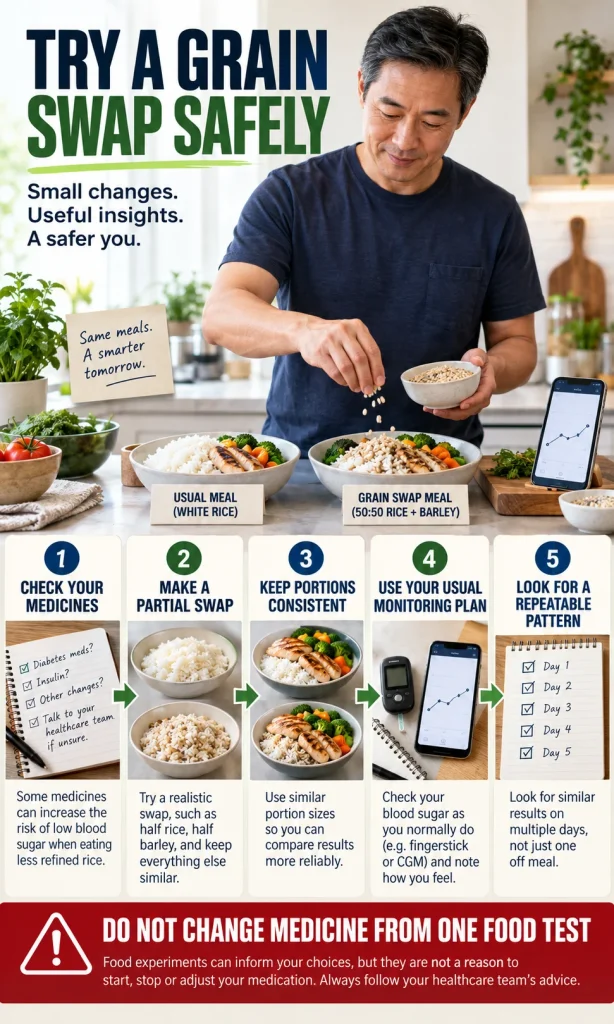
A practical way to test whether barley fits your meal plan
Use barley as a controlled substitution and decide in advance what you are trying to learn. For glucose, the useful question is whether a similar meal produces a more favorable and repeatable post-meal pattern for you; for cholesterol, the useful question is whether your overall eating pattern provides enough viscous soluble fiber while also improving saturated-fat and refined-carbohydrate choices. Those are different outcomes measured on different timescales, so one good glucose reading does not prove an LDL effect and one cholesterol result does not tell you how a single meal behaves.
If you have access to a continuous glucose monitor or blood glucose meter, use the timing and targets already given by your diabetes care team rather than inventing new thresholds for this experiment. If you do not monitor glucose, you can still make the food swap for its whole-grain and soluble-fiber benefits, but you should not assume a numerical blood-sugar reduction. The interactive Beta-Glucan Meal Reality Check on this page is designed around that principle: label-based fiber math where the evidence supports it, and no fake personalized glucose percentage where it does not.
The main point is simple: barley is a credible high-fiber grain with useful evidence behind its beta-glucan, but the strongest headline about it needs correction. The “50%” figure describes how much barley was mixed into the test grain, while the measured glucose benefit in the small type 2 diabetes study was closer to a 25% reduction in overall 180-minute glucose exposure. That is still potentially useful, just not the same claim.
Frequently Asked Questions
Does barley lower blood sugar by 50%?
No. In the small type 2 diabetes study often linked to that claim, 50% referred to the proportion of high-beta-glucan barley mixed with white rice. The reported 180-minute glucose iAUC was about 25% lower with the barley-rice meal, and the 60-minute glucose peak was not significantly different.
Is barley better than white rice for type 2 diabetes?
High-beta-glucan barley can be a useful replacement for part of a refined-grain serving, and small controlled studies show lower post-meal glucose exposure in some settings. The size of the effect depends on the barley product, portion, meal and individual, so it should not be treated as a guaranteed result.
How much beta-glucan is used for cholesterol lowering?
Around 3 g/day of beta-glucan from eligible oat or barley sources is a common evidence-based reference point used in cholesterol-lowering research and U.S. soluble-fiber health-claim rules. Ordinary total-fiber grams are not automatically equivalent to beta-glucan grams.
Are oats and barley interchangeable?
Both contain beta-glucan, but products differ in beta-glucan concentration, processing and food structure. Oats have a particularly large trial base for cholesterol and post-meal glucose, while specific high-beta-glucan barley products also have supportive evidence.
Can I reduce my diabetes medicine if barley improves my readings?
Do not change diabetes medicine based on a food experiment without guidance from your clinician. This is especially important with insulin, sulfonylureas and meglitinides because mismatches between medication and food intake can cause hypoglycemia.
Beta-Glucan Meal Reality Check
Translate a grain swap and label information into a practical plan without pretending a food can predict your personal glucose response.
Your practical result
Meal approach
Monitoring + safety
This experience is educational. It does not diagnose diabetes, set a glucose target, estimate a medication dose, or replace advice from your diabetes care team.