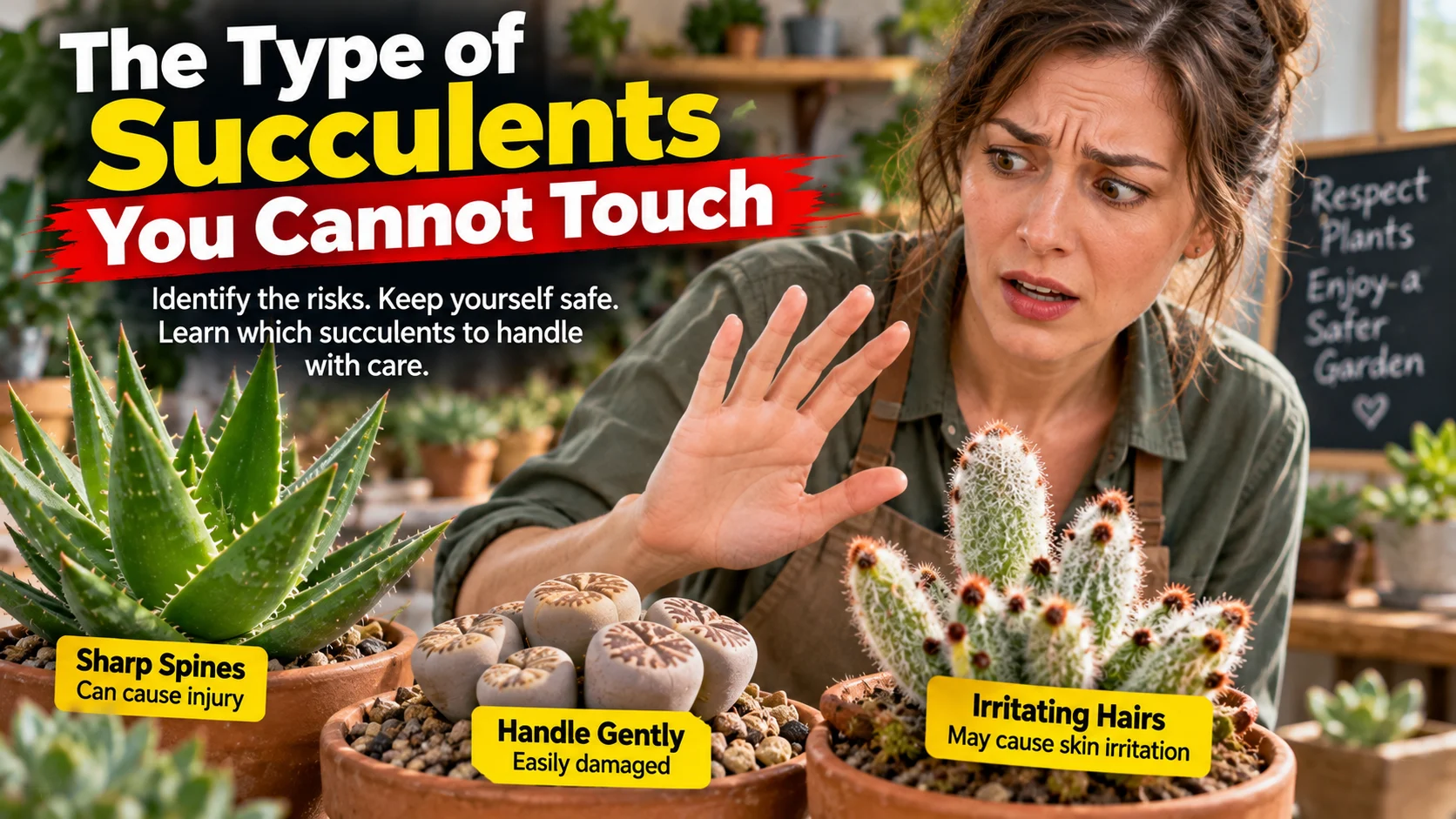

Some succulents are best handled with gloves because their sap, spines, or tiny glochids can irritate or injure you, while others are simply easy to damage with your fingers. Euphorbia, prickly pear cactus, and many agaves deserve the most caution; powdery Echeveria-type rosettes are a different case because touching usually harms the plant rather than the person. The useful question is not “Can I touch succulents?” but “What kind of contact risk does this particular plant create?”
The old idea that Haworthia and Lithops are automatically “succulents you cannot touch” is too broad. Zebra Haworthia is generally considered non-toxic to people and pets, while Lithops are delicate rather than inherently dangerous to bare skin, so routine contact is mainly a plant-care issue rather than a human-safety issue. If you do not know the plant, avoid cutting, snapping, or rubbing it until you can identify whether it has irritating sap, defensive spines, or a fragile surface coating.
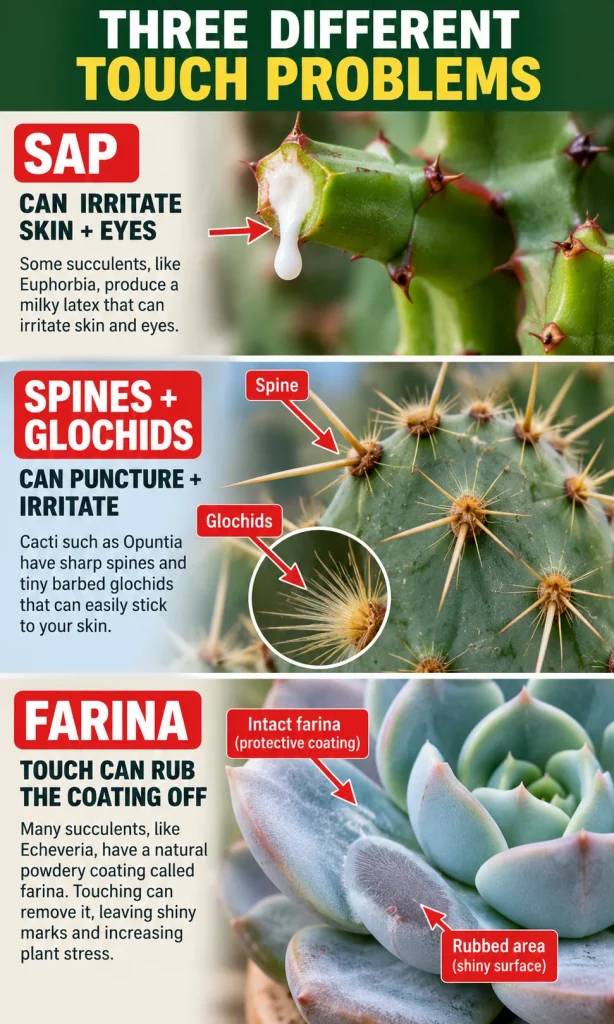
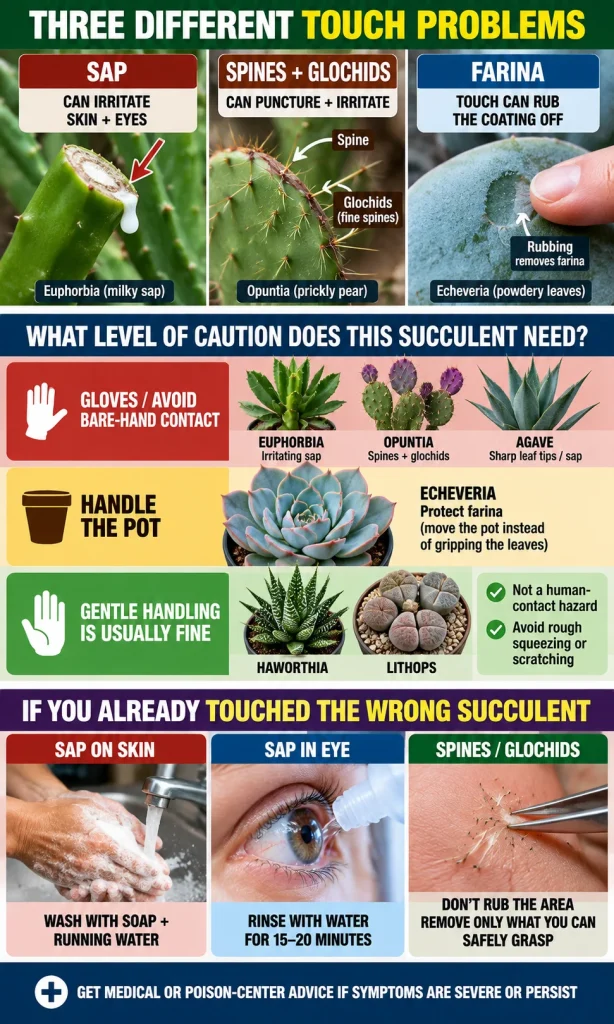
Three different problems often get mixed together under the word “touch.” A Euphorbia can release milky latex that irritates skin and eyes, an Opuntia can leave almost invisible barbed glochids in the skin, and a powdery Echeveria can lose its protective farina when a finger rubs across the leaf. Those are different hazards, so they should lead to different handling advice rather than one blanket rule.
If you are moving a plant without pruning it, the safest default is to handle the pot rather than the leaves or stems. If you are repotting, dividing, or cutting an unidentified succulent, add gloves and eye protection until you know what it is, especially when the stem produces white or clear sap. That simple habit prevents most of the avoidable problems covered in this guide without making ordinary succulent care feel dangerous.
The quickest way to decide what level of caution is reasonable is to look for a physical clue before you touch the plant. Milky sap points toward the Euphorbia group, flattened cactus pads may carry spines or glochids, stiff agave leaves may end in hard terminal spines, and a matte blue-white bloom on a rosette may be farina that should not be rubbed away. The table below separates personal-safety hazards from “protect the plant” handling issues.
| Plant or clue | Main contact issue | Best handling approach |
|---|---|---|
| Euphorbia / crown of thorns / pencil-type spurge | Milky latex can irritate skin and especially eyes; some species also have thorns | Gloves for handling, eye protection when cutting, keep sap away from face |
| Opuntia / prickly pear | Large spines plus tiny barbed glochids can puncture and irritate skin | Use tools, tongs or folded material plus sturdy gloves; do not rub the pads |
| Agave | Sharp leaf-tip and marginal spines; some species have sap that can cause dermatitis | Gloves, long sleeves and eye protection for close work or pruning |
| Powdery Echeveria, Pachyphytum or Graptopetalum | Farina can be rubbed away, leaving fingerprints and reducing the plant’s protective surface | Handle by the pot or stem base rather than wiping or pinching the leaves |
| Haworthia / Haworthiopsis | Usually a low touch hazard; rough or pointed leaves can still scratch delicate skin | Normal gentle handling; use the pot when moving the plant |
| Lithops | Plant is physically delicate, but not a general “do not touch” hazard | Avoid squeezing or repeatedly pressing the paired leaves |
The succulents that deserve the most caution
Euphorbia is the group where “do not handle casually” is most useful. Many succulent Euphorbias look like cacti, but cutting or breaking them releases a sticky white latex that can irritate skin and can be much more serious if it reaches the eyes. North Carolina Extension advises protective gloves when handling Euphorbia, and Poison Control recommends prompt washing after sap exposure and immediate eye irrigation if sap splashes into an eye.
Crown of thorns adds a second problem because the stems carry sharp thorns as well as irritating latex. That means pruning a Euphorbia milii is not the same task as moving a smooth-leaved jade plant; you are managing both a puncture hazard and a sap hazard at the same time. Wear gloves that protect against the sap, keep your face out of the cutting path, and clean tools after the job so dried latex is not transferred later.
Prickly pear cactus is a mechanical hazard rather than a sap hazard. Opuntia pads can carry obvious spines and tiny hairlike glochids that are easy to overlook, and those barbed structures can irritate skin after contact. The University of Arizona specifically recommends protective gloves and tools for handling prickly pear because the small glochids are one of the easiest cactus hazards to underestimate.
Agave needs space as much as it needs gloves. Many species have rigid teeth along the leaf edges and a hard terminal spine, while some also have sap capable of causing contact dermatitis. If an agave sits beside a narrow walkway, the practical problem may be accidental contact long before you ever decide to repot it, which is why mature size and placement matter as much as handling technique.
Some succulents are better left untouched because of farina
A powdery blue, white, or silver surface on an Echeveria-type rosette is often farina, a natural protective coating rather than dust. Repeated rubbing can remove that coating from the contacted area, leaving shiny fingerprints and changing how the leaf surface handles intense light and water. That is why a beautiful powdery rosette may be a “look, do not rub” plant even though it is not dangerous to your skin.
Handle farinose succulents by the pot whenever possible, and support the plant low on the stem or root ball when repotting rather than pinching the leaf blades. If debris lands on the rosette, resist the urge to polish the leaves clean, because the cosmetic fix can remove the coating you were trying to protect. New growth will develop its own surface coating, but an existing fingerprint can remain visible on that leaf for a long time.
This is also why “touching helps Echeveria” is poor general advice. A light accidental touch is not a crisis, but there is no care benefit in repeatedly rubbing healthy leaves, and the visible powdery coating gives you a good reason to minimize contact. If the plant is stretching, pale, or growing loosely, solve the light problem rather than using touch as a diagnostic test; the separate guide on how to expose succulents to the sun is the better place to make that decision.
Succulent Touch Safety Studio
Separate irritating sap, spines or glochids, delicate farina, and ordinary gentle handling—then get the safest next step for what you are about to do.
Need help identifying the plant?
Enter your area to open a real Google Search or Maps search for succulent identification help. No business data is invented here.
Compare real candidates you find
Haworthia and Lithops are not blanket “never touch” plants
Zebra Haworthia is a useful example of why the original wording needed correction. North Carolina Extension lists Haworthiopsis attenuata as non-toxic to people and pets, so it does not belong in the same contact-risk category as Euphorbia sap or Opuntia glochids. Its pointed leaves may still feel rough, and some related Haworthia sap can irritate sensitive skin, but ordinary gentle handling is not normally a reason for alarm.
Lithops are different again because the concern is physical damage to the plant. Their paired leaves are thick but compact, and repeated squeezing, scratching, or picking at the split can injure tissue or introduce damage around a plant that grows slowly. Move the pot, inspect the surface visually, and avoid treating the leaves like stones that need to be pressed to “test” firmness.
What to do if you already touched the wrong succulent
If you touched an intact spiny or sap-producing plant and nothing happened, you usually do not need to create a problem by scrubbing aggressively. Wash your hands before touching your face, then inspect for visible spines, glochids, sap, cuts, or irritation. The next action depends on whether the exposure was mechanical, chemical, or simply cosmetic damage to the plant.
If Euphorbia sap reaches the skin, remove contaminated material and wash the area thoroughly with soap and running water; Poison Control notes that water alone may not remove the sticky latex well. If sap reaches an eye, start rinsing immediately with room-temperature water for 15 to 20 minutes, remove contact lenses if practical, and seek poison-center or medical guidance if pain, redness, swelling, blurred vision, or other symptoms persist or are severe. This article provides handling orientation, not a medical diagnosis, so significant eye exposure or worsening symptoms should be treated as a health problem rather than a gardening problem.
If a cactus spine or glochid enters the skin, avoid rubbing the area because that can drive fine material farther in. Clean the skin, remove only what you can safely grasp without digging deeply, and watch for increasing redness, swelling, drainage, persistent pain, or other signs that need medical attention. Tiny glochids can be frustrating because they are difficult to see, which is why prevention with tools and controlled handling is usually easier than removal afterward.
A practical handling routine before you repot or prune
- Identify the plant first. If the stem looks cactus-like but can release milky sap, treat it as a possible Euphorbia until you know otherwise.
- Look for the hazard before choosing gloves. Sap, large thorns, fine glochids and sharp leaf tips are different problems and may require different protection.
- Move the pot, not the rosette. This protects both your hands and delicate leaves, especially plants with farina.
- Use eye protection for cutting sap-producing plants. A pruning cut can send sap in an unexpected direction even when the plant seems small.
- Keep children and pets away from the work area. Cut stems, loose pads and dropped leaves can create exposure after you finish handling the plant.
- Clean the bench and tools afterward. Dried sap, tiny glochids and detached spines can remain on the work surface.
If you are still deciding which succulent belongs in a certain space, combine touch safety with plant size, light and watering needs rather than choosing on appearance alone. The guides to choosing the right type of succulent and how big succulents grow can help you avoid putting a sharp or irritating plant where people brush past it every day. If the plant is already stressed or soft at the base, solve the care problem first; saving a plant from root rot is a different job from deciding whether its leaves are safe to handle.
Decision summary
Reserve the strongest “avoid bare-hand contact” warning for succulents with a real human contact hazard: irritating Euphorbia latex, Opuntia spines and glochids, and many sharp or sap-producing agaves. Treat powdery Echeveria-type plants as “protect the leaf surface,” not “dangerous to touch,” and treat Haworthia and Lithops as plants that simply benefit from gentle handling. Once you separate personal injury from plant damage, the advice becomes much easier to remember and much harder to misuse.
Frequently Asked Questions
1. What succulent should you not touch with bare hands?
Succulent Euphorbias are among the clearest examples because broken stems can release irritating milky latex, and crown of thorns also adds sharp thorns. Opuntia and many agaves deserve similar caution for mechanical injury from spines or glochids. Gloves are most important when cutting, repotting, or handling damaged tissue.
2. Is Echeveria dangerous to touch?
Most Echeveria are not handled as dangerous contact plants, but many have a powdery farina that is easily rubbed away. The reason to avoid touching those leaves is mainly to protect the plant’s surface and appearance. Handle the pot or lower stem instead of repeatedly wiping the rosette.
3. Can you touch Lithops?
Yes, but there is rarely a reason to press or squeeze them. Lithops are slow-growing, compact plants whose paired leaves can be physically damaged by rough handling. Move the pot rather than testing the leaves with your fingers.
4. Is Haworthia poisonous to touch?
Zebra Haworthia, now commonly placed in the genus Haworthiopsis, is listed by North Carolina Extension as non-toxic to humans and pets. Some related plants may still irritate sensitive skin if sap is released, so broken leaves are different from simply brushing an intact plant. Normal gentle handling is not the same risk as Euphorbia sap.
5. What should I do if Euphorbia sap gets on my skin?
Remove contaminated clothing or gloves and wash the exposed skin thoroughly with soap and running water. Avoid touching your face or eyes until the sap is removed. Seek poison-center or medical advice if significant pain, blistering, swelling or other symptoms develop or worsen.
6. What should I do if succulent sap gets in my eye?
Begin rinsing the eye immediately with room-temperature running water for 15 to 20 minutes and remove contact lenses if practical. Do not put soap in the eye. If pain, redness, swelling, tearing or vision changes are severe or persist, get urgent poison-center or medical guidance.