
Fairway Staffing Services connects candidates with client companies, but the useful decision is whether a particular assignment fits your working hours, travel limits and employment needs. Confirm the branch handling your application, the employer named in the offer and the actual worksite before accepting a start date. A company name or advertised hourly rate cannot settle those questions on its own.
Start with the assignment, then judge the agency relationship. For someone seeking dependable income, clear paid hours and an achievable journey usually matter more than a vague promise of flexibility or future permanent work. This guide focuses on checking a Fairway opportunity from first contact through the first shift, rather than ranking staffing companies or promising a placement.
Which Fairway office should you contact?
Use the official location directory to identify the branch handling the role, then confirm where the interview or onboarding will happen. The recruiting office, corporate headquarters and client worksite can be three different places. Treat each address as a separate destination with its own purpose.
Fairway’s published service categories include warehouse and packing, manufacturing, material handling, office support and hospitality. Those categories indicate areas of recruitment, not a promise that a matching vacancy exists near you. Ask about the duties and location of a specific opening rather than assuming every branch offers every category.
The official site currently lists its headquarters at 2099 South State College Boulevard, Suite 450, Anaheim, California 92806, and gives the main number as (833) 635-2020. The Fairway location directory distinguishes branch addresses from this headquarters contact. Confirm your appointment destination directly, especially when an old directory entry or search result names a different city.
| Location | Purpose | Question to resolve |
|---|---|---|
| Headquarters | Corporate contact | Is this actually my appointment destination? |
| Recruiting branch | Application, interview or onboarding | Which branch is handling the opening? |
| Client worksite | Daily attendance and work | What address, entrance and shift apply? |
A nearby agency office does not necessarily mean a nearby job. A branch may recruit for client premises elsewhere, so a short trip to register can turn into a much longer daily commute. Ask for the worksite before deciding that an assignment is local enough for you.
Separate the interview branch from the client worksite
Use this check when you receive an invitation, a callback or a proposed start. First identify the branch through the official directory. Then ask whether the appointment is an interview, an onboarding session or a first working shift, and confirm the exact destination for that event.
Next establish whether the eventual job is at that same location. If it is elsewhere, ask for the client address, entrance and reporting contact when those details are available. You can reasonably discuss a possible opening before knowing everything, but you cannot judge the daily journey from the agency address alone.
For an illustrative example, imagine an applicant who can reach the branch by one bus but needs two connections to reach the warehouse. The branch appointment is manageable; the proposed early shift may not be. The correction is to discuss another shift or worksite before accepting, rather than discovering the mismatch at the first attendance.
If you cannot comfortably search a directory, use the published main number and ask which branch serves the role. The completed check is a confirmed destination and appointment purpose. A city name without a street address or a statement such as “come to the office” leaves the practical question unresolved.
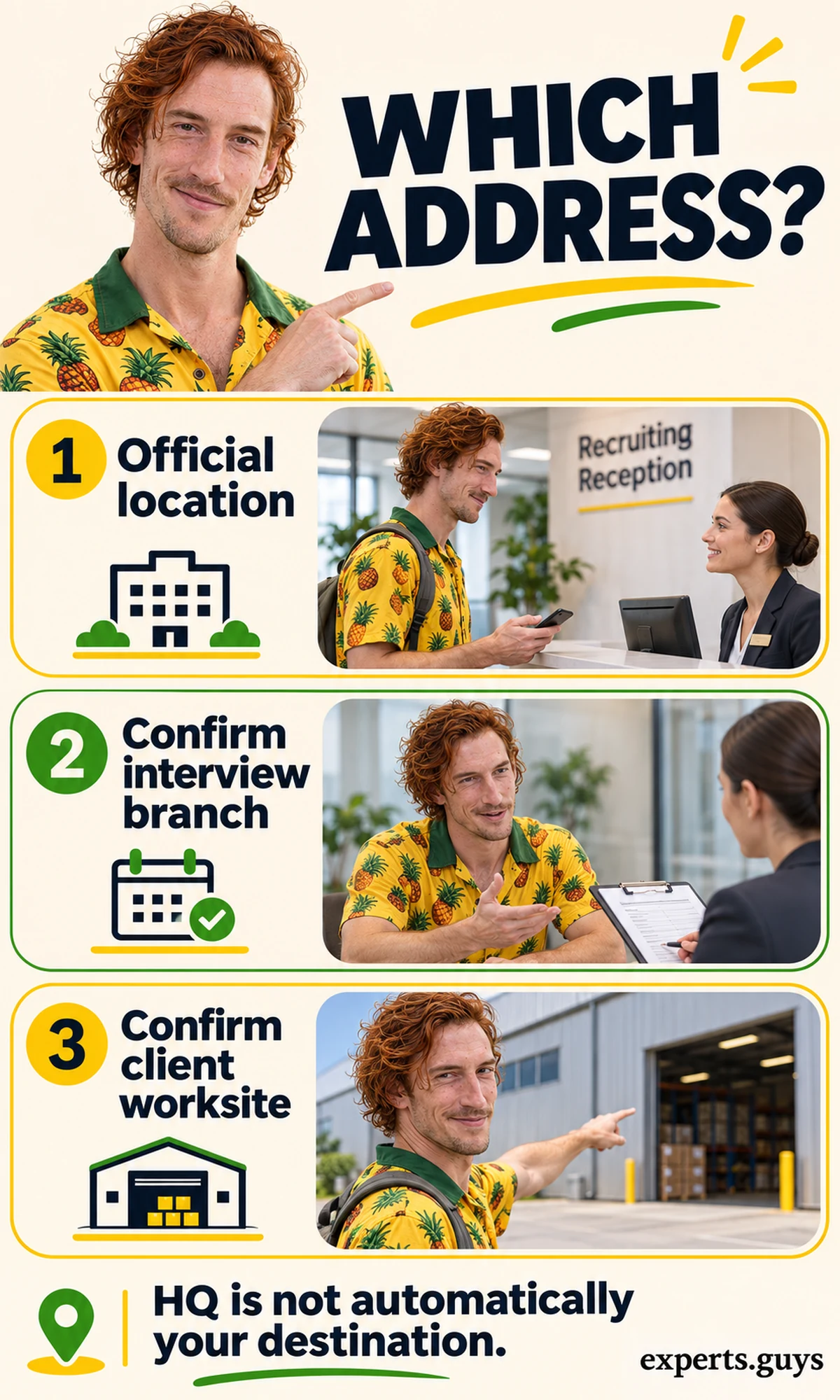
Branch labels can also conceal an address mismatch. If a listing’s city heading and its street address appear inconsistent, ask which one to use instead of choosing whichever seems familiar. That is a reason to clarify the appointment, not sufficient evidence that a business or message is fraudulent.
Keep your enquiry narrow: “Which branch is handling this opening, and where would I actually work?” This gives the recruiter something concrete to answer. Asking generally whether Fairway has jobs may produce a broad conversation that still leaves your location constraint unexplained.
Verify an unexpected recruiter before sharing information
Use an independent contact check when a message arrives unexpectedly, contains a new application link or asks for sensitive information. Pause the request, navigate to the official company website yourself and contact a published branch or main number. Ask whether the person and the vacancy can be confirmed through that channel.
Do not treat a familiar company name, copied branding or a convincing job description as authentication. An impersonator can reuse real company details. The check works because you choose the contact route independently instead of relying on the number or link supplied by the unexpected sender.
The FTC’s recruitment-scam guidance recommends independently verifying openings and warns against paying for a job promise. An upfront placement payment, an equipment-payment demand from an unverified contact or a request to deposit a check and send money onward should stop the transaction. These are general recruitment safeguards, not allegations about Fairway.
- Confirm the person: is the named recruiter connected with this branch?
- Confirm the opening: does the role exist, and which location handles it?
- Confirm the channel: where should the application or onboarding information go?
Verification should come before sensitive onboarding. A real hiring process can require identity and payroll information, but that does not make every request for it legitimate. Ask the independently reached branch which channel to use and what stage you have reached before sending documents.
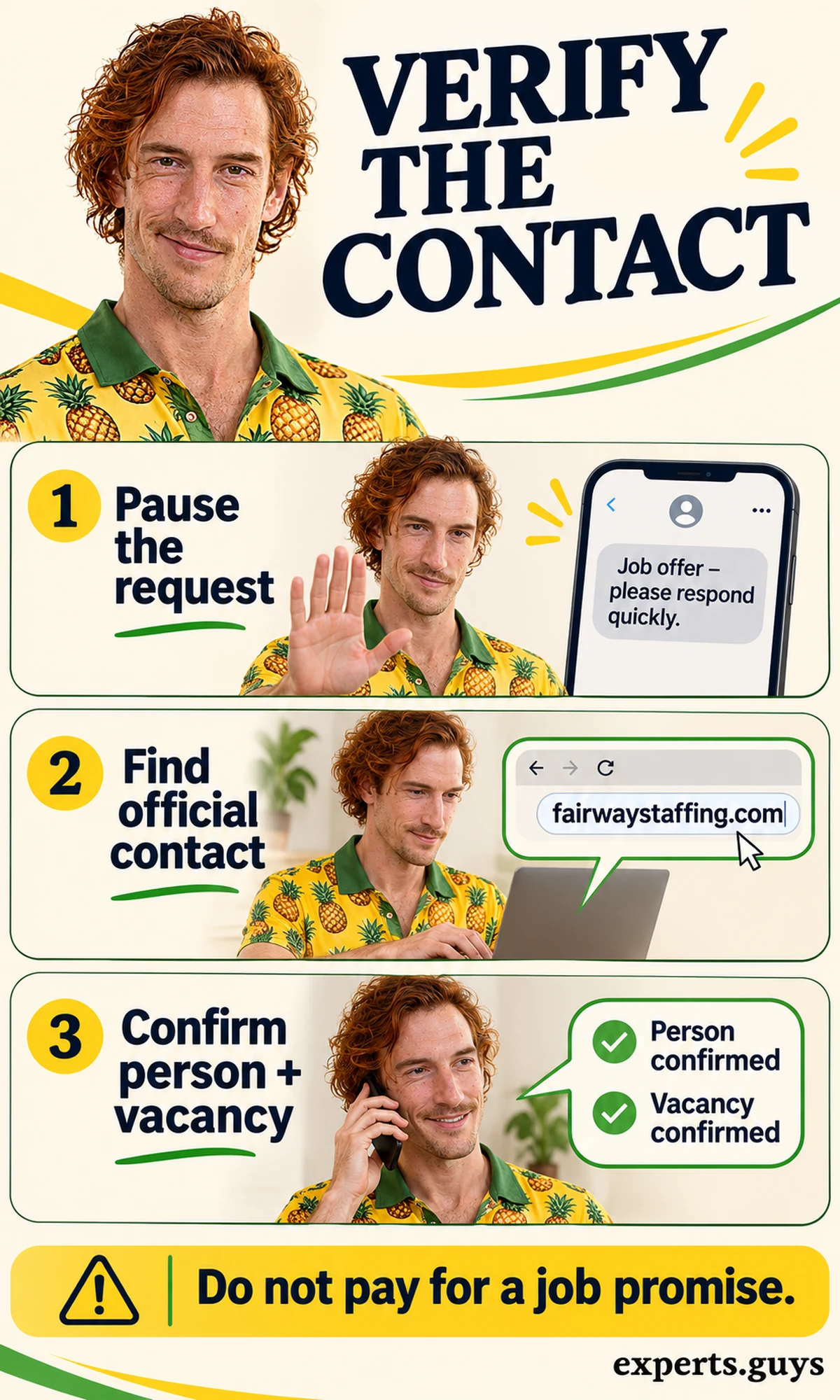
If the branch cannot identify the sender immediately, ask it to confirm the next legitimate application route. Avoid repeatedly sending personal details in an effort to prove that you applied. The useful outcome is a verified route forward, or a decision to stop until the contact can be authenticated.
There is no need to turn this into an investigation of every review site. A direct confirmation of the person, role and submission channel addresses the immediate risk. Broader research can inform your view of an agency, but it cannot substitute for verifying the specific person requesting your information.
If you are still deciding whether agency work fits your search, the broader staffing-agency overview explains the general job-seeker relationship. The next question here is what a specific Fairway offer actually commits to.
Who employs you, and what does the assignment promise?
Separate the company directing the daily work from the organisation named as your employer. Fairway’s published FAQ describes agency assignments in which Fairway provides pay, while direct placements become employees of the client. Confirm the arrangement for your own offer rather than applying one model to every opening.
Three independent questions often become mixed together: how many hours you work, how long the assignment is expected to last and who employs you. “Full time” addresses hours; it does not by itself promise an indefinite term or direct employment with the client. Ask about each dimension separately.
The broader guide to staffing agency hiring models covers the general distinctions. Here, the important application is narrower: determine what your particular Fairway-related offer commits to, what remains conditional and which organisation answers each employment question.
Trace the employer named in the offer
Start with the employment or assignment terms you have actually received. Identify the employer name, payroll contact and workplace supervisor. If the wording is unclear, ask: “Am I joining Fairway’s payroll for a client assignment, or becoming the client’s employee through a direct placement?”
Then ask where to direct an absence report and a pay question. These may be different contacts, so a supervisor’s name alone is incomplete. An understandable arrangement gives you a route for the work itself and a route for the employment administration, without requiring you to guess between organisations when something goes wrong.
An illustrative warehouse assignment might involve receiving daily task instructions from a client supervisor while asking Fairway payroll about a missing pay item. That division does not make the worker self-employed, and it does not mean the client has no safety responsibilities. Employment documents and applicable law govern the actual relationship and duties.
If the paperwork has not arrived, ask the employer question verbally before arranging a start, then obtain the relevant terms through the verified hiring channel. A verbal explanation helps you understand the proposal; it should agree with the documents you eventually accept. A contradiction needs clarification before you rely on either version.

Do not use the badge, uniform or building sign as your only guide. Those identify where someone works or how access is managed; they do not necessarily identify payroll or define contractual benefits. Similarly, working beside directly employed colleagues does not establish that everyone has identical employment terms.
Benefits need a specific answer about eligibility, waiting periods and the arrangement offered. Avoid assuming paid leave, insurance or a particular payment schedule from a company summary. Ask which terms apply to your role and when they begin; a general benefits statement cannot answer those questions.
If your main concern is maintaining a particular schedule, bring that constraint into the discussion now. An arrangement can be correctly described and still be unsuitable for you. Clarity about the employment model prevents confusion, but it is only one part of the acceptance decision.
Distinguish possible conversion from a direct job offer
When someone describes a role as temp-to-hire, ask what must happen before direct employment is offered. Clarify whether there is an approved vacancy, who decides on hiring and what conditions must be met. An opportunity to be considered is different from an offer with a named employer and agreed terms.
A conversion can depend on factors outside your performance, such as the client’s staffing requirement or hiring approval. That is why good attendance alone should not be treated as a guaranteed route to direct employment. Ask how the decision is made without demanding a certainty the recruiter cannot legitimately provide.
Imagine a candidate comparing a temporary assignment with a confirmed direct-hire offer. The temporary role may still be worthwhile for immediate work or a suitable location, but its speculative future benefits should not be valued as if already secured. Compare the current terms first and treat possible conversion as conditional.
If the conversion process is vague, use a simpler question: “Would this assignment still work for me if no direct offer follows?” A yes can justify considering it on its present merits. A no means you need clearer commitments or a different opportunity, particularly if leaving another job would be difficult to reverse.

Ask what ends when the assignment ends. The last shift at one client, the end of a project and the end of an employment relationship are not interchangeable descriptions. Obtain instructions about the immediate next step and any reassignment process rather than assuming another placement begins automatically.
The same care applies to duration. An expected end date is useful planning information, but you should ask whether the hours and term are committed or only forecast. Do not make a major spending decision solely on a possible extension, an unconfirmed start or a recruiter saying that work is usually available.
Does the pay still work after hours and travel?
Compare the hourly rate alongside the paid hours you can realistically work and the journey required for that shift. A higher rate can produce less weekly gross pay when fewer hours are available. A workable rate can also become impractical if the client site cannot be reached at the required start or finish.
Use confirmed terms where available and make uncertainty visible. If hours are variable, compare the assignments over a lower-hours week as well as the advertised schedule. This is a planning comparison, not a prediction of how much Fairway or any client will actually schedule.
Compare paid hours before comparing hourly rates
For a basic straight-time comparison, multiply the quoted hourly rate by paid hours for the same period. Keep the assumptions consistent: use a week for both assignments and separate any overtime, bonuses or reimbursements. If special pay rules apply, the simple multiplication is only the starting point.
Consider two illustrative assignments with no overtime: A pays $20 for 40 paid hours, giving $800 gross for the week. B pays $22 for 30 paid hours, giving $660. The higher hourly rate in B produces $140 less gross because ten fewer hours are paid.
These figures are invented solely to demonstrate the calculation; they are not Fairway vacancies or wage quotations. Neither result is take-home pay. Taxes, deductions and personal expenses are outside the example, and the figures do not establish a lawful rate or an entitlement in a particular jurisdiction.
The decision can change with your needs. Someone fitting work around another commitment might prefer the shorter schedule despite lower total earnings. Someone needing a minimum weekly income may prefer more dependable hours, provided those hours and the rest of the arrangement are actually confirmed.

The common mistake is to multiply a high rate by hours the recruiter has not promised. If B offers “up to 40 hours,” ask what is expected and what is guaranteed, if anything. Do not silently substitute the maximum into your budget and treat the result as dependable income.
Use a smaller comparison if the full week is unclear: ask about the paid hours and rate for the first confirmed shift. That will not establish the whole assignment’s value, but it gives you a concrete starting point. A specific answer is more useful than an attractive weekly estimate built on missing inputs.
| Unknown term | Why the estimate can mislead | Clarify before relying on it |
|---|---|---|
| “Up to” weekly hours | Maximum is not a commitment | Expected hours and any guaranteed minimum |
| Headline hourly rate | Different rates may cover different work | Rate for this specific assignment and shift |
| First start date | A proposed start may remain conditional | What approval or onboarding is outstanding? |
| Overtime or extra shifts | Availability is not automatic | Whether extra work is offered and how it is paid |
Separate the number of hours on site from the number of paid hours used in an estimate. Ask how breaks, required preparation and training are handled rather than guessing from a start and finish time. Applicable wage and hour rules vary; this arithmetic does not decide whether any particular period must be paid.
A travel-expense comparison is useful only when it remains transparent. You can subtract your own expected transport cost from gross pay to understand cash pressure, but the answer is still before tax and other deductions. Do not label it net salary, and do not present a personal cost assumption as an agency charge.
Avoid comparing one assignment’s best possible week with another’s ordinary week. Use the same basis, then separately consider uncertainty. If one assignment depends on overtime or extra shifts to meet your needs, ask whether those hours are actually available before treating them as part of the offer.
Test the shift journey in both directions
First confirm the exact client worksite and the required start and finish times. Then check whether your normal transport can reach that entrance before the shift and get you home afterward. A route that works during daytime office hours may fail for an early start or late finish.
Include the last part of the journey: the correct gate, pedestrian entrance, security check-in and any distance from a transit stop or parking area. A map pin at a large site’s centre can conceal a different entrance. Ask which route workers should use rather than following vehicle access into a loading area.
In an illustrative situation, the morning connection arrives in time but the last return service leaves before the shift ends. The outward journey passes the check and the return fails. A later start does not solve that particular problem; another finish time, site or dependable transport arrangement might.
If you cannot easily use an online timetable, ask the branch to clarify the worksite and shift, then have a trusted person help check the relevant transport service. The simpler option is still a check of both directions. Do not rely on the fact that you managed to reach the recruiting office.
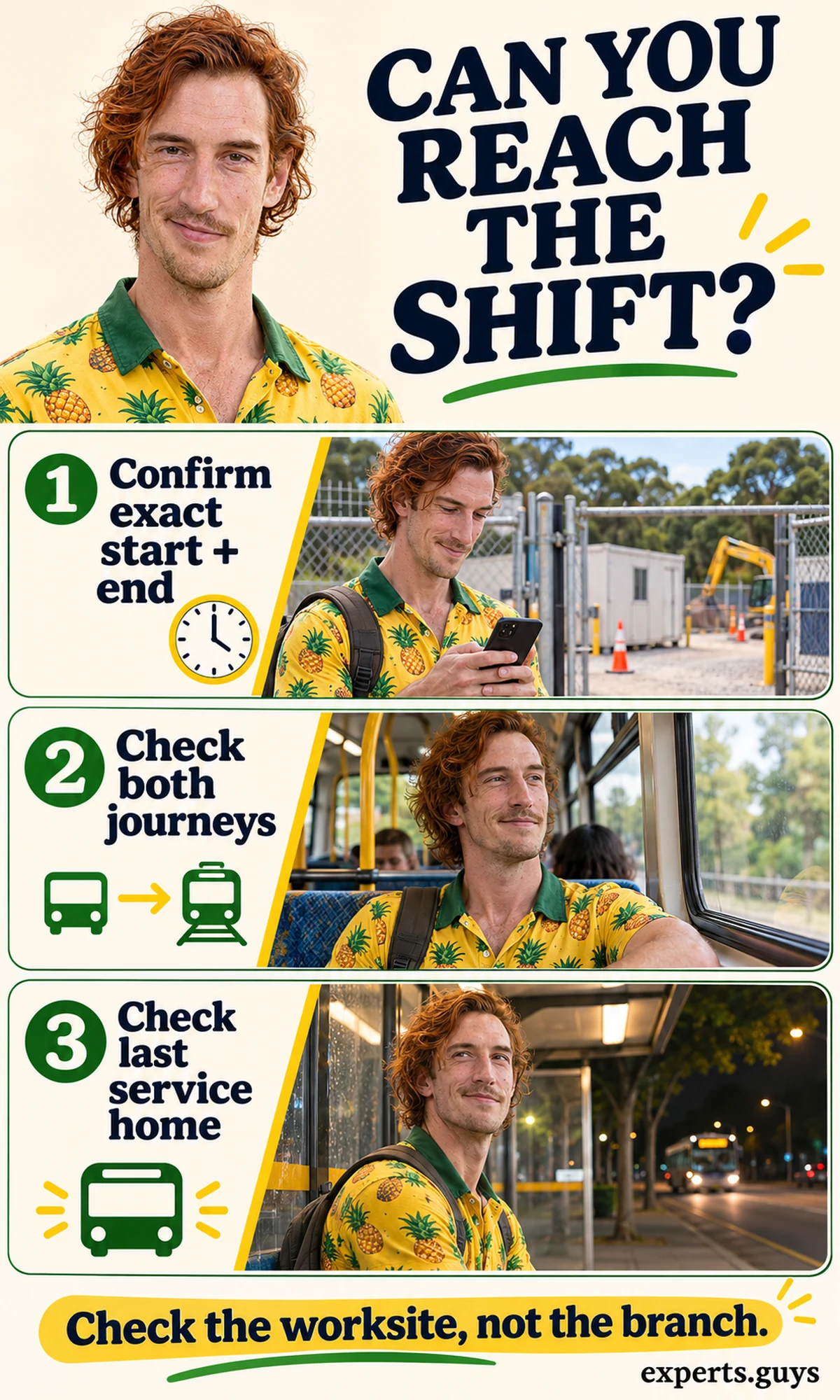
Discuss travel constraints before accepting rather than promising availability you cannot sustain. Saying “I can start at this site from the later shift” gives the recruiter a usable alternative. A vague assurance that you will somehow manage leaves both sides exposed to an avoidable first-day problem.
Also ask whether the end time can change and how any change is communicated. A fixed route may be workable for a fixed finish and unsuitable for an unpredictable one. You are checking compatibility between your transport and the assignment, not asking the agency to guarantee the transport service.
Judge flexibility in the same concrete way. It may refer to the variety of assignments offered, the client’s staffing needs or your ability to state availability; it does not necessarily mean you can alter an accepted shift at will. Ask which part of the schedule is flexible and who must approve a change.
The practical result is an assignment you can reach and leave under the stated schedule. If that cannot be established, keep the opportunity conditional while discussing another shift or site. A successful interview does not remove the physical travel constraint.
What should be settled before the first shift?
Before starting, know who receives you, what task you will perform, how the site trains you and how hours reach payroll. General recruitment or safety onboarding does not explain every hazard at a particular client workplace. The first shift needs a clear handover between the staffing arrangement and the actual job.
This matters especially when a role title is broad. “Warehouse associate” could involve tasks with different equipment, movement, handling and supervision requirements. Ask what you are authorised to do rather than treating a familiar job title as permission to carry out every task nearby.
Complete the handover before an unfamiliar task
On arrival, use the confirmed entrance and find the designated supervisor before entering operational areas. Ask which task you are assigned, what hazards it presents and what training and protective equipment are required. Follow the site’s safe access route rather than improvising a shortcut through vehicle movement or storage areas.
Before operating equipment or accepting a materially different task, confirm that you have the necessary training and authorisation for that work. Experience with similar equipment elsewhere does not establish approval at this site. If the task or protection is unclear, pause and ask the supervisor; do not demonstrate competence by guessing.
OSHA’s temporary-worker guidance explains that staffing agencies and host employers share workplace-safety responsibilities, with the details depending on the circumstances. General agency training and worksite-specific instruction serve different purposes. The presence of one does not automatically show that the other has been completed.
For an illustrative example, a worker recruited for packing is asked to use unfamiliar powered equipment. The correction is to stop before operating it and clarify task assignment, training and authorisation with the supervisor, involving the staffing contact where needed. The completed step is a safe, understood assignment, not simply a completed orientation form.
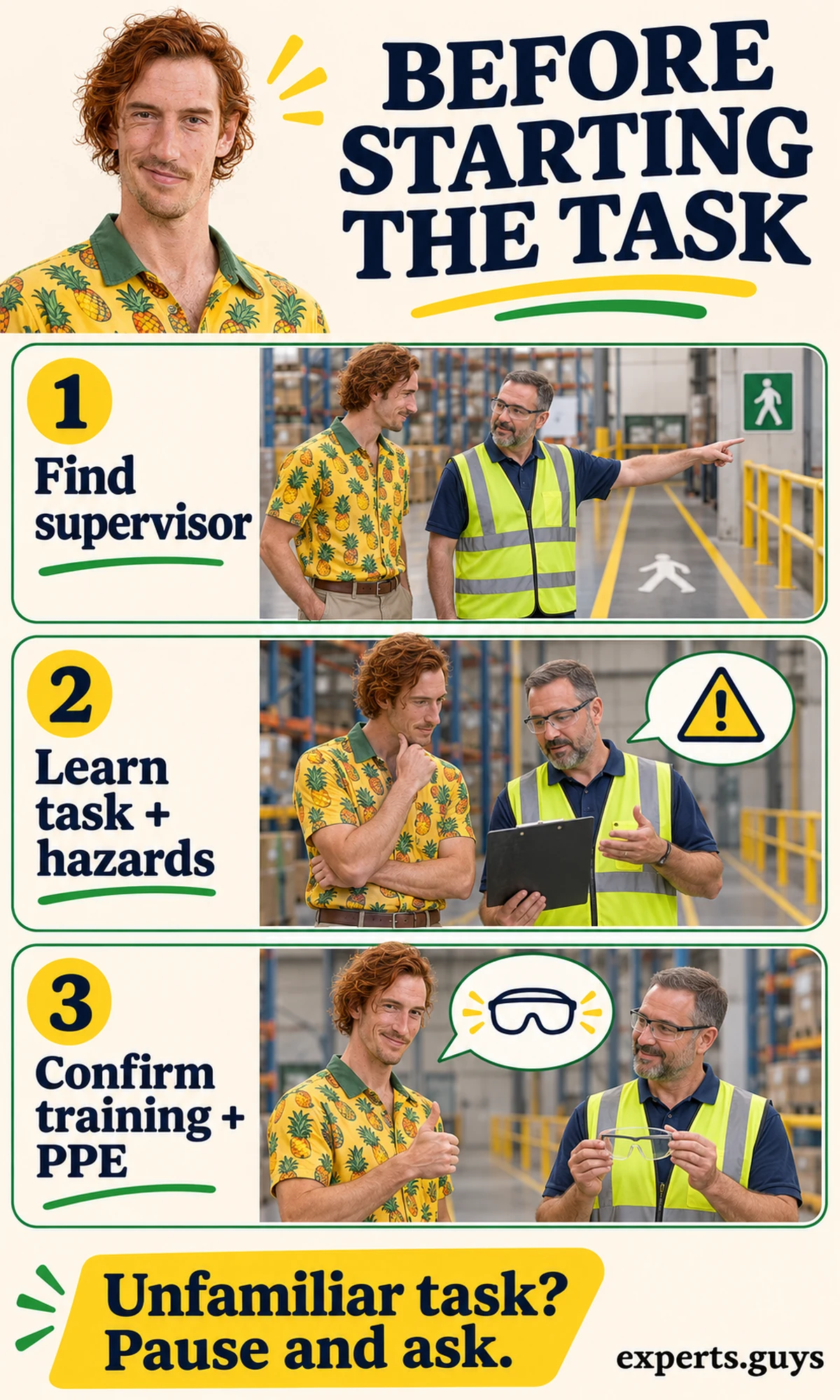
If language, hearing or another communication barrier makes the instructions unclear, ask for an accessible explanation or demonstration before proceeding. Repeat the task back in your own words where helpful. An easier explanation must still cover the hazards and precautions; confusion is not evidence that training has been understood.
Know the immediate reporting route for an injury, unsafe condition or emergency before an incident occurs. Follow the site’s emergency arrangements for an urgent danger, and use the staffing contact for the employment-side follow-up. Do not delay immediate assistance while trying to determine which organisation should handle administration.
For employers using Fairway, the same handover needs an identified site supervisor and an accurate description of the work. A last-minute duty change should trigger a check that the worker understands and is prepared for that task. The commercial staffing agreement cannot replace a usable explanation on the worksite.
Resolve a pay question without guessing at the cause
Find out how hours are submitted and who answers payroll questions before the first pay period closes. If a payment appears wrong, distinguish a missing shift, a different paid-hours total, an incorrect rate and a deduction you do not understand. Each points to a different question; “my pay is wrong” gives payroll less to investigate.
Use the employer-provided time and pay information already available to you. Compare the affected shift or period with the pay details, identify the discrepancy and ask the verified payroll contact to explain or correct it. This is resolving an employment transaction, not an invitation to maintain a separate diary or pen-and-paper exercise.
For an illustrative example, two worked shifts appear in the employer’s system but only one appears in the paid-hours breakdown. Ask payroll to check that specific missing shift and confirm the correction process. If the hours agree but the rate differs, ask about the rate instead; do not assume both problems have the same cause.
When the issue concerns an approval you cannot see, ask which contact can resolve it and when you should expect an answer. Ask for clarification through the verified channel, particularly if someone tells you to ask a different organisation. An administrative query does not waive your pay rights; unresolved issues may require the appropriate local labour authority.
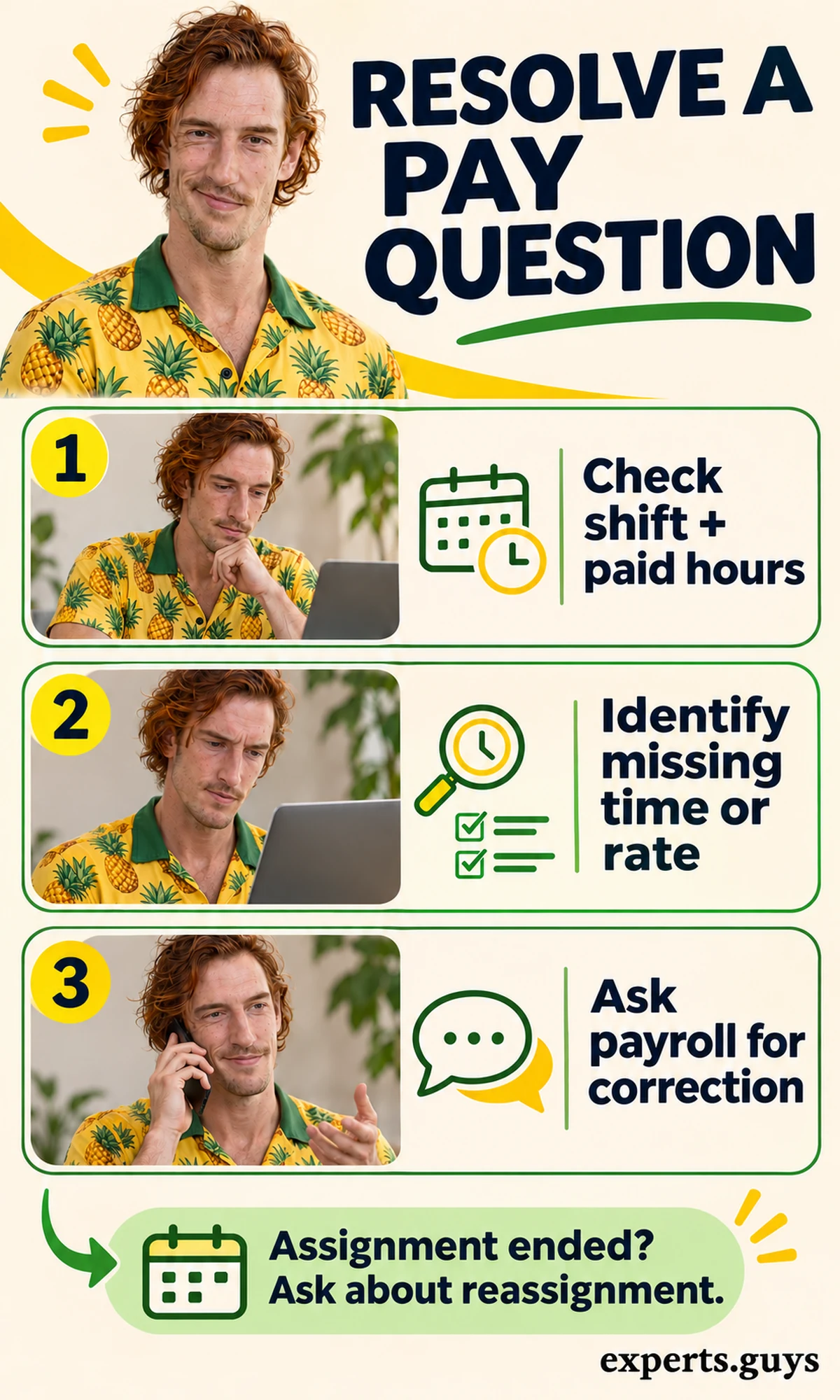
If an assignment ends, separately confirm the last scheduled shift, any outstanding hours and whether reassignment is available. An enquiry about future work does not settle a pay discrepancy, and correcting pay does not establish another placement. Keeping those questions separate makes the next action easier to understand.
You do not need to solve every future possibility before applying. You do need the terms that materially affect whether you can accept and perform the work: employer, task, paid hours, rate, worksite, schedule and the appropriate contacts. Where one answer is missing, make the next conversation about that gap rather than restarting the whole application discussion.
Frequently asked questions
Can I apply without completing everything online?
Fairway’s FAQ lists online and in-person application options. Confirm the appropriate branch and appointment arrangements before travelling, particularly if you need help with the application or an accessible way to complete a required step.
Does an application mean I already have a start date?
No. Treat an application, an interview and a confirmed assignment as separate stages. Ask what remains outstanding and when the next decision will be made. Continue considering other suitable opportunities while an opening remains unconfirmed.
Can a company listing prove that a recruiter’s message is genuine?
No. A real company can be impersonated. Use contact details you independently find on the official site to verify the sender and vacancy. Do not rely on copied branding or on the sender supplying another number to “confirm” the same message.
What if the recruiter cannot yet name the client?
You can have an initial conversation about the duties, area and likely shift. Before accepting attendance instructions, obtain enough verified detail to identify the actual destination, reporting contact and relevant terms. Early confidentiality is different from being asked to start at an unidentified worksite.
Should I stop considering other jobs after registering?
Registration alone does not establish paid work. Base that decision on a confirmed offer and your circumstances, including any notice obligations to an existing employer. Avoid giving up another workable opportunity solely because an agency says suitable work may become available.
Decide on the terms you can use now
Consider a Fairway assignment when the current work is suitable, the journey is achievable and the employment terms are clear enough to act on. Keep the decision conditional when a missing answer could change your ability to attend, your expected income or your safety. Possible extensions and future direct employment can add interest, but they should not carry an offer whose present terms do not work for you.
Begin with the biggest unresolved constraint. If it is location, confirm the worksite; if it is income, confirm paid hours; if it is employment status, identify the named employer. That focused next step gives you a practical basis for accepting, requesting an adjustment or moving on to another opening.