



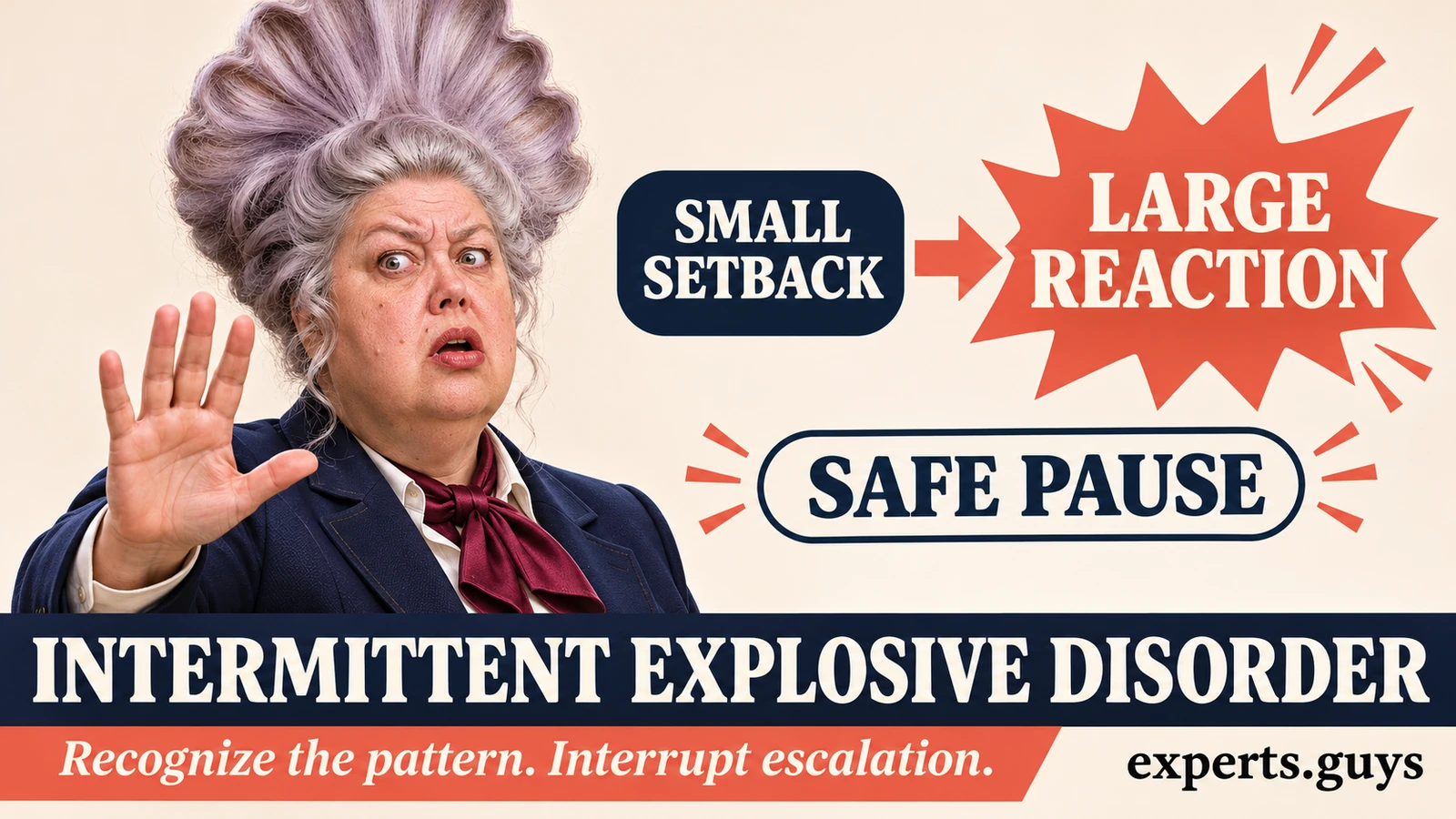
Intermittent explosive disorder (IED) involves repeated, impulsive aggressive outbursts that are far out of proportion to the situation and cause significant distress or problems in daily life. A frightening argument alone cannot establish the diagnosis; the recurring pattern and alternative explanations matter. When escalation is happening, the immediate priority is to stop adding to the confrontation and create safe distance.
If someone is threatening harm, blocking an exit, using a weapon or becoming physically violent, prioritize safety and urgent local help. Do not stay close to test a calming technique, confront them about a diagnosis or physically restrain them. The skills below are for situations where a person can still disengage safely; they are not an emergency response or a replacement for treatment.
What pattern makes intermittent explosive disorder different?
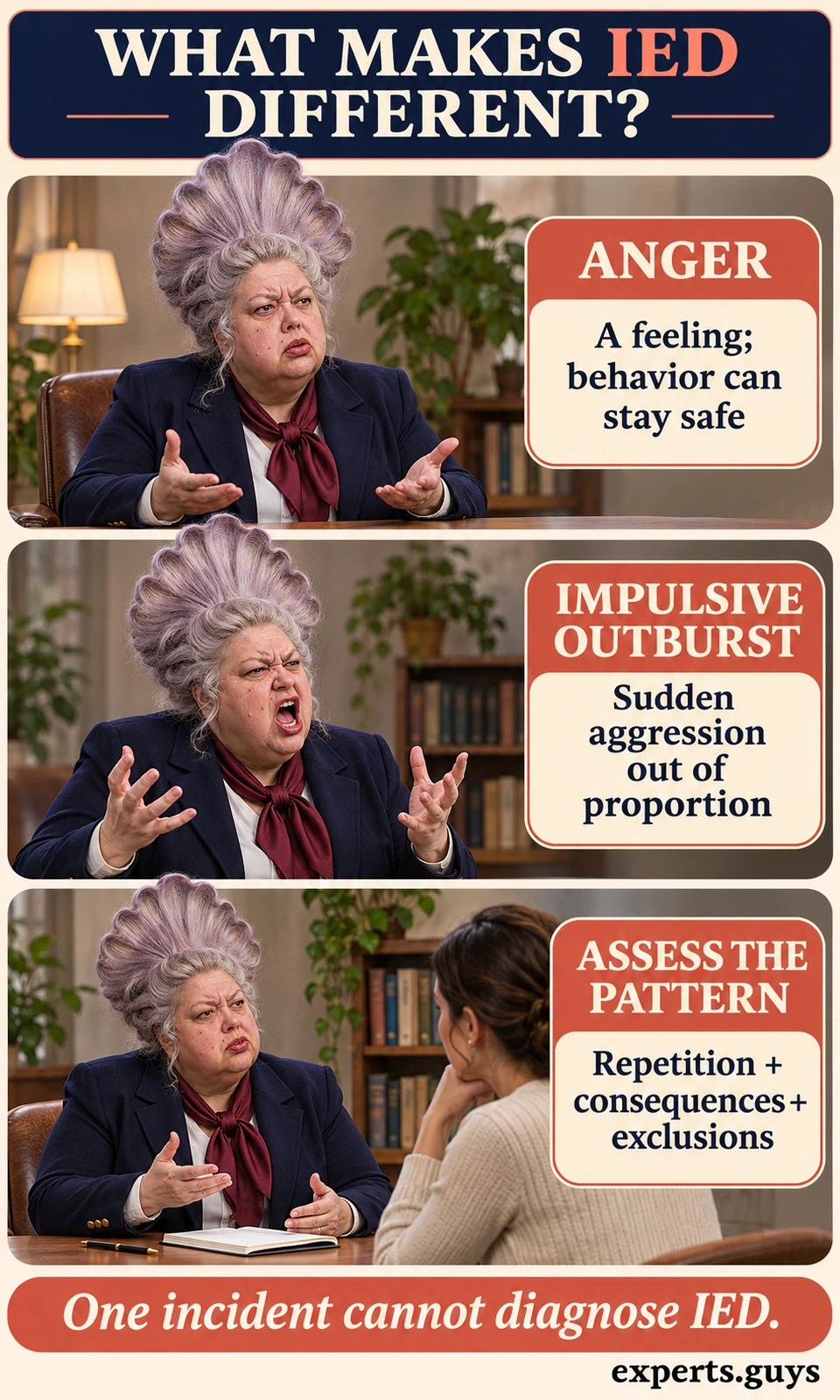
The defining issue is recurrent loss of control over aggressive behavior. Anger is an emotion; aggression is behavior, which may include verbal attacks, damaging objects or assault. Someone can feel furious without becoming aggressive, and someone can behave aggressively for reasons that have nothing to do with IED. Keeping those distinctions separate prevents an ordinary feeling from becoming a diagnosis and prevents a diagnosis from becoming an excuse.
An IED assessment asks whether the reaction is grossly disproportionate, impulsive rather than planned, and associated with distress, impairment or consequences. The American Psychiatric Association’s overview of impulse-control disorders explains these central features. The triggering problem can be real and worth addressing, while the aggressive response remains unacceptable.
- A small disagreement repeatedly turns into shouting, threats or aggression that overwhelms the original issue.
- The outbursts are anger driven and impulsive, rather than planned to obtain money, power or another objective.
- The pattern disrupts relationships, work, education or everyday activities, or creates significant distress or other consequences.
- Other mental-health conditions, substances, medication effects and medical explanations need consideration before IED is diagnosed.
The word “intermittent” does not mean that everything between episodes must be comfortable. People may experience irritability between outbursts, and others may remain apprehensive even after the person feels calmer. Equally, a calm presentation during an appointment does not erase events that occurred elsewhere. Assessment concerns the pattern across situations and time, rather than how angry a person looks during one conversation.
The most useful first distinction is between the size of the trigger and the size of the response. Imagine, as an illustrative example, that a shared payment is delayed. Asking when it will arrive is a proportionate response; repeatedly screaming insults or smashing an object is a different behavioral problem. The delay explains what happened before the outburst. It does not establish why aggression occurred or prove that the person has IED.
Can verbal outbursts count without physical injury?
Yes. Diagnostic criteria include a frequent verbal or non-injurious aggression pattern as well as a less frequent pattern involving injury or property damage. The SAMHSA comparison of DSM diagnostic criteria describes the two routes below. These are clinical thresholds within a larger assessment, not targets to wait for before seeking help and not an online diagnosis.
On a narrow screen, swipe horizontally to read every column.
| Pattern | Frequency and severity | What the numbers cannot establish |
|---|---|---|
| Frequent outbursts | Verbal aggression or non-injurious, non-destructive physical aggression, averaging twice weekly for three months. | The threshold alone does not establish disproportion, impulsivity, impairment or exclusion of another cause. |
| Destructive or injurious outbursts | Three outbursts involving property damage or destruction, or assault causing injury, within twelve months. | A serious first incident still warrants a safety response; nobody needs to wait for three incidents. |
IED also requires an age of at least six years, or the equivalent developmental level, along with the other criteria. A child’s behavior needs a developmental assessment; adult descriptions of an argument cannot simply be applied to a young child. The table summarizes diagnostic orientation and deliberately leaves the actual diagnostic judgment to a qualified assessment.
Remorse may follow an episode, but remorse is neither a diagnostic test nor proof that another episode will not happen. Relief after releasing anger can also coexist with shame and damaged trust. The practical question is what changes before the next confrontation: whether treatment is engaged, whether a pause is respected, and whether threatening behavior actually stops.
How is IED distinguished from bipolar disorder, ADHD and other causes?
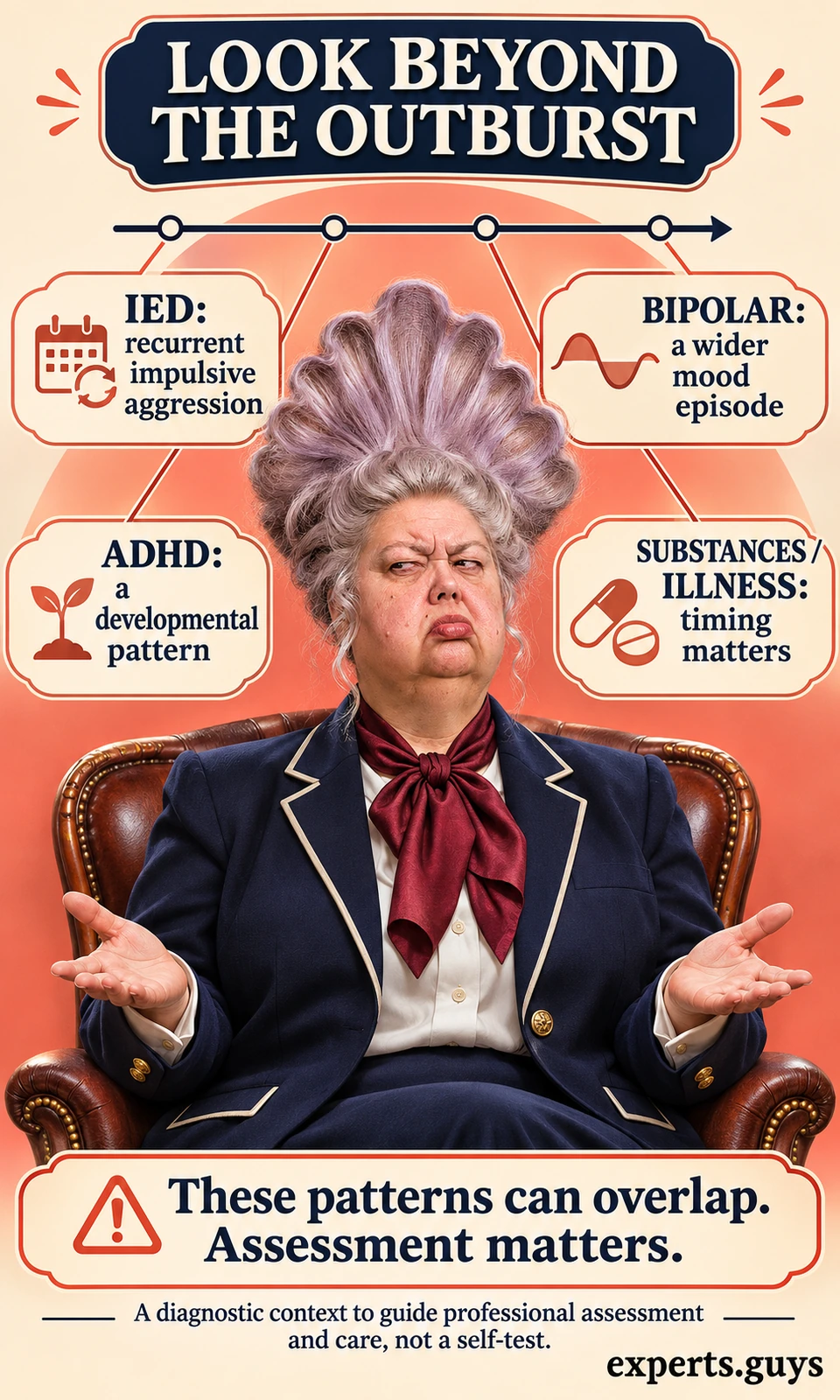
The surrounding pattern matters more than the word “rage.” IED centers on recurrent impulsive aggression, while other conditions are identified through additional features and a broader history. An assessor considers what happens before, during and between outbursts, whether symptoms occur only within another condition, and whether substances or a medical problem explain them better. More than one condition can exist, so this is not a contest to select one label from a table.
A sudden change from a person’s usual behavior deserves particular attention. New aggression alongside confusion, a recent head injury, a medication change, intoxication or withdrawal should not be assumed to be a longstanding impulse-control disorder. Immediate danger requires an urgent safety response; a new unexplained behavioral change also warrants medical evaluation. A label found online cannot resolve those possibilities.
On a narrow screen, swipe horizontally to read every column.
| Possible explanation | What else needs attention | Practical implication |
|---|---|---|
| Bipolar disorder | Distinct changes in mood, sleep, energy, activity and functioning over an episode. | Do not diagnose bipolar disorder from an angry outburst or assume IED explains a wider episode. |
| ADHD | A longstanding developmental history of attention and/or hyperactivity-impulsivity difficulties. | Frustration during an interruption may need a different formulation from recurrent disproportionate aggression. |
| Trauma-related difficulties | Trauma history and the broader symptom pattern, including the context of perceived threat. | A trigger alone cannot establish a trauma diagnosis or exclude IED. |
| Substance, medication or medical effects | The timing of symptoms relative to exposure, withdrawal, illness or neurological changes. | Evaluation may need to address the underlying cause rather than treating the behavior as IED. |
| Coercive or planned aggression | Threats or aggression used to control another person's behavior or achieve an objective. | Safety and accountability apply whether or not a mental-health diagnosis is present. |
For example, a person may repeatedly snap when interrupted while concentrating, yet have a longstanding pattern of attention difficulties. That deserves assessment in its own context. The separate guide to ADHD, anger and interruptions explores the task-switching problem; its practical focus is different from this article’s focus on disengaging from aggressive escalation.
Likewise, anger occurring with a sustained change in sleep, energy and activity raises a different question from an isolated short outburst. Our guide to bipolar symptoms at work provides broader mood-episode context. Those additional features matter because a response aimed only at anger may miss the condition driving the change.
Does a trigger tell you the cause?
A trigger is what immediately precedes the response. A cause is a broader explanation for why that response happens. A criticism, financial disagreement or unexpected delay can be the trigger without explaining a person’s recurrent loss of control. Sleep disruption, substance use, learned responses and other difficulties may influence the situation, but no single everyday detail proves IED.
This distinction changes what a useful response looks like. Correcting a billing mistake may solve the original dispute, yet leave the aggressive pattern untouched. Conversely, treating every disagreement as a symptom can prevent legitimate problems from being addressed. There are two tasks: deal safely with the behavior, then address the underlying practical issue when a non-threatening conversation is possible.
Biological explanations also need limits. Research about emotional reactivity or control cannot establish why a particular person acted aggressively. A group-level association does not reveal an individual’s motive, predict the next incident or determine whether a household is safe. Practical decisions still require the actual history, current behavior and assessment context.
Does IED explain or excuse abuse?
A diagnosis can help explain treatment needs; it does not make threats, intimidation or assault acceptable. It also cannot tell a partner that staying is safe. Someone may have mental-health difficulties and still engage in coercive behavior that requires its own response. The affected person’s access to safety should never depend on proving whether an outburst was impulsive.
Do not use “they cannot help it” to transfer responsibility for prevention to family members. A household can make reasonable arrangements around conflict, but relatives should not have to anticipate every possible trigger or surrender ordinary boundaries. When fear is organizing the household, the first question is what protects people, rather than which diagnostic explanation sounds most sympathetic.
What can you do before an outburst escalates?
If you are the person starting to lose control and it is safe to disengage, stop the exchange before trying to settle the disagreement. This article’s lead skill is a safe conversational pause: interrupt your own participation, create distance without threatening anyone, and avoid continuing the argument from another room. It is a practical adaptation of established anger-management principles, not a separately validated IED treatment protocol.
Choose an early, observable warning cue rather than waiting for maximum anger. Examples include repeatedly interrupting, raising your voice or feeling the urge to throw what you are holding. A cue is useful because it can prompt a rehearsed action. It does not need a numerical mood score, a notebook or a phone; the aim is to change what happens next, rather than document how bad the moment became.
Practise a safe pause while you are calm
Preparation should happen during a calm period, in an ordinary space with a safe route away from the disagreement. Choose somewhere that does not trap you or another person, and do not rely on a car journey, alcohol or access to dangerous objects as part of the pause. If announcing a pause could provoke someone else’s violence, use an individualized safety plan instead of rehearsing this conversation with them.
- Stop speaking and stop gesturing toward the other person. If you are holding an ordinary object that could be thrown, place it down safely without slamming it; do not handle a weapon as part of this exercise.
- Use one brief statement: “I am getting too worked up to speak safely. I am stepping away.” Do not add a final accusation or demand agreement.
- Move away without touching, following, cornering or blocking anyone. Keep the other person’s exit clear and respect their choice to leave.
- During the pause, stop the argument itself. Do not shout through a doorway, send hostile messages or rehearse threats. Reconsider a conversation only when it can happen without intimidation.
The completion outcome is a safely interrupted exchange, not immediate calm or agreement. An easier rehearsal is to practise the single pause sentence aloud when alone and identify an accessible place to disengage. If mobility is limited, the arrangement may involve ending the conversation and the other person moving away by prior agreement. Nobody should be required to stay within reach to make the exercise possible.
A common failure is treating the pause as a punishment: storming out with a threat, slamming a door or refusing all future discussion until the other person gives in. Correct that by removing the threat and separating two decisions: whether a conversation is safe now, and how the original issue can be addressed later. A pause is not permission to control when another person is allowed to speak or leave.
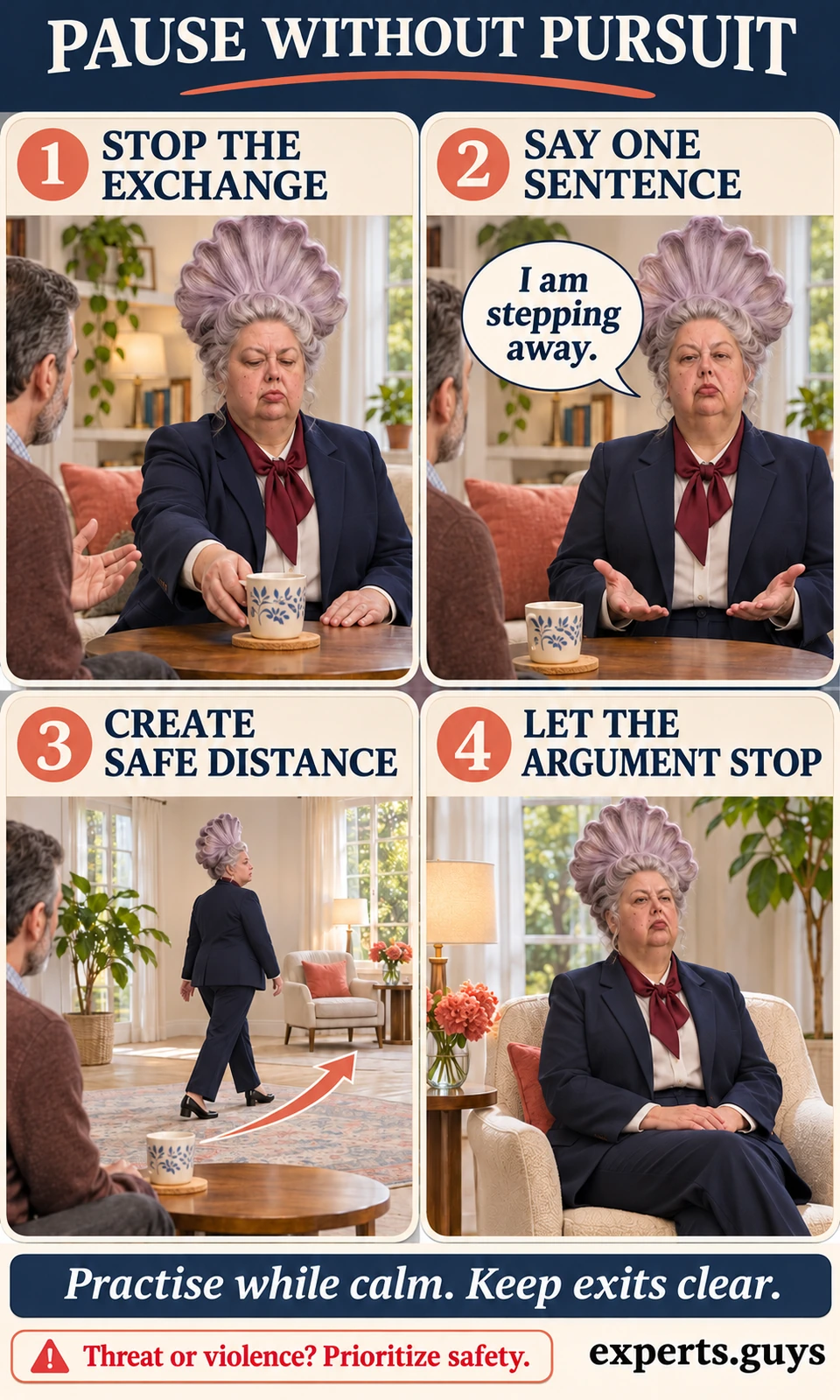
Consider an illustrative household example. A question about a late payment starts to become an accusation; you notice that you are speaking over the reply. You stop, set down the mug already in your hand, use the brief sentence and move to a separate safe area without slamming the door. The bill remains unresolved, but the immediate behavioral task has been completed: the disagreement has not been continued through shouting or pursuit.
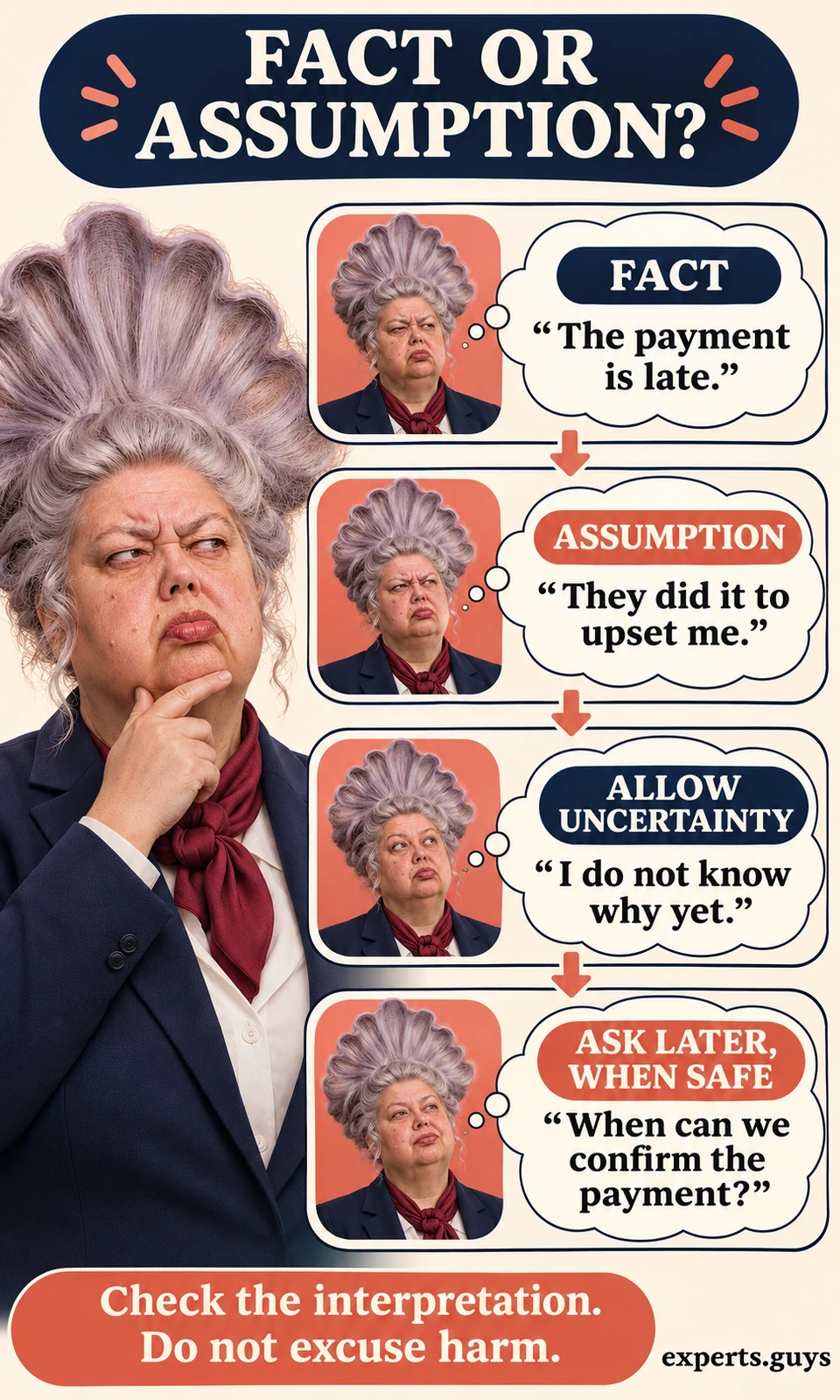
Separate the fact from the hostile interpretation
Use this thinking exercise only after you have disengaged safely enough to consider another explanation. A hostile interpretation such as “They are trying to humiliate me” can turn an unresolved fact into a personal attack. You do not need to force a positive explanation or dismiss genuine mistreatment. The task is to notice which part is observed and which part is an inference, then choose a response that does not depend on aggression.
- Name the observable fact in one short sentence: “The payment has not arrived.” Avoid adding a motive to the description.
- Notice the interpretation: “I am assuming this was deliberate.” Treat that as a thought to examine, rather than proof.
- Allow another possibility without claiming it is true: “There may be a delay or a misunderstanding.”
- Choose a checkable request for later: “When can we confirm the payment status?” If no safe answer is possible, leave the issue paused.
The easier version is simply, “I do not know their intention yet.” The checkpoint is whether you can make a factual request without an insult; a more pleasant feeling is optional. A common mistake is replacing a hostile certainty with an equally unsupported reassuring certainty. “They definitely meant well” is unnecessary. Uncertainty is enough to prevent a guessed motive from becoming the basis for a threat.
The American Psychological Association’s anger-management guidance describes changing rigid thinking, improving communication and approaching problems constructively. The payment example here is an editorial demonstration of those principles, not evidence that a brief self-help exercise treats IED. If returning to the subject immediately restarts escalation, the useful adjustment is further distance and structured support, rather than arguing harder with the thought.
Return to one issue, with permission to stop
A return conversation is appropriate only when everyone involved feels able to participate safely. The person who was frightened may not want to resume, may prefer support or may choose to leave the relationship. Respecting that decision is part of accountability. An apology does not create an obligation to talk, forgive, meet privately or reassure the person who became aggressive.
- Ask whether a brief conversation is welcome. Accept “not now” without following, bargaining or repeating the request.
- Name your behavior plainly: “I shouted at you.” Do not attach “but you made me” or ask the other person to minimize what happened.
- State one practical issue and make one specific request: “Can we confirm when the payment will arrive?” Leave unrelated grievances aside.
- Listen to the answer without interrupting. If insults, threats or pursuit restart, end the discussion and return to safety rather than trying to finish at any cost.
The easier version is a short acknowledgment with no request for a reply: “I shouted. That was not acceptable. I will give you space.” The observable outcome is a respectful acknowledgment or a bounded discussion, not restored trust. If the other person declines, stopping is the successful boundary. Repair requires behavior over time; a perfectly worded apology cannot substitute for a change in aggression.
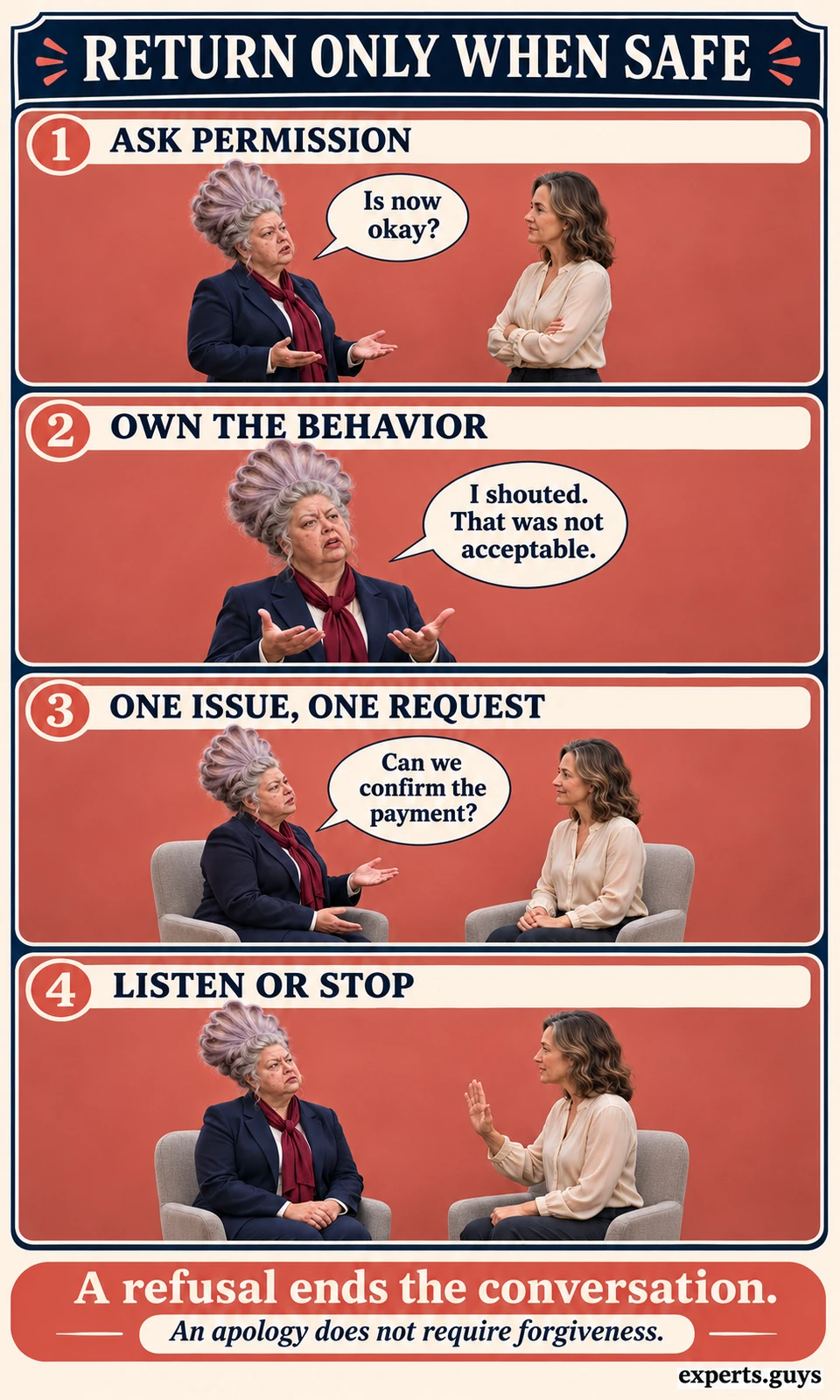
These skills work at different points in the sequence. The pause addresses active escalation; separating facts from interpretations addresses thinking after enough distance; a return conversation addresses a practical issue when participation is voluntary. Trying to do all three in the middle of a threatening outburst makes them less usable. Choose the step that fits the actual level of safety, and leave the other tasks for later.
What does effective treatment and household safety involve?
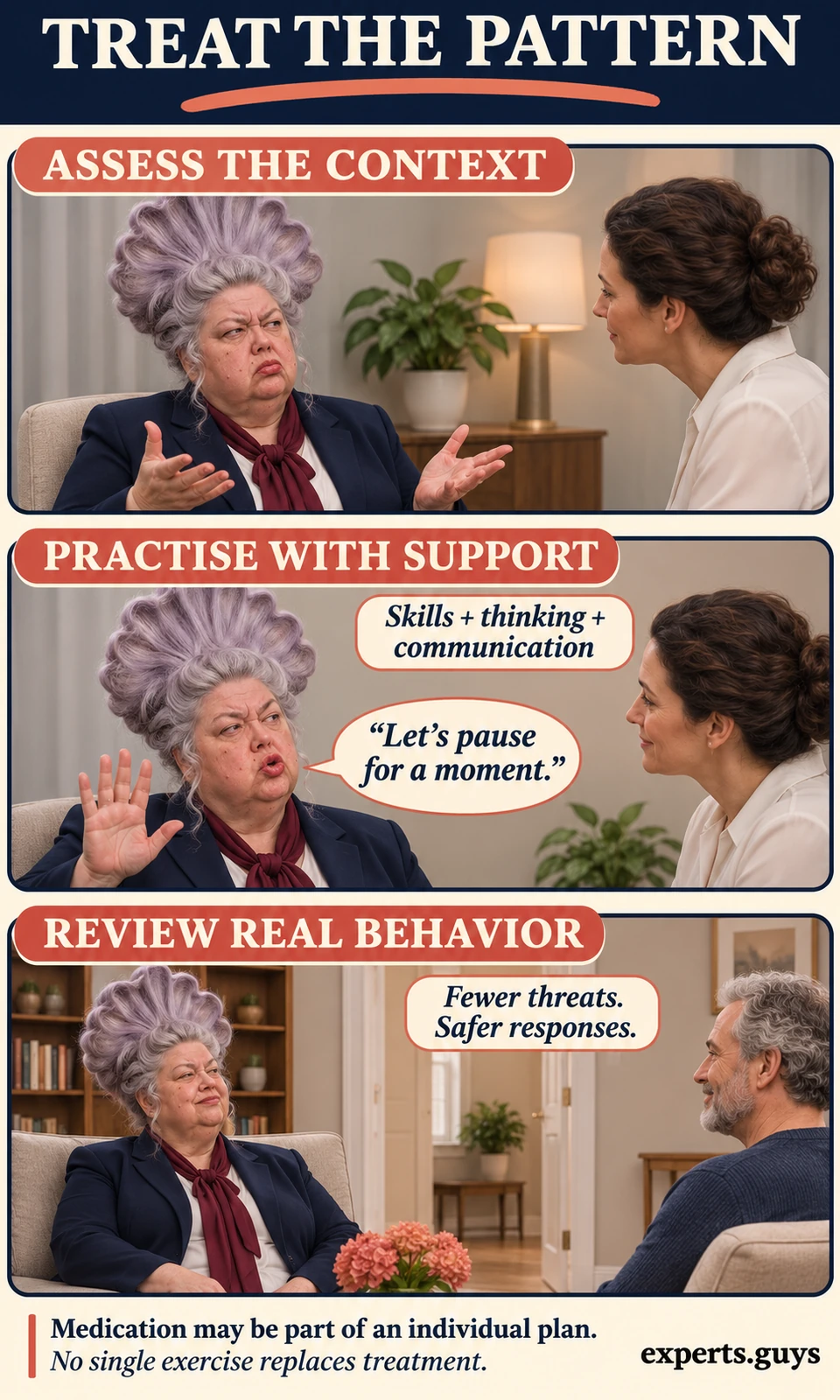
Treatment should address aggressive behavior directly, alongside any condition that contributes to it. That means more than becoming knowledgeable about IED or feeling sorry afterward. A useful plan connects early cues, practiced responses, thinking patterns, communication and the situations in which control is most likely to fail. For readers wanting the underlying therapy model, the separate explanation of cognitive behavioural therapy provides additional context.
There is direct trial evidence for a structured, multicomponent cognitive behavioral approach. In a randomized trial comparing CBT with supportive psychotherapy, 44 adults completed twelve individual sessions; the CBT intervention produced greater reductions in aggressive behavior and relational aggression. The study supports a structured approach, but its modest sample and short follow-up do not establish that every person will respond, or that one exercise reproduces the treatment.
Medication may also form part of an individualized plan. Mayo Clinic’s treatment overview describes psychotherapy and medicines, including certain antidepressants and other options. Selection depends on the person’s presentation and other conditions. This article does not provide a medicine choice, dose or instruction to start, stop or change a prescription.
A practical assessment can begin with a spoken account of a representative episode: what preceded it, what you did, whether anyone was injured or threatened, and what happened afterward. Explain any substance use, recent medication changes, sleep or mood changes and relevant medical history. You do not need to arrive with a long diary. Clear examples help connect the treatment plan to the behavior that needs to change.
What should change beyond a lower anger score?
Judge progress by behavior and its effect on other people. Relevant changes include fewer threats, no property destruction, a pause used earlier, and respect for someone else’s decision to stop a conversation. Feeling less angry is welcome, but a person who still intimidates others has an unresolved safety problem. A calmer explanation of the same controlling behavior is not the outcome the household needs.
A setback should lead to a specific review of the plan. Was the cue noticed too late? Was the supposed pause spent rehearsing the grievance? Did alcohol, another condition or an unsafe relationship context change the situation? These are questions to examine with treatment support, not reasons to blame the person who received the aggression. If risk has increased, the plan needs to prioritize protection rather than more unsupervised practice.
The recommendation here is to start with reliable interruption of unsafe behavior because it creates room for the later thinking and communication work. The trade-off is that stepping away does not solve the original dispute. That is acceptable in the short term, but repeatedly avoiding every difficult subject is a separate problem. Once safety permits, a treatment plan should support both non-aggression and constructive resolution.
If you live with someone who has explosive outbursts
You are not responsible for diagnosing the person or delivering their treatment during an episode. When someone is escalating, do not block their path, crowd them, mock them or insist that they explain their feelings immediately. Those actions are not required to maintain a boundary. Your boundary can be to stop participating and seek safety; no particular wording guarantees how another person will react.
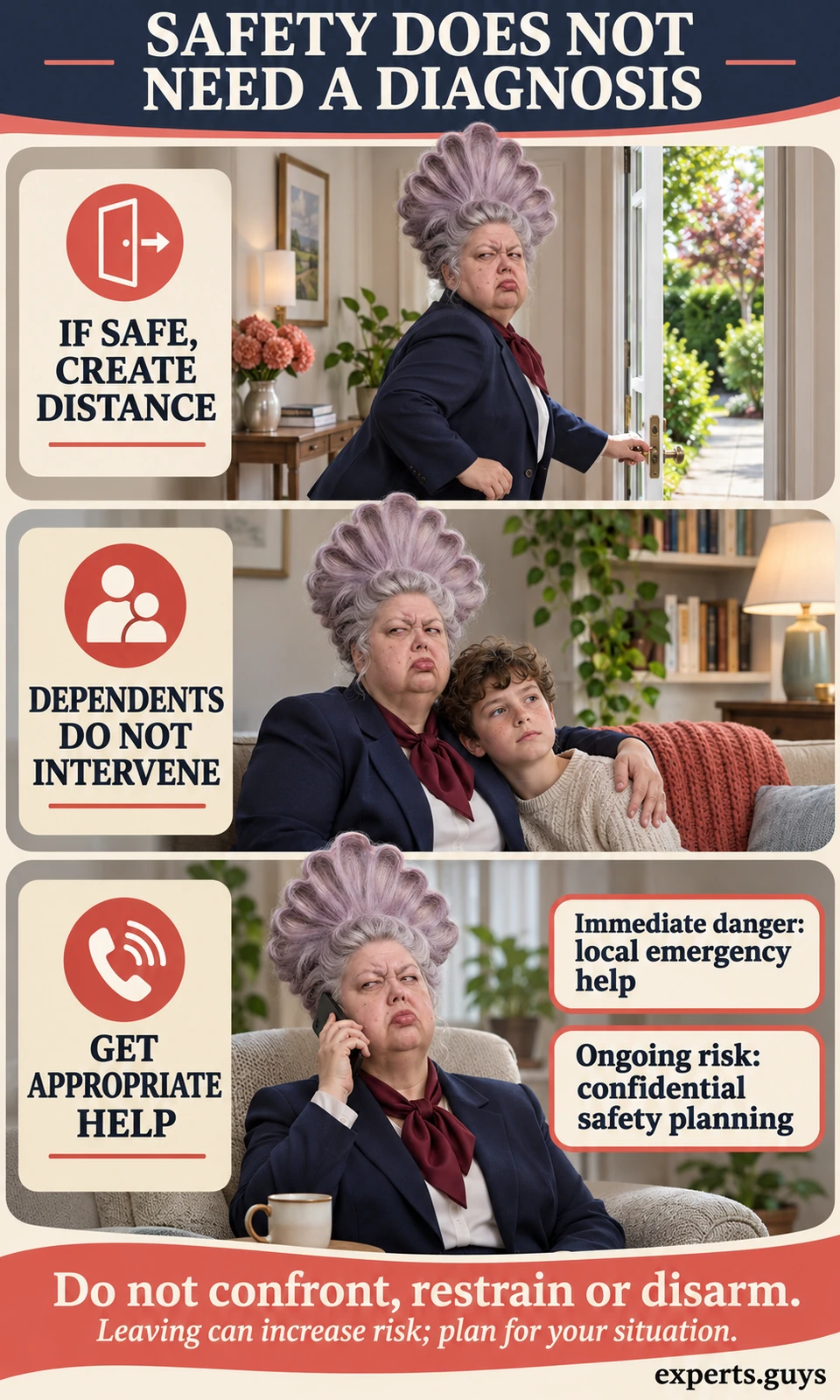
A household safety plan needs to fit the real risks. Think through a safe way out, how children or dependents can get help without intervening, and a trusted person or service to contact. Do that in advance when it is safe, rather than negotiating an escape route in the middle of violence. If leaving could increase danger, confidential domestic-violence support can help plan around that risk. Joint communication exercises may be inappropriate where coercion or abuse is present.
- At immediate risk, prioritize distance and an accessible exit if leaving is safe. Do not return to retrieve objects or try to take a weapon from someone.
- Children and other dependents should move away from the confrontation rather than mediate or physically intervene.
- Use the local emergency number for immediate danger; seek urgent care for injuries. When the threat is not immediate, contact confidential domestic-violence support to discuss individualized options.
The illustration below shows a simplified safety decision, not a universally safe route out of an abusive home. Its easier option is to seek confidential planning support before the next crisis when possible; it does not require confronting the person about that plan. The checkpoint is access to help and safer distance, not persuading the aggressive person to agree that you are entitled to it.
Families also need room to describe what happened without being told that the diagnosis makes it harmless. A small broken object can function as intimidation even if nobody was struck. Likewise, “I would never hurt you” does not resolve the risk created by threats or blocking exits. Take the observable behavior seriously and let safety decisions reflect that behavior rather than a promise made after the event.
Questions readers often still have
Can someone have IED and appear calm at work?
Behavior can differ across settings, so appearing calm in one place does not settle the diagnosis. Assessment still needs the full pattern, consequences and alternative explanations. Being selective about where aggression occurs also deserves careful attention to control and coercion; it is not something an online article can interpret confidently.
Is punching a cushion a useful way to release the anger?
Do not make hitting things the practice response. The goal is to interrupt aggression and build a response that keeps people and property safe, rather than rehearse striking while angry. Use the safe pause described above if you can disengage; immediate danger requires safety help rather than an exercise.
Does apologizing mean an episode is over for everyone?
No. The person who shouted may feel relief while someone else is still frightened or dealing with damage. An apology can acknowledge responsibility, but the affected person decides whether to talk or accept contact. Repair depends on sustained safer behavior and practical accountability.
Can I use these pictures to decide whether my partner has IED?
No. The images explain concepts and illustrate actions; they do not establish a diagnosis or prove what caused a real person's behavior. You can act on threats and unsafe conduct without first obtaining a diagnostic label. A clinical assessment is needed to evaluate IED and other explanations.
Choose the next step by the behavior happening now
- Immediate threat or violence: prioritize safety and urgent local assistance. Do not practise a discussion technique within reach of danger.
- Early escalation with a safe way to disengage: stop your own contribution, use the brief pause and keep exits clear.
- Repeated disproportionate outbursts: arrange an assessment that directly addresses aggression and possible contributing conditions.
- Calm, voluntary discussion: acknowledge the behavior, address one practical issue and respect anyone’s decision to stop.









