




Intermittent explosive disorder (IED) involves repeated, impulsive aggressive outbursts that are far more intense than the situation warrants and cause distress or harm. Recognizing the pattern means looking beyond anger itself: what happened, how suddenly it escalated, what the person did and what consequences followed. If anyone is threatened or unsafe, protection takes priority over working out the diagnosis.
A single furious argument cannot establish IED, and neither can a checklist of body sensations. The useful distinction is between an emotion, an aggressive act and a recurring clinical pattern. You can take harmful behavior seriously before you know what explains it, while still leaving the diagnosis open to a proper assessment.
Which signs point toward an IED pattern?
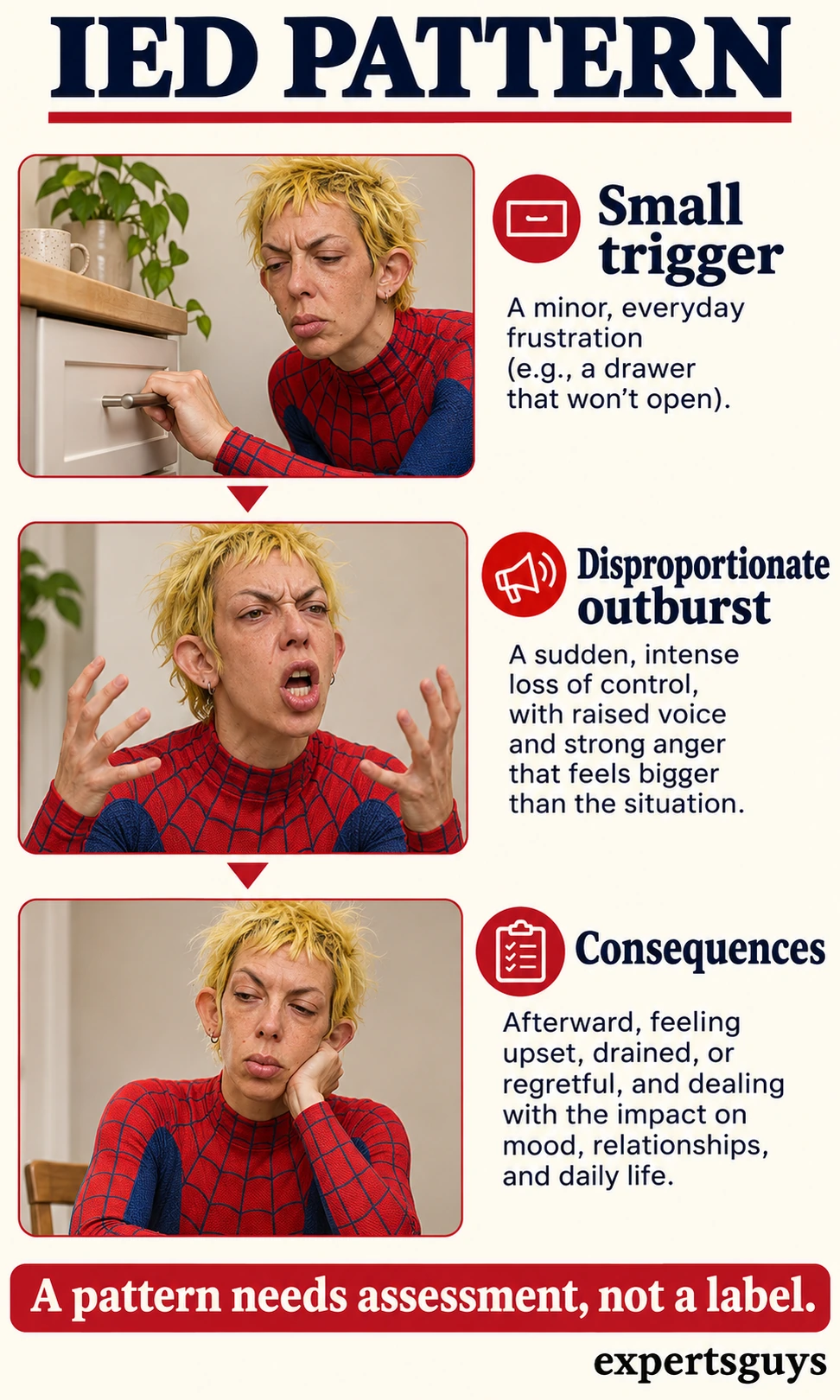
The central concern is recurrent failure to control aggressive impulses, rather than simply feeling irritated frequently. Outbursts may involve verbal aggression or physical aggression; their intensity is grossly out of proportion to the provocation. An ordinary frustration can be the starting event, but the event does not explain away threats, assault or destruction.
Think in terms of the relationship between trigger, action and consequence. A delayed delivery may cause understandable disappointment. A sudden aggressive eruption in response raises a different question, particularly when similar episodes recur and damage relationships, work or everyday safety. This comparison is an orientation aid, not a way to judge a diagnosis from one scene.
Descriptions such as “short fuse” often conceal important differences. Someone may speak sharply and then listen, while another person threatens a partner or throws an object. Both may call the experience losing their temper, but the actions and risks differ. Describe what actually happened rather than treating all angry behavior as equivalent.
- Repeated sudden verbal or physical aggression deserves attention.
- The reaction is much larger than the immediate situation would explain.
- The behavior is impulsive rather than a planned means to obtain something.
- The pattern causes distress, relationship damage, practical impairment or other consequences.
- Another condition, a substance effect or a medical problem may explain the presentation instead.
These features belong together. Strong anger without aggressive behavior is not the same presentation, and planned intimidation cannot be explained simply by calling it an impulsive outburst. At the same time, an outsider cannot reliably determine intent from facial expression. The assessment needs the sequence of events, the wider history and accounts of impact.
| What you notice | What it means for the next step |
|---|---|
| Anger without aggression | Understand the feeling and its context; anger alone cannot establish IED. |
| Repeated impulsive aggression | Arrange assessment of the full pattern, including distress, impairment and competing explanations. |
| Threats, assault or blocked exits | Prioritize immediate protection and urgent local help. Do not wait for a diagnosis or a frequency threshold. |
| Remorse after an episode | Consider the impact and behavior that still need to change; regret does not establish a diagnosis or erase harm. |
What might happen before, during and after an outburst?
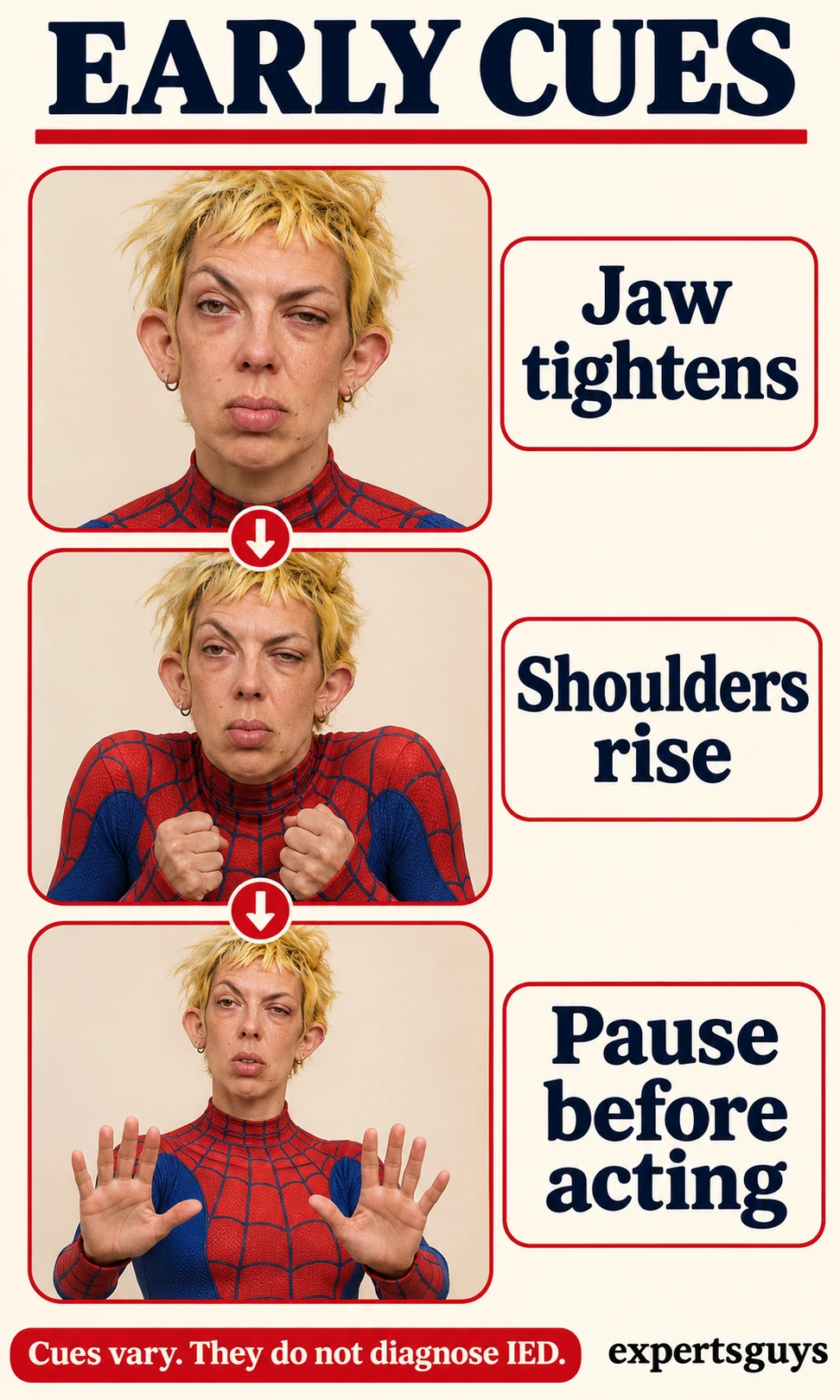
Before an episode, some people notice tension, racing thoughts, a pounding heart or a rising urge to react. During it, speech or behavior may become aggressive very quickly. Afterward, there may be fatigue, relief, embarrassment or remorse. These experiences vary and are not specific enough to identify IED on their own.
When persistent low mood or loss of interest accompanies irritability, anger and irritability in depression explains that broader context. The useful purpose of recognizing an early cue is to change the next action, not to prove a label. If you notice your jaw tightening while a disagreement accelerates, that can be a reason to stop the exchange before acting aggressively. You do not need to decide whether the sensation is “definitely IED” before making more room for safety.
A physical sensation also needs context. A tight chest during a familiar surge of anger is different from new or severe chest pain, collapse or difficulty breathing. Do not assume a concerning physical symptom is psychological because an argument happened first; urgent physical symptoms require medical attention appropriate to their severity.
For someone nearby, visible behavior is more useful than guessing an internal state. A clenched hand, a rising voice or a person moving closer may prompt caution, but none proves what they will do. You are allowed to increase distance or end an interaction because it feels unsafe without persuading the other person that their behavior meets a diagnostic description.
Can verbal aggression matter without broken objects?
Yes. Assessment does not depend on dramatic property damage being present every time. Repeated aggressive verbal episodes can be clinically relevant and can make a household or workplace frightening. Avoid using “nothing was broken” as the whole measure of seriousness; it leaves out threats, humiliation and the effect on everyone who anticipates another episode.
There is still a difference between identifying a serious problem and deciding which disorder explains it. Anger, swearing, intimidation and distress require a careful account rather than a shortcut. If the behavior is making someone change where they go, whom they see or what they feel able to say, the impact deserves its own attention alongside the symptom question.
A person may seem settled between episodes, or there may be continuing irritability. Neither a pleasant afternoon nor a difficult week settles the diagnosis. The history matters because an isolated snapshot can exaggerate or hide the problem: people often see either the worst moment or the calm period that follows it.
How is IED distinguished from other causes of anger?
IED assessment examines the aggressive episodes and checks whether another explanation fits better. This is why a page that mixes bipolar symptoms, ADHD difficulties and IED under one heading can mislead: similar-looking anger may occur in very different patterns. The task is to understand the whole presentation, not choose the most familiar label.
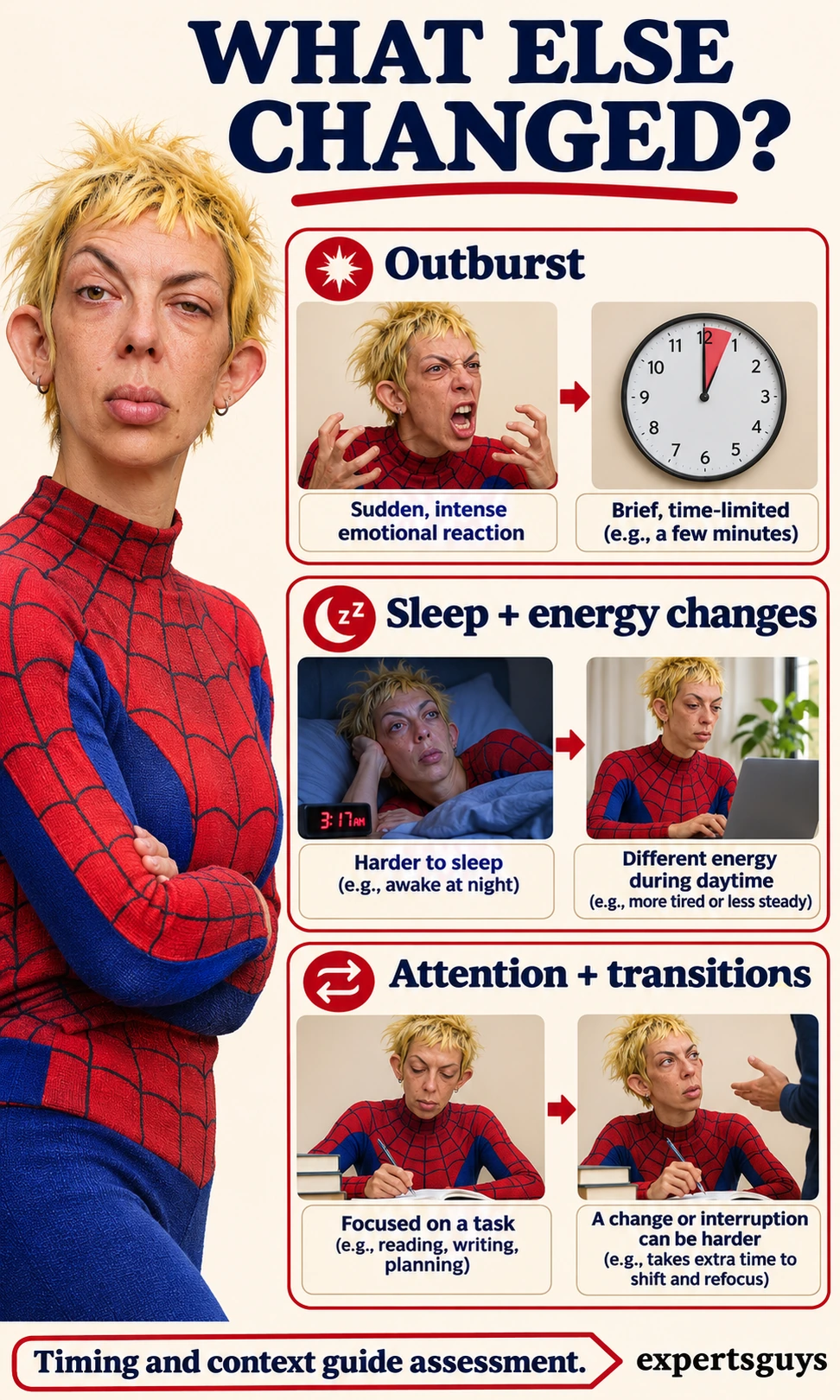
Two dimensions are especially useful to keep separate: the time course of the aggressive behavior and the wider changes around it. A short outburst is an event. A sustained alteration in sleep, energy, activity or thinking may point to a broader episode requiring different assessment. The event and the background can coexist, so duration alone is not a diagnostic test.
For bipolar disorder, the relevant question is whether anger belongs to a larger mood episode. The NIMH bipolar disorder overview describes changes in mood, energy and activity that extend beyond a momentary argument. Our explanation of sleep, speech and judgment changes in bipolar symptoms develops that comparison without treating irritability as sufficient evidence.
| Pattern or context | Useful distinction |
|---|---|
| Brief aggressive eruptions | Assess what the person did, proportionality, recurrence, intent and consequences. |
| Sustained mood and energy change | Explore a broader episode rather than treating anger as a standalone explanation. |
| Longstanding attention difficulties | Consider developmental history and functioning; a difficult interruption is not an ADHD diagnosis. |
| New change after a substance or medical event | Discuss the timing and relevant physical or medication history rather than assuming a chronic anger disorder. |
| Control and intimidation | Address safety and coercion directly. A clinical label is not required to take these behaviors seriously. |
What about ADHD, trauma and substance use?
ADHD is assessed as a developmental pattern of inattention and/or hyperactivity-impulsivity with impairment, not as anger alone. The NIMH ADHD guide explains the importance of childhood onset and difficulties across life. If the recurring problem is losing your place when interrupted, handling interruptions without snapping addresses that specific obstacle; it does not replace assessment of aggression.
Trauma history can be important without explaining every later reaction. A person may feel threatened in circumstances that others do not understand, yet the assessment still needs to establish what they experience, what they do and whether another condition accounts for it. Avoid turning an assumed history into a diagnosis or using it to discount another person’s safety.
Alcohol, recreational drugs, medication effects and medical conditions are also relevant to the timeline. A marked change after substance use, a medication change or a head injury needs a different line of questioning from a longstanding pattern. Tell the assessor about that timing directly; do not stop prescribed medication or experiment with doses to test a theory.
Do the diagnostic frequency thresholds tell me whether to seek help?
They describe part of the diagnostic framework, not how long someone should tolerate danger. The Cleveland Clinic explanation of IED diagnostic criteria describes two alternative frequency patterns: verbal or physical aggression averaging twice weekly for three months without injury or property destruction, or three outbursts involving property damage or injurious assault within twelve months. Other criteria must also be met.
The aggression must be grossly disproportionate, impulsive rather than premeditated or aimed at a tangible objective, and associated with significant distress or impairment or financial or legal consequences. The framework includes age and developmental requirements, and competing explanations must be considered. A person does not receive an IED diagnosis simply by reaching a number, and one dangerous incident can warrant urgent intervention without meeting that number.
This distinction prevents two opposite mistakes. One is self-diagnosing after counting arguments while ignoring their nature and context. The other is postponing help because there have “only” been two damaging episodes. Clinical classification and immediate safety answer different questions, and neither should be used to cancel the other.
What information makes an assessment more useful?
An accurate spoken account is enough to start; you do not need a diary or a completed worksheet. Explain a representative incident in sequence: the situation, the actual words or actions you remember, any injuries or damage, and what followed. Say when you do not remember. Concrete details are more informative than a general description such as “I went crazy.”
The assessor also needs to understand what life is like outside those incidents: sleep, energy, substance use, longstanding attention difficulties, medical history and other symptoms. A partner or relative may have a different account of the impact. Their perspective should be considered safely and with appropriate consent, without requiring them to confront the person or defend their experience in a joint interview.
No home test, face photograph or brain illustration can replace that process. The point of preparation is a clearer conversation, not building a case for the diagnosis you already suspect. A useful assessment may identify IED, identify another condition or show that several problems need separate attention.
What can you do before anger becomes aggression?
For manageable escalation, the most useful immediate priority is to interrupt the interaction safely before harm occurs. That means stopping the exchange and allowing space, with exits clear and no pursuit. This is an everyday application of timeout principles, not a treatment for IED and not a promise that a threatening person will become safe if you use the right words.
Start by distinguishing an early-warning situation from danger already unfolding. Someone who can stop speaking, respect distance and leave others free to move may be able to use a pause. Threats, assault, a weapon, blocked exits or fear of imminent harm require protection and urgent local assistance instead. Do not turn a dangerous confrontation into a practice session.
Use a pause that protects freedom to move
This approach is for the person noticing their own escalation while there is still a safe opportunity to disengage. Its purpose is to remove the continuing exchange, not punish someone with silence or make them surrender the disagreement. It works only as part of behavior that respects everyone else’s movement, choices and safety.
Before conflict, consider whether there is a safe place to step away and a route that does not require squeezing past another person. No equipment is needed. If there is a history of violence or coercive control, a household agreement may be unsafe or insufficient; individualized safety support matters more than having a shared script.
- Stop adding words to the argument. If safe, say, “I am getting too worked up. I need to stop this conversation.” Do not attach a final insult or accusation.
- Keep your hands away from other people and objects. Step back without approaching, cornering or touching anyone. Leave the doorway and other exits unobstructed.
- Move to a separate safe space if you can do so safely. Do not follow the other person, demand that they stay or continue the argument through calls or messages.
- Reconsider discussion only when everyone can participate safely and willingly. A pause may need to become a postponement; it does not create a right to an immediate reply.
The observable result is modest and concrete: the exchange stops, distance is available and nobody’s exit is restricted. You may still feel angry. That does not mean the pause failed; its immediate job is to change the behavior and situation, not instantly erase the emotion or settle the original disagreement.
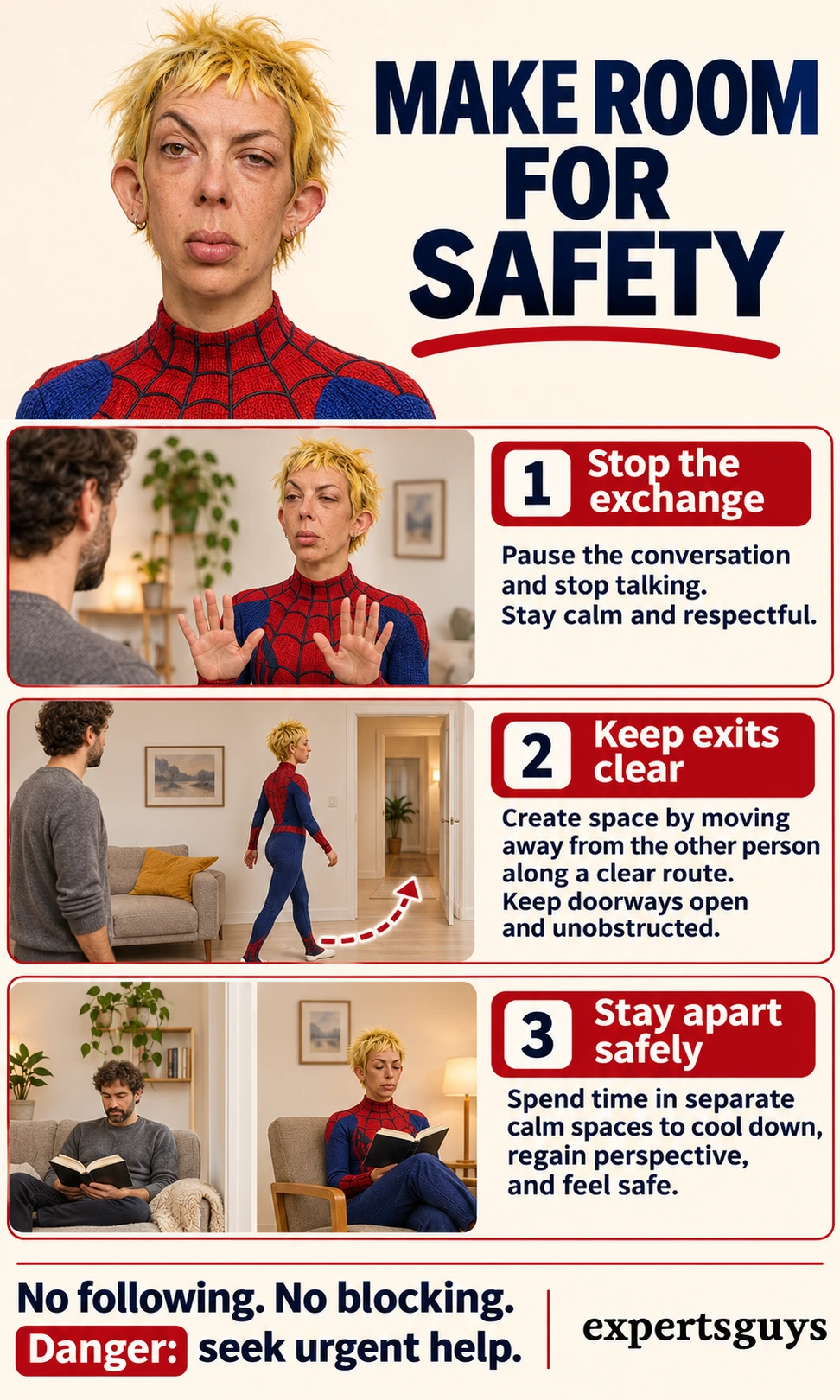
If movement is difficult, stopping the exchange may mean remaining seated and allowing others space rather than trying to stand quickly. This is an access adaptation, not an instruction to stay in danger. If you cannot safely create distance, or someone prevents it, the situation has moved beyond a self-help demonstration.
The most common failure is continuing to argue while announcing a timeout. “I am leaving because you always do this” keeps the accusation active and may invite another round. Replace the extra explanation with the brief stop statement, then disengage. You can address the substance later if that is safe; it does not have to be decided at the doorway.
Another failure is treating a pause as control: leaving only if the other person apologizes, demanding their location or insisting they remain available. Those conditions defeat its safety purpose. A useful pause gives space rather than imposing a new obligation on the other person.
Rehearse the exit while calm, without provoking an argument
Rehearsal belongs in a calm period, preferably within an agreed care plan when aggression has been recurrent. The aim is to make the simple sequence familiar: say the phrase, stop the exchange and use an unobstructed route. Do not ask a partner to provoke you, test your limits or act frightened so that the exercise feels realistic.
Practice alone in a safe, quiet setting. Say your short pause phrase aloud, move along the clear route at a comfortable pace and stop in the separate space. Then imagine postponing the discussion without adding a last word. If another adult takes part in a calm demonstration, their participation must be voluntary and they can stop at any time.
The checkpoint is whether the sequence remains brief, physically practical and free of demands on someone else. If the route is awkward, choose a more accessible option while calm. If speaking is difficult, an agreed neutral gesture may be easier, but it must never be interpreted as permission to ignore distress or override another person’s need to leave.
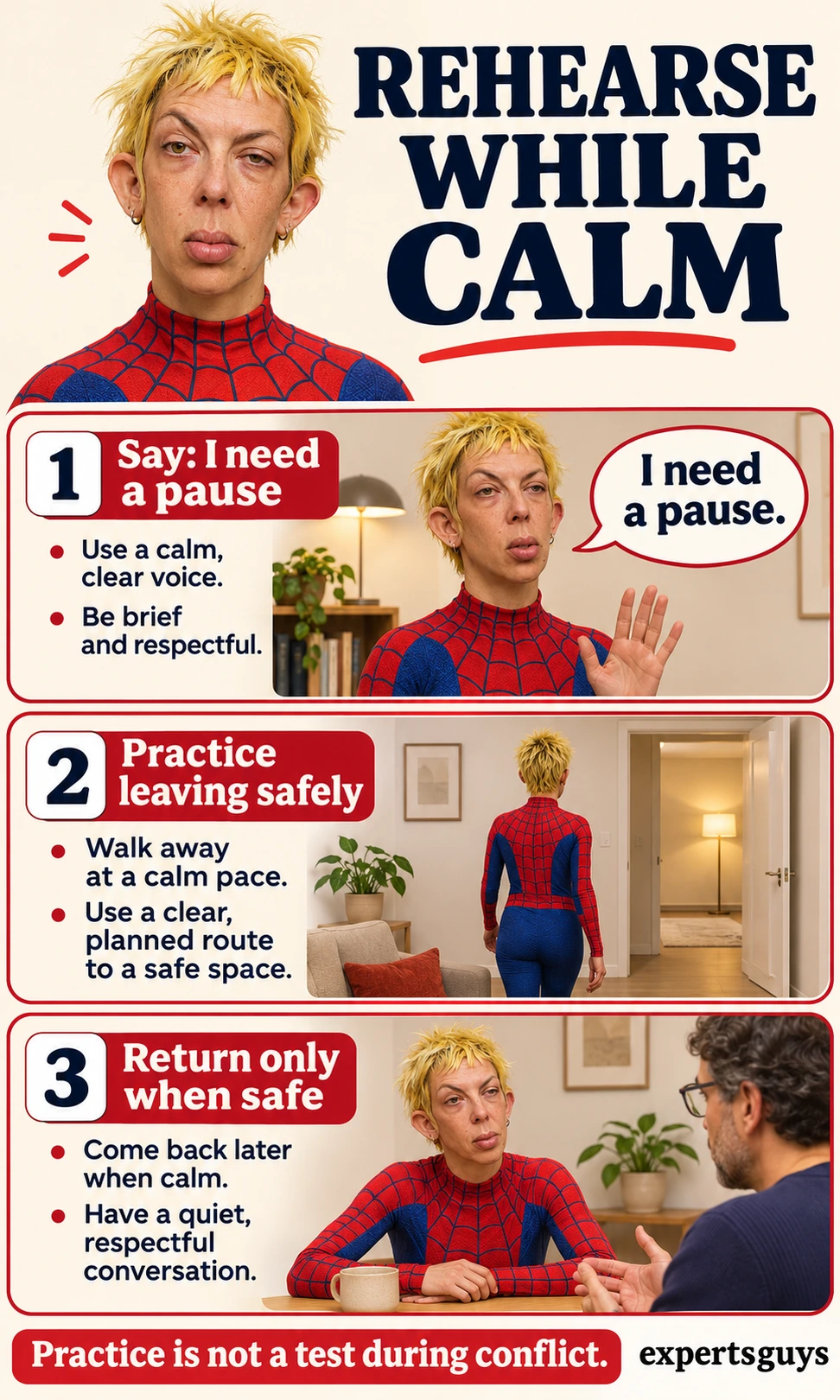
This rehearsal is an illustrative adaptation of established anger-management practice, not a separately validated IED protocol. SAMHSA’s anger-management manual discusses cues, timeouts and planned responses within a cognitive behavioral program. Here, the emphasis is narrower: practice stopping the exchange without blocking, chasing or demanding compliance.
What if you are the person facing the outburst?
You are not responsible for performing a calming technique correctly enough to prevent someone else’s aggression. Avoid arguing about whether they “really have IED” during a frightening episode. If safe, increase distance and seek help; if leaving or announcing a plan would increase danger, use a safer option with specialist support rather than applying a generic script.
Do not attempt to restrain the person, retrieve a weapon or physically force a route open as a self-help exercise. Children and other vulnerable people should not be recruited to calm the adult or carry messages between adults. If danger is immediate, contact local emergency services when it is safe to do so and give your location and the concrete threat.
The NHS guidance on domestic abuse explains that abuse includes more than physical injury and that support is available before an emergency. Diagnosis and safety support can proceed separately. A person being harmed does not have to wait for an IED assessment, accept an apology or participate in couples work to deserve protection.
What effects matter, and what should improvement look like?
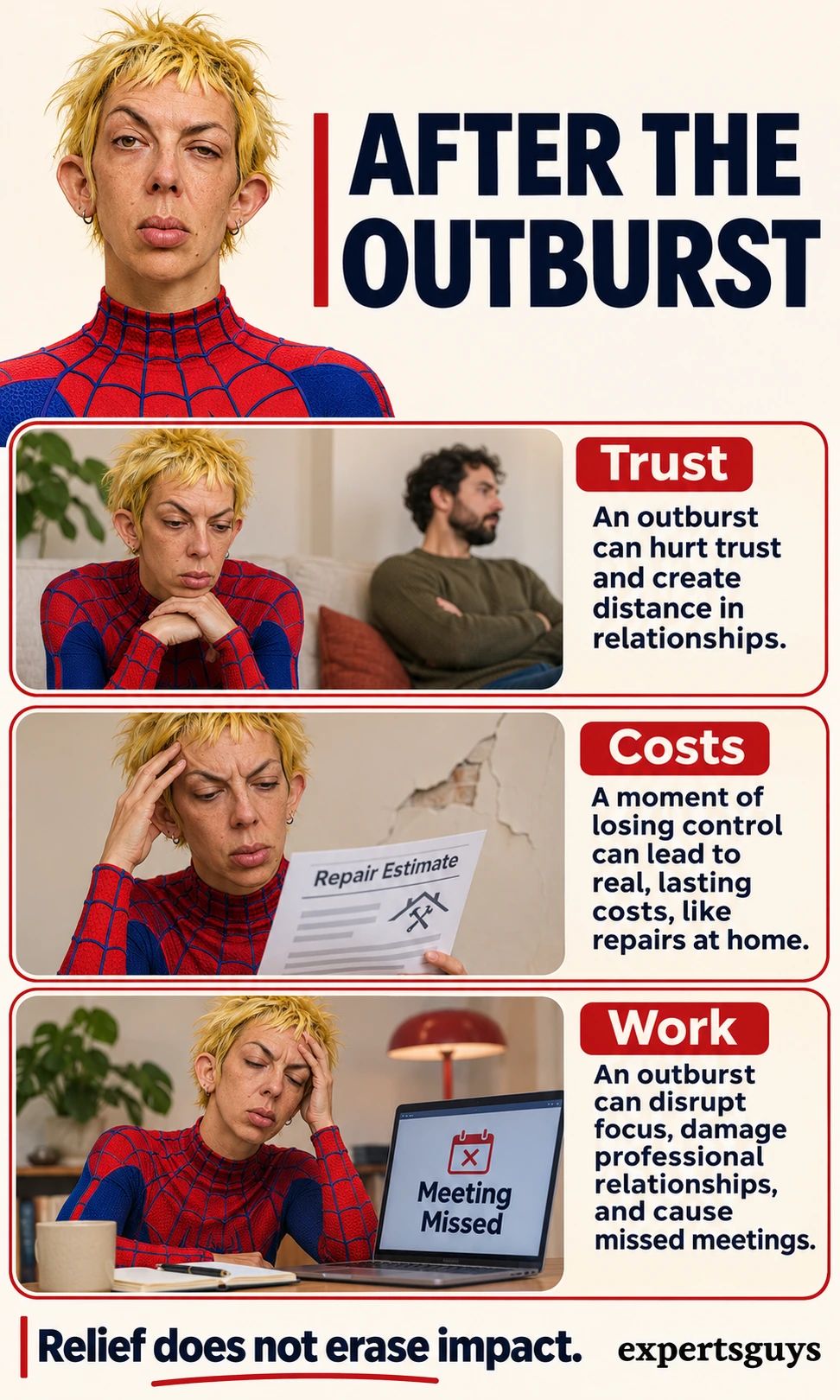
The effects of repeated aggression extend beyond the minutes of the outburst. A useful assessment of impact asks what other people now fear, what activities have become difficult and what practical consequences remain. Feeling relieved afterward does not mean the situation has returned to how it was before.
In an illustrative household example, an adult erupts after a minor disagreement about a purchase, then feels calm and apologetic. Their partner remains reluctant to discuss money because the next conversation may feel risky. The important mismatch is between the adult’s internal relief and the partner’s ongoing loss of safety; another apology alone does not resolve that difference.
Work effects may be less visible than dismissal or formal discipline. Colleagues may stop raising concerns, a manager may avoid assigning public-facing tasks, or the person may spend time repairing strained relationships. These are examples of how aggressive behavior can interfere with functioning, not predictions about what every employer will do or proof of a particular diagnosis.
Separate accountability from self-condemnation
Accountability means acknowledging the actual behavior and its consequences without transferring responsibility to the person affected. “I shouted and frightened you” identifies an action. “You know how to push my buttons” shifts the focus to blame. The first description leaves room for change; the second asks the other person to manage the risk by becoming more careful.
This does not require describing yourself as permanently dangerous or beyond help. Those conclusions can become another way to avoid the specific work. The practical question is what must change so that others do not have to organize their lives around the next incident. Treatment participation, safer behavior and respect for boundaries provide more relevant information than dramatic promises.
Someone affected may want distance, practical restitution, independent support or no further contact. You cannot use an explanation, a diagnosis or attendance at therapy to demand forgiveness. Where damage or injury has occurred, addressing the concrete consequences is separate from deciding whether a relationship continues.
What does treatment actually target?
Treatment is individualized and may combine psychotherapy with medication. A clinician can help examine the relationship between triggers, interpretations and aggressive behavior, then practice safer responses. Mayo Clinic’s IED treatment guidance outlines these options; there is no single approach that suits everyone.
Cognitive behavioral work can address assumptions that intensify conflict and build alternative responses. For example, “They disagreed with me” is an observation, while “They are deliberately humiliating me” adds an interpretation. In therapy, the useful question is whether that interpretation fits the evidence and what response remains appropriate even when you dislike the situation.
A randomized trial comparing cognitive behavioral and supportive psychotherapy for IED found greater improvement in aggressive behavior with the cognitive behavioral intervention. Forty-four adults completed twelve individual sessions in the trial, with follow-up at three months. That is a small, structured treatment study, rather than a test of advice read at home. The study supports structured treatment, not the claim that a brief web exercise has the same effect. Outcomes depend on the person, treatment delivery and the problems being addressed.
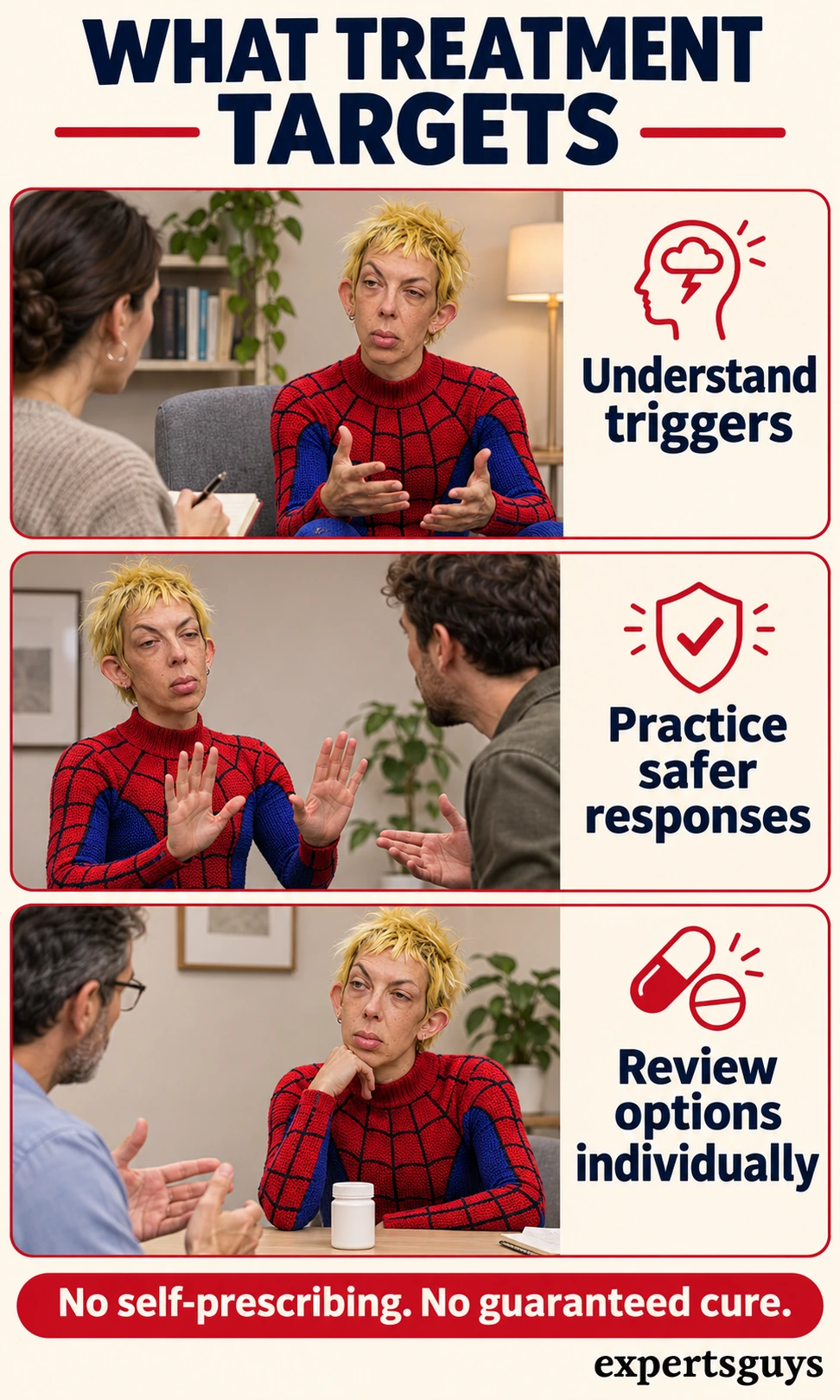
Medication decisions require an individual review of benefits, risks, other conditions and current prescriptions. This article does not recommend a medicine or dose. If a treatment is not helping or seems to be associated with a concerning change, describe that change to the prescriber rather than stopping, borrowing or increasing medication independently.
Someone who already has a bipolar, ADHD or other diagnosis may still need the aggression addressed explicitly. Conversely, an IED label should not hide a broader change in health. Ask what the treatment is targeting and how the team will distinguish improvement in one problem from continuing risk in another.
Judge progress through safer behavior and functioning
“I felt less angry” can be useful information, but it is not enough if threats, pursuit or damage continue. A stronger sign is that an escalating exchange ends without aggression and the other person’s boundaries are respected. Another is being able to disagree without other people having to suppress reasonable concerns to keep the peace.
| Area | Meaningful change |
|---|---|
| Aggressive behavior | No threats, injury, pursuit or damage; escalating conversations stop without restricting anyone else. |
| Respect for boundaries | Other people remain free to decline contact, postpone discussion or leave. |
| Daily functioning | Ordinary disagreement becomes possible without people avoiding every difficult subject. |
| Treatment fit | The plan addresses the actual remaining behavior and any other relevant health concerns. |
| Accountability | Consequences are acknowledged without blaming the person affected or demanding forgiveness. |
Do not turn the table into a score or ask someone to certify that you are safe. It is a way to make the aim of care concrete. A quiet period achieved because everyone avoids you is different from improved control during ordinary disagreements, and a single successful pause does not establish lasting recovery.
If outbursts continue despite a plan, the response is to reassess the plan and its fit, not ask others to tolerate more practice. Explain what still happens, whether danger is increasing and which steps cannot be carried out safely. That gives a treatment team a clearer problem to solve than a vague verdict that therapy has “failed.”
Questions that often remain
Can a child be diagnosed with IED?
The diagnostic framework requires an age of at least six years, or an equivalent developmental level, and careful interpretation of the child’s development and other possible explanations. Ordinary developmental tantrums should not be relabeled from an adult checklist. If a child is hurting people, animals or themselves, the immediate task is safe adult support and an age-appropriate assessment, rather than debating the label at home.
Does feeling calm afterward mean the episode was harmless?
No. Your emotional state afterward and another person’s experience are different. A person affected may still feel frightened, have an injury or face practical consequences after you feel settled. What matters next is whether those consequences are addressed and whether the behavior changes, rather than whether everyone agrees that the argument is over.
Is IED caused by one chemical imbalance?
No single cause explains IED. Biological, genetic and environmental factors may contribute, and an individual’s history still requires assessment. A simplified chemical explanation cannot establish the diagnosis, identify a medicine that will work or show that behavior is unavoidable. Avoid treating a brain graphic or a family history as proof about one person.
Does an angry driving incident prove IED?
No. The setting of an incident does not identify a disorder. An assessment needs the recurrent pattern and other criteria, while dangerous driving must be taken seriously on its own. A home pause demonstration should not be attempted while driving: protect road safety, avoid confrontation and obtain appropriate help for the actual danger.
Your next step
If the immediate situation is safe, choose the question that is still unresolved: whether the pattern needs assessment, how to stop an escalating exchange safely, or what consequences and treatment goals remain unaddressed. Start with that job rather than trying every anger strategy at once. If safety is uncertain, make protection and appropriate help the next action; resolving the label can wait.
- For assessment, describe the actual behavior and timing rather than choosing a diagnosis first.
- For manageable escalation, check that the pause respects clear exits and the other person’s freedom to disengage.
- For continuing consequences, ask whether the treatment plan addresses the specific behavior that is still causing harm.









