
Major depressive disorder can improve before every part of daily life feels manageable again. If your mood is better but concentration, energy or ordinary responsibilities remain difficult, bring those unfinished problems into the treatment review rather than treating “better” as the end of care. Start by separating what has improved from what still needs attention.
The correct clinical term is major depressive disorder (MDD), not “important depressive disorder.” MDD affects mood and can also affect thinking, sleep, appetite and functioning. This guide focuses on adults already receiving care who need to explain incomplete improvement; for the initial assessment, see understanding an MDD diagnosis.
These steps organise a care conversation; they do not diagnose the cause of a symptom or prescribe treatment. You do not need a daily diary, an app subscription or a perfect record. A brief spoken example or a private phone note is enough to start.
Choose the row that best describes the unfinished problem. More than one can apply, and a new concern should not be dismissed because another symptom improved. Urgency depends on the concern itself, not on how long you have been in treatment.
| What you notice | What to clarify | Useful next step |
|---|---|---|
| Mood improved; tasks remain hard | Symptoms and daily function are different questions | Bring one example of each to review |
| A symptom changed after treatment changed | Timing can guide investigation but cannot prove cause | Describe the sequence to the prescriber |
| The plan keeps being interrupted | Access and delivery may be limiting care | Identify one barrier and request a workable alternative |
| A familiar pattern is returning | A warning change deserves an agreed response | Use your care team’s contact plan |
| You feel better and want to stop care | Continuation benefits and burdens need review | Discuss the plan before changing medication |
Why can mood improve while everyday life still feels difficult?
Feeling less low and managing a demanding day are related, but they are not interchangeable. Concentration, sleep, physical health, treatment effects and the demands around you can all affect what you can do. A functional difficulty therefore deserves its own description rather than an assumption that you need to try harder.
Depression treatment does not necessarily change every symptom at the same time. The NIMH overview of depression describes changes in thinking and daily activities as well as mood, and notes that some symptoms can improve earlier than others during medication treatment. That does not establish the reason for any particular person’s remaining problem.
Separate symptom relief from daily functioning
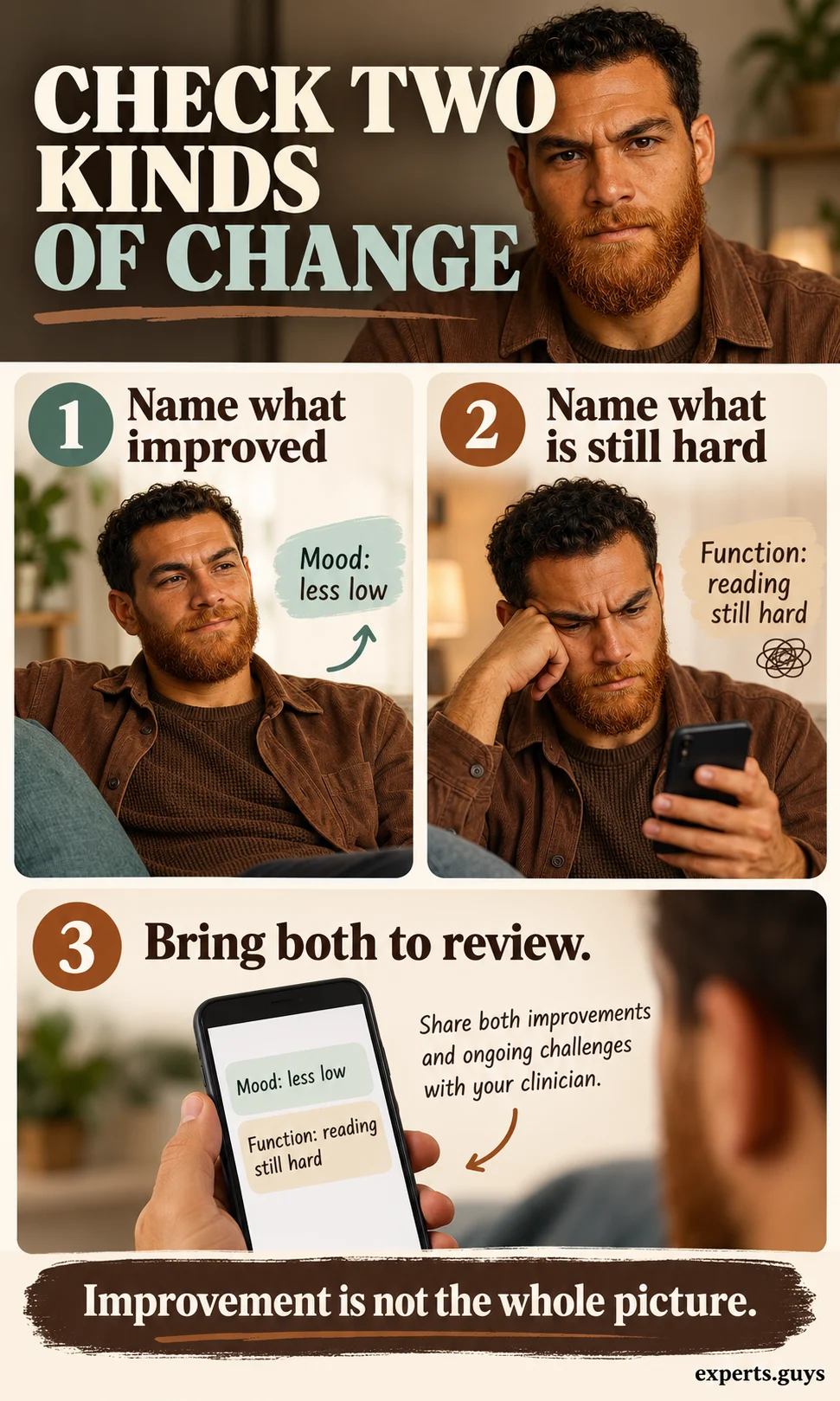
Use this comparison when “better” feels true but incomplete. A mood question and a functioning question describe different parts of the same week. Keeping them separate prevents a useful improvement from hiding a difficulty that still needs attention.
- Name one symptom that has eased, such as low mood or loss of interest. If nothing has improved, say that plainly.
- Name one activity that remains difficult, such as understanding a short message or managing a familiar responsibility.
- Bring both observations to the review, verbally or in one private phone note. Ask whether the remaining problem needs a separate assessment or treatment goal.
Example: “I feel less hopeless, but I still cannot follow a short email without rereading it.” Make it workable: Avoid translating a better mood into “everything is fine.” If typing is tiring, say the two observations aloud or ask a trusted supporter to help with your permission. Checkpoint: The useful result is a clearer description of the unfinished problem, not a higher productivity target.
Use one comparable task as a real-life example
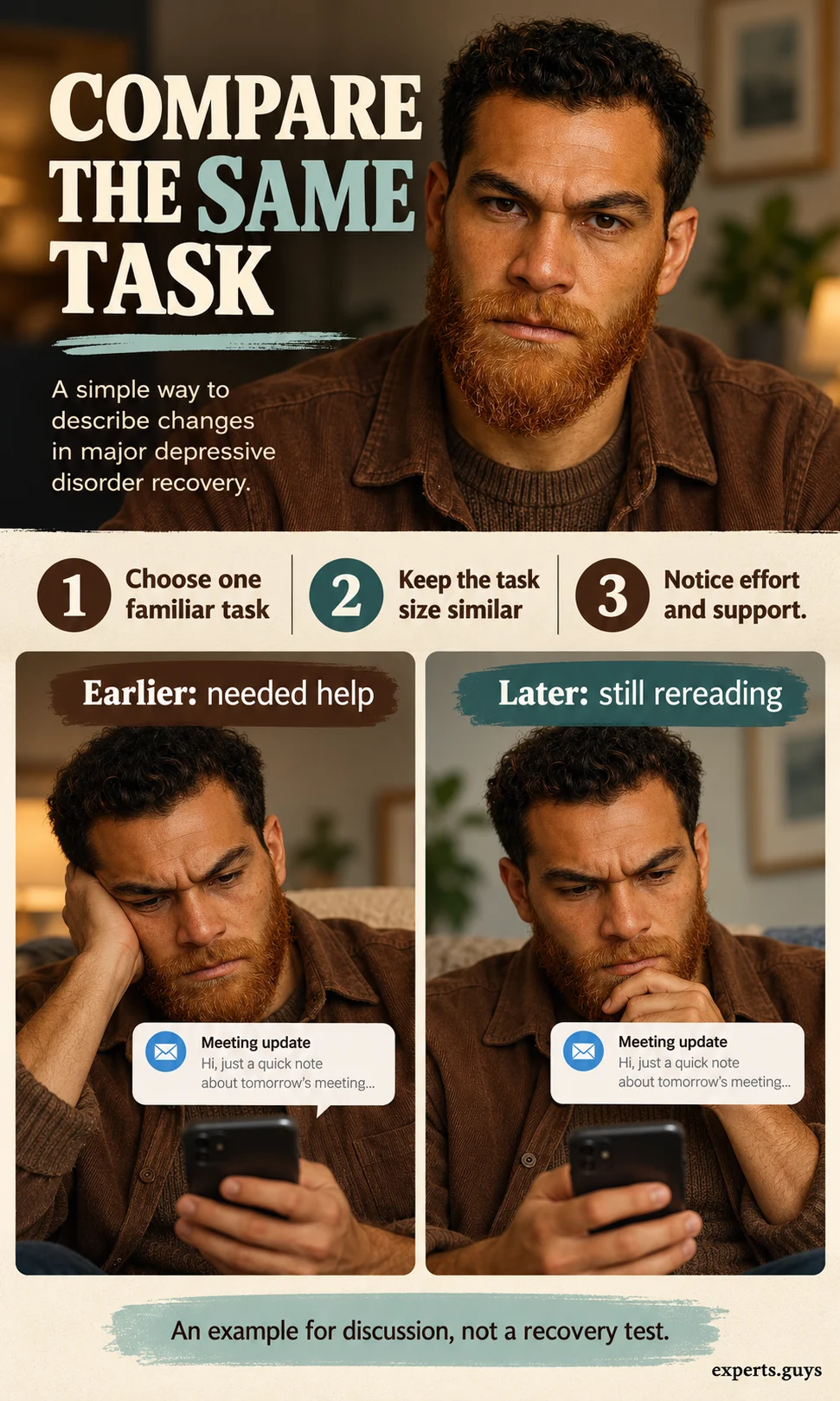
A familiar task can make change easier to describe when your overall impression varies from day to day. Choose something you already encounter rather than creating a daily performance test. The comparison is an informal example for discussion, not a validated measure of recovery.
- Choose one ordinary, low-stakes task, such as reading a short email. Do not use driving, machinery or another safety-critical activity as a test.
- Compare similar versions of that task on ordinary occasions. Notice the effort, rereading or assistance involved; do not force a speed target.
- Tell the clinician whether the task feels easier, unchanged or harder, including any change in the help you receive.
Example: “I can now read the message alone, but deciding how to reply still takes a lot of effort.” Make it workable: Do not compare a quiet morning with an unusually demanding day as though the conditions were identical. If checking makes you anxious, stop comparing and use one recent example instead. Checkpoint: Look for a useful description of function and support needs. A completed task does not establish remission or readiness for full responsibilities.
If memory or concentration is the main unfinished problem, the guide to depression and memory problems explains the symptom in more detail. New or rapidly worsening confusion should not be attributed to depression without assessment. The example you bring should help open that discussion, not close it.
What should a review check before treatment is called unsuccessful?
A review needs to distinguish partial benefit, poor tolerability, interrupted care and a possible mismatch between the treatment and the problem. These situations can lead to different next steps. Calling all of them “treatment failure” loses information that could help the clinician make a better decision.
The NICE adult-depression guideline recommends reviewing how treatment is working between two and four weeks after starting, with closer monitoring where needed. That is a review point, not a universal deadline for recovery or an instruction to wait through worsening symptoms. Your own review schedule should reflect the treatment and your risk.
Separate a longstanding symptom from a new change
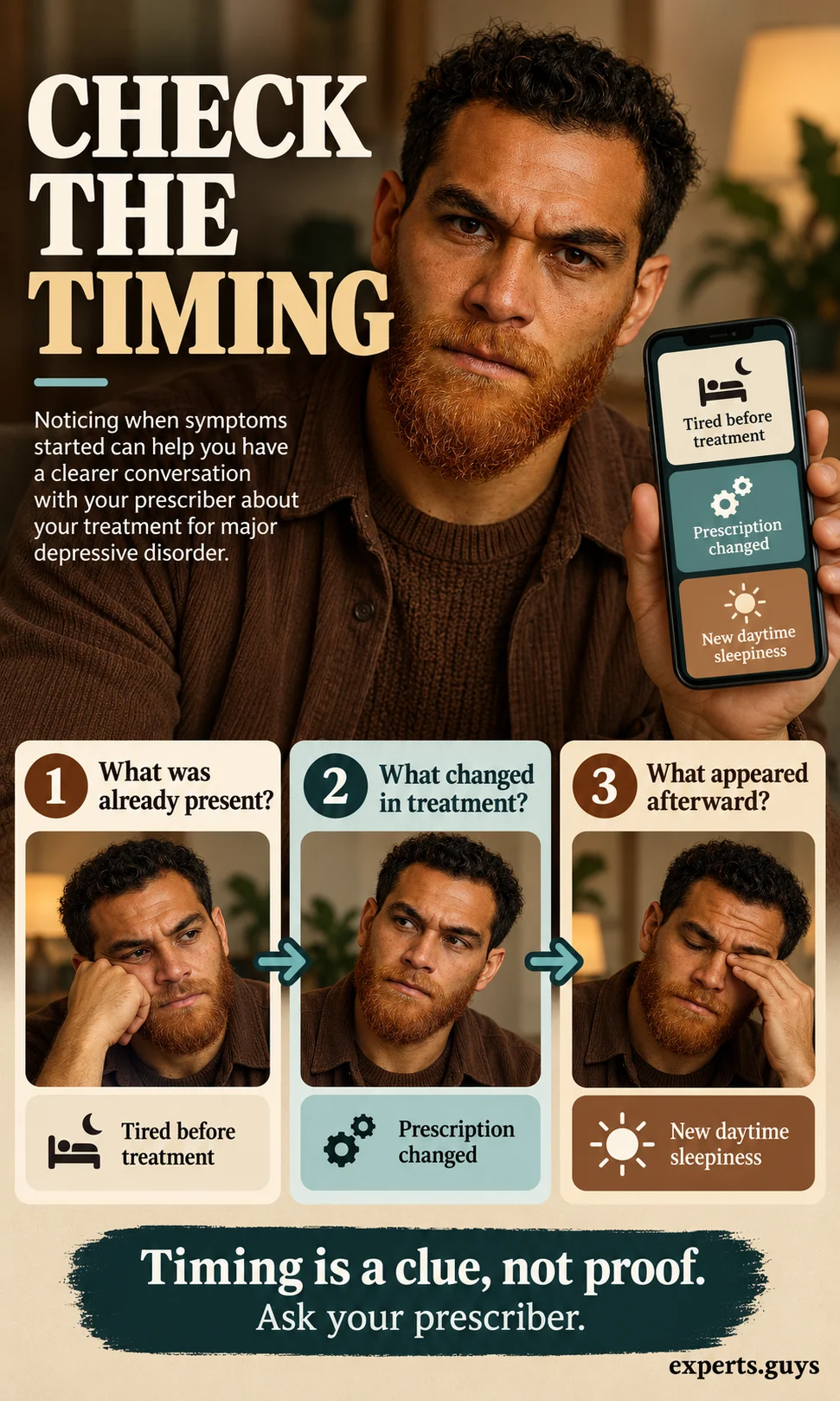
Use timing when a symptom persists or something new appears during treatment. Fatigue, poor concentration and sleep changes can have more than one explanation. A sequence helps the prescriber investigate possibilities, but it cannot establish that a medicine caused the change.
- Identify what was already present before treatment or the most recent change. Approximate timing is acceptable.
- Use your existing prescription or patient-portal history to identify what changed, without guessing a date or dose.
- Explain what appeared afterward and how it affects you. Ask the prescriber or pharmacist whether the change needs prompt review.
Example: “I was tired before treatment; the daytime sleepiness became much stronger after the prescription changed.” Make it workable: Avoid testing the cause by skipping doses or changing the time you take medicine. If dates are unclear, say “before” and “after” and let the care team check the record. Checkpoint: The checkpoint is an agreed response to the symptom, not proof of its cause. Severe agitation, suicidal thoughts or dangerous sleepiness need timely help rather than more observation.
Check what was actually tried before calling treatment a failure
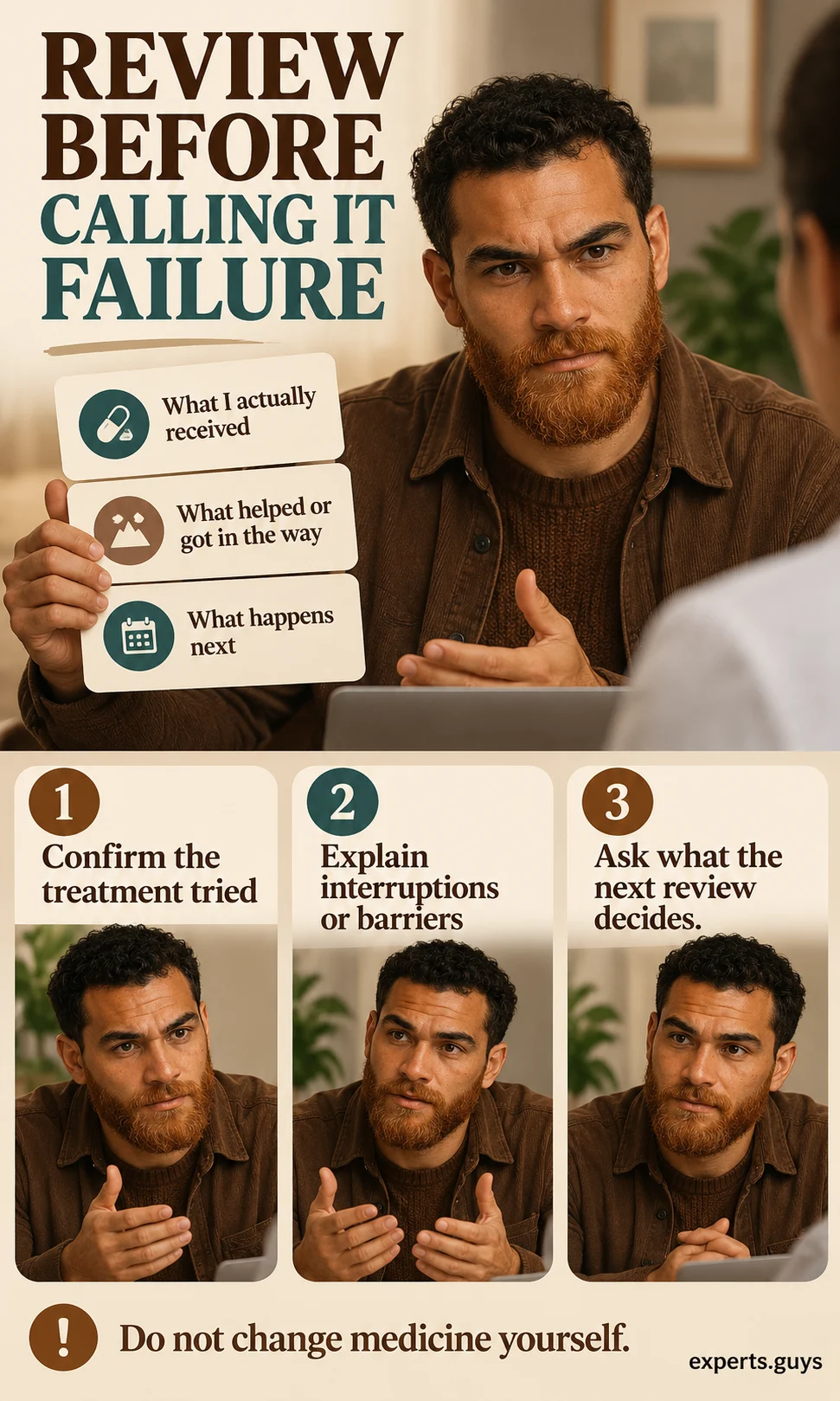
A prescription date does not show how much treatment you received, and a therapy referral does not mean sessions happened. A useful review considers the treatment, its delivery, benefit, difficulties and remaining symptoms. It should also leave room to reconsider the diagnosis or another health problem when appropriate.
- Confirm the treatment actually received: the current prescribed regimen or the sessions attended, using available records.
- Explain interruptions, intolerable effects, missed sessions or practical barriers honestly. These are information for care, not evidence of personal failure.
- Ask what the next review will decide: continue, adapt, investigate another contributor or consider a different treatment with the clinician.
Example: “The referral was six weeks ago, but I have only had one session. What should we assess now?” Make it workable: Do not count time on a waiting list as a completed course of therapy. If details are overwhelming, ask the clinician to check the record with you and correct only what is inaccurate. Checkpoint: You should understand the reason for the next decision and when it will be reviewed. Do not make medication changes from this checklist.
If the question is about using a new prescription correctly, go to starting an antidepressant for the separate first-prescription checks. Here the task is to explain benefit, burden and what was actually received. A label such as treatment-resistant depression requires a clinical review of prior treatment, not a tally of disappointing weeks.
How can care and returning responsibilities become more workable?
Sometimes the unfinished problem lies partly between the person and the plan: appointments are inaccessible, or ordinary demands return faster than support does. Those obstacles need practical changes as well as clinical attention. Removing a barrier does not prove recovery, but it can make agreed care or participation possible.
Resolve one obstacle between the plan and the appointment
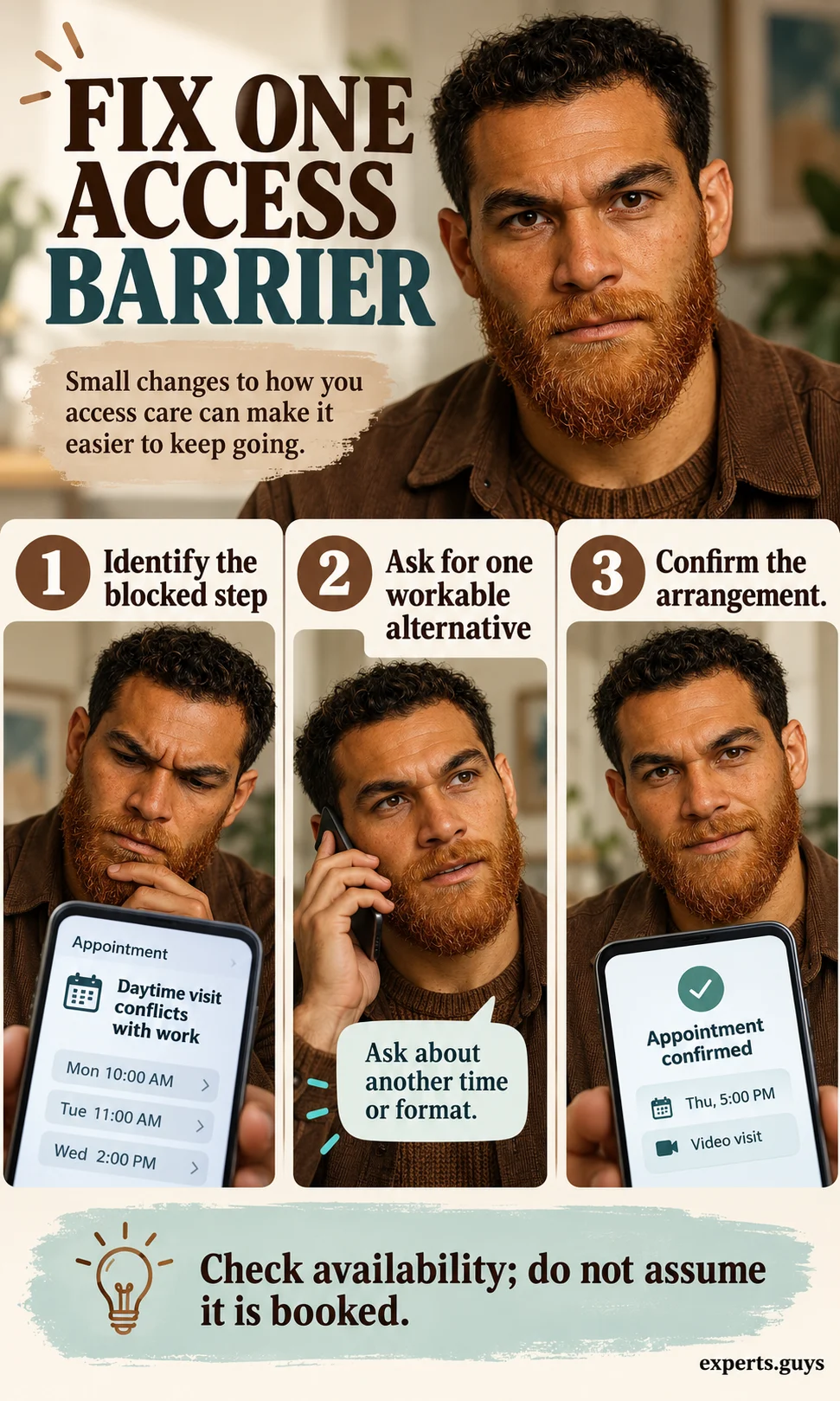
Use this when the recommended care exists on paper but you cannot reliably access it. A barrier such as transport, cost, language or appointment timing can interrupt treatment without saying anything about its potential benefit. Naming the blocked step makes a specific request possible.
- Identify the immediate obstacle: for example, every available appointment conflicts with your work shift.
- Ask the service about one feasible alternative, such as another appointment time, an interpreter or an appropriate remote format. Availability varies.
- Confirm who will arrange the alternative and how you will receive confirmation. A request is not a booking.
Example: “I can attend after my shift. Is another time or a suitable remote appointment available?” Make it workable: Avoid asking yourself to solve the entire healthcare system at once. If making the call is difficult, ask someone you trust to sit with you, or use the service’s approved contact route. Checkpoint: The barrier is addressed when there is a confirmed workable arrangement, or a clear answer that lets you discuss another route. Urgent symptoms should not wait for administrative changes.
Match returning responsibilities to an agreed adjustment
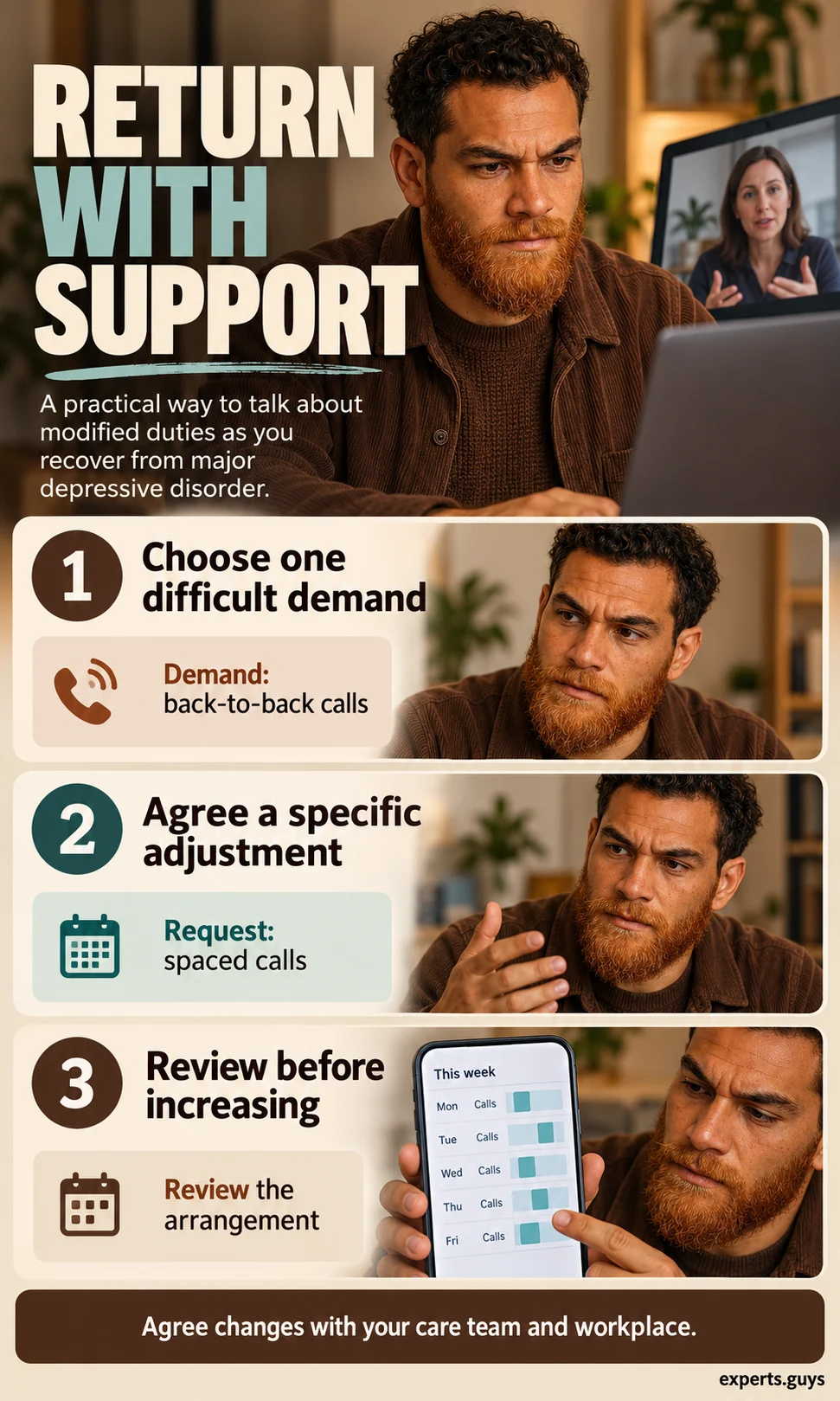
Use this when you are doing more again but a particular demand remains difficult. Returning to work can require changes to the work itself alongside ongoing care. The WHO describes options such as flexible hours, modified assignments and phased return; the suitable arrangement depends on the person and setting.
- Identify one specific demand that is hard, such as back-to-back calls, rather than describing yourself as unable to do everything.
- Discuss a practical adjustment with the relevant workplace contact and your care team where needed. Share only the health information necessary for that conversation.
- Agree when to review the arrangement before increasing the demand. Raise worsening symptoms or safety concerns sooner.
Example: “Could calls be spaced out while I return, with a review of how the arrangement is working?” Make it workable: Do not use one productive day as evidence that all support can end. For unpaid responsibilities, a similar conversation may be possible with a trusted person who can share a specific task. Checkpoint: An adjustment should make participation more manageable without concealing deterioration. This is not a fitness-for-work certificate or a statement of legal entitlement.
The WHO guidance on mental health at work supports combining work adjustments with continuing clinical care. It does not say that every workplace can offer the same arrangement or that returning to work proves symptoms have resolved. Ask what is feasible in your own setting and keep the review focused on the specific demand.
What should stay in place after improvement?
An improved period is a useful time to clarify the next review, continuing care and the response to a familiar warning change. NICE identifies remaining symptoms and previous episodes among factors relevant to relapse risk. Risk factors guide a discussion; they cannot predict with certainty what will happen to one person.
Agree what to do if a familiar warning pattern returns
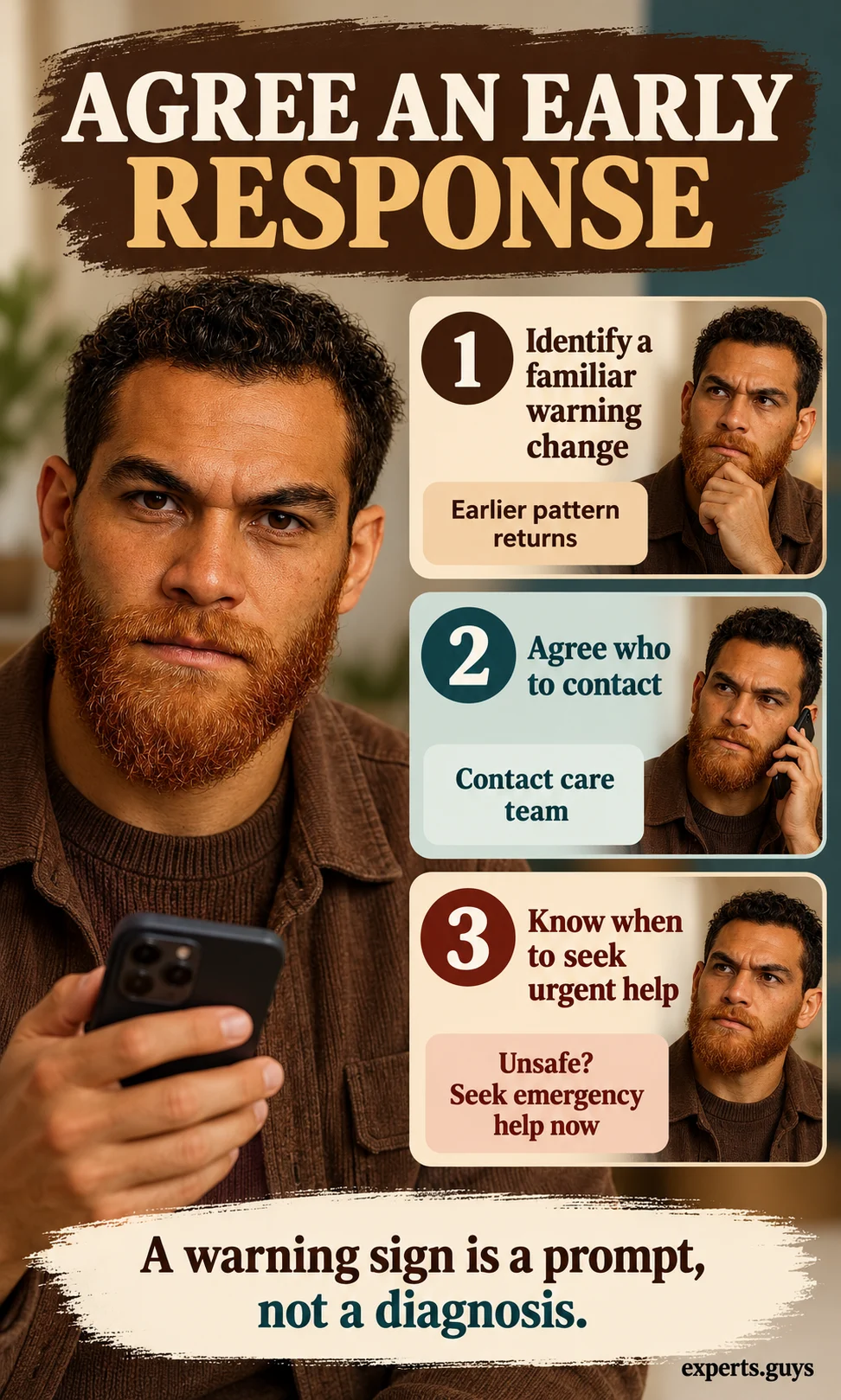
Relapse preparation is most useful when it connects a personally relevant change to an action. An isolated bad day does not establish another depressive episode. Discussing familiar patterns in advance can make it easier to respond when you are less able to organise help.
- With your care team, identify a change that was meaningful in an earlier episode, such as a recognisable pattern of withdrawal or sleep disruption. If this is your first episode, ask which changes to report.
- Agree who to contact, through which route and how soon if the pattern returns or worsens. Save the agreed contact details privately on your phone.
- Confirm a separate urgent route for immediate danger or inability to stay safe. Routine clinic messages may not be monitored promptly.
Example: “If the same withdrawal and sleep disruption return, I will use the contact route we agreed rather than waiting for my next scheduled visit.” Make it workable: Avoid making a long list of every possible feeling to monitor. If you choose to involve a supporter, agree what they can notice and how they should raise it without surveillance. Checkpoint: You can identify the contact and the next action without relying on memory during a difficult period. No warning-sign list can guarantee that relapse will be predicted or prevented.
Review continuing care even when you feel better
Improvement changes the conversation; it does not automatically end treatment. Continuing care may help maintain gains, while burdens or unwanted effects still deserve discussion. For antidepressants, decisions about continuation and eventual reduction should be made with the prescriber.
- Ask what continuing the current care is intended to protect or improve in your situation.
- Discuss benefits, remaining difficulties and unwanted effects, including problems you have been reluctant to mention.
- Agree the next review and who to contact if the balance changes. If stopping is appropriate, ask for an individual plan rather than stopping suddenly.
Example: “I feel better, but this side effect is difficult. Can we review the balance and what my options are?” Make it workable: Do not wait until you have already stopped to mention that treatment feels burdensome. If speaking is uncomfortable, show the clinician one short private message during the appointment. Checkpoint: You leave understanding the current plan and how it can be reconsidered. This section does not supply a taper schedule or require lifelong medication.

The Royal College of Psychiatrists’ guidance on stopping antidepressants explains why sudden stopping can cause withdrawal and why reduction should be individualised. Withdrawal symptoms and a return of depression can overlap, so a change after reducing medicine needs discussion rather than a confident self-diagnosis. For the distinction between persistent symptoms and recurring episodes, see is depression a chronic mental illness?.
Frequently asked questions
Does feeling better mean I am in remission?
Not necessarily. Improvement is a change from where you started; remission is a clinical description of the remaining symptom burden. Ask what the clinician means by the term and whether daily functioning still needs separate support.
Can I have a good day during a depressive episode?
Yes. A good day does not by itself rule out depression or establish recovery. Describe the broader pattern and meaningful changes rather than using the best or worst day as the whole story.
Must I record symptoms every day?
No. These communication steps do not require daily tracking. If recording increases distress or becomes repetitive checking, use one recent example and discuss what kind of monitoring, if any, would be useful.
What if I cannot explain the unfinished problem clearly?
You can start with “something is still difficult, but I cannot describe it well.” Ask the clinician to help you explore a recent situation. A trusted supporter can contribute with your permission, without speaking over you.
Does incomplete improvement mean I will never recover?
No. It means there is still something to assess or address, not that the outcome is fixed. The next step depends on the remaining symptoms, treatment received, tolerability, other health issues and practical circumstances.
Can these steps tell me which medicine to take?
No. They help organise a review and do not select a drug, dose or taper. Bring the question to the prescriber, especially if you are considering changing treatment because of symptoms or unwanted effects.
A useful next step
If recovery feels incomplete, bring one unfinished problem into the next care conversation. Separate what has improved from what remains hard, then ask what decision or support follows from that distinction. Use earlier help for worsening symptoms or safety concerns rather than waiting to complete a record.