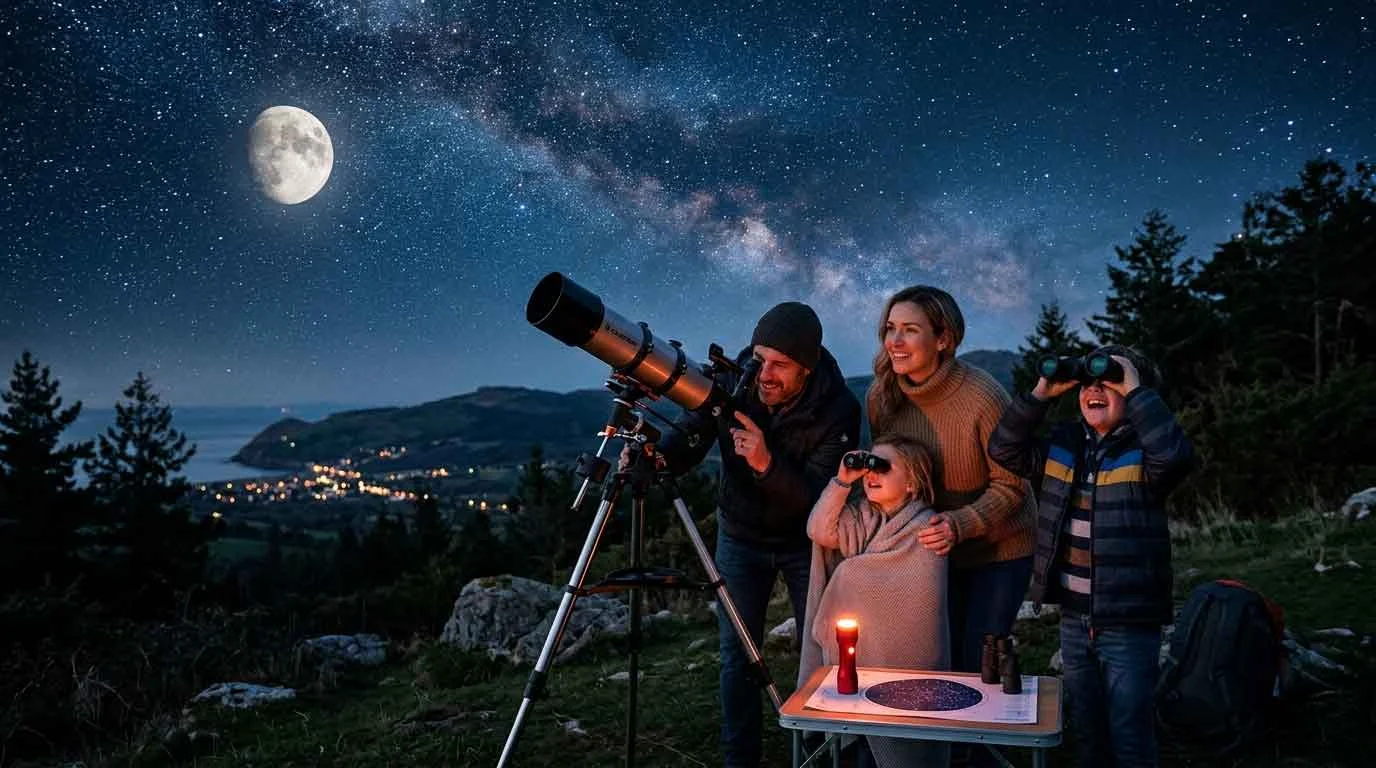

Why Most Families Do Not Enjoy the Night Sky
Most families do not struggle with astronomy because it is complex. They struggle because the experience is undefined.
When a family steps outside and looks up at the night sky, they are not interacting with a system. They are facing an unstructured environment. There is no clear starting point, no feedback loop, and no visible progression.
The sky appears vast but empty. The stars look similar. The distance removes detail. Within minutes, attention drops.
This pattern is consistent across different countries, climates, and cultures. It is not caused by lack of intelligence or curiosity. It is caused by lack of design.
A family of non-astronomers does not need more information about stars. They need a controlled experience that converts observation into engagement.
Without that conversion layer, the night sky remains passive. Passive environments rarely hold attention, especially for beginners.
The Core Mechanism That Creates Enjoyment
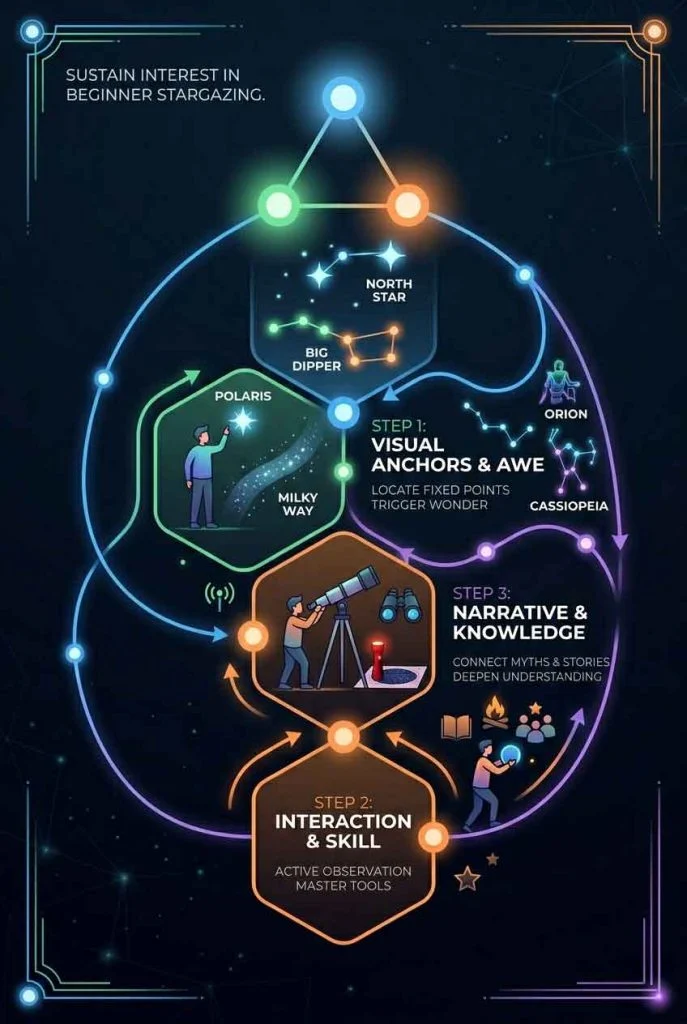
Enjoyment of the night sky is not spontaneous. It is constructed through three interacting mechanisms.
People engage with what they can interact with, not what they can only observe.
1 – Visual Anchoring Mechanism
The human brain requires a clear visual anchor to maintain focus. This is the same underlying principle used when people learn to analyse visual patterns effectively, where structure and contrast guide attention and understanding.
Wide fields of similar light sources do not create engagement. The brain cannot differentiate or prioritize objects. Everything blends into the same category.
An anchor introduces contrast and structure.
Examples of effective anchors:
- The Moon with visible surface detail
- Bright planets such as Jupiter or Saturn
- Recognizable constellations with simple shapes
Without anchors, the sky feels uniform. With anchors, it becomes segmented and readable.
2 – Interaction Mechanism
Attention increases when an action produces a visible result.
If a child adjusts a viewing device and sees a clearer image, the brain registers cause and effect. This creates a feedback loop.
Action leads to outcome. Outcome leads to curiosity. Curiosity leads to repeated action.
Without interaction, observation remains passive. Passive observation does not sustain engagement.
3 – Narrative Mechanism
Objects become meaningful when they are connected to simple explanations.
A star alone is not memorable. A short narrative attached to it creates retention.
The narrative does not need depth. It needs clarity.
For example:
- A bright point becomes more engaging when identified as a planet
- A group of stars becomes recognizable when framed as a pattern
The purpose of the narrative is not education. It is orientation.
Why Knowledge Alone Does Not Work
A common assumption is that families should learn astronomy before attempting observation.
This sequence is ineffective.
Knowledge without direct visual experience does not produce engagement. It creates abstraction without reinforcement.
The correct sequence reverses the process:
- First, create a visible and interactive experience
- Then allow understanding to follow naturally
Gadgets function as the bridge between these two stages.
They convert distant, abstract objects into visible and interactive elements. This transformation reduces cognitive effort and increases immediate engagement.
The Role of Gadgets in Beginner Astronomy
Gadgets are not enhancements. They are entry tools.
Without them, the night sky requires interpretation. With them, the sky becomes observable.
A simple device can:
- Magnify distant objects
- Increase brightness and clarity
- Introduce control through adjustment
This changes the experience from passive viewing to active exploration.
The difference is not incremental. It is structural.
The Real Barriers That Prevent Enjoyment
Understanding these barriers explains why most first attempts fail.
Barrier 1 – Lack of Immediate Results
If a family cannot see something clearly within the first few minutes, engagement declines rapidly.
The brain expects feedback. Without it, attention shifts elsewhere.
Barrier 2 – Undefined Observation Targets
Looking at “the sky” is too broad.
Beginners require specific targets:
- One object
- One pattern
- One visible feature
Without a defined target, observation lacks direction.
Barrier 3 – Equipment Complexity
Many entry-level devices introduce friction instead of removing it.
Complex alignment, unstable mounts, or unclear instructions delay the first result. Delay reduces motivation.
Barrier 4 – Expectation Mismatch
People expect a sky filled with dense stars and vivid colors.
In reality, visibility varies depending on location and conditions. When expectations are not met, interest drops.
The Correct System – Experience First, Knowledge Second
A working system follows a specific order:
Step 1 – Immediate Visibility
The first experience must produce a clear visual result quickly.
The Moon is the most reliable starting point because it is:
- Bright
- Large
- Structurally detailed
Step 2 – Controlled Interaction
Allow users to adjust the viewing device.
Simple actions such as focusing or repositioning create engagement through control.
Step 3 – Single Expansion
Introduce one additional object.
This prevents overload while expanding the experience.
Step 4 – Repeatable Loop
Repeat the process with small variations.
Repetition builds familiarity. Familiarity builds confidence. Confidence sustains interest.
Why This Model Works Globally
This system is not dependent on geography.
Whether the observation happens in a city, suburb, or rural area, the same principles apply:
- Clear visual anchor
- Immediate interaction
- Simple narrative
Environmental differences affect visibility, but they do not change the mechanism.
Why the Right Gadget Changes Everything
A beginner does not fail because the sky is unclear. They fail because their tools do not translate the sky into something visible, controllable, and repeatable.
The correct gadget does not “enhance” the experience. It creates the experience.
For a family of non-astronomers, the device must solve three problems immediately:
- Reduce visual ambiguity
- Provide fast, visible results
- Allow simple interaction without technical friction
Most devices on the market do not meet all three conditions simultaneously. That is why many first-time purchases lead to abandonment.
The Three Gadget Categories That Define the Experience
All beginner stargazing tools fall into three functional categories. Each category activates the engagement mechanism differently.
Category 1 – Binoculars (Fastest Entry Point)
Binoculars are the lowest-friction tool for beginners.
They require:
- No setup
- No alignment
- No technical knowledge
They provide immediate magnification and brightness improvement. This allows users to see:
- The Moon with surface texture
- Star clusters as grouped patterns
- Brighter planets as defined points
The key advantage is speed. A user can pick up binoculars and see a result within seconds.
This satisfies the “immediate visibility” requirement.
However, binoculars have limitations:
- Lower magnification compared to telescopes
- No stable mount unless paired with a tripod
- Limited ability to track moving objects
They are ideal for the first exposure, not long-term exploration.
Category 2 – Beginner Telescopes (Structured Exploration)
A telescope introduces structure and depth.
Unlike binoculars, a telescope creates a focused viewing path. It isolates a single object and magnifies it significantly.
This transforms the sky from a flat field into a layered environment.
A beginner-friendly telescope must meet three conditions:
- Minimal setup steps
- Stable mount
- Clear focusing mechanism
When these conditions are met, the telescope enables:
- Detailed views of the Moon
- Visible planetary features
- Controlled observation sessions
The telescope activates the interaction mechanism more strongly than binoculars. Adjusting focus, repositioning, and switching targets all reinforce engagement.
But this category has the highest failure rate.
The reason is not the device itself. It is the mismatch between product complexity and user expectation.
Category 3 – Smart Astronomy Devices (Guided Experience)
Smart devices represent a newer category.
These tools combine optics with software guidance. They often include:
- Automated object tracking
- Mobile app integration
- Built-in star maps
The key advantage is guidance.
Instead of searching manually, users are directed toward visible objects. This reduces uncertainty and shortens the time to first result.
Smart devices activate all three mechanisms simultaneously:
- Visual anchoring through guided targets
- Interaction through app control
- Narrative through built-in explanations
However, they introduce trade-offs:
- Higher cost
- Dependence on battery and connectivity
- Less manual learning
For families seeking ease rather than technical understanding, this category provides the most consistent experience.
Why Most Beginner Telescopes Fail
The majority of negative experiences come from a specific type of product: low-cost, high-complexity telescopes.
These devices often include:
- Unstable tripods
- Confusing alignment procedures
- Poor optical clarity
They appear attractive due to price, but they violate all three engagement conditions:
- Slow setup delays first result
- Poor stability reduces visual clarity
- Lack of guidance creates frustration
The result is predictable. The device is used once, then stored away.
The failure is not due to astronomy. It is due to poor product design relative to user needs.
The Correct Selection Logic for Families
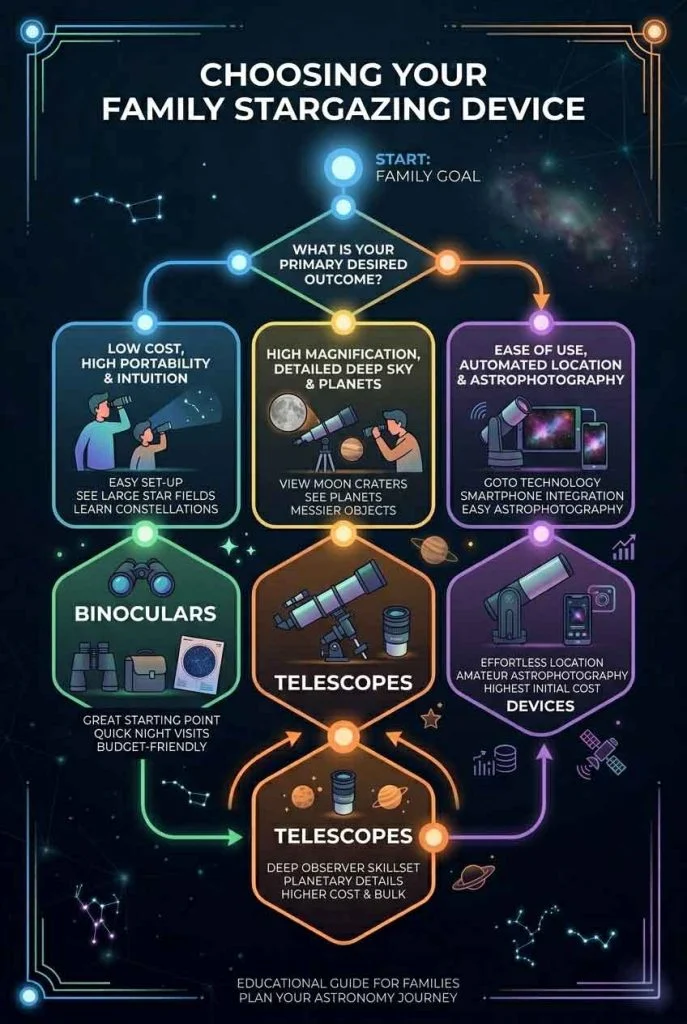
Instead of choosing based on specifications, families should choose based on experience outcomes.
If the Goal Is Immediate Engagement
Choose binoculars.
They provide:
- Instant results
- Zero setup friction
- Easy sharing among family members
This is the fastest way to activate interest.
If the Goal Is Structured Exploration
Choose a beginner-friendly telescope.
It provides:
- Higher detail
- Focused observation
- Repeatable sessions
This builds deeper engagement over time.
If the Goal Is Simplicity and Guidance
Choose a smart astronomy device.
It provides:
- Automated direction
- Reduced learning curve
- Consistent results across sessions
This is the most controlled experience.
The Experience Flow With the Right Gadget
A properly selected device creates a predictable experience flow.
Phase 1 – Discovery
The user sees something clearly for the first time.
This is the most critical moment. It determines whether interest forms or disappears.
Phase 2 – Control
The user interacts with the device:
- Adjusting focus
- Changing position
- Selecting targets
Control increases engagement.
Phase 3 – Expansion
The user explores additional objects.
This expands the experience without overwhelming it.
Phase 4 – Repetition
The process repeats with small variations.
Repetition builds familiarity and confidence.
Common Misconceptions About Stargazing Gadgets
Misconception 1 – Higher Magnification Means Better Experience
Higher magnification does not guarantee better results.
Excessive magnification reduces stability and field of view. This makes it harder for beginners to locate objects.
Clarity and ease of use are more important than raw power. This reflects a broader principle in how people learn to recognize visual patterns clearly, where simplicity often produces faster understanding than complexity.
Misconception 2 – Telescopes Are Always Better Than Binoculars
Telescopes provide more detail, but they also introduce complexity.
For first-time users, binoculars often create a better initial experience because they deliver immediate results.
Misconception 3 – Expensive Devices Guarantee Engagement
Cost does not determine engagement.
A well-matched simple device can outperform a complex expensive one if it produces faster results and easier interaction.
Why Most Stargazing Attempts Fail in the First 10 Minutes
The first 10 minutes determine whether the entire experience succeeds or collapses.
If nothing clear is seen quickly, attention drops. If the process feels uncertain, confidence disappears. If there is no structure, the session ends without engagement.
Most families unknowingly follow this pattern:
- Step outside
- Look around randomly
- Try to identify something
- Give up after a few minutes
This sequence lacks direction, feedback, and progression.
A successful system must reverse this pattern by designing the first 10 minutes with precision.
The 10-Minute Engagement System (Repeatable Framework)
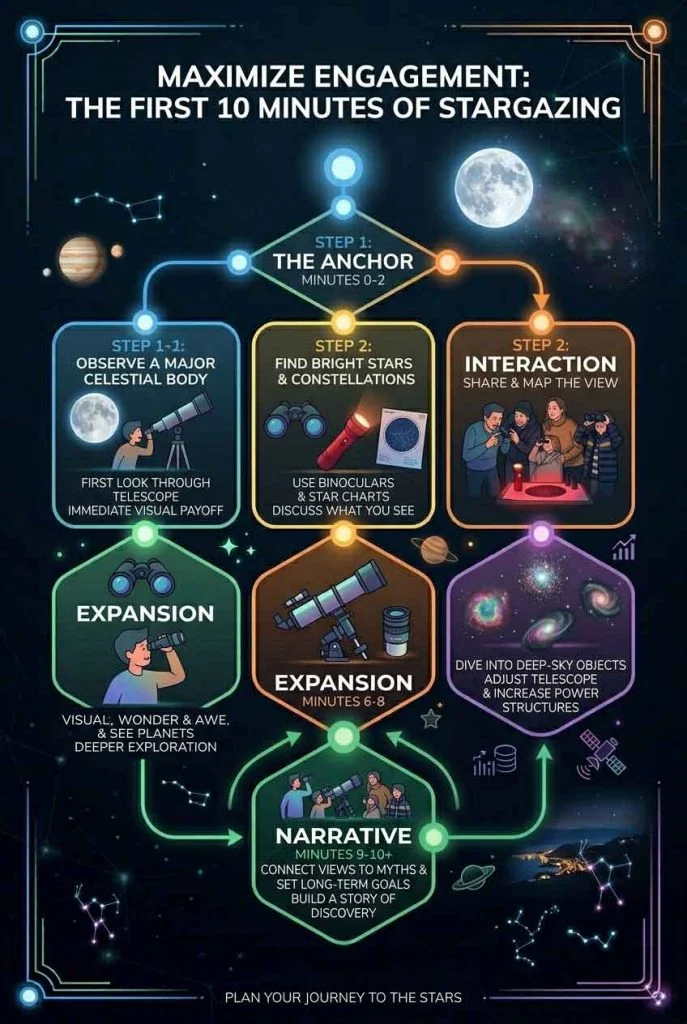
This system is built to produce a visible result quickly and establish a repeatable loop.
Minute 0–2 – Immediate Anchor Setup
The first action is not searching. It is positioning.
Select a single, guaranteed visible object:
- The Moon (primary choice)
- A bright planet (secondary choice)
The goal is certainty. There should be no ambiguity about where to look.
Position the gadget before handing it to others. This removes friction and prevents early confusion.
The first viewer should see a clear image within seconds.
This moment establishes the experience.
Minute 2–5 – Controlled Interaction
Once the first object is visible, the next step is interaction.
Allow each person to:
- Adjust focus slightly
- Reposition the device
- Reconfirm the object
This creates ownership of the experience.
The key is not teaching. It is allowing small actions that produce visible results.
This activates the interaction mechanism and strengthens engagement.
Minute 5–7 – Introduce One New Target
After the first object is confirmed, introduce a second target.
The selection should follow two rules:
- It must be visible without complex searching
- It must be different from the first object
For example:
- After the Moon, introduce a bright planet
- After a planet, introduce a simple constellation
The purpose is contrast.
Contrast prevents monotony and maintains attention.
Minute 7–10 – Narrative Layer Activation
At this stage, introduce simple explanations.
Keep narratives short and clear:
- Identify the object
- Provide one distinguishing feature
- Avoid technical detail
The narrative should support what is already visible.
This transforms observation into understanding without overwhelming the audience.
The Family Engagement Loop
Once the first 10 minutes are successful, the experience enters a loop.
Step 1 – Observe
View a clear object.
Step 2 – Adjust
Allow interaction with the device.
Step 3 – Identify
Attach a simple narrative.
Step 4 – Switch
Move to a new target.
This loop can repeat indefinitely with small variations.
Each cycle reinforces familiarity and builds confidence. This follows the same principle used when people build consistent habits effectively, where repetition and small actions create long-term engagement.
How to Maintain Attention Across Different Age Groups
Different age groups respond to different aspects of the experience.
Younger Children (Short Attention Span)
Focus on:
- Immediate visual results
- Frequent switching between targets
- Hands-on interaction
Avoid:
- Long explanations
- Waiting periods
Teenagers (Exploration-Oriented)
Focus on:
- Control of the device
- Independent target selection
- Simple challenges
Example:
- “Find the brightest object you can see”
This introduces autonomy.
Adults (Context-Oriented)
Focus on:
- Understanding what is being observed
- Connecting objects to broader concepts
- Structured progression
Adults often sustain engagement through meaning rather than novelty.
The Role of Environment in the Experience
The environment influences visibility but does not determine success.
Even in less ideal conditions, the system can function if:
- The first object is clearly visible
- The gadget provides sufficient clarity
- The sequence is maintained
The mistake is waiting for perfect conditions.
Perfect conditions are not required for engagement. Structure is.
What to Say During the Session (Narrative Scripts)
Providing consistent phrasing reduces uncertainty.
For the First Object (Moon)
“This is the Moon’s surface. The darker areas are plains, and the brighter parts are elevated regions.”
For a Bright Planet
“That bright point is a planet. It looks like a star, but it does not twinkle in the same way.”
For a Constellation
“These stars form a pattern that people have recognized for generations.”
These scripts are intentionally simple. Their purpose is orientation, not depth.
Common Execution MistakesMistake 1 – Trying to Show Too Many Objects
Introducing multiple targets too quickly creates confusion.
Beginners require clarity, not variety.
Mistake 2 – Overexplaining
Long explanations reduce attention.
The experience should remain visual and interactive.
Mistake 3 – Delayed First Result
If the first clear image takes too long, engagement drops before it begins.
Mistake 4 – Lack of Turn-Taking
If only one person controls the device, others disengage.
Shared interaction is essential.
Expertise Reinforcement – Limitations of the System
No system guarantees universal success.
Certain limitations remain:
- Weather conditions can reduce visibility
- Urban lighting can limit object clarity
- Equipment quality affects outcomes
However, these limitations do not eliminate engagement. They only influence the range of visible targets.
The system remains valid because it focuses on structure rather than conditions.
Why Interest Drops After the First Few Sessions
Even when the first experience succeeds, many families stop after two or three sessions.
This is not caused by loss of curiosity. It is caused by lack of progression.
The initial sessions provide novelty:
- First clear view of the Moon
- First interaction with a device
- First recognition of a pattern
Once these are achieved, the experience becomes repetitive if no new layer is introduced.
Without progression, the brain no longer receives new signals. Engagement declines.
Sustaining interest requires controlled expansion, not random variation.
The Expansion Model – How to Scale the Experience
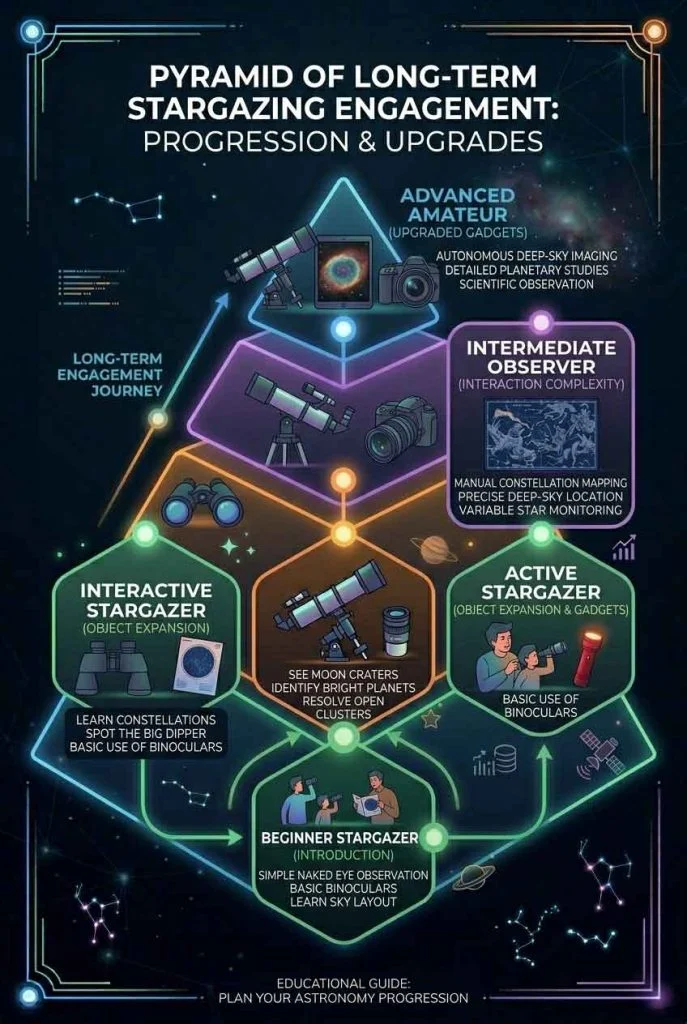
Long-term engagement depends on introducing new elements in a structured way.
Layer 1 – Object Expansion
After initial sessions, increase the range of observable targets.
Introduce:
- Different lunar phases
- Additional visible planets
- Brighter deep-sky objects
Each new object should still meet the core rule:
- It must be visible without excessive searching
This maintains the feedback loop.
Layer 2 – Observation Depth
Instead of adding more objects, increase detail within the same object.
For example:
- Observe different regions of the Moon
- Compare brightness of stars
- Notice subtle differences in appearance
This shifts the experience from discovery to analysis.
Layer 3 – Interaction Complexity
Gradually introduce more control over the device:
- Fine focus adjustments
- Manual tracking
- Target selection
This increases user involvement without overwhelming beginners.
Gadget Upgrade Path – When and Why to Upgrade
Upgrading equipment should follow experience milestones, not time.
Stage 1 – Initial Exposure
Use:
- Binoculars or simple telescope
Goal:
- Create first successful experience
Stage 2 – Consistent Engagement
Upgrade to a more stable telescope and better optical clarity improves viewing quality and reduces frustration. This reflects how users learn to understand visual clarity differences, where clearer visuals directly enhance perception, comparison, and recognition of detail.
Goal:
- Improve viewing quality and reduce frustration
Stage 3 – Guided Exploration
Introduce:
- Smart astronomy devices or tracking systems
Goal:
- Expand observable range with minimal effort
Upgrading too early introduces unnecessary complexity. Upgrading too late limits progression.
The correct timing aligns with user confidence.
The Role of Digital Tools in Modern Stargazing
Digital tools extend the experience beyond physical observation.
They provide:
- Object identification
- Guided navigation
- Visual overlays
These tools reduce uncertainty and support the narrative mechanism.
However, they should not replace direct observation.
The primary experience remains visual and interactive. Digital tools act as support layers.
Creating a Repeatable Weekly System
Consistency transforms occasional activity into sustained engagement.
Step 1 – Fixed Time Window
Select a consistent time each week.
Predictability reduces decision fatigue and increases participation.
Step 2 – Predefined Targets
Choose targets before the session begins.
This removes uncertainty and speeds up execution.
Step 3 – Role Rotation
Assign roles:
- Device operator
- Target identifier
- Observer
Rotating roles increases involvement across all participants.
Step 4 – Session Limitation
Limit sessions to a manageable duration.
Short, consistent sessions maintain interest better than long, infrequent ones.
Avoiding the Most Common Drop-Off Triggers
Trigger 1 – Repetition Without Variation
Repeating the same observation without change leads to disengagement.
Introduce small variations in each session.
Trigger 2 – Increasing Complexity Too Quickly
Adding advanced techniques too early creates friction.
Complexity should follow confidence, not curiosity.
Trigger 3 – Loss of Interaction
If interaction decreases, engagement follows.
Ensure each session includes active participation.
Trigger 4 – Lack of Progression
Without visible improvement or expansion, the experience feels stagnant.
Progression must be intentional.
Expertise Reinforcement – Limits and Trade-Offs
Even with structured progression, certain constraints remain.
Limitation 1 – Environmental Conditions
Cloud cover, atmospheric clarity, and light pollution affect visibility.
These factors cannot be controlled, only managed.
Limitation 2 – Device Constraints
Each device category has inherent limitations:
- Binoculars – limited magnification
- Telescopes – setup complexity
- Smart devices – dependency on technology
Understanding these trade-offs prevents unrealistic expectations.
Limitation 3 – Attention Variability
Different individuals maintain attention differently.
The system must remain flexible to adapt to varying engagement levels.
FAQs
Do beginners need a telescope to enjoy the night sky?
No. Binoculars can provide immediate results and are often more suitable for first-time users because they require no setup and deliver quick visual feedback.
What is the best object to start with for family stargazing?
The Moon is the most reliable starting point because it is bright, large, and shows clear surface details even with basic equipment.
Why do most beginner telescopes fail to engage users?
Many beginner telescopes introduce complexity through unstable mounts and difficult alignment, delaying the first visible result and reducing engagement.
How long should a family stargazing session last?
Short, structured sessions are more effective than long ones. A 10 to 20 minute session with clear targets and interaction can maintain attention better than extended viewing.