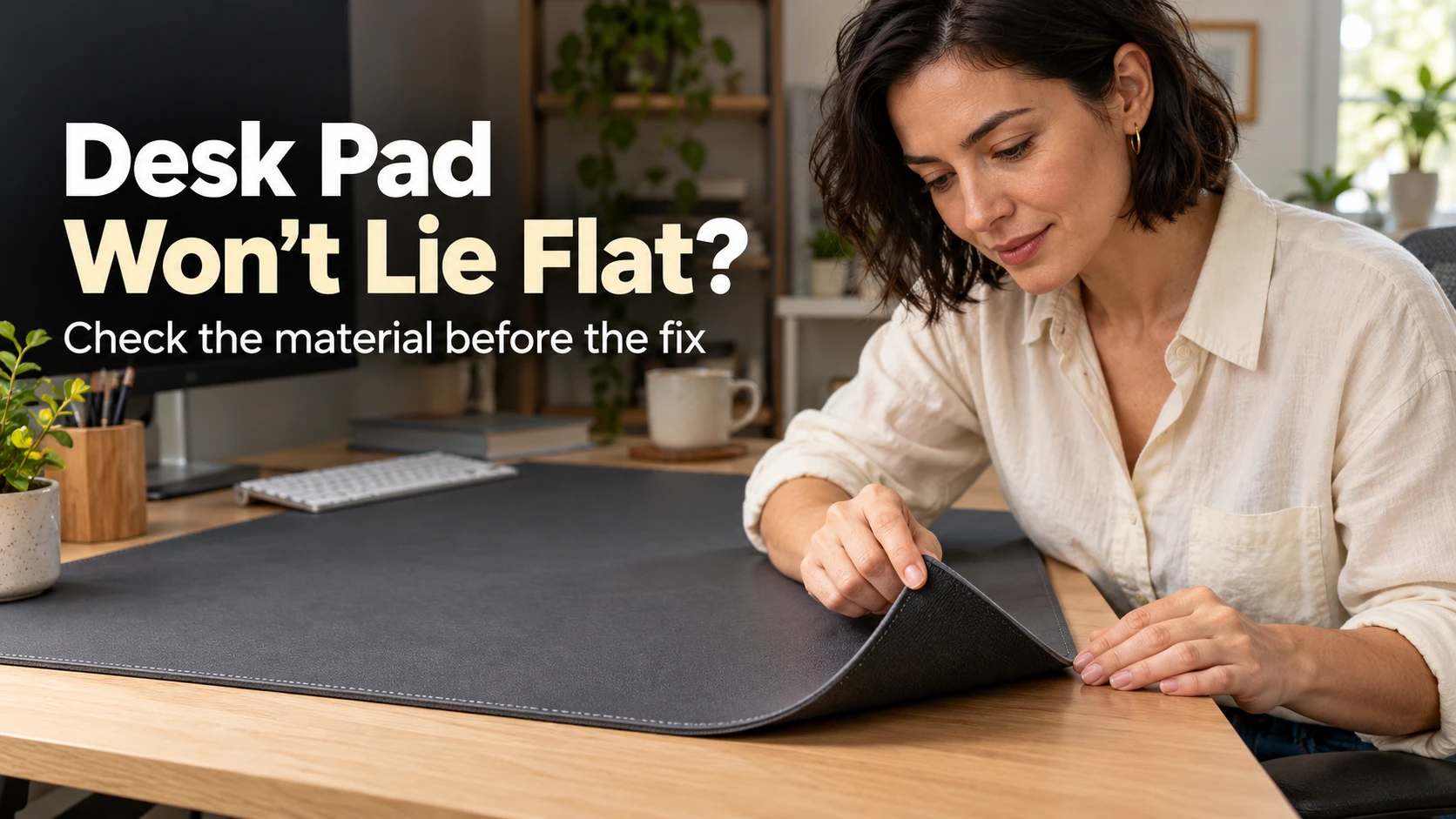
A new desk pad often will not lie flat because it has retained the curve of its shipping roll. For an intact, flexible mat, start with a clean, dry surface and gentle, evenly spread weight if its care instructions allow it; skip heat until you know exactly what the maker permits. A crack, peeling layer, or rigid illuminated edge needs a different response from a smooth packaging curl.
Check the product label or order listing before changing the mat’s shape. “Vegan leather” describes an alternative to animal leather, but does not tell you every coating, backing, adhesive, or edge construction. If the material is unclear, treat it as an unknown coated mat and ask the seller for its flattening instructions.
Match the symptom to the first safe action
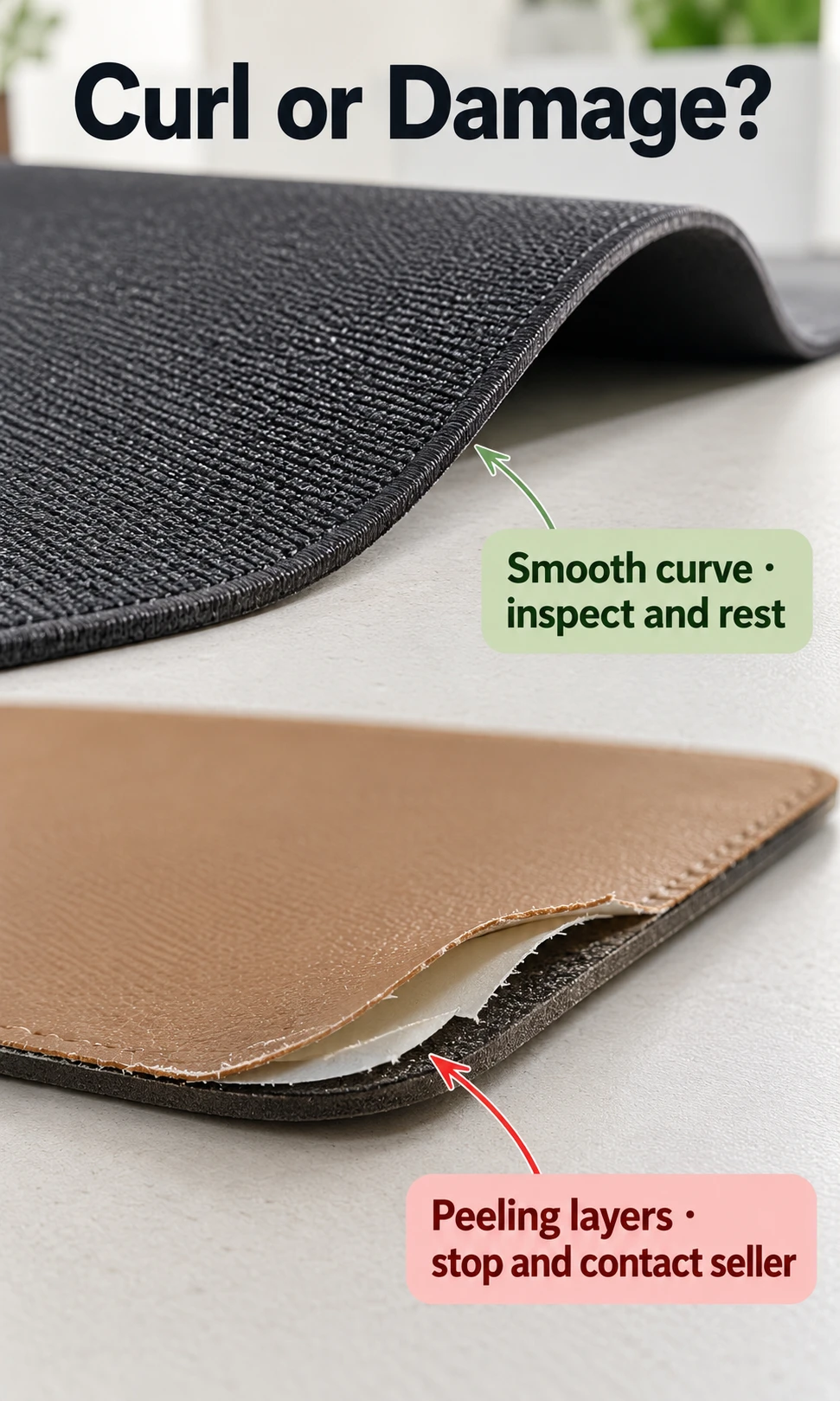
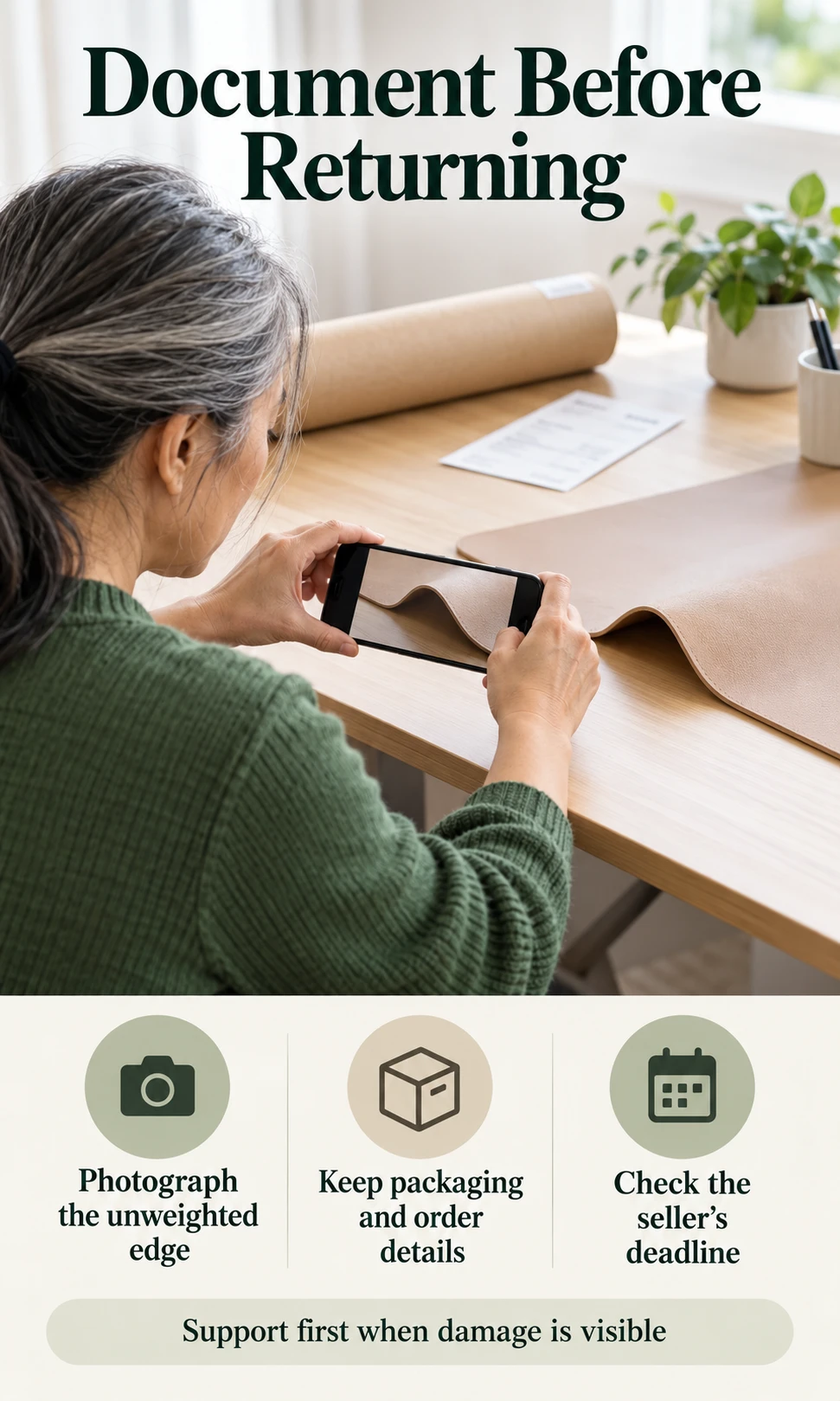
Look at the pad without pulling or forcing a corner down. A broad, smooth curve on a newly unrolled mat is consistent with packaging, while a sharp fold or separating surface suggests damage that resting alone may not resolve. Photograph the mat now so you have an arrival record before trying a remedy.
| What you see | What to check | First action |
|---|---|---|
| Smooth curl straight from the box | Was it rolled? Is the surface and backing intact? | Check care instructions; allow flat rest and gentle weight where permitted. |
| Sharp crease, split, or peeling edge | Is the finish broken or are the layers separating? | Stop bending it. Photograph the damage and contact the seller. |
| Edges lift after the mat was flat | Has its position, moisture exposure, or nearby heat changed? | Remove the possible exposure and inspect the underside. |
| Hard pad is bowed or cracked | Is this rigid plastic, glass, or another non-flexible construction? | Do not reverse-roll it; request product-specific support. |
| RGB border, charging area, or fixed rail | Are cables, seams, or rigid parts carrying the strain? | Disconnect power and follow the model’s setup instructions. |
Why a rolled desk mat keeps its curve
A mat held in a roll can continue to curve after you unpack it. The visible bend may involve the surface, the backing, or both, so two pads with similar colors can respond differently to the same treatment. Check the direction of the curve and the condition of each layer rather than assuming the surface material explains everything.
A fabric top does not make the whole pad safe to iron. Many cloth desk mats also have a rubber base, bonded layers, or stitched edges, and those components change what the product can tolerate. A glossy patch, new ripple, or opening seam after a treatment is a reason to stop, even if the original corner looks flatter.
Manufacturer instructions illustrate why a universal fix is unreliable. Native Union’s desk-mat care guidance allows reverse-rolling and weighted flattening for its own polyester-and-polyurethane product. That permission belongs to that construction; it is not approval to bend every mat sold as faux leather.
Fix it in this order
Start with the least intrusive step and inspect the pad between attempts. Keep the packaging, order details, and return deadline available while you work, because repeated home remedies can make an arrival problem harder to document. If the maker gives a specific method or settling period, use that ahead of the general checkpoints below.
Prepare a flat, dry surface
Remove the keyboard, mouse, and loose objects, then check whether the desk itself is level and free of crumbs or cable bulges. Let any recently cleaned surface dry before putting the pad back. If the pad’s underside is damp, follow its drying instructions instead of trapping moisture under a stack of books.
Place the pad in its normal working orientation and let it rest away from direct sunlight or a heater. A clean tabletop is usually more useful than a soft bed, which can hide the remaining bend. Check the desk’s finish too: a rubber or coated backing should not be left pressed against a surface that its manufacturer says is incompatible.
Use broad, gentle weight where permitted
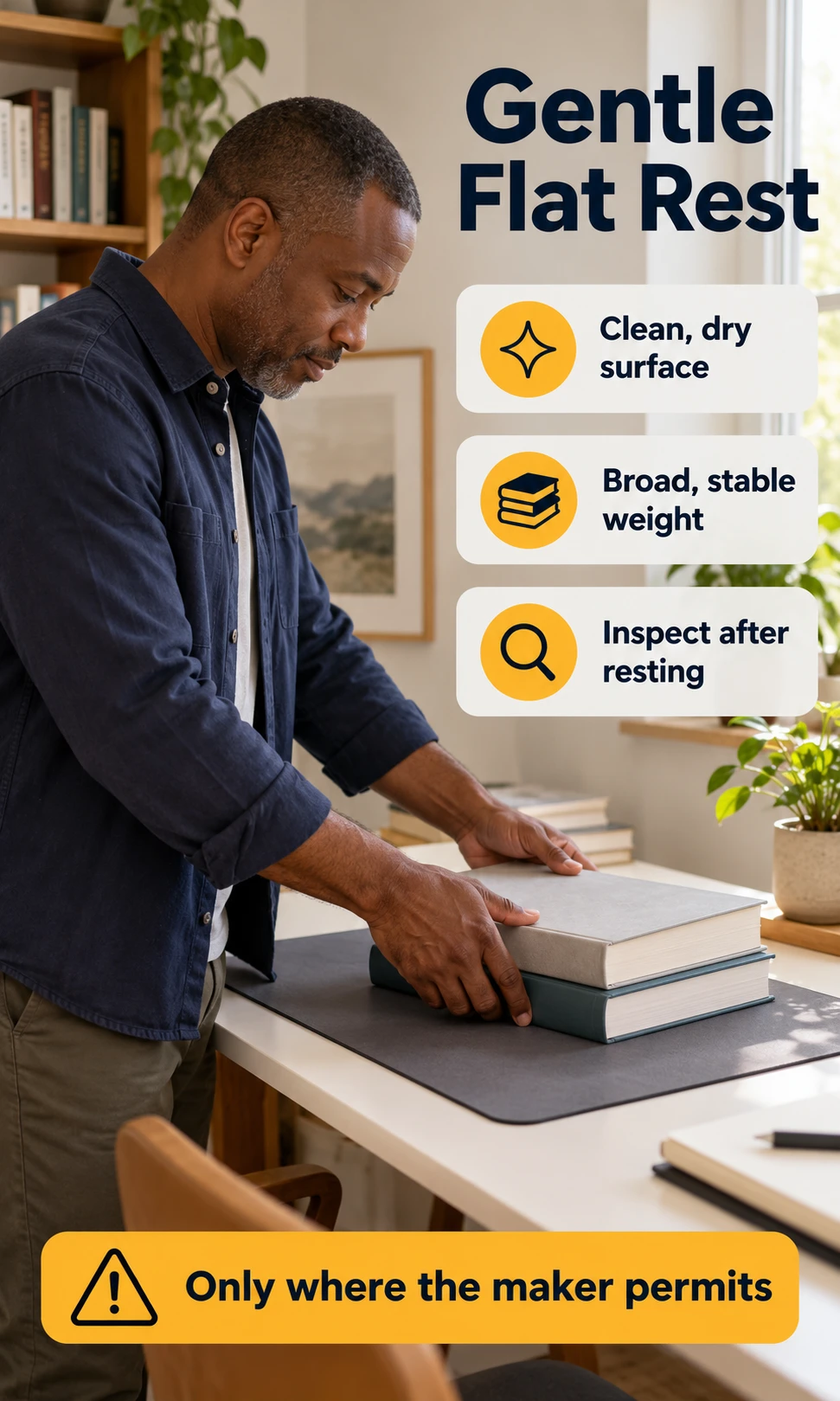
Choose clean, flat books or a smooth board that distributes pressure over the curled area. Avoid narrow weights, sharp edges, colored covers that might transfer dye, and unstable stacks. The aim is steady contact across the curve, not enough force to crush a seam or mark the coating.
- Record the starting condition: take one overhead photo and one low side view of the affected edge.
- Leave it undisturbed: use the maker’s settling period; if none is given, check progress after about 24 hours.
- Inspect without the weights: compare the same corner from the same angle and look for surface marks or separation.
- Reassess by about 48 hours: if there is no useful improvement, contact support rather than escalating pressure or heat. These are editorial checkpoints, not a guaranteed flattening time.
Reverse-roll only when the maker permits it
If the pad remains intact and its instructions allow reverse-rolling, use a broad, loose counter-curve. Do not fold it, squeeze the roll flat, or force a tighter radius than the product’s instructions allow. Stop immediately if the finish whitens, the seam strains, or the movement produces a sharp crease.
Some designs have a rail or layered organizer that needs its own setup sequence. Orbitkey’s flattening instructions, for example, address its toolbar construction. Follow that model’s demonstration rather than copying its bending step onto an unrelated desk pad.
Skip irons, steam, and improvised heating
Do not use an iron, steam cleaner, hairdryer, heat gun, hot water, or sunlight as a default flattening method. Heat and moisture tolerance depends on the complete construction, including the backing and bonded edges, and a fabric surface alone is insufficient permission. A towel over the mat does not establish a safe temperature for an unknown coating.
If the maker explicitly authorizes a heat-based method, follow its exact equipment, temperature, exposure, and protection instructions. This guide does not supply a universal heat setting because the sources do not establish one. If you cannot find those instructions, leave heat out of the process and ask support.
If the edges lift after the pad was flat
A mat that was usable for weeks and then starts lifting deserves a new inspection. Check whether it moved closer to a window, heater, monitor exhaust, or spill, and whether the underside is damp or visibly distorted. Timing can help you locate a possible exposure, but it cannot prove which material changed shape.
Natural leather can respond to its environment. Grovemade’s leather-pad care guidance notes that changing humidity can cause some warping in its leather pads. That is a product-specific explanation to consider, rather than a reason to diagnose every curled polyurethane mat as a humidity problem.
Move the mat to a stable, dry position, allow manufacturer-approved rest, and compare the same edge after the exposure is removed. If a ridge remains between layers, a corner repeatedly springs back, or the underside no longer appears intact, stop treating it as uncomplicated shipping curl. The seller is better placed to distinguish a construction issue from a normal settling period.
| Construction | Conservative approach | Avoid without explicit permission |
|---|---|---|
| Cloth with rubber backing | Dry flat rest; evenly spread weight if allowed. | Ironing, steam, aggressive washing, tight counter-rolling. |
| PU or other coated vegan leather | Check both sides and edge seams; use the model’s care method. | Solvents, soaking, direct heat, forced creases. |
| Natural leather, felt, or cork | Use the exact material-care instructions; watch environmental changes. | Assuming coated-mat cleaning or bending rules apply. |
| Rigid pad or electronics-bearing border | Keep rigid parts unstressed; contact model support. | Reverse-rolling, pressing components, treating a crack as curl. |
| Unknown material | Identify the product before attempting a remedy. | Any treatment that depends on knowing the coating or backing. |
What to do if a treatment leaves a shiny patch
Stop the treatment and photograph the new mark under ordinary light. A change in sheen can signal that the finish has changed, but a photograph alone cannot establish whether the coating, texture, or another component is responsible. Do not try to disguise it with polish, alcohol, oil, or a hotter second pass.
Tell support what you used and how long you applied it, including whether the patch appeared after pressure or heat. Keep the original arrival photos separate from the later images so the sequence is clear. This article includes no measured heat-damage experiment; the illustrations show checks and warning signs, not photographs of a tested product.
When to contact the seller or return it
Contact the seller promptly for a crack, peeling layers, a sharp permanent-looking fold, damaged wiring, or a mat that cannot be used normally. An intact pad with no progress after a reasonable approved settling attempt also merits support, especially if its return deadline is near. The 48-hour checkpoint here is a reminder to reassess, not a legal definition of a defect or a universal warranty rule.
- Gather evidence: keep arrival, 24-hour, and 48-hour photos where available, plus the order number and packaging.
- Describe use: explain whether the keyboard rocks, the mouse catches the edge, or the pad repeatedly curls after being laid flat.
- Ask for a specific remedy: request the model’s flattening method, replacement criteria, or return route.
- Check the actual policy: seller terms and local consumer rights vary; do not assume a return or warranty outcome.
Use the seller’s own damaged-item process. Grovemade’s return and damage guidance, for instance, directs buyers to contact support about damaged or defective items. Keep any instruction you receive in writing before trying a remedy that goes beyond the published care notes.
Choose your next step with Desk Pad Flat Check
Select the construction, when the lifting began, the visible condition, and the result of any approved rest attempt. Desk Pad Flat Check returns a cautious next action and a printable summary of those selections. It cannot inspect a coating, identify a defect, or decide warranty coverage; uncertain materials and visible damage are routed to support.
Keep the workspace decision separate from the fix
Flatten the pad before deciding whether the desk needs more accessories. A rocking keyboard or catching mouse can make an otherwise suitable setup feel wrong, and buying another device will not resolve an uneven surface. Once the pad is usable, compare accessories against your actual workflow in Best Gadgets for Content Creators.
If the desk is also used for drawing or hands-on work, a smooth writing surface may matter more than its appearance in a setup photo. Check that paper stays supported and that the mat’s thickness suits your task before replacing it. For the broader accessory decision, see Top Useful Gadgets for Starving Artists; that guide has a different job from diagnosing a curled pad.
Frequently asked questions
How long does a rolled desk pad take to lie flat?
The settling time depends on its material, construction, and packaging. Follow the maker’s instructions; if none gives a time, use 24 hours as a first inspection and about 48 hours as a support checkpoint after a permitted flat-rest attempt. Those intervals are not a promise that every mat will flatten.
Can you iron a desk mat?
Do not iron a desk mat unless its manufacturer explicitly provides an ironing method for that exact product. Cloth on top may conceal a rubber base, adhesive, or edge component with different heat limits. A towel does not make an unknown construction safe to iron.
Will a desk pad flatten on its own?
Some flexible mats relax with normal flat rest after unrolling. Check the product’s setup instructions and compare the unweighted edge over time. Persistent lifting, a sharp fold, or separating layers should be referred to the seller rather than left indefinitely.
Why do desk-mat edges curl after a month?
Check for a change in sunlight, nearby heat, moisture, or where the mat sits. Some materials can warp with environmental changes, but timing alone does not establish the cause. Inspect the backing and seams and contact the maker if lifting returns or the layers separate.
Will water ruin a vegan-leather desk pad?
Water resistance and cleaning instructions vary by product. Use only the maker’s permitted cleaning method, dry it as instructed, and avoid soaking or using water as a flattening treatment. A leather-like appearance does not establish whether the backing or bonded edges tolerate moisture.
Is a curled desk pad defective?
A smooth packaging curl alone does not prove a defect. Visible damage, unusable persistent lifting, or separation between layers is a reason to contact the seller with photos. The seller’s policy and applicable consumer rights determine the remedy; this guide cannot decide coverage.
The practical next step
An intact rolled mat earns a cautious settling attempt that respects its construction. Check progress without the weights, stop if the finish or edges change, and use the seller’s instructions before trying anything more aggressive. If the pad stays unusable or the return window is closing, documentation and support are the next useful steps.