
Hospitality event staffing works best when the team is planned around the work happening at the same time: arrival, service, transitions and close. Start with defined posts, required skills and handovers, then agree who covers them. A single guest count cannot tell you whether a registration desk, service station and clearing task can share the same person.
This guide is for organisers coordinating a temporary event team with a venue or provider. It is not a ranking of agencies or a universal staffing-ratio chart. The aim is to make the work visible before the event, so a booking request can distinguish real coverage from a headcount that looks sufficient only on paper.
Map the service before ordering the team
Describe the guest journey and the supporting work in time order. A conference might begin with a concentrated registration period, move into refreshments, then need a room reset while some guests still need assistance. A wedding or reception has a different pattern. Use your actual programme rather than assuming a standard sequence.
For each phase, identify what must stay open, what can move and who makes the transition decision. If a desk remains active when meal service begins, its coverage has not disappeared simply because the programme has advanced. This is the first useful check against counting one person in two places at once.
| Phase | Examples of posts to define | Handover question |
|---|---|---|
| Before guests arrive | Setup support, service preparation, briefing attendance | Who confirms the area is ready and the team briefed? |
| Arrival | Entry guidance, registration, queue support | Which posts remain open when service starts? |
| Service | Defined service stations, clearing, replenishment, guest assistance | Who owns each task and who answers an exception? |
| Reset or transition | Room reset, clearing and retained guest support | Which tasks overlap and need separate coverage? |
| Close | Agreed clear-down, return of equipment, hours approval | Who accepts the handover and releases the team? |
A post should describe a task and location, not merely a title. “Support the entrance until the lead releases the post” is more usable than “general event staff.” Specify the skill or permission required where it matters, and distinguish ordinary guest guidance from security, technical work, food service or other responsibilities that may need a different arrangement.
Also include the work before and after the advertised guest hours. Access, setup, briefing, return of equipment and agreed clear-down can all affect the assignment. Confirm what is included in the booking and who approves changes, rather than leaving the team to discover that the event’s finish time was not the end of the work.
Count simultaneous posts, not just names on a rota
Use a small worked example to test the idea. If two entry posts and one registration desk must operate from 09:00 to 09:30, the stated demand is three posts during that interval. If only the desk remains from 09:30 to 10:00, the later demand is one. Adding every phase’s total together would misrepresent the overlap.
The example contains two required post-hours: two entry posts for half an hour make one post-hour, and one desk for an hour makes another. Those are arithmetic descriptions of the entered work. They are not a recommendation that three people can safely run an entire event or that two paid hours cover briefing, relief, supervision and close.
Skills also prevent simple substitution. An available person is not automatically qualified or authorised for a different post. A coverage plan should retain that distinction even when the overall total looks comfortable. A spare registration worker cannot be assumed to replace someone doing technical, food-service or security work.

Use the coverage workspace to expose a gap
Enter each duty row with a start, end, required posts and the coverage you believe is assigned. The workspace shows peak simultaneous required posts, required post-hours and any uncovered post-hours from those entries. It flags shortfalls by row so surplus coverage in one task does not silently cancel a gap in another.

Load the sample to reproduce the entrance-and-desk example, then change one entrance row’s coverage from two to one. The missing half-hour becomes visible. Replace the sample with your own agreed duty windows; the tool does not infer demand from guest count, validate a worker’s skill or detect that the same individual has been entered against overlapping roles.
Use it as a discussion document with the venue and staffing provider. Ask who covers each unresolved row, which timings are assumptions and what happens during breaks or delays. If the plan spans midnight, use separate daily plans or supported end-of-day entries; do not disguise an overnight shift as a short same-day interval.

Prepare a briefing people can actually use
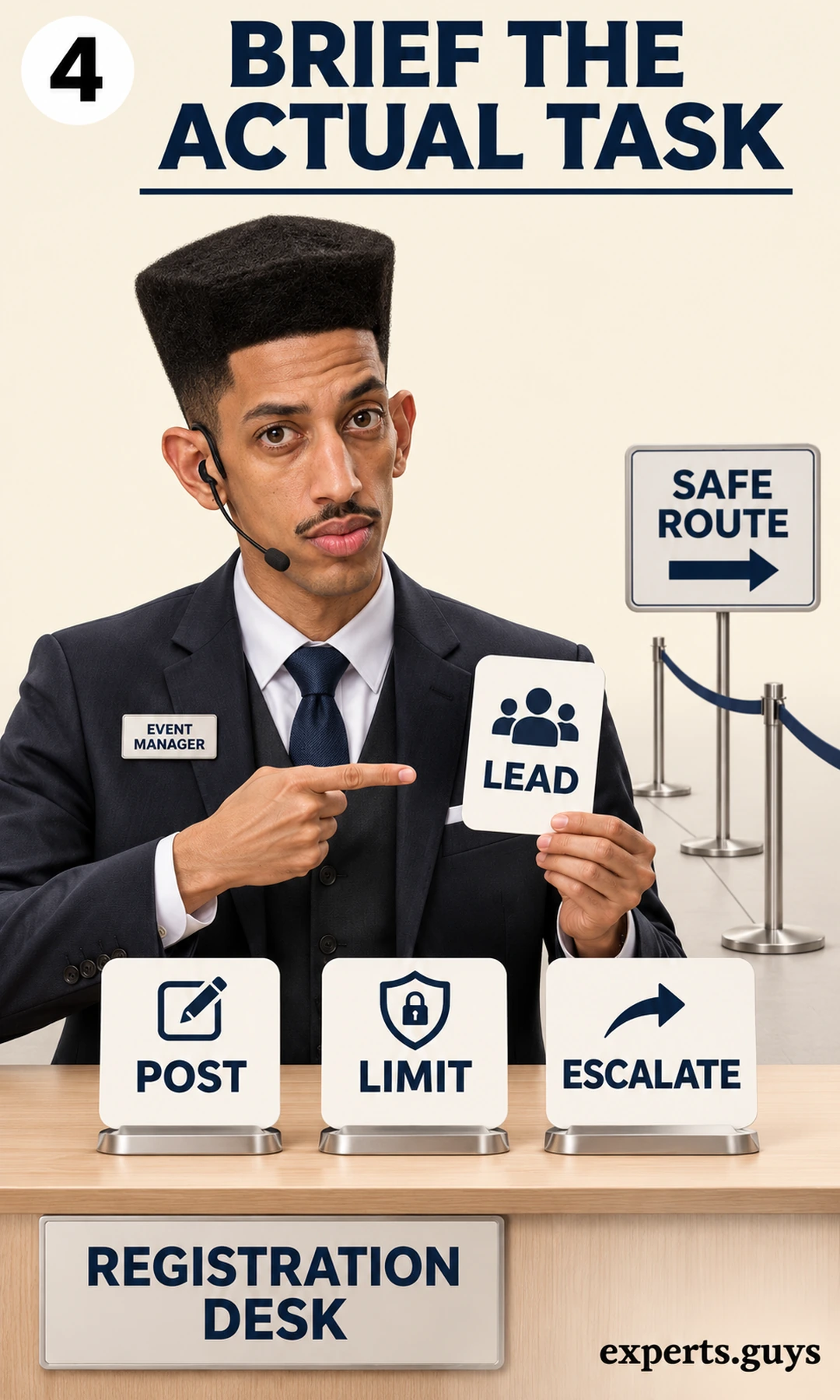
The team needs a named lead, an agreed arrival point, a task boundary and a way to raise a problem. A short digital briefing can include the current plan, relevant routes, role contacts and the changes since the last version. Remove superseded copies from active circulation so staff do not receive conflicting instructions.
At the venue, confirm that people can locate their post, explain their task and identify whom to contact if it cannot be carried out. A message marked “read” is not proof that the person understood a changed route or received the relevant site-specific instruction. Check understanding before assigning an unfamiliar task.
- Confirm the responsible lead and the route for urgent concerns.
- Explain the actual task, location and limits of the role.
- Identify safe access and movement routes relevant to that task.
- Confirm food-service, guest-assistance and incident escalation contacts.
- Check the person understands changes before the work begins.
In the US, OSHA’s temporary-worker guidance describes shared safety responsibilities between staffing agencies and host employers. The practical implication is to clarify who provides which information, training and protection; a booking should not be treated as a way to make the venue’s responsibilities vanish.
OSHA’s communication and coordination guidance also addresses planning, trained and equipped workers, and access to decision-makers. Apply the requirements relevant to the actual work and jurisdiction. This event-planning framework does not determine legal compliance or replace task-specific safety arrangements.
Give food questions a responsible route
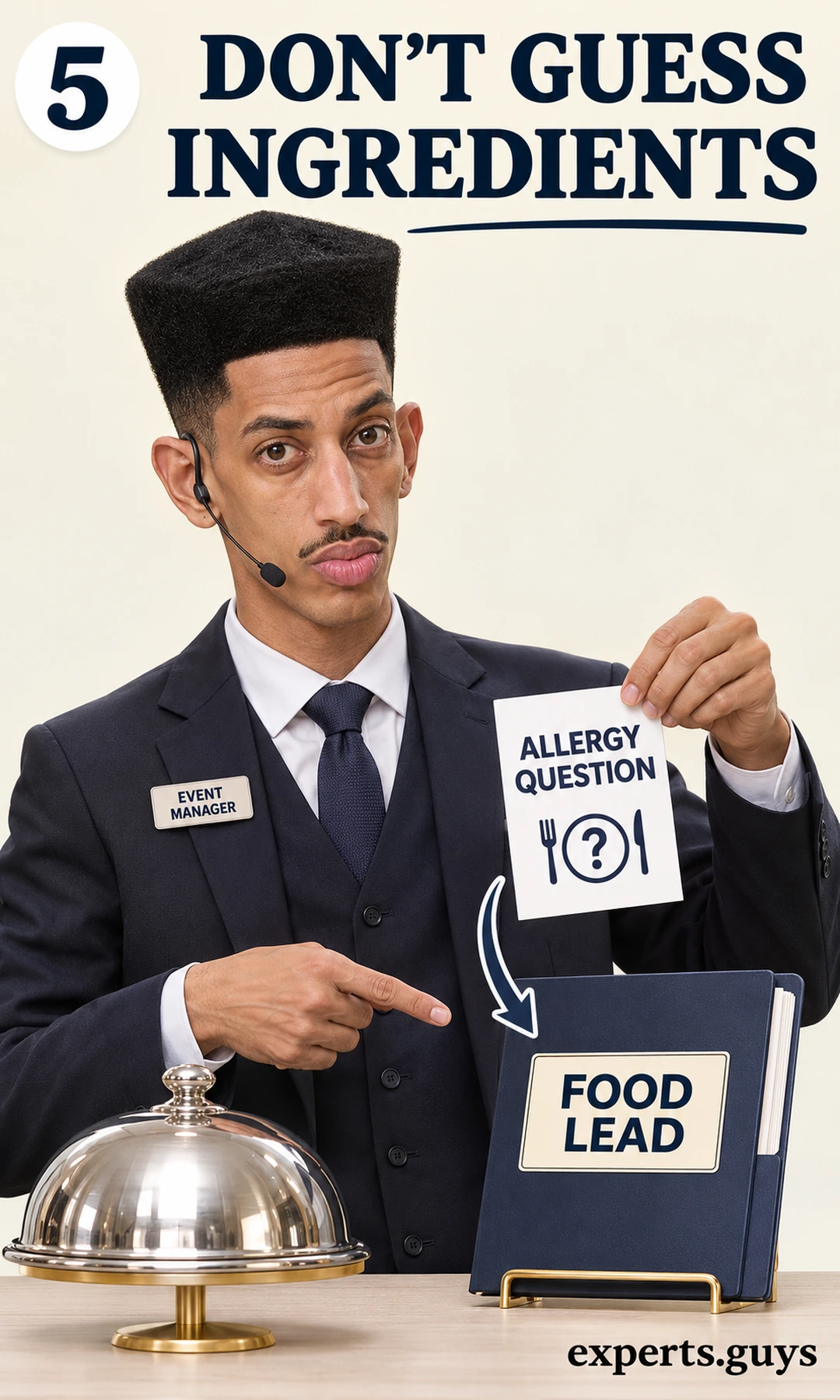
For food-service posts, establish who owns ingredient information and the procedure for an allergy question or an unexpected substitution. Temporary staff should not improvise an assurance because a dish looks familiar. If the answer is uncertain, the right action is to stop the guess and contact the responsible food-service lead.
The FDA Food Code is a model for adoption by relevant jurisdictions, not a statement that every location has enacted identical provisions. Use the venue’s applicable requirements and trained procedures. FDA’s retail food training resources identify areas including allergens, employee health and cross-contamination.
The same principle applies outside food service. A guest who needs accessibility assistance, a technical fault or a potentially unsafe queue needs the agreed responsible route. Good hospitality does not require every temporary worker to know every answer; it requires them to recognise the boundary and reach the person who can act.
Protect relief, late arrivals and changes
A break plan needs a real handover where a post must remain covered. Confirm who relieves whom, whether the replacement can perform that task, and how the original worker knows it is safe to leave. Do not treat a supervisor who is already managing an incident as automatically available relief.
For a late arrival, use the agreed contact route and identify the consequence for the live plan. The responsible lead can then change the service, reallocate suitable cover or request a replacement under the actual agreement. Avoid promising a universal replacement time; travel, availability, briefing and contract terms all matter.
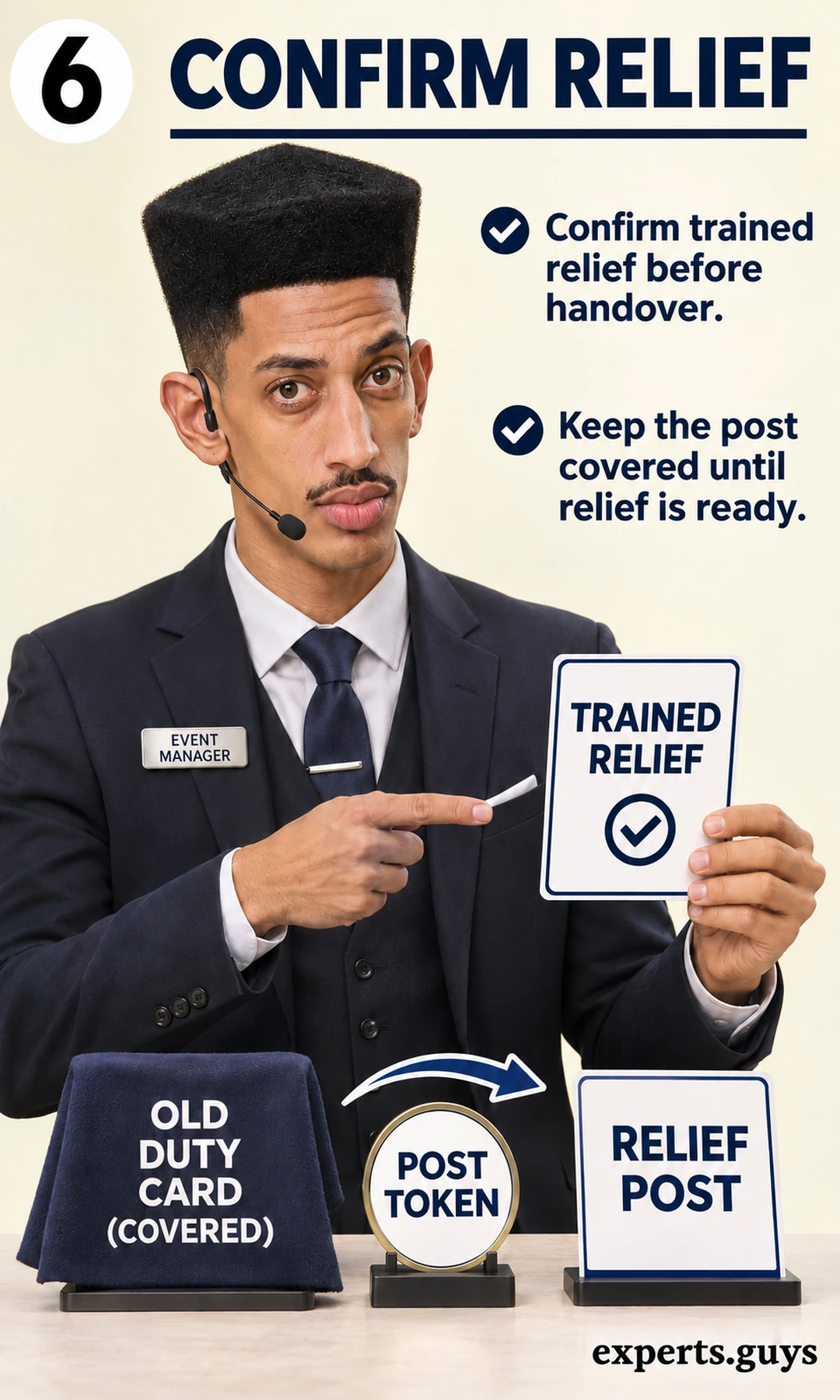
When a role changes, explain the new task and check that the worker is trained, equipped and authorised for it. Moving a name on a digital rota is not the whole handover. Where the revised task cannot be performed appropriately, the lead needs another plan rather than pressure to proceed.
Close the work and the information loop
Agree who accepts the area or equipment handover, who approves hours and how unresolved issues reach the provider. A clear close reduces the chance that someone leaves with an incomplete task, missing information or a disagreement about what was authorised. Confirm the agreed end rather than assuming that guests leaving releases every post.
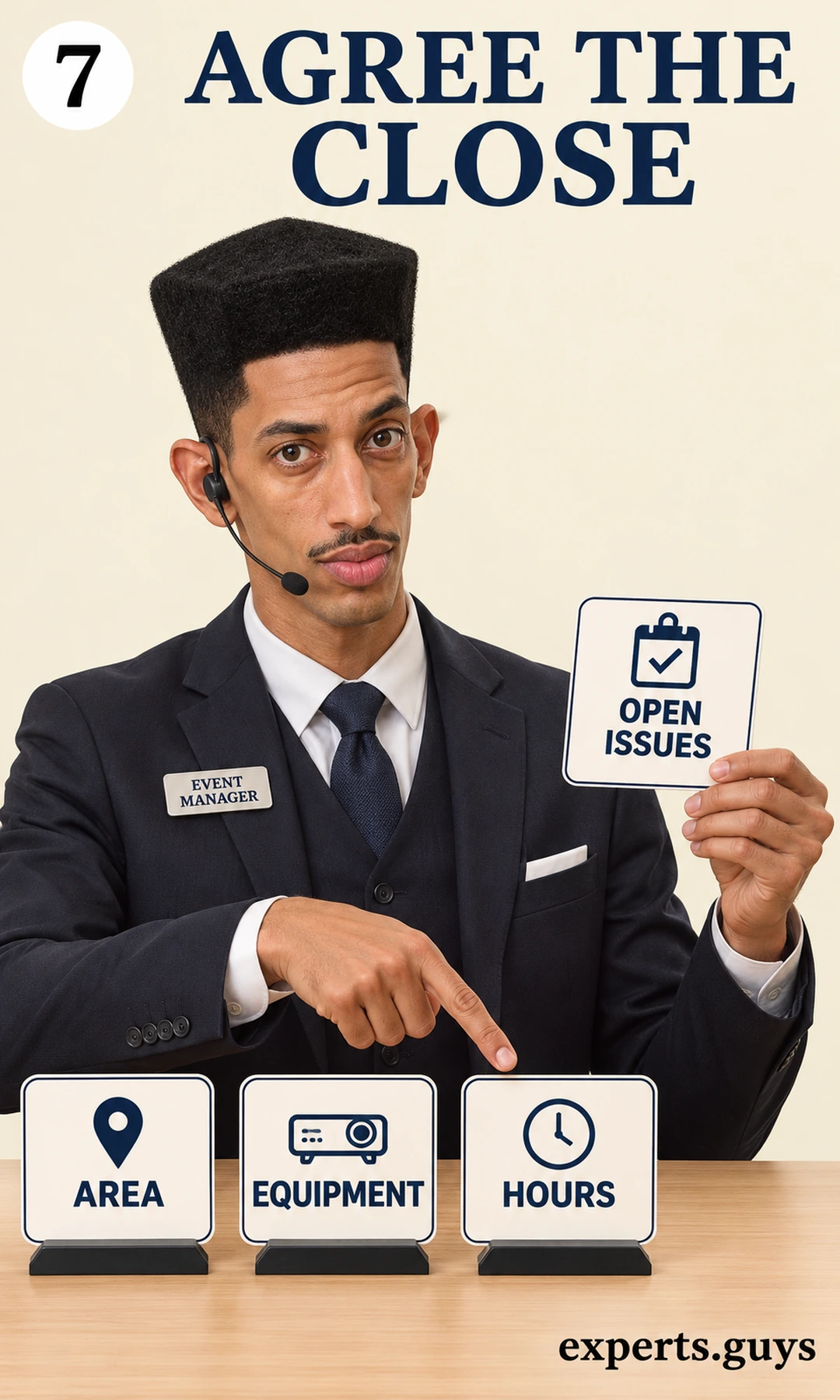
Keep any follow-up factual and relevant: what changed, what was covered, what remained unresolved and which decision would improve the next event. Do not circulate unnecessary personal details about workers or guests. The useful record is the operational lesson and accountable next step, kept through the approved channel.
For broader provider selection, the staffing-agency comparison guide covers a consistent brief and comparable proposals. Hospitality recruitment includes longer-term hiring questions. This article stays with the event’s live coverage and handovers, rather than repeating a directory of firms.
Frequently asked questions
How many hospitality staff do I need per guest?
There is no single ratio suitable for every event. Service style, simultaneous posts, layout, skills, equipment, timings and relief arrangements change the plan. Use a scoped operational discussion with the venue and provider.
Does the workspace recommend a team size?
No. It sums the posts and time windows you enter, shows peak simultaneous demand and flags entered coverage gaps. It does not allocate named workers, check qualifications or establish safe staffing.
Can one worker cover two event roles?
Only where the timings, skills, permissions and practical duties permit it. If both posts need coverage at the same time, do not count the same person twice. The workspace does not check individual double-booking.
Does an agency booking remove the venue’s safety responsibilities?
No. In the US, OSHA describes shared responsibilities between staffing agencies and host employers. Responsibilities depend on the facts and applicable requirements; clarify them rather than assuming the booking transfers everything.
Can temporary service staff answer allergen questions?
They should follow the venue’s trained process and refer uncertainty to the responsible food-service lead. Do not guess about ingredients, substitutions or cross-contact.
What if someone arrives late?
Use the agreed escalation route, confirm which duties remain covered and have the responsible lead approve any change. A rushed unbriefed substitution can introduce a different problem.
Action checklist
- Map arrival, service, transitions and close using the actual programme.
- Define simultaneous posts, required skills and who approves each handover.
- Use the workspace to expose entered gaps, then review them with the venue and provider.
- Brief task boundaries, safe routes and responsible contacts before work starts.
- Confirm trained relief, the change process and the final hours and equipment handover.