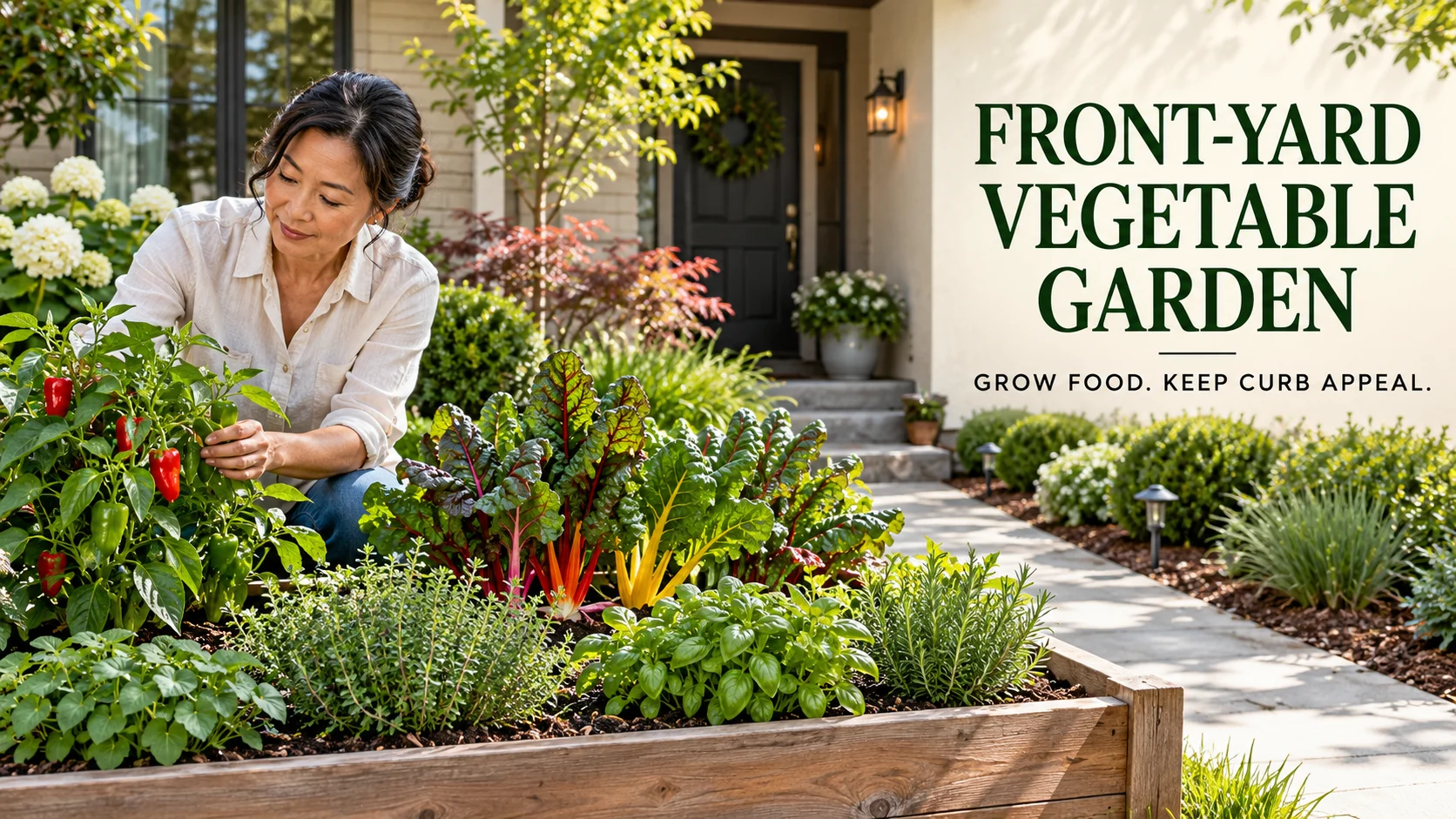

A front-yard vegetable garden looks intentional when the planting area has a clear edge, the crops stay within their mature footprint, and the entrance remains easy to use. Start with one bed or a small group of containers, then match the planting scheme to your sunlight and any rules that apply to the property. The six layouts below give you starting quantities and spacing without promising that appearance alone will secure HOA approval.
Before you buy plants, check what the site allows
Treat permission as a separate job from garden design. A neat bed may answer concerns about maintenance, but it does not automatically satisfy restrictions on front-yard crops, structures, setbacks, or visible containers. Read the current property documents and ask what needs approval before removing lawn or ordering a raised bed.
The strip between a sidewalk and the road deserves extra caution. It may be a public right-of-way, contain buried services, or fall within a driveway sightline, even when you mow it yourself. Choose a planting area wholly inside a confirmed permitted space, and check soil history before growing food near traffic or an older painted building.
- Check HOA or estate rules, lease conditions, and local requirements separately.
- Mark the entrance route, driveway visibility, utility access, and any required setbacks.
- Measure the planting envelope after reserving paths; a bed dimension is not the whole project footprint.
- Identify a water source and investigate soil contamination where the site history warrants it.
What “HOA-friendly” can and cannot mean
Here, an HOA-conscious layout means a restrained planting scheme that is easier to explain and maintain. It does not mean an approved design, a legal exemption, or a standard amount of lawn you must retain. Written rules and the authority responsible for the site determine those details.
Right-to-garden laws also need jurisdiction-specific reading. For example, Florida’s vegetable-garden statute addresses regulation by counties, municipalities, and other political subdivisions; it is not a blanket statement that private HOA covenants disappear. Check the current law and governing documents for your address rather than relying on a nationwide state count.
Sunlight, reach, and mature height come first
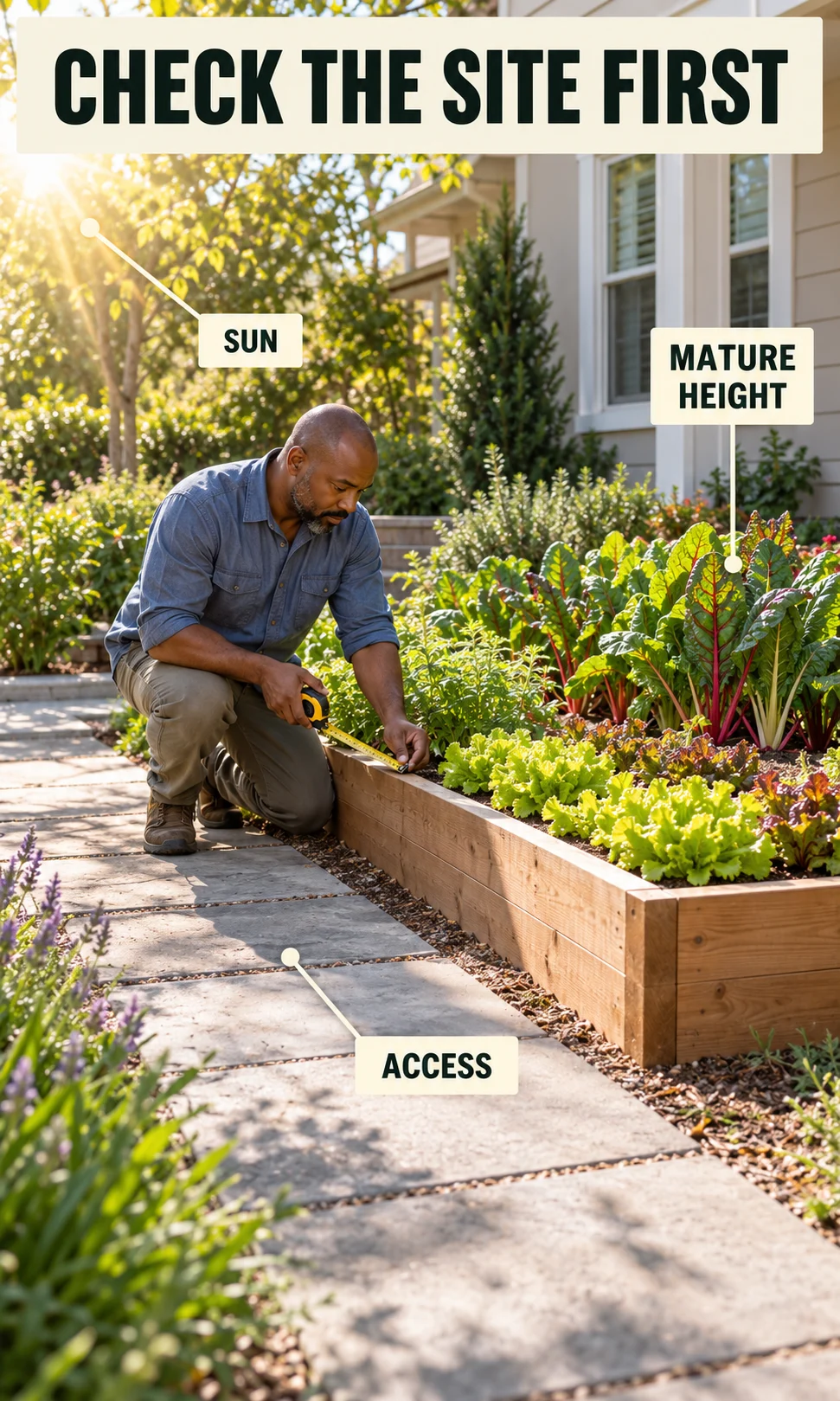
Observe direct sun at several points through the day and repeat the check when seasonal shade changes. Fruiting crops such as peppers and tomatoes generally need at least six hours of direct sun, with six to eight hours a useful target. Leafy crops can be more forgiving, but a bright-looking front yard beneath a dense tree canopy is not equivalent to an open sunny site.
A four-foot-wide bed works only if you can comfortably reach its middle from both sides. Against a wall or fence, a narrower bed is usually easier to maintain; use your actual reach rather than a standard dimension. Reserve enough clear walking space for the people, mobility aids, and equipment that use the route, and follow any applicable access requirements.
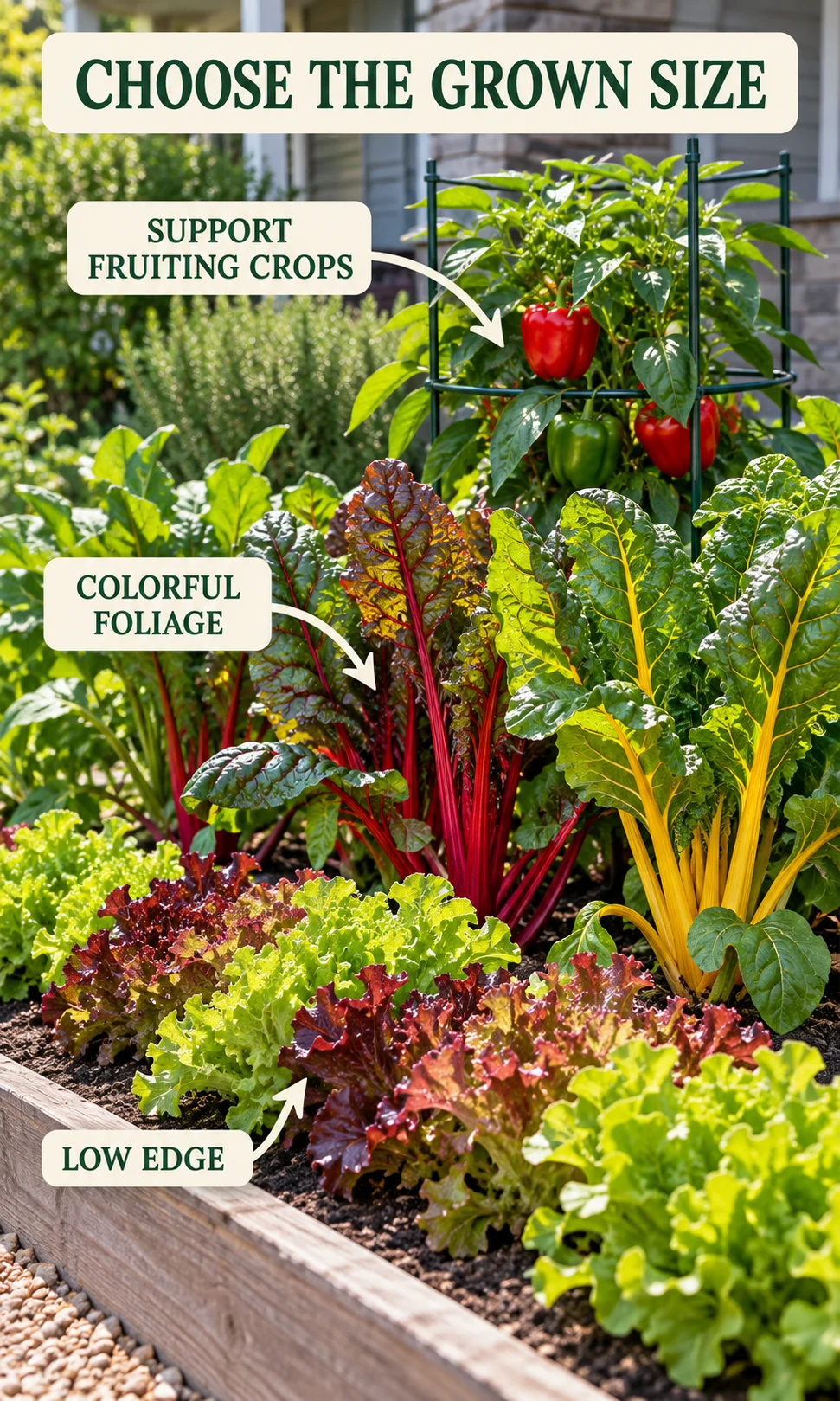
Put lower crops along the main viewing edge and locate taller plants where they will not shade the rest of the bed or obscure visibility. In much of the Northern Hemisphere, the north edge is a useful starting position for tall crops, but it is not a universal rule for every yard or latitude. Watch the real shadow pattern, including shadows from the house, fences, and support structures.
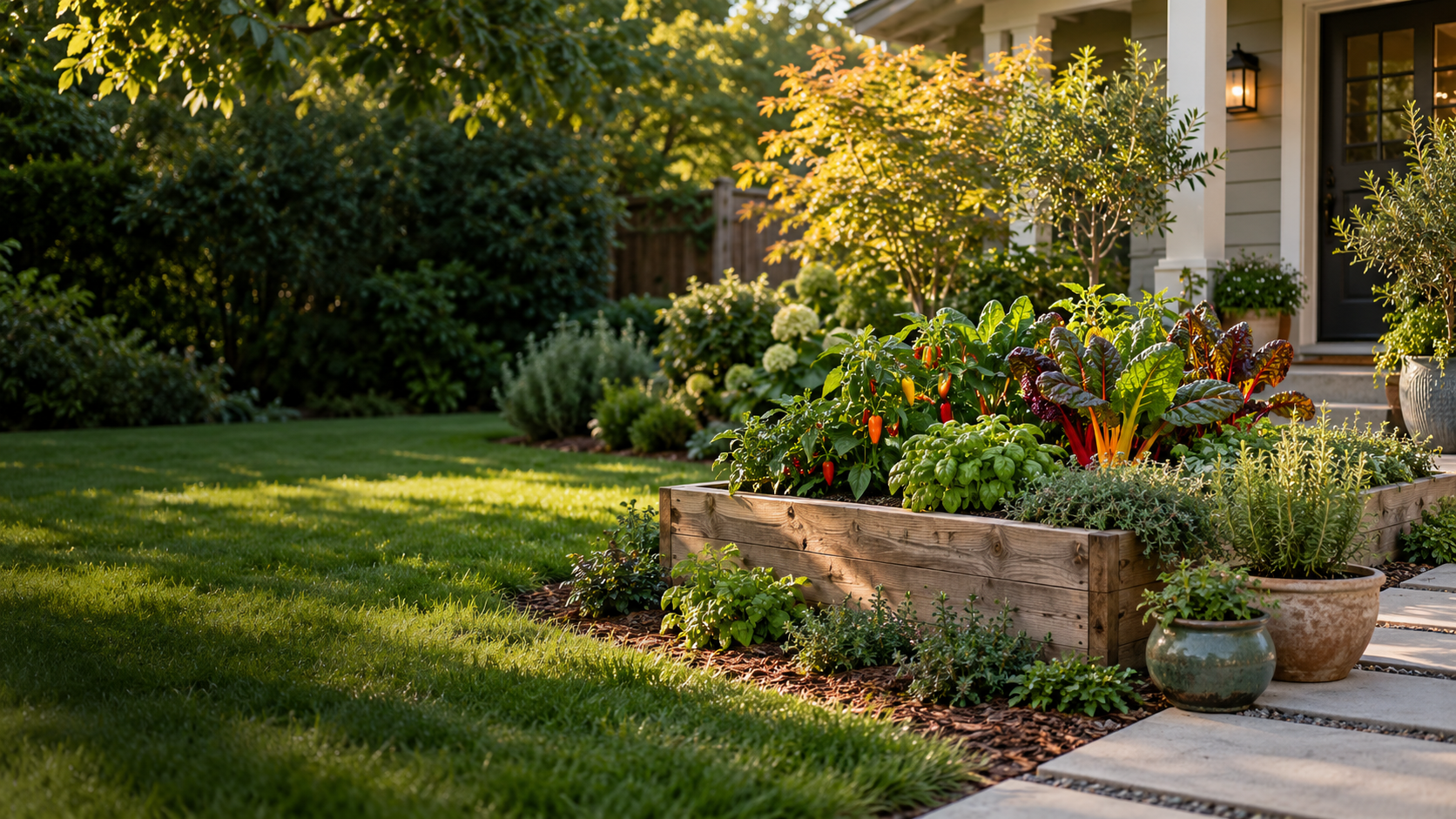
The layout should also survive the interval between crops. Matching bed materials, restrained supports, and a clean mulch surface keep the garden organized when a lettuce patch has been harvested. For the wider entrance composition, use the principles in our front-yard landscaping guide, while keeping the vegetable planting decisions on this page.
Use the plans as planting templates, not as a reason to squeeze in every crop you want. Quantities below are for the specified varieties and footprints, with generous space around the plants. Seed packets and nursery labels take priority when a cultivar grows larger than the example.
Six front-yard vegetable garden layouts with planting counts
Every dimension below refers to the planting area unless a path is explicitly included. “Front” means the principal viewing edge, not automatically the south side. The interactive studio following the plans shows the planting positions and helps you compare the footprints; its diagrams are planting schematics, not surveyed site drawings.
Layout 1: a 4×8 raised bed for colorful greens
For a cool or mild growing period, plant four Swiss chard plants in one rear row and eight leaf-lettuce plants in one front row. Put the chard centers 24 inches apart and the lettuce centers 12 inches apart, with the two rows 24 inches apart. In an eight-by-four-foot bed, this places both rows one foot in from their nearest long edge.
This twelve-plant scheme gives the bed a repeated color band without filling every square foot. Harvest outer chard leaves and lettuce selectively, and replace lettuce when it bolts or declines. In a suitable warm season, an alternative is four compact peppers in the rear row and eight compact parsley plants in front; do not add those twelve plants on top of the greens plan.
Layout 2: a 2×8 herb ribbon beside an entrance
Use a two-foot-deep, eight-foot-long bed wholly within your permitted property area. Plant four parsley plants along its center line, with centers 24 inches apart and the end plants one foot from each end. The generous gaps make the planting read as a repeated border and leave space to weed and harvest.
Keep the entrance surface clear as foliage grows, and avoid adding a trellis in a driveway sightline. This is a useful one-sided-access scheme because the planting is shallow enough for many gardeners to reach. If you want it on a curb strip, resolve ownership, permission, visibility, and soil suitability before transferring the plan there.
Layout 3: a 3×8 mixed edible border
In a clear three-by-eight-foot planting pocket, use four chard plants at the back and four parsley plants at the front. Each row has centers 24 inches apart, and the rows sit 18 inches apart. Keep the chard row nine inches from the rear edge and the parsley row nine inches from the front edge.
Repeat the same varieties to make the border look deliberate. Existing shrubs can provide background structure outside this pocket, but their roots and canopy still compete with the crops. Do not count space underneath a spreading shrub as vacant planting room, and avoid spraying adjacent ornamentals with products that could drift onto food crops.
Layout 4: a five-container cluster
Group two compact pepper plants, one basil, one parsley, and one thyme in five separate pots. As a practical starting size, use at least five US gallons of growing medium for each compact pepper and roughly three to five gallons for each herb, increasing volume when the variety or climate warrants it. Arrange the two larger pots behind the three herb pots, with enough separation for mature foliage and access.
A roughly six-by-four-foot clear area can accommodate a restrained cluster, but measure the actual pots and expected foliage before committing. Use containers with drainage and a container growing mix rather than filling small pots with garden topsoil. Water thyme separately from moisture-loving herbs; matching pots do not mean all five plants have the same watering needs.
Layout 5: two formal 4×4 beds
Place two four-by-four-foot beds side by side with a three-foot clear path between them as a design example. The bed-and-center-path rectangle is eleven feet wide and four feet deep, before adding access around the outside. In each bed, put two chard plants in the rear row at 24-inch centers and four lettuce plants in the front row at 12-inch centers, with 24 inches between rows.
That makes four chard and eight lettuce plants across the pair. Matching bed heights, repeated crops, and identical edges create the formal effect; extra decorations are unnecessary. The center route must be widened if your access needs or local requirements call for more room, and both beds still need reachable outer edges.
Layout 6: a supported container line by a fence
Place two compact determinate tomatoes in separate containers of about twenty US gallons each, plus one parsley plant in a separate three-to-five-gallon pot. Reserve an eight-by-three-foot planting envelope as a starting arrangement and check actual canopy widths before selecting the cultivar. Use sturdy individual cages or freestanding supports, with the parsley where the tomatoes will not overwhelm it.
This gives height without sending vines across the walk, but it is a higher-maintenance choice than the herb ribbon. Leave air space beside the fence, keep support height within permitted limits, and avoid attaching loads to a wall without a suitable fixing design. If tomatoes would block a window or sightline, choose a lower layout instead.
Compare the layouts for your own space
Enter the clear planting area after reserving entrance and maintenance access. The Front Yard Edible Studio filters these six examples and highlights checks that still need an answer. It does not issue HOA approval, certify soil safety, or predict a harvest; the result is a starting scheme you can verify on site.
Front Yard Edible Studio
Find a restrained planting scheme for the space you can actually use.
Compare defined planting schemes after reserving paths and setbacks. Counts are starting quantities; permission, soil suitability, cultivar size, and season still need verification.
Need help with the site?
For growing conditions, contact a local extension service or horticultural adviser. For layout and access, compare qualified landscape designers. For permission, use the property’s governing body or local authority.
Searches show real external results. Compare experience with edible gardens, site assessment, scope, and quoted work; no provider is endorsed here.
This is a planting comparison, not HOA approval, legal advice, a soil-safety assessment, or a harvest forecast. Inputs stay in this page; location is sent to Google only when you open a search.
Choose vegetables that earn their front-yard space
A plant is useful here when its mature form, harvest habit, and support needs fit the visible space. Chard supplies color through its leaf stalks, lettuce makes a low band, and parsley gives a repeated green texture. Compact peppers offer fruit and structure, while tomatoes require enough room for a cage, airflow, and regular attention.
Treat companion planting as a question of compatible light, water, spacing, and harvest timing. A few flowers do not guarantee pest control, and adding basil or marigolds cannot compensate for crowded tomato roots or a shaded bed. Keep additional flowers outside the specified planting footprint unless you deliberately reduce the crop count.
Install the structure before filling it with crops
First mark the proposed footprint with string, temporary stakes, or empty pots and walk the entrance route. Check it from the road, the doorway, and the driveway before committing to materials. If there are underground services or you will excavate, use the relevant utility-location process before driving posts or digging.
For an ordinary open-bottom raised bed, prepare a well-drained site and fill with an appropriate topsoil-and-compost blend. A four-by-eight-foot bed filled twelve inches deep holds 32 cubic feet of material, about 1.19 cubic yards, before allowing for freeboard or settlement. That arithmetic describes fill volume; it does not establish a universal safe rooting depth or a construction design.
Sheet mulching can suppress some existing lawn, but it is not an instant solution for aggressive perennial weeds or contaminated soil. Investigate those problems separately and avoid old railway ties, unidentified treated timber, or questionable fill. Where lead or another contaminant is plausible, arrange suitable testing and follow local guidance before deciding how to isolate the growing area.
Use a container potting mix for pots and a suitable raised-bed mix for beds; the two situations drain differently. Our guide to choosing garden edging can help you finish the perimeter cleanly. Keep mulch clear of plant crowns, install unobtrusive irrigation, and do not direct overflow onto the pavement or a neighbor’s property.
Keep the garden tidy between harvests
A front-yard edible garden needs routine attention, even when the crop list is small. Check moisture and pests often enough for the weather, especially with pots in hot conditions. A weekly tidy pass is a useful addition to that care, not a promise that the whole garden only takes fifteen minutes.
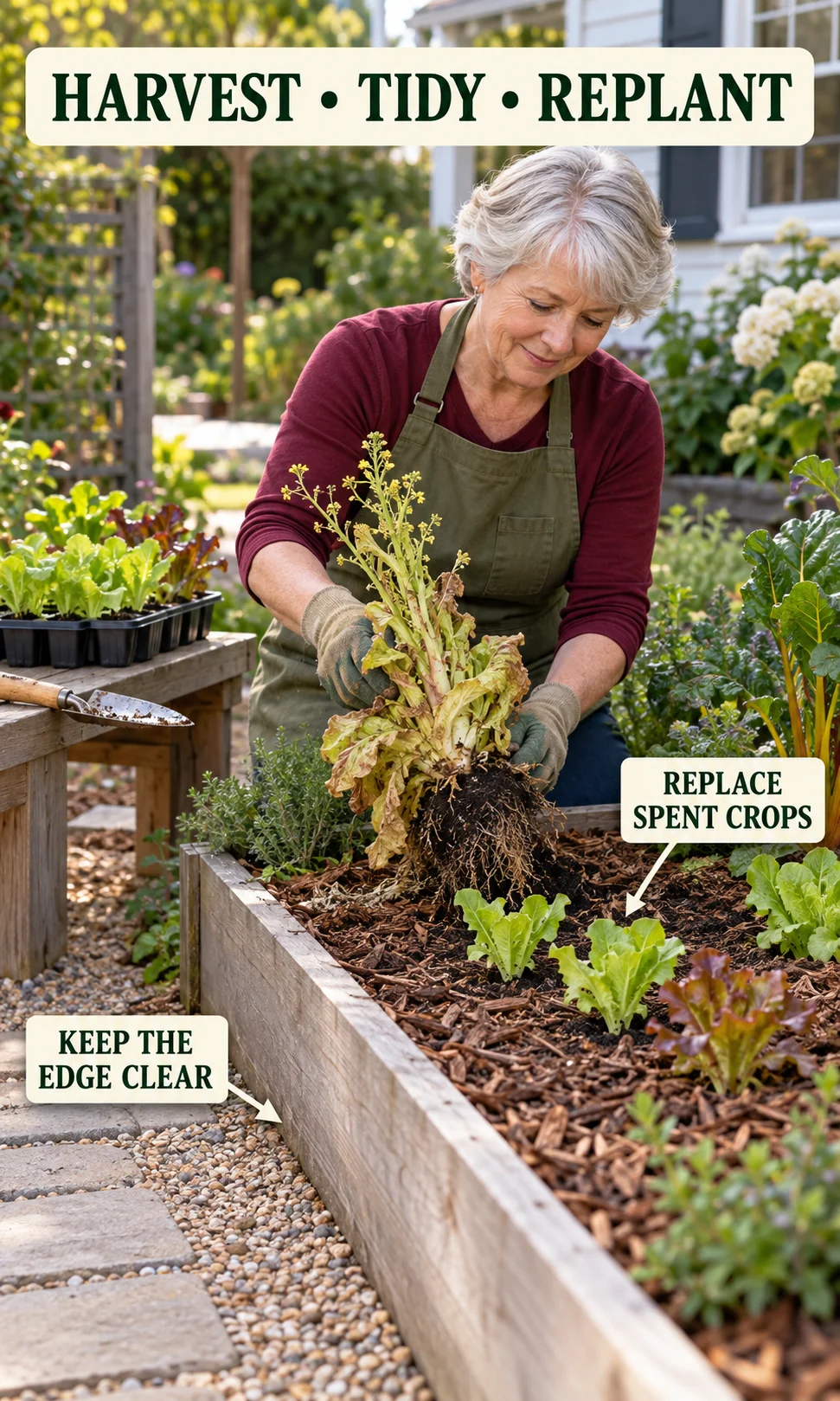
- Harvest ready leaves and fruit before they deteriorate or fall onto the path.
- Remove declining crops promptly, and check whether disease affects disposal or replanting.
- Tie supported growth securely and keep foliage inside the intended envelope.
- Clear the edge and entrance, remove weeds, and check irrigation for leaks.
- Reserve replacement plants or seed for the next suitable growing period.
Schedule crops by local growing conditions rather than a single worldwide calendar. Lettuce and many leafy crops perform best in a cool or mild window; peppers, basil, and tomatoes need suitable warmth and frost-free conditions. In very hot or humid climates, locally recommended varieties and planting windows may change the whole scheme.
Do not promise that every bed will stay productive throughout winter. In freezing climates, a cleared, mulched bed with stored supports can look cared for even without a crop. In milder regions, suitable cool-season plants may replace summer crops, while perennial herbs only provide year-round structure where the climate supports them.
Prepare an approval request that explains the whole garden
Submit a dimensioned sketch showing the bed or pot group, paths, boundaries, and distances to the entrance and driveway. Include the mature height of both crops and supports, the materials, and the maintenance and end-of-season arrangement. Describe the actual planting honestly rather than disguising vegetables as ornamentals to avoid a rule.
Ask for the applicable approval process and any written conditions before buying permanent structures. If an objection cites a specific restriction, revise the element that conflicts with it or seek advice on the rule’s applicability. A container arrangement may be easier to change, but there is no verified universal approval rate that makes it automatically acceptable.
Front-yard vegetable garden questions
Can I grow vegetables in my front yard if I have an HOA?
Possibly, but check the governing documents, approval process, and applicable law for your property. A tidy layout does not itself create permission. Obtain written approval when it is required before changing the front landscape.
What is a good beginner front-yard raised-bed size?
A 4×8 bed is a useful starting example when both long sides are accessible and you can reach the middle. For one-sided access, a narrower bed may work better. Measure the planting area and the surrounding access separately.
Can two tomatoes, peppers, herbs, and lettuce all fit in a 4×8 bed?
The answer depends on mature cultivar sizes, supports, spacing, and whether crops overlap in time. Do not treat a seedling-sized plant as its final footprint. The twelve-plant greens example on this page is a separate scheme from its warm-season alternative, not a combined shopping list.
Which vegetables look attractive in a front-yard garden?
Colorful chard, compact lettuce, parsley, and compact peppers can create repeated shapes and a restrained color scheme. Choose varieties suited to your growing season and available sunlight. Larger tomatoes and sprawling vines need more deliberate support and space.
Can I use the strip between the pavement and the road?
Check ownership or right-of-way status, planting permission, utility access, and visibility requirements first. Investigate soil history before growing food in a roadside area. A strip you maintain is not necessarily a strip you may alter.
Does a north-side trellis always work best?
No. Position tall plants and supports according to actual sun and shadow patterns, latitude, nearby structures, and visibility constraints. A north-edge position is a common Northern Hemisphere starting point, not a worldwide rule.
How much food will these layouts produce?
The plant counts are starting quantities, not yield estimates. Harvest depends on the cultivar, growing season, sunlight, soil, watering, pests, and picking habits. Trial a small planting and keep your own harvest record before expecting it to feed a household.
Start with one planting area you can maintain
Choose the smallest layout that answers your main goal, whether that is a herb border, colorful greens, or a few supported fruiting plants. Confirm the rules and soil conditions, then set out the footprint before buying materials. A garden that stays reachable, healthy, and neat is a better foundation for expansion than an ambitious first planting that crowds the entrance.