
Finance recruiting firms and accounting recruiters often cover overlapping roles. Choose the consultant who understands the work your hire must own, then check the search process, candidate evidence and commercial terms rather than relying on the firm’s label.
A controller search, an FP&A appointment and a treasury vacancy may all sit under a finance desk, but they need different evidence. The useful distinction is between the outcomes required: dependable reporting, forward-looking decisions, cash management or leadership across several functions.
This guide is primarily for employers comparing recruitment partners, with a separate candidate section near the end. It uses illustrative hiring scenarios and calculations rather than agency rankings, salary benchmarks or promises about how quickly a role will be filled.
A specialist is worth considering when the recruiter can explain where suitable people work, what comparable responsibilities look like and how those capabilities will be assessed. A broad firm may do this well through one experienced consultant; a narrowly named boutique may still lack the network for your exact assignment.
- Start with the deliverable and decision authority the person will own.
- Test the named consultant's understanding of comparable work.
- Compare the same search scope and fee basis before choosing.
- Treat unverified candidate claims as questions to resolve, not established strengths.
Which recruiting specialty fits the work you need?
| Work you need owned | Relevant search focus | Evidence to ask about |
|---|---|---|
| Accurate close and reporting | Accounting, financial control or reporting | Reconciliations, review responsibility and treatment of exceptions |
| Forecast and commercial decisions | FP&A or commercial finance | Assumption ownership, variance explanation and business partnership |
| Cash and liquidity | Treasury or cash management | Cash visibility, funding responsibilities and relevant controls |
| Leadership across functions | Senior finance leadership or executive search | Decision authority, team scope and comparable organisational complexity |
1. Match the search to a business output
Use this approach when a job title could mean different things across employers. Begin with the work that must be dependable after the hire joins, identify the decisions the role can make and separate that responsibility from tasks it only supports. Then ask the recruiter which candidate background would demonstrate that combination.
For an accounting appointment, the output might be a reconciled month-end close with clear ownership of review and exceptions. For FP&A, it could be a forecast that connects operational drivers to financial consequences. Treasury may require cash visibility, funding coordination or liquidity management. These boundaries are practical starting points, not rigid occupational walls: smaller teams often combine them.
Also distinguish a finance function from the financial-services industry. A bank’s regulatory reporting appointment and a retailer’s commercial finance appointment can both be advertised as finance jobs, but sector vocabulary alone does not establish transferable experience. Ask which products, reporting obligations, stakeholders or controls materially change the work. An employer outside banking may still need a highly specialised finance hire; a role inside a bank may principally require accounting expertise.
In an illustrative manufacturing search, the immediate problem is unexplained margin changes. A candidate who prepares accurate historical reports may be capable, but the vacancy also needs someone who can distinguish price, volume, mix and cost effects and discuss them with operations. Ask the recruiter to describe how that evidence would appear in a candidate conversation.
The common mistake is using ‘finance experience’ as a substitute for scope. Correct it by asking what the person owned, what they produced and who acted on it. If the team cannot specify every duty yet, begin with the single most consequential output. This step is complete when the hiring manager and recruiter can describe the same result without relying on the job title.

2. Calibrate ownership before adding requirements
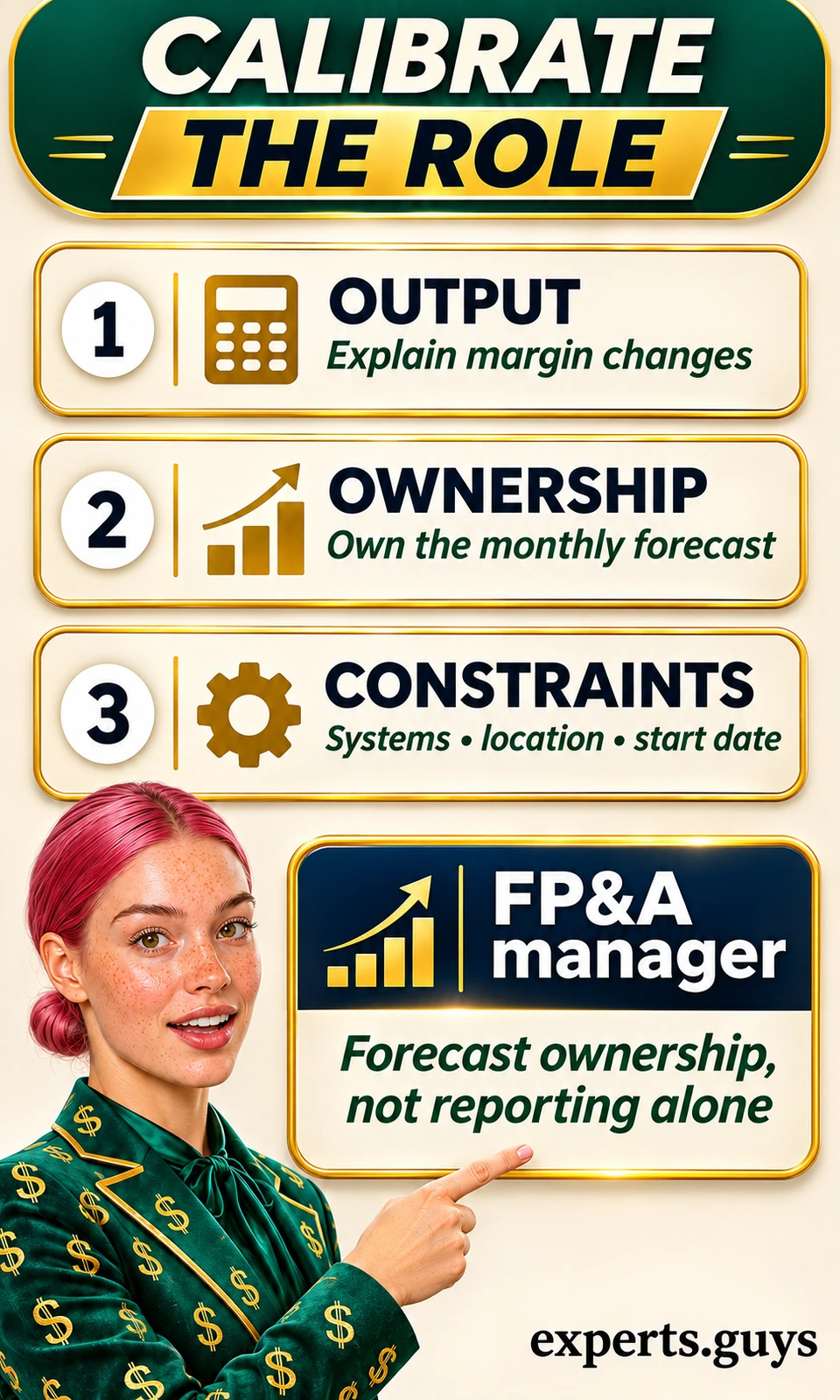
Use a role-calibration conversation when the job description has accumulated requirements from several people. Bring the actual reporting line, available compensation range, working arrangement and required start window. Discuss the essential output first, then decide which experience is indispensable on entry and which can be learned with the support available.
A concise spoken brief might be: ‘We need an FP&A manager who owns the monthly forecast, explains margin changes to operations and can work with our existing reporting environment.’ Clarify whether that means building assumptions, challenging business inputs, consolidating submissions or approving a forecast. Each verb changes the search, the assessment and potentially the level of responsibility.
Separate a genuine constraint from a preference. If nobody can train the new hire on a critical reporting process, that experience may be essential. If the team can teach a software interface, requiring the identical product may exclude people who understand the underlying work. A local professional qualification or licence may matter for particular duties; confirm the requirement in the relevant jurisdiction rather than treating every finance vacancy alike.
Avoid combining controller, analyst, systems administrator and transformation lead responsibilities under one salary and expecting a recruiter to solve the mismatch. Where budget is fixed, narrow the accountable output or supply internal support. An easier version is to agree only the first deliverable and one non-negotiable constraint before expanding the brief. Completion means the consultant can explain the trade-off they would make if an otherwise strong candidate lacks one preferred attribute.
How can you tell whether a recruiter knows your market?
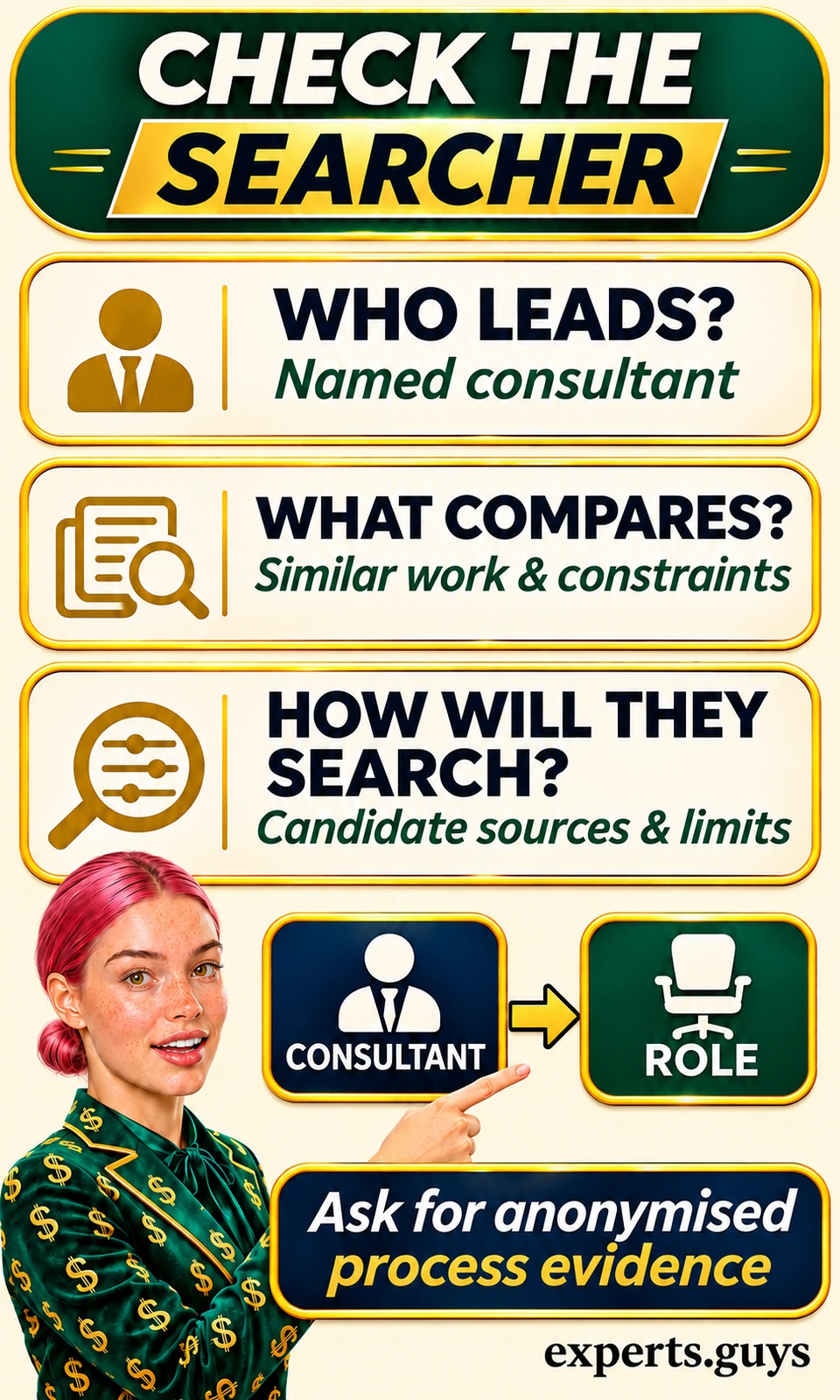
Assess the person who will run the assignment, not only the firm’s overall reputation. Relevant knowledge includes function, seniority, industry context, location and the practical limits on approaching candidates. A large contact database does not tell you whether the consultant can reach the people your vacancy needs.
The original comparison between finance and accounting firms becomes useful only at this level. An accounting specialist may understand a complex controller appointment better than a broadly branded finance firm; a finance consultant with an established treasury network may be the stronger choice for cash-management work. Neither label establishes candidate quality by itself.
3. Ask for comparable-search evidence
Use this check before granting exclusivity or signing an engagement. Ask who will lead sourcing, who will assess candidates and who remains accountable if the lead consultant changes. Then ask for anonymised examples of assignments with comparable responsibilities and constraints. The purpose is to understand the searcher’s reasoning, not to obtain confidential client names or candidate records.
Useful questions include: What made the role difficult? Which backgrounds transferred well? What did the initial brief get wrong? How did the search change? A meaningful answer explains decisions and limitations. A list of prestigious clients or a claim to cover every finance role gives you much less information about the proposed assignment.
For the manufacturing FP&A example, a relevant comparison might involve someone who partnered with production leaders and explained inventory-related margin movements. A recent accounts-payable placement shows activity in accounting recruitment, but it does not by itself demonstrate an FP&A network. Conversely, the absence of an identical past placement is not automatic disqualification if the recruiter can explain a credible adjacent pool and assessment approach.
Check practical access to the candidate pool as well as knowledge of it. Ask whether existing client relationships, conflict rules or other agreed restrictions limit the organisations the firm can approach. You do not need confidential client lists to discuss the effect on your assignment. If an important source of candidates is unavailable, the recruiter should explain an alternative route and the consequences for scope. A famous brand with restricted access may be less useful for this search than a smaller consultant with a credible reachable pool.
Do not request an entire pipeline as proof before engagement. Ask for the method, the likely sources of candidates and the reasons those sources fit. If confidentiality limits detail, accept a redacted process explanation and discuss reference availability through an appropriate channel. This check is complete when you know who owns the search, what relevant evidence supports the approach and what remains an assumption.
4. Run a calibration conversation before widening the search
Use an early calibration meeting to detect a misunderstanding before it produces a large unsuitable shortlist. Ask the recruiter to explain how they would distinguish two hypothetical profiles against the agreed output. No real CVs or personal data are needed for this initial exercise. If actual candidates are discussed later, use authorised information and the firm’s agreed confidentiality process.
Consider Profile A: an accountant who prepares monthly results and distributes a forecast assembled by others. Profile B: an analyst who owns the forecast assumptions, challenges departmental inputs and explains variances to operational managers. For a role centred on forecast ownership, B appears closer on the available facts. A may still be suitable if the missing ownership evidence can be established; the comparison does not settle overall capability.
Ask the consultant what they would verify next. A good next question tests the uncertain responsibility: ‘Which assumptions did the person set or challenge, and what decision changed as a result?’ A weaker question simply asks whether the candidate has ‘done forecasting’. The difference matters because participation, preparation, review and accountability can all appear under the same CV keyword.
The mistake is requesting more candidates when the definition of a suitable candidate is still unstable. Correct the brief or evidence standard first. If you have little interview time, calibrate one responsibility rather than several hypothetical profiles. The checkpoint is agreement on what evidence would justify progressing a candidate and what uncertainty would keep them on hold.

For a broader overview of engagement types, the existing guide to finance recruitment staffing options provides additional context. Use this page’s calibration approach to test the consultant handling your specific search; a provider overview cannot establish that fit for you.
How should you compare fees and engagement terms?
Compare the obligation you are buying before comparing the quoted number. A placement fee, a retained search assignment and a contract staffing bill purchase different services and allocate risk differently. There is no universal percentage, refund entitlement or completion time that can safely be inferred from the words ‘finance recruitment’.
The examples below use hypothetical U.S.-dollar amounts purely to demonstrate arithmetic. They are not market rates, quotations or estimates of what a particular firm charges. Apply your own currency and the exact compensation definition, taxes, expenses and payment triggers in the proposed agreement.
5. Normalise the fee basis before comparing prices
Use this method when two proposals quote different percentages or compensation definitions. Confirm the chargeable base, apply the quoted rate and add disclosed separate charges. Keep the calculation beside its assumptions. Do not treat a fee percentage as meaningful until you know whether it applies to base salary, guaranteed cash, target bonus or another defined amount.
Suppose Proposal A charges 20% of a $120,000 base salary: the placement fee is $24,000. Proposal B charges 18% of $140,000 defined compensation, including an assumed $20,000 target bonus: the fee is $25,200. B has the lower percentage but a fee $1,200 higher on these assumptions. If the actual contract defines compensation differently, recalculate before using the comparison.
Compare any fixed fee or minimum fee as well. Ask when the fee becomes due, how compensation changes affect it and whether tax, travel, assessments or other expenses are additional. Keep salary and employer employment costs separate from a recruitment placement fee. A placement fee is not the employee’s total cost to the business.
For contract staffing, compare bill rate multiplied by approved hours, then any applicable additional charges. For example, $80 per hour for 160 hours is $12,800 of billed service before any excluded items. Do not compare that directly with a permanent placement fee as if both cover the same period or employment arrangement. If you cannot resolve a proposal’s basis, request a worked invoice example rather than guessing. Completion is a like-for-like cost explanation, not a claim that the cheapest quote gives the best hire.
| Proposal | Assumed fee basis | Calculation | Fee before extras |
|---|---|---|---|
| A | $120,000 base salary | 20% × $120,000 | $24,000 |
| B | $140,000 defined compensation | 18% × $140,000 | $25,200 |
| Difference | Same hypothetical comparison | $25,200 − $24,000 | B costs $1,200 more |

6. Test the agreement with a failure scenario
Use this check before acceptance, especially when a proposal emphasises a guarantee. Ask what happens if the search is cancelled, a candidate is already known to you, the role changes materially or the person leaves soon after starting. Read the relevant clauses together with the fee schedule: a reassuring headline may depend on notice, payment deadlines, role stability or a replacement-search condition.
For example, ask: ‘If the hire leaves after six weeks, which clause applies and what do we receive?’ The answer might be a replacement search, a conditional credit, a partial refund or no remedy in that situation. Do not convert a replacement commitment into a promise that money will be refunded. Also clarify the time allowed to notify the firm and whether a replacement carries additional expenses.
For a retained executive search, agree the deliverables and reporting milestones as well as the commercial commitment. The AESC Client Bill of Rights describes a retained, exclusive advisory model for its member firms. That is useful context for evaluating an executive assignment; it is not a rule that every recruiter or every finance vacancy follows that model.
Exclusivity may support a focused search, but it also limits alternative routes for the period agreed. Clarify the duration, exceptions, progress updates, termination provisions and the handling of direct applicants. The same applies to candidate introduction provisions: establish how prior contact, duplicate submissions and later hiring are handled. Contract interpretation depends on the agreement and jurisdiction; this is a comparison process rather than a legal determination.
The common mistake is treating a guarantee as a substitute for a clear brief and selection process. A simpler first pass is to discuss the one failure scenario that would be most costly for your team, then check the surrounding conditions. Completion means both sides can describe the payment and remedy for that scenario using the actual agreement.

If the unresolved choice is temporary cover, direct employment or payroll support, use the broader staffing and payroll service comparison to orient the discussion. Obtain the current written terms for your own assignment before relying on any quoted charge.
What evidence should move a candidate toward an offer?
Ask for evidence of the responsibility you need, then make the remaining uncertainty visible. Recruiter screening can organise that evidence, but it does not remove the employer’s responsibility to select a suitable person. Credentials, years of experience, references and work examples answer different questions; none alone establishes the whole fit.
The most useful shortlist is not necessarily the longest. It explains why each person matches the agreed output, what was actually checked, which claims remain candidate-reported and where training or support would be needed. This makes interview time more productive and allows fairer comparison than a collection of enthusiastic summaries.
| Claim or evidence | Useful information | Still unresolved |
|---|---|---|
| Prepared a forecast pack | Experience producing reporting material | Whether they owned assumptions and challenged inputs |
| Used your ERP product | Familiarity with that environment | Depth of use and ability to solve the required problem |
| Held a senior title | Position within a particular employer | Actual authority, team size and complexity |
| Recruiter checked references | A stated verification step | Who was contacted, what was verified and any limits |
| Completed a relevant discussion | Observed reasoning on a defined task | Performance across the full job and over time |
7. Assess one relevant piece of work under consistent conditions
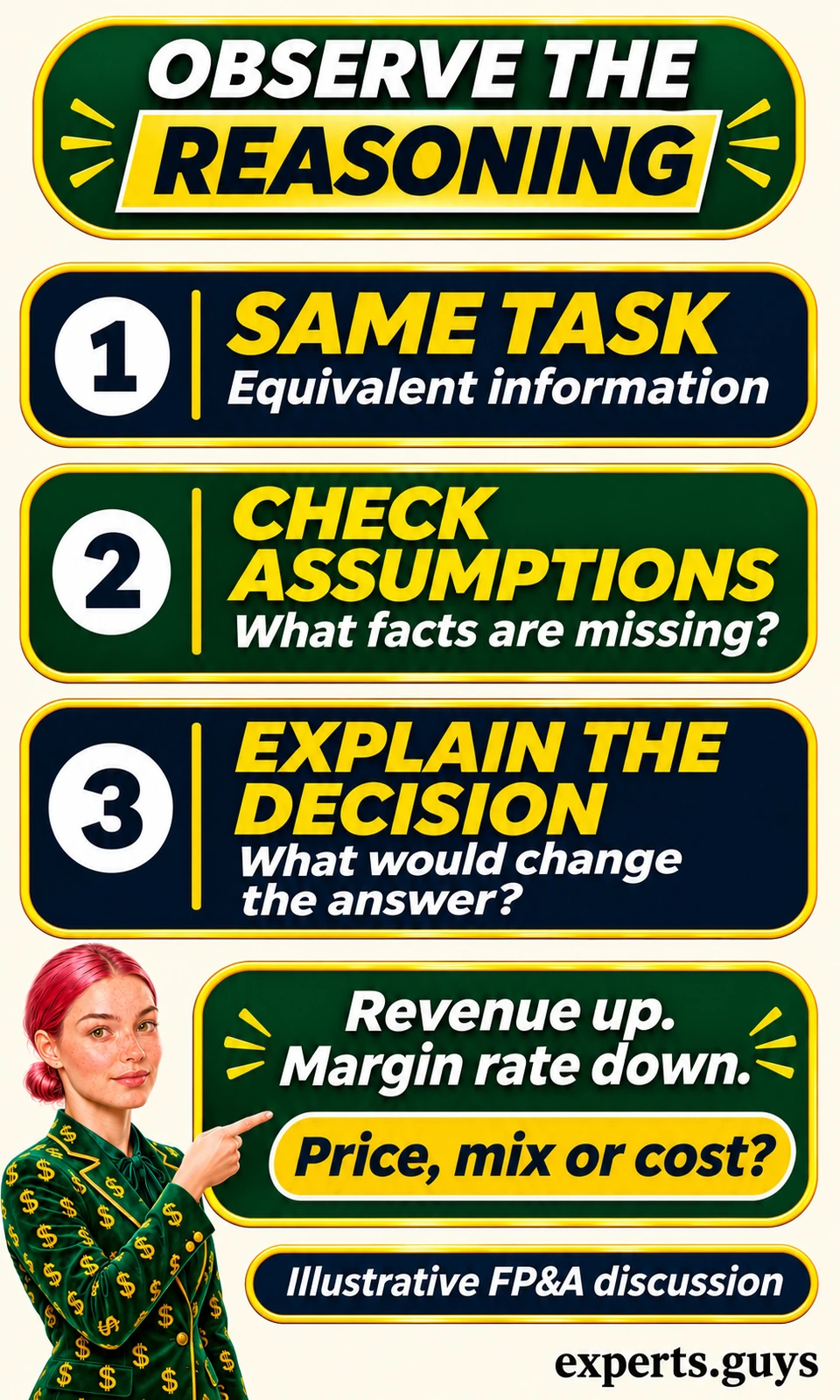
Use a short, job-relevant discussion or exercise when CV language cannot establish competence. First define the responsibility and the evidence you want to observe. Give candidates equivalent information and evaluation criteria, offer appropriate adjustments and keep the task proportionate. Use invented or safely anonymised data, not your company’s confidential information or a request for a previous employer’s model. The CIPD selection-method guidance supports job-relevant assessment and consistent conditions; the FP&A example below is an illustrative application.
For the illustrative FP&A role, present a small example in which revenue increased while gross margin percentage fell. Ask the candidate which missing facts they would check, how they would separate plausible drivers and how they would explain uncertainty to an operations manager. Do not grade the answer as a secret guessing game: a reasoned request for price, volume, product mix and cost information may be more useful than a confident unsupported conclusion.
The exercise can be verbal. You do not need a lengthy unpaid spreadsheet project to see how a person structures a question. Ask what they would reconcile before recommending action, what decision the analysis supports and where they would seek input. If advanced modelling is genuinely essential, agree an appropriately scoped assessment, communicate expectations beforehand and consider a paid task where warranted.
Separate observation from verification in the shortlist. A candidate’s explanation is candidate-reported until independently checked; a recruiter interview is an assessment, not confirmation of every fact. Ask the consultant to distinguish qualifications verified, references completed, work discussed and matters still pending. If a reference is unavailable before a confidential search progresses, keep that limitation visible and agree an appropriate later stage. This avoids either rejecting a person for an unresolved administrative step or treating an incomplete check as finished.
A common mistake is confusing a polished presentation with sound reasoning. Correct it by asking the same follow-up about assumptions and checking how the candidate responds when one input changes. An accessible alternative is a structured conversation about a genuine past task without requesting confidential details. This method is complete when you can describe the observed reasoning and its limits, rather than assigning an unexplained overall score.
8. Repair the search at the point where evidence breaks down
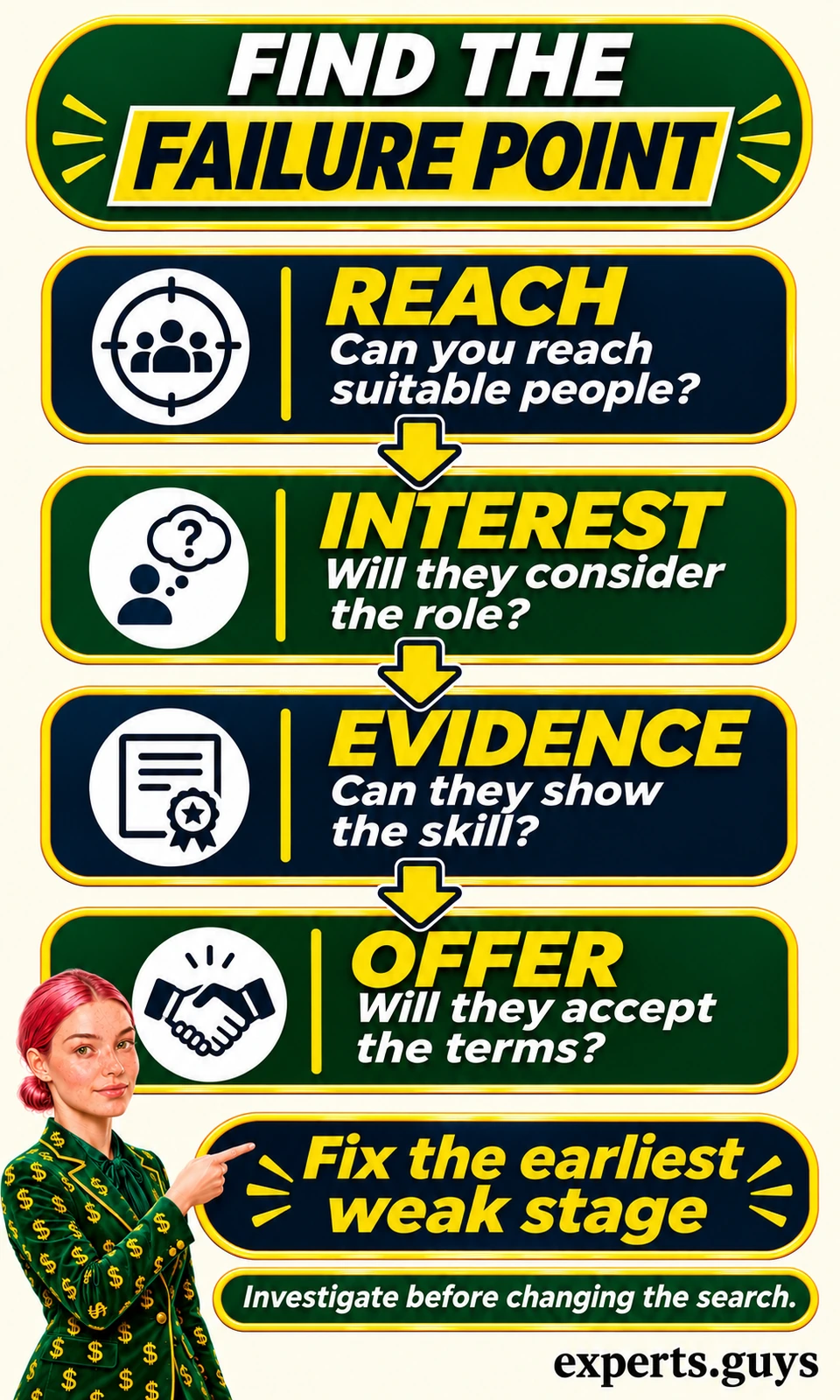
Use a search review when progress stalls. Compare the agreed role with what is actually happening: are suitable people being reached, are they interested, do interviews confirm the required skill, and are offers being accepted? These are different failure points. Increasing CV volume will not fix an uncompetitive working arrangement or a mismatch between responsibilities and compensation.
If the recruiter reaches relevant people but they decline before interview, discuss the opportunity, location, compensation and timing. If candidates attend but cannot demonstrate the required output, revisit calibration and screening evidence. If finalists repeatedly decline offers, examine the offer conditions, decision delays and accuracy of expectations communicated earlier. Treat these as working hypotheses to investigate, not proof that one party caused the problem.
In the manufacturing example, repeated rejection of candidates who only distribute forecasts suggests the ownership criterion was not screened clearly enough. Tighten that question before launching a wider search. By contrast, if candidates with strong ownership evidence decline an entirely on-site arrangement, changing the screening script does not address the obstacle. The employer must decide whether to alter the arrangement, change another constraint or accept the narrower pool.
Avoid changing several requirements at once without telling the search team which trade-off matters. Begin with the earliest identifiable failure point, make one material adjustment and agree what evidence will show whether it helped. For a small search, a verbal progress review is sufficient; a dashboard is unnecessary. Completion is a specific change to the brief, outreach, assessment or offer process with an agreed reason.
A verified recruiting-firm website can confirm service scope, but it cannot prove a consultant is right for your assignment. For example, Robert Half’s U.S. finance and accounting services include contract, full-time and retained executive search options. That illustrates overlap between finance and accounting recruitment, not an endorsement or a comparison of firm performance.
If you are a candidate: understand whose search this is
A recruiter engaged by an employer is working to fill that employer’s vacancy. The consultant may offer useful guidance and introduce other suitable opportunities, but registration does not mean they represent every candidate equally or can create a suitable role on demand. A lack of contact can reflect the assignments available rather than a verdict on your value.
You can use the same ownership distinction as the employer. Explain genuine responsibilities clearly: preparing a forecast, reviewing inputs and owning the assumptions are different claims. State your actual contribution and avoid presenting a team’s result as something you delivered alone. Where results are confidential, explain the decision process and scope without disclosing a previous employer’s numbers or files.
Before an introduction, understand the employer, role, location, compensation structure and information the recruiter proposes to share, subject to legitimate confidentiality constraints. Clarify representation for a specific vacancy if another recruiter or a direct application is already involved. This reduces confusion; it is not an invitation to sign broad restrictions without understanding them.
Be especially cautious about paying to obtain a promised job. The U.S. FTC’s job-scam guidance explains that honest placement firms typically receive their fee from the hiring company, not the candidate, and warns against upfront placement fees. That is U.S. consumer guidance, not a statement that every paid career service worldwide is unlawful. A separately purchased CV or coaching service is different from an employer-paid recruitment assignment.
A legitimate-looking logo, detailed profile or familiar company name does not authenticate the sender. If an approach asks for money or sensitive information unexpectedly, verify the firm through contact details obtained independently from its official site before proceeding. Do not treat an interview invitation as a reason to share bank credentials, transfer money or purchase equipment through an unverified intermediary.
Frequently asked questions
Can an accounting recruiter fill a finance role?
Yes, where the consultant's actual coverage includes the responsibilities involved. Many firms combine finance and accounting recruitment, while individual consultants specialise within that range. Ask about the specific output, seniority and candidate pool rather than assuming the desk name sets a firm boundary.
Does a bigger candidate database mean a better shortlist?
No. Database size does not show whether people have relevant experience, are reachable, are interested or can meet the assignment's constraints. A smaller, well-explained shortlist can be more useful than a large set of CVs with unclear evidence.
Should you give several firms the same vacancy?
That depends on the engagement and how coordination will work. Multiple firms may extend reach, but can also create duplicate introductions and inconsistent messages. Check exclusivity and introduction provisions first, then agree who communicates what. Do not assume several firms automatically create faster or better results.
Is a professional qualification always essential?
No single qualification is essential for every role described as finance. Particular regulated duties, protected titles or employer requirements may require specific credentials in the relevant jurisdiction. Where a qualification is preferred rather than mandatory, assess whether it predicts the actual work better than other evidence.
How long should a finance search take?
There is no reliable universal deadline. Scope, seniority, location, compensation, notice periods and interview decisions all affect timing. Ask for a search plan with meaningful progress updates and distinguish time to identify candidates from time to accept an offer or start work.
Can a recruiter guarantee the person will stay?
No recruiter can control every reason someone leaves. An agreement may provide a conditional replacement, credit or refund, but that is a contractual remedy rather than a guarantee of retention. Role accuracy, management, onboarding and working conditions remain relevant after the search ends.
Summary
Start with the output your team needs, then ask a named consultant to explain the candidate evidence that would demonstrate it. Compare the commercial commitment only after both sides are describing the same search. The clearest proposal is the one that makes responsibilities, assumptions and unresolved questions visible before you commit.
If two firms remain credible, use the calibration conversation as the tie-breaker: which consultant can explain the important distinction in your role and the next question needed to verify it? A confident sales presentation is easier to produce than a clear account of what remains unknown.