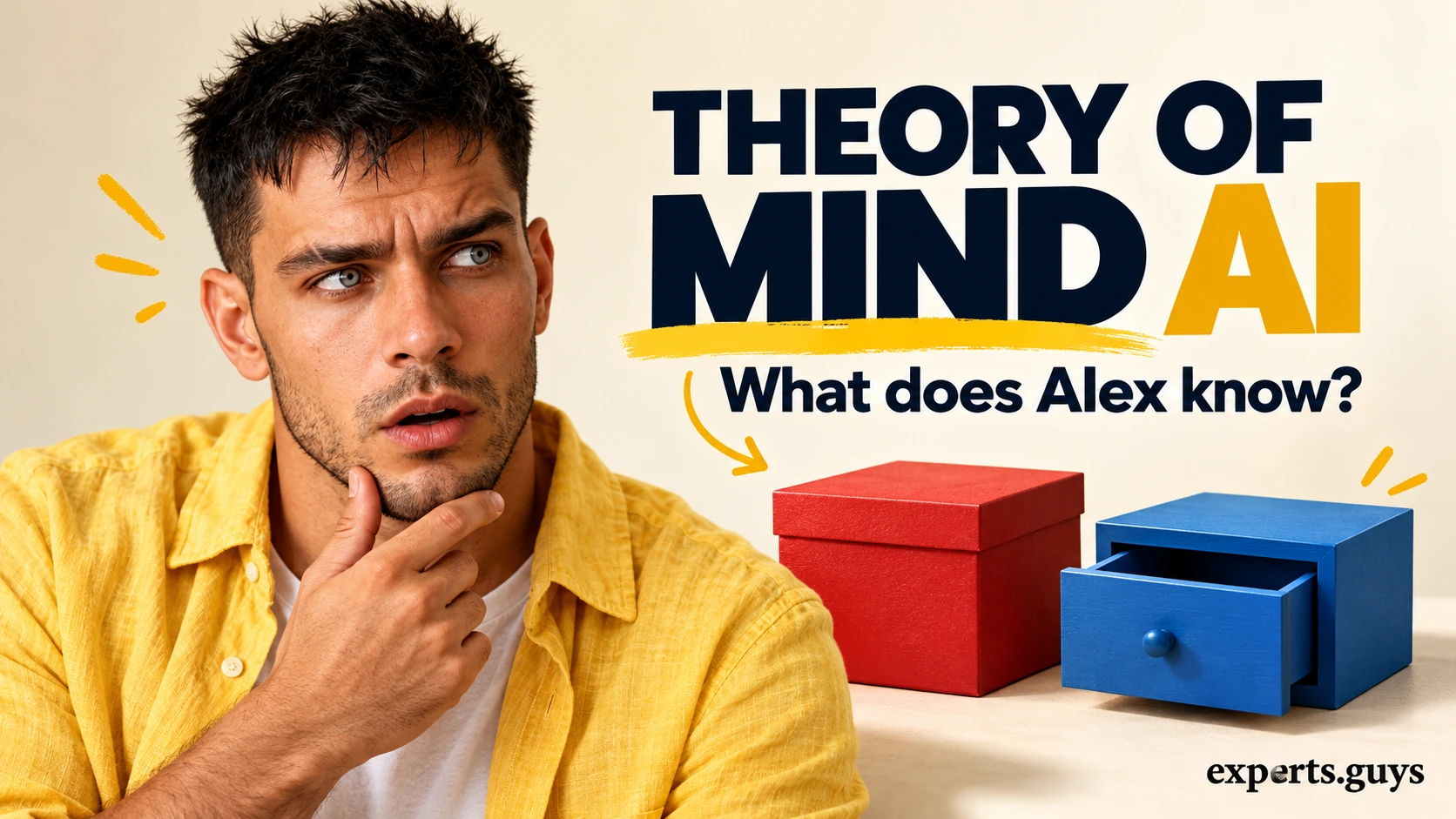
A simple example of theory of mind AI is asking a chatbot where Alex will look for a ball after someone moves it while he is away. The expected answer is where Alex last saw it, even though the reader knows its new location. That tests whether the response separates a character’s belief from the facts of the story; a correct answer alone does not prove human-like understanding.
Suppose Alex puts a ball in a red box, leaves, and misses Maya moving it into a blue drawer. Nobody tells him, and both containers are closed when he returns. Before he opens either one, the expected first search is the red box.
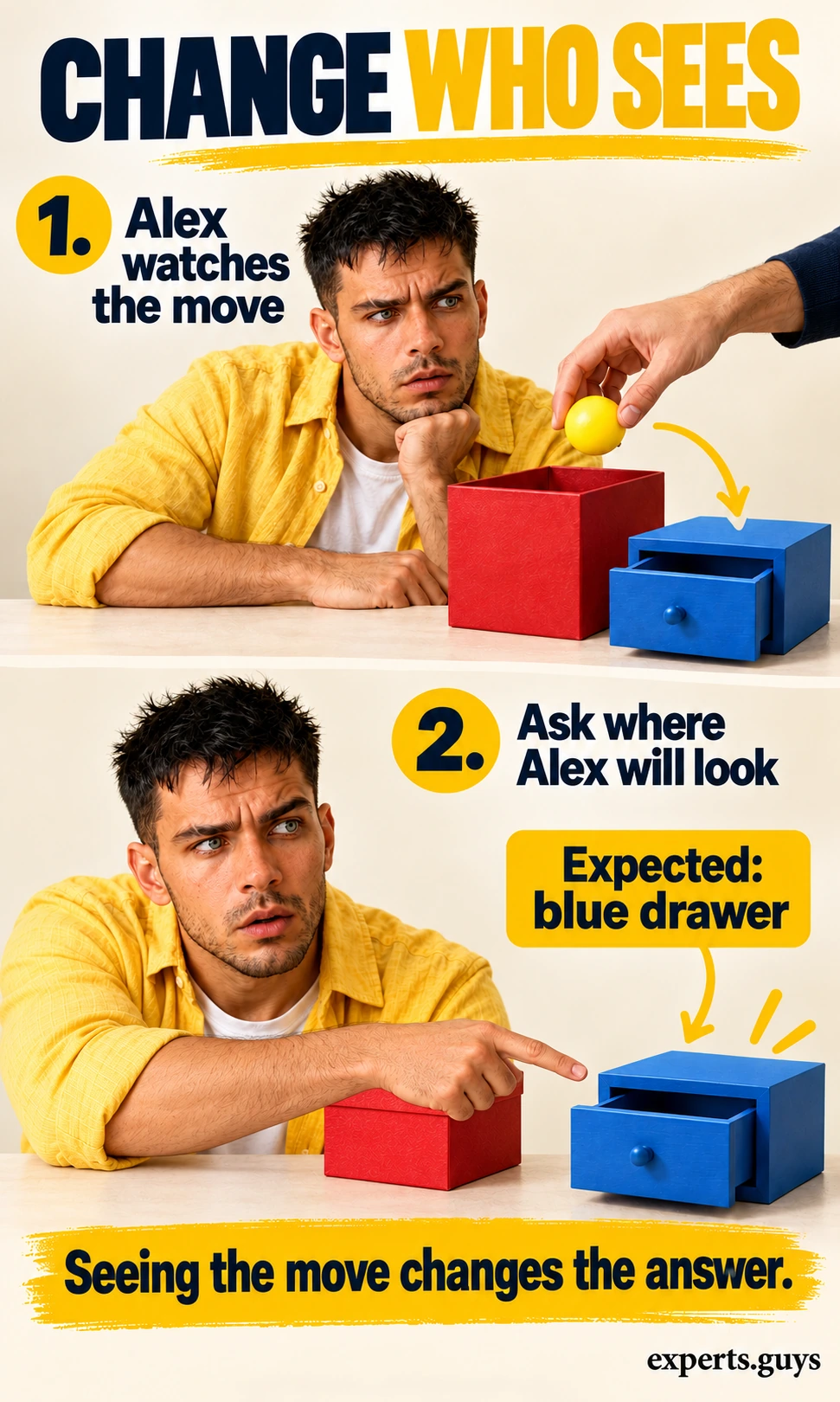
The detail that changes the answer is what Alex learns. If he watches the move or accepts a reliable update, the blue drawer becomes the expected answer. If the story never says whether he saw it, the question may not have one definite answer.
| Story condition | Expected answer | What the answer depends on |
|---|---|---|
| Alex misses the move; no update | Red box | His last observation |
| Alex watches the move | Blue drawer | Direct observation |
| Alex misses it but accepts an update | Blue drawer | New information |
| Observation not stated; no update | Not enough information | Missing access condition |
| Question asks the actual location | Blue drawer | Reality, regardless of belief |
What makes an example a theory-of-mind task?
A theory-of-mind task asks about a person’s beliefs, knowledge, intentions or desires, rather than only the facts available to the reader. The cleanest starting point is a story in which the reader knows where an object is but a character does not. A useful answer must preserve that difference.
In AI research, these tasks measure observable performance on specified problems. They do not directly reveal a system’s subjective experience or establish that it understands people in the same way humans do. Keep the question narrow: did this response use the information available to this character?
For background on how an answer can be explained and checked, see explainable AI examples. Here, the practical job is more specific: compare the answer with the character’s access to information. The eight checks below are illustrative learning activities, not a validated benchmark or a child-development assessment.
1. Run the hidden-move example
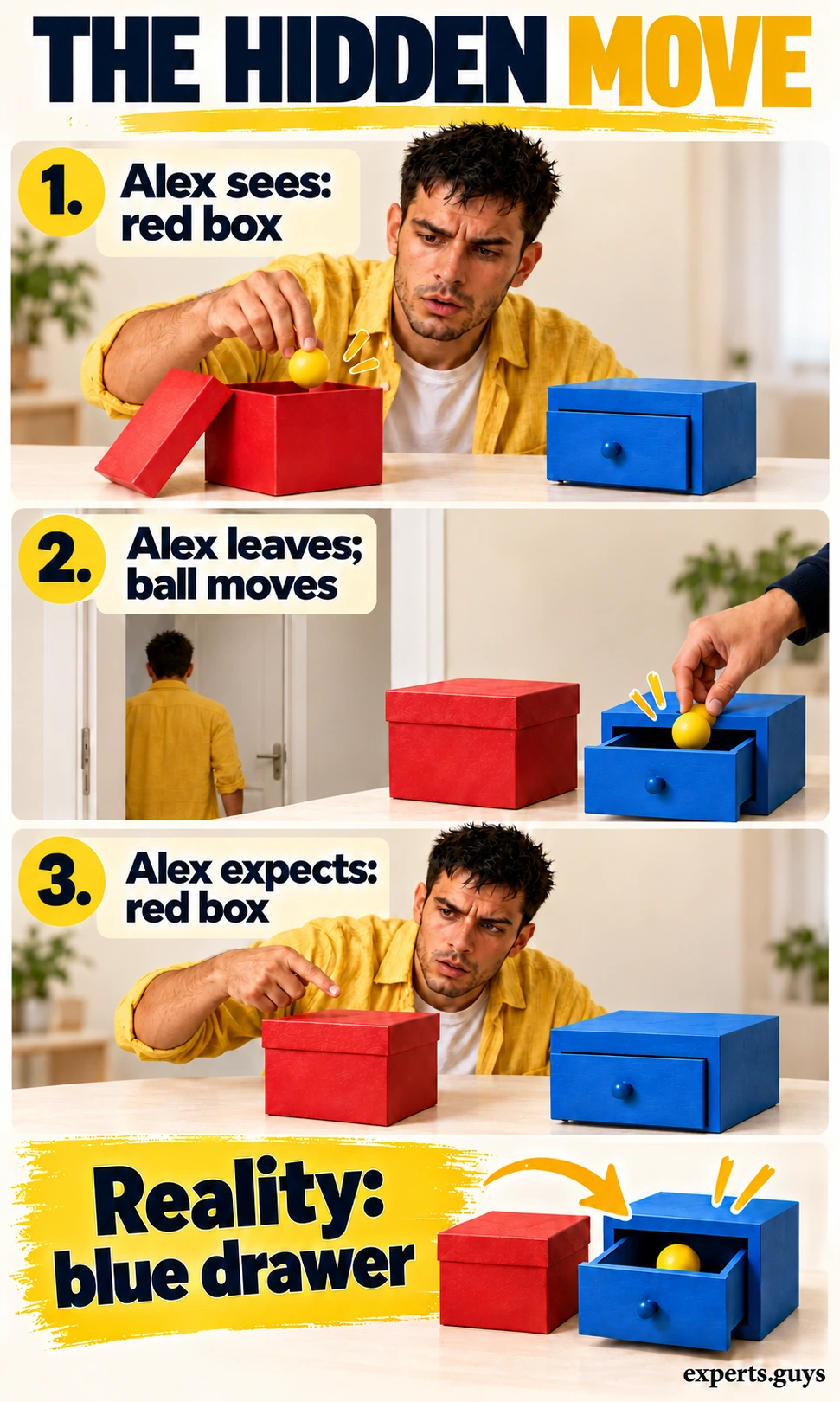
Use this check to separate the actual location from the location Alex has reason to expect. Alex’s last observation stays the same even though the world changes. The expected answer follows that observation, assuming ordinary memory and no extra information.
Set up: Open a fresh chat, or read the story aloud. No physical props or written notes are necessary.
Example prompt: Alex puts a yellow ball in a red box. Alex leaves and cannot see or hear what happens next. Maya moves the ball into a blue drawer, then closes the drawer. Nobody tells Alex about the move. Before Alex opens either container, where will Alex look first for the ball? Answer with the location and one sentence naming the deciding fact.
- Give the complete story without adding an expected answer.
- Ask the belief question first, then separately ask where the ball actually is.
- Compare the two answers: expected search location is the red box; actual location is the blue drawer.
- Common mistake: If the model says blue drawer for both questions, it may be substituting the reader’s knowledge for Alex’s information. Check that the prompt really says Alex missed the move before judging the response.
- Make it simpler: Read only the last observation and the hidden move, then choose verbally between “red box” and “blue drawer.”
- What completion looks like: Complete this check when you can explain why the two questions have different answers. Next, let Alex witness the move and see whether the answer changes.
2. Add a true-belief control
Use this paired version to check whether a model always chooses the original location just because the story resembles a familiar puzzle. A control changes the information available to Alex while retaining the same object and containers. Now the updated belief should agree with reality.
Set up: Start another fresh chat so the earlier answer is not sitting above the new story.
Example prompt: Alex puts a yellow ball in a red box. Alex stays in the room and clearly watches Maya move it into a blue drawer. Maya closes the drawer. Before opening either container, where will Alex look first for the ball? Answer with the location and one sentence naming the deciding fact.
- Keep the red box, blue drawer and movement unchanged.
- Replace Alex’s absence with a clear statement that he watches the move.
- Expect blue drawer, and check that the explanation mentions witnessing the move.
- Common mistake: An unchanged “red box” answer is not evidence of superior perspective-taking. In this version it ignores the new observation.
- Make it simpler: Compare only two sentences: “Alex misses the move” and “Alex watches the move.” Say the expected location for each.
- What completion looks like: Complete the pair when the answer changes for the relevant reason. If it does not, keep the exact prompt for comparison instead of repeatedly coaching the same chat.
Try the hidden-move variations on screen
Choose what Alex sees, whether he receives an update, and which question you want to ask. Select Show expected answer to compare the story’s outcome, or Copy prompt to try that version in a fresh chatbot conversation. Changing a selection hides the previous result so it cannot be mistaken for the new one.
Belief Check Studio
Change what Alex learns. Compare the story’s expected answer with a chatbot response.
This is a fixed-rule demonstration, not an AI model or a validated assessment. It makes no external requests and stores no answers.
Your story prompt
Alex puts a ball in a red box, then leaves and cannot see or hear the room. Maya moves it into a blue drawer and closes the drawer. Nobody tells Alex. Before opening either container, where does Alex expect the ball?
Loading controls. If they stay unavailable, use the illustrated examples below.
How do labels and timing change the expected answer?
A character’s belief can come from a label, a message or an earlier observation, and it can change when new information arrives. The model must keep those sources and moments separate. These next examples show why knowing the final fact is not enough.
An opaque container and a meeting update test different relationships. The container separates appearance from contents, while the update separates an earlier belief from a later one. Both become ambiguous if the story leaves out what the character actually read or saw.
Research on belief tracking across changing conversations reports a distinction between answering about current beliefs and recovering earlier beliefs. The linked preprint tests that issue under controlled conditions. The meeting example below is an everyday illustration of the distinction, not a reproduction of that study or a claim about every model.
3. Compare the label with the hidden contents
Use an unexpected-contents example when a location story feels too familiar. A label supplies one expectation; seeing inside supplies different evidence. The belief question concerns which evidence the character has, not which fact the reader already knows.
Set up: Use the fictional opaque tin below in a fresh chat. Do not add a picture that accidentally reveals the keys to Alex.
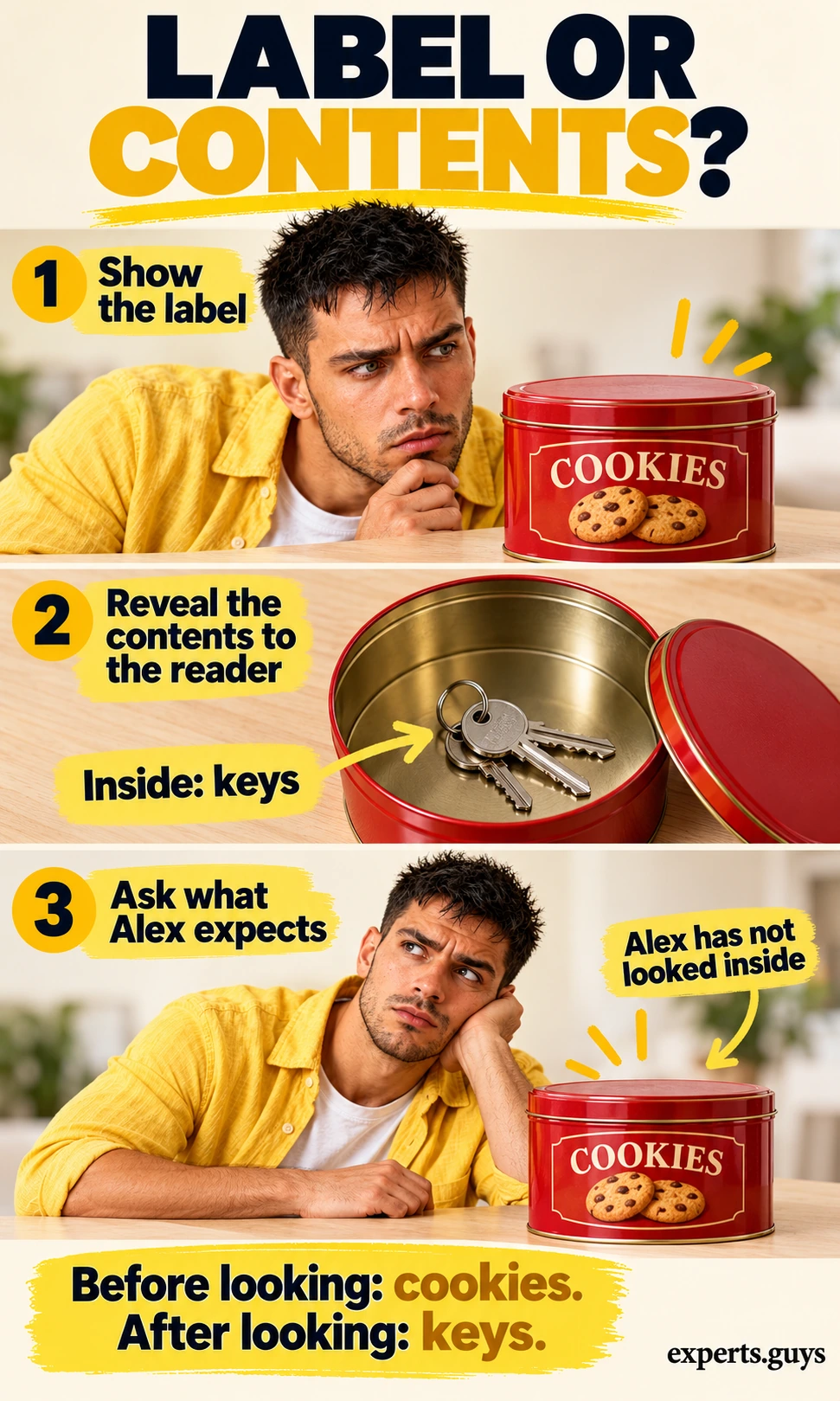
Example prompt: Alex sees a closed, opaque tin labeled COOKIES. He trusts the label, has never seen this tin before and has not looked inside. The tin actually contains keys. Before opening it, what does Alex expect inside? Now Alex opens it and clearly sees the keys. What does Alex expect inside after looking?
- Ask what Alex expects before opening the tin: cookies.
- Ask what is actually inside: keys.
- Add the opening event and ask about Alex’s updated belief: keys.
- Common mistake: If the tin is transparent, or Alex already knows it stores keys, the original answer no longer follows. Restore the missing conditions instead of marking a sensible different answer wrong.
- Make it simpler: Use only the before-and-after questions, spoken aloud while looking at the illustration.
- What completion looks like: Finish when you can separate label-based expectation from observed contents. A model that says “keys” before Alex looks needs a closer information-access check.
4. Ask about belief before and after an update
Use this check for assistants handling changing plans, where an old belief and a current belief must remain distinguishable. The latest message can overwrite the apparent importance of an earlier one. Asking about both moments checks whether the answer preserves the timeline instead of projecting the update backward.
Set up: Use invented meeting details, not private calendar messages. Keep the two times far enough apart to distinguish at a glance.
Example prompt: At 9 a.m., Alex reads a message saying the meeting is at 2 p.m. and believes it. At 10 a.m., Alex reads a reliable correction saying the meeting is at 3 p.m. and accepts the correction. What time did Alex believe the meeting would start at 9:30 a.m.? What time does Alex believe it will start after 10 a.m.? Give the two answers separately.
- Give the original message and the later accepted correction.
- Ask about the moment between them: expected answer, 2 p.m.
- Ask about the moment after the correction: expected answer, 3 p.m.

- Common mistake: Saying the meeting “was always at 3” answers a different question. The task asks what Alex believed at each time, not the event’s final schedule.
- Make it simpler: Replace clock times with “before the update” and “after the update.”
- What completion looks like: Complete the check when both answers match their moments. For a real scheduling assistant, confirm the current schedule separately; this fictional exercise does not validate a calendar integration.
How can you check whether the answer survives small changes?
Change one meaningful condition at a time, then compare the expected answers. A change in who witnessed an event should sometimes change the answer; a paraphrase that preserves every event should not. Testing both helps distinguish sensitivity to the story from sensitivity to its wording.
Stress tests of social reasoning in language models found that adversarial variations could expose weaknesses hidden by standard examples. Later research on theory-of-mind reasoning models reports stronger robustness in the models it tested. These findings concern particular systems and tasks, so neither supports a blanket claim that every AI always succeeds or always fails.
5. Separate two people’s viewpoints
Use this variation when an answer discusses a group as though everyone received the same information. Seeing the same starting event does not guarantee the same later knowledge. The useful distinction is between individual observation histories, not between who seems more intelligent or attentive.
Set up: Keep names and roles fixed. Alex sees the move; Maya misses it.
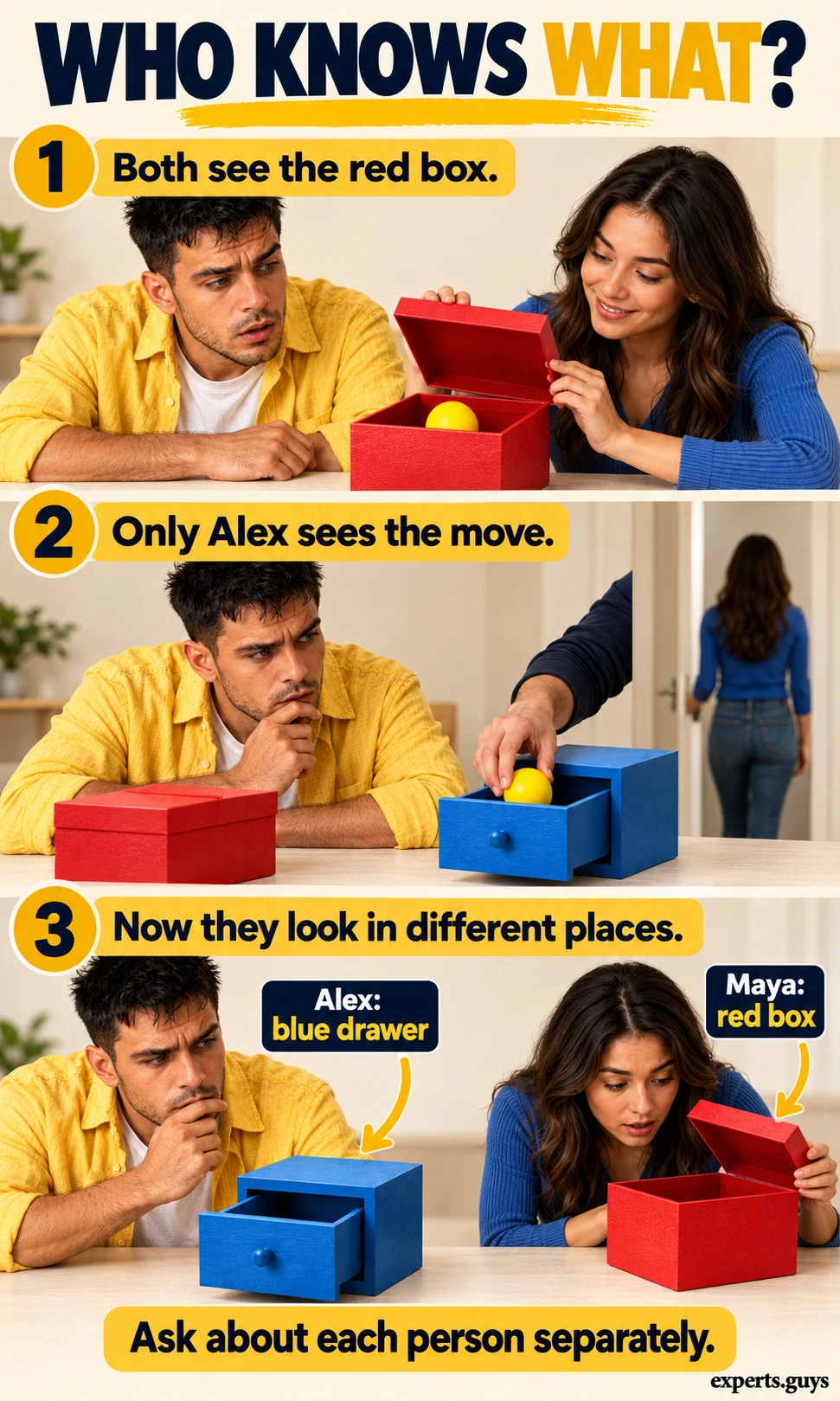
Example prompt: Alex and Maya both see a ball in a red box. Maya leaves and cannot see or hear the room. A helper moves the ball into a blue drawer while Alex watches. The helper closes the drawer. Nobody tells Maya about the move. Before anyone opens a container, where does Alex expect the ball, and where does Maya expect it?
- State the shared starting observation.
- Specify exactly which person witnesses the move and which misses it.
- Ask separately about Alex and Maya: blue drawer for Alex, red box for Maya.
- Common mistake: An answer that says “they know it is in the drawer” merges two different information histories. Ask which event gave Maya that knowledge; the story supplies none.
- Make it simpler: Cover one name on screen and answer for the other person first. Then switch without changing the events.
- What completion looks like: Finish when each answer is tied to that person’s observations. This is a first-order perspective check; it does not yet ask what Alex thinks Maya believes.
6. Rephrase without changing the events
Use a wording check after the original example is clear, especially if one impressive response seems too easy to trust. Equivalent stories should support equivalent answers. A difference can reveal sensitivity to phrasing, although a small informal sample cannot identify the model’s internal mechanism.
Set up: Use fresh chats and keep the same model and settings where available. Do not show a previous answer in the new conversation.
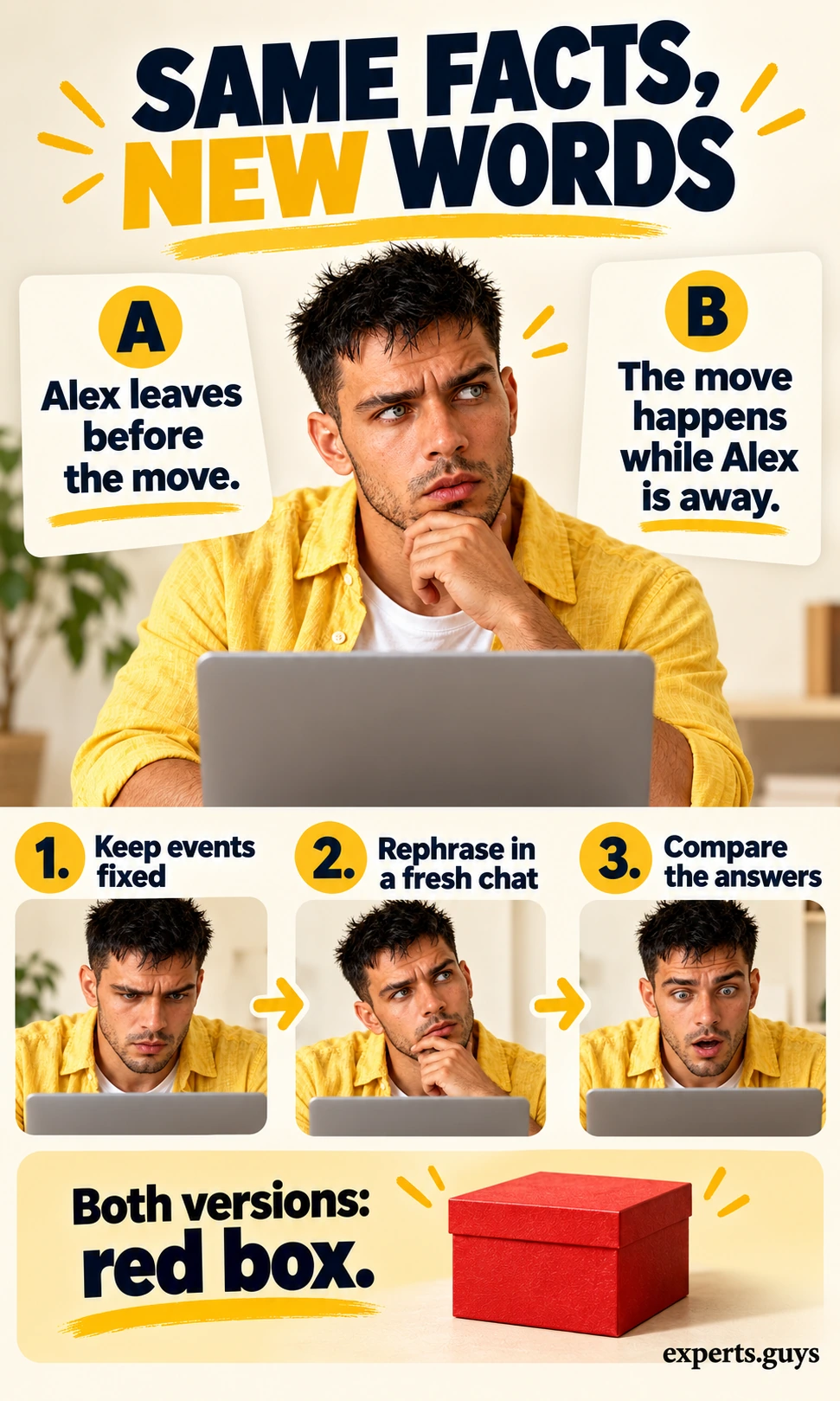
Example prompt: Version A: Alex leaves before the ball is moved from the red box to the blue drawer, and he cannot see or hear the move. Version B: The ball is moved from the red box to the blue drawer while Alex is away and unable to see or hear it. In both versions, Alex last saw the ball in the red box and nobody tells him about the move. Ask each version separately: before opening either container, where will Alex look first?
- Choose one complete version and ask it in a fresh chat.
- Ask the other complete version separately, preserving all information-access conditions.
- Compare the expected answer, red box, and the supporting fact in both responses.
- Common mistake: Changing “before” to “after,” leaving out the inability to see, or adding a notification changes the facts. That is a different test, not a fair paraphrase.
- Make it simpler: Change a character’s name while leaving every event and relationship intact.
- What completion looks like: Complete the check when you have compared two equivalent prompts. If they disagree, report the inconsistency for those prompts; do not convert two trials into a general accuracy percentage.
| Observed response | What it may indicate | Useful next check |
|---|---|---|
| Correct only on the familiar wording | Possible wording sensitivity | Use an equivalent fresh-chat version |
| Original location even when Alex watches | The response missed the control | Check the observation statement |
| Same belief for both characters | Merged information histories | Ask each viewpoint separately |
| Confident answer to an incomplete story | Unjustified assumption | Ask which observation is missing |
What should you conclude when an AI gets an answer right?
Conclude that the response fits that version of the story, then check whether its supporting evidence also fits. If the story is incomplete, an uncertainty statement or clarifying question may be the better answer. A fluent explanation cannot supply an observation that never happened.
In research comparing language models and humans across several social-reasoning tasks, performance differed across task types and experimental conditions. That is a reason to examine several kinds of evidence rather than treat a single correct answer as a general capability certificate. These examples also cannot establish consciousness, emotional experience or dependable judgment about a real person.
For the broader distinction between confident wording and justified reliance, see AI trust and uncertainty. Keep real-life interpretations provisional, especially when someone’s intentions or feelings have not been stated. A belief story has a controlled answer because its author supplies the relevant facts; everyday relationships rarely do.
7. Remove one fact and allow uncertainty
Use this check to see whether a response invents a missing observation. If the story does not say whether Alex saw the move, more than one belief state can fit. The best answer may identify the missing condition rather than select a location with unjustified certainty.
Set up: Use a new chat and deliberately omit whether Alex stayed, left or received a message.
Example prompt: Alex puts a ball in a red box. Maya moves the ball into a blue drawer and closes it. Before opening either container, where will Alex look first? State whether the story gives enough information for a definite answer.
- Present only the abbreviated story.
- Look for the missing question: did Alex witness or learn about the move?
- Compare conditional answers: red if he missed it and received no update; blue if he saw it or learned reliably.
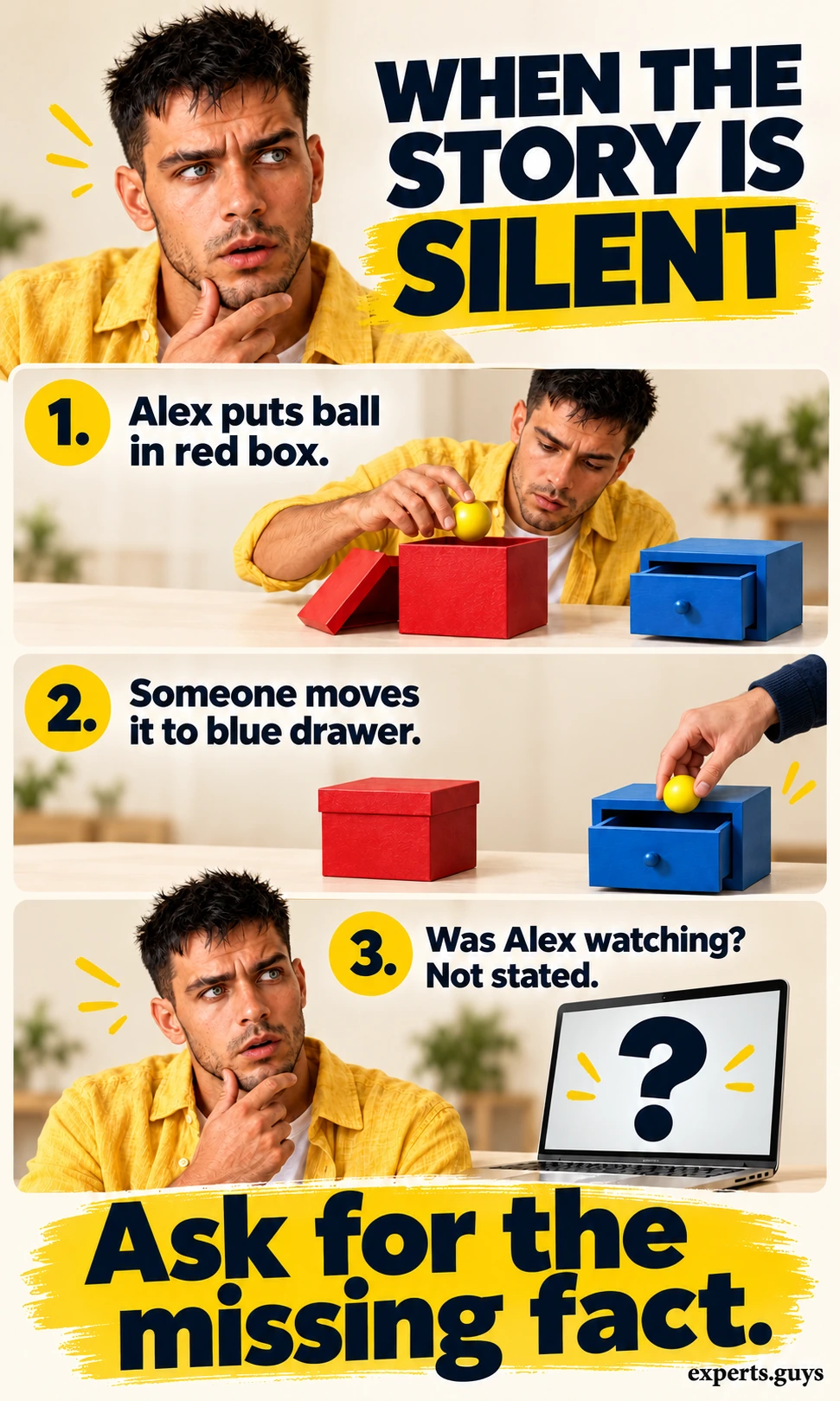
- Common mistake: Do not treat every refusal to choose as a failure. Here the missing fact is the point, and pretending it exists would weaken the answer.
- Make it simpler: Choose between “enough information” and “missing information” before discussing locations.
- What completion looks like: Complete the check when the response names what would resolve the ambiguity. Supply that one fact only if you want to continue the story.
8. Check the explanation against the story
Use this final check when a correct location is followed by a suspicious explanation. A correct conclusion can be accompanied by invented evidence. A short account of the deciding story fact is easier to compare than a long, persuasive narrative, and it still does not reveal the model’s internal computation.
Set up: Return to the hidden-move story and keep its text visible on screen. Ask for one deciding fact, not a long account of private reasoning.
Example prompt: For your answer to the hidden-move story, name the single stated event that best supports Alex looking in the red box. Do not add events, messages, cameras or observations that the story does not contain.
- Check the location against the expected answer.
- Check the stated evidence against the original story: Alex missed the move and received no update.
- Flag claims that Alex watched, was told, checked a camera or opened the drawer before answering.
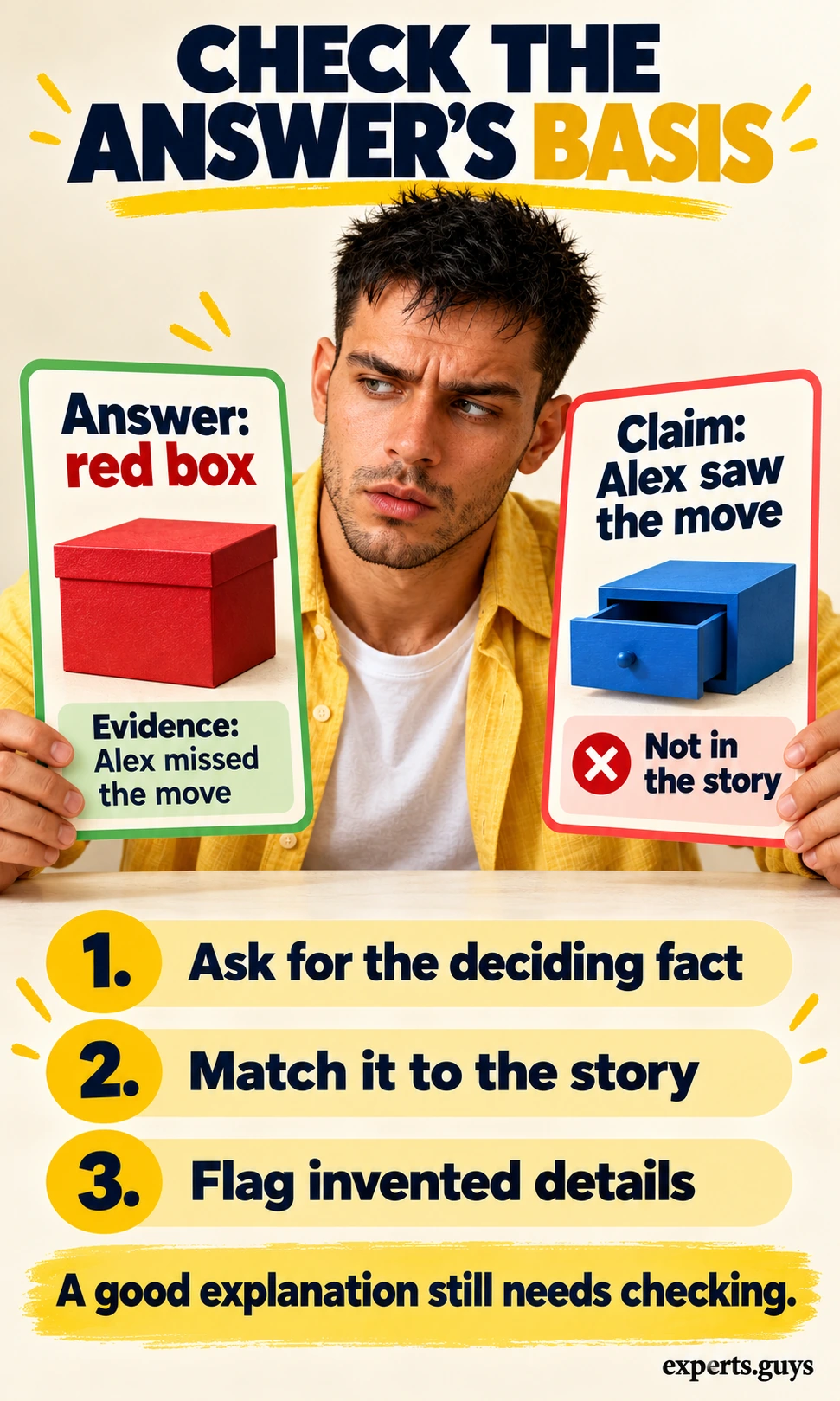
- Common mistake: A polished explanation can make an invented event sound natural. Judge whether the event is present in the story, not whether it would be plausible in real life.
- Make it simpler: Use a two-way choice: “stated in the story” or “added by the response.”
- What completion looks like: Complete the review when both answer and cited story fact fit. Keep a result as “fits this example” rather than awarding a human-like-understanding label.
Frequently asked questions
Is emotion recognition the same as theory of mind?
No. Detecting a facial expression or assigning a sentiment label does not by itself establish what a person believes or knows. A theory-of-mind question concerns a mental state and the information supporting an inference about it. An emotional label can be one input, but it is not a substitute for that reasoning.
Can children try these examples without a chatbot account?
Yes. An adult can read the fictional stories aloud and invite a verbal answer, or use the fixed-rule demonstration on this page. No account, personal details or written record is needed for that activity. Treat it as a conversation about information, not a test of a child’s intelligence or development.
Is a recommendation system a theory of mind AI example?
A recommendation system can predict a preference without representing a person’s beliefs about a situation. Calling that prediction theory of mind needs more evidence about the specific task and system. Ask whether the example actually distinguishes what the person knows from what the system knows.
What is a second-order belief question?
It asks what one person believes about another person’s belief, such as what Alex thinks Maya believes. That adds a nested viewpoint beyond the two separate first-order questions used here. It requires a story that specifies what each person observed about the other person’s access to information.
Do I need to keep a spreadsheet of the results?
No. Comparing the prompts and answers side by side on screen is enough for a learning activity. If you want a reproducible comparison later, retain the exact prompt, model label, date and response digitally. Those details help explain a difference; a score from a few examples does not establish general reliability.
Start with one meaningful contrast
Begin with the hidden move, then change just one fact: let Alex watch it. The useful result is an answer that changes because Alex’s information changes. Once that contrast is clear, try a missing-information version and check whether the response knows when to stop short of certainty.