Environmental exposures such as air pollution, noise and some chemicals are studied in relation to mental health. The evidence can inform prevention and further research, but it does not establish that a particular exposure caused one person’s depression. The useful approach is to read the claim carefully, check the actual situation and choose proportionate steps that reduce avoidable exposure.
This guide concerns physical exposures. It does not treat every difficult life circumstance as an environmental toxin or recommend a “detox” programme. Social pressures and practical burdens belong in the broader causes of depression discussion. Keeping the scope clear makes it easier to distinguish an air or noise question from a general explanation of distress.
Begin with the exposure and outcome actually measured
A study needs a definition of exposure: an estimated outdoor concentration, a noise measure, a reported workplace history or another specific indicator. It also needs a definition of the mental-health outcome. A symptom questionnaire, a recorded diagnosis and use of a service do not necessarily describe the same thing.
The National Institute of Environmental Health Sciences’ air-pollution overview describes a broad research field, including associations with mental-health outcomes. A finding in a particular population or time period should retain that context. It should not be restated as the same effect for every age, location and pattern of exposure.
Other differences matter too. Traffic exposure can coincide with noise, housing conditions, access to green space and economic circumstances. Researchers try to account for relevant factors, but observational evidence can still leave uncertainty. Asking what else differed is not dismissing the research; it is part of understanding what the result can support.
An illustrative headline saying “pollution linked to depression” leaves several questions open. Which pollutant, over what period, in whom, and measured how? Did the study investigate a new diagnosis or a change in questionnaire responses? The answers determine whether the headline is useful for your question or only broadly related to it.

Separate a plausible pathway from a personal cause
Research can examine possible biological pathways while also studying population relationships. These are complementary questions, not interchangeable proof. A laboratory mechanism does not establish that it occurred at a meaningful level in a particular person, and a population association does not identify a unique pathway.
NIEHS’s supported air-pollution research includes work on exposures and their health implications. The field’s breadth is a reason to be precise about the agent and setting. “Environmental chemicals” is too broad a label to tell you which exposure, dose or control matters.
The European Topic Centre report on air pollution, chemicals, noise and mental health brings several evidence areas together. It is useful for seeing the range of research and its uncertainties. It does not turn an address or a product ingredient list into a personal diagnostic test.
Noise has its own measurement problems. Continuous traffic, intermittent machinery and a sudden disruptive sound are not interchangeable exposures. A systematic review of environmental noise and depression examines associations across a limited and varied evidence base. Avoid converting an average finding into a universal threshold for a mental-health diagnosis.
For an individual concern, begin with what is directly observable: the source you are worried about, when the exposure occurs, what symptoms or disruption happened and whether a hazard has been identified. You do not need to assign a psychiatric cause before asking a building manager, safety team or health professional to investigate a specific problem.
| Finding | Reasonable use | Overstatement to avoid |
|---|---|---|
| Long-term air exposure associated with a mental-health outcome | Investigate exposure, methods and prevention questions | Pollution is proven to be the sole cause of my depression |
| Noise associated with depressive symptoms | Consider sleep disruption and practical noise concerns | Every noisy home produces the same illness |
| Chemical exposure studied in an occupation | Check the specific agent, dose and workplace controls | Any chemical smell proves toxic injury |
| An air cleaner reduces some indoor particles | Consider it within source control and suitable ventilation | Buying a device is an established depression treatment |
Use current local advice for current air conditions
A research article about long-term exposure does not replace today’s official air-quality guidance. Conditions, advice and personal vulnerability can differ. In Singapore, use NEA’s haze information and the Ministry of Health haze guidance for the relevant current advice. Elsewhere, use the corresponding local authority rather than importing another country’s index thresholds.
Open the current advisory and match its guidance to the activity and the people involved. A person with a relevant existing condition may need different precautions from someone without it. Avoid guessing from smell, visibility or a screenshot of an old reading; these do not provide the same information as a current official advisory.
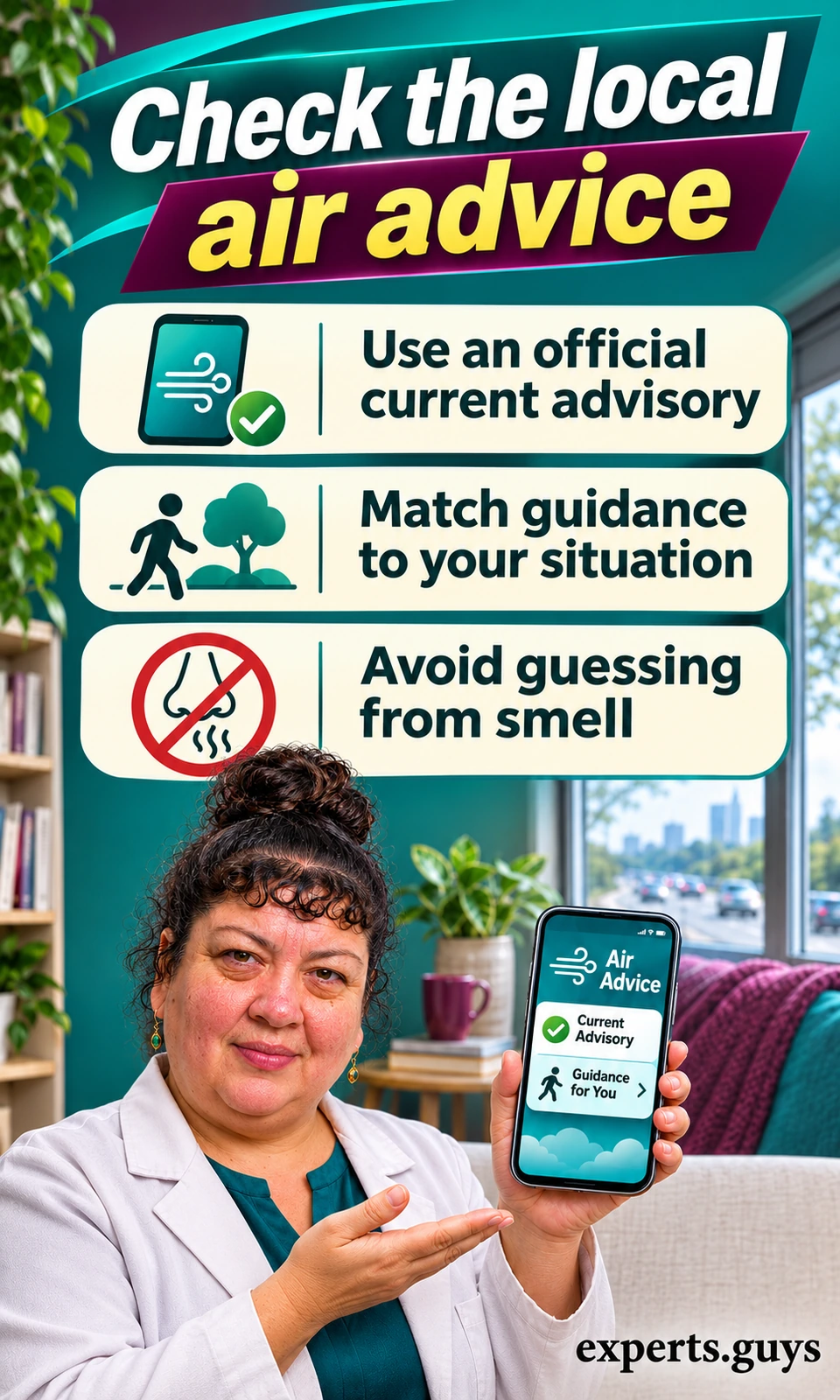
This step is about exposure and general health protection, not testing whether pollution explains your mood. If following an advisory changes your plans, choose a feasible alternative rather than assuming all activity must stop indefinitely. The appropriate adjustment depends on the guidance and circumstances; this article does not invent a new air-quality rule.
Reduce one avoidable source without creating another problem
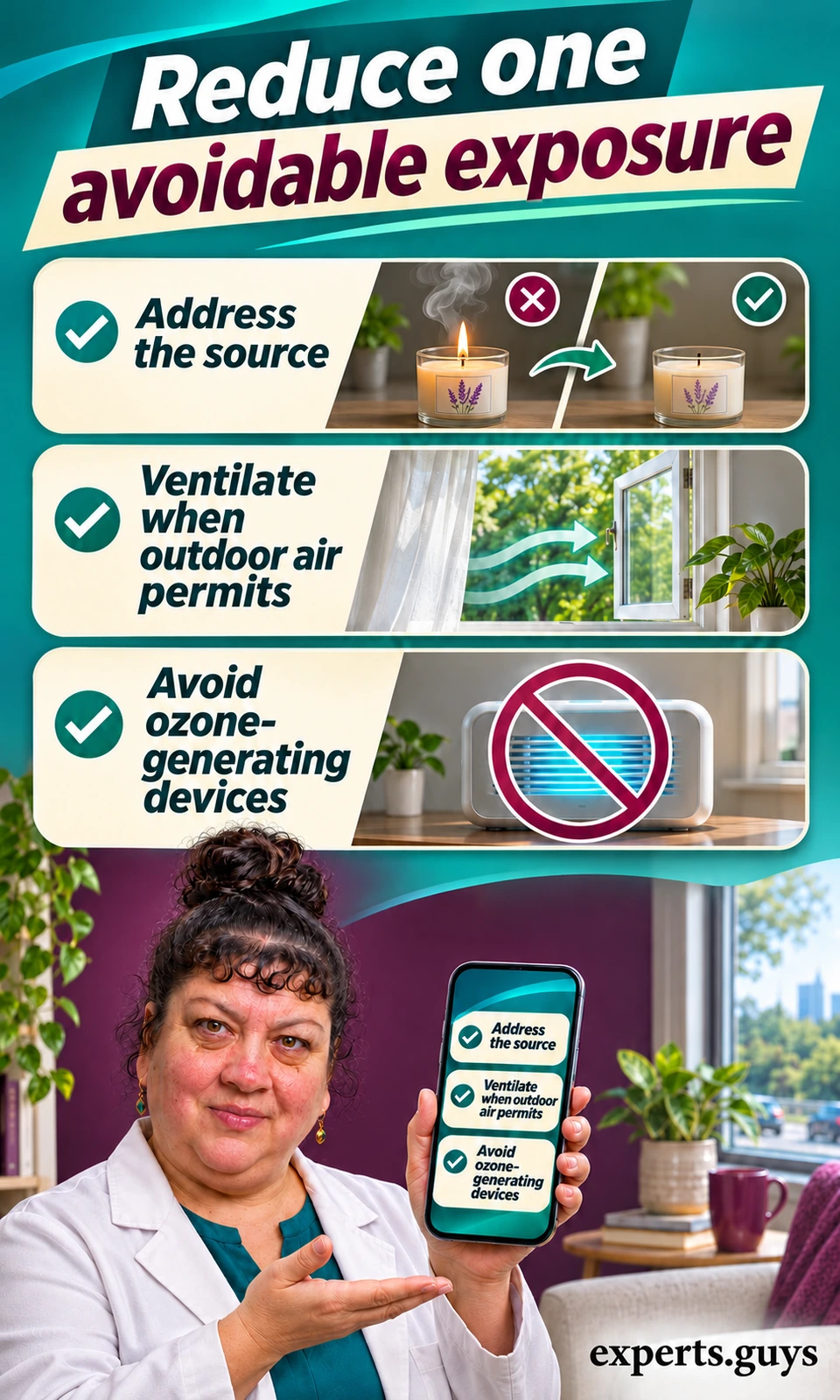
Start with an identifiable source where you have some control. For example, if an indoor activity produces smoke or strong emissions, address that source through an appropriate safe process rather than trying to cover it with fragrance. If the concern is outside, ventilation decisions need to consider outdoor conditions as well as the indoor setting.
- Identify the specific source or period of exposure you can reasonably address.
- Follow current local guidance before changing outdoor activity or ventilation.
- Use appropriate source control and suitable ventilation for the situation.
- Avoid devices that intentionally generate ozone.
- Route unresolved building or workplace hazards to the responsible team.
The EPA guide to air cleaners in the home places filtration within a broader approach that includes source control and ventilation. A device has to match the air-cleaning task; the existence of a filter does not establish that every pollutant is removed or that a health condition will improve.
EPA also explains concerns about ozone generators sold as air cleaners. Do not assume that “fresh” smelling air or a marketed purification effect means a device is safe for an occupied room. No product purchase is necessary to apply the evidence-reading framework in this article.
Send the concern to the right route
A recurring ventilation fault or water-damaged area may need a building investigation. A workplace chemical concern may require the organisation’s safety process and information about the specific substance. A new health symptom needs health assessment. These routes can operate together; the resident or worker should not have to prove a depression mechanism before a concrete hazard receives attention.
When contacting the responsible team, describe the location, source and timing in ordinary language and include existing information such as a relevant product label or official incident notice if available. Do not enter an unsafe area, mix chemicals or perform an improvised exposure test to gather evidence. A useful report is specific and safe, not exhaustive.
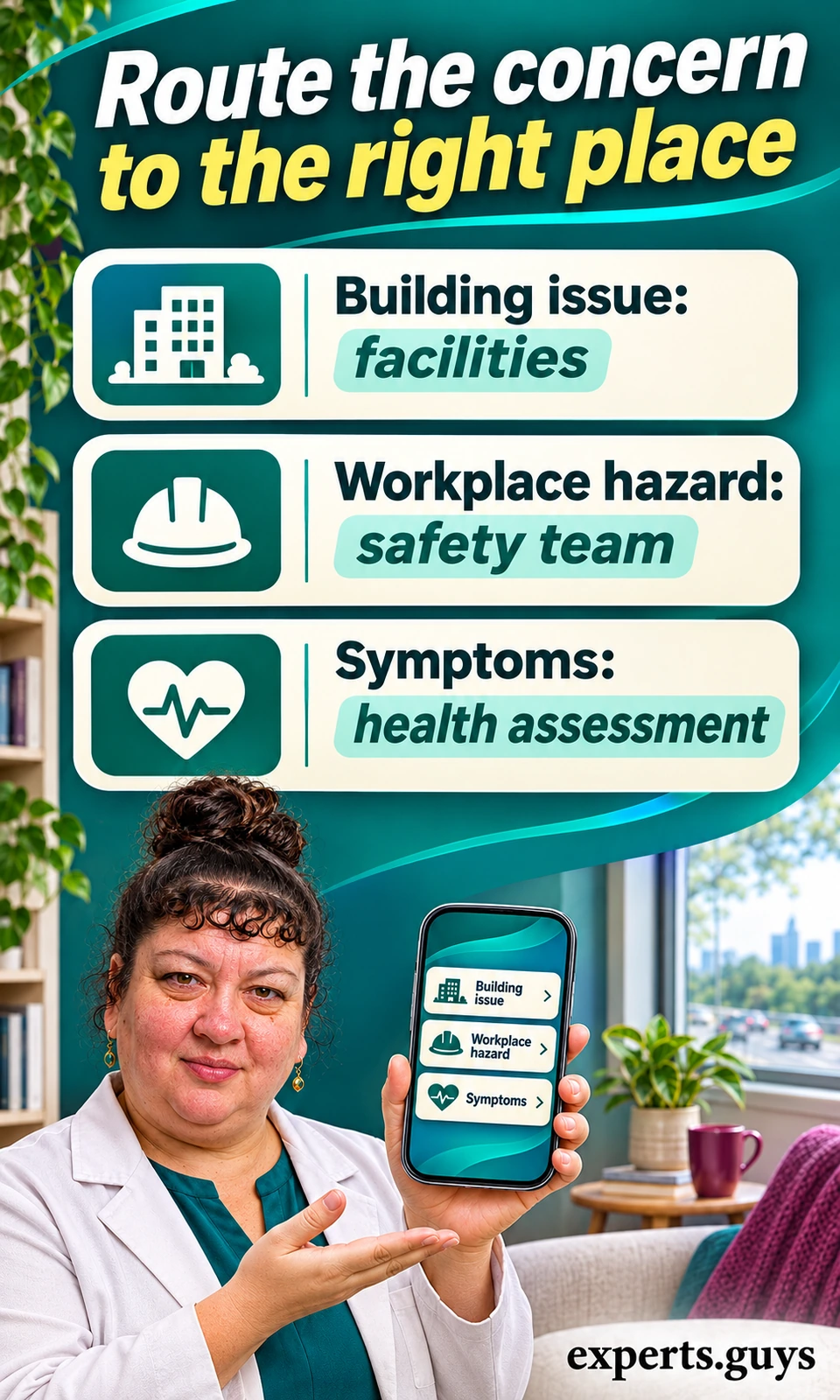
New symptoms after a suspected exposure should be described with that context, while allowing for other possible explanations. Severe breathing difficulty, collapse or immediate danger requires emergency help. For ongoing low mood and functioning difficulties, the NIMH depression guide provides a broader clinical context; an environmental hypothesis should not delay support.
The separate depression theories comparison explains why a biological, psychological or social model answers only part of a question. Here the boundary is the same: you can address a plausible exposure concern without claiming that it explains the whole illness. You can also receive depression care while the environmental question remains unresolved.
Frequently asked questions
Can pollution cause my depression?
Research can investigate population relationships and possible pathways. It cannot identify the cause of an individual’s depression from an address, smell or general exposure estimate.
Should I move because of a study?
A study alone is not a sound basis for a major relocation decision. Start with the actual exposure, official advice, feasible controls and any specific hazard assessment.
Does an air purifier treat depression?
This article makes no such claim. Filtration can be considered for an indoor-air purpose within broader source control and ventilation; that is different from evidence of depression treatment.
Should I use an ozone generator to clean the air?
EPA guidance warns about ozone generators sold as air cleaners. Avoid devices that intentionally generate ozone in occupied spaces; assess an air-cleaning need using appropriate guidance.
What should I do about symptoms after a suspected exposure?
Seek an appropriate health assessment and explain the suspected agent, timing and symptoms. Severe breathing difficulty, collapse or immediate danger needs emergency help. Do not wait for an online causal conclusion.
Next steps
Choose one specific exposure concern. Check the current official guidance, identify a feasible control or the team responsible for investigation, and keep any symptom concern connected to appropriate assessment. Let the evidence guide a proportionate action rather than a costly purchase, a personal verdict or an unsupported cure claim.