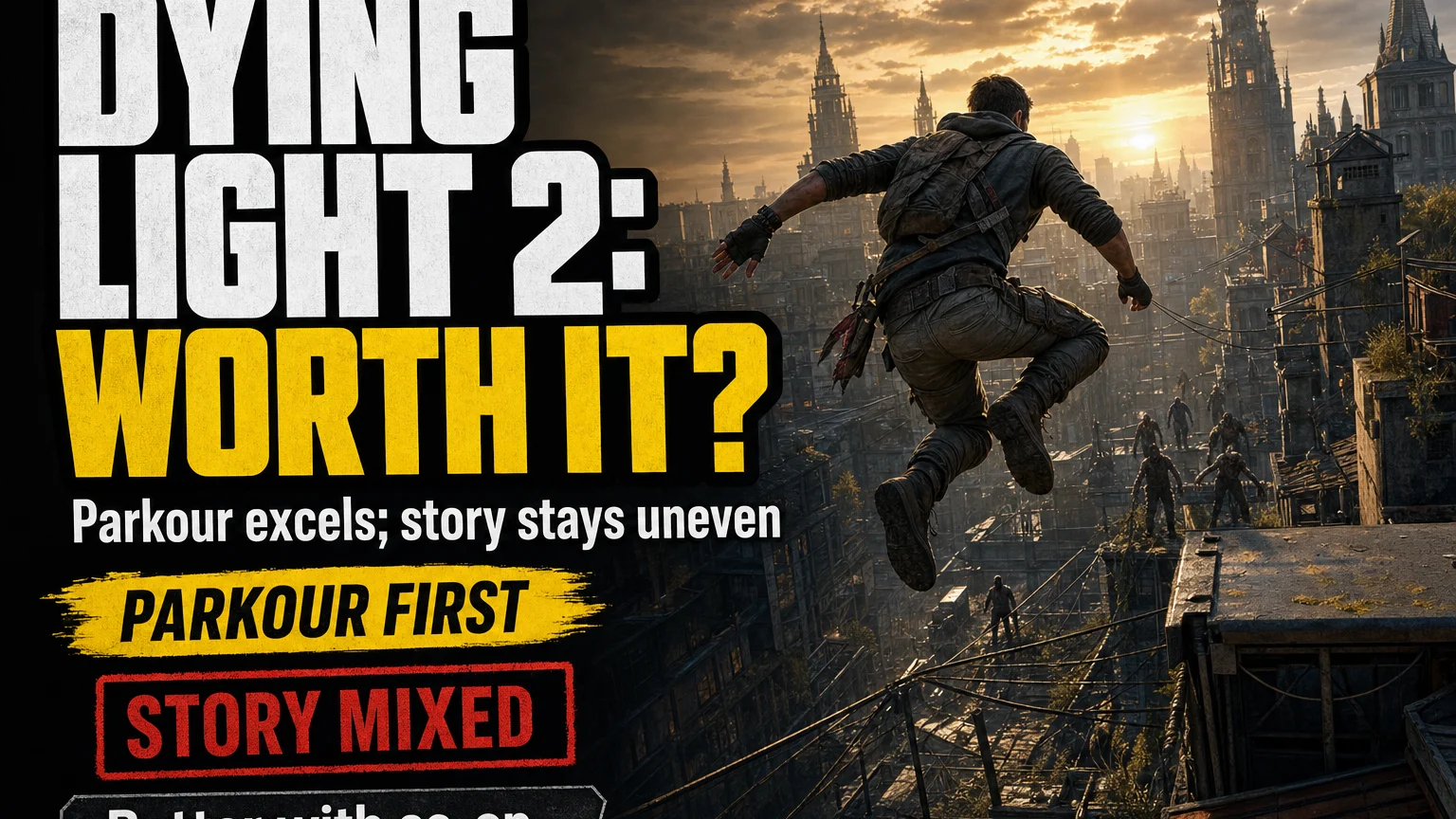

Dying Light 2 is worth playing if parkour, melee combat, open-world movement and co-op matter more to you than a consistently strong story. The current version is a much fuller game than the launch build, with firearms, Bloody Ties, permanent Tower Raid, community maps and mods, and faster early progression now layered onto the original campaign. Players who mainly want the oppressive nighttime horror and tighter atmosphere of the first Dying Light should go in with more caution, because Villedor is still built more like a large action-RPG playground than a direct recreation of Harran.
| If You Care Most About | How Dying Light 2 Fits | Main Caveat |
|---|---|---|
| Parkour and movement | Excellent fit. Movement is the strongest reason to play. | The early hours still feel more limited before key movement skills open up. |
| Melee combat | Strong fit. Kicks, environmental attacks and weapon impacts work especially well with vertical terrain. | Loot tiers and action-RPG systems can make the combat feel less grounded than the first game. |
| Story and characters | Mixed fit. Choices change some routes, relationships and outcomes. | The writing and pacing are less consistent than the movement and combat systems. |
| Nighttime horror | Good if you enjoy risk-reward exploration and chases. | The tone is usually more action-focused and less oppressive than the first game. |
| Co-op | Strong fit for groups that want open-world chaos and shared missions. | Verify your exact platform combination and current service status before buying specifically for multiplayer. |
| Long-term replay value | Much stronger than at launch because the game now has more repeatable modes and community content. | How much that matters depends on whether you enjoy repeating combat and traversal systems after the story. |
The Short Verdict
Dying Light 2 works best when you treat Villedor as a movement-and-combat playground. Once the parkour tree expands, the city stops feeling like a set of streets between quest markers and becomes a layered route network where rooftops, vents, cables, launch points, wall runs, the paraglider and grappling hook let you improvise how to reach almost anything. That freedom remains the game’s clearest advantage over many open-world action games.
The weaker side of the experience is still the narrative. Aiden Caldwell has a clear personal motivation, factions can change parts of the city and some choices alter later events, yet the campaign does not consistently make those decisions feel as emotionally substantial as the systems surrounding them. If you can accept a serviceable story supporting excellent traversal and strong combat, the game is much easier to recommend than it was when launch-day technical problems dominated the conversation.
Dying Light 2 Is No Longer the Launch Version People Remember
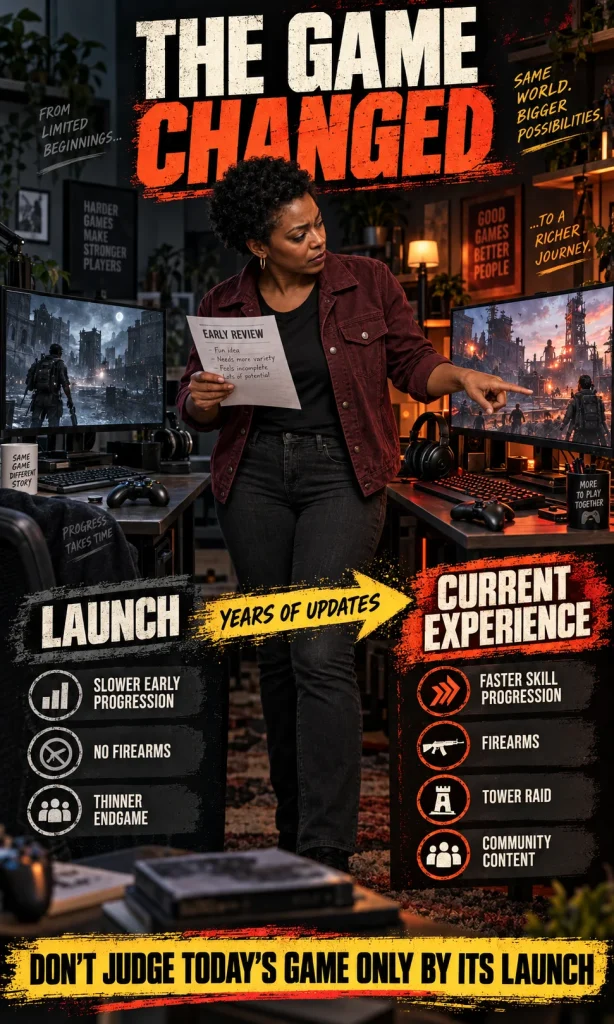
A launch review is now a poor description of the complete product. Techland’s Reloaded Edition folded the Firearms Update and Bloody Ties story DLC into the package, while later updates continued changing progression, combat, replay modes and community content. Permanent Tower Raid added a repeatable roguelite-style activity, and The Breach expanded the game’s community-map and mod direction far beyond the original campaign.
The most important recent change for a new player is less flashy. The Summer of Enhancement update increased experience gains from main missions and also raised side-mission progression, which means useful abilities such as slides, drop kicks and heavier attacks arrive earlier. That matters because one of the original game’s biggest pacing problems was how long the opening could feel constrained compared with the movement system players were promised.
The result is still recognizably the same game, but the first ten hours are easier to judge on the systems that eventually make Dying Light 2 enjoyable. It is fairer to evaluate the current build on what you can actually play today instead of repeating a launch verdict frozen around bugs and a slower progression curve.
Parkour Is Still the Best Reason to Play
Movement is where Dying Light 2 separates itself. Villedor is built vertically, so climbing is not a side activity used to reach collectibles; it is the basic language of the city. You learn to read roof heights, poles, ledges, ventilation units, ropes and wall surfaces as a connected route, then chain them together without dropping back to street level.
The skill tree gradually turns that movement into expression. A basic climb becomes a wall run, a gap becomes an opportunity to swing or launch, and the paraglider changes how you think about distance once the central city opens up. The system can feel slightly floatier than the first Dying Light, but the larger move set gives skilled players more ways to recover from mistakes and create their own line through an area.
That makes ordinary travel entertaining in a way many large open worlds struggle to achieve. Fast travel is useful, but it can also feel like skipping the best system in the game. When a title makes crossing the map enjoyable enough that you keep ignoring the nearest teleport point, the traversal design is doing real work.
Combat Works Best When You Use the Environment
Dying Light 2 is not at its best when you stand in front of an enemy and trade swings until a health bar disappears. The combat becomes much more satisfying when movement, positioning and environmental hazards stay involved. Vaulting over an infected, kicking a renegade from a rooftop, using a doorway as a choke point or turning a ledge into a weapon gives the fighting a physical rhythm that ordinary loot-based combat would not have on its own.
Melee weapons still do most of the heavy lifting, but firearms now broaden the available play style. Guns are useful when the situation demands range or burst damage, while melee remains more naturally integrated with parkour and the city’s tight spaces. The combination gives the current version a more flexible sandbox than the original launch build.
The role-playing layer is less convincing. Weapon rarity, levels, crafting and stat differences give you reasons to search buildings and repeat activities, but they can also make the world feel more systemized than frightening. Players who enjoyed the rough survival texture of the first game may find the colored-loot structure a little too visible, especially early in the campaign.
Night Is Dangerous, but the Fear Feels Different
The day-and-night cycle still changes how you move through the city. Darkness pushes more dangerous infected into the streets, chases can escalate quickly, and locations that are relatively safe during daylight become much more stressful once your escape route starts collapsing. The system gives nighttime exploration a useful risk-reward structure because some activities become more practical when infected have moved elsewhere.
What changed is the emotional texture. Dying Light 1 often made nighttime feel like a reason to stop what you were doing and reconsider whether leaving the safe zone was worth it, while Dying Light 2 eventually gives you enough mobility and combat options to treat darkness as a challenge to master. That can be more fun for an action player, but it is less effective if your main reason for loving the series is fear.
Players who want the hardest survival pressure can increase the difficulty, and Nightmare Mode exists for people who deliberately want a more demanding experience. I would not start there simply because you liked the first game. Learn how Villedor’s movement and stamina systems behave first, then raise the pressure once you know whether the difficulty is making decisions more interesting or merely slowing your progress.
The Story Has Big Choices, but Uneven Payoff
Aiden enters Villedor looking for information about his sister, and that personal search becomes entangled with the city’s factions, power structure and larger experiments connected to his past. The campaign gives you decisions that can change who controls facilities, which characters survive, how certain quests unfold and what the final state of the story looks like. That creates replay value because a second run can meaningfully differ in route and outcome.
The limitation is consistency. Some choices feel immediate because the city or a relationship changes in front of you, while others promise a larger moral consequence than the later writing can fully support. The game is ambitious enough that you can see what the branching structure is trying to do, but its strongest memories usually come from escaping a bad night chase or improvising a rooftop fight rather than from a conversation wheel.
If narrative is your primary reason for playing an action RPG, this is the section that should lower your expectations. The story is functional and sometimes effective, but it is not the reason I would recommend the game. Movement, combat, exploration and co-op carry far more of the experience.
Villedor Is Huge, but Size Is Both a Strength and a Weakness
The city gives the movement system room to breathe. Dense low-rise districts make you think about rooftop chains, while taller areas shift the rhythm toward vertical climbs, gliding and long-distance navigation. Safe zones, metro stations, GRE facilities, dark hollows, convoys and faction structures create a steady supply of practical reasons to explore beyond the main quest.
The trade-off is repetition. When a map contains many activities built from familiar templates, the reward loop can become more visible than the world itself. This is where your tolerance for open-world checklists matters more than the raw amount of content available.
My advice is to stop treating every icon as mandatory. Follow the story, pursue activities that improve the movement or equipment you actually use, and let spontaneous routes create the rest of the play session. Dying Light 2 becomes much more enjoyable when the city feels like a place to move through rather than a board that needs every symbol removed.
Co-Op Turns the City Into a Better Sandbox
The official co-op overview supports groups of up to four players, and the basic design benefits from company. A rooftop route becomes funnier when somebody misses a jump, difficult encounters become easier to improvise around, and open-world activities feel less repetitive when the group is creating its own problems between objectives.
Co-op does not fix weak writing, but it changes what you expect from the session. A mission that feels like routine open-world work alone can become an excuse for four people to experiment with drop kicks, traps, improvised weapons and increasingly bad escape decisions. For players whose main goal is social action rather than narrative immersion, multiplayer substantially improves the value proposition.
Platform compatibility should still be checked before buying specifically for co-op. Cross-generation support has changed over the game’s life, online services can be patched, and platform-family restrictions matter more than the phrase “four-player co-op” suggests. Confirm the exact devices you and your friends use instead of assuming every version can connect to every other version.
Should Dying Light 1 Fans Play Dying Light 2?
Yes, if the first game’s parkour and physical combat were the parts you loved most. Dying Light 2 expands those systems and gives them a much larger vertical playground, so the mechanical reason to continue the series is strong. The sequel also gives you more ways to build a character around movement, combat, tools and long-term progression.
The answer becomes less certain if Harran’s atmosphere was the real attraction. The first game feels dirtier, tighter and more immediately threatening, while the sequel often feels brighter, more system-heavy and more comfortable letting you become extremely capable. That does not make the second game worse in every respect, but it means the two games can satisfy different moods.
If you stopped Dying Light 2 shortly after launch, returning is more reasonable than starting over from your old opinion. The game has received enough mechanical and content changes that the experience deserves a fresh look, particularly if slow early progression or the lack of firearms were part of what pushed you away.
Use the Villedor Fit Check Before You Buy
The review can tell you what the game does well, but it cannot know whether you care more about movement than story, whether you plan to play alone, or whether the price you are seeing fits your own budget. The interactive experience below turns those differences into a personal fit result and also calculates cost per expected hour from the price and play time you enter.
DYING LIGHT 2 PLAYSTYLE + VALUE CHECK
Villedor Fit Check
See whether the current version of Dying Light 2 matches the way you actually play. The result combines your priorities, available time, price you are seeing, co-op needs, and tolerance for the game's weaker areas.
 PARKOUR / COMBAT / STORY
FIT FIRST - THEN BUY
PARKOUR / COMBAT / STORY
FIT FIRST - THEN BUY
Your purchase context
Use the price you can actually buy the game for. Nothing here assumes a current sale.
What matters most to you?
Rate each factor from 0 to 10. A high number means that part of the game heavily affects whether you will enjoy it.
Your tolerance for the trade-offs
This is where a strong movement game can still become the wrong purchase for a particular player.
Optional local shopping check
Use this only if you want a physical copy or want to compare nearby retailers. No live store names or ratings are invented.
Personalized recommendation + cost-per-hour context + one-page A4 result.
Who Should Buy Dying Light 2?
- Buy or seriously consider it if first-person parkour is the main attraction, you enjoy physical melee combat, you like large open worlds, or you want a four-player zombie sandbox.
- Wait for a price you are comfortable with if you are interested but story quality is important enough that weaker writing could shorten your play time.
- Approach cautiously if what you want above everything else is the exact horror atmosphere and grounded survival tone of Dying Light 1.
- Revisit it if you quit near launch because of slow progression, missing firearms or a thin endgame, since those parts of the package have changed substantially.
- Verify the current platform details first if co-op with a specific friend or hardware combination is the main reason you are buying.
Dying Light 2 vs Dying Light 1
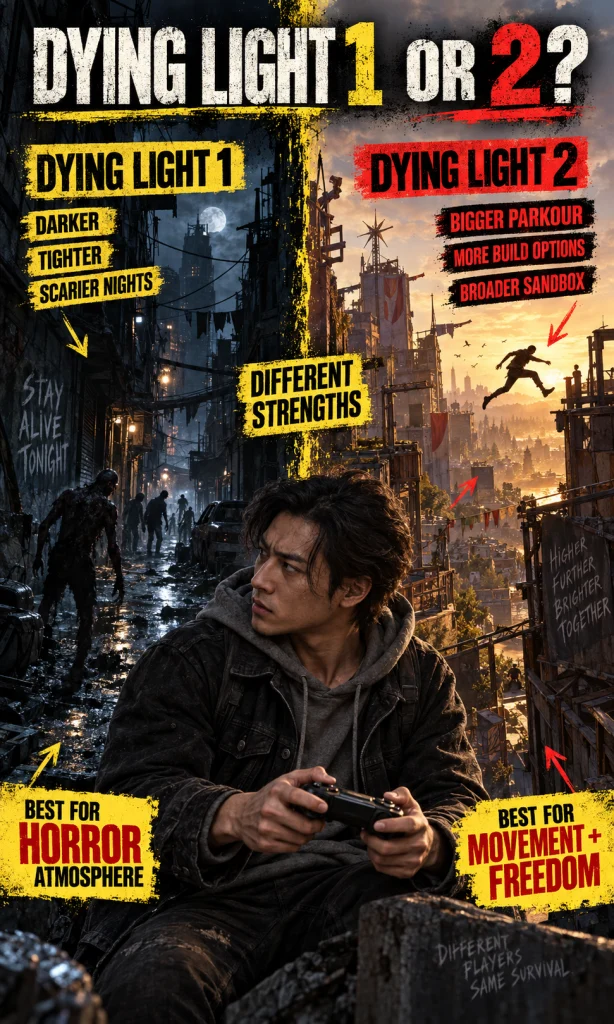
| Area | Dying Light 1 | Dying Light 2 | Better Fit For |
|---|---|---|---|
| Atmosphere | Tighter, dirtier, more oppressive | Broader, brighter, more action-RPG driven | DL1 for horror tone; DL2 for sandbox scale |
| Parkour | More grounded and direct | Larger move set and more vertical options | DL2 for movement depth |
| Combat | Raw survival feel | More skills, more environmental interaction, broader build options | Depends on whether you value grounded feel or mechanical variety |
| Night experience | More frightening and restrictive | More systems-driven and increasingly manageable as you grow stronger | DL1 for fear; DL2 for mastery |
| Current content breadth | Mature complete package | Large campaign plus post-launch modes, DLC and community content | DL2 for ongoing variety |
Final Verdict
Dying Light 2 has become a strong action game whose best systems are easier to reach and have more content around them than they did at launch. Parkour remains excellent, environmental melee combat is consistently entertaining, co-op amplifies the sandbox, and the current package has enough repeatable content to keep movement-focused players busy long after the main campaign ends.
The story remains the reason to temper the recommendation. If you need memorable writing, deeply consequential choices and the same oppressive horror that defined the first game for you, Dying Light 2 can still feel like a mechanical upgrade wrapped around a less compelling emotional experience. If your priority is the physical pleasure of getting across a city, surviving a chase and turning the environment into part of a fight, Villedor is still one of the most distinctive open worlds to move through.
Verdict: play it for parkour, combat, exploration and co-op; buy with more caution if story and first-game horror atmosphere are your deciding factors.
Frequently Asked Questions
Is Dying Light 2 worth playing now?
Yes, especially if you value parkour, melee combat, open-world exploration and co-op. The current package includes far more than the launch build, with firearms, Bloody Ties, permanent Tower Raid, faster early progression and community-map support. Story quality and the less oppressive horror tone remain the main reasons some players will still prefer the first game.
Is Dying Light 2 better than Dying Light 1?
Dying Light 2 has the deeper movement system and a larger action sandbox, while Dying Light 1 still has the stronger horror atmosphere for many players. Which one is better depends on whether you value mechanical freedom or tension and tone more heavily.
Does Dying Light 2 have guns now?
Yes. Firearms became part of the modern game through the Firearms Update and are included in the Reloaded Edition era. Melee combat still fits the parkour system more naturally, but guns broaden the available approach to difficult encounters.
Can you play Dying Light 2 in co-op?
Yes. Dying Light 2 supports groups of up to four players. Verify your exact platform combination and current online-service details before purchasing specifically for multiplayer because compatibility can differ by platform family and can change through updates.
Is the Dying Light 2 story good?
The story is functional and includes meaningful route changes, faction consequences and different outcomes, but the writing and pacing are less consistent than the movement and combat systems. Players who require a strong narrative should treat the game as a conditional recommendation rather than buying for the story alone.
Is Dying Light 2 scary?
It can be tense at night, especially during escalating chases and before your movement abilities are fully developed. It is generally more action-oriented than the first Dying Light, so players looking for sustained survival horror may find the sequel less frightening once Aiden becomes highly mobile and powerful.
Should I replay Dying Light 2 if I quit near launch?
It is worth reconsidering if slow progression, missing firearms or a thin endgame were major reasons you stopped. Those parts of the package have changed significantly, although the underlying story and the sequel’s action-RPG tone are still recognizably the same game.