
“Congruent depression” is not a separate diagnosis: mood-congruent psychotic symptoms are beliefs or perceptions whose themes fit a depressed mood, such as extreme guilt or deserved punishment. If you are trying to explain a change in yourself or someone close to you, start with the exact words, when they began and what changed in daily life; this page shows how to make that account useful without diagnosing anyone.
First, decide whether taking notes can wait
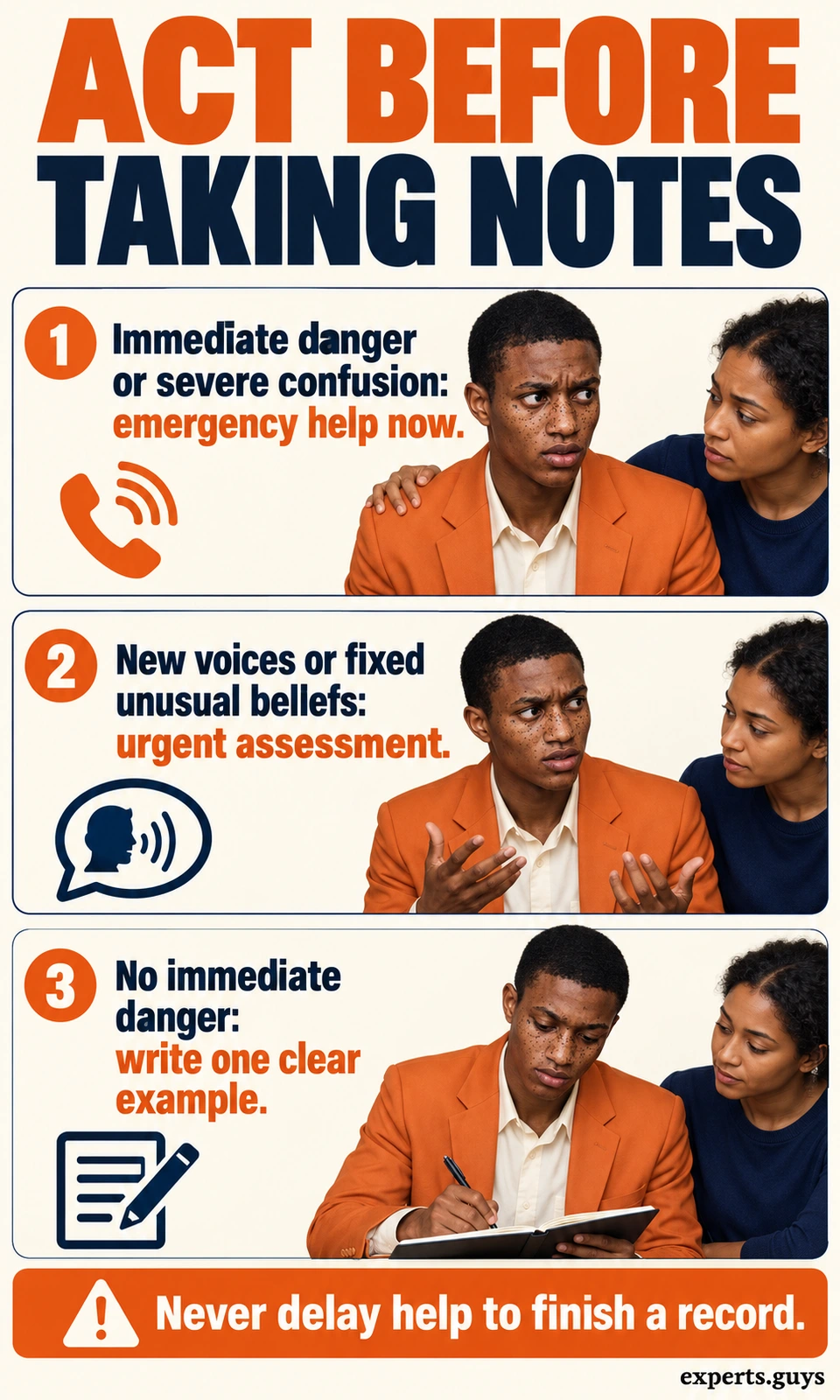
A clear description can help, but completing a worksheet is never a condition for getting care. New possible psychotic symptoms need prompt assessment even when the person looks calm. Use the urgency of the change, not the label “congruent,” to decide what happens first.
- Immediate danger, inability to stay safe, sudden severe confusion, or serious physical deterioration: seek emergency help now through local emergency services. Stay nearby if it is safe; do not attempt to physically restrain someone or put yourself at risk.
- New voices, strongly held unusual beliefs, or a substantial loss of contact with shared reality: arrange urgent assessment through the existing mental health team or an urgent medical service. Explain the new change directly; do not wait several days to finish a diary.
- No immediate danger while support is being arranged: write one short example using the steps below. You may stop after any step if writing becomes tiring or upsetting.
What does “mood-congruent” actually describe?
“Congruent” describes the relationship between the content of a symptom and the mood around it. In depression, a belief about being irredeemably guilty can fit that mood; the fit does not make the belief accurate or the illness less serious. Depression with hallucinations or delusions is commonly called psychotic depression.
A painful thought alone is not enough to establish psychosis. A person may repeatedly worry that they disappointed someone while still recognizing that they could be mistaken. Clinicians consider the wider history, cultural context, degree of conviction and other symptoms, rather than diagnosing from one sentence.
| Expression or experience | Useful distinction | What to describe |
|---|---|---|
| “I keep remembering my mistakes.” | Selective recall or rumination is not, by itself, a delusion. | What returns to mind and how much it interrupts daily activities. |
| “I feel responsible, but I may be judging myself harshly.” | Some uncertainty is expressed; this does not rule a condition in or out. | The person’s own wording, including the uncertainty. |
| A conviction of impossible personal guilt despite contrary information | May warrant assessment for a delusional belief; content alone is insufficient. | Exact statement, onset, conviction as described and practical consequences. |
| A reported voice saying the person deserves punishment | A perceptual experience is different from remembering an event. | How the experience was described and whether it affects safety. |
This article focuses on describing changes, not on trying to prove or disprove a belief. General terminology belongs in the congruent depression explanation; treatment choices belong in the psychotic depression overview. The examples below are invented teaching examples, not patient records or a screening test.
1. Separate exact words from your interpretation
Use this when you remember the concern but struggle to explain it clearly. Prepare one private note with two headings: “Words” and “Observation.” This simple separation reduces the chance of replacing a person’s account with your own assumption.
- If recording someone else’s experience, ask whether they are comfortable with a brief written note. Explain who you intend to share it with.
- Under Words, record one sentence as accurately as you can. Use quotation marks only for wording you actually remember.
- Under Observation, write what happened: “Left dinner untouched,” rather than “Was being difficult.” If you did not witness it, label it “reported by…”
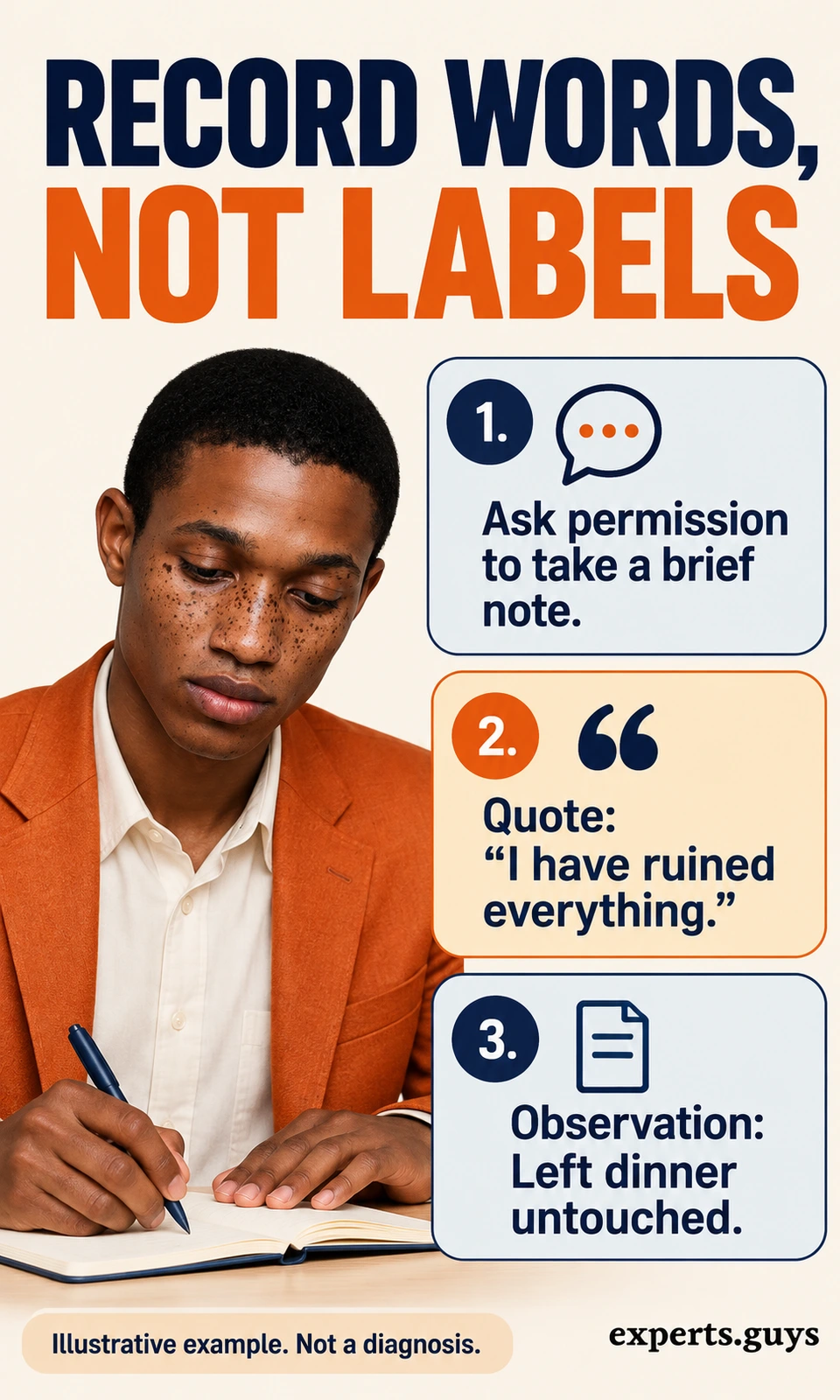
Worked example: “I have ruined everything” is the statement; “did not join dinner” is the observation. Neither establishes a diagnosis. If exact wording is unavailable, write “approximately said” rather than polishing the memory into a quotation.
Adjust it: one sentence is enough when concentration is poor. A useful result is a note another person can understand without guessing what was seen and what was inferred. Avoid secret recordings or distributing sensitive notes to a group chat.
2. Describe uncertainty without turning it into a test
Use this only if the person is willing to talk, including when you are describing your own experience. A gentle question about certainty can preserve an important detail, but repeated questioning can feel like an interrogation. Do not use this exercise to challenge a belief or determine whether it is a delusion.
- Ask once: “How certain does it feel to you?”
- Record the answer in ordinary words, such as “unsure,” “completely certain,” or “not discussed.” Keep any nuance the person offers.
- Stop if the question causes distress, suspicion or frustration. Continue with practical support instead.
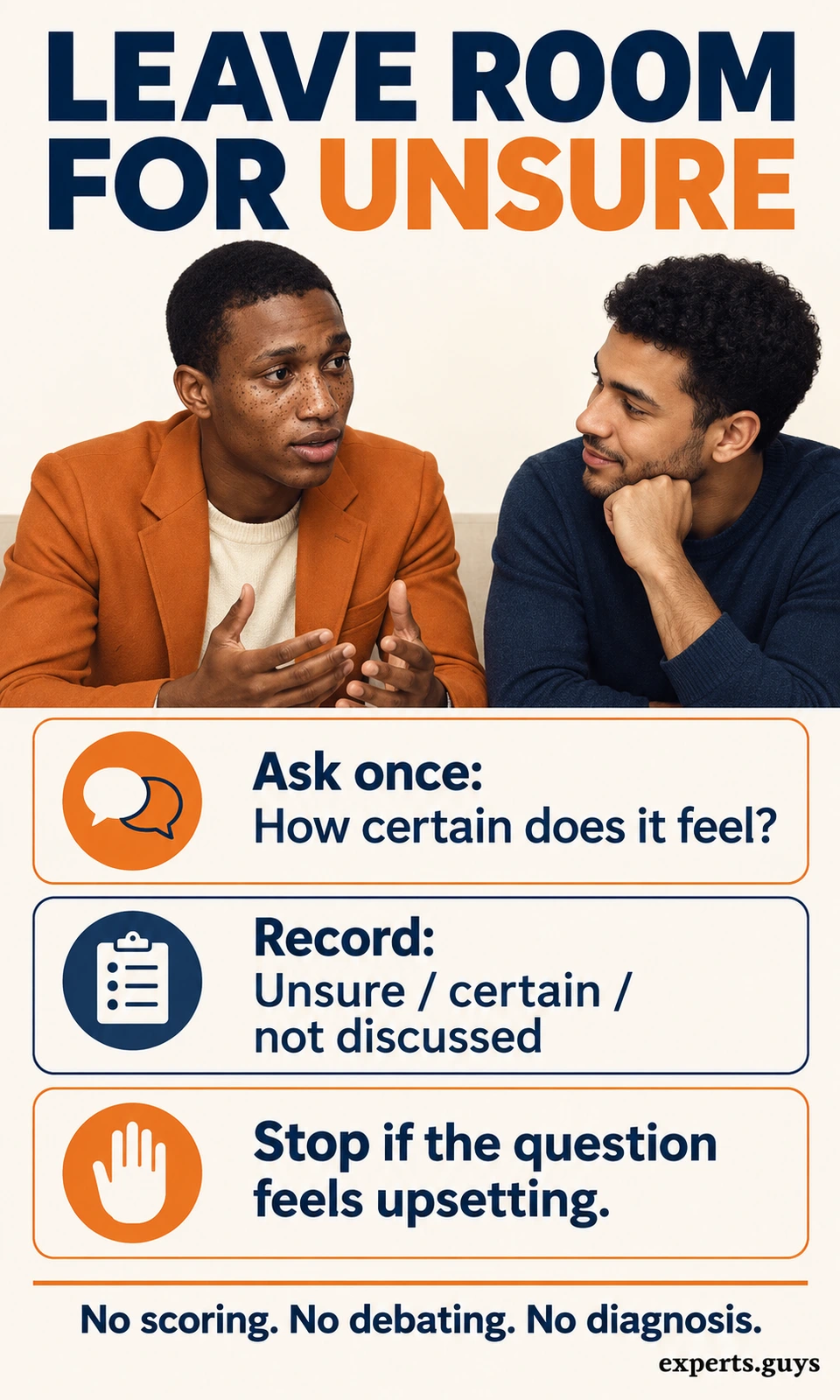
Example: “It feels true, but part of me wonders if I am wrong” is more useful than assigning “70% delusional.” There is no home cutoff score that diagnoses psychosis. If the person declines, “not discussed” is a complete and honest entry.
3. Put mood and belief changes on the same timeline
A sequence helps distinguish what started first from what was noticed later. Use three short entries rather than reconstructing every difficult day. Do not postpone assessment while trying to make the record complete.
- Write when the mood change was first noticed, using an approximate date if needed.
- Add when the unusual belief or perception was first reported. Record whether similar experiences have occurred outside periods of low mood, if known.
- Add one relevant change in functioning and mark uncertain dates as “unknown” or “approximately.”

Example: Monday: low mood noticed; Wednesday: lunch left untouched; Friday: reported hearing a voice. This sequence records observations, not proof that a missed meal caused the later experience. The first day someone tells you about a symptom may be later than its actual beginning.
If dates are hard: anchor the entry to an ordinary event, such as “after the weekend visit,” without inventing a date. A useful timeline preserves uncertainty and makes the sequence easier to explain. It does not need to be detailed enough to identify a diagnosis.
4. Compare daily life with the person’s usual pattern
“Not themselves” communicates concern but leaves the listener guessing. Choose a few observable changes relative to that person’s normal routine, allowing for shift work, disability, culture and ordinary variation. The goal is to explain impact, not grade someone against an ideal day.
- Choose relevant areas such as meals, sleep, communication or an ordinary daily task.
- Write a short “usual” description and the specific recent change beside it.
- Use concrete wording: “Did not answer the two calls we had agreed on” is clearer than “completely withdrawn.”

Example: someone who usually joins lunch has left it untouched and says they do not deserve food. Record the missed meal and the explanation separately. If eating or drinking problems are causing physical deterioration, act on the health concern rather than waiting to count more missed meals.
| Unhelpful entry | More useful entry | Why it helps |
|---|---|---|
| “Never sleeps.” | “Said they were awake much of last night; total sleep unknown.” | Avoids presenting an estimate as a measured fact. |
| “Lazy lately.” | “Could not start their usual morning task.” | Describes a change without assigning blame. |
| “Fine today.” | “Joined breakfast; still reported the same frightening belief.” | Preserves improvement and continuing difficulty together. |
5. Add relevant context without deciding the cause
Bring relevant context into the account because unusual experiences can have more than one explanation. Medicines, substances, sleep disruption and physical illness may matter, but a coincidence in timing is not a diagnosis. Gather information you already know; do not investigate someone’s possessions or private messages.
- List recent prescribed medicine changes, with the name and date if known. Include supplements or non-prescribed substances only when relevant and known.
- Note major sleep changes, recent illness, or alcohol and other substance use in neutral language.
- Write “unknown” where needed and leave causation open. Do not stop, restart or change medication on the basis of this record.
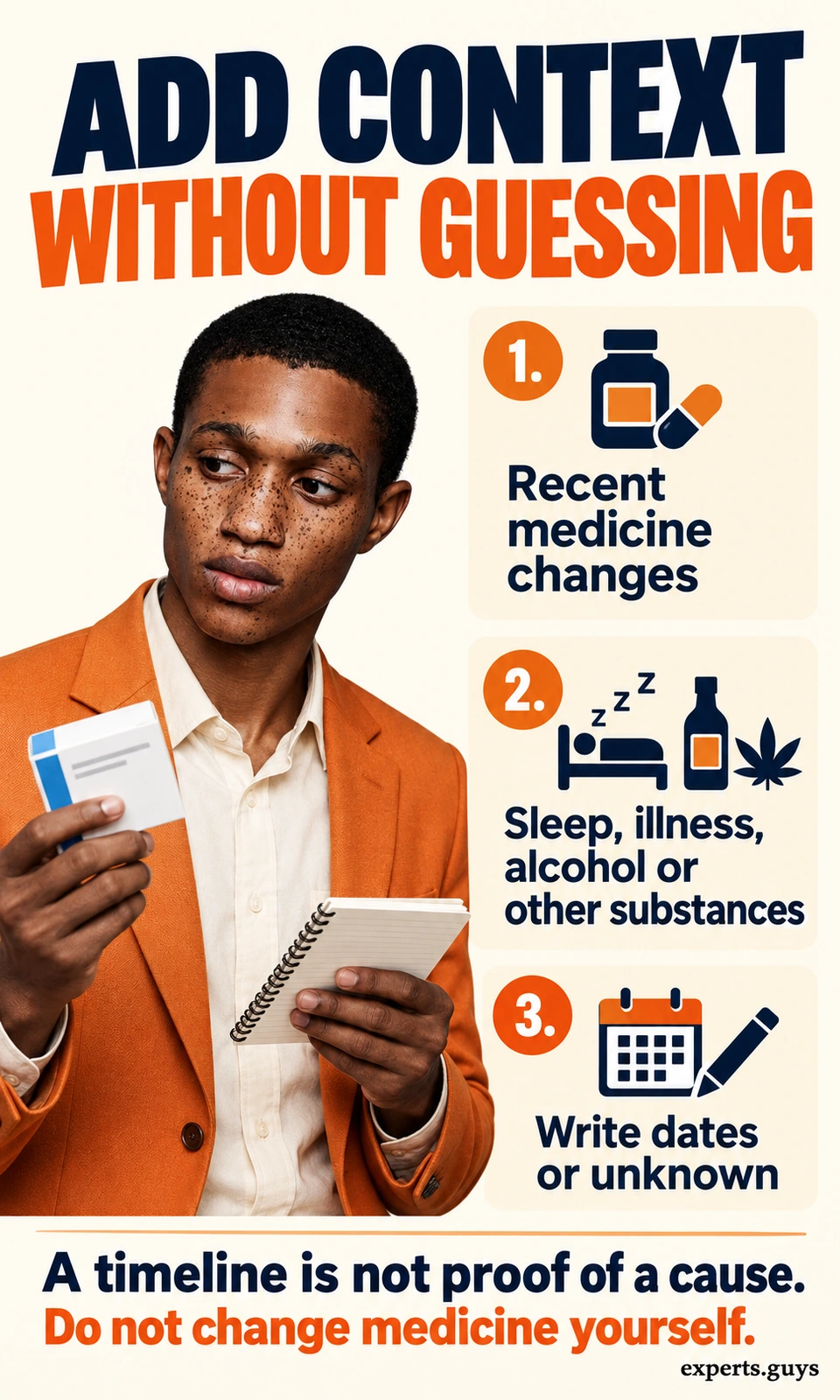
Example: “New prescription started last week; symptoms noticed Friday; relationship unknown” is a usable entry. “The prescription caused psychosis” makes a claim the record cannot establish. When recall is difficult, bring the current medicine list or packaging to the assessment instead of guessing doses.
6. Respond to distress without confirming the belief
A conversation works better when its purpose is connection and immediate support, rather than winning an argument. Use a quiet setting, comfortable distance and brief sentences. The NSW Health communication guidance supports calm, respectful listening and avoiding confrontation.
- Acknowledge the feeling: “That sounds frightening.”
- If asked whether you agree, answer honestly and gently: “I do not experience it the same way.”
- Offer one manageable choice: “Would you like me to sit with you?” Accept a refusal to talk while remaining available, provided immediate safety does not require urgent action.

Common mistake: saying “Yes, they are punishing you” can reinforce a frightening interpretation, while “That is ridiculous” can shut down communication. You can acknowledge fear without endorsing its explanation. If talking increases distress, reduce demands and allow space; do not crowd, touch unexpectedly or block the exit.
7. Turn the notes into one clear summary
Use a summary when several observations have become hard to follow or you need to explain the change by phone. The aim is a readable account that supports assessment, not a self-made medical record. One useful page can be enough even when many details are still unknown.
- Start with When: when the change was first noticed and whether the timing is approximate.
- Add Words: one exact or clearly labelled approximate statement.
- Add Impact: one concrete change in daily life and any immediate safety concern.
- Finish with Request: “I need an assessment of this new change and advice on the next steps.” Share only with the relevant care team or support person.
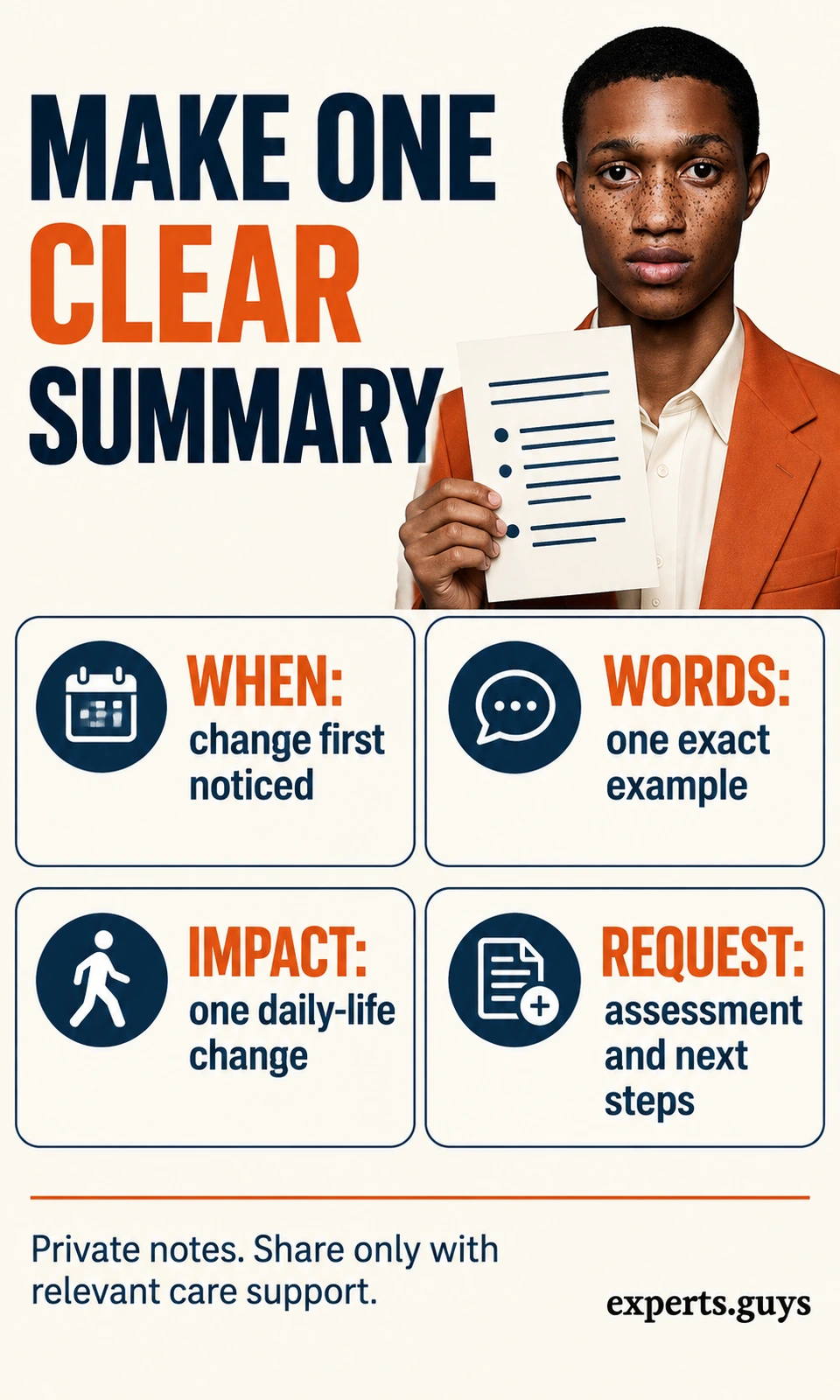
Completed example: “Over the past week, my brother has seemed much lower than usual. Yesterday he said, ‘I have ruined everything,’ and left dinner untouched; I do not know how long he has felt this way. I am concerned about this change and would like an assessment and advice on what to do next.” This example deliberately avoids diagnosing the statement as a delusion.
Make it easier: if you cannot write a page, use the four headings as spoken prompts. A useful result conveys the change, its effect and your request without forcing a conclusion. Do not wait for a complete summary if safety or physical health is deteriorating.
What these observations can and cannot establish
A record can clarify onset, content, uncertainty and impact. It cannot establish whether an experience is a delusion, separate a mood disorder from another condition, or select a medicine. The NIMH explanation of psychosis describes multiple possible conditions and contributors, which is why a full assessment matters.
If depression with psychotic symptoms is diagnosed, care may include antidepressant and antipsychotic medication, psychological treatment and practical support. NICE recommends considering combined medication treatment and monitoring psychotic symptoms; individual decisions require clinical assessment. These observation methods help communication alongside care and are not treatments for psychosis.
Frequently asked questions
Does “mood-congruent” mean the belief is reasonable?
No. It describes how the theme relates to the mood, not whether the belief is supported by reality. A guilt-related belief can fit a depressed mood and still require assessment. The label also does not measure how urgently someone needs help.
Should I leave out an experience that does not match sadness?
No. Include a brief, accurate description even if the theme seems unrelated to low mood. Do not try to force every experience into one category. The overall pattern is more useful than a self-selected label.
What if the person does not want me to write anything?
Respect that preference and offer a conversation instead when there is no immediate danger. You can describe your own observations to a care service without pretending the person consented to a shared diary. An urgent safety concern should be communicated promptly and with only relevant detail.
Does a brighter day mean the concern has passed?
One brighter day does not explain the whole pattern. Describe what improved and what continued, especially a persistent unusual belief or voice. Decisions about follow-up should take the wider course into account rather than one reassuring moment.
Your next action
- Address an urgent change before collecting notes.
- Choose one statement and one observable effect.
- Keep uncertainty visible and avoid arguing about the belief.
- Use the short summary to explain the concern and request the appropriate assessment.
Written for ExpertsGuys by the ExpertsGuys Team. Educational illustrations and worked examples are simulated; they do not depict an actual patient or establish a diagnosis. Clinical review of this rewritten draft is pending.