
Feeling low the day after drinking can accompany a hangover, but timing alone cannot tell you whether alcohol, withdrawal or an existing mental-health problem is responsible. First check for urgent symptoms and dependence risk; if you are alert and physically stable, start with basic comfort and one manageable coping step. Persistent, worsening or disabling low mood deserves assessment rather than another attempt to drink it away.
What needs help now?
A rough morning and an unsafe withdrawal can overlap. The decision below is about the next action, not a diagnosis. If you cannot confidently judge what is happening, contact a medical service rather than trying to complete an exercise.
| What you notice | What to do |
|---|---|
| Seizure, confusion, hallucinations, trouble breathing or difficulty waking | Seek emergency medical help now. Do not drive yourself. |
| Immediate danger or you cannot keep yourself safe | Call local emergency services or go to the nearest emergency department with support. |
| Shaking, sweating, racing heart or marked agitation after reducing regular drinking | Get urgent medical advice. Severe shaking or agitation can require emergency care. Do not manage a detox alone. |
| Fully awake and stable, with a low mood and ordinary next-morning discomfort | Try the comfort steps below, then one coping exercise. Seek help if symptoms worsen. |
| Low mood keeps returning, affects daily life or also occurs without drinking | Arrange a primary-care or mental-health assessment. Do not wait for a particular duration if symptoms are severe. |
The NIAAA overdose guidance identifies impaired consciousness and breathing as danger signs. The NHS alcohol-use disorder guidance explains that withdrawal after cutting down can be dangerous and needs medical support. These warning signs take priority over how long it has been since the last drink.
Why can alcohol leave you feeling low the next day?
Alcohol can disrupt sleep and leave you tired, nauseated and less able to cope with an ordinary demand. As its relaxing effects wear off, anxiety and irritability may emerge. The NIAAA hangover factsheet describes this rebound alongside stomach irritation, fluid loss and other contributors; it does not reduce every difficult morning to a single neurotransmitter problem.
There is also a difference between a drug being a central nervous system depressant and a person having a depressive disorder. The first describes a drug effect; the second requires clinical assessment. A morning of sadness does not establish depression, and having a hangover does not rule depression out.
- Physical discomfort: poor sleep, thirst or nausea can make the day harder to manage.
- Emotional context: regret about a real event and fear about an uncertain event need different responses.
- Existing difficulties: mood problems may predate drinking, follow it or be worsened by it.
- Dependence: symptoms after cutting down need a different care pathway from an occasional hangover.
The useful question is not whether you have used the perfect label. It is whether you are safe, whether this pattern recurs, and what support you need today. Someone who already felt low before the evening began should bring that history to an assessment rather than assuming the alcohol explains everything.
Start with safety, then support your body
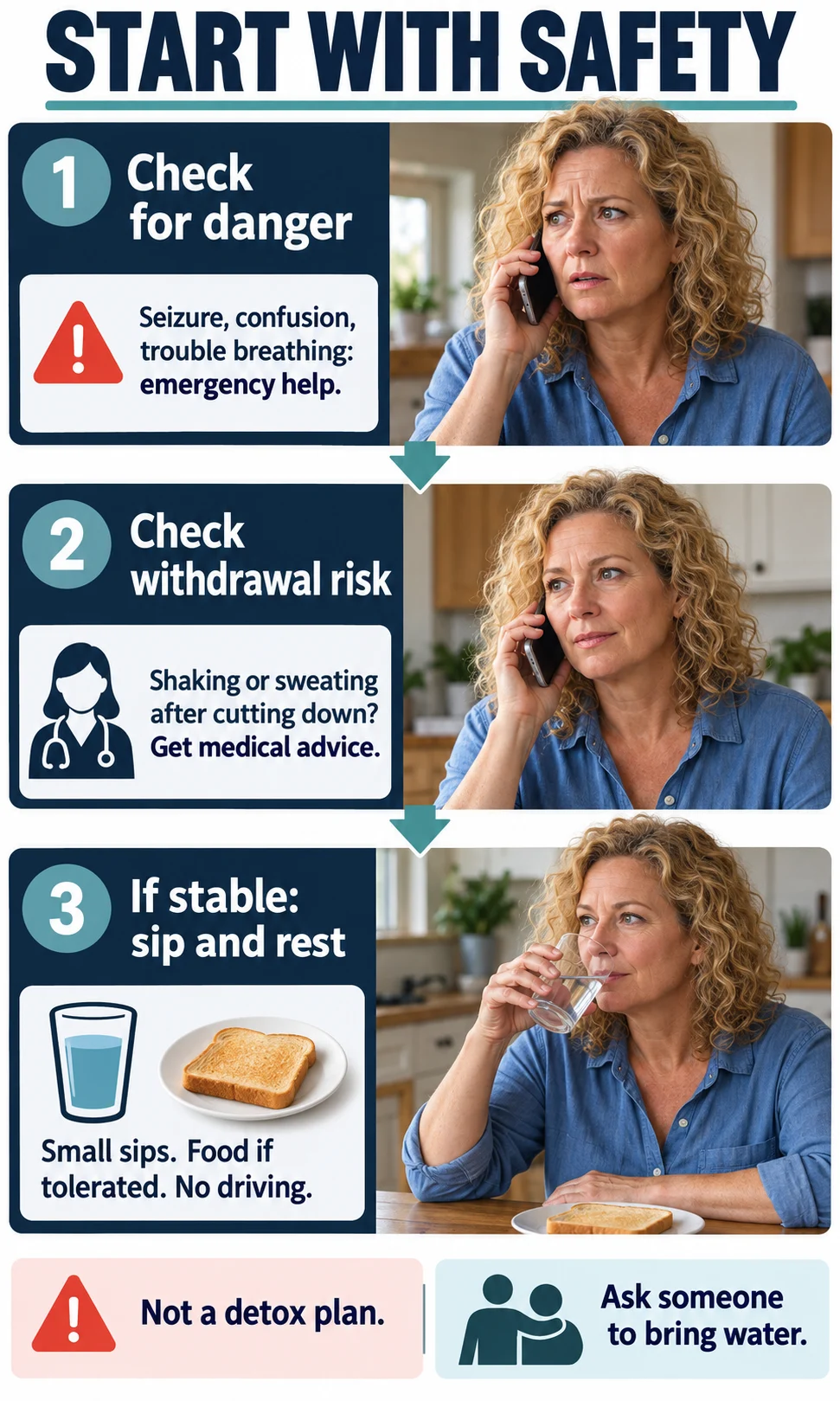
Use this sequence only if you are fully awake, able to swallow normally and not showing emergency signs. You need a drink within reach, a safe place to sit and, if tolerated, a small amount of familiar food. This is ordinary comfort care, not treatment for poisoning, withdrawal or depression.
- Check danger first: use the help table above. If there is trouble breathing, a seizure, confusion, hallucinations or difficulty waking, get emergency help.
- Check withdrawal risk: new shaking, sweating or agitation after reducing regular drinking needs prompt medical advice. A history of withdrawal is another reason to seek medical support before changing intake.
- If stable, take small sips: do not force a large drink. The NHS dehydration guidance recommends starting with small sips when nausea makes drinking difficult.
- Keep the next step simple: try a little familiar food if tolerated, rest somewhere safe and postpone driving or risky work. Seek medical advice if you cannot keep fluids down, are worsening or feel persistently dizzy on standing.
Illustrative example: you are awake and steady but nauseated, with no signs of withdrawal or emergency danger. Sit at the kitchen table, take a small sip, and try a little toast if it feels manageable. If getting a drink feels difficult, ask someone to bring it; completing the step means meeting a basic need, not proving that your mood has improved.
Choose one next step for the difficulty you have now
You do not need to complete every exercise. Choose the one that matches your immediate problem, and use the smaller version if concentration is poor. The interactive experience below follows the same manual methods and routes concerning answers toward help.

Next-Day Support Studio
Choose one manageable action for this morning.
No account No mood scoreEveryday support, not a diagnosis or detox plan. These answers cannot rule out withdrawal or another medical problem. If you are unsure, contact medical help.
Find and compare appropriate support
For recurring low mood, start with primary care. Withdrawal concerns need medical or specialist alcohol care. Use emergency services for immediate danger; do not wait for a search result.
Compare three real services you find. Ask about credentials, alcohol and mood experience, appointments, fees, and urgent-care routes. No ratings or providers are supplied or ranked here.
Entries stay in this page's memory and clear on reload or Reset. Search and Maps links send only your location and selected provider category to Google.
Adapted from NIAAA and NHS public guidance. Examples are editorial adaptations. Completion means practising a step, not symptom improvement. No answers are saved or sent by this plugin.
When you feel keyed up: breathe gently
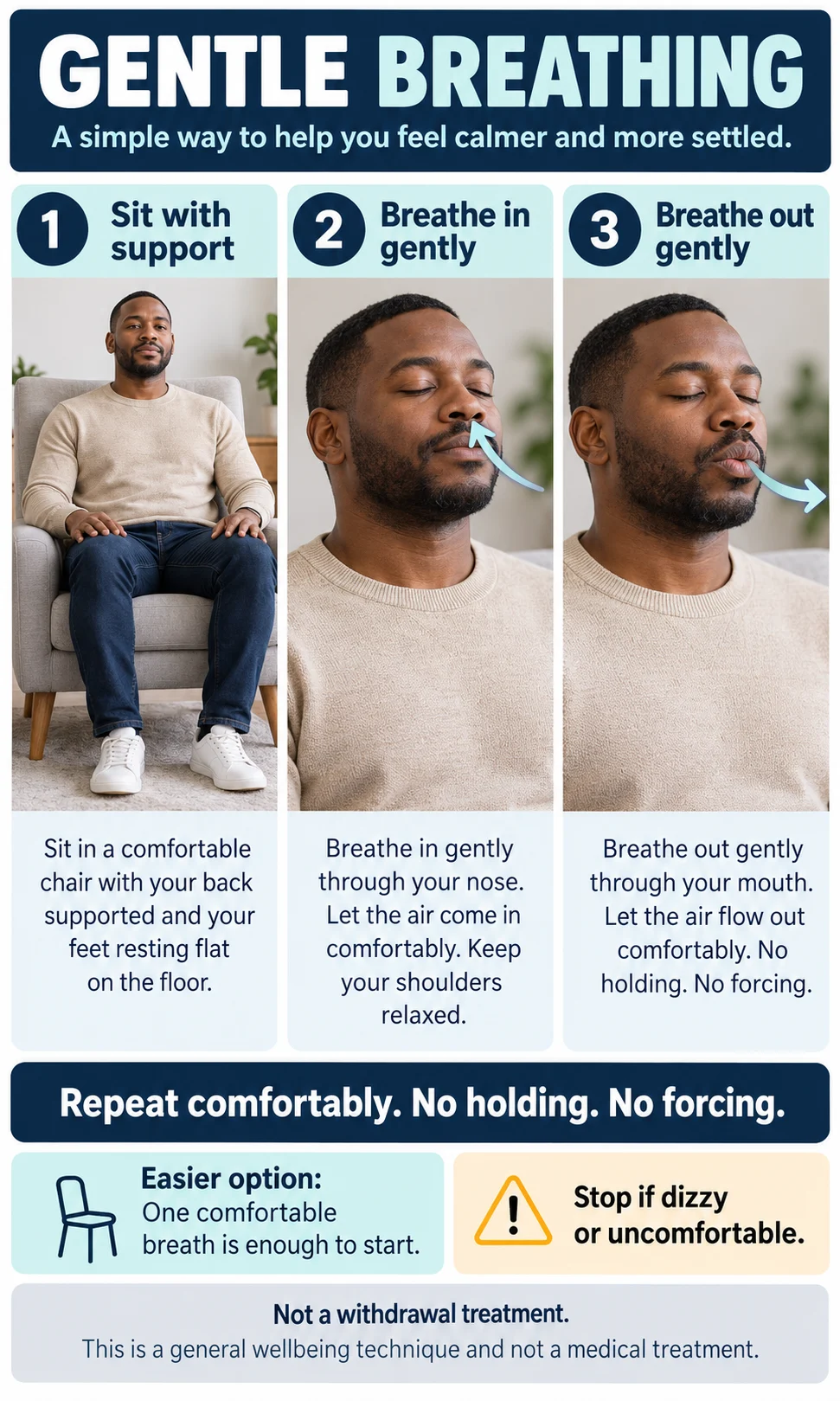
Gentle breathing may help you practise settling during stress when you are physically stable. Sit in a chair with your back supported and feet resting on the floor. This exercise does not treat alcohol withdrawal or unexplained breathing difficulty.
- Relax clothing that feels restrictive and let your shoulders settle.
- Breathe in gently through your nose, then out gently through your mouth. Do not hold your breath or force a deep inhalation.
- Repeat comfortably. The NHS breathing exercise suggests five minutes of regular practice; start with one comfortable breath if that is all you can manage.
- Stop if the exercise makes you dizzy or uncomfortable. New breathing difficulty needs medical help, not more breathing practice.
Illustrative example: after sitting down, you notice that you are rushing each breath while thinking about last night. Try a comfortable inhale and exhale without counting, then decide whether to continue. One unforced breath counts as practice; if focusing on breathing feels worse, stop and choose another suitable form of support.
When shame takes over: separate facts from guesses
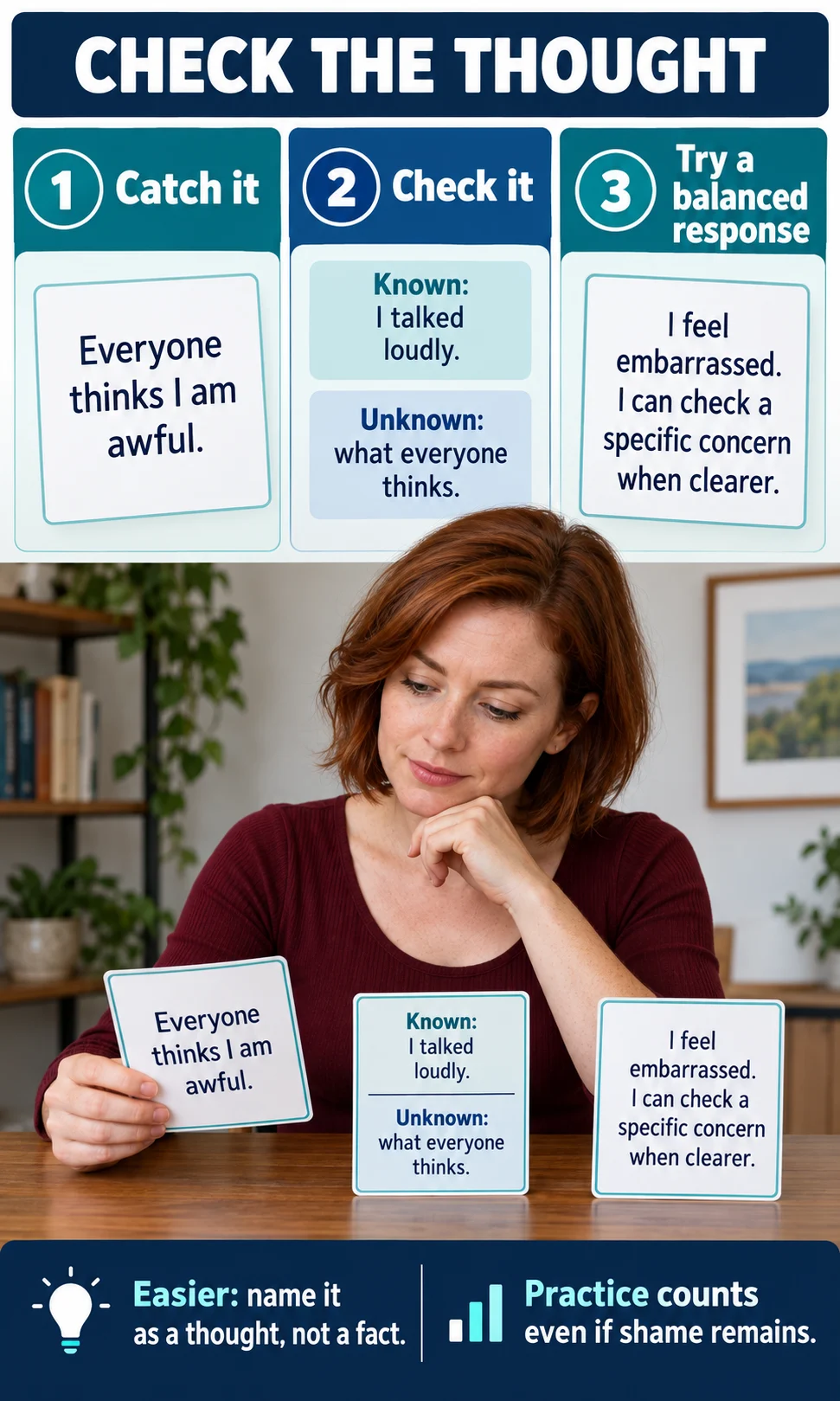
Use a balanced response when a harsh interpretation is running ahead of the facts. The NHS reframing method encourages checking evidence and considering another perspective. The point is to think more accurately, not to deny a mistake or force a cheerful conclusion.
- Catch: name the thought, such as “Everyone thinks I am awful.”
- Check: separate what you know from what you assume. Missing a message is a fact; knowing what everybody thinks is not.
- Change: try a response that allows uncertainty: “I feel embarrassed, but I do not know what everyone thinks. I can address a specific concern when I am clearer.”
- Smaller version: simply say, “That is a thought, not a confirmed fact.” You do not have to solve it now.
Illustrative example: you remember talking loudly but cannot recall offending anyone. Catch the prediction that all your friends dislike you, then notice that you have no evidence for that conclusion. A balanced response leaves room for a real repair later while refusing to turn an uncertain memory into a verdict on your character; completion means practising that distinction, even if embarrassment remains.
When starting feels impossible: choose one small task
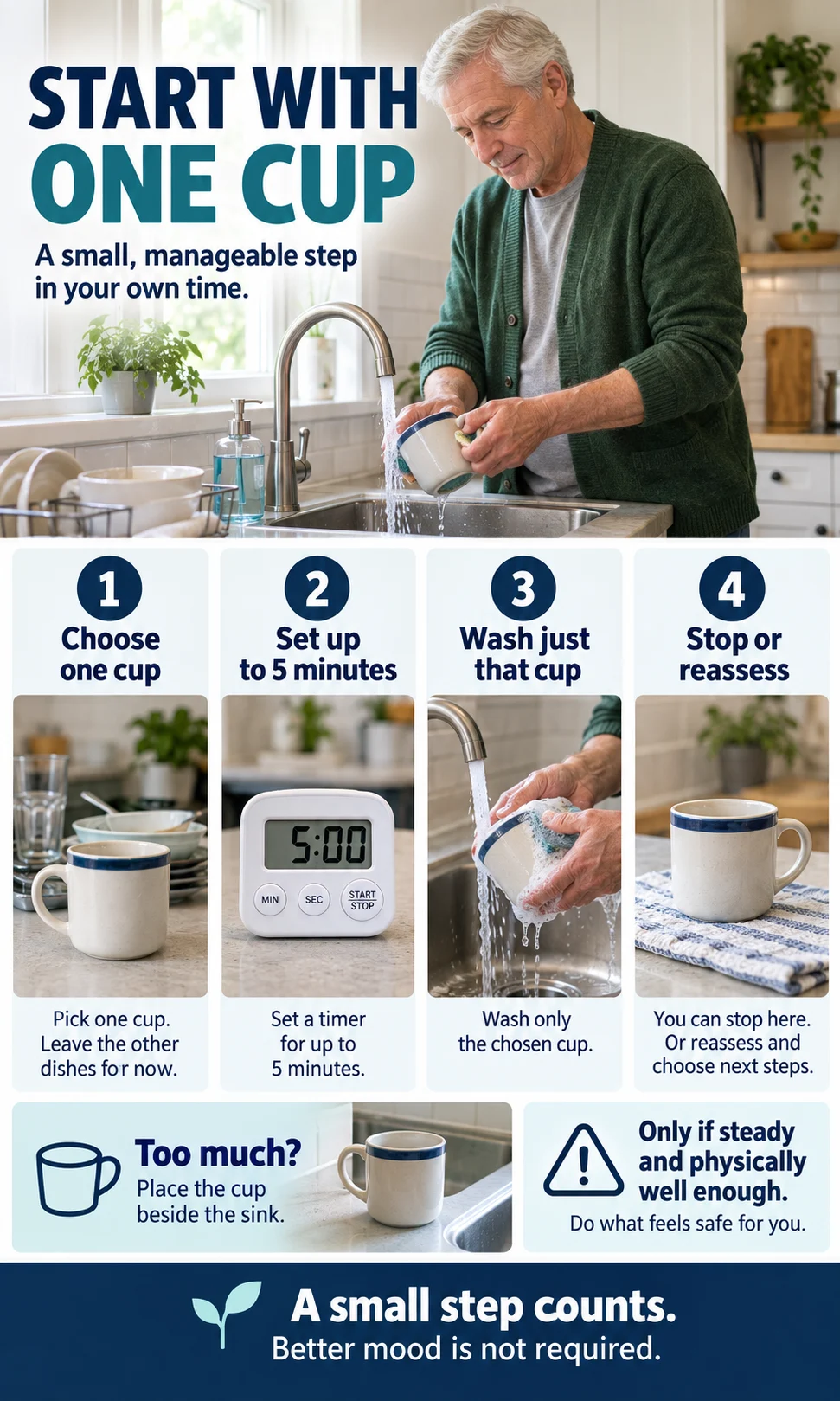
If you are steady and physically well enough, a small ordinary task can give the day a manageable starting point. Choose something low risk, not a workout or a large cleanup. The short timer comes from NHS guidance on tackling avoided tasks; the one-cup example below is an editorial adaptation.
- Choose one cup to wash, not the whole kitchen.
- Set a timer for up to five minutes; you may stop sooner.
- Wash that cup at a comfortable pace. Do not continue if you feel unsteady or significantly exhausted.
- When the time is up, stop or decide whether another small step is suitable. There is no requirement to finish the room.
- Smaller version: place the cup beside the sink. That is a complete chosen step, even if you do nothing more today.
Illustrative example: the sink looks overwhelming, so you choose only the mug from breakfast. You set a short timer, wash it, and stop while the rest stays where it is. Completing this task means starting a chosen activity; if the smaller version is still too much, leave it and ask for support rather than treating exhaustion as failure.
What if the low mood keeps returning?
Recurring next-day distress is a reason to discuss both alcohol use and mood with a clinician. Explain whether the low mood also occurs on days without drinking and whether sleep, interest in activities, work or relationships are affected. The NHS depression overview describes depression as more than a brief unhappy period and advises seeking help when you think you may be depressed.
For symptoms that began after stopping regular alcohol use, the related guide to depression and anxiety after quitting drinking covers that distinct situation. This page focuses on the next-day decision after drinking. Neither page can determine whether you are safe to detox at home.
| Main concern | Useful professional discussion |
|---|---|
| Repeated low mood after drinking | Primary care: review the drinking pattern, physical health, medicines and mood together. |
| Difficulty cutting down or withdrawal concerns | An alcohol treatment service or clinician experienced in withdrawal care; ask about medically supported treatment. |
| Persistent sadness, loss of interest or impaired daily life | A mental-health assessment; discuss appropriate therapy and whether medication is indicated. |
| A practical coping exercise is not enough | Ask for guided support. Difficulty practising is information about your support needs, not proof you failed. |
Talking therapies, medical withdrawal support and relapse-prevention treatment serve different purposes. Treatment should address the problems actually present rather than assuming an antidepressant treats every alcohol-related symptom. Do not stop prescribed medication or start supplements or sedatives to manage this situation without professional advice.
Questions about feeling depressed after drinking
Does feeling depressed the next day mean I have depression?
No. A difficult morning does not establish a depressive disorder. Low mood that persists, returns frequently or disrupts life deserves assessment, including when you are not drinking.
How long will the feeling last?
There is no reliable deadline for an individual mood change. Hangover symptoms can last beyond the following morning, but worsening symptoms or a pattern of low mood should change the plan toward assessment rather than waiting for a promised recovery time.
Can water or breakfast fix it?
They can address thirst or help you meet an ordinary need when tolerated. They do not establish the cause of low mood or treat withdrawal or depression. Use the safety check before home comfort steps.
Should I drink again to feel better?
Using another drink as a remedy can prolong the cycle. If you may be dependent or have withdrawal symptoms, get medical advice about a safe plan rather than trying to regulate symptoms with alcohol or stopping abruptly on your own.
Do I need therapy?
Therapy may be useful for persistent mood problems, self-criticism or harmful drinking patterns. A clinician can help distinguish those needs from urgent withdrawal care. You do not need to decide on the diagnosis before seeking help.
What if I cannot keep myself safe?
Seek immediate help through local emergency services or an emergency department, and involve someone you trust if you can. Do not wait for an online result or the next morning to decide whether you deserve support.
Your next action today
- Use emergency or urgent care first if the safety check raises concern.
- If you are stable, meet a basic need and choose one exercise that fits.
- Count the chosen step as complete without demanding a better mood.
- Arrange assessment if the pattern returns, worsens or interferes with daily life.
Sources and method limits
The exercises support everyday coping; they have not been established here as treatments for a hangover or alcohol-related depression. The breathing, reframing and short-task examples adapt public NHS self-help guidance. All examples and images are illustrative, and individual care needs can differ.