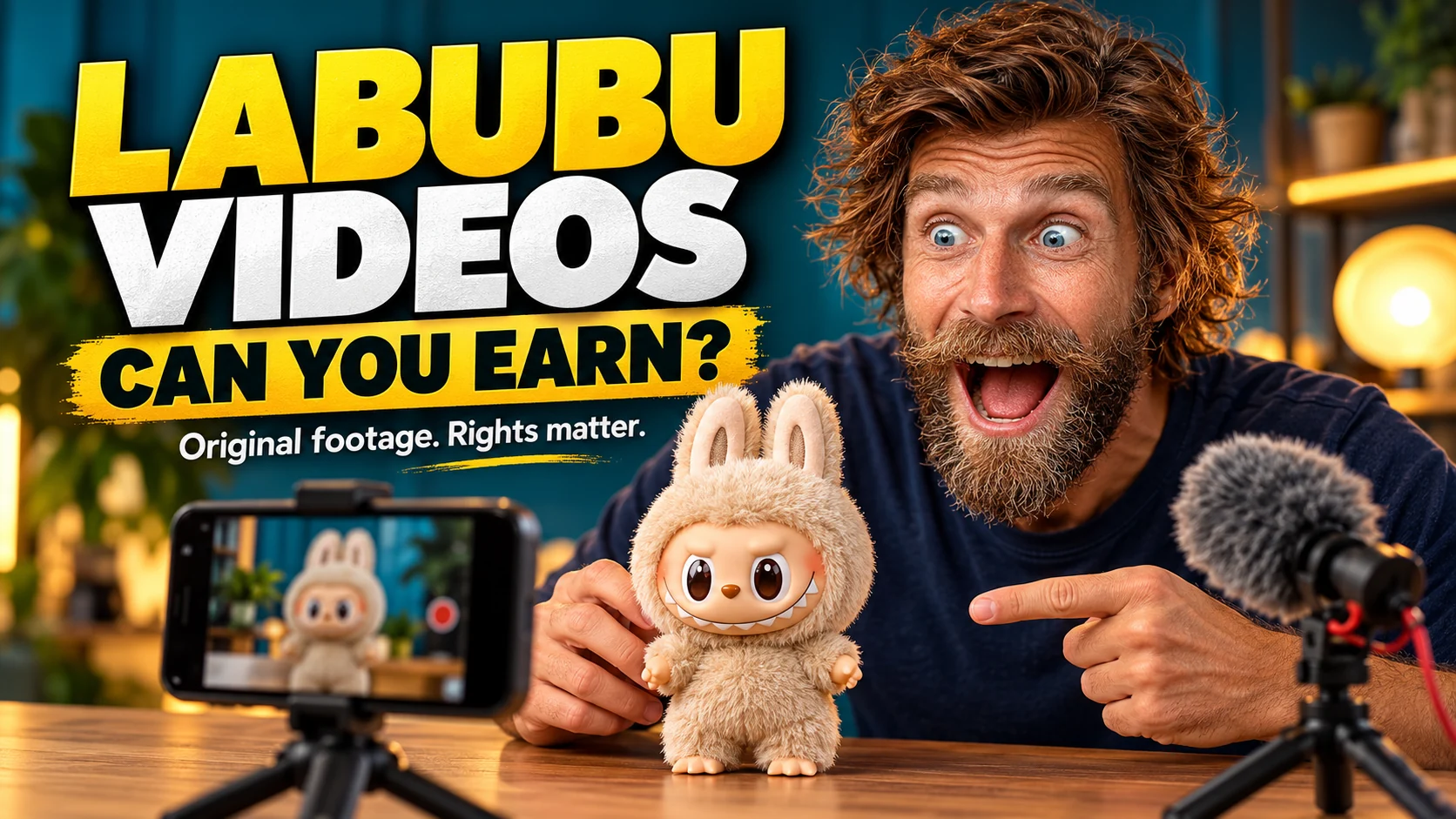
Yes, you can potentially earn money from original videos about Labubu, such as your own collector reviews and demonstrations. Featuring the toy does not automatically give you rights to its character, other people’s footage, or music. Start with a useful video you can make yourself, then check the rights and earning requirements that apply.
On a small screen, scroll the table sideways to read every column.
| Proposed video | Main issue | Practical direction |
|---|---|---|
| Your own filmed collector review | Rights, originality and audience | Explain observations with your own footage; check every additional asset. |
| A compilation of other people’s unboxings | Third-party rights and reused content | Do not treat permission or credit as a guarantee of YouTube eligibility. |
| An AI-generated Labubu story or song | Character rights and repetitive production | AI generation does not itself supply a character licence. |
| A paid or gifted-product review | Commercial terms and disclosure | Keep the assessment honest and disclose the relationship. |
Labubu is a character created by Kasing Lung and associated with Pop Mart’s The Monsters range. This guide concerns making videos about a collectible, rather than obtaining a merchandise licence or predicting a toy’s resale value. The useful starting point is your contribution to the video: what viewers can learn from you that the toy alone does not explain.
What rights do you need to feature Labubu in a monetized video?
You need an appropriate legal basis for the material you use, and buying a physical Labubu does not transfer its intellectual property to you. Pop Mart’s designer information identifies the character’s creator and its licensing relationship. Your own camera recording, the toy’s design, background music and an inserted photograph involve different rights; ownership of one does not establish ownership of Labubu itself.
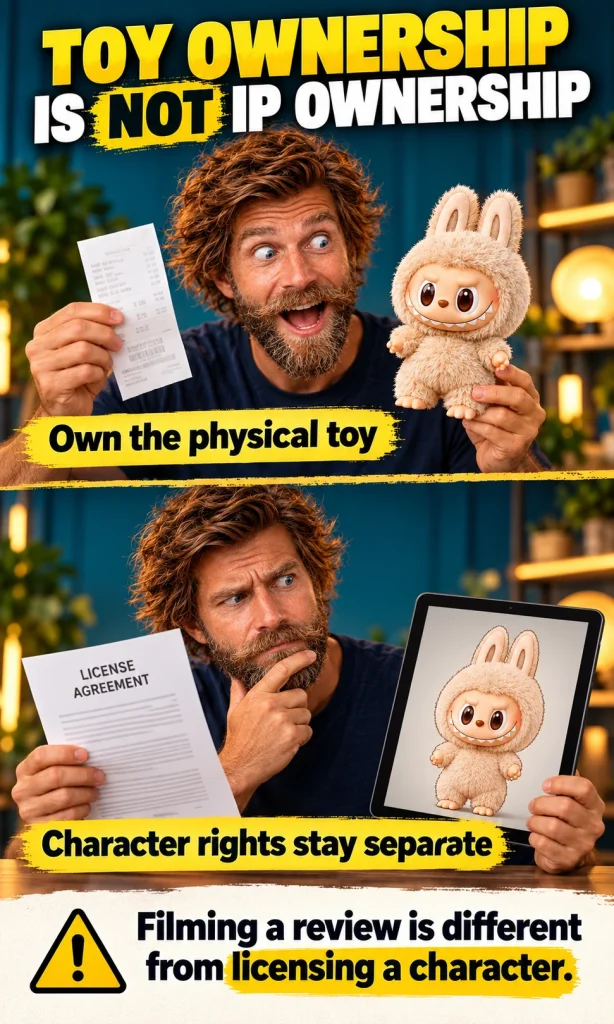
An independent review of a toy and a new animation built around the character are materially different uses. A review can discuss and show the object to support criticism or explanation, while a character-led entertainment series may depend much more heavily on protected creative material. That difference calls for a use-specific assessment, not a blanket statement that every monetized appearance is permitted or forbidden.
In the United States, fair use is assessed through four factors: purpose, the nature of the work, the amount used and the market effect. Commercial purpose does not automatically decide the outcome, and there is no universally safe clip length or percentage. Other jurisdictions have different exceptions; a disclaimer, credit or the words “fan-made” do not settle whether a use is lawful.
Check every asset before editing
- List footage, music and images. Include thumbnails, background audio, official product photographs and any clips you plan to insert.
- Record sources and permissions. Note who made each asset and the basis for using it. For a licence, check commercial use, editing, platform and any territory or duration limits.
- Replace unclear assets. Record a missing shot yourself, use suitable licensed material, or omit it. Your own recording still does not resolve every underlying character-rights question.
- Keep your evidence. Save original recordings, licence terms and correspondence alongside the finished project. Pause an unresolved use rather than treating silence as consent.
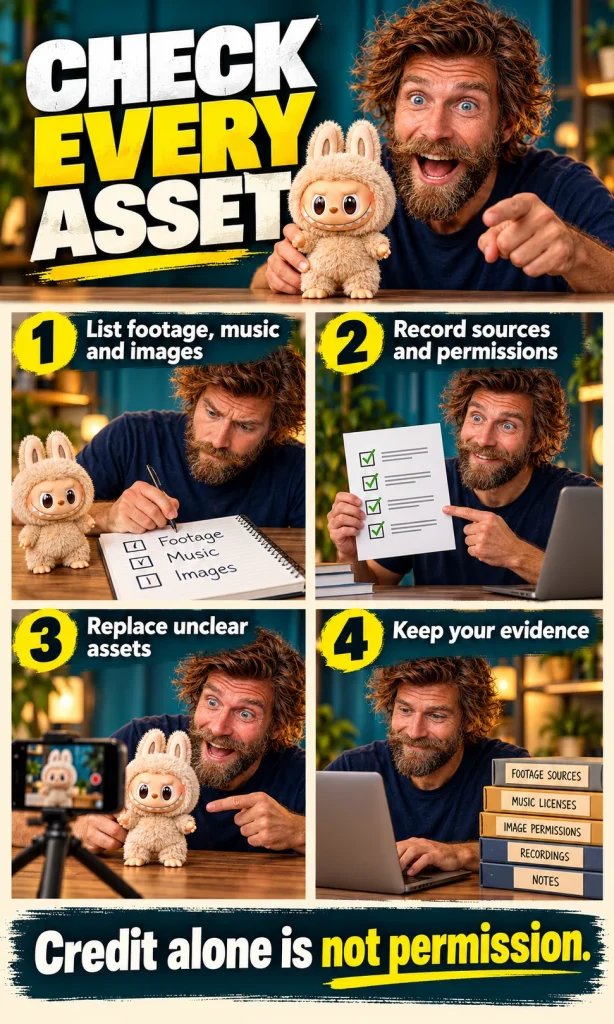
A simple evidence folder is enough for a first review: original camera files, your script and the terms for any added audio. Its purpose is to explain why each included asset can be used, not to certify that the whole video is legally cleared. Seek qualified advice or an appropriate licence if your business depends on reproducing the character in animation, products or branding.
A Content ID claim and a copyright strike are different. A claim can block, track or monetize matching content, whereas removal following a valid copyright removal request leads to a strike. Revenue therefore does not always transfer automatically to a rights holder, and an upload without a detected claim is not proof of permission.
Takeaway: Keep the first project focused on your own explanation and recordings, with every added asset accounted for. The site’s How to Monetize YouTube guide explains the separate platform approval process. Rights clearance and platform eligibility should remain separate decisions.
Which YouTube requirements apply to a Labubu channel?
A Labubu channel follows the same core YouTube earning requirements as other channels, plus any rules triggered by its audience and content. Three separate questions matter: can you use the material, can the channel join the relevant earning program, and can the particular video earn? A “yes” to one does not answer the others.
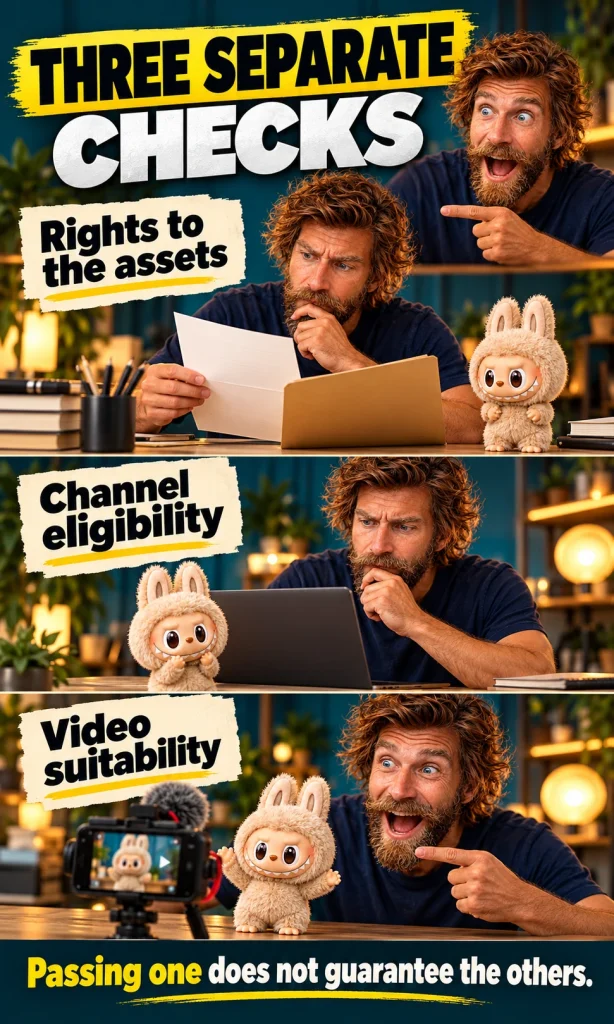
The YouTube Partner Program requirements combine eligible channel activity with account conditions and a channel review. Subscriber and viewing milestones allow an application; they do not guarantee acceptance. Program availability, feature access and the required agreements also matter, so your own Studio Earn tab is the operational reference.
On a small screen, scroll the table sideways to read every column.
| Level | Subscriber requirement | Additional qualifying activity |
|---|---|---|
| Earlier access in eligible regions | 500 | 3 valid public uploads in 90 days, plus 3,000 qualified public watch hours in 12 months OR 3 million qualified Shorts views in 90 days. |
| Ads and Premium entry | 1,000 | 4,000 qualified public watch hours in 12 months OR 10 million qualified public Shorts views in 90 days. |
The earlier-access route concerns eligible fan-funding and Shopping features, rather than automatic ad sharing. Shorts Feed watch time does not count toward the watch-hours route. Use the qualifying counters and their time windows instead of a lifetime view total.
Announced change: From 1 February 2027, YouTube announces higher ads-and-Premium entry thresholds for new creators: 1,000 subscribers plus 8,000 qualified watch hours in 365 days or 20 million qualified Shorts views in 90 days. Existing YPP status is not affected by that entry change, and the earlier-access thresholds remain unchanged. The announcement also adds a 10-million-qualified-Shorts-view requirement over 90 days for monthly Shorts Creator Pool earnings; affected creators should review the updated terms by 31 January 2027.
Originality and permission answer different questions
YouTube’s channel monetization policies distinguish reused content from repetitive or mass-produced inauthentic content. Permission to repost a clip does not by itself establish the original value needed for monetization. A channel of near-identical toy slideshows or minimally changed compilations can therefore face a policy problem even when a copyright complaint is absent.
Does a toy make the video made for kids?
A toy alone does not decide the audience setting. An adult-focused discussion of materials, collector costs and ownership experience differs from pretend play directed at children, but the complete presentation matters. YouTube’s audience guidance includes mixed-audience content directed at children within its made-for-kids category, so an adult viewer presence does not automatically settle the classification.
- Audience: Who is the content intended to reach, and what evidence supports that intention?
- Language and activities: Does it use child-directed speech, games, songs or pretend play?
- Presentation: Assess characters, toys, visuals, metadata and other relevant factors together, then select the accurate audience setting.
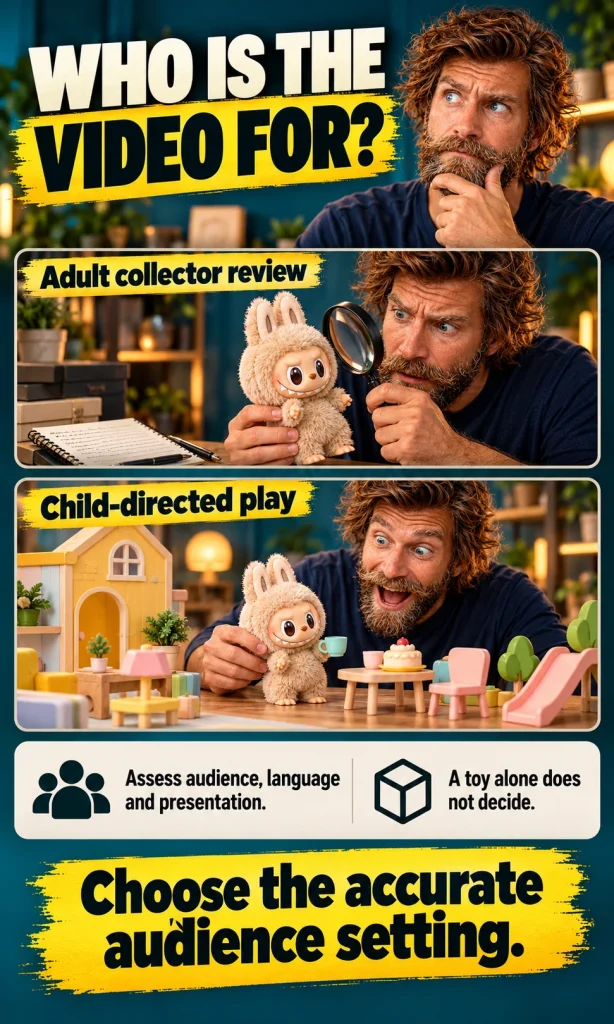
Made-for-kids videos can still carry certain ads, but personalized ads and several engagement features are unavailable. That changes which revenue routes and audience interactions are practical. Do not choose a setting simply because it appears more profitable; heavily promotional or low-quality child-directed content can also face monetization restrictions.
Takeaway: Assess audience and originality before investing in a production format. For the account application, agreements and feature activation steps, continue with How to Monetize YouTube. This specialist article keeps the focus on how the Labubu subject changes the content decision.
How do you make an original Labubu video worth watching?
Make a video that answers a collector’s real question using observations and footage you produced. A narrow question gives you a reason for each shot and a standard for the final verdict. “What surprised me about this toy’s finish?” creates a clearer review than a sequence of reactions with no explanation.
Useful originality comes from what you demonstrate and conclude, rather than simply placing your face next to a popular object. A close-up can support a specific observation about the item you own, and narration can explain why that observation matters to a collector. Keep the conclusion limited to the sample shown; one toy cannot establish the quality of every unit or prove authenticity across a whole range.
Make one useful review
- Choose one collector question. Use one toy you already own and write the question plus the observations needed to answer it. No new blind-box purchase is necessary for the exercise.
- Film your own close-ups. Use stable framing, usable light and clear sound. Show the actual parts being discussed, and keep order details or other personal information out of the shot.
- Explain what you observe. Record your commentary about visible evidence, drawbacks and uncertainty. Separate a personal preference from a specification or a claim about the entire product range.
- Edit to evidence and verdict. Keep the shots needed to support the answer, remove repeated setup and end with a qualified conclusion. Completion means a clear, self-produced review, not a promised view count.
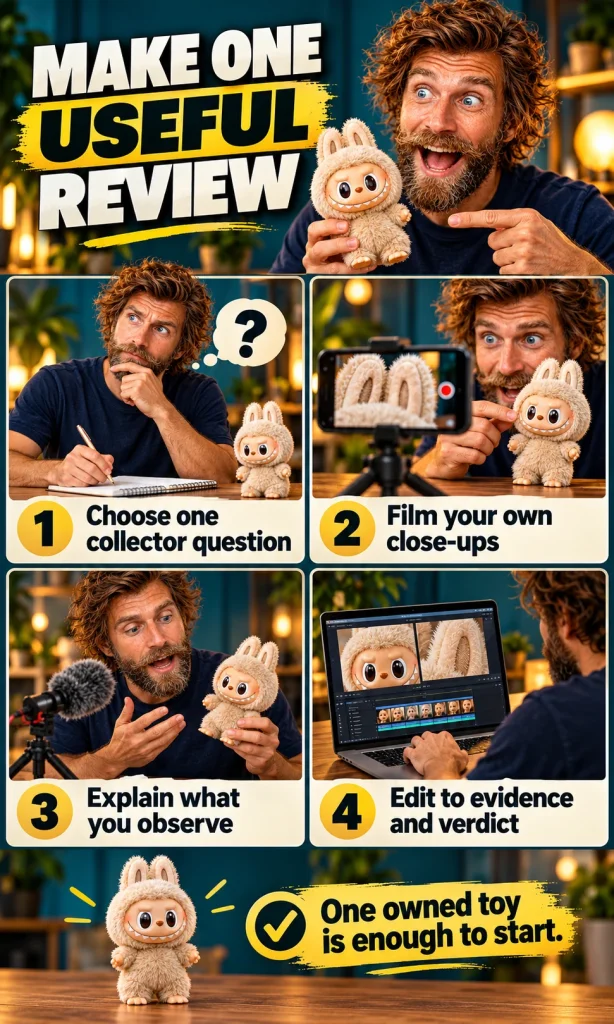
Illustrative example: a creator reviews whether their owned plush pendant feels practical for everyday carrying. Their footage shows its attachment, size in use and a close-up of visible stitching, while the commentary explains their experience. This is an editorial production example, not a durability test, an authentication method or a recommendation to alter the product.
For a lower-effort start, film one uninterrupted explanation at a table and add no external music. That reduces the number of assets and editing decisions without removing the need for a useful answer. Hands-only footage with original narration can also work; an on-camera face is not the defining measure of originality.
Check the finished video before publishing
- Review the full cut. Watch and listen from beginning to end; confirm that each important conclusion has supporting evidence in the video.
- Check rights and audience. Reconcile the finished edit with the asset list and assess the actual presentation. Pause if a rights question remains unresolved.
- Disclose gifts and sponsors. Explain a relevant commercial relationship clearly to viewers, including a product supplied for coverage. Use YouTube’s paid-promotion declaration when its rules apply, and disclose affiliate relationships appropriately.
- Match title to the video. Use your own relevant frame or other appropriately cleared visual. Remove unsupported authenticity, rarity and income claims from the title, thumbnail and description.
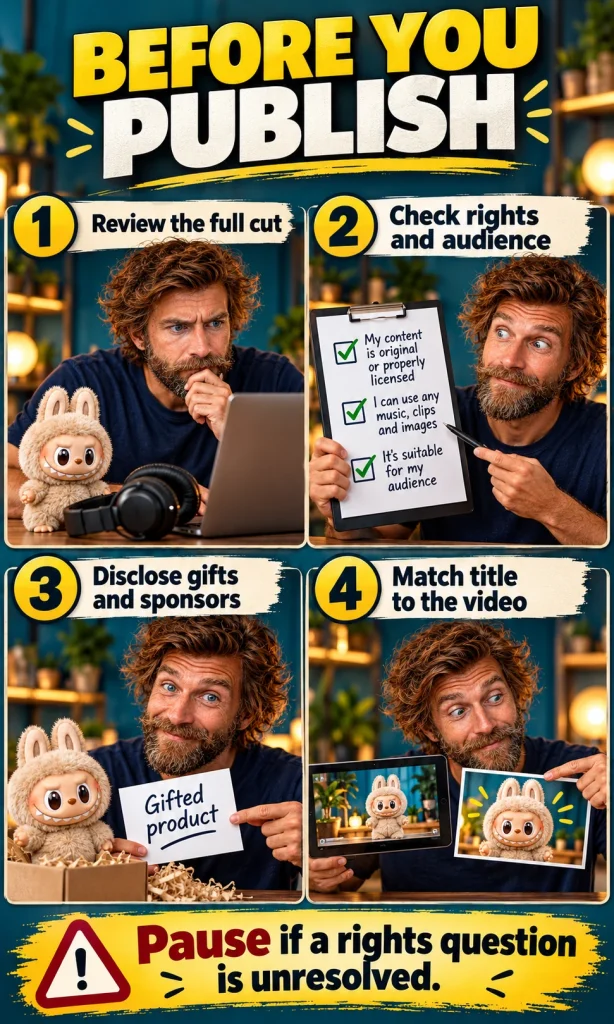
YouTube’s branded-content instructions require creators to notify the platform about covered commercial relationships. The platform label does not replace every local advertising disclosure obligation. For example, “This product was supplied free for this review” is clearer than leaving viewers to infer the arrangement from an affiliate link.
Takeaway: Start with one complete review and improve its explanation before expanding into more formats. If you later adapt your own footage for another platform, the YouTube to Facebook Reels workflow addresses that separate publishing task. Recheck licences when changing platforms, especially audio permissions.
How can you test whether Labubu videos are worth the cost?
Test the production cost against actual income before buying more toys for content. There is no verified Labubu-specific payout rate that lets this article turn views into a dependable earnings forecast. A channel can attract attention while still spending more on stock and production than it receives.
On a small screen, scroll the table sideways to read every column.
| Route | What generates income | What can reduce the result |
|---|---|---|
| YouTube revenue | Eligible viewing and activated earning features | Eligibility, restrictions, audience and format differences. |
| External sponsorship | An agreed commercial deliverable | Production obligations, usage rights, fees and unpaid invoices. |
| External affiliate commission | Qualifying purchases under a merchant’s terms | Program admission, returns, attribution and payout conditions. |
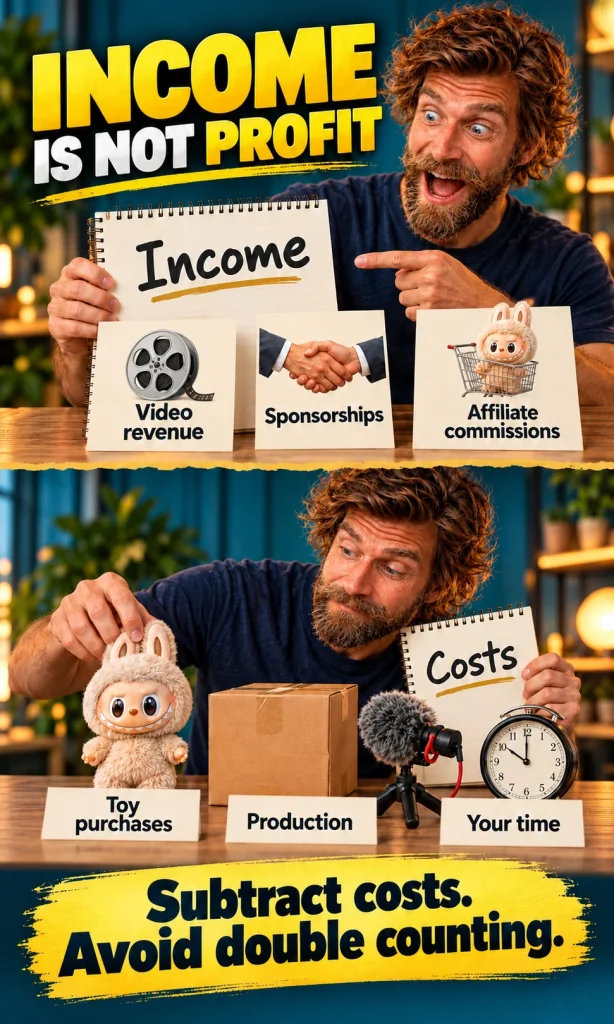
An outside sponsor or affiliate merchant can have requirements separate from YPP, so ad sharing is not the only possible business route. However, no Pop Mart partnership or affiliate access is assumed here. For a broader comparison of audience fit and income models, see How to Make Money on YouTube.
Your own YouTube revenue analytics are more useful than another creator’s public view count. RPM is creator revenue per thousand relevant views after YouTube’s share, and can include several YouTube income sources. Shorts use engaged views for this measure, while long videos use video views; do not apply one format’s rate to the other or add an included revenue source twice.
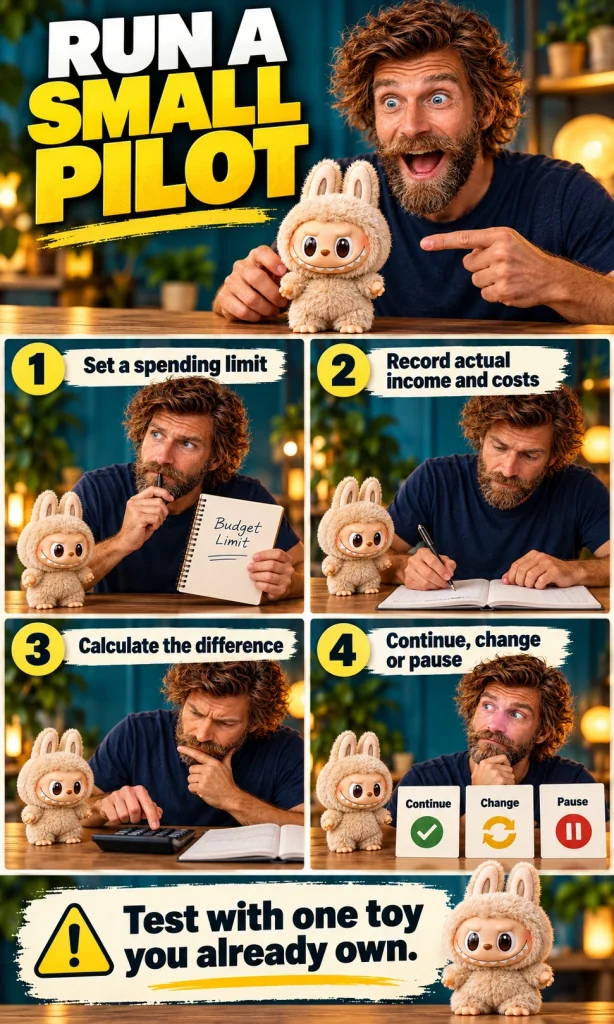
Run a small pilot with a stopping rule
- Set a spending limit. Decide the cash and time you can afford before recording. Start with one toy and equipment you already own; treat any new purchase as a cost, not a guaranteed income-producing asset.
- Record actual income and costs. Keep YouTube revenue, outside sponsorships and affiliate commissions separate. Record production spending and time, distinguish pending amounts from money received, and account for any returns or adjustments.
- Calculate the difference. Subtract project cash costs from the income being assessed, counting each item once. Separately compare the remaining amount with your hours and any relevant taxes or continuing overheads.
- Continue, change or pause. Continue only if the result fits your budget and purpose; change the format if production is too costly. Pause further purchases when the limit is reached or the evidence is too weak to justify more spending.
Illustrative arithmetic, not an earnings forecast: Suppose a small batch receives USD 90 in YouTube revenue and USD 20 in external commissions, with USD 75 of project cash costs. The cash remainder is USD 35 before tax, general overhead and payment for your time: 90 + 20 – 75 = 35. If it took five hours, the remainder is USD 7 per hour before those further deductions; none of these numbers represents a typical Labubu channel.
Buying a toy for a pilot and still owning it afterwards makes the cash comparison different from a formal accounting profit calculation. For a simple spending decision, counting the full new purchase prevents you from overlooking the money already committed. If this becomes a business, use accounting and tax treatment appropriate to your jurisdiction rather than presenting the pilot remainder as audited profit.
Takeaway: A useful first outcome is a finished original review, a clear rights record and a known production cost. Income can be zero, and a small pilot can still show that the format is too expensive or time-consuming. Let those findings determine the next purchase instead of treating the character’s popularity as evidence that the channel will pay.
Frequently asked questions
Do I need permission for every appearance of a Labubu toy?
There is no universal answer covering every use and jurisdiction. An independent review of an owned object differs from reproducing the character as entertainment, branding or merchandise. Assess the proposed use, any relevant exception and third-party assets; obtain appropriate advice or permission where needed.
Can I use AI to make Labubu videos?
AI can assist production, but it does not automatically give you rights to a protected character or make a video eligible for monetization. The finished content still needs an appropriate legal basis and original value. Repeating a template at scale can create a separate channel-policy problem.
Does crediting another creator let me repost their unboxing?
Credit alone is not permission, and permission alone does not guarantee YouTube monetization. You must address the rights to the material and the original value of your finished video separately. Recording your own demonstration avoids dependence on that creator’s recording rights.
Does a sponsor need to be Pop Mart?
No. A relevant third party could sponsor a video under its own commercial agreement, but no sponsorship is guaranteed here. Explain the relationship clearly and avoid implying official Pop Mart authorization. The sponsor’s brief does not resolve rights to unrelated music, images or character uses.
Does no copyright claim mean the video is cleared?
No. Automated detection is not a legal clearance service, and rights issues can surface after upload. Keep the basis for using each asset even when no notice appears. Read the actual notice if a restriction arrives, because a claim and a strike have different consequences.
Your next step
Use one Labubu you already own to answer one collector question with your own footage. Finish the rights, audience and disclosure checks before publishing, then record what the production actually cost. Expand only when the evidence supports the next step, with legal permission, YouTube eligibility and financial viability kept as separate questions.