



Bruce Springsteen’s account of depression became a major part of the public discussion around his memoir, Born to Run, and interviews accompanying its release. The clearest way to understand that story is to distinguish what he described experiencing from when he described it publicly; neither an old interview nor a newly shared headline establishes his health today.
This account follows the historical disclosures and explains how to read their different forms. It does not reconstruct a private medical record, assign a diagnosis beyond what was disclosed, or turn a musician’s treatment history into advice about anyone else’s medication.
When did Bruce Springsteen open up about depression?
The best-known cluster of disclosures belongs to the memoir period in 2016, with a later extended interview in 2018. Those are publication landmarks, rather than proof of when his difficulties began or a claim that he had never discussed them before. A reader looking for the source behind a familiar headline needs the interview date and setting before interpreting the story.
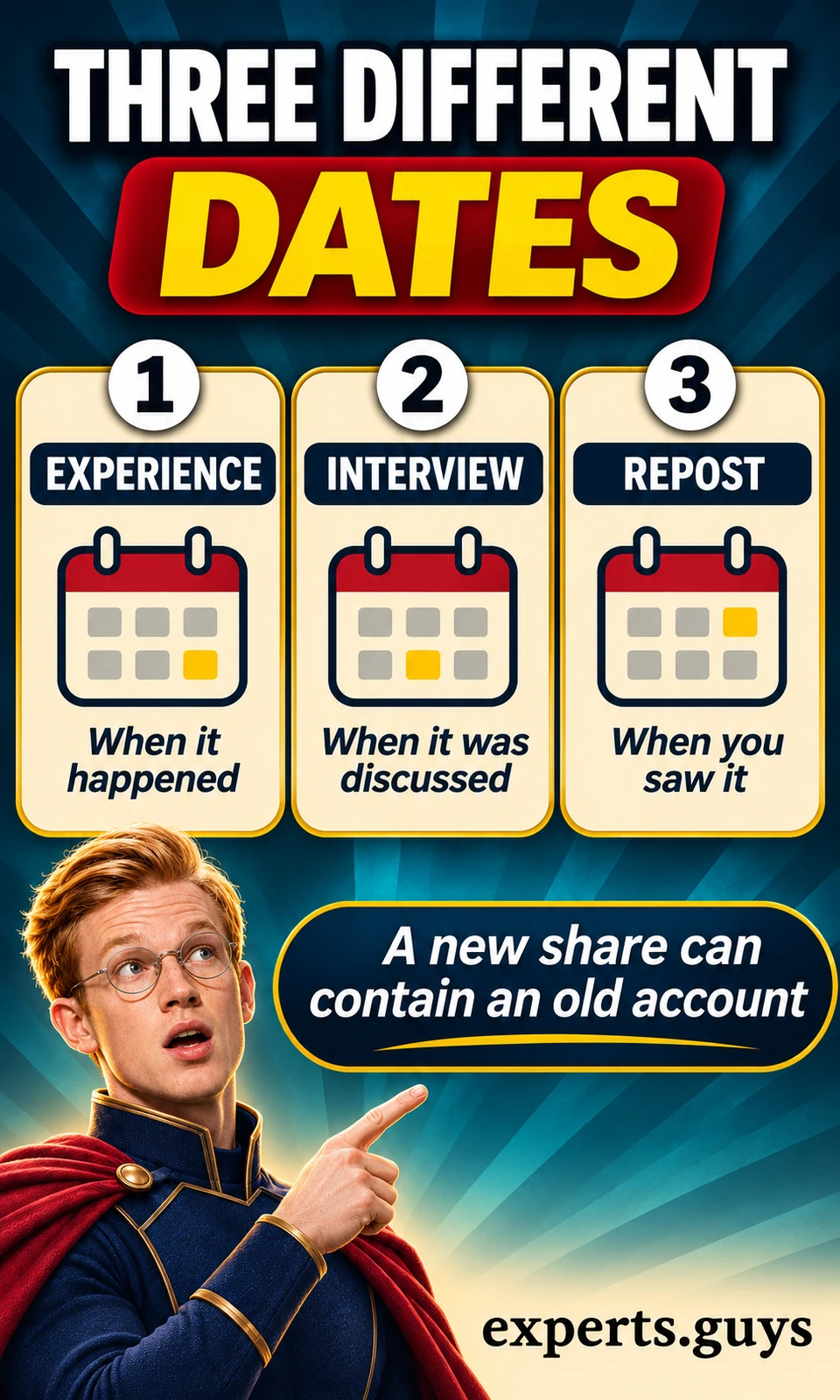
Three kinds of time operate at once: the period a person remembers, the date an interview is conducted or published, and the date a reader encounters it. They can be years apart. Keeping them separate prevents an archive article from becoming an accidental announcement of a new episode.
| Source and date | What it establishes |
|---|---|
| Vanity Fair profile — September 6, 2016; David Kamp’s cover story | The profile’s publication, not the start of symptoms. |
| CBS Sunday Morning — September 18, 2016; Anthony Mason interview | The broadcast setting for that conversation. |
| Born to Run memoir — September 27, 2016; autobiography released | The book’s publication, not a complete clinical timeline. |
| Esquire interview — November 27, 2018; Michael Hainey profile | A later conversation that also looks backward. |
The official Born to Run announcement identifies September 27, 2016 as the memoir’s release date. That date anchors the book’s publication, but it does not date every experience within it. Autobiography looks backward, often across several decades, and can group experiences by meaning rather than provide a clinical calendar.
The television conversation with Anthony Mason was broadcast on September 18, 2016, before the memoir appeared. A preview, an interview broadcast and the book’s release are related events, yet they remain separate publications. Combining their wording into one supposedly new interview makes it harder to tell which question was being answered and what context surrounded it.
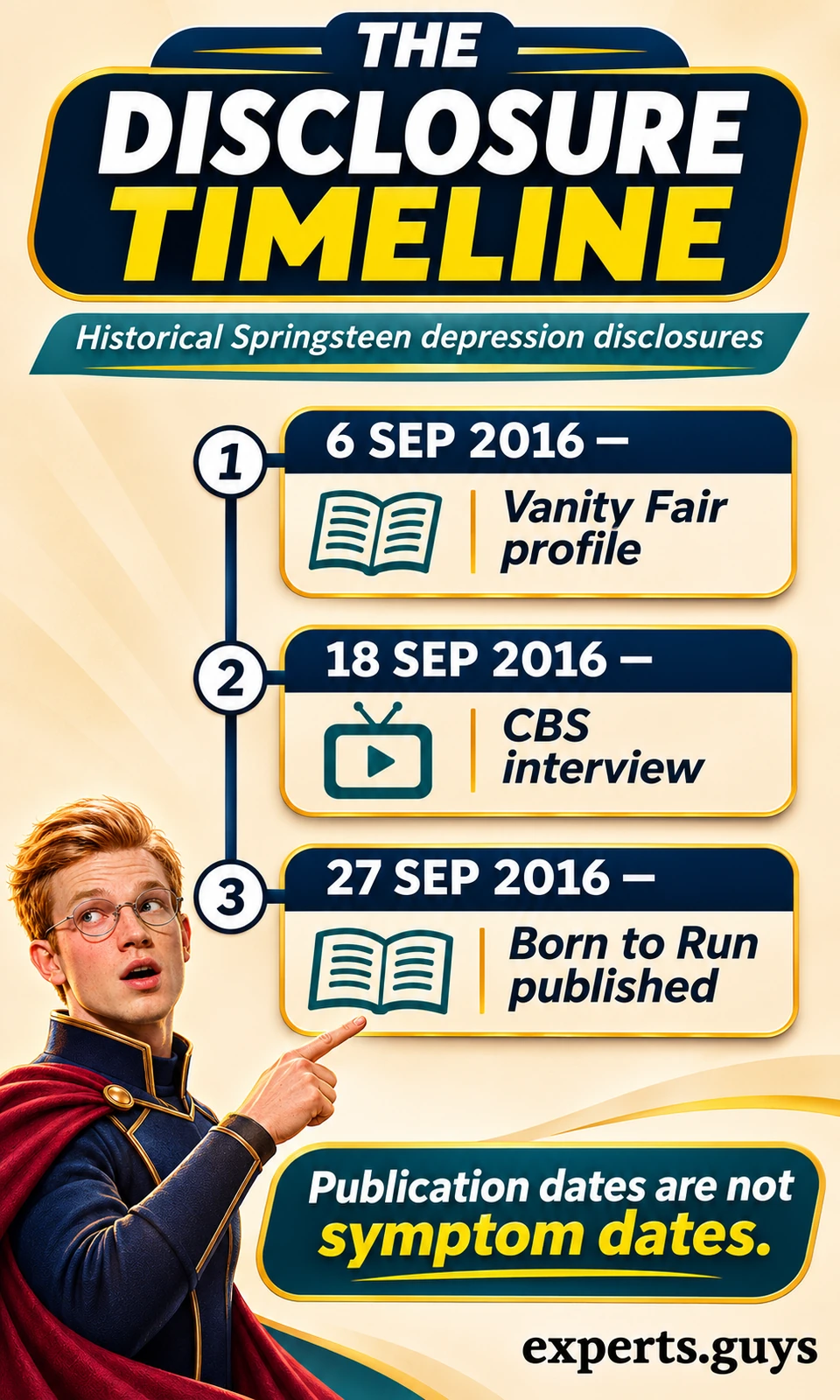
David Kamp’s Vanity Fair profile, published on September 6, 2016, belongs to the same period. Michael Hainey’s Esquire interview, dated November 27, 2018, belongs to a later conversation. They should not be flattened into a single announcement merely because both discuss mental health. A later interview can revisit an older experience rather than report something that has just happened.
This matters especially when the surrounding entertainment news uses words such as “new,” “next year,” or “upcoming.” Those words refer to the original publication’s present. If they remain in a recirculated article without their anchor, the reader may reasonably think an old memoir, performance or treatment comment is current. The historical fact should survive the removal of stale promotional language.
Why an episode date is different from a disclosure date
Imagine an illustrative archive item published in November 2018 that recalls a difficult period in someone’s early adulthood. The publication date tells you when the account entered that outlet’s record. It does not move the experience into 2018. Equally, an older experience described again in a later interview is not automatically a second, separate episode.
A careful timeline therefore uses event labels rather than a continuous line of symptoms. “Interview published” is a verifiable publication event. “Illness began” would require appropriate evidence about onset. Drawing a bar across the space between two interviews would invent information about what happened during the intervening years, even if the graphic looked convincing.
The distinction also limits age-based arithmetic. A recollection expressed as “in my sixties” does not automatically identify a precise start date, an end date or the number of uninterrupted months involved. Calculating an exact calendar interval from an approximate age can make a source seem more precise than its speaker intended. Keep the source’s resolution rather than improving it by guesswork.
- Identify who is speaking: the interview subject, interviewer, another participant or a later reporter.
- Keep the time reference attached to the experience it qualifies.
- Preserve qualifications such as an approximate period or an acknowledged uncertainty.
- Leave an interpretation identified as interpretation instead of turning it into a disclosed fact.
For the broader meaning of the disclosure, the companion article on why Springsteen’s depression story matters considers recognition and stigma. The job here is narrower: keeping the historical record understandable before drawing a lesson from it.
What did the original interviews actually establish?
The interviews establish that Springsteen publicly described substantial emotional difficulty and discussed receiving help. They do not provide all the information that a clinician would use to assess a person’s condition. The strongest reading preserves both parts: the experience he chose to describe deserves to be taken seriously, while the undisclosed details remain unknown.
In his CBS conversation with Anthony Mason, Springsteen described prolonged distress and benefit from therapy and antidepressants. That is a report of individual experience. It supports including treatment in the history, without supporting a particular prescription for readers or a claim about his present care.
The Vanity Fair profile discusses the memoir’s treatment of depression and family concerns. Its value is contextual: the public account had a personal history around it. The profile does not make that history a complete explanation of cause, nor does it allow a reader to calculate someone else’s inherited risk.
| Material | Use and limit |
|---|---|
| A direct interview answer | Useful for what the speaker chose to describe. Does not establish a complete assessment or undisclosed history. |
| A memoir passage | Useful for a retrospective personal account. Does not establish an independently measured episode timeline. |
| A writer’s interpretation | Useful for understanding a proposed meaning. Does not establish a diagnosis attributed to the interview subject. |
| A later summary | Useful for finding the original source. Does not establish independent confirmation of every repeated claim. |
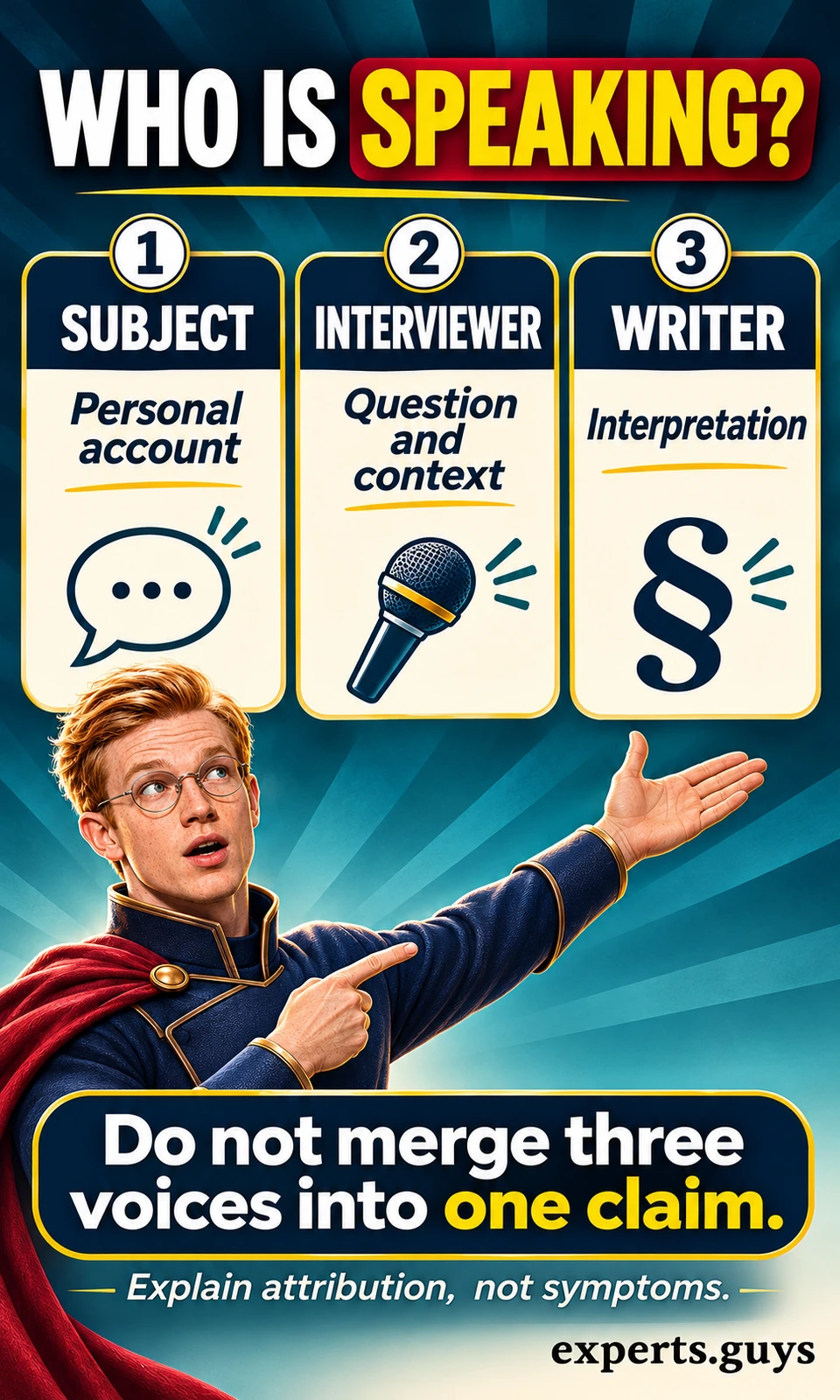
An interview contains more than one voice. There are the subject’s words, the interviewer’s questions, reported background and the writer’s interpretation. They may all be useful, but they do different jobs. A quotation tells you what was said; a paragraph explaining what the writer thinks it means remains interpretation, however persuasive the writing may be.
An autobiography adds another layer. A passage can be a first-person memory, selected and shaped for a narrative, while still being a meaningful account of distress. Calling it a memoir is not a reason to dismiss it. It is a reason to avoid pretending it is an independently assessed chart with standardized observations, complete dates and access to treatment decisions.
The 2018 Esquire interview revisits earlier periods of distress and the continuing work of understanding his life. Its retrospective structure matters more than extracting a dramatic phrase: looking back on a difficult period is different from announcing a new crisis. A magazine profile cannot settle his current diagnosis, medication or safety.
What can be quoted, and what should remain a paraphrase?
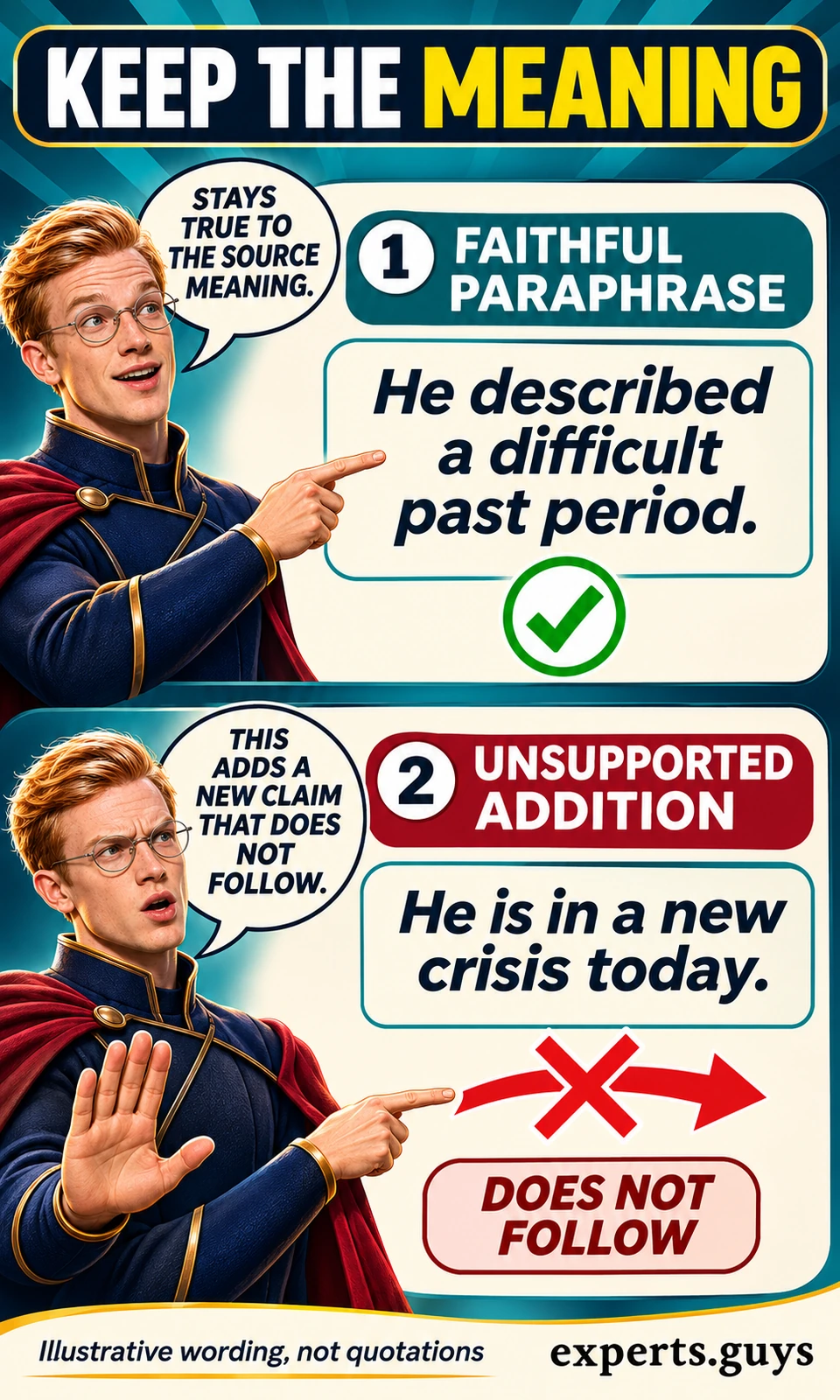
A direct quotation needs the original wording and enough surrounding context to preserve its meaning. A paraphrase should communicate the same bounded claim in fresh language. Neither should silently change a past-tense recollection into a present-tense condition, or attach an interviewer’s description to the speaker as though it were their own diagnostic wording.
Consider this illustrative example, which is not a quotation from Springsteen: a speaker says that a difficult period made ordinary activities feel overwhelming. A fair paraphrase keeps the reported difficulty and its historical setting. An unfair rewrite announces that the person can no longer function, adds a diagnosis, or suggests that the statement was made this week. The error is a change in meaning, not merely an inaccurate choice of adjective.
Descriptions such as a “breakdown” need particular care. In everyday conversation they can convey that someone felt unable to cope, but the term does not identify one specific diagnosis or a standard severity category. Replacing it with an undisclosed psychiatric label would add a claim that the interview did not establish. The plain description is often both clearer and more faithful.
The same restraint applies to song titles and stage material. A song can express despair, tell a fictional story, combine several experiences or use a narrator who is not the writer. Its existence cannot identify a symptom’s onset, a treatment response or an exact episode. Music can matter deeply without functioning as a medical document.
For another common interpretive mistake, the related guide to what Springsteen’s public story can show explores the limits of judging wellbeing through visible achievement. Keeping that issue on its own page leaves room here for the less obvious question of how an account changes as it travels through headlines and summaries.
What can readers learn from the treatment discussion?
The useful lesson is that receiving treatment belongs within the account, rather than being edited out of a story about endurance. It would be equally misleading to turn that account into a universal treatment sequence. An individual can describe something as helpful without proving it will be the right first choice, dose or combination for someone else.
The National Institute of Mental Health’s depression guidance describes psychotherapy and medication as common treatment options, sometimes used together. Assessment also considers other conditions and medications that can produce similar symptoms. Those general clinical principles explain why a personal success story cannot make an individual treatment decision for its audience.
There are several questions between a reported benefit and a useful recommendation. What problem was being treated? What else was happening at the time? Which outcomes changed, and over what period? What risks or unwanted effects mattered? A public interview may leave most of those questions unanswered because it was never intended to make a clinical comparison.
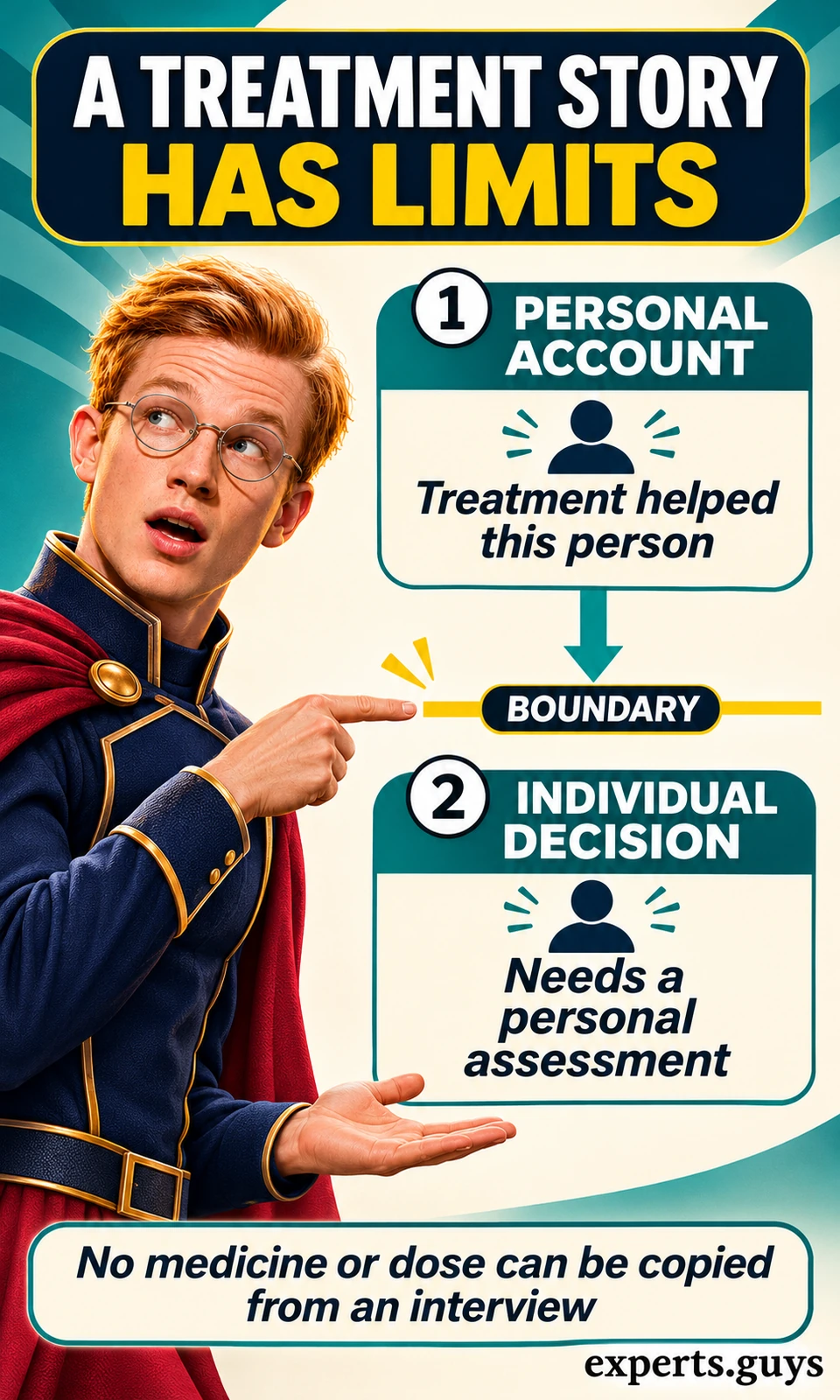
That missing information should produce a boundary rather than speculation. “He described receiving help” is a reasonable historical statement. Naming an unverified drug, proposing that it explains every later improvement, or concluding that a reader needs the same approach would go beyond the available record. Leaving those details unknown is more accurate than filling the gap with a plausible story.
The distinction between sequence and cause is especially useful. If treatment and improvement appear in the same account, a person may reasonably credit the treatment in describing their own experience. A journalist can report that attribution. The account still does not isolate the contribution of each component or predict what would have happened without it, as a comparative study tries to do.
Why “medication first” is too broad a conclusion
A statement about one person’s need at one time cannot establish that medication is always the first step for everyone. Treatment choices depend on the person’s symptoms, history, circumstances, preferences and clinical assessment. The correction is not to dismiss medication; it is to remove an unjustified rule while retaining the fact that treatment was discussed.
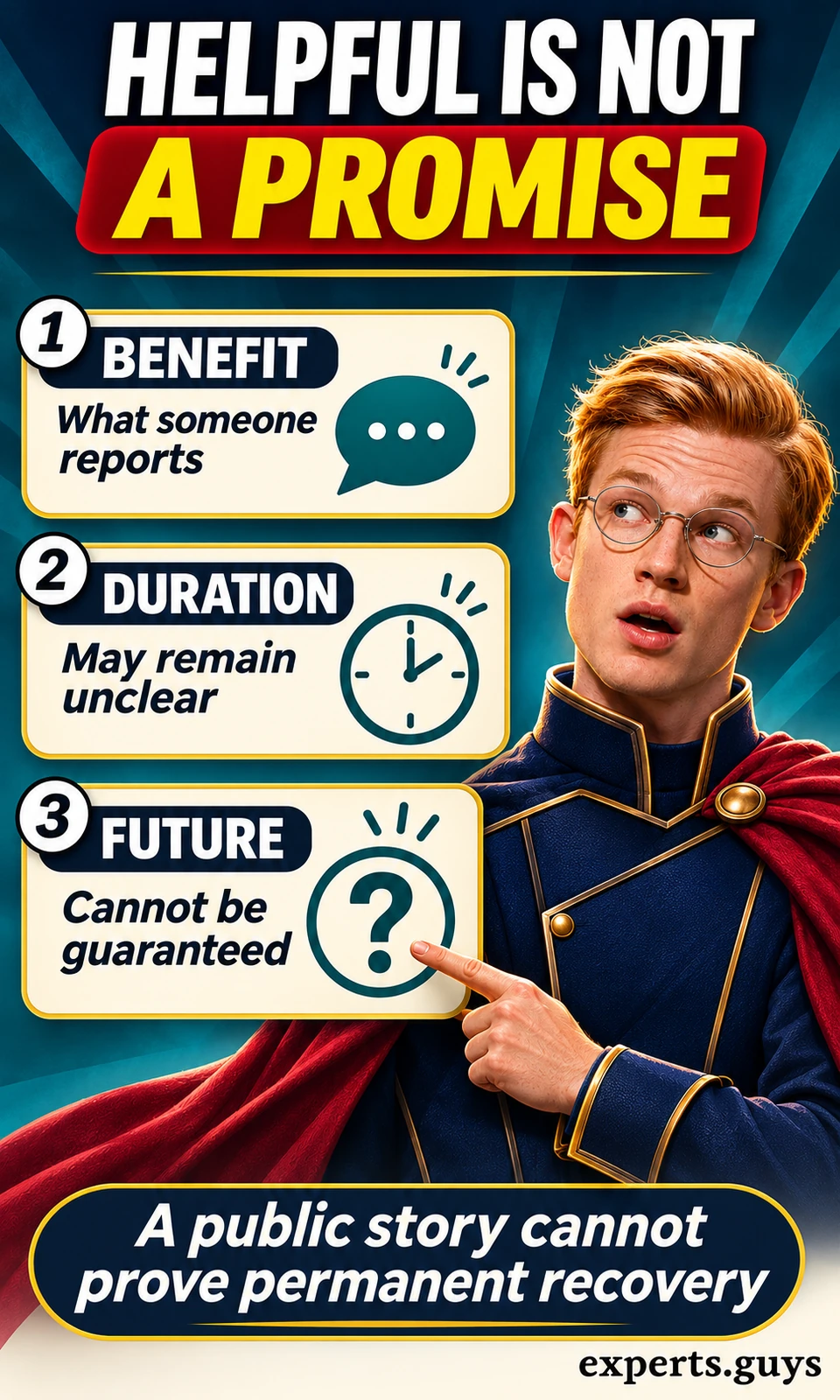
A second problem is the expectation of a complete ending. A profile can describe benefit, difficulty, recurrence or continuing care without establishing permanent recovery. “Helpful” is a different claim from “curative,” and a later return of symptoms does not by itself prove that an earlier benefit was invented. Public narratives often compress a course of illness that is more complicated than a single before-and-after story.
| Claim | Appropriate conclusion |
|---|---|
| Treatment was described as helpful | Report the person’s account, including its historical setting. |
| A particular medicine or dose is not disclosed | Leave it unknown; do not infer it from symptoms. |
| Several forms of support appear in the account | Do not assign all improvement to one component without evidence. |
| Improvement is described | Do not extend a reported benefit into a promise of permanent recovery. |
The same logic applies to how people talk about support from a partner. Personal support can be significant while leaving clinical care as a distinct part of the picture. A partner’s presence should not become a prescription for another household, an obligation to provide unlimited care, or a claim that love alone resolves illness. Each of those conclusions adds a responsibility or promise that the disclosure cannot justify.
Readers who are concerned about family history can continue with the separate guide to family mental illness, support and boundaries. That page addresses the household question directly. It is more useful than treating a musician’s family account as evidence that a relative will follow the same course.
If your own symptoms are persistent, worsening or interfering with eating, sleeping, work or basic care, a personal assessment is more useful than comparing yourself with an interview. Describe the difficulty in ordinary terms and ask about suitable options; no polished account or written diary is required. Do not start, stop or change prescribed medication to match a public figure’s story. Immediate danger calls for local emergency help rather than further reading.
How can you check a recirculated Springsteen headline?
Check the dated source behind the claim, then compare what the headline promises with what that source actually says. This is a reading skill, not a mental-health assessment. Its purpose is to decide whether a shared item contains a new disclosure, a historical account or an unsupported inference, without investigating anyone’s private life.
Begin with the question that made you open the link. If it is “Did he say this recently?”, the decisive evidence is a dated interview or statement, not the date printed beside a repost. If it is “What did he say about treatment?”, the useful section is the relevant exchange, with the speaker and context preserved. Choosing the question first prevents unrelated biographical detail from looking like an answer.
Check the source, date and claim in that order
Open the linked original interview or publication and locate its publication information. Next, find the passage that supports the shared claim and read the surrounding question or paragraph. Finally, compare the scope of the original with the scope of the headline. Stop when you can describe the limited claim accurately; there is no need to build a personal archive or keep a written log.
- Find the originating interview or statement, rather than relying only on a summary of a summary.
- Separate the publication date from the period being remembered and from any repost date.
- Match the headline’s main claim to the original passage, including who said it.
- Choose a bounded conclusion: historical disclosure, clearly new statement, or not established by the accessible evidence.

An easier version is to use just one reliable original source and answer one question. Someone with limited time or concentration does not need to compare every article online. For this story, confirming that a claim comes from the memoir-era interviews may resolve the main confusion. A browser’s find function or a screen reader can help locate a name or date without rereading a long profile.
If a source is paywalled, unavailable or missing a clear date, do not promote uncertainty into certainty. You may still be able to confirm a narrow publication fact from an official announcement or another accessible original interview. If the claim itself remains inaccessible, the honest result is that it has not been checked. A confident summary elsewhere does not repair that evidence gap.
A common mistake is treating several similar reports as independent confirmation. Five websites may all repeat one interview, sometimes with the same shortened phrase. That can show how widely the story circulated, but it does not create five separate observations of the person’s health. Trace the shared detail back to its origin before treating repetition as additional evidence.
A worked example: an old interview in a new feed
Suppose a social post shared today says that Springsteen has “opened up” about depression and links to a November 2018 interview. This is an illustrative reading example, not a report about a particular social account. The present-day share is new; the interview is historical. You can describe the post as recirculating an earlier interview without deciding whether anything has changed in his health since then.
Now suppose the post adds that the interview proves he is currently struggling or has permanently recovered. Neither conclusion follows just from the old interview date and content. The useful correction is specific: the accessible evidence concerns what was discussed at that time. That correction preserves the significance of the account while refusing an additional claim about the present.

When sharing the story, a concise historical framing does most of the work: “Springsteen discussed depression in interviews around Born to Run.” If a particular publication matters, name it and its date. Avoid adding a current diagnosis, a treatment recommendation or an imagined private scene. Accurate framing can be simple; it does not need to sound like a legal notice.
This check is complete when you know what the source supports and what it leaves unresolved. It does not establish whether a person is well, measure the severity of an illness or certify the reliability of an entire website. It gives you a proportionate way to read one claim and decide whether to repeat it.
Questions readers still ask
Does Born to Run mean the song or the memoir here?
Here it means Springsteen's autobiography, published in 2016. The same title is associated with his music, so the surrounding context matters. A reference to publication, chapters or an autobiography points to the book; a reference to listening, a recording or a performance points to the music. They should not be used interchangeably as sources.
Can I tell whether he has a particular depressive disorder from these interviews?
A public description does not supply a complete diagnostic assessment. Different conditions can involve depressive symptoms, and an everyday phrase does not establish a clinical subtype. Use the terminology the person actually disclosed rather than upgrading it to a more specific label through inference.
Should an old interview be removed because its details are historical?
Historical interviews can remain useful when their date and scope are clear. The problem is presenting them as a fresh announcement or carrying forward predictions that were only current at the time. Preserve the account, correct inaccurate framing and distinguish any genuinely new information from the archive material.
Does a newly updated webpage mean the person gave a new interview?
No. A page update can involve editing, formatting or additional context. To establish a new disclosure, identify the actual new interview, statement or other primary material and its date. A webpage's update label alone cannot establish that another conversation took place.
Keep the account in its proper setting
Start with the interview that answers your question, preserve its date, and stop at the claim it supports. Read the memoir-era material for the experience Springsteen chose to describe; use current, individual information for decisions about your own health. That distinction lets the public story remain meaningful without asking it to answer questions it cannot settle.










