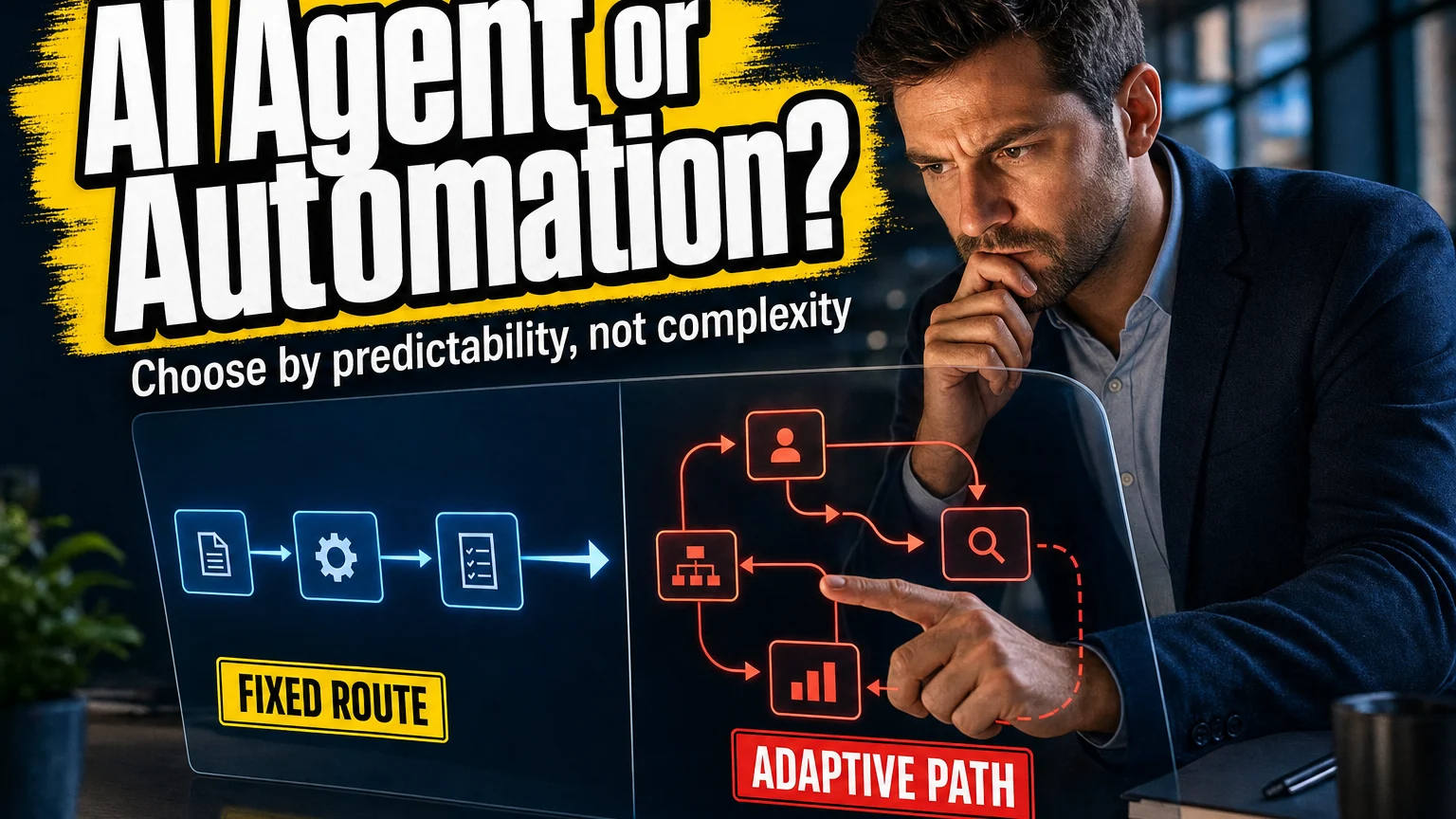
Automation and AI agents can both remove repetitive work, but they solve different kinds of problems. Traditional automation follows a route that has already been designed: when a known trigger occurs, the workflow applies predetermined rules and performs a defined action. An AI agent can operate with a broader goal, inspect changing information, decide which permitted action makes sense and adjust its route when the situation does not match a predefined path.
That difference matters because businesses can easily over-engineer a simple process. A workflow that always receives the same input and should always perform the same action usually benefits from ordinary automation. Giving an AI model permission to reconsider the process every time may increase cost, variability and monitoring requirements without improving the result.
The opposite problem also occurs. Some workflows become so crowded with exceptions, branching rules and manual handoffs that traditional automation becomes difficult to maintain. When the correct next action depends on changing context rather than a stable rule, an AI agent can become useful because it can evaluate what is happening while the work is underway.
The practical distinction is therefore:
Automation follows the route you designed. An AI agent can choose the route while the work is happening.
Google Cloud describes AI agents as software systems that can pursue goals and complete tasks on behalf of users, while conventional workflow automation is generally built around predefined triggers, logic and actions. The technology labels matter less than the operational question underneath them: how predictable is the next correct action?
Readers who need the broader foundation first can review what agentic AI means and how AI agents work. If the main question is whether AI should generate an output or continue pursuing a larger result, see agentic AI vs generative AI. This page focuses specifically on the architecture decision between fixed automation and adaptive agent behavior.
AI Agent vs Automation: The Short Answer
Automation is usually the better choice when a process is stable, repeatable and predictable. The workflow designer already knows what should happen when a trigger occurs, so the system can execute the same rules consistently without asking an AI model to reason through the situation each time.
An AI agent becomes more useful when the process contains changing conditions and the correct next step cannot always be determined in advance. Instead of following one fixed route, the agent can examine available information, choose among permitted actions, use tools, inspect the result and continue toward a goal.
Consider two examples.
A predictable workflow might be:
Invoice marked paid → update account → generate receipt → send confirmation
The route is known. Traditional automation is a strong fit because each step can be defined clearly.
A less predictable workflow might be:
Customer reports a billing problem → inspect account → determine what happened → collect missing information → choose an approved resolution → escalate unusual cases
The second process contains decisions whose answers depend on what the system discovers. Trying to encode every possible variation as a rule can eventually create a brittle automation maze.
The important comparison is therefore not simple task versus complicated task. A complicated process can still be highly predictable, while a seemingly small task can require judgment because its circumstances change frequently.
The stronger question is:
Can we reliably know the next correct action before the workflow starts?
The Predictability Gap
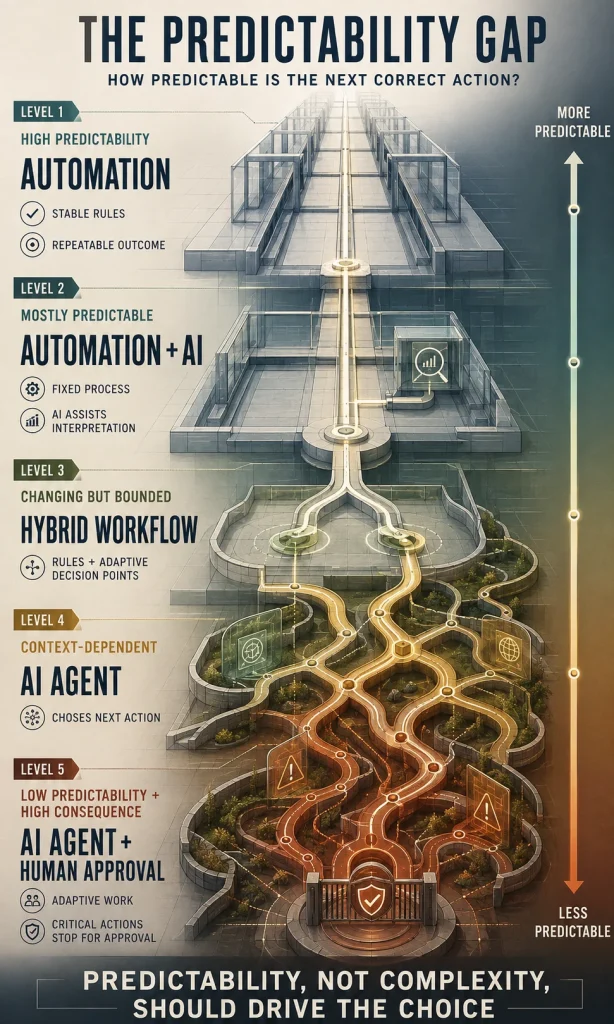
The central idea of this comparison is the Predictability Gap.
When the next correct action is highly predictable, traditional automation usually has an advantage. Rules are easier to test, easier to audit and usually cheaper to execute than asking an AI system to reason through a decision that has already been solved.
As predictability falls, rule-based systems need more branches. Every exception produces another condition, every condition creates additional maintenance and the workflow increasingly depends on somebody anticipating unusual situations before they happen.
Eventually a process can reach a point where the effort required to describe every possible route becomes greater than the value of keeping the workflow fully deterministic.
That is where an agent may begin to earn its complexity.
A useful spectrum is:
High predictability → Automation
Mostly predictable with some interpretation → Automation + AI
Changing but bounded situations → Hybrid workflow
Context-dependent next actions → AI Agent
Low predictability + high consequence → AI Agent + Human Approval
This spectrum is more useful than assuming there is a clean technological border between automation and agents. Real systems can combine deterministic rules, generative AI, agentic decisions and human checkpoints inside one workflow.
Predictability matters more than task complexity
Imagine a payroll calculation involving hundreds of employees, many tax rules and several deductions. The process is technically complicated, but if every rule is precisely defined, deterministic software can still be the correct architecture.
Now consider a customer emailing:
“I think I was charged incorrectly, but I am not sure whether the issue is with my renewal, my discount or the plan change I made last month.”
The task appears smaller, yet the route is less predictable. The system may need to inspect several records, determine which events matter, identify whether information is missing and select the appropriate resolution.
Complexity asks:
How many things are involved?
Predictability asks:
Can we know the correct route in advance?
For an AI agent versus automation decision, the second question is often more useful.
How Traditional Automation Works
Traditional automation begins with known conditions.
A trigger occurs. The system evaluates predetermined rules. Those rules determine what action happens next.
A simple example is:
New web form submitted → create CRM record → assign owner → send confirmation
The workflow does not need to decide whether creating the record is generally a good idea. The organization already made that decision when the automation was designed.
That predetermined structure gives automation several important advantages.
It is consistent. The same conditions should produce the same result.
It is relatively easy to test. A designer can provide known inputs and verify that the expected actions occur.
It is easier to audit. If something goes wrong, the workflow can often be traced through explicit rules.
It can also be economical because the system does not need to repeatedly invoke an AI model to interpret circumstances that have already been defined.
This is why a strong AI workflow automation system should not automatically replace deterministic workflows with agents. AI should be introduced where interpretation or adaptation contributes something meaningful.
Automation is strongest when the route is stable
Consider a business that sends a reminder three days before every subscription renewal.
The logic could be:
Renewal date is three days away
↓
Subscription is active
↓
Customer has not opted out of service notifications
↓
Send approved renewal reminder
An AI agent could theoretically perform this task, but there is little reason to let an AI model reinterpret the situation every time. The organization already knows the desired action.
Using automation keeps the process transparent and predictable.
Automation handles known exceptions well
Traditional automation is not limited to one straight line.
A workflow can contain branches.
For example:
If invoice < 7 days overdue → reminder A
If invoice 7-30 days overdue → reminder B
If invoice > 30 days overdue → create review task
This is still deterministic automation because the designer has already defined what each condition means.
The problem begins when the exception structure grows faster than the organization can maintain it.
When Automation Becomes a Maze
Many automations begin elegantly.
IF A → B
Then one exception appears.
IF A + C → D
Another business rule follows.
IF A + E but not F → G
Then customer segment, account status, historical behavior, product type, location, risk level and timing all begin affecting what should happen.
The workflow may eventually contain dozens or hundreds of interacting branches.
Nothing has technically stopped being automation. The system can still execute every condition exactly as written.
The problem is maintainability.
A change to one rule can affect several downstream branches. Teams become afraid to modify the workflow because they no longer understand every dependency. New exceptions are patched into the existing structure rather than simplifying the underlying logic.
This is the point where traditional automation can become brittle.
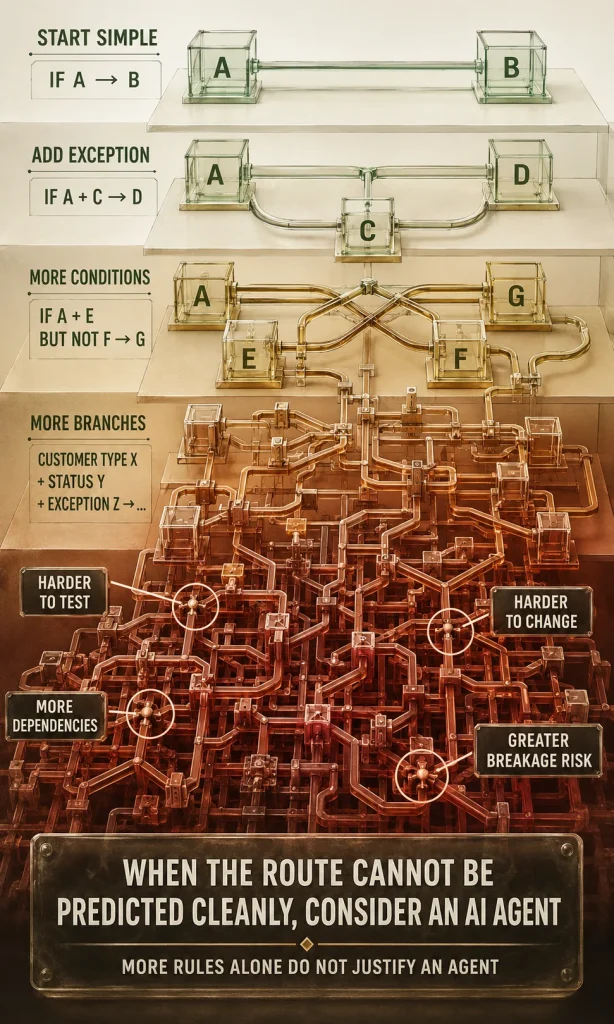
More rules do not automatically mean you need an agent
A large workflow should not be converted into an agent simply because the diagram looks intimidating.
Some complicated processes remain deterministic for good reasons. Financial calculations, compliance rules, permissions and safety constraints may benefit from explicit logic precisely because the organization wants the result to remain predictable.
The decision should depend on why the workflow is complicated.
If the complication comes from many stable business rules, better workflow design may solve the problem.
If the complication comes from repeatedly encountering circumstances that cannot be anticipated cleanly, agentic reasoning becomes more attractive.
That distinction can prevent businesses from replacing understandable software with an AI system when the real issue was simply poor process architecture.
How an AI Agent Works Differently
An AI agent can begin with a goal rather than a complete route.
For example:
“Review new customer billing disputes and move each case toward resolution within our approved policy. Escalate cases involving large amounts, possible fraud or policy exceptions.”
The organization defines the objective and boundaries, but it does not necessarily prescribe every action the system must take for every possible customer.
The agent might inspect the account, compare transactions, examine previous messages and determine that more information is required.
For another customer, it might discover an obvious duplicate charge and prepare an approved correction.
For a third, it might identify conflicting records and escalate the issue rather than acting.
The route changes according to context.
An agent can choose among permitted actions
This is the central operational difference.
Automation asks:
Which predefined rule applies?
An agent can ask:
Given what I know now, which permitted action is most appropriate?
That decision might involve choosing a tool, retrieving more information, asking a question, preparing an action or determining that the situation should be handed to a human.
The agent does not need unlimited autonomy for this behavior to be useful. It can operate inside a carefully constrained action space.
For example, a support agent might be permitted to:
Read an order
Check shipment status
Retrieve approved policy
Prepare a customer response
Issue a replacement below a defined value
but be unable to:
Change pricing
Issue large refunds
Modify account ownership
Override fraud controls
The architecture can therefore combine adaptive reasoning with deterministic boundaries.
An agent checks what happened after acting
Traditional automation frequently assumes that execution completes the step.
Agentic systems can incorporate a feedback loop.
The agent performs an action, inspects the resulting state and decides whether the objective has been satisfied.
Suppose an agent schedules a meeting.
It identifies an available time and attempts to reserve a room. The reservation fails because another booking happened moments earlier.
A fixed workflow may stop with an error or move to a predefined fallback.
An agent can inspect the new situation, find another room, reconsider the schedule and continue.
That ability to observe → act → check → adapt is one of the strongest reasons to use an agent when the environment changes while the task is being completed.
AI Agent vs Automation Comparison
| Decision Factor | Traditional Automation | AI Agent |
|---|---|---|
| Starting point | Trigger | Goal or objective |
| Route | Predetermined | Can change according to context |
| Who chooses the next step? | Rules designed in advance | Agent within defined boundaries |
| Best environment | Stable and predictable | Variable and context-dependent |
| Handling exceptions | Exceptions usually need predefined branches | Can reason about some new situations |
| Consistency | Very high when rules are correct | Can vary according to reasoning and context |
| Auditability | Usually straightforward | Requires stronger tracing and evaluation |
| Typical operating cost | Usually lower | Usually higher because reasoning and tool use can repeat |
| Maintenance | Rules, triggers and integrations | Models, prompts, tools, permissions, evaluations and integrations |
| Main failure risk | Incorrect rule or broken integration | Incorrect reasoning becoming an external action |
| Best use | Repeatable workflows | Adaptive multi-step work |
| Human role | Design the process and exceptions | Define goals, authority, monitoring and escalation |
The comparison explains why an AI agent should not be viewed as the next version of every automation. Automation has advantages precisely because it does less interpretation. When the process is known, that restraint can make the system faster, cheaper and easier to trust.
An agent becomes valuable when predetermined rules stop representing the real environment well enough. Its flexibility can reduce manual exception handling, but the same flexibility introduces variability that must be governed.
Rules vs Reasoning
Automation depends on explicit logic.
The designer defines conditions such as:
If customer type = business
and account age > 90 days
and payment status = current
then apply process X
The system does not need to understand why those conditions matter. It only needs to evaluate whether they are true.
An AI agent can instead use contextual reasoning.
Suppose a customer writes:
“I was promised a different rate when I upgraded, but my invoice looks higher than expected.”
The important facts may be spread across billing records, previous messages, product history and policy documentation. The system may need to determine whether the issue is a billing error, expired promotion, misunderstanding or account change.
Trying to encode every possible combination as rules may be impractical.
An agent can inspect the available evidence and decide which investigation step is most useful.
Reasoning should not replace rules that already work
One of the strongest design principles in agentic systems is to keep deterministic decisions deterministic when possible.
If a transaction above a certain amount always requires human approval, there is no reason to ask an agent whether approval feels appropriate each time.
The agent can reason about the surrounding situation, but the approval threshold can remain a hard rule.
Likewise, if deleting a record is prohibited, the system should enforce the restriction through permissions rather than merely instructing the model not to delete records.
This creates a stronger hybrid architecture:
AI reasons where judgment is valuable.
Software rules control where consistency is required.
That division is often more reliable than making the agent responsible for every decision.
Trigger vs Goal
Traditional automation usually begins with a trigger.
Examples include:
New form received
Invoice becomes overdue
Calendar event created
File uploaded
Status changes to approved
The trigger activates a workflow whose path is already known.
An AI agent can instead begin with a broader objective.
Examples might be:
Resolve ordinary billing questions within approved policy.
Keep this project schedule updated as dependencies change.
Prepare each account for the next appropriate sales action.
Investigate customer-reported delivery problems and escalate unusual cases.
A goal provides more flexibility because it describes what the system should achieve rather than every step it must follow.
That flexibility is useful only when the goal is sufficiently clear.
A vague goal can produce unpredictable behavior
Imagine telling an agent:
“Reduce support backlog.”
Several strategies could reduce the number of open cases. The agent could close duplicates, request missing information, prioritize easy cases or encourage broader use of automated replies.
Some of those actions may improve service. Others could make the backlog look better while reducing customer satisfaction.
A stronger objective would include constraints:
“Reduce unresolved routine support cases while maintaining approved response standards. Do not close cases without evidence of resolution, and escalate refund, fraud and account-security issues to a human.”
The second version gives the system a goal and defines the boundaries around success.
This is why adopting an AI agent often requires more operational thinking than creating an automation. The organization must explain what it wants the system to optimize without accidentally encouraging shortcuts that conflict with the real business objective.
Predetermined Path vs Adaptive Path
The simplest automation looks like a railway track.
Once the workflow enters the route, every switch has already been designed.
An agentic process behaves more like controlled navigation. The destination and available roads are defined, but the system can choose a different permitted route when conditions change.
Consider supplier research.
Automation might work well for:
Every Monday → download approved supplier price file → compare selected fields → flag increases above 5 percent
The inputs and comparison rules are stable.
An agent becomes more useful if the objective changes to:
“Investigate any supplier change likely to materially affect our cost or delivery risk.”
Now the system may need to determine whether a price increase is offset by lower shipping cost, whether minimum order quantities changed, whether delivery time increased or whether an alternative supplier has become more attractive.
The route cannot be completely known before the investigation begins.
Adaptability has a cost
An adaptive route is more difficult to predict than a fixed one.
Two similar cases may produce different investigative paths because the agent notices different evidence or interprets ambiguity differently.
That can be acceptable when flexibility is the reason the agent was introduced.
It becomes a problem when the business expected deterministic behavior.
Before replacing automation with an agent, the organization should therefore decide whether variability is a feature or a defect for that particular decision.
When Automation Is Better Than an AI Agent
Automation is usually superior when predictability is valuable and interpretation adds little.
A payment received should update the appropriate balance. A backup completed successfully should generate a status record. A form submitted with valid information should move into its known next stage. A scheduled report should run at the specified time.
These processes do not benefit from being reconsidered repeatedly.
Traditional automation also performs well where organizations require strong reproducibility. If the same input should always produce the same action, deterministic rules provide a clearer foundation than probabilistic reasoning.
Cost can reinforce the decision. A workflow that executes thousands of simple transactions may be far cheaper when implemented as conventional software than when each event invokes an AI model.
Auditability matters as well. A reviewer can often trace a deterministic process by inspecting the trigger, condition and action that executed.
For these reasons, ordinary automation should remain the default architecture for stable work rather than being treated as an older technology waiting to be replaced.
When an AI Agent Becomes More Useful
An agent becomes more attractive when several characteristics appear together.
The workflow encounters situations that vary.
Relevant information is distributed across several sources.
The next correct action depends on what the system discovers.
Exceptions are frequent enough that people spend significant time deciding what should happen.
The process may also need to continue across several steps rather than produce one output.
Customer-support investigation, complex account review, project coordination, research and some software-development workflows can fit this pattern.
The stronger signal is repeated decision work.
If employees spend much of their time moving between systems, interpreting what happened and deciding the next action, there may be a meaningful opportunity for an agent.
The agent does not need to replace the whole role. It may simply absorb some of the coordination between decisions while escalating cases where human judgment has greater value.
The Most Useful Architecture Is Often Hybrid
The choice between automation and an AI agent does not need to be absolute.
A strong workflow can use deterministic automation for predictable stages and an agent only where the route becomes uncertain.
Imagine a customer-support process.
Automation receives the case, records it, identifies the product and checks whether required information is present.
An AI agent investigates ambiguous cases, gathers context and proposes a resolution.
Deterministic policy rules determine whether the proposed action falls within allowed limits.
A human approves unusual or consequential exceptions.
The architecture becomes:
Trigger → Automation → Agentic Investigation → Policy Check → Action or Human Approval
Each component performs the kind of work it handles best.
This approach can also reduce risk because the agent does not need broad authority over every stage of the process.
It receives adaptive control only where adaptive reasoning creates enough value to justify it.
Cost Differences Between Automation and AI Agents
Traditional automation is usually cheaper to operate when the workflow is predictable because the system does not need to repeatedly interpret the situation before each action. Once the rules have been designed and tested, the same logic can execute thousands of times with relatively little computational overhead. The main costs tend to come from workflow software, integrations, maintenance and the staff time required to manage exceptions or update rules.
AI agents introduce additional operating costs because reasoning may happen repeatedly while the workflow is running. An agent may inspect information, call a model, choose a tool, execute an action, examine the result and then call the model again to determine what should happen next. One successful outcome can therefore involve several model interactions and several external tool calls rather than one deterministic execution.
The comparison should not stop at software cost. A cheap automation can still be expensive if employees spend significant time dealing with cases the rules cannot handle. An AI agent can have a higher technical cost while reducing enough manual coordination to make the overall workflow more economical.
The more useful calculation is:
Technology cost + human handling time + maintenance cost + correction cost = total workflow cost
This is a practical evaluation model rather than a formal accounting equation. Its purpose is to keep the decision focused on the cost of producing a useful outcome rather than the price of one API call or software subscription.
Automation usually wins when volume is high and variability is low
Consider a workflow that validates and routes ten thousand standard transactions every day. If the required conditions are stable, deterministic automation can process those events consistently without repeatedly paying for AI reasoning.
Replacing that system with an agent could add model calls without adding meaningful judgment. The workflow would become more expensive while producing essentially the same outcome.
High volume therefore strengthens the case for automation when the process remains predictable.
Agents can become economical when manual exception handling is expensive
The economics change when a large percentage of cases require human investigation.
Suppose an automation handles seventy percent of support requests correctly, but the remaining thirty percent require employees to open several systems, understand the customer’s history and decide what action to take. Those exceptions may consume far more time than the automated majority.
An agent that investigates the variable cases without replacing the stable automation could reduce that human workload. The stronger architecture might therefore keep seventy percent deterministic and introduce agentic reasoning only for the thirty percent where the next action is difficult to predefine.
This is another reason hybrid systems frequently make more sense than converting an entire workflow into an AI agent.
Maintenance Is Different, Not Eliminated
Automation and AI agents both require maintenance, but the maintenance burden appears in different places.
Traditional automation requires teams to maintain triggers, conditions, integrations and branching logic. When business rules change, the workflow may need to be updated manually. When many rules interact, testing becomes increasingly important because a small change can affect several downstream routes.
AI agents reduce the need to encode every contextual branch, but they introduce another set of maintenance responsibilities. Teams need to evaluate model behavior, monitor tool use, manage prompts or instructions, maintain permissions, test integrations, review failure patterns and confirm that the agent still behaves appropriately when the surrounding business environment changes.
An AI agent therefore does not remove maintenance. It changes the type of maintenance required.
Rule maintenance is visible but can become cumbersome
One advantage of conventional automation is that its logic is often explicit.
A designer can inspect the workflow and see that Condition A sends the case to Action B while Condition C sends it somewhere else. This visibility can make debugging straightforward when the workflow remains manageable.
As the rule tree grows, that transparency begins to weaken because understanding one branch requires understanding how it interacts with many others.
The problem is not that the rules disappear. There are simply too many relationships to reason about comfortably.
Agent maintenance requires evaluation rather than only inspection
An AI agent may not have one visible rule explaining every decision.
Instead, organizations need to evaluate whether the agent consistently makes acceptable choices across a representative set of situations. This requires test cases, logs, tracing, outcome review and clear definitions of what counts as success or failure.
The maintenance question becomes:
Is the agent continuing to make good decisions within its permitted boundaries?
That is a different operational challenge from asking whether a deterministic rule executed correctly.
Auditability: Automation Has a Natural Advantage
Traditional automation is usually easier to audit because the route can often be reconstructed from explicit conditions.
A reviewer may be able to see:
Trigger occurred → Condition 1 was true → Condition 2 was false → Action B executed
That sequence creates a relatively clear explanation of why the system behaved as it did.
Agentic systems can require more detailed tracing because the decision may depend on several pieces of context, model reasoning, tool results and intermediate actions. A useful audit record may therefore need to capture what information was available, which tools were called, what action was selected, whether approval was requested and what happened after execution.
This does not make agentic systems impossible to audit, but auditability needs to be designed rather than assumed.
A business should be able to reconstruct consequential decisions
For low-risk activity, a simple activity log may be sufficient.
For higher-consequence workflows, teams may need a stronger record of what information influenced the action and which boundary allowed the system to proceed.
This becomes particularly important when an agent can communicate externally, modify customer data, authorize financial activity or affect another operational system.
The level of traceability should rise with the consequence of the action.
Failure Modes Are Different
Automation typically fails because a rule is wrong, an input falls outside the expected structure or an integration breaks.
An AI agent can fail in those ways as well, but it can also make a poor contextual judgment even when every technical component is functioning correctly.
This distinction matters because the system may appear healthy while producing the wrong decision.
Automation can execute a bad rule perfectly
Suppose a workflow contains the rule:
If account status = inactive → stop all communication
The automation may execute that condition exactly as designed.
If the underlying business rule was wrong, the technology still behaved correctly according to its instructions.
This type of failure is usually deterministic and repeatable, which can make it easier to identify once someone notices the problem.
An agent can make a plausible but wrong decision
An agent might inspect several account records and conclude that communication should stop because the customer appears inactive.
The reasoning could sound reasonable while still being incorrect because one relevant record was outdated or misunderstood.
The system may then choose an action based on that incorrect interpretation.
This creates a different quality-control problem. The organization must evaluate judgment, not only execution.
Agent errors can propagate through multiple actions
Agentic workflows can also create chains of dependent decisions.
An agent may make one incorrect assumption, use that assumption to choose a tool, interpret the resulting data through the same incorrect frame and then take another action.
The original mistake can therefore become more consequential as the workflow continues.
Stopping conditions and approval gates become especially important when the agent is allowed to perform several actions without interruption.
Human Approval Should Follow Consequence, Not Fashion
Human-in-the-loop design should not be treated as a decorative safety label. Approval should be placed where human authority meaningfully changes the risk of the workflow.
Requiring approval for every action can destroy the efficiency an agent was introduced to create. Removing approval from every action can expose the organization to unnecessary operational risk.
A stronger approach is to classify actions according to consequence and reversibility.
Routine information gathering may happen automatically.
Drafting an internal note may happen automatically.
Changing a customer-facing commitment may require approval.
Issuing a large refund, deleting important records or changing sensitive account permissions may require stronger controls or remain fully human-controlled.
OpenAI’s practical guidance for building agents recommends human intervention for situations such as repeated failures and sensitive, irreversible or high-stakes actions. The broader lesson is that autonomy should expand according to the consequences the system can safely handle rather than according to how capable the underlying model appears.
Security Starts With Permission Boundaries
An AI agent connected to operational tools needs a carefully limited permission model.
The system should receive only the access required to perform its approved role. An agent that needs to read project status does not automatically need permission to delete projects. An agent that prepares payments does not necessarily need authority to release them.
This is one of the strongest differences between an informational AI assistant and an operational agent. Once the system can act, access control becomes part of the AI architecture rather than a separate IT concern.
A useful AI safety and ethics framework therefore needs to address both what the model can reason about and what the surrounding system allows it to change.
Read permission and write permission should be treated differently
Allowing an agent to inspect a database creates one level of exposure.
Allowing the same agent to modify that database creates another.
The safest architecture often starts with observation. The system reads information, produces recommendations and demonstrates whether its decisions are reliable.
Write access can then be introduced selectively where the operational benefit is strong enough to justify it.
Permissions should be technically enforced
Instructions such as “do not delete records” are useful, but important restrictions should not rely only on language inside the agent prompt.
If the agent should never delete records, the relevant tool or permission layer should make deletion unavailable.
If refunds above a certain amount require human approval, that boundary should be enforced by the surrounding system rather than leaving the agent to remember the policy each time.
This keeps deterministic constraints deterministic while allowing agentic reasoning inside the safe operating area.
When an AI Agent Is Overkill
Agentic AI is unnecessary when the workflow does not contain meaningful uncertainty.
A straightforward process such as:
Trigger → Validate → Update → Notify
already has a clear route. If the same valid input should produce the same action every time, traditional automation provides the consistency the business needs.
Adding an agent can make that workflow more expensive, harder to test and potentially less predictable without improving the user experience.
The existence of AI does not create a requirement to use AI.
Keep automation when the process is already well defined
If employees can explain the complete workflow with a small number of stable rules and those rules rarely change, automation is usually the stronger starting point.
This remains true even if the business processes a large number of transactions or the software architecture is technically sophisticated.
A complicated deterministic process can still be a better fit for automation than a small but highly ambiguous process.
Keep automation when consistency matters more than flexibility
Some workflows should behave identically every time.
Regulatory calculations, system backups, routine data synchronization, deterministic validations and other controlled processes may benefit from predictable execution.
Allowing an agent to reinterpret the rule each time would weaken one of the reasons the automation exists.
Keep automation when AI reasoning would add no information
If the system already has everything it needs to determine the next action, another reasoning step is unnecessary.
This principle can save substantial complexity:
Do not pay AI to rediscover a decision the workflow already knows.
When a Hybrid Workflow Is Better Than Either Extreme
Many real workflows contain predictable stages and uncertain stages together.
Choosing only automation can create an enormous rule tree. Choosing only an agent can make stable stages unnecessarily variable.
A hybrid workflow separates them.
Consider a supplier-management process.
Automation can collect scheduled price files, normalize the data and flag changes above a defined threshold.
An agent can investigate unusual changes by checking delivery terms, minimum orders, recent supplier communications and alternative options.
A deterministic rule can require human approval before changing the approved supplier.
The resulting architecture is:
Automation for collection
↓
Agent for investigation
↓
Rules for policy boundaries
↓
Human for consequential approval
This arrangement uses each system where its strengths are most useful.
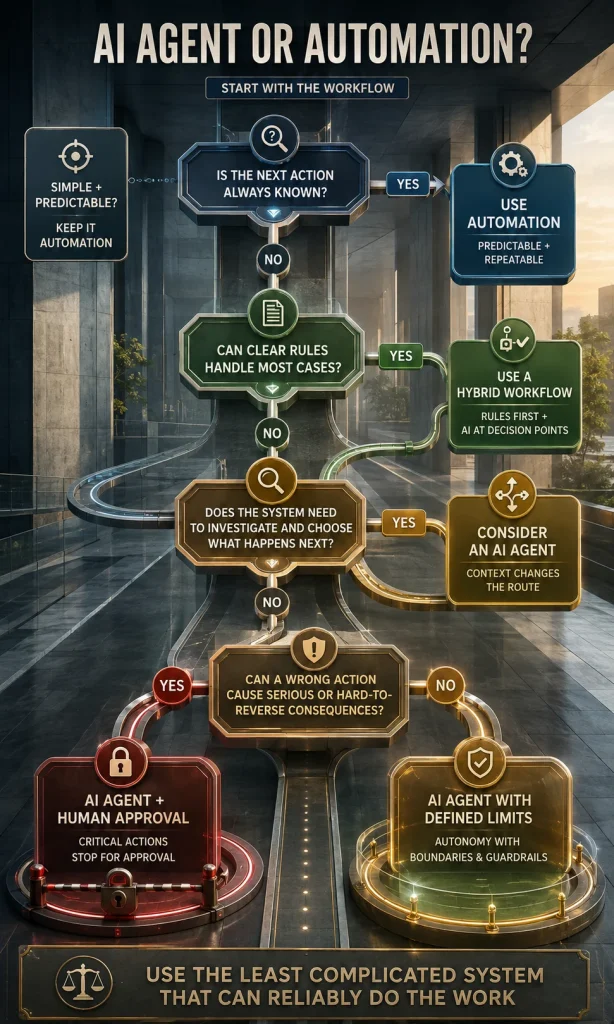
AI Agent or Automation? A Practical Decision Framework
| Decision Question | If YES | If NO |
|---|---|---|
| Is the next correct action reliably known in advance? | Start with automation | Continue evaluating |
| Can clear rules handle most cases? | Use automation, possibly with AI at limited decision points | Consider agentic reasoning |
| Does the correct route change according to context? | An AI agent may add value | Keep the workflow deterministic |
| Does the system need to investigate before deciding? | Agentic behavior becomes more useful | Automation or AI-assisted workflow may be enough |
| Are exceptions frequent and difficult to predefine? | Investigate an agent or hybrid workflow | Maintain explicit rules |
| Can a wrong action cause serious or hard-to-reverse consequences? | Add human approval or retain human control | Defined autonomous limits may be practical |
| Can success and escalation conditions be defined clearly? | Controlled agent deployment becomes more feasible | Clarify the process before increasing autonomy |
The framework deliberately gives automation the first opportunity to solve the problem. An AI agent should enter the decision only when adaptive reasoning addresses a real limitation of deterministic workflow design.
This produces a useful operating principle:
Use the least complicated system that can reliably do the work.
Four Architecture Outcomes
Use Automation
Choose automation when triggers, conditions and actions are predictable enough to define before execution.
Strong examples include scheduled reports, routine notifications, data synchronization, standard validations, recurring status updates and transactions governed by explicit rules.
The strength of automation is precisely that it does not need to reconsider a solved decision every time.
Use Automation + AI
Some workflows benefit from AI interpretation without requiring an autonomous agent.
For example, AI might classify an incoming request, summarize a document or extract information from unstructured text. Traditional automation then routes the result according to known rules.
The architecture might look like:
Incoming request → AI classification → fixed routing rule → known action
AI helps interpret the input, but it does not own the continuing process.
Use a Hybrid Workflow
Choose a hybrid approach when most of the process remains predictable but a few stages require contextual judgment.
A workflow can stay deterministic until it reaches one uncertain decision point. An agent handles that section and then returns the task to controlled automation.
This prevents the business from giving the agent more authority than the problem actually requires.
Use an AI Agent
Choose an AI agent when the workflow genuinely requires investigation, context-dependent choices and adaptive continuation.
The strongest cases involve repeated situations where employees currently gather information from several places and then decide what should happen next.
The agent earns its complexity by taking over some of that decision coordination rather than simply performing a task that ordinary automation already handled well.
Real Business Examples
Customer Support
Automation can route a support case according to product, customer tier or issue category.
An AI agent becomes more useful when the system must investigate the customer’s history, determine what information is missing, interpret policy and choose an appropriate next action.
A hybrid design often works best. Automation performs intake and routing, the agent investigates complex cases and humans approve unusual remedies.
Accounts Receivable
Automation can send the same reminder when an invoice reaches a known overdue threshold.
An agent becomes more useful when the correct action depends on customer history, previous communication, disputed charges, payment commitments or other changing context.
High-value or sensitive accounts can remain behind human approval.
Project Coordination
Automation can create recurring tasks, send deadline reminders and update known fields.
An agent becomes useful when dependencies change and somebody needs to investigate what the change means for several other tasks.
The system might gather recent updates, identify the affected work, prepare a revised sequence and escalate major schedule changes.
This can complement an AI task management workflow rather than replacing its stable components.
Research
Automation can retrieve the same known data source on a schedule.
An agent becomes useful when the research route depends on what earlier evidence reveals.
The system might begin by comparing supplier prices, discover a delivery-time difference and then investigate whether the shipping change outweighs the apparent saving.
The investigation evolves rather than following one fixed branch.
Software Operations
Automation is extremely effective for known deployment steps, scheduled backups, monitoring thresholds and repetitive system tasks.
An agent may become useful when an error requires investigation across logs, code, configuration and previous incidents before the correct next action can be determined.
Even then, production changes may remain behind deterministic controls or human approval because the consequences are larger.
What Should Never Be Delegated Just Because an Agent Can Do It?
Technical capability and appropriate authority are different questions.
An AI agent may be capable of preparing a large financial transaction, deleting records, modifying access permissions or sending a sensitive communication. That does not mean the system should receive autonomous authority to perform those actions.
The better question is:
What happens if the agent is confidently wrong?
When the consequence is difficult to reverse, the design should become more conservative.
The NIST AI Risk Management Framework provides a broader governance structure for identifying and managing AI risk across design, deployment and use. For agentic systems, that governance becomes practical through permissions, monitoring, escalation, testing and clearly defined human authority.
The Final Test: Who Should Decide the Next Step?
The AI agent versus automation decision becomes much easier when the workflow is examined at the moment where one action ends and another must begin.
If the answer to “what happens next?” is already known, use automation.
If the answer depends on a small amount of interpretation while the route remains fixed, use automation with AI assistance.
If the answer changes according to context and the system needs to investigate before choosing, an AI agent becomes more useful.
If the answer changes according to context and a wrong choice could cause serious consequences, use an agent only inside defined limits with human approval at the appropriate checkpoint.
That sequence gives the business a clearer architecture than starting with a product label and attempting to fit the workflow around it.
The Bottom Line
Automation and AI agents should be treated as different tools rather than competing generations of the same technology. Traditional automation is strongest when the organization already knows the correct route and wants the system to execute it consistently. AI agents become valuable when the route itself needs to be selected while the work is happening.
The Predictability Gap provides a practical way to decide between them. As long as the next correct action remains easy to define, automation usually deserves the advantage. As context becomes more variable and exceptions become harder to predefine, hybrid workflows and AI agents become increasingly useful.
The strongest architecture may still combine several approaches. Automation can control predictable stages, AI can interpret difficult inputs, an agent can handle adaptive investigation and human approval can protect consequential decisions.
The goal is not maximum autonomy.
The goal is a workflow that is reliable enough, flexible enough and no more complicated than necessary.
Frequently Asked Questions About AI Agents vs Automation
What is the main difference between an AI agent and automation?
Traditional automation follows predefined triggers, rules and actions. An AI agent can receive a broader goal, examine changing context and choose among permitted next actions while the workflow is running. Automation works best when the route is predictable, while an AI agent becomes more useful when the correct route depends on what the system discovers.
Is an AI agent just advanced automation?
An AI agent can automate work, but the important distinction is how the next action is selected. Traditional automation usually executes logic created before the workflow begins. An agent can use AI reasoning to choose among possible actions according to the current situation.
When should I use automation instead of an AI agent?
Use automation when the trigger, conditions and next action can be defined reliably in advance. Stable workflows such as notifications, routine updates, data synchronization and known approval sequences usually benefit from deterministic automation because it is easier to test, audit and maintain.
When is an AI agent worth using?
An AI agent becomes useful when the workflow contains changing conditions, frequent unexpected exceptions, several information sources and repeated decisions about what should happen next. The agent should solve enough manual coordination or decision work to justify its additional complexity.
Can automation and AI agents work together?
Yes. Automation can handle predictable stages while an AI agent handles specific decision points where context changes the route. Deterministic policy rules and human approval can control higher-consequence actions.
Does a complicated workflow automatically need an AI agent?
No. A process can be complicated while still being predictable. An AI agent becomes more relevant when the correct next action cannot be represented cleanly in advance and the system must interpret changing circumstances while the workflow is running.
Should AI agents always have human approval?
Not every action needs human approval. Low-risk, reversible actions can sometimes operate within defined limits. Human approval becomes more important when actions are sensitive, consequential, irreversible or outside the agent’s normal operating boundaries.