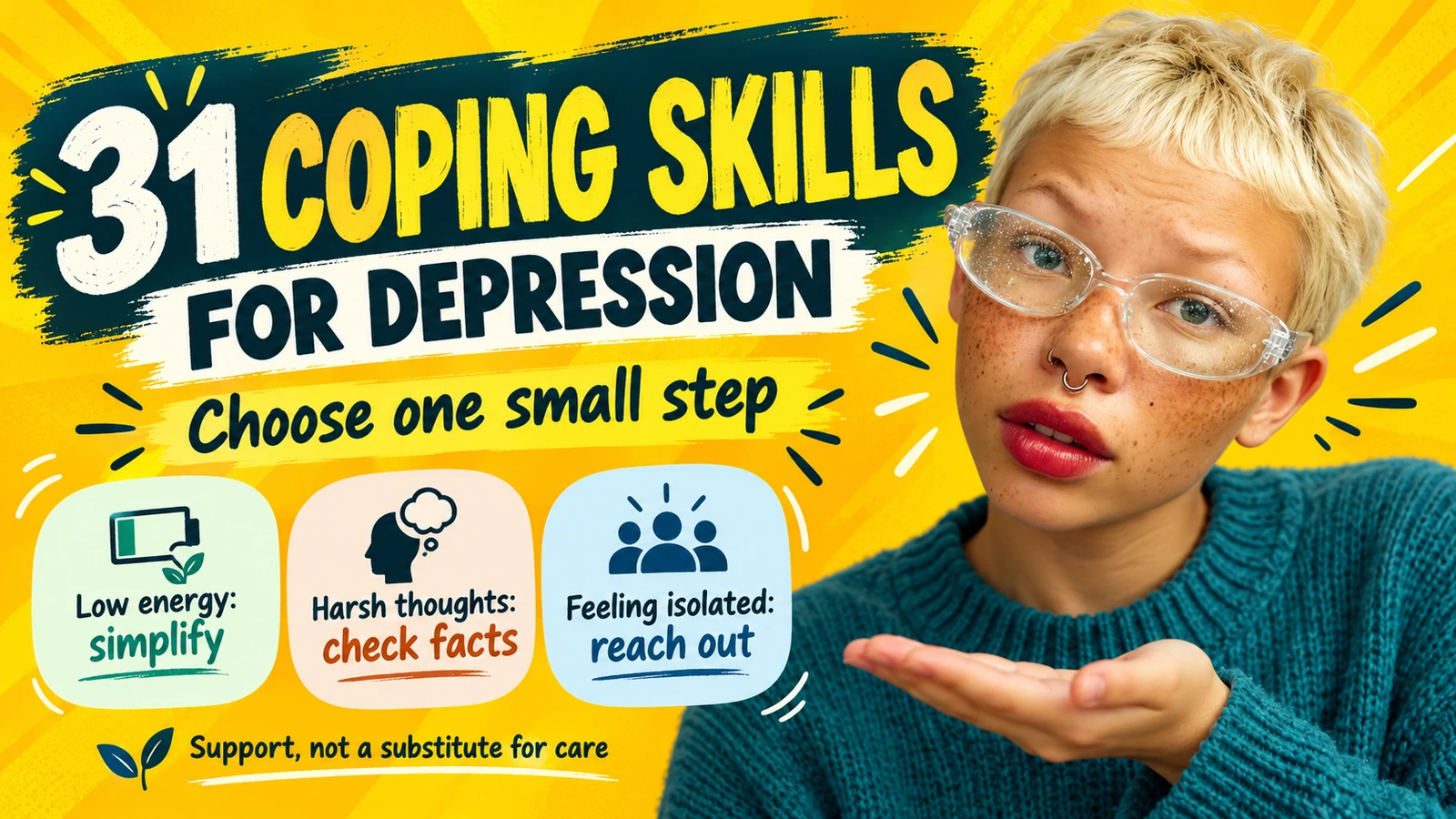
Start with the smallest useful action you can manage, rather than trying all 31 coping skills. If symptoms are persistent, worsening or making daily life difficult, use these skills alongside professional support. The list below helps you choose between practical steps, thought skills, connection and getting care.
This guide is written mainly for adults and offers educational self-help, not diagnosis or an individualized treatment plan. Depression can affect energy, concentration, appetite, sleep and the ability to feel pleasure, so a useful action may need to be much smaller than your usual routine. If you are under 18, involve a trusted adult or an appropriate child or adolescent mental-health service.
| Current difficulty | Start here | What counts as completion |
|---|---|---|
| A task feels too big | Skills 1–4: shrink the start | One chosen action, not the whole chore |
| Food, sleep or activity have slipped | Skills 5–8: support daily basics | One feasible part of a routine |
| Thoughts feel harsh or stuck | Skills 9–16: check facts or choose an action | One fair response or practical next step |
| You are withdrawing | Skills 17–24: lower-pressure contact | One message, request or shared activity |
| Symptoms persist or worsen | Skills 25–31: connect with care | A usable care route; urgent help when needed |
The numbering is a menu, not a checklist or a ranking of effectiveness. Several items are different applications of the same principle, and no trial has established this exact 31-item set as a treatment. The examples and shorter versions are editorial adaptations of established guidance; choose one that fits your capacity and stop an exercise that increases distress.
Which coping skills help when depression makes starting difficult?
Make the starting point smaller before asking yourself to do more. Depression can reduce drive and make the effort of a task feel larger than its likely reward. Reducing the task, preparing materials and limiting time can lower that immediate barrier without requiring motivation first.
Repeated avoidance may bring brief relief while leaving fewer experiences of achievement, connection or enjoyment. Behavioural activation addresses that pattern by rebuilding useful activity in manageable stages; it does not require you to wait until you feel better. Public-health behavioural activation resources explain the activity–mood connection, while short-task guidance offers a practical starting method.
Structured treatment involves more than a timer or a walk. Depression treatment guidance includes supported psychological approaches selected to fit symptoms, preferences and clinical needs. The small actions below illustrate starting principles, and daily food or sleep support should not be presented as a cure.
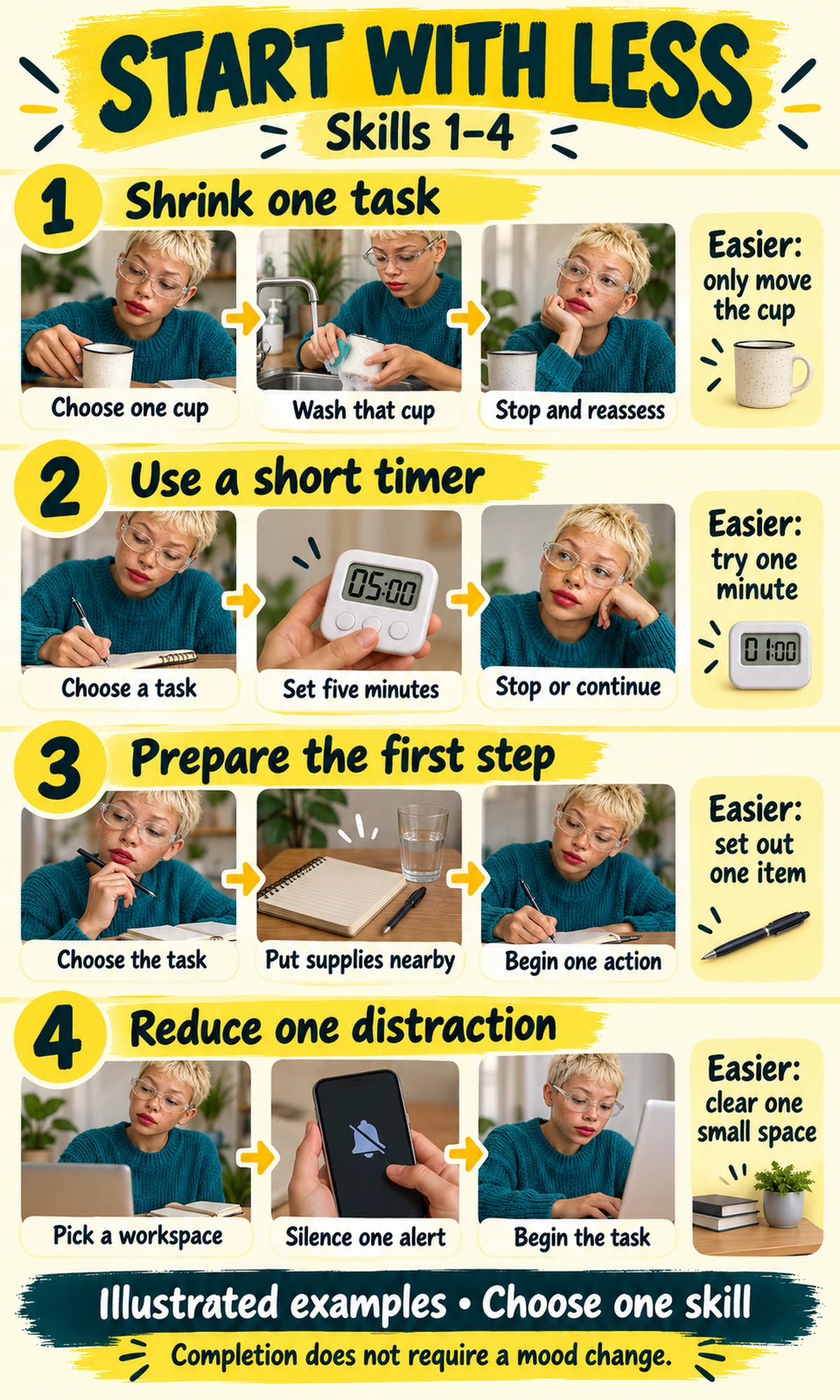
1. Shrink one task
- Choose one cup
- Wash that cup
- Stop and reassess
When a chore feels impossible, choose a unit with a visible end. For example, wash one cup rather than clean the kitchen; stop after that cup and decide whether to repeat. Moving it beside the sink is the easier version, and completing that chosen step counts even if your mood stays low.
2. Use a short timer
- Choose a task
- Set five minutes
- Stop or continue
For a task you can safely interrupt, set a five-minute timer and begin one part. When it rings, stop or continue by choice; an illustrative example is sorting a few letters, without committing to every bill. If five minutes is too much, try one minute; the timer is a permission to limit effort, not a deadline to finish everything.
3. Prepare the first step
- Choose the task
- Put supplies nearby
- Begin one action
If preparation is the barrier, put the needed item where the task will happen. For example, place your toothbrush by the sink, then brush when you are ready. Setting out the brush alone is the smaller version; keep medicines, sharp items and cleaning products safely stored.
4. Reduce one distraction
- Pick a workspace
- Silence one alert
- Begin the task
Choose somewhere suitable for the task, silence one nonessential notification and start the first action. An illustrative example is reading one letter at a table instead of beside a noisy television. If changing rooms is too much, clear enough space for the letter; keep essential contact and safety alerts available.
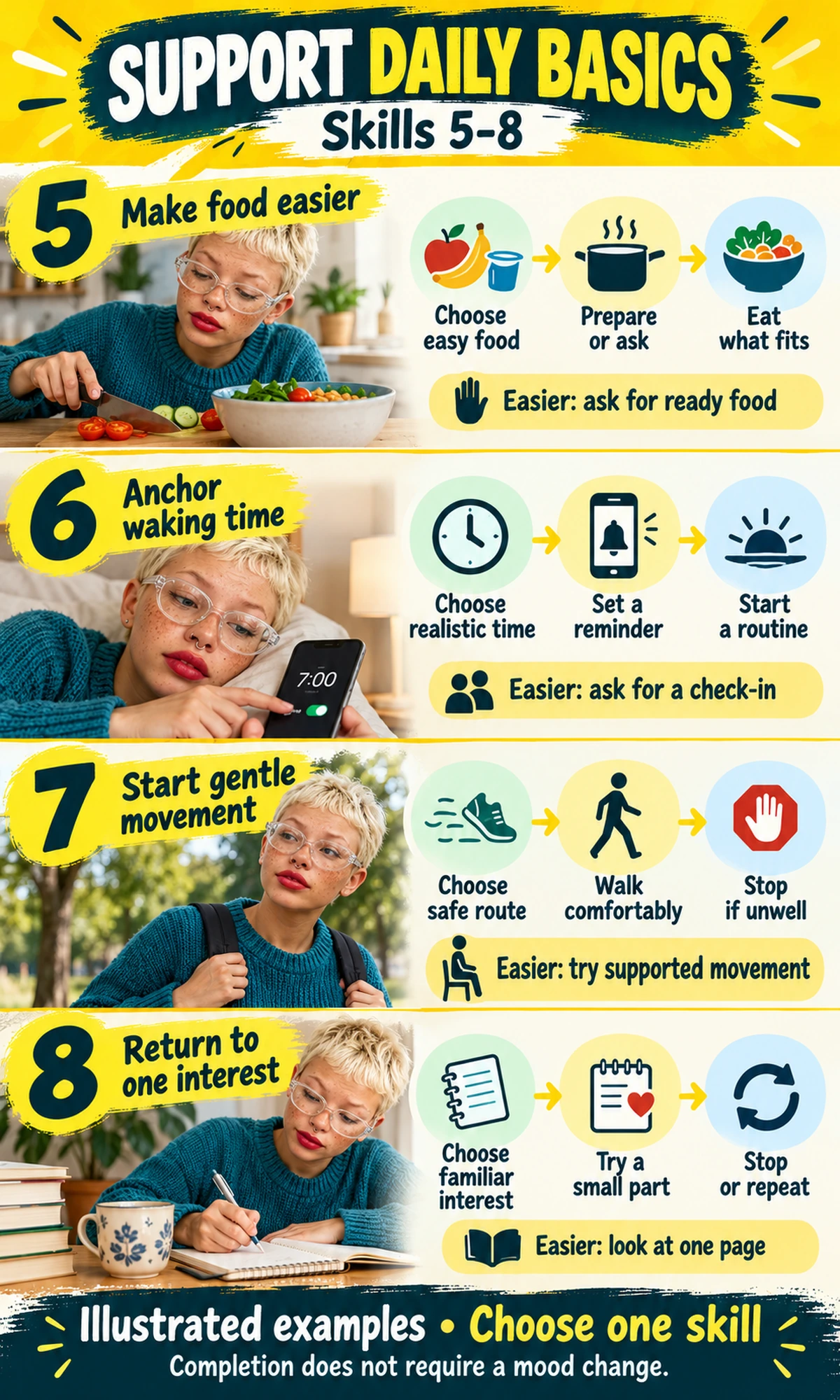
5. Make food easier
- Choose easy food
- Prepare or ask
- Eat what fits
When preparing meals feels difficult, choose an accessible food you can tolerate, prepare it or ask someone to help, and eat what you can. Toast with an egg or a ready meal is an illustrative option rather than a depression diet. A ready-to-eat portion is the smaller step; seek medical advice for ongoing poor intake, unintended weight change or difficulty keeping fluids down.
6. Anchor waking time
- Choose realistic time
- Set a reminder
- Start a routine
Choose a realistic waking time and use a reminder to begin a familiar morning action, such as opening the curtains. A supported check-in is an easier option if getting up is difficult. Repeatedly sleeping very little while feeling unusually energized needs assessment, rather than stricter self-discipline; do not restrict needed sleep to meet a target.
7. Start gentle movement
- Choose safe route
- Walk comfortably
- Stop if unwell
If walking is safe for you, choose a short familiar route and walk at a comfortable pace. For example, walk to the gate and back, then decide whether to repeat another day; a brief supported movement within your ability is the smaller version. Stop for pain, dizziness or significant breathlessness and seek advice; this tiny start is not equivalent to a full supervised exercise treatment.
8. Return to one interest
- Choose familiar interest
- Try a small part
- Stop or repeat
Choose an activity that used to matter to you and try a small part without requiring enjoyment. For example, read one page of a familiar book or handle your drawing materials; looking at the page alone is an easier option. The outcome is making contact with the activity, not proving that your pleasure has returned.
If missed meals need explaining at a visit, our guide to logging skipped meals before a depression appointment shows what an optional record can clarify. Keep practical food support first, and do not wait to finish a record before seeking care.
How can you respond to harsh thoughts and repetitive worry?
Check one specific thought, or choose one action for a solvable problem. Self-criticism can turn a difficult event into a sweeping conclusion about your worth, while repetitive worry can keep attention on threats without producing a decision. The useful distinction is between a claim that needs evidence, a practical problem that needs action and an uncertainty you cannot settle now.
Thoughts, emotions and behaviour can reinforce one another: expecting rejection may encourage withdrawal, leaving fewer chances to discover a different response. Thought-reframing guidance supports examining evidence and trying a more balanced interpretation. This is flexible thinking, not a demand to feel positive or deny genuine adversity.
For an actionable concern, structured problem solving turns a broad worry into a choice and a next step. Bounded worry practice is a separate approach to repetitive worrying, and it may not suit depressive rumination or severe distress. Avoid repeatedly rehearsing traumatic events or trying to settle every thought on your own; ask a therapist for support if the exercise becomes upsetting.
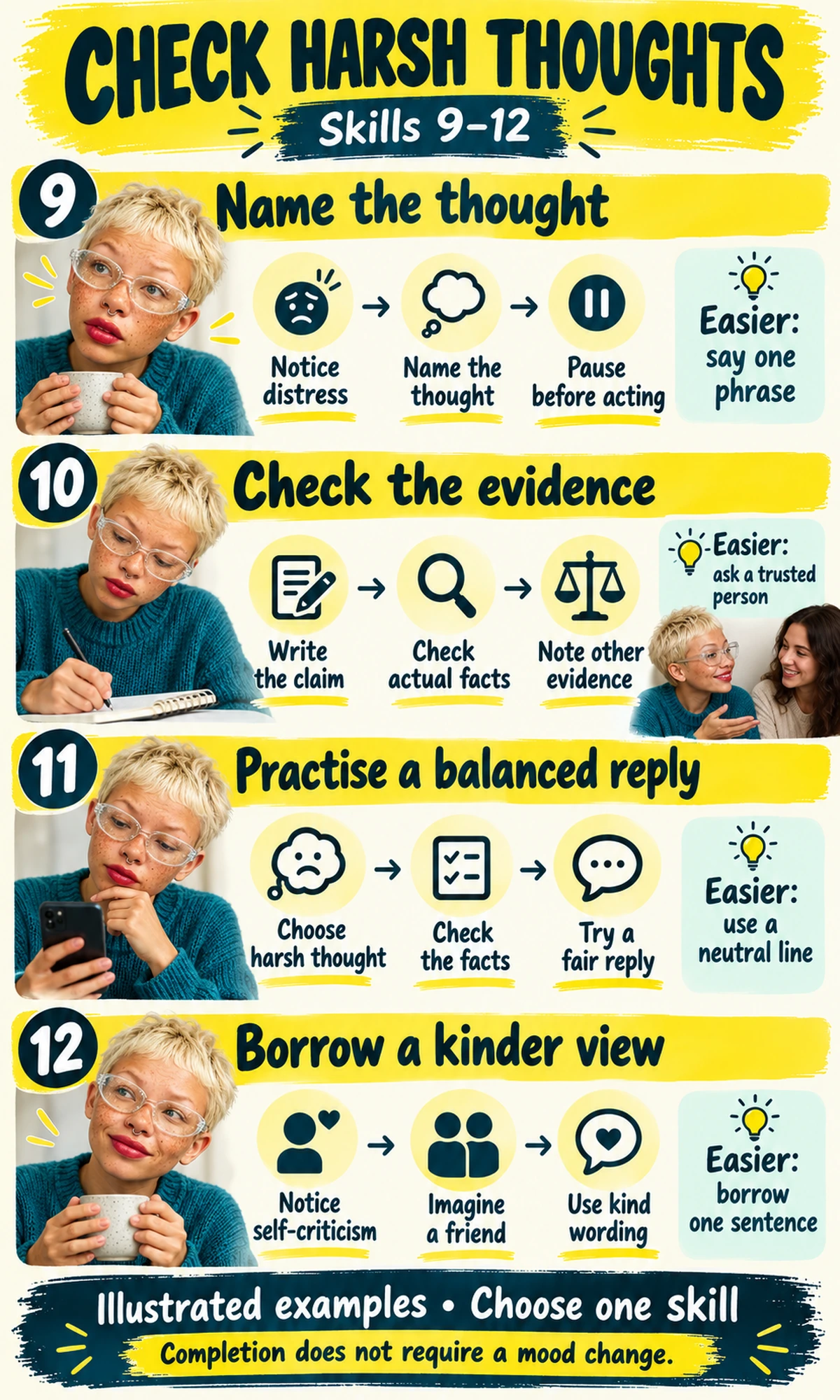
9. Name the thought
- Notice distress
- Name the thought
- Pause before acting
When a harsh judgment arrives, identify it as a thought before treating it as a fact. For example, replace an automatic ‘I am useless’ with ‘I am having the thought that I am useless.’ Saying the phrase quietly is enough; noticing does not require arguing with every thought.
10. Check the evidence
- Write the claim
- Check actual facts
- Note other evidence
Choose one specific claim, look for facts that support and challenge it, and name at least one alternative explanation. For example, an unanswered message may mean someone is busy, rather than that everyone dislikes you. Ask a trusted person to help if concentrating is difficult; checking facts is not denying a real problem or unsafe relationship.
11. Practise a balanced reply
- Choose harsh thought
- Check the facts
- Try a fair reply
After checking a thought, try a response that is fair rather than unrealistically positive. For example, ‘I did not finish everything, but I washed one cup and can ask for help’ answers ‘I did nothing.’ If that is too difficult, use ‘I do not have all the evidence yet’; practising the reply is completion, even if you do not believe it fully.
12. Borrow a kinder view
- Notice self-criticism
- Imagine a friend
- Use kind wording
Ask what you would say to a friend facing the same difficulty, then try that wording toward yourself. An illustrative response is ‘This is hard; needing support does not make you weak.’ Borrowing that single sentence is the easier version; kindness should support the next manageable action, not excuse someone else’s mistreatment.
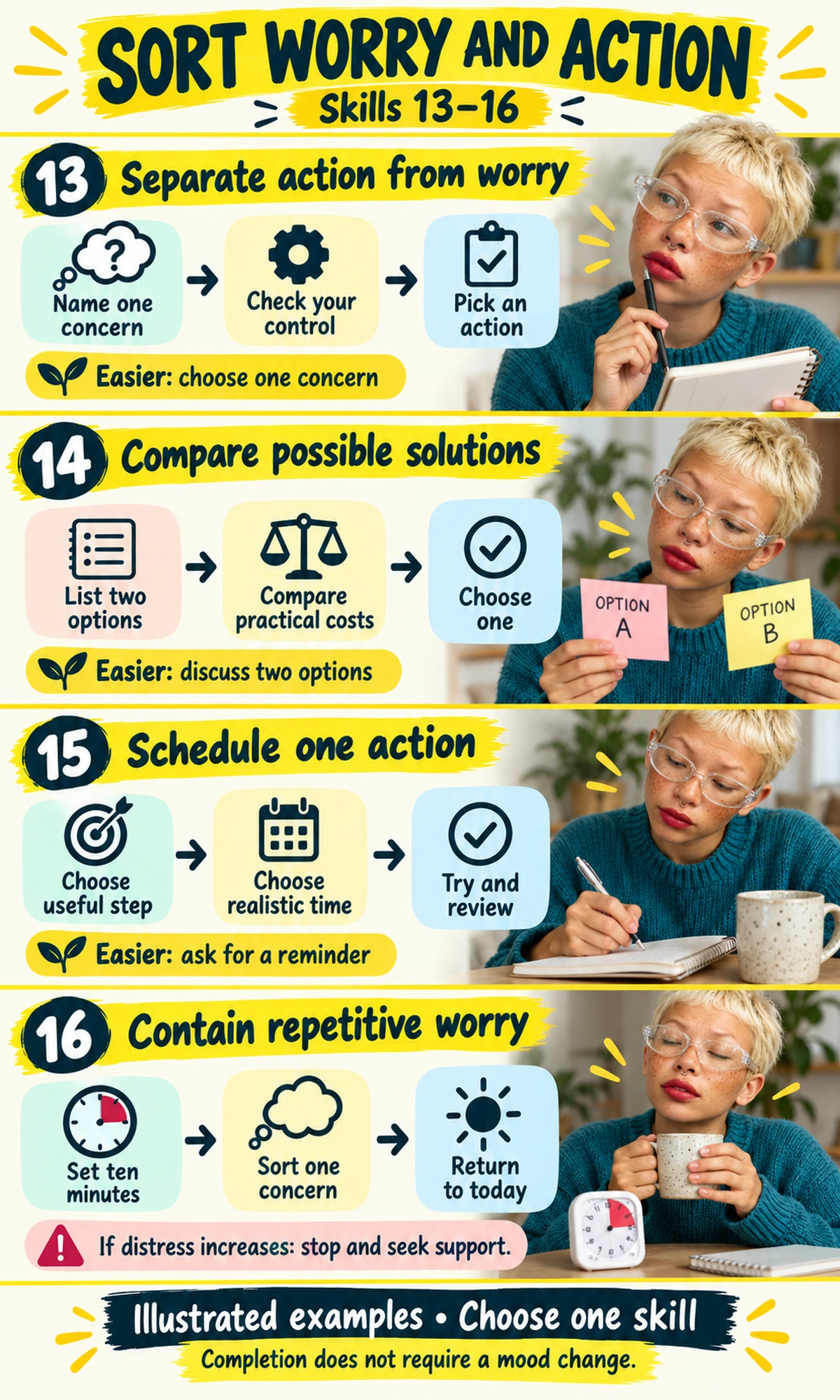
13. Separate action from worry
- Name one concern
- Check your control
- Pick an action
Choose one concern and ask whether a practical action can change it now. An overdue bill may allow a call about payment options; a prediction that every future day will be terrible has no equivalent immediate solution. Naming one concern is the smaller version; do not postpone an urgent safety issue as ordinary worry.
14. Compare possible solutions
- List two options
- Compare practical costs
- Choose one
For a solvable problem, list two possible actions and compare effort, consequences and available help. If meals are difficult, compare a grocery delivery with asking someone to bring food, then choose the more feasible option. Discussing those options aloud is the easier version; the best choice is the one you can safely use, not the most ambitious one.
15. Schedule one action
- Choose useful step
- Choose realistic time
- Try and review
Turn a chosen solution into one specific action at a realistic time. For example, ‘After breakfast I will call about the bill’ is easier to begin than ‘Fix my finances.’ Ask for a reminder if needed, then review whether the action helped or needs changing; avoid turning missed timing into a judgment of your worth.
16. Contain repetitive worry
- Set ten minutes
- Sort one concern
- Return to today
If repetitive worry is taking over, try a short ten-minute period earlier in the day to consider one concern and identify an action, then return to your current activity. Outside that period, a brief reminder can help you return to it later. If this makes distress stronger, stop and seek support; this adaptation targets worry, is not a stand-alone treatment for depressive rumination, and must never delay urgent help.
If a written format would help you practise, our depression worksheet guide offers related formats. A worksheet is useful when it leads to a clearer response or decision; it is not a test you must pass.
How can you stay connected without exhausting yourself?
Choose a safe person and make the contact smaller and more specific. Depression can make conversation feel costly, and shame may make it difficult to explain why you have gone quiet. A short message or concrete request reduces how much you have to organize while making it easier for another person to respond.
Connection can provide practical assistance, perspective and a route to care; it cannot guarantee that sadness will lift immediately. Public-health guidance encourages staying in touch when depressed, but the quality and safety of the relationship matter. You do not need to confide in someone who belittles you, pressures you or makes you unsafe.
A clear request names what would help, while a boundary explains what you can manage. Assertive communication guidance supports expressing needs directly and respectfully rather than leaving others to guess. The message scripts below are illustrative adaptations, and friends or peer groups do not replace clinical assessment.
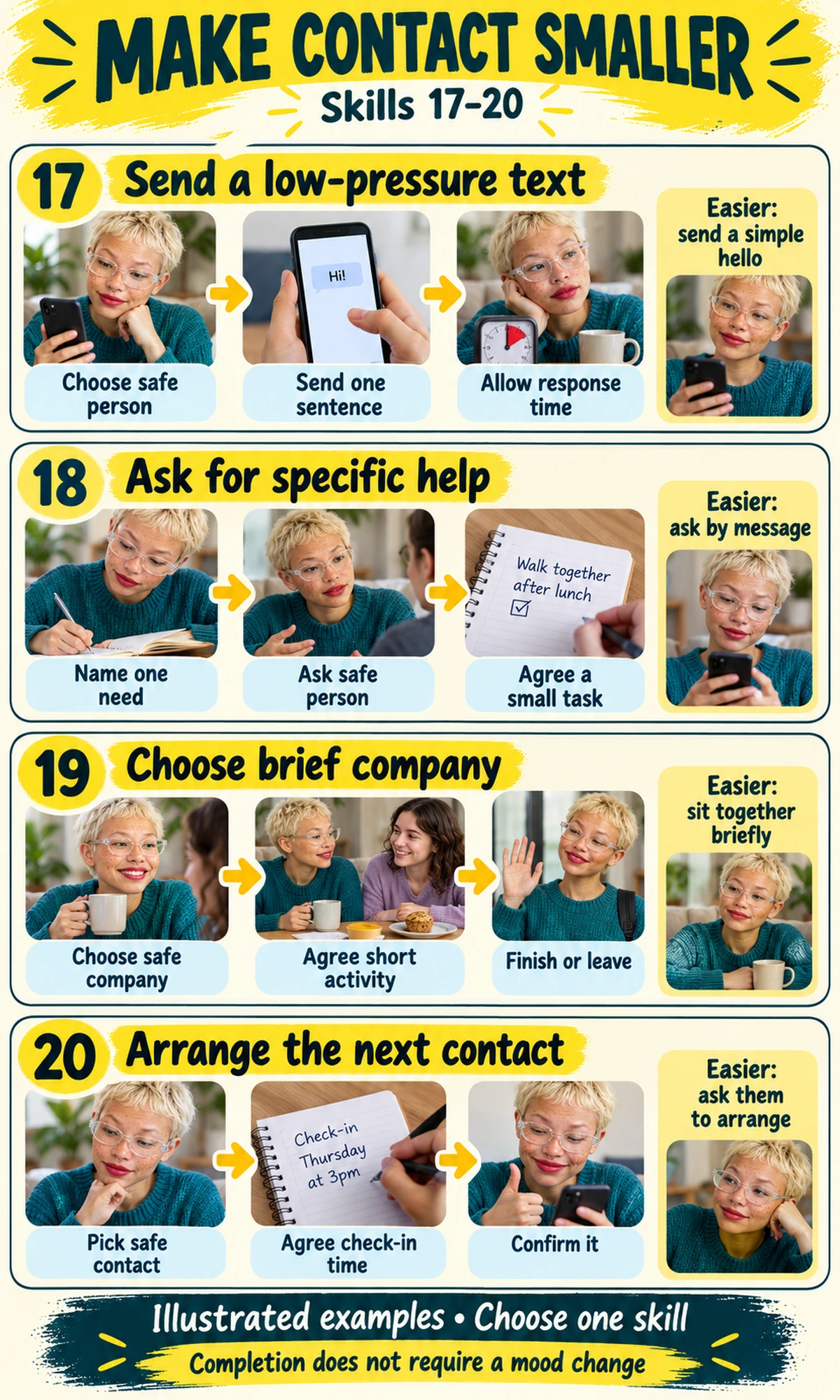
17. Send a low-pressure text
- Choose safe person
- Send one sentence
- Allow response time
Choose someone you trust and send a small message, such as ‘I have been having a hard week; could we talk sometime?’ A simple hello is the lower-effort version. Sending it is completion; a delayed reply does not tell you what that person thinks, and another safe contact may be needed.
18. Ask for specific help
- Name one need
- Ask safe person
- Agree a small task
Ask for one concrete form of help rather than expecting someone to guess. For example, ‘Could you bring an easy meal tomorrow?’ gives the other person something they can respond to. Sending the request by message is the smaller version; if they cannot help, try another safe person or service rather than treating it as rejection.
19. Choose brief company
- Choose safe company
- Agree short activity
- Finish or leave
Agree a short, low-pressure activity with someone safe, such as having tea together. Set a manageable length and leave or stop when needed; sitting together briefly without much conversation is the easier version. Completion is shared time, not being cheerful or entertaining the other person.
20. Arrange the next contact
- Pick safe contact
- Agree check-in time
- Confirm it
Before a helpful conversation ends, agree when to check in again. For example, ask ‘Could we speak on Friday evening?’ and confirm what works for both of you. Asking the other person to suggest a time is easier; they remain a support person, not your only safety plan.
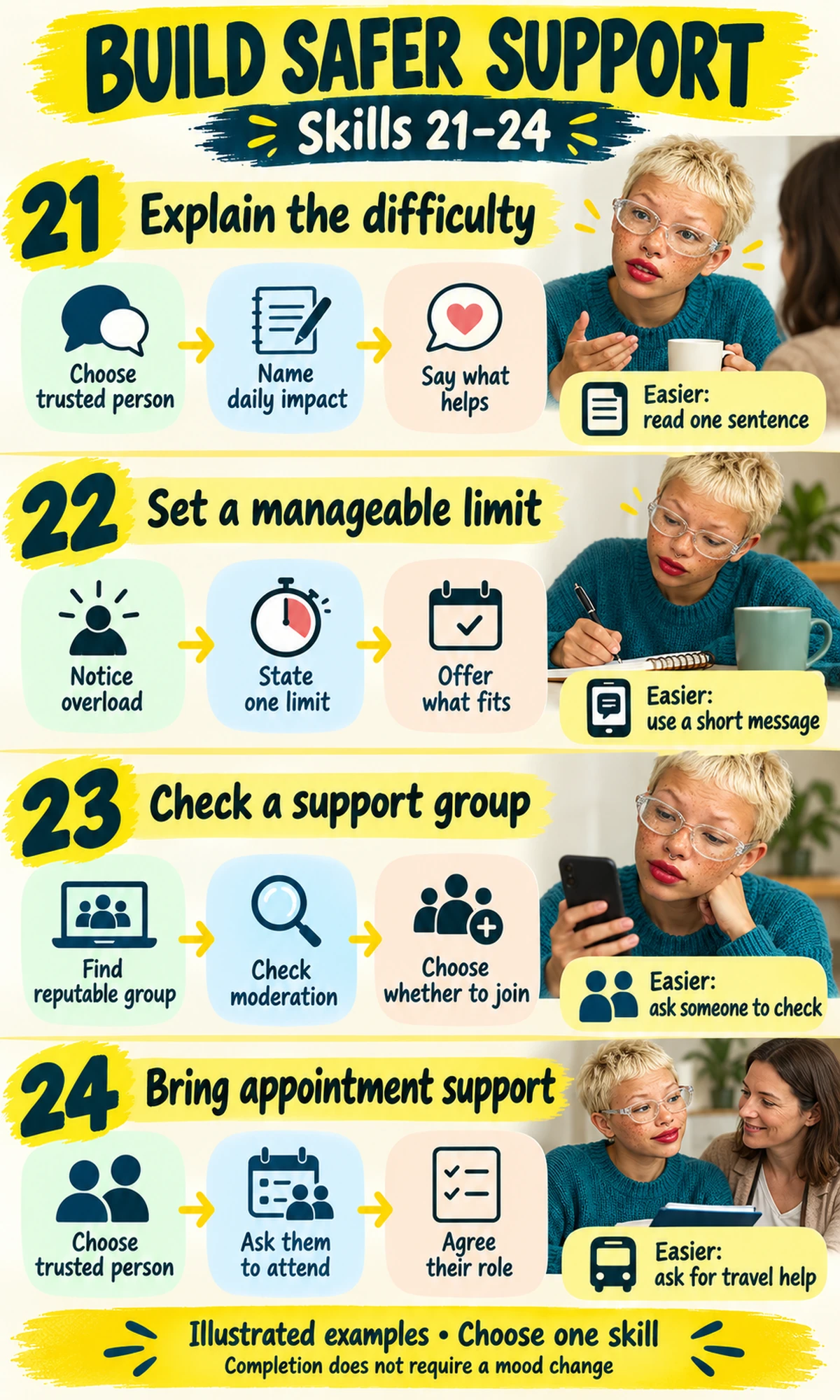
21. Explain the difficulty
- Choose trusted person
- Name daily impact
- Say what helps
Tell a trusted person what depression is making difficult and what support would help. For example, ‘Starting meals is hard; company while I eat would help’ gives useful context without requiring your entire story. Read one prepared sentence if speaking is difficult; choose a different contact if the person is dismissive or unsafe.
22. Set a manageable limit
- Notice overload
- State one limit
- Offer what fits
When a demand exceeds your current capacity, state a clear limit and, if useful, a smaller alternative. An illustrative message is ‘I cannot stay all evening, but I can join for a short visit.’ A brief text is easier than a difficult conversation; limits can protect energy, but cutting off every safe relationship may deepen isolation.
23. Check a support group
- Find reputable group
- Check moderation
- Choose whether to join
If peer support interests you, look for a reputable local or online group, check moderation and privacy expectations, then decide whether its purpose fits. Ask a trusted person to review those details if searching feels difficult. Decline groups that pressure you to buy cures, stop prescribed treatment or reveal private information; peer support complements professional care.
24. Bring appointment support
- Choose trusted person
- Ask them to attend
- Agree their role
If attending an appointment is difficult, ask a trusted person to accompany you and agree whether they will listen, help explain or wait outside. Travel help alone is the smaller version. You can request private time with the clinician; bringing support should help you speak, rather than remove control over your care.
If contact and other routines are becoming harder, our signs that depression management skills are getting worse can help you describe that decline. Use the changes to guide a care conversation rather than to grade your effort.
When should coping skills lead to professional or urgent help?
Seek assessment when symptoms persist, worsen or interfere with ordinary life, and use urgent services for immediate danger. The common two-week symptom duration used in assessing depression is not a rule to wait before asking for help. Significant decline, self-harm thoughts, unusual high energy with very little sleep or symptoms you cannot safely manage deserve earlier attention.
Self-help can make a difficult day more manageable without resolving the condition that caused it. Depression care guidance describes effective treatments, while a clinician can assess symptom severity, physical-health contributors and the possibility of a different mood disorder. Treatment choices depend on that wider picture rather than on how many coping exercises you finish.
Appointment preparation has a different job from mood tracking: it helps you explain what has changed and ask useful questions. Mental-health visit preparation guidance recommends bringing concerns and medicine information, and medication safety guidance warns against stopping prescribed treatment without professional help. The practical completion outcome is reaching a care service or knowing your next contact route.
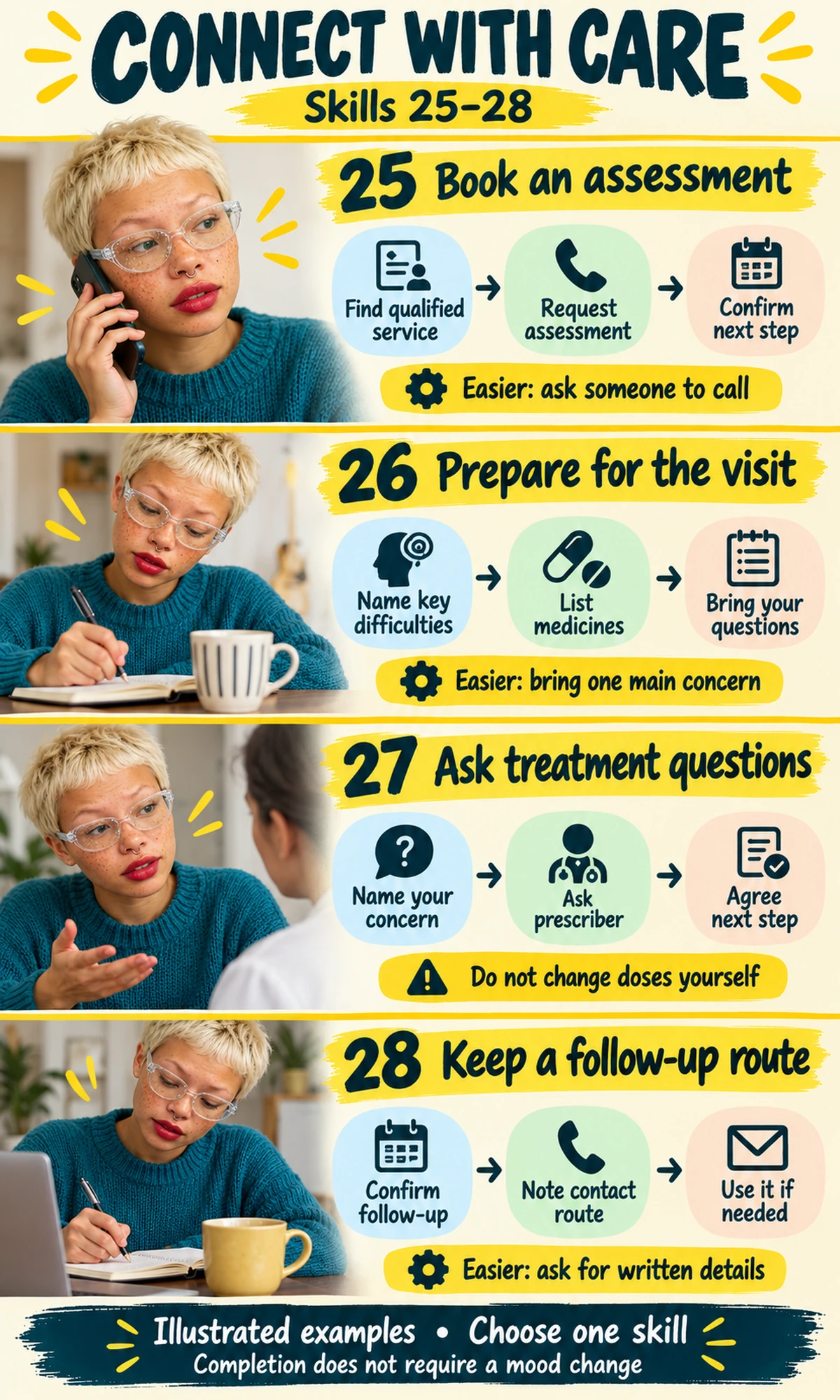
25. Book an assessment
- Find qualified service
- Request assessment
- Confirm next step
Contact a primary-care clinician or qualified mental-health service when symptoms persist, worsen or disrupt daily life. Request an assessment, then confirm the appointment or the service’s next step; ask someone to help make contact if needed. You do not need to complete these coping skills or wait two weeks when the impact is serious.
26. Prepare for the visit
- Name key difficulties
- List medicines
- Bring your questions
Prepare a short summary of what has changed, how long it has lasted and how daily life is affected, along with medicines and relevant substance use. Include any periods of unusually high energy with very little sleep, and tell the clinician about self-harm thoughts. Bringing one main concern is the easier version; the purpose is to guide assessment, not diagnose yourself.
27. Ask treatment questions
- Name your concern
- Ask prescriber
- Agree next step
If prescribed treatment raises concerns, ask the prescriber about expected effects, side effects and what to do if problems arise. For example, ask who to contact if a side effect interferes with eating or sleep; a pharmacist can help you prepare questions. Do not stop, start or change a dose on your own; severe reactions or immediate danger require urgent help.
28. Keep a follow-up route
- Confirm follow-up
- Note contact route
- Use it if needed
Before a care appointment ends, confirm the next review and whom to contact if things get worse. Ask for written details if remembering is difficult. Completion is having a usable route back to care, not waiting silently until the scheduled visit when urgent needs arise.
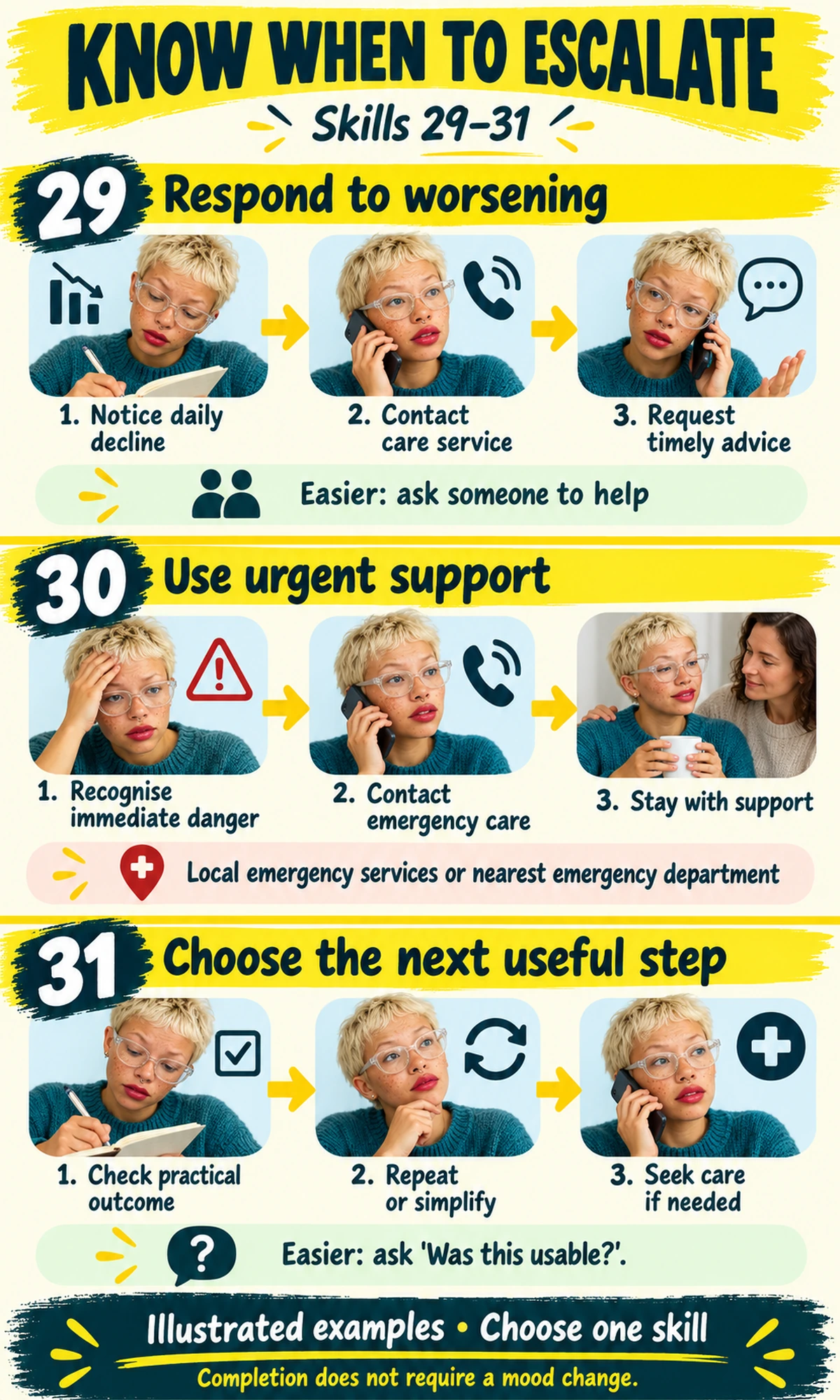
29. Respond to worsening
- Notice daily decline
- Contact care service
- Request timely advice
If eating, self-care, sleep or daily functioning is deteriorating, contact your clinician or mental-health service for timely advice. Give one concrete example, such as being unable to manage meals, instead of waiting for an arbitrary score. Ask someone to help contact the service; immediate danger belongs on the urgent route below.
30. Use urgent support
- Recognise immediate danger
- Contact emergency care
- Stay with support
If you may act on self-harm thoughts or cannot keep yourself safe, contact local emergency services or go to the nearest emergency department now. Ask a trusted person to help make contact and stay with you while help is arranged. Do not use another coping exercise as a reason to delay; thoughts of self-harm without immediate danger also deserve prompt professional or crisis support.
31. Choose the next useful step
- Check practical outcome
- Repeat or simplify
- Seek care if needed
After trying one skill, ask whether it made a practical step easier or created more distress. Repeat a feasible action, simplify one that was too demanding, or stop an upsetting exercise and seek support. The easier check is ‘Was this usable?’; task completion is not proof of recovery, and persistent or worsening symptoms still need care.
If you want to understand the labels used during an assessment, our types of depression overview introduces that separate question. A label should support discussion with a clinician rather than be chosen from a coping list.
Frequently asked questions
Do I need to practise all 31 coping skills?
No. Choose one that addresses the difficulty you face now and use its smaller version if needed. The list offers options, not a daily workload or a measure of how hard you are trying.
What if I complete a skill but still feel depressed?
Completing a task and recovering from depression are different outcomes. A useful step may make eating, contacting someone or starting a chore easier without changing your mood immediately. Persistent or worsening symptoms still need professional support.
Can these coping skills replace therapy or medication?
They cannot replace an individualized care plan. Some actions draw on principles used in psychological treatment, but a short article is not a course of therapy. Discuss treatment choices or concerns with a qualified clinician, and do not change prescribed medicines on your own.
What if a thought exercise makes me feel worse?
Stop the exercise and choose a practical support step, such as contacting someone safe or your care service. Repeatedly analyzing a thought is not always helpful, particularly when it turns into distressing rumination. A therapist can help decide whether a different approach is better.
Can a teenager use these ideas?
Some small daily actions may be adaptable, but this guide is mainly written for adults. A teenager with persistent low mood should involve a trusted adult or a qualified child or adolescent mental-health service. Urgent safety concerns need immediate help at any age.
Is alcohol a useful way to cope with depression?
Alcohol may offer brief distraction while worsening mood or other problems. If you are physically dependent, do not try to manage withdrawal alone or abruptly stop without medical advice. Ask a clinician for an appropriate route to reducing use safely.
Your next step
Choose the skill that reduces the most immediate barrier: a tiny task, a fairer response, a safe contact or reaching care. Use the smaller version when necessary and let that chosen action be enough for now. If symptoms are worsening or ordinary life is becoming unmanageable, take the care route rather than adding more self-help demands.