
A household staffing agency recruits people to work in a private home, including nannies, housekeepers, private chefs and household managers. Choose an agency that handles your actual duties, location and employment arrangement; a familiar name or a nearby office does not establish that fit. Start by resolving competing responsibilities, then compare the providers below against a role your household can realistically support.
The useful starting point: protect the responsibility that cannot be interrupted. If someone must supervise a child, drive to a school or provide agreed personal support, other duties must fit around that responsibility rather than silently compete with it. A broad job title cannot make two simultaneous tasks possible.
This is a selection guide for households, with eleven agencies to investigate rather than a tested league table. Their official pages establish advertised services, not present candidate availability, service quality or suitability for your family. The practical examples are illustrative, and the employment rules discussed are expressly limited to their jurisdictions.
Which household role and service do you actually need?
Resolve the duty conflict before choosing a title
Begin with the busiest overlap in an ordinary day. Imagine a household that needs school collection at 3 p.m., a cleaner to finish bathrooms at the same time and someone to admit a repair contractor. Calling the vacancy “nanny-housekeeper-personal assistant” hides the problem: one person cannot be at school and inside the home simultaneously. The first hiring decision is which responsibility gets protected and which work moves.
For a verbal planning conversation, name the fixed commitment, ask what would happen if another task interrupted it, and move or reassign the conflicting work. In this example, school collection stays protected; cleaning happens in a different block, while an adult household member handles the contractor. If nobody can cover that third responsibility, reduce the scope or consider separate support rather than advertising an impossible combination.
Completion means a workable priority: the recruiter can explain what the person will do when two requests collide. If describing the whole week feels cumbersome, test only the busiest hour first. The common mistake is adding “flexible” to the vacancy instead of deciding what may wait; flexibility helps with variation, but it does not create extra capacity or remove agreed hours.

A combined role can be sensible when the duties genuinely fit together. A nanny may handle agreed child-related laundry during a suitable interval, but that is different from guaranteeing a full-house deep clean while providing sole-charge care. A housekeeper may coordinate a familiar vendor visit, but supervising several properties and managing a household budget introduces a different level of responsibility.
Use the distinction below to choose the recruiting conversation. These are practical boundaries, not universal job descriptions; duties, training and local requirements still need agreement. Ask the candidate as well as the agency whether the proposed mix is realistic. Someone declining an unsafe or unworkable combination is providing useful information about the job.
On small screens, swipe the table horizontally to compare all columns.
| Primary need | Recruiting route to investigate | Boundary to settle |
|---|---|---|
| Consistent child supervision | Nanny or childcare specialist | Which household duties can wait when care needs attention? |
| Cleaning and laundry | Housekeeper recruitment or a cleaning service | Are you employing a person or purchasing a defined service? |
| Meals and kitchen organisation | Private chef or household cook | Menu scope, shopping, allergies and kitchen responsibilities |
| Vendors and household operations | Household or estate manager | Decision authority, spending limits and supervision |
| Support for an older adult | Appropriate companion, personal-care or regulated care service | Actual care tasks, competence and local service requirements |
| A short absence or seasonal need | Temporary domestic staffing | Dates, daily hours, employer and cancellation arrangements |
Separate recruitment from employment and service delivery
A placement agency may find and introduce a candidate while the household becomes the employer. A staffing provider may supply a worker under a different arrangement. A cleaning business may sell a defined service using its own operating model. The broader staffing-agency guide explains the common recruitment models; for your home, establish the particular relationship before comparing prices.
Ask the agency to explain, in order, who will contract with you, who employs and pays the worker, who directs daily work, and who supplies absence cover. Match the explanation to the proposed agreement. A payroll administrator handling payments is not automatically the employer, and a short assignment is not automatically an agency-employed assignment.
For example, “we introduce the housekeeper and refer you to payroll support” describes a different purchase from “we provide a staffed service for the agreed dates.” Neither sentence settles every legal responsibility. If the answer remains unclear, compare just one practical issue first: who pays the worker if the household cancels tomorrow? An agency should be able to explain its proposed arrangement before you proceed.

In the United States, the IRS household employer guide explains that control over what work is done and how it is done can make the worker your employee, including when an agency introduced them. It also explains that outsourcing payroll duties generally does not remove the employer’s responsibility for filings and payments. Labels in a proposal do not replace the actual arrangement.
In the United Kingdom, official guidance on employing someone at home covers responsibilities including payroll, employment rights and right-to-work checks. Other countries use different rules. For a cross-border hire, settle the work location and permitted employment route before spending time on candidates; an international agency network does not itself give a person permission to work in your country.
The local employment-agency guide covers the broader search for nearby recruiters. For a private household, locality is only one filter: the more useful distinction is whether the agency understands this particular role and the arrangement you need.
Which household staffing agencies are worth investigating?
Filter by location, duties and service before making enquiries
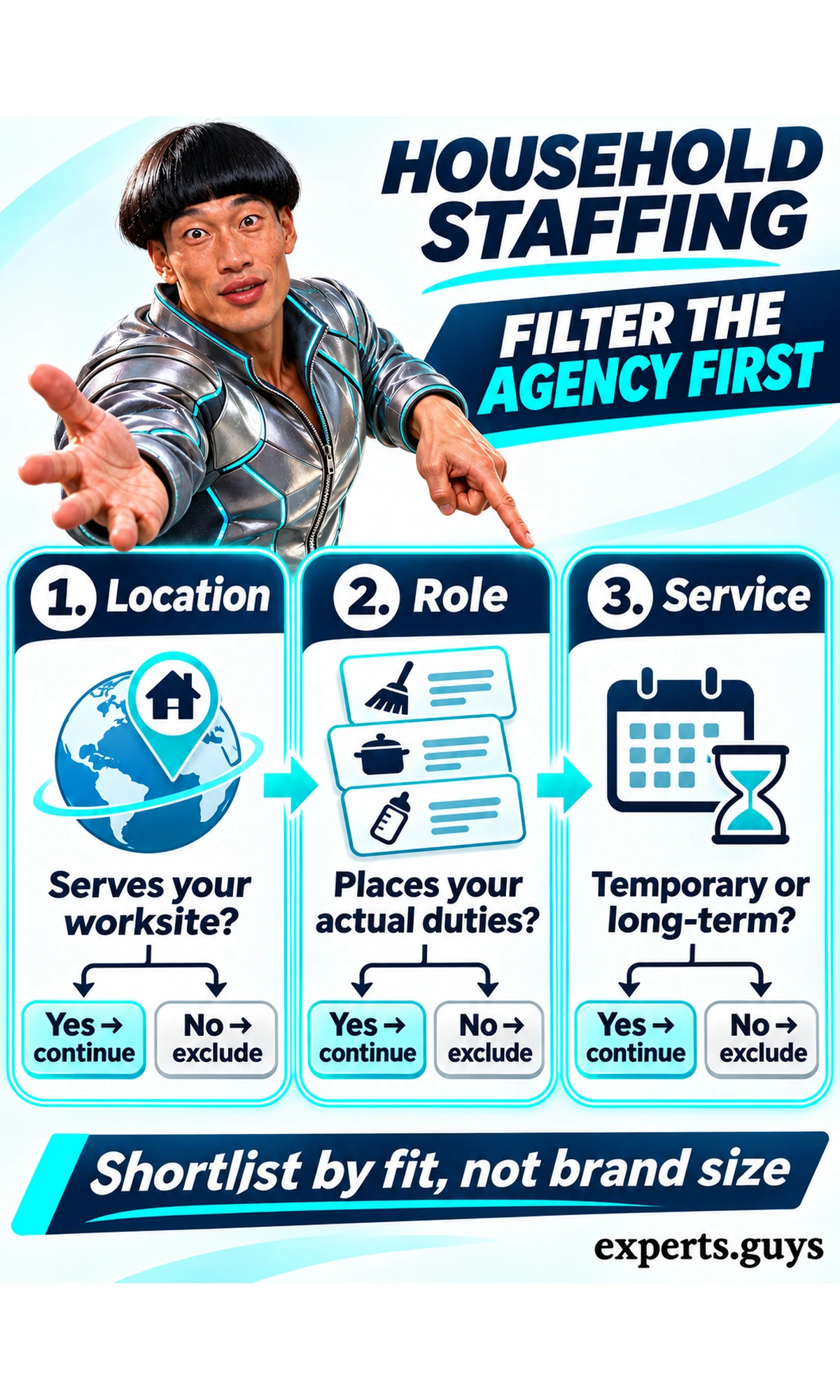
Use three gates to narrow the directory: does the provider serve the worksite, does it recruit the actual role, and does it offer the required temporary or longer-term service? Follow its official contact route to confirm anything the website leaves unresolved. “Nationwide” or “international” describes a stated reach, not a promise of a suitable candidate within your deadline.
- Location: identify the home where the work happens, plus any regular second property or travel requirement.
- Role: state the protected responsibility and the duties that fit around it.
- Service: specify the term and ask whether this is introduction, supplied staffing or another contracted service.
Apply those gates before comparing sales language. A provider may be relevant to a live-out housekeeper search yet unsuitable for immediate overnight childcare. If you have limited time, start with two agencies that clearly pass all three gates. When neither can describe a realistic search, widen the relevant geography or revisit the scope rather than submitting the same vague request everywhere.
Eleven official starting points, grouped by the enquiry they support
The following descriptions were checked against official provider pages. Grouping them helps you choose where to enquire; it does not rate their performance or imply that one group is better. Temporary availability, local coverage, screening scope, fees and remedies must be confirmed for the particular search.
1. Household Staffing
Household Staffing advertises nationwide US domestic recruitment across household and estate, childcare and education, and lifestyle and hospitality categories. Its published process includes interviews and an in-home trial stage. It is a starting point for a household seeking a domestic placement rather than a general commercial temp worker.
Ask how the proposed trial is arranged and paid, which duties the search covers, and what the signed replacement terms require. Treat promotional introduction times as advertising rather than your confirmed start date. A candidate being available to interview does not establish that checks, notice periods and employment arrangements are complete.
2. British American Household Staffing
British American Household Staffing lists childcare specialisms as well as housekeepers, household and estate managers, chefs, chauffeurs and personal assistants. Its location pages provide routes into several US and international markets. This breadth makes it worth investigating when a household needs a defined private-service role or coordination across more than one location.
Ask which team owns your search and how travel or multiple homes changes candidate requirements. For a rota or travel role, clarify the working pattern rather than assuming that the label means constant availability. Published specialisms are evidence of advertised focus, not confirmation that one person can cover every category.
3. Pavillion Agency
Pavillion Agency publishes domestic recruitment categories including nannies, housekeepers, chefs, domestic couples and estate managers, with separate routes for temporary staff and household payroll. It offers a useful enquiry route when you need to distinguish a long-term domestic search from temporary cover or payroll administration.
Ask which service applies to your dates and whether payroll is included, optional or supplied separately. Keep candidate wages, placement fees and administrative charges distinct. The existence of several services on one website does not mean that a single agreement includes all of them.
4. The Wellington Agency
The Wellington Agency advertises US household and estate recruitment, childcare, private assistants and family-office staffing. Its official site names several Florida markets alongside other US locations. It is a relevant starting point when the search involves private-home operations or an assistant role with clearly defined authority.
Ask whether your vacancy belongs with household operations, personal assistance or a family-office team. A person coordinating maintenance at home has a different remit from someone handling business administration or financial responsibilities. Be explicit about which decisions remain with the family and which may be delegated.
5. Town + Country Resources
Town + Country Resources advertises childcare, housekeeping and estate staffing in the continental United States, including temporary and longer-term assistance. Its site provides service and placement-fee routes. It is a starting point for comparing ongoing domestic recruitment with a shorter period of household support.
Ask the team to confirm its service model for your exact location and dates. For temporary cover, clarify who handles changes, cancellations and an unavailable worker. Do not confuse this US business with Town and Country Staff in the UK; similar names do not establish that the organisations share contracts or candidate pools.
6. Adventure Nannies
Adventure Nannies advertises US nanny recruitment with separate services for long-term nannies, travel and temporary nannies, private educators and newborn care specialists. Its narrower childcare focus makes it relevant when the primary responsibility is care or education rather than general household upkeep.
Describe the child’s routine and the adults available for handovers, then confirm the specific skills required. Travel experience does not establish competence for every care need. If a title includes “newborn care” or another specialist description, verify the person’s actual training and permitted tasks rather than assuming a clinical qualification.
7. Greycoat Lumleys
Greycoat Lumleys separates private households and estates, childcare, catering and hospitality, and international staffing on its official site. Its contact structure includes UK and overseas routes. That separation is useful when the same household enquiry could otherwise drift between domestic employment and event-service requirements.
Ask which division handles your vacancy and which jurisdiction its proposal assumes. For a dinner or event, establish whether you are recruiting an employee or buying a service. For an ongoing home role, confirm the relevant domestic duties instead of relying on experience in a different hospitality setting.
8. Eden Private Staff
Eden Private Staff advertises nannies, maternity support and a range of private household positions, including housekeepers, chefs, household managers and domestic couples. It also describes temporary and part-time enquiries. It is worth investigating when you need to distinguish childcare, household work and a proposed combined role.
Ask how the agency tests the feasibility of the combination. A nanny-housekeeper vacancy needs protected care time, realistic cleaning expectations and a clear priority when duties conflict. Where a service uses a title such as maternity nurse, establish the individual’s qualifications and scope rather than interpreting the title as a universal professional licence.
9. Hutchinsons Domestic Staff
Hutchinsons Domestic Staff publishes role categories including housekeepers, household managers, chefs, domestic couples, companions and personal assistants. Its official site provides a route for households seeking candidates. Use it to investigate a defined domestic role, while confirming current geographical coverage directly.
A companion enquiry needs particular clarity about the tasks involved. Social company, household help and regulated care are different needs. Ask whether the proposed search covers the required support and what must instead be supplied by an appropriately qualified or regulated service; do not let a reassuring title leave the boundary unresolved.
10. Morgan & Mallet
Morgan & Mallet describes recruitment for private households across several markets and distinguishes recruitment and placement from direct-employment services. Its published categories include household staff, childcare, culinary roles and family-office support. It is a starting point for a household comparing those service models or coordinating an international search.
Ask for the exact legal entity, country-specific agreement and responsibilities of any proposed employment service. A group offering a service in one country does not establish that it offers identical coverage elsewhere. Separate the recruiter’s introduction work from employment, payroll and other services before evaluating the quote.
11. Town and Country Staff
Town and Country Staff advertises domestic recruitment in London, elsewhere in the UK and internationally, including housekeepers, nannies, butlers and household or estate managers. It is a separate starting point from the similarly named US provider above.
Ask which office and agreement apply to your home and whether the search assumes a live-in or live-out arrangement. If accommodation is part of the proposal, discuss its suitability, privacy and working-time boundaries explicitly. A room in the home is an accommodation arrangement; it should not quietly become an expectation of unlimited availability.
Compare the total quote using the same assumptions
Once an agency passes the fit gates, compare the purchase rather than a headline percentage. A lower placement fee may exclude screening or administration that another proposal includes. A temporary hourly bill may combine wages and provider charges, while a placement quote may leave wages entirely outside the agency invoice. Putting both numbers in one column creates a misleading comparison.
Use the same hours, term and wage assumption for each proposal, then identify the fee base and excluded costs. An illustrative US-dollar example is 40 paid hours a week at $30 an hour for 52 weeks: $62,400 in annual wages. If an assumed agency fee is 15% of that wage base, it is $9,360, giving a $71,760 wage-plus-fee subtotal.
Those figures are arithmetic assumptions, not a salary recommendation, current market rate or provider quotation. The subtotal excludes employer taxes, insurance, benefits, payroll administration, backup cover and any additional applicable charges. If comparing annual figures is distracting, ask both agencies to price the same initial period and identify any later commitments; do not simply multiply a temporary bill into an assumed permanent arrangement.

Read how the fee is triggered and what happens if the role changes. A fee based on annual compensation may use a different base when bonuses, accommodation or other elements are involved. Ask whether a retainer is credited against a later charge and whether a restart creates a new fee. These are questions for the actual proposal, not standard terms shared by every agency.
Choose on the cost of a workable arrangement. Removing necessary cover to reach a lower total can recreate the original duty conflict. Equally, paying for a senior household manager when the need is a defined cleaning service buys responsibility you may not need. Ask what each additional service changes in practice before treating a larger package as better value.
How do you verify a candidate beyond the word vetted?
Ask for evidence that matches the responsibility
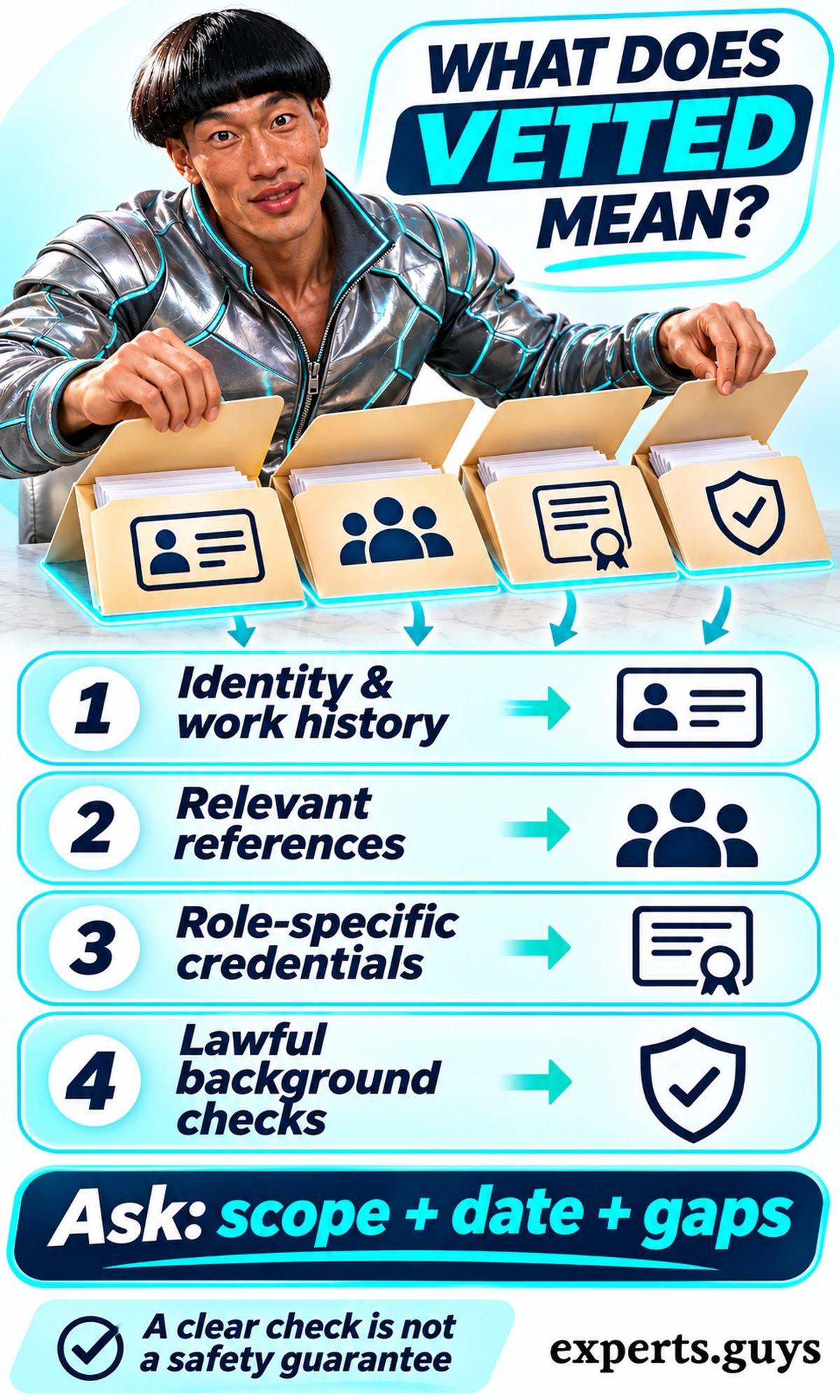
“Vetted” does not describe a single standardised package. Ask what was checked, when, by whom and with what limits. Distinguish identity and work history, relevant references, role-specific credentials and legally appropriate background screening. A report can be accurately completed yet cover fewer jurisdictions or dates than you assumed.
Work through that sequence with the recruiter before making a final decision. For references, ask whether the referee supervised comparable duties and whether the account supports the role being proposed. For credentials, confirm the issuing body, relevant scope and currency where applicable. Resolve a specific gap with the agency rather than collecting additional unrelated documents that do not answer it.
For example, a glowing reference about formal dinner service does not establish experience with newborn care. The appropriate correction is evidence relevant to the care role, not a longer general biography. If you can address only one uncertainty first, start with the responsibility where a mistake would matter most; the remaining necessary checks still need completion before the corresponding work begins.
In the US, employment decisions using third-party consumer reports can trigger Fair Credit Reporting Act duties. The FTC’s employer guidance explains disclosure, permission and adverse-action procedures. Establish who is obtaining the report and handling the required process; an agency’s involvement does not justify informal searches or ignoring applicable state restrictions.
Screening reduces uncertainty within its scope; it cannot guarantee future behaviour or replace supervision and a sensible start. Protect candidate information too. Request relevant findings through the agency’s proper process rather than circulating full identity documents or reports among household contacts. Confidentiality should work in both directions.
Use one realistic interview conflict to test judgement
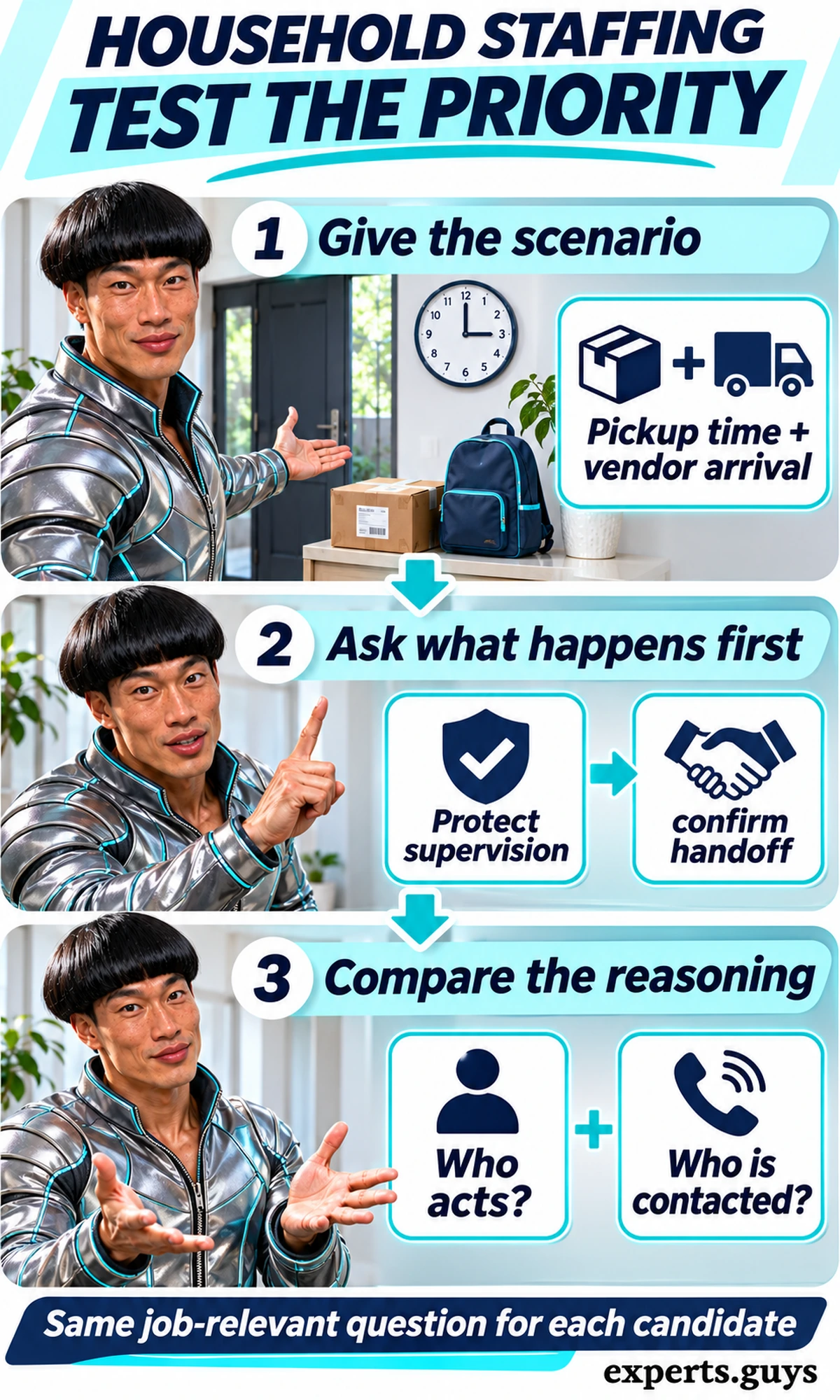
Turn the protected responsibility into a job-relevant scenario. Explain the ordinary routine, introduce one competing request, and ask the candidate to talk through what happens first, whom they contact and what they would not undertake without agreement. Use the same core situation for candidates being considered for the same job so that you compare reasoning rather than conversational style.
For the illustrative school-collection role, say that a vendor arrives shortly before departure and ask how the candidate would respond. A useful answer recognises the fixed care responsibility, confirms who can receive the vendor and escalates if no safe handover exists. The point is not a secret script; it is whether the candidate identifies the conflict and asks for the information needed to handle it.
Then ask one follow-up that changes a real constraint: what if the nominated adult cannot be reached? Listen for a safe boundary and an alternative consistent with the household’s agreed plan. Do not reward a promise to “do everything.” If an in-person interview is difficult, discuss the scenario remotely or through an accessible format; a house tour is not required to assess this reasoning.
Keep questions tied to the work, avoid irrelevant personal probing and accommodate legitimate access needs. Do not ask candidates to reveal a previous household’s private arrangements as proof of discretion. They can describe how they handle confidentiality and uncertainty without disclosing names, schedules, security details or other sensitive information.
The observable result is an understood decision boundary, including what the household must provide. If every capable candidate flags the same gap, reconsider the vacancy. Recruitment cannot repair a missing adult handover, unlimited hours or an authority structure in which several people give incompatible instructions.
How should a paid trial and the first handover work?
Use a bounded paid demonstration rather than a free shift
A trial should answer a specific remaining question about the role. Agree the task, duration, pay, supervision, cancellation terms and relevant employment arrangements before it begins. Treat productive work as paid work and confirm applicable local requirements. Calling a shift an interview does not by itself remove wage or other obligations.
Start with an ordinary, low-risk task that can be demonstrated safely. For an illustrative housekeeping trial, show the household’s clean-laundry system, ask the candidate to organise a small agreed batch and explain how they would flag an unfamiliar fabric or damaged item. Observe communication and the handoff as well as the finished work. Avoid turning the trial into a full day of extra duties that were never discussed.
Use synthetic information for an assistant demonstration and keep private accounts, payment authority, access codes and sensitive documents out of the exercise. Do not place someone in sole charge of a child, a vulnerable adult or a high-risk task merely to see how they cope. A low-risk demonstration can inform a decision, but it does not verify every competence needed for the eventual job.

If a practical trial is not feasible, use a structured walkthrough of the task with the candidate and agency, then plan the relevant supervised introduction before independent duties. The useful outcome is a resolved job question: did the person understand the standard, identify an uncertainty and hand the work back clearly? A polished result obtained by guessing about a delicate item may be less reassuring than an appropriate question.
Working time needs its own agreement. US Department of Labor domestic-service guidance distinguishes live-in arrangements, hours worked and overtime treatment, with important differences by employer and circumstances. Live-in accommodation does not mean unrestricted duty. Federal rules are not the whole picture; state or local requirements may provide additional protections.
Hand over access and authority in stages
At the start, provide only the access needed for the agreed duties. Walk through where the person may work, which household member gives instructions, which decisions require approval and how to raise an urgent problem. Then demonstrate one ordinary handoff, such as reporting an unfinished task or a vendor requesting extra work. Confirm understanding through conversation rather than assuming that silence means agreement.
In the school-collection example, the employee needs the agreed collection arrangement and escalation route; that does not imply permission to approve a contractor’s invoice or enter private accounts. A household manager may need more authority, but it should still have boundaries. If comprehensive onboarding is overwhelming, begin with the first shift’s actual duties and delay tasks whose access or training is not ready.
Review access when duties, personnel or employment change. Recover keys and revoke account permissions through the relevant household systems; do not rely on the agency to know every access route you granted. This process limits avoidable exposure, but it does not establish that a person is safe or replace lawful employment procedures.

Connect any placement problem to the agreement’s remedy. A replacement clause may require prompt notice, payment of the original fee or an unchanged job specification; it may offer another search rather than a refund or immediate worker. Ask what happens during the gap and which costs remain yours. Do not assume that a reassuring guarantee heading settles those details.
Distinguish a correctable expectation mismatch from a serious safety concern. Discuss ordinary scope or communication problems against the agreed job, with a concrete change the household and employee understand. For immediate danger, prioritise safety and appropriate local emergency action. A guarantee process is not a reason to leave an unsafe arrangement operating while waiting for a recruiter response.
A successful handover leaves everyone able to answer the same practical questions: what is the priority, who can authorise a change, and what happens when the plan cannot be followed? That is a more useful finish to the recruitment process than the arrival of a person whose responsibilities remain open-ended.
Frequently asked questions
Does an agency need an office near my home?
Not necessarily. The useful question is whether it can recruit for the actual worksite and support the arrangement there. Ask how interviews, local checks and any practical introduction would work. A nearby office is convenient, but it does not establish role expertise or a suitable candidate pool.
Should both adults in a household give instructions?
Agree a primary point of contact and how other requests are prioritised. If two adults give conflicting instructions, the employee needs a clear way to resolve them. The arrangement can accommodate several household members without expecting the worker to guess whose request overrides an agreed responsibility.
Can I use several household agencies at once?
Check the proposed agreements for exclusivity, introduction ownership and fee triggers first. The same candidate may be represented through more than one route. Resolve that overlap before proceeding so that the household and candidate understand which agency is handling the introduction.
Is a domestic couple one vacancy or two?
It involves two people whose responsibilities, hours and employment terms each need clarity. Ask what happens if one person is unavailable or leaves. A combined recruitment search should not conceal separate duties or make one person’s suitability stand in for the other’s.
Do private household assistants also handle business work?
Only if the remit and relevant arrangements explicitly cover it. Personal scheduling and errands differ from business administration, financial approvals or access to company systems. Keep those boundaries visible when defining authority, confidentiality and the service being purchased.
Can job seekers apply through these agencies?
Use each provider’s official candidate route and check whether it handles your role, location and working arrangement. Household employers and applicants have different next steps. The US recruitment-agency guide for job seekers explains the applicant-side route; it does not establish eligibility for a specific domestic vacancy.
Next steps
Begin with the busiest duty conflict in your household, then choose two agencies whose advertised services fit the resulting role and location. Ask each to explain its employment arrangement and price the same scope. Progress when the role is workable, the evidence addresses its responsibilities and the proposed agreement makes the start, cover and remedy clear.