



The Assumption That Bigger Platforms Always Mean Better Outcomes
The idea that every business should build a mobile app has become widely accepted.
It appears in startup conversations, investor decks, and digital strategy discussions as an almost automatic next step.
A business grows.
Traffic increases.
Engagement stabilizes.
And then the question emerges:
“Should we build an app?”
The assumption behind this question is rarely examined.
It assumes that expansion into a mobile app is a natural progression.
It assumes that more platforms lead to more growth.
It assumes that what works for large companies will work for smaller systems.
But these assumptions are built on visible outcomes, not underlying structure.
Why This Misconception Persists
The visibility of successful apps distorts perception.
Large platforms dominate attention:
- social media applications
- ride-hailing services
- food delivery ecosystems
- messaging platforms
These systems demonstrate high engagement, frequent interaction, and continuous user presence.
From the outside, it appears that the app itself is the source of success.
But the app is not the cause.
It is the interface of an already compatible system.
What Is Often Not Seen
What remains hidden are the conditions that make apps effective:
- high interaction frequency
- repeated user need
- embedded behavioral loops
- strong value reinforcement
These conditions exist before the app is introduced.
The app does not create them.
It amplifies them.
Why Replication Fails
When businesses attempt to replicate this model without matching conditions, the results diverge.
A company may build an app expecting:
- increased engagement
- higher retention
- stronger brand presence
Instead, they observe:
- low download rates
- minimal usage
- high uninstall rates
The difference lies not in execution, but in alignment.
When Additional Layers Increase Complexity Instead of Efficiency
A mobile app is not simply another version of a website.
It is a separate system layer.
This layer introduces its own requirements, constraints, and long-term commitments.
The Structural Cost of Adding an App
Building an app involves more than initial development.
It creates a continuous operational cycle:
- updates for operating systems
- compatibility across devices
- performance optimization
- user feedback handling
Each of these elements requires ongoing resources.
The Cost Does Not Decline Over Time
Unlike one-time investments, app maintenance persists.
Even when usage is low:
- updates must continue
- bugs must be fixed
- systems must remain compatible
This creates a fixed cost structure that does not scale down with engagement.
When Efficiency Reverses
In systems where user interaction is infrequent, this structure becomes inefficient.
The app exists.
But it is not used often enough to justify its presence.
The system expands.
But value does not.
The Core Mechanism Behind Failed Mobile App Adoption
A mobile app does not create value by itself. It operates as part of a broader behavioral system, which is explored in Why Businesses Quietly Lose Users Without Apps, where the underlying patterns behind app-driven engagement are explained.
It does not generate demand.
It does not manufacture engagement.
What it does is amplify existing behavioral patterns.
If users already interact frequently, an app strengthens that interaction.
If users interact rarely, an app makes that absence more visible.
The Amplification Principle
Every platform functions as an amplifier.
It takes existing user behavior and increases its efficiency.
This is why apps work exceptionally well in systems where:
- users return daily
- interactions are repeated
- value is continuously refreshed
In these environments, reducing friction creates exponential impact.
When Amplification Works Against the System
In low-frequency systems, amplification produces the opposite effect.
Instead of strengthening engagement, it exposes its absence.
The app becomes:
- installed but unused
- opened once, then forgotten
- eventually removed
The problem is not the app.
It is the lack of behavior to amplify.
Low Interaction Frequency Systems
Not all businesses operate on repeated interaction.
Some operate on need-based usage.
What Defines Low-Frequency Behavior
Low-frequency systems include:
- furniture purchases
- insurance services
- home renovation providers
- medical or dental appointments
- legal or consulting services
In these cases, users interact:
- occasionally
- irregularly
- only when a need arises
There is no natural repetition.
Why Users Do Not Return Frequently
The reason is structural, not emotional.
Users do not avoid returning because they dislike the service.
They simply do not need it often.
The demand cycle is long.
The interaction gap is wide.
Why Apps Cannot Shorten Natural Cycles
A mobile app cannot create artificial frequency.
It cannot make a user:
- buy furniture weekly
- visit a dentist monthly
- hire a lawyer repeatedly
Attempts to force interaction through notifications often fail.
Because they do not align with real needs.
The Behavioral Resistance to App Installation
One of the most underestimated barriers is the decision to install an app.
This step appears simple.
But it involves multiple layers of evaluation.
The Hidden Questions Behind Every Download
Before installing, users subconsciously evaluate:
- Will I use this often?
- Is it worth storage space?
- Can I access this through a browser instead?
- Will it send unnecessary notifications?
If the answer to these questions is uncertain, hesitation increases.
Why Websites Win in Low-Commitment Scenarios
Websites require no commitment.
Users can:
- open instantly
- close instantly
- forget without consequence
This aligns perfectly with low-frequency behavior.
The Cost of Commitment
Installing an app introduces commitment.
It occupies:
- storage space
- attention
- notification channels
If the perceived value does not exceed this cost, users avoid installation.
Real-World Failure Patterns
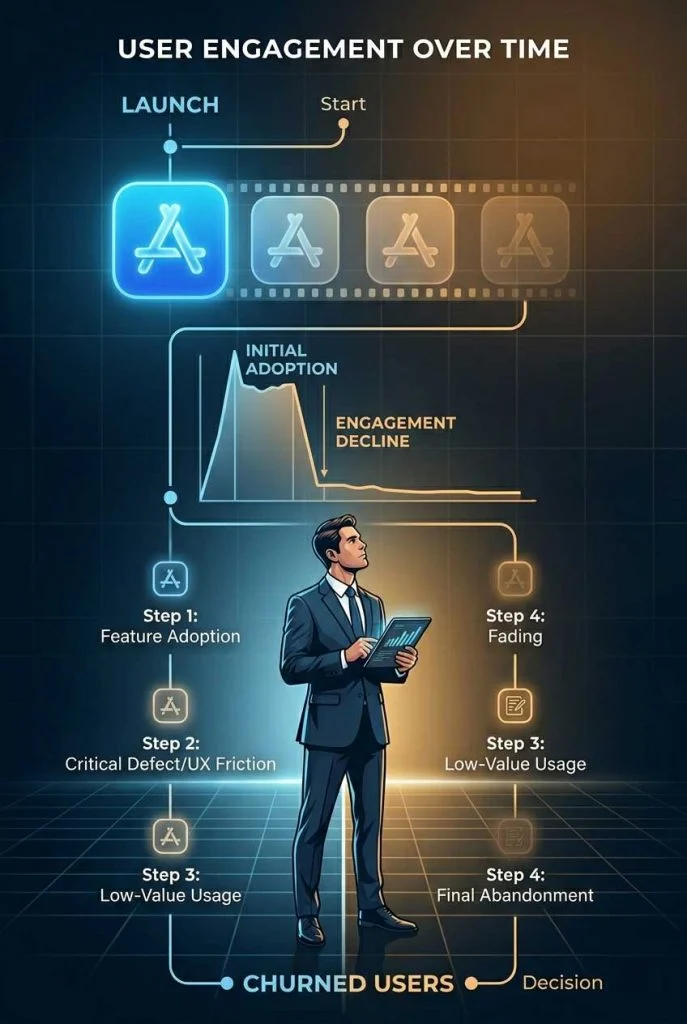
The gap between expectation and reality becomes visible after launch.
The Download Drop-Off Pattern
Many businesses observe:
- initial curiosity downloads
- followed by sharp decline in usage
The app is installed.
But it is not integrated into user behavior.
The “One-Time Use” Pattern
Some apps are opened once.
Used for a specific task.
Then never opened again.
This is common in:
- booking apps
- event apps
- temporary service apps
The app serves a moment.
Not a system.
The Silent Abandonment Pattern
Unlike websites, apps remain on the device.
But inactivity grows.
Users do not actively reject the app.
They simply stop using it.
Over time, it becomes invisible.
The Uninstall Trigger
Eventually, users clean their devices.
Unused apps are removed.
Not because of dissatisfaction.
But because of irrelevance.
Notification Fatigue and Its Reverse Effect
Notifications are often seen as a solution.
A way to bring users back.
When Notifications Work
Notifications are effective when:
- they align with user intent
- they provide timely value
- they reinforce existing behavior
When Notifications Fail
In low-frequency systems, notifications feel intrusive.
Users receive messages unrelated to immediate needs.
This creates:
- annoyance
- disengagement
- eventual disabling of notifications
The Negative Feedback Loop
As notifications lose effectiveness:
- engagement drops
- attempts to re-engage increase
- user resistance strengthens
This creates a loop where effort increases but results decline.
The Economic Reality Behind Mobile App Decisions
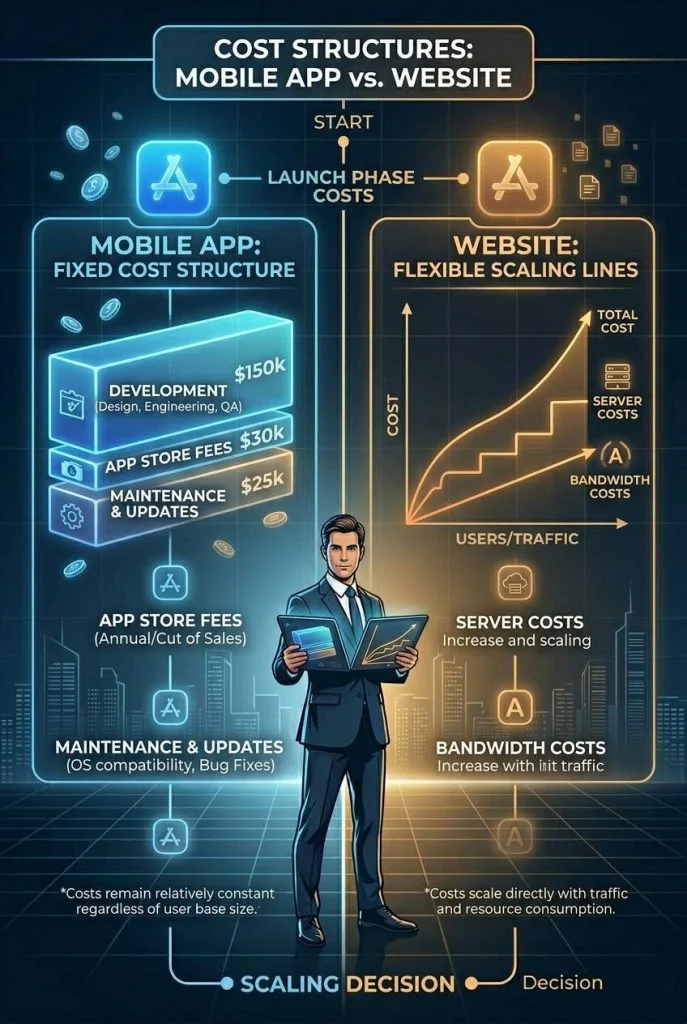
At a strategic level, a mobile app is not a design decision.
It is a resource allocation decision.
It determines how time, capital, and operational effort are distributed.
The Cost Structure of Mobile Apps
The cost of building an app is often underestimated.
It is not limited to development.
It includes:
- initial design and engineering
- backend infrastructure
- integration with existing systems
- ongoing maintenance and updates
- performance optimization across devices
These costs accumulate across the lifecycle of the app.
Fixed Costs vs Variable Engagement
A key issue emerges when comparing cost structure with usage.
Mobile apps introduce fixed costs:
- maintenance continues regardless of usage
- updates are required regardless of engagement
- support must be maintained at all times
User interaction, however, is variable.
If engagement is low, the cost does not decrease accordingly.
The Mismatch That Drives Inefficiency
When fixed costs meet variable engagement, inefficiency appears.
The app exists.
Resources are allocated.
But user interaction does not scale with investment.
This creates a widening gap between cost and value.
Why ROI Collapses in Low-Frequency Systems
Return on investment depends on usage.
Without repeated interaction, value generation remains limited.
The Relationship Between Frequency and Value
Each interaction contributes to value:
- transactions
- engagement signals
- behavioral data
- retention potential
In high-frequency systems, these accumulate quickly.
In low-frequency systems, they remain sparse.
When the Return Cycle Is Too Slow
If users interact:
- once a month
- once every few months
- once per year
The return cycle becomes too slow to sustain the cost structure of an app.
The Invisible Cost of Underutilization
An unused app still consumes resources.
- it must remain functional
- it must remain updated
- it must remain compatible
But it does not produce proportional value.
This creates silent inefficiency.
When Websites Outperform Apps
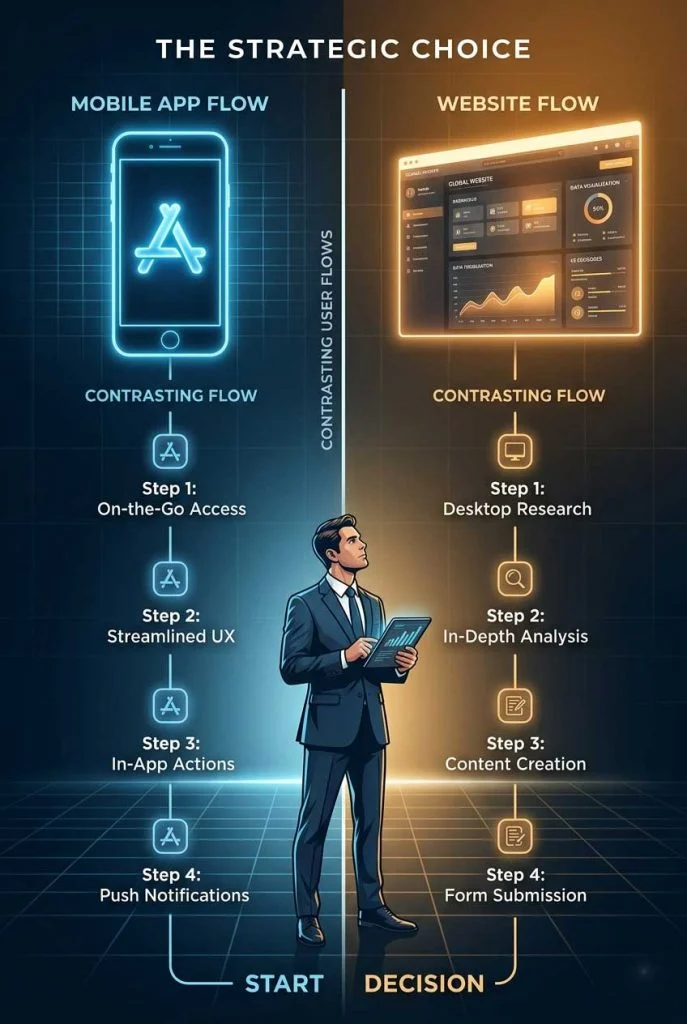
In many business systems, websites provide greater efficiency than mobile applications.
This is not because websites are more advanced.
It is because they align more closely with how users behave in low-frequency environments.
Immediate Access Without Commitment
Websites require no installation.
Users can:
– access instantly
– leave instantly
– return without friction
This matches low-frequency behavior better.
Lower Maintenance Overhead
Websites:
– update centrally
– maintain one version
– reduce compatibility issues
This simplifies system management.
Matching Structure With Behavior
For low-frequency systems, this structure aligns better with user behavior.
There is no expectation of continuous interaction.
No need for persistent presence.
No requirement for repeated engagement.
On-Demand Access Without Persistent Cost
Websites do not require user installation.
They function on demand.
Users access them when needed.
And leave when finished.
Cost Efficiency Through Centralization
Websites:
- operate from a single codebase
- update universally across users
- reduce fragmentation across devices
This centralization lowers operational complexity.
The Trade-Off Between Control and Efficiency
Apps provide control. However, how this control translates into actual engagement depends on the retention system itself, which is explained in How Mobile Apps Increase Customer Retention, where the mechanism behind repeated usage is broken down.
Every platform choice involves trade-offs.
Apps and websites optimize for different outcomes.
What Apps Provide
Apps offer:
- control over user environment
- direct communication channels
- persistent presence on devices
These features are powerful.
But only when they are used.
What Websites Provide
Websites offer:
- accessibility across platforms
- discoverability through search
- minimal user commitment
These features prioritize reach and flexibility.
Why Efficiency Often Outweighs Control
In systems where users do not return frequently, control becomes underutilized.
Efficiency becomes more valuable.
Because:
- users prefer immediate access
- businesses benefit from lower cost
- interaction remains aligned with real demand
Case-Based Comparison – Where Decisions Diverge
To understand this difference clearly, consider how platform choice affects different business models.
Case 1 – High-Frequency Content Platform
A content platform with daily usage patterns benefits from:
- push notifications
- personalized feeds
- continuous engagement
In this system, an app enhances behavior.
Case 2 – Low-Frequency Service Business
A home renovation service experiences:
- long decision cycles
- infrequent user interaction
- high-value but rare transactions
In this system, an app introduces unnecessary friction.
Users prefer quick access through search and web.
Case 3 – Transaction-Based E-commerce
An e-commerce platform sits between these extremes.
It may benefit from:
- apps for repeat customers
- websites for discovery and first-time access
This creates a hybrid system.
Why Context Determines Outcome
The same platform decision produces different results depending on:
- interaction frequency
- user intent
- system structure
There is no universal answer.
Only alignment.
When Mobile Apps Partially Work – But Not Fully
Not all cases are binary.
Some businesses operate in a middle ground.
Apps are not completely ineffective.
But they are not fully justified either.
The “Occasional Return” Model
In some systems, users return occasionally.
Not daily.
Not rarely.
But irregularly.
Examples include:
- fashion retail platforms
- travel booking services
- event-based businesses
In these cases, apps may generate some engagement.
But not enough to fully leverage their structure.
Why Partial Engagement Creates Strategic Tension
When engagement is inconsistent:
- some users install the app
- others prefer the website
- behavior becomes fragmented
This creates operational complexity.
The business must support:
- two platforms
- two interaction models
- two user expectations
Without clear dominance from either.
Hybrid Systems – When Both App and Website Coexist
Some businesses adopt hybrid strategies.
They use:
- websites for discovery
- apps for retention
How Hybrid Models Work
In hybrid systems:
- new users enter through search (website)
- returning users migrate to the app
- high-frequency users remain within the app ecosystem
This allows the business to capture both:
- reach
- retention
The Complexity Behind Hybrid Systems
While effective, hybrid systems are not simple.
They require:
- clear user flow design
- consistent experience across platforms
- strategic segmentation of user behavior
Without these, fragmentation increases.
Progressive Web Apps (PWA) – A Middle Ground
Some businesses explore alternatives to native apps.
One of the most discussed is the Progressive Web App.
What a PWA Attempts to Solve
PWAs aim to combine:
- web accessibility
- app-like experience
They offer:
- faster loading
- offline capabilities
- optional installation
Where PWAs Fit in the Decision Spectrum
PWAs are often suitable for:
- moderate interaction frequency
- businesses testing engagement models
- systems transitioning between web and app
Why PWAs Do Not Replace All App Use Cases
PWAs reduce friction.
But they do not fully replicate:
- deep device integration
- advanced push systems
- native performance optimization
They are a compromise.
Not a complete replacement.
Misconceptions That Lead to Poor Decisions
Many app decisions are driven by simplified beliefs.
“Apps Automatically Increase Engagement”
Apps can increase engagement.
But only when:
- behavior supports repetition
- value reinforces usage
- friction reduction matters
Without these, engagement does not increase.
“Users Prefer Apps Over Websites”
Users prefer convenience.
Not platforms.
If a website provides faster access with less commitment, it will be preferred.
“Every Growing Business Needs an App”
Growth does not automatically require platform expansion.
It requires alignment.
Between:
- user behavior
- system structure
- interaction frequency
The Long-Term Strategic Risk of Misalignment
When a mobile app is introduced without alignment, the effects extend beyond cost.
Resource Dilution
Teams must divide focus:
- app development
- website maintenance
- user support across platforms
This reduces efficiency.
Strategic Distraction
Instead of optimizing the core system, effort shifts toward maintaining an unnecessary layer.
This delays improvements that would have had greater impact.
Brand Experience Fragmentation
Inconsistent experiences across platforms create confusion.
Users encounter:
- different interfaces
- different flows
- different expectations
This weakens overall cohesion.
Final Synthesis – A Mobile App Is a Multiplier, Not a Solution
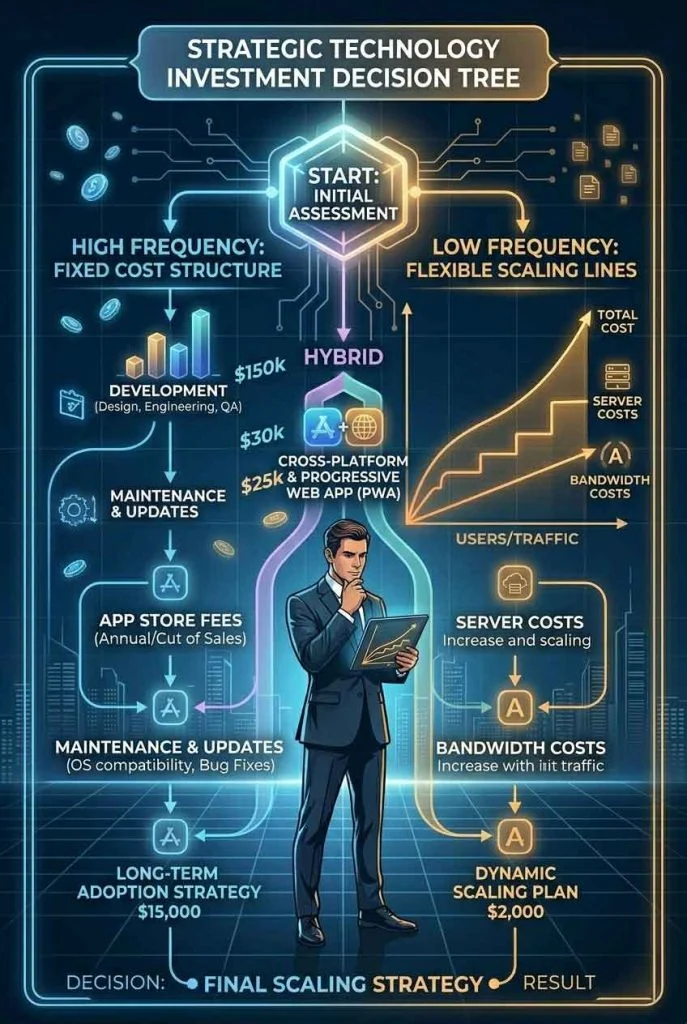
A mobile app does not solve structural problems.
It magnifies them.
When Alignment Exists
When:
- users return frequently
- interaction is continuous
- behavior supports repetition
An app strengthens the system.
When Alignment Does Not Exist
When:
- interaction is infrequent
- demand is irregular
- behavior lacks repetition
An app introduces inefficiency.
The Decision Framework
The decision to build an app should not begin with:
“Do we need an app?”
It should begin with:
“How often do users return, and why?”
To see how this decision fits within a broader comparison of platform performance, read Mobile App vs Website for Business, where both systems are analyzed across conversion, retention, and accessibility.
Frequently Asked Questions
Do all businesses need a mobile app?
No. Businesses with low interaction frequency or one-time services often benefit more from websites than mobile apps.
Why do some mobile apps fail?
Apps fail when user behavior does not support repeated interaction, making it difficult to build retention or habit formation.
Is a website better than a mobile app?
In many cases, websites provide better accessibility and lower maintenance, especially for low-frequency user interaction systems.