


The Assumption That Retention Comes From Value Alone
Most businesses believe retention is earned.
Build something useful.
Offer something better.
Users will return.
It sounds logical.
But in practice, it rarely works that way.
Because value alone does not guarantee repetition.
And without repetition, retention never stabilizes.
Why Good Products Still Lose Users
A product can be:
- useful
- well-designed
- competitively priced
And still struggle to retain users.
Not because it lacks value.
But because it lacks a return system.
After the first interaction, the connection weakens.
And unless something brings the user back, the relationship fades.
The Retention Mechanism Most Businesses Never Build
Retention is not a feature.
It is a process.
A sequence of events that repeats often enough to form behavior.
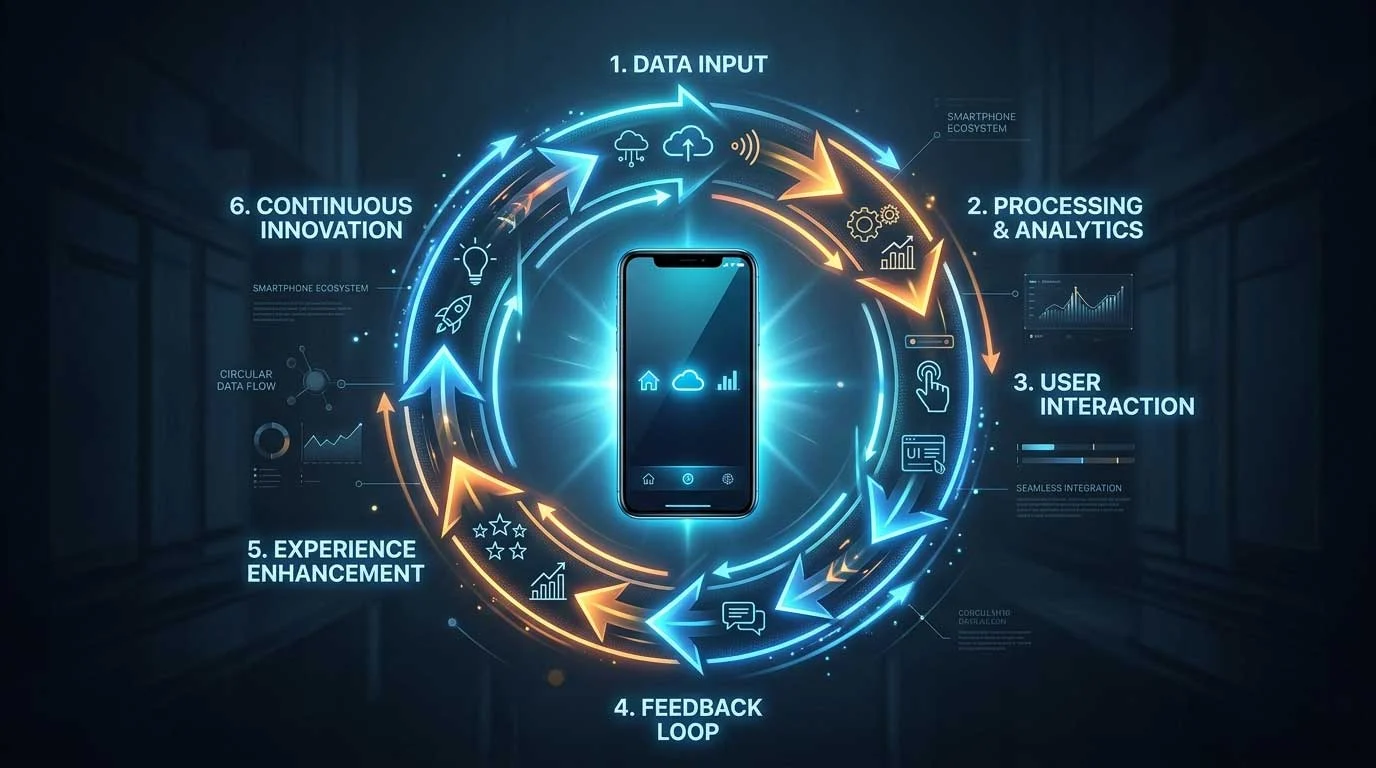
This process can be broken into a simple loop:
Trigger → Action → Experience → Return
Most businesses focus on the experience.
Very few control the rest.
Where Retention Actually Begins
Retention does not begin during usage.
It begins after usage ends.
At that moment, the system either:
- reconnects with the user
- or loses them
This is the point where apps and websites diverge.
The First Layer – Reducing Friction to Near Zero
Friction is one of the most underestimated forces in user behavior.
It does not need to be large to matter.
Small delays are enough.
What Friction Looks Like in Practice
On a website, returning often requires:
- opening a browser
- searching again
- logging in
- navigating
Each step adds resistance.
Individually, these seem minor.
Together, they reduce return probability.
How Apps Change the Equation
Mobile apps remove many of these steps.
They:
- keep users logged in
- remember preferences
- reduce navigation depth
The path from intent to action becomes shorter.
And when the path is shorter, repetition becomes easier.
Why Easier Repetition Becomes Habit
Habits do not form because something is important.
They form because something is easy to repeat.
Apps make interaction easier.
And ease leads to repetition.
The Second Layer – Triggering Return at the Right Moment
Even with low friction, users do not always return on their own.
They need triggers.
The Role of Triggers in Behavior
A trigger reconnects the user with the system.
It acts as a reminder.
A prompt.
A reason to return.
Why Timing Matters More Than Content
A perfectly crafted message at the wrong time is ignored.
A simple message at the right time is effective.
Apps can respond to:
- inactivity
- behavior patterns
- user history
This allows them to reach users when attention is available.
Why Websites Struggle With This Layer
Websites rely on external channels:
- ads
- browser notifications
These channels are less immediate.
Less visible.
Less integrated into daily behavior.
The Third Layer – Building Repetition Into Routine
Once friction is reduced and triggers are present, repetition increases.
Over time, repetition becomes routine.
From Intentional Use to Automatic Behavior
At the beginning, users choose to return.
Later, they return without thinking.
The action becomes automatic.
Why Routine Is More Powerful Than Satisfaction
Satisfaction explains why users like a product.
Routine explains why they keep using it.
And routine is what drives retention.
To understand how retention differs from initial discovery, see Mobile App vs Website for Business, where the structural differences between platforms are explained.
When Repetition Turns Into Habit
Repetition alone does not guarantee retention.
Users can return a few times and still disappear.
The shift happens when repetition becomes automatic.
The Transition From Effort to Default
At the beginning, returning requires a decision.
The user must think:
“Should I open this?”
Over time, that question disappears.
The action becomes immediate.
Tap. Open. Continue.
No evaluation.
No comparison.
Why Habit Reduces Drop-Off
When behavior becomes habitual:
- fewer decisions are required
- fewer alternatives are considered
- fewer interruptions break the flow
This reduces drop-off without requiring additional incentives.
The Compounding Nature of Retention
Retention is not linear.
It compounds.
Each return increases the likelihood of the next.
Why Early Returns Matter More Than Later Ones
The first few returns are the most critical.
They:
- establish familiarity
- reduce uncertainty
- build initial patterns
Once these patterns form, future returns become easier.
The Loop That Reinforces Itself
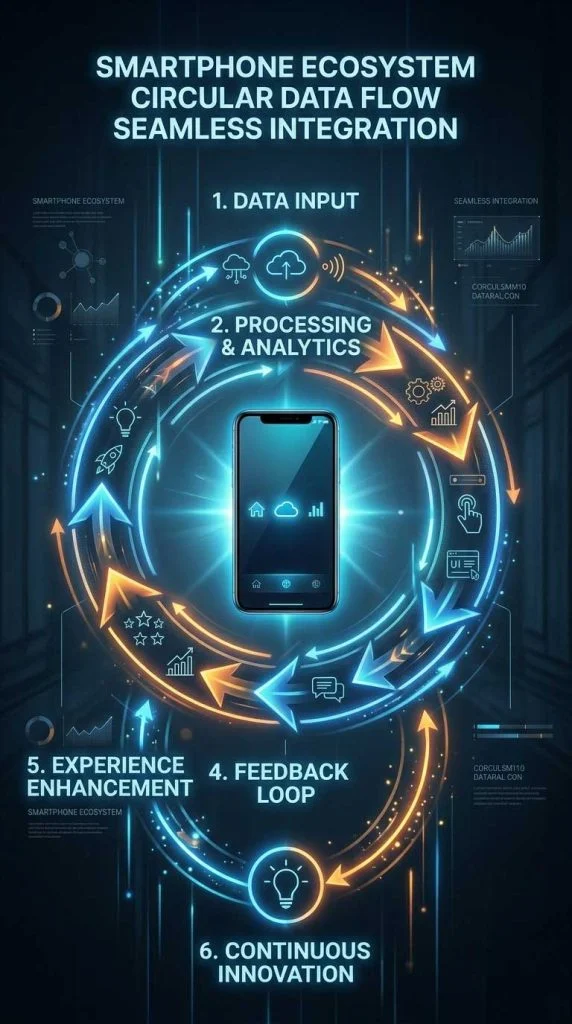
The retention loop strengthens with each cycle:
Return → Interaction → Familiarity → Reduced Effort → Return
Each stage reinforces the next.
Over time, the loop stabilizes.
The Behavioral Lock-In Effect
At advanced stages, retention creates a form of lock-in.
Not through restriction.
But through familiarity and ease.
Why Users Stop Exploring Alternatives
When a system becomes familiar:
- switching requires effort
- alternatives feel uncertain
- existing behavior feels sufficient
Users do not actively decide to stay.
They simply do not leave.
The Role of Cognitive Load
Every new platform introduces cognitive effort.
Learning new navigation.
Understanding new flows.
Adapting to new systems.
When users are comfortable with one app, they avoid this cost.
The Monetization Effect – Why Retention Drives Revenue More Than Traffic
Many businesses focus on acquisition.
Traffic.
Clicks.
New users.
But revenue is more closely tied to retention.
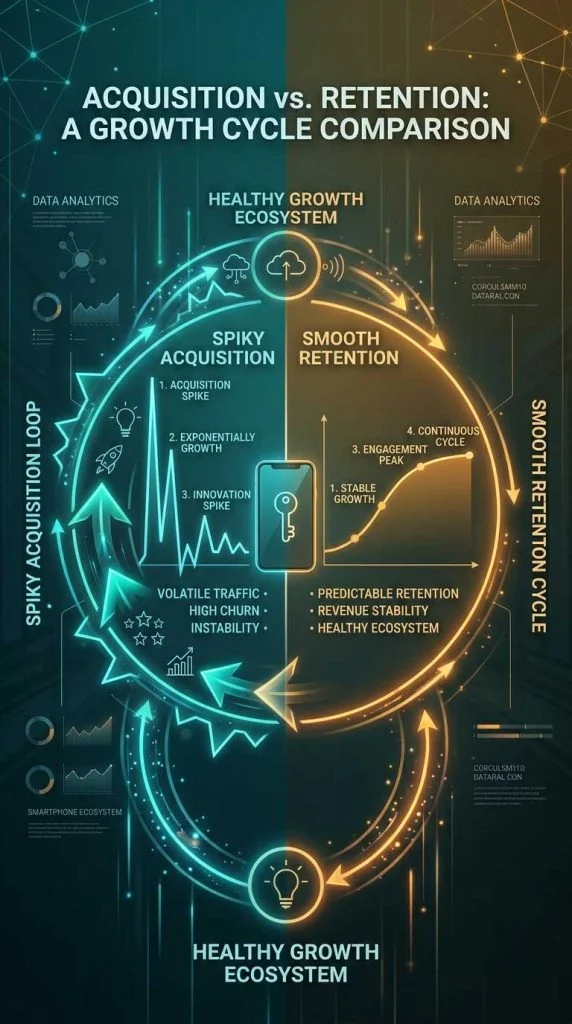
Frequency vs Volume
A large number of one-time users produces limited value.
A smaller number of returning users produces consistent value.
Apps increase frequency.
And frequency increases revenue.
The Stability Advantage
Retention creates predictability. This predictability becomes more visible when comparing how different platforms structure user interaction, which is explored in Mobile App vs Website for Business, where the differences in engagement flow are explained.
Users return regularly.
Engagement stabilizes.
Revenue becomes less volatile.
This reduces dependence on constant acquisition.
Why This Changes Business Strategy
When retention is strong:
- marketing costs decrease
- user value increases
- growth becomes more efficient
The system becomes self-reinforcing.
Where Retention Systems Can Fail
Retention is not guaranteed.
Even with an app.
When Triggers Become Noise
If notifications are too frequent or irrelevant:
- users ignore them
- users disable them
- users uninstall the app
The system weakens.
When Friction Returns
If updates introduce complexity:
- navigation slows
- actions require more steps
- interaction becomes harder
Retention declines.
When Value and System Do Not Align
A strong system cannot compensate for weak value.
If the core offering is not useful, retention will not sustain.
The Difference Between Users Who Visit and Users Who Stay
At a surface level, all users look the same.
They arrive.
They interact.
They leave.
But over time, a divide forms.
Some users return.
Most do not.
What Separates These Two Groups
The difference is not always product quality.
It is not always price.
It is not even always intent.
It is structure.
Users who return are part of a system that makes returning easier.
Users who leave are part of a system that resets after every interaction.
Why This Difference Compounds
Each return strengthens:
- familiarity
- ease
- habit
Each missed return weakens:
- memory
- connection
- likelihood of re-engagement
This creates a widening gap over time.
The Strategic Shift – From Acquisition to Retention Systems
Most businesses focus heavily on acquisition.
More traffic.
More users.
More exposure.
But without retention, acquisition becomes inefficient.
Why Acquisition Alone Cannot Sustain Growth
New users require:
- marketing spend
- attention
- repeated effort
If users do not return, the system must continuously replace them.
This creates instability.
Why Retention Changes the Equation
Retention reduces the need to replace users.
Instead of constantly starting over, the system builds forward.
Each interaction adds to the next.
Growth becomes cumulative.
The Long-Term Effect – Stability Over Time
When retention systems are effective:
- engagement becomes consistent
- user behavior becomes predictable
- revenue becomes more stable
This does not eliminate variability.
But it reduces it significantly.
Why Stability Matters More Than Growth Spikes
Short-term growth can be driven by campaigns.
Long-term stability requires structure.
Retention provides that structure.
Final Synthesis – Why Retention Is Designed, Not Earned
Retention is often described as something businesses “earn.”
In reality, it is something they design.
It emerges from:
- reduced friction
- timely triggers
- repeated interaction
- consistent experience
Without these elements, retention remains inconsistent.
With them, it becomes predictable.
The Core Question Businesses Should Ask
The question is not:
“Do users like our product?”
The better question is:
“What makes them come back without thinking?”
That is where retention begins.
To understand how retention fits into the broader platform structure, see Why Businesses Quietly Lose Users Without Apps, where the full behavioral system is explained.
Frequently Asked Questions
Why is customer retention important for businesses?
Customer retention is important because returning users generate more consistent engagement and revenue compared to one-time visitors, reducing the need for constant acquisition.
How do mobile apps improve retention?
Mobile apps improve retention by reducing friction, enabling push notifications, and supporting repeated interaction cycles that lead to habit formation.
What is a retention loop?
A retention loop is a cycle where triggers bring users back, interactions reinforce familiarity, and reduced effort increases the likelihood of repeated use.
Can retention improve without a mobile app?
Retention can improve without an app, but it is generally harder to achieve because websites lack persistent presence and real-time re-engagement mechanisms.