

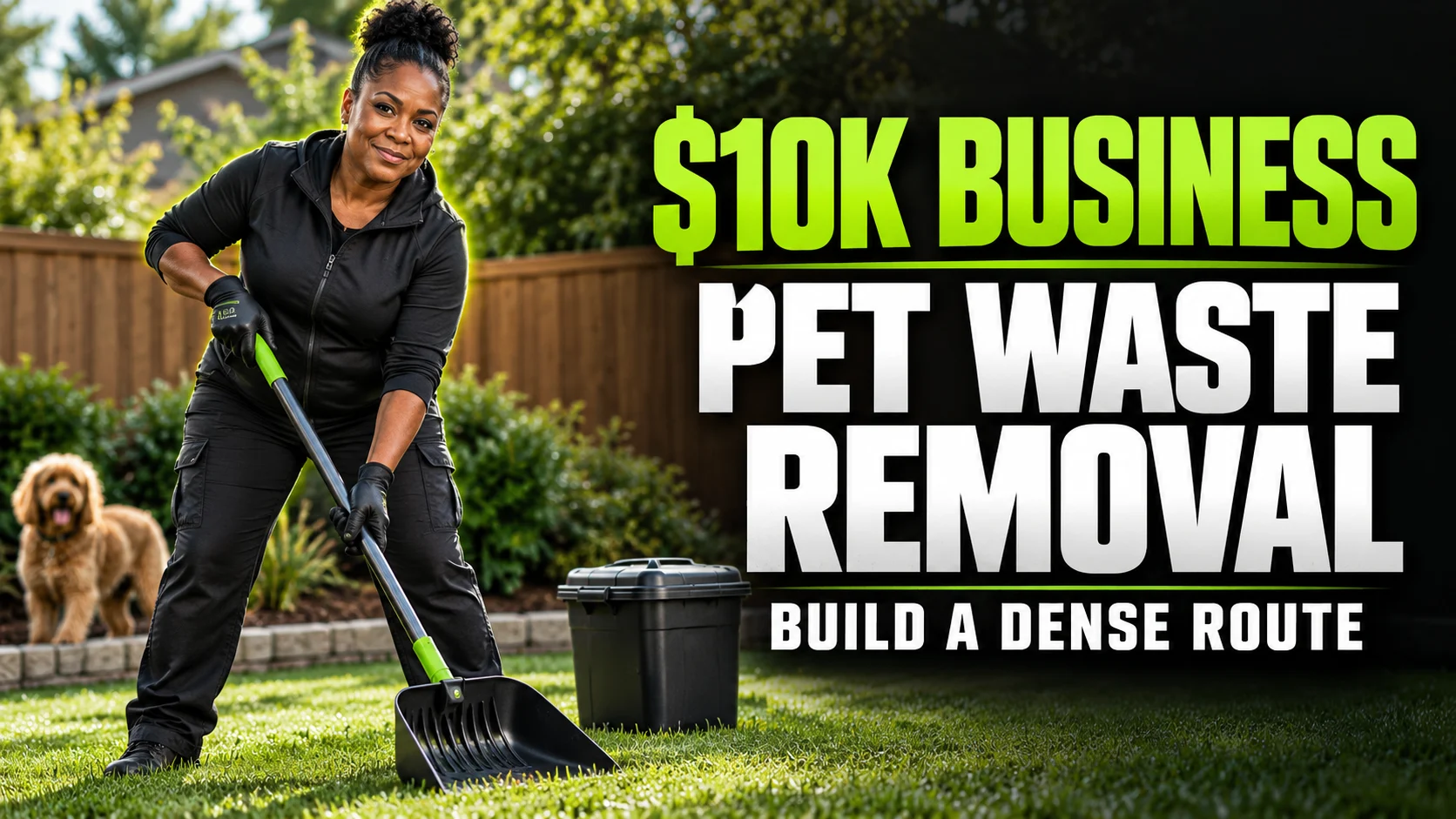

With $10,000, you can test a small service business such as cleaning, lawn care or pet waste removal, provided the budget covers a reliable way to reach customers and enough cash to operate. Pet waste removal is worth examining when you can build repeat visits in a compact area, but the return depends on paid demand, travel time and the value of your own labor. The plan below allocates the full budget without assuming you must spend it all.
The worked example uses U.S. dollars and an existing suitable vehicle. Austin, Texas, provides one pricing reference, while the decision framework can be adapted elsewhere by replacing costs, prices and local requirements. A vehicle purchase, personal living costs or a large service territory can make the same $10,000 inadequate.
The first decision is whether nearby households will pay enough for a repeat visit that you can deliver consistently. A low equipment bill makes testing easier, but it does not create customers or protect your margin. Before comparing potential returns, establish these three conditions.
- Reachable demand: several paying households in one practical service area.
- Complete unit economics: a price that covers travel, cleanup, disposal, fees and labor.
- Operational permission: suitable insurance, lawful waste handling and safe access arrangements.
Why pet waste removal deserves a closer look
Pet waste removal sells a simple recurring outcome: a yard that is regularly cleared without the owner doing the work. Weekly bookings create a predictable service pattern, and manual equipment lets you test the work before committing to expensive machinery. Recurrence is a feature of the offer, however, not evidence of low cancellations or guaranteed customer loyalty.
The work is more demanding than its short equipment list suggests. You must locate waste across grass and beds, manage gates, avoid loose or aggressive dogs, protect your hands and footwear, and keep dirty supplies separate from clean ones. Heat, rain, long grass, leaves and inaccessible yards all change the time required for a visit.
The price you see online is useful evidence of an existing offer, rather than proof of what your customers will accept. Scoop Soldiers’ Austin pricing lists $22.99 for one weekly visit covering up to four dogs, while Doody Scoop in Tennessee lists $19.99 per weekly visit for one dog. The $22 used below is an editable scenario assumption, and the businesses’ differing scopes make direct price copying unwise.
There is no sound basis here for calling this the highest-ROI business or predicting a full-time income in the first year. Equipment spending, customer acquisition and owner hours vary too much for an unsourced ranking to help. The useful comparison is which business you can test safely and deliver profitably with your existing resources.
Compare the main constraint before choosing an idea. A machine can consume capital before you have a location, while a cleaning job may consume several hours before you can serve the next customer. This table compares operating differences rather than presenting speculative industry margin averages.
| Business | What makes it workable | What can break the budget or return | What to prove first |
|---|---|---|---|
| Pet waste removal | Simple manual kit; repeat neighborhood visits | Scattered stops, slow yards, disposal and vehicle costs | Paid local demand and complete minutes per stop |
| Residential cleaning | Recurring customers; can begin with a narrow service scope | Long jobs, rework, chemical use and property damage | Price versus measured whole-job time |
| Lawn care | Repeat seasonal maintenance | Vehicle, mower, repairs, storage and seasonality | Existing transport and viable local route |
| Pressure washing | Project work with a defined visible outcome | Surface damage, training and wastewater handling | Competence on the exact surface and lawful runoff handling |
| Small vending route | Sales can occur between restocking visits | Poor locations, equipment repairs and inventory | Written placement terms and credible location sales evidence |
An exact $10,000 allocation, with $4,800 kept available
A $10,000 budget is a ceiling, not a shopping target. In this example, $5,200 is assigned to launch categories and $4,800 stays in reserve until the pilot supports further spending. Replace every allowance with a local quote, and do not treat the table as a national startup-cost survey.
| Category | Allowance | What it covers |
|---|---|---|
| Equipment and first supplies | $700 | Primary and spare rake/pan, sealed containers, bags, gloves, footwear and cleaning supplies |
| Existing vehicle preparation | $500 | Washable containment, secure storage and protective liners; no vehicle purchase |
| Registration, advice and insurance setup | $800 | Locally applicable filing and setup costs or deposits; obtain actual quotes |
| Website, booking and basic identity | $600 | Simple service page, domain, initial setup and clear booking terms |
| Staged customer acquisition | $1,800 | Small print/referral/advertising tests, released in batches |
| Launch contingency | $800 | Approved unexpected setup needs; leave unspent when unnecessary |
| Operating reserve | $4,800 | Cash retained for slow acquisition, operating shortfalls and disruption |
| Total capital allocated | $10,000 | Maximum launch categories: $5,200; retained reserve: $4,800 |

The largest discretionary expense is finding customers, so release that money gradually. A $150 test that attracts two retained weekly customers costs $75 per acquired customer; the same spend with no paying customers buys no useful route revenue. Track paid customers and repeat visits before deciding whether to extend the campaign.
A lean launch could omit much of the website and marketing allowance if you already have supplies, transport and prospective customers. A more polished launch can justify spending later when your booking process or equipment is limiting a proven route. Neither option removes the need for coverage, safe work practices and an accepted disposal arrangement.
Your operating reserve should also be separate from your household emergency fund. The $4,800 reserve is not a promise of 60 days of runway, because the amount you spend each month and any owner withdrawals determine how long it lasts. If you need this business to pay your rent immediately, model those withdrawals before committing money.
Choose equipment by function, then obtain local quotes
Start with a long-handled rake and collection pan that work on the grass and surfaces you intend to service. Add a spare set so a broken handle does not cancel a route, plus closable containers that can be secured without contaminating the passenger area. Test reach, weight, bag fit and cleaning practicality before buying multiple kits.
- Collection: primary and spare rake/pan, suitable bags and washable containment.
- Protection: durable gloves, appropriate footwear, handwashing supplies and weather protection.
- Cleaning: a method and compatible products for removing debris and cleaning equipment between properties.
- Administration: a phone, secure customer records, visit scheduling and a payment method.
The $700 equipment allowance is a spending envelope rather than a product recommendation. Local availability, tax, delivery charges and the quality you need can change what fits inside it. A wrapped vehicle, custom app and large trailer have little value while you are still testing whether ten nearby customers will renew.
Set prices around scope and complete visit time
Define the weekly offer before quoting: yard size, dog count, access, normal accumulation, disposal method and service day. Quote an initial cleanup separately when backlog makes it substantially slower than a routine visit. Explain what happens when a gate is locked, weather prevents safe work, payment fails or the customer wants to pause.
Every-other-week service should not automatically cost half of weekly service. The yard may take longer, waste can become harder to find, and a missed visit can create a larger backlog. Likewise, extra dogs or an oversized yard should change the quote only through a clear, consistently applied scope rule.
For a starting price check, include labor for the complete stop as well as overhead. At $25 per hour and 18 combined service-and-travel minutes, labor alone is $7.50; add $3 of variable cash costs and a $350 monthly overhead allocation spread over 60 weekly clients, or about $1.35 per visit. With an assumed 3% percentage payment fee, that simplified route-only floor is about $12.22, but it still excludes administrative labor, taxes, acquisition recovery and a profit cushion.
Route density decides whether the work pays
Suppose a routine yard takes 12 minutes and travel averages six minutes per stop, including an allocated share of outbound and return travel. Sixty weekly clients then require 18 route hours each week; add five hours for scheduling, selling, cleaning, billing and disposal for 23 total hours. These are testable assumptions, and the pilot should measure them rather than accepting them as an industry benchmark.
Now increase travel from six to 15 minutes without changing the customer count or price. Route time rises to 27 hours a week, adding nine hours of work; at $25 an hour, that is another $975 a month of owner time. Fuel and vehicle costs may rise as well, so the true deterioration can be larger than the labor comparison alone.

Choose one neighborhood or connected pocket of neighborhoods and allocate service days by area. Make a nearby new customer easier to accept than a distant one, and add an outer area only when there is enough work to justify a separate route day. For the customer-selection work behind this decision, use finding your niche and target market to define whose yard and schedule you can realistically serve.
Model revenue and earnings after owner labor
The following scenarios assume one completed, paid visit per client each week for 52 weeks, billed at $22 per visit. They use $3 of variable cash costs per stop, a 3% percentage payment fee, $350 monthly fixed cash costs, 18 route minutes per stop and five administrative hours weekly. Monthly equivalents use 52 divided by 12, so a real month or a route with service pauses will differ.
| Weekly clients | Revenue | Cash surplus before owner pay | Owner hours/month | Surplus after owner labor at $25/hour |
|---|---|---|---|---|
| 40 | $3,813 | $2,829 | 73.7 | $987 |
| 60 | $5,720 | $4,418 | 99.7 | $1,927 |
| 80 | $7,627 | $6,008 | 125.7 | $2,866 |
| 100 | $9,533 | $7,597 | 151.7 | $3,806 |
Cash surplus here means modeled receipts less variable costs, percentage fees and fixed cash costs before paying the owner. The last column also values every modeled owner hour at $25, even if no wage is actually withdrawn. It is a decision measure rather than an accountant’s net-profit calculation, and it excludes income taxes, debt, depreciation, launch-cost recovery and any expense you have not entered.
Build the $3 variable allowance from bags, incremental fuel, disposal and a per-stop vehicle wear allowance. Build the $350 fixed allowance from recurring coverage, software, communications, maintenance reserves and ongoing marketing; replace it with your itemized costs, especially as the route grows. If insurance or software is prepaid at launch, reconcile actual payment dates separately so you do not count the same cash payment twice.
A useful formula is monthly revenue = weekly clients × visit price × 52 ÷ 12. Subtract per-visit costs, percentage fees and monthly fixed costs, then subtract total monthly hours × the owner’s target hourly value. Fixed transaction charges, sales taxes and different billing frequencies need their own treatment; a single assumed fee percentage is only a simplified planning input.
Why operating break-even and startup payback differ
At the example inputs, about five weekly clients cover the modeled fixed cash costs if the owner takes no pay. About 19 cover those costs and the modeled owner labor, including five weekly administrative hours. A route can therefore look cash-positive while compensating its owner poorly, particularly when the customer count is small.
Recovering launch spending is another hurdle. At 60 weekly clients and approximately $1,927 monthly surplus after owner labor, $5,200 equals about 2.7 months of steady-state surplus. That is not a forecast that a new business recovers its investment in three months, because the route may take many months to build and early losses increase the amount to recover.
Consider a deliberately hypothetical first-year ramp with average weekly client counts of 10, 25, 40 and 60 in successive quarters. At the same price and cost assumptions, annual revenue is $38,610, modeled cash surplus before owner pay is about $27,987, and the surplus after valuing 786.5 owner hours at $25 is about $8,324. Subtracting the full $5,200 launch allocation leaves about $3,124 before tax; no acquisition success, cancellations, holiday pauses or unexpected costs are guaranteed by that illustration.
Use Route Reality Check before committing the budget
Enter a proposed client count, visit price, measured cleanup and travel time, available weekly hours and your target hourly pay. Then replace the cash-cost assumptions with quotes and pilot data, and compare a tighter route with a scattered one. The result shows the change in earnings and time capacity rather than awarding the business a speculative success score.
Route Reality Check
See what a weekly pet waste route earns after costs and owner time.
Compare a proposed client count with your price, full stop time, costs and available hours. Results model a steady weekly route; they do not predict bookings, customer retention or profit.
Monthly route picture
After modeled owner labor • before tax—- Gross revenue
- —
- Cash surplus before owner pay
- —
- Weekly hours needed
- —
- Clients fitting your hours
- —
- Clients to cover cash costs
- —
- Clients to cover costs + owner time
- —
- Steady-state launch-cost recovery
- —
- Reserve / modeled monthly cash costs
- —
Reserve coverage assumes no revenue and no owner withdrawals. Recovery uses spent launch capital and positive surplus after owner labor; acquisition time and early losses are additional.
Simplified planning only. Taxes, debt, depreciation, fixed transaction fees, absences and unentered costs are excluded. No data is sent to a server.
How the calculation works
Monthly visits = clients × 52 ÷ 12. Cash surplus = revenue × (1 − percentage fee) − visits × variable cost − fixed costs. Hours = (clients × (cleanup + travel) ÷ 60 + admin hours) × 52 ÷ 12. Surplus after owner labor = cash surplus − hours × owner time value. Client break-even rounds up to whole clients; capacity rounds down. A nonpositive per-client contribution cannot cover overhead by adding more clients.
A staged launch for the first 90 days
Days 1–14: establish permission and a bounded offer
Check business registration, local tax treatment, waste transport rules and the receiving provider’s disposal terms. Ask an insurance broker about liability, accidental gate escape or property damage, business vehicle use and workers’ compensation if you later hire; an LLC does not replace insurance. The SBA business-launch guidance explains that requirements depend on activity and location, while a U.S. EIN, when needed, is available free directly from the IRS.
Write a short service agreement covering access, dog confinement, scope, disposal, visit frequency, payment, missed visits and cancellation. Keep gate codes and customer records in a protected business system rather than a public spreadsheet or advertising audience. Create a minimal booking page that states the service area and the price conditions clearly.
Days 15–30: secure a small paid pilot
Contact a defined group of nearby prospective customers and offer a clearly priced recurring service. Use permitted local promotion, neighborhood groups and referral introductions from pet businesses, with each venue’s rules respected. Ten interested replies are not ten customers; record how many people book, pay and continue after the first visits.
Set up a Google Business Profile only if the business meets its eligibility and representation rules. Avoid presenting a home as a staffed storefront or inventing locations to appear across the city. Use small customer-acquisition tests and keep a record of paid bookings, renewals and the full cost of each campaign.
Days 31–60: measure the complete route
Record arrival, departure, travel, disposal and administrative time, plus bags used and actual payment costs. Compare the customers who renew with those who pause, and ask why without assuming every cancellation is a service failure. Amend the offer, boundary or price when repeated evidence shows that a stop cannot cover its complete cost.
Days 61–90: release more capital only after repeat demand
Expand the promotion that produces retained customers near existing stops and stop the campaigns that do not. Set a personal expansion condition, such as enough repeat visits to establish a stable service time and a cost per acquired customer you can recover. Keep spending staged even if the route starts well, because repairs, sickness and weather interruptions can consume reserve quickly.
Waste handling and reliability belong in the business model
A household disposal instruction is not the same as permission for commercial hauling. Austin advises residents to scoop and trash pet waste, and its curbside composting guide excludes pet waste. Before collecting multiple customers’ bags, obtain an accepted commercial arrangement, use a customer bin only with the necessary permissions, and never place waste in someone else’s bin or a storm drain.
Rules change across countries as well as cities. In England, for example, waste-carrier registration guidance can be relevant when a business transports other people’s waste. The U.S. financial example does not determine your local registration, tax or disposal duties.
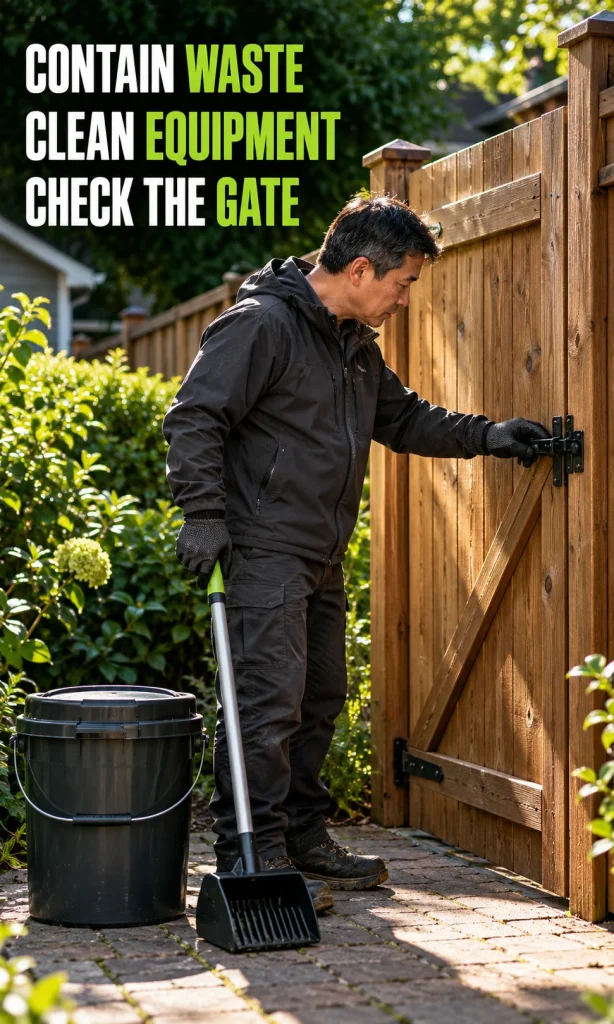
Use a consistent service routine: confirm pets are secured, check access, sweep the yard systematically, bag and contain waste, clean equipment appropriately, and verify the gate before leaving. Photograph a closed gate when appropriate and consented, while avoiding people, addresses and unnecessary private details. Stop the visit if an unsecured dog, unsafe access or severe weather makes the work unsafe.
Gloves do not replace handwashing. The CDC’s dog hygiene guidance recommends soap and running water after contact with dog waste, even when a bag is used. Keep food away from contaminated equipment, follow cleaning-product labels, and avoid offering disinfectant or deodorizing treatments you cannot use safely and lawfully.
When to add help, and when to pause
Hiring makes sense when a proven route supports the full employment cost, rather than when the gross revenue looks impressive. Budget wages, payroll costs, required coverage, training, supervision, travel and backup capacity before treating owner time as replaceable. Use when to hire your first employee to examine that transition once the route has reliable economics.
Pause expansion when the route exceeds available hours, pay after full costs falls below your target, the reserve is shrinking unexpectedly, or a legal or insurance question remains unresolved. A better boundary or a higher price may correct an operating problem, while weak paid demand may require a different offer entirely. Choosing to stop a small pilot can protect more capital than persisting with a fully branded but unprofitable route.
Pet waste removal business questions
How much does it cost to start a pooper scooper business?
There is no universal startup price. With an existing suitable vehicle, a small paid pilot can use a fraction of $10,000, but registration, coverage and disposal requirements can change the budget. This example allocates $5,200 to launch categories and keeps $4,800 unspent; those are planning allowances rather than supplier quotes.
How much can you make with 50 or 100 weekly clients?
At $22 per weekly visit, 50 clients generate about $4,767 monthly revenue and 100 generate about $9,533, using 52 visits per year. Under this article’s cost and time assumptions, the modeled surplus after valuing owner labor is about $1,457 and $3,806 respectively, before taxes and launch-cost recovery. Larger yards, cancellations, slower travel and higher costs reduce those results.
Do I need a special license or an LLC?
Check the rules where you operate rather than assuming the service is exempt. Registration, tax treatment, waste transport and disposal requirements can differ between jurisdictions, and an LLC is one possible structure rather than a universal requirement. Ask the relevant authorities and an insurance broker about your exact activities before accepting paid work.
Can I start a pet waste removal business part-time?
Yes, if you can offer a reliable service day and fit every stop, travel segment and administrative task into your available hours. Twenty weekly clients at 18 minutes per stop require six route hours before administration and disruption allowances. Restricting the service area usually makes a part-time schedule easier to sustain.
Is pet waste removal a good business in 2026?
It can be a workable recurring service where enough nearby customers accept a price that covers the work. Existing operators demonstrate that the service is sold, but they do not establish demand or profitability for your proposed neighborhood. Use a paid pilot to measure willingness to pay, route time, acquisition cost and retention before expanding.
How should a pet waste removal business dispose of waste?
Confirm an approved commercial disposal arrangement with the local authority and receiving waste provider. Household advice to bag waste and place it in trash does not automatically authorize a business to transport or dispose of accumulated customer waste. Use customer bins only when the customer and provider permit it, and keep waste out of storm drains and ordinary yard compost.
Is pet waste removal better than pressure washing with $10k?
Pet waste removal can suit a beginner seeking repeat neighborhood visits with a relatively simple equipment set. Pressure washing may suit someone with surface-care skills, suitable transport and the ability to manage damage and wastewater risks. Compare verified local prices, complete job time and paid customer acquisition costs before deciding; neither business has a guaranteed return.
How long does it take to recover the startup cost?
Divide spent launch capital by a positive surplus after allowing for owner labor to obtain a steady-state illustration. At 60 weekly clients, this example produces about $1,927 per month on that basis, so $5,200 represents roughly 2.7 steady-state months. Customer acquisition takes time, early losses can add to the amount to recover, and this calculation is not a launch-to-payback forecast.
Your next decision
Use the $10,000 to fund evidence in stages, starting with a lawful, insured and clearly scoped service in one compact area. Keep the reserve available while the pilot reveals what customers will pay and how long the complete route takes. Expand only when the measured result compensates your time and leaves room for disruption.
- Confirm the local registration, coverage and disposal requirements.
- Replace every launch allowance with a quote and set a pilot spending limit.
- Secure a small group of nearby paying customers and time the complete service.
- Recalculate earnings after owner labor, then decide whether to expand, change the offer or stop.