
Water damage in a house begins with unwanted moisture entering a material or building cavity and staying there long enough to alter how that material behaves. A brown ceiling mark or swollen cabinet panel may be the first visible symptom, but the important questions are where the moisture originated, where it travelled, what materials absorbed it, and whether those materials have actually returned to a dry condition. Repairing the visible finish before answering those questions can trap moisture inside an assembly and allow the same damage to return.
Water damage can come from plumbing failures, roof or exterior-envelope leaks, overflowing fixtures, appliance hoses, HVAC condensate, groundwater, flooding, or condensation on surfaces that repeatedly fall below the surrounding air’s dew point. Each source produces a different moisture pattern, so the stain itself should never be treated as a reliable map of the full affected area. Water can move downward under gravity, sideways through porous materials, through seams and fastener holes, and upward short distances through capillary action.
What Should You Do First When You Discover Water Damage?
The first objective is to stop additional water from entering the building without exposing anyone to electrical, structural, sewage, or contaminated-water hazards. Shut off the relevant fixture or water supply when that can be done safely, move vulnerable belongings away from the affected area, and document visible damage before destructive work begins if an insurance claim may be involved. Significant flooding, standing water near electrical equipment, sewage, unstable ceilings, or structural movement warrants professional assessment rather than immediate DIY demolition.
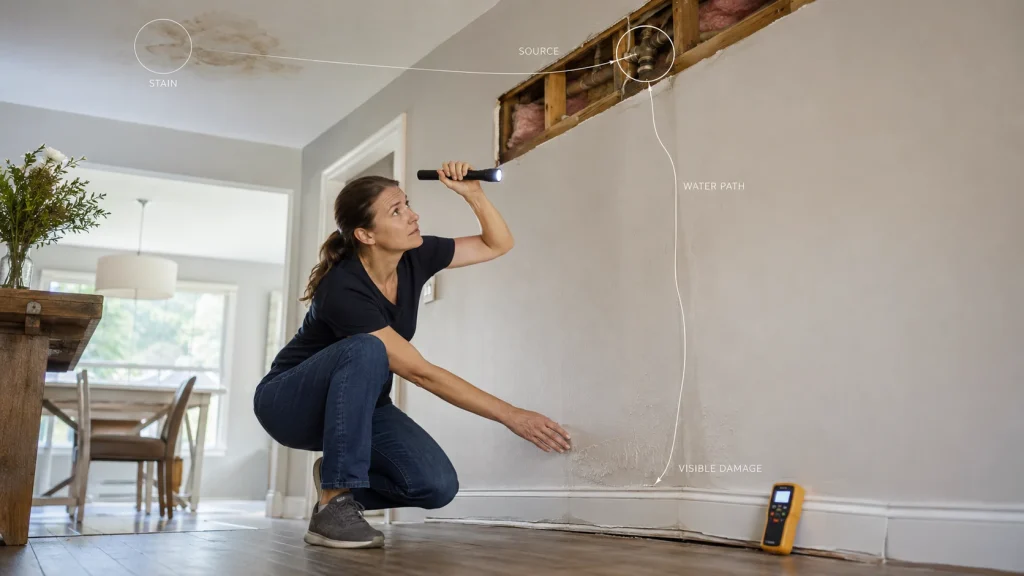
The next objective is source identification because drying equipment cannot compensate for a leak that remains active. A ceiling stain below a bathroom can result from a supply connection, drain fitting, failed shower waterproofing, toilet seal, tub overflow, or condensation, while an exterior-wall stain can involve flashing, cladding, window interfaces, plumbing, or indoor condensation. The location therefore narrows the investigation but does not prove the mechanism.
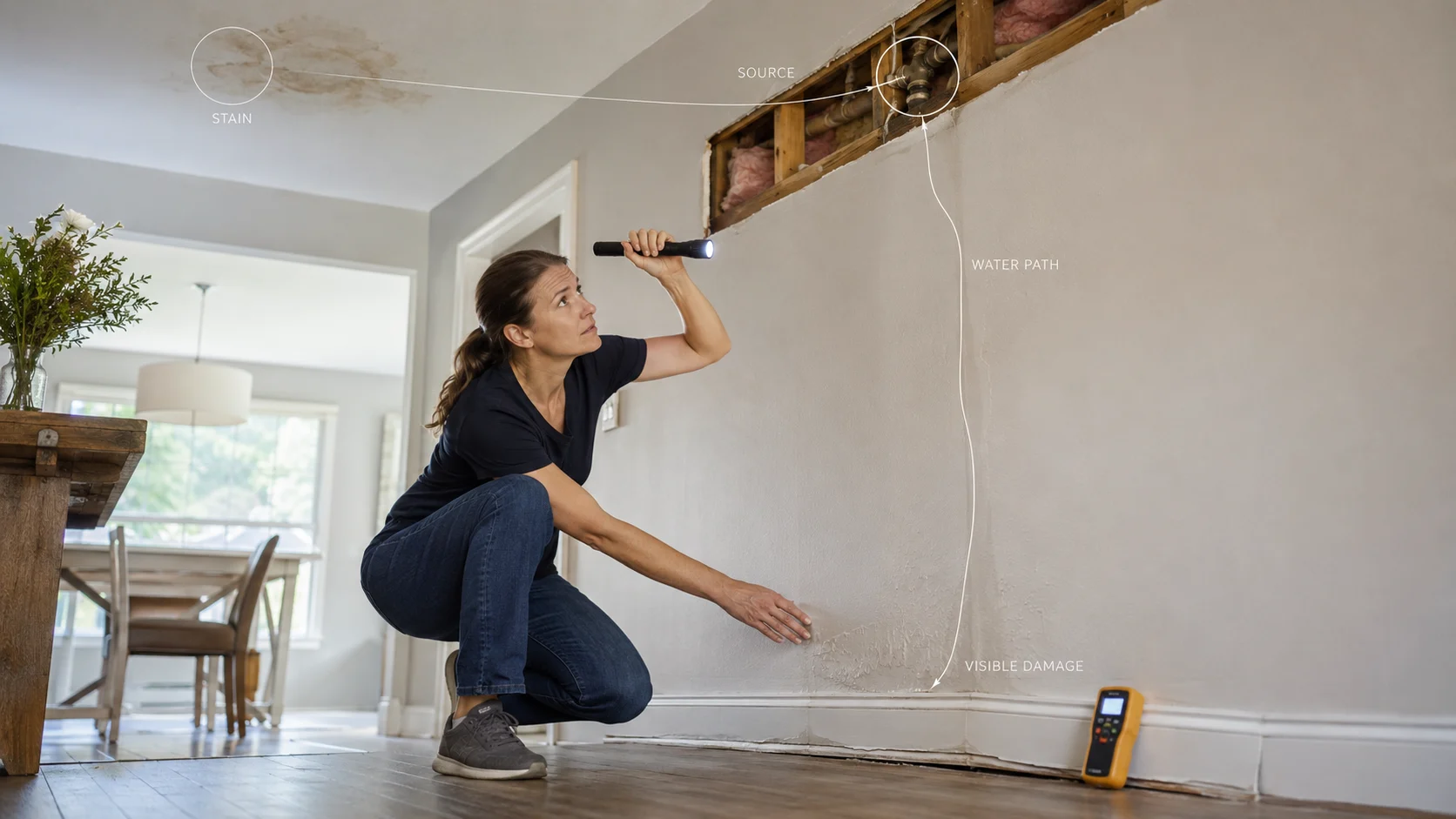
A useful diagnosis separates the moisture source from the moisture path and the damaged material. The source is where water originates, the path is how it moves through the assembly, and the damage is where sufficient moisture accumulates to change the material. Keeping those three concepts separate prevents a common repair failure in which damaged drywall is replaced while the concealed source remains untouched.
Technical source patterns worth checking
- Pressurized plumbing leak: Water can continue leaking even when the fixture is unused. Check supply tubes, angle stops, compression fittings, braided hoses, pipe joints, and concealed supply lines; isolate or repair the failed connection before drying.
- Drain or waste leak: Moisture often appears mainly during fixture use. Inspect traps, slip joints, waste fittings, toilet seals, drain connections, and overflow assemblies while the fixture is operating.
- Roof or flashing intrusion: Damage commonly correlates with rain or wind direction. Inspect penetrations, valleys, flashing transitions, roof-wall interfaces, deteriorated sealant joints, and drainage paths rather than assuming the visible ceiling stain sits directly below the defect.
- Exterior-envelope leak: Window perimeters, cladding joints, penetrations, poorly detailed sill pans, and wall transitions can admit rainwater that then travels through framing cavities. Investigation should follow the likely drainage plane instead of opening random wall sections.
- HVAC condensate problem: A blocked drain, overflowing condensate pan, uninsulated cold pipe, or poorly controlled humidity can create recurring moisture without a conventional plumbing leak. Correct drainage, insulation, airflow, or humidity conditions before repairing finishes.
- Condensation: Moisture may form because a surface temperature falls below the air’s dew point. The long-term fix may involve insulation, air sealing, ventilation, humidity control, or thermal-bridge correction rather than waterproofing.
- Groundwater or capillary moisture: Basement and slab assemblies can remain wet because moisture is entering from soil or migrating through porous masonry. Exterior drainage, grading, waterproofing, capillary breaks, sump systems, or vapor-control measures may be more important than interior cosmetic work.
- Floodwater or sewage: Treat the event as a contamination problem as well as a drying problem. Material removal, protective equipment, containment, cleaning, and professional restoration can become necessary depending on the source and extent.
Why Water Damage Often Extends Beyond the Visible Stain
A water stain records where pigments, dirt, tannins, corrosion products, or dissolved material accumulated during wetting and drying. It does not show the complete moisture boundary. Water may spread across the back of gypsum board, follow framing members, saturate insulation, move below flooring, or collect beneath cabinets while leaving adjacent finished surfaces apparently normal.
This is why hidden water damage inside walls deserves its own specialist inspection discussion. A wall can remain visually intact while insulation, paper-faced gypsum, timber framing, or the bottom plate retains elevated moisture. Odor, peeling paint, softened drywall, swollen trim, unexplained flooring movement, or repeatedly high moisture readings can provide better diagnostic clues than stain size alone.
How Different Building Materials React to Water
Gypsum drywall absorbs water readily through its paper facings and porous core, especially along cut edges and the lower portion of a wall. Limited clean-water wetting does not automatically mean every sheet must be removed, but loss of rigidity, delamination, persistent moisture, contamination, mold growth, or inaccessible wet insulation behind it can change the decision. The wall cavity also has to be dry, so simply heating the painted face is not sufficient.
Solid wood behaves differently because its moisture content changes with surrounding conditions and direct wetting. Wood can swell across the grain, cup, bow, split, stain, support fungal growth, and transmit moisture into adjoining materials, yet many solid-wood components can be dried successfully when contamination and structural deterioration are limited. The critical question is whether the material reaches an acceptable dry condition without remaining distorted or biologically damaged.
Composite wood products such as particleboard, fiberboard, some cabinet-box materials, and certain laminated panels can respond much less favorably. Once water penetrates their edges, the wood particles or fibers may swell permanently, weakening fastener holding and breaking the bond beneath decorative laminates. Fibrous insulation, paper products, carpet pad, and other absorbent materials also require material-specific decisions because cleanliness, duration of wetting, accessibility, and dimensional stability matter alongside moisture content.
EPA guidance emphasizes that wet building materials should be dried quickly and that moisture control is central to preventing mold growth. Its current homeowner guidance recommends drying water-damaged areas and items within roughly 24 to 48 hours where practical.
How Professionals Check the Extent of Water Damage
A useful inspection begins with a dry reference area before measuring the suspected loss area. The investigator can compare the same material in an unaffected location, then work outward from the obvious damage to create a moisture map. This method is generally more informative than relying on one isolated reading because different materials, thicknesses, coatings, density, temperature, and meter settings can affect measurements.
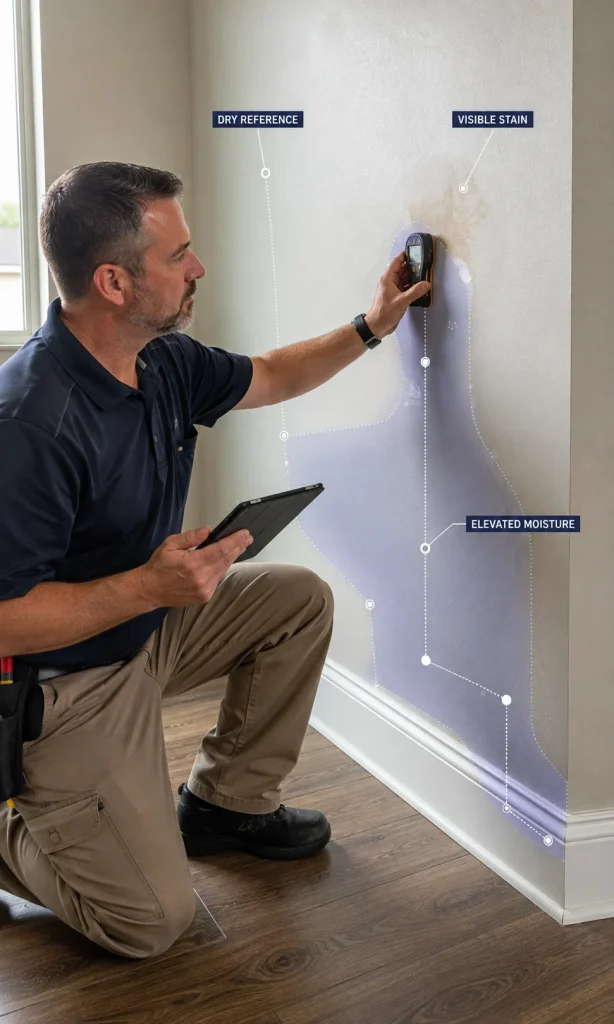
Pin-type moisture meters measure electrical resistance between probes and can help investigate moisture at specific depths or layers when used appropriately. Pinless meters can scan larger surfaces rapidly and are useful for finding relative moisture patterns without making probe holes, although density, metal, substrate thickness, and material composition can influence results. Neither instrument should be treated as a universal pass-or-fail device without understanding what material is being measured.
Infrared cameras can identify temperature patterns that suggest possible wet areas, but they do not directly see water. Evaporation, missing insulation, solar heating, air leakage, HVAC supply air, thermal bridges, and different surface materials can all create thermal anomalies. Suspected areas should therefore be verified with direct moisture measurements and inspection rather than declaring every cool thermal image to be a leak.
Indoor relative humidity also matters because evaporation moves moisture from building materials into the surrounding air. If that moisture is not removed, the air becomes increasingly humid and the drying rate falls. EPA recommends controlling indoor humidity and, where possible, keeping relative humidity below 60 percent, although professional structural drying decisions require more than simply achieving a room-humidity target.
How Structural Drying Actually Works
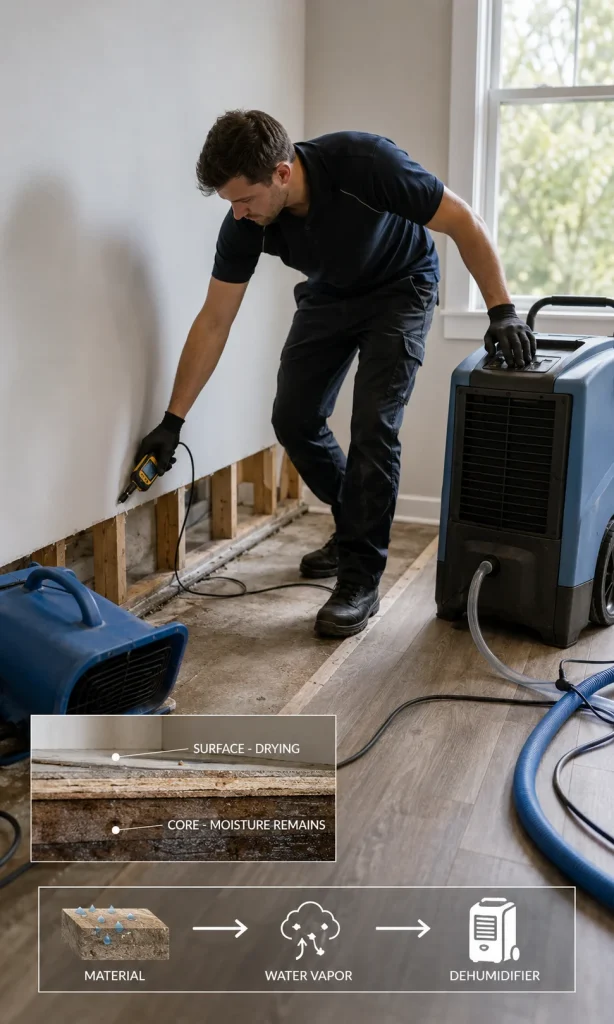
Effective drying normally begins with water removal before evaporation. Bulk water is extracted or physically removed first because attempting to evaporate standing water with fans is slow and can move large quantities of moisture into the indoor air. Once excess water is removed, the drying system has to promote evaporation from wet materials while continuously removing the resulting water vapor.
Dehumidification reduces the amount of moisture in the air so wet materials have somewhere for their stored moisture to go. Air movement reduces the saturated boundary layer immediately above a wet surface and can accelerate evaporation when the surface and contamination conditions are appropriate. Temperature also affects drying, but uncontrolled heating without moisture removal can simply create warm humid air rather than a dry structure.
Air movers are therefore useful tools, but placing fans everywhere is not automatically correct. Suspected mold growth, sewage contamination, contaminated dust, asbestos-containing materials, lead hazards, or other hazardous conditions can require containment and a different work plan before aggressive air movement is introduced. Professional restoration practice is structured around inspection, building and material science, psychrometry, drying technology, equipment, and contamination considerations under standards such as the ANSI/IICRC S500 Standard for Professional Water Damage Restoration.
How Do You Know When Water-Damaged Materials Are Dry?
A material should not be declared dry merely because its surface feels dry or because the room no longer smells damp. Surface evaporation can occur while moisture remains deeper inside wood, beneath flooring, behind cabinetry, within insulation, or against a cooler substrate. Closing the assembly too early can therefore recreate a moisture problem after the new finish is installed.
Drying goals should be based on the material, the surrounding environment, manufacturer requirements where relevant, and comparison with suitable unaffected reference materials. There is no single moisture percentage that proves every wall, floor, cabinet, or framing member in every building is ready for reconstruction. The better approach is repeated measurement that documents a downward moisture trend and confirms that affected materials have returned to an appropriate equilibrium or project-specific drying target.
The salvage decision also depends on what the water contacted before it reached the material. A clean plumbing release discovered quickly can present a very different restoration problem from sewage, outdoor floodwater, long-term leakage, or moisture that has supported mold growth for an unknown period. CDC guidance notes that floodwater may contain biological, sewage, agricultural, or industrial contaminants, which is why heavily contaminated water losses should not be approached as ordinary drying projects.
| Material | What water tends to do | More likely salvageable when | Removal becomes more likely when |
|---|---|---|---|
| Solid framing lumber | Absorbs moisture, swells and dries comparatively slowly | Structurally sound, accessible and capable of being dried | Decay, severe deformation or structural deterioration is present |
| Drywall | Wicks moisture through paper and gypsum core | Limited clean-water exposure with retained integrity and complete drying | Softening, delamination, contamination, persistent wetness or mold occurs |
| Particleboard / MDF | Edges swell and internal bonds may weaken | Exposure is extremely limited and dimensional stability remains intact | Swelling, crumbling, laminate release or fastener failure occurs |
| Solid hardwood flooring | Boards swell, cup or crown as moisture becomes uneven | Contamination is limited and controlled drying can restore acceptable moisture balance | Severe buckling, biological deterioration or irreversible deformation remains |
| Fibrous insulation | Can trap moisture within concealed cavities and lose performance | Material type, cleanliness and accessibility allow verified drying | Contaminated, compressed, persistently wet or inaccessible for reliable drying |
| Concrete / masonry | Stores moisture within a porous mineral structure | Source is corrected and sufficient drying time is provided | Replacement is rarely for moisture alone, although coatings and attached finishes may fail |
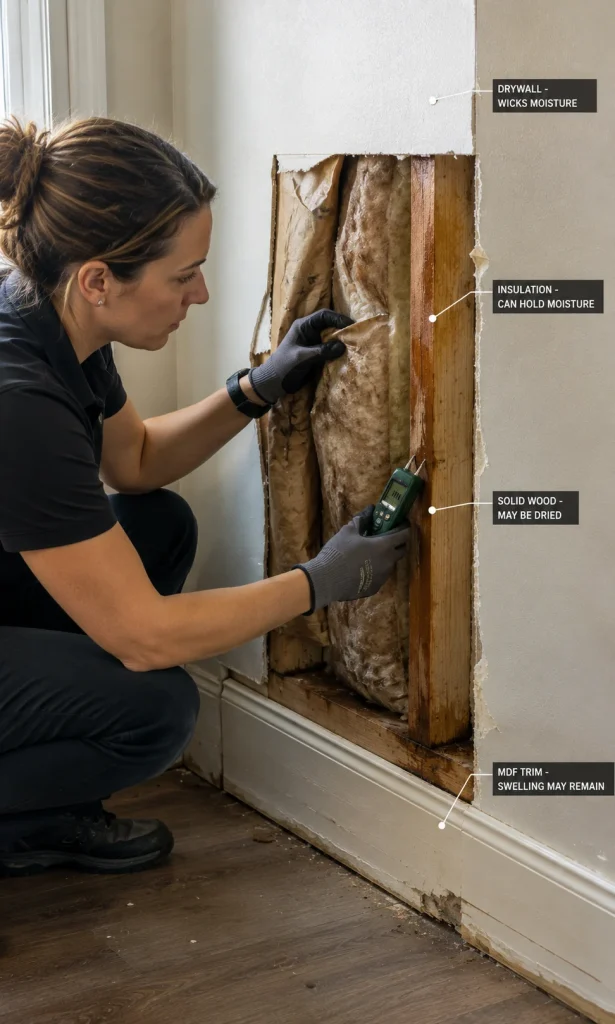
EPA’s material-specific cleanup guidance similarly distinguishes between materials that can often be extracted and dried and absorbent products that may require replacement depending on the circumstances. Ceiling tiles and some insulation materials, for example, are treated more conservatively than concrete or masonry surfaces.
Repair Water Damage Only After the Moisture Problem Is Resolved
Reconstruction should follow a sequence of source correction, moisture verification, removal of unsalvageable materials, cleaning or remediation where required, substrate repair, and only then replacement of finishes. Installing new drywall, baseboards, cabinets, flooring, insulation, or paint over a damp substrate hides evidence and reduces the assembly’s ability to dry. Moisture testing immediately before closing concealed cavities is therefore a useful final quality-control step.
Paint stains and cosmetic discoloration should also be treated as the final layer of the repair rather than the diagnosis. Stain-blocking primer may be useful after the underlying assembly is dry and the cause has been corrected, but primer does nothing to stop a leaking pipe or wet framing. The most successful repair removes the mechanism that created the water problem before restoring appearance.
Can Water Damage Turn Into Mold Damage?
Water damage and mold damage frequently overlap because indoor mold growth depends on available moisture. EPA and CDC both emphasize rapid drying, commonly using the 24-to-48-hour period as an important practical target after water intrusion. That does not mean mold automatically appears at exactly 48 hours, but it explains why waiting several days before investigating wet drywall, carpet, cabinetry, or wall cavities increases the likelihood that the project will require more than ordinary drying.
If discoloration, persistent musty odor, visible fungal growth, or recurring dampness develops, the investigation should return to the moisture source rather than treating mold as an independent cosmetic defect. The pages on early signs of mold damage and what causes mold to grow on walls are natural next steps when the loss has moved from a simple wet-material problem toward a moisture-and-microbial problem.
When Water Damage Needs Professional Assessment
Professional assessment becomes more appropriate as the affected area becomes larger, the water source becomes more contaminated, concealed assemblies are involved, electrical or structural systems may have been affected, or drying cannot be verified with ordinary homeowner equipment. It is also sensible when expensive materials such as hardwood flooring, custom cabinetry, stone assemblies, or complex wall systems may be saved with controlled drying but damaged by an improvised approach. Extensive water damage, uncertain contamination, recurring moisture, substantial mold growth, or damage that has remained wet for an unknown period raises the value of documented moisture mapping and a defined restoration plan.
Preventing the Same Water Damage From Returning
Prevention begins with the mechanism found during the investigation rather than a generic waterproof coating. Plumbing connections need inspection and replacement when deterioration appears, roof and flashing details need drainage continuity, wet rooms need functioning waterproofing and exhaust systems, condensate drains need maintenance, and exterior grading should move water away from the structure. A periodically checked leak detector beneath sinks, water heaters, washing machines, HVAC equipment, and other high-risk fixtures can also reveal small failures before they become concealed material damage.
Compare Local Home Specialists Near You
Tell us what kind of help you need, then compare nearby businesses by location, Google rating, review volume and contact options.
HomeFix Local Match
Turn a home problem into a practical local hiring decision. Check the clues, see the specialist types that fit, open focused surrounding-location searches, then compare the strongest three before you call.
 YOUR PROBLEM
YOUR AREA
COMPARE 3
✓ Ready to compare
YOUR PROBLEM
YOUR AREA
COMPARE 3
✓ Ready to compare
What is happening?
Choose the closest problem type, then check every clue that applies. Your selections change the specialist order.
Where should the search focus?
Use Google’s “near me” context or enter the area you actually want a specialist to serve.
Simple local search: open nearby Google results, choose the businesses that look suitable, then compare your best three here before you call.
Problem snapshot
Who should you call first?
These are the specialist types most likely to fit the clues you selected.
Search around your location
Compare your top three
Use the same factors for each option so a high star rating does not hide a weak scope, poor diagnosis, missing credentials or unclear aftercare.
Comparison result
Your result combines the Google signals you entered with the practical hiring checks you completed.
Questions to ask every finalist
Use the same questions with each shortlisted business so the comparison stays consistent.
Frequently Asked Questions
How long does water damage take to dry?
There is no single drying time because the result depends on the material, amount of water, depth of absorption, temperature, humidity, airflow, assembly design, and drying equipment. A wet painted surface may appear dry long before concealed wood, insulation, subflooring, or wall cavities reach an acceptable moisture condition. Drying should therefore be verified with repeat measurements rather than assumed from elapsed time alone.
Can drywall be saved after water damage?
Sometimes, particularly when clean water exposure is limited, the drywall retains its physical integrity, and the wall assembly can be dried completely. Softened gypsum, delaminated paper, contamination, mold growth, persistent moisture, or inaccessible wet insulation behind the sheet can make removal more appropriate. The decision should consider the complete wall assembly rather than the painted face alone.
How can you tell whether water is still behind a wall?
Moisture mapping with appropriate meters can identify areas that remain wetter than comparable unaffected materials, while thermal imaging may help locate temperature anomalies worth investigating. Infrared imagery cannot confirm moisture by itself, so suspicious areas should be verified with direct measurement or inspection. Persistent odor, staining, swollen finishes, deteriorated trim, or recurring paint failure also justify further investigation.
Should you run fans immediately after water damage?
Air movement can accelerate evaporation after excess water has been removed and the loss has been assessed, but it is not appropriate in every situation. Sewage, suspected mold, hazardous dust, or other contamination can require containment and controlled remediation before aggressive airflow is introduced. Drying equipment should therefore match the water source and material conditions rather than being deployed automatically.
Does a water stain mean the area is still wet?
No. A stain may remain long after a material dries, while another apparently clean area can still contain concealed moisture. The visible mark shows where discoloration occurred, not necessarily the full current moisture boundary. Moisture measurements and source investigation are more reliable than appearance alone when deciding whether repair can begin.
Can water damage cause mold even after the leak is repaired?
Yes, because stopping the leak prevents additional water but does not automatically remove moisture already absorbed by drywall, wood, flooring, insulation, or cabinetry. Materials that remain damp can still support mold growth after the plumbing or roof defect has been corrected. The repair therefore needs both source correction and complete drying of the affected assembly.
Summary
Water-damage repair succeeds when the investigation follows the moisture rather than the stain. Stop the source, identify the path, map the affected materials, remove bulk water, establish controlled drying, verify the result with measurements, and reconstruct only after the assembly has reached an appropriate dry condition. That approach turns water damage from a cosmetic patching exercise into a building-science problem that can actually be solved.