
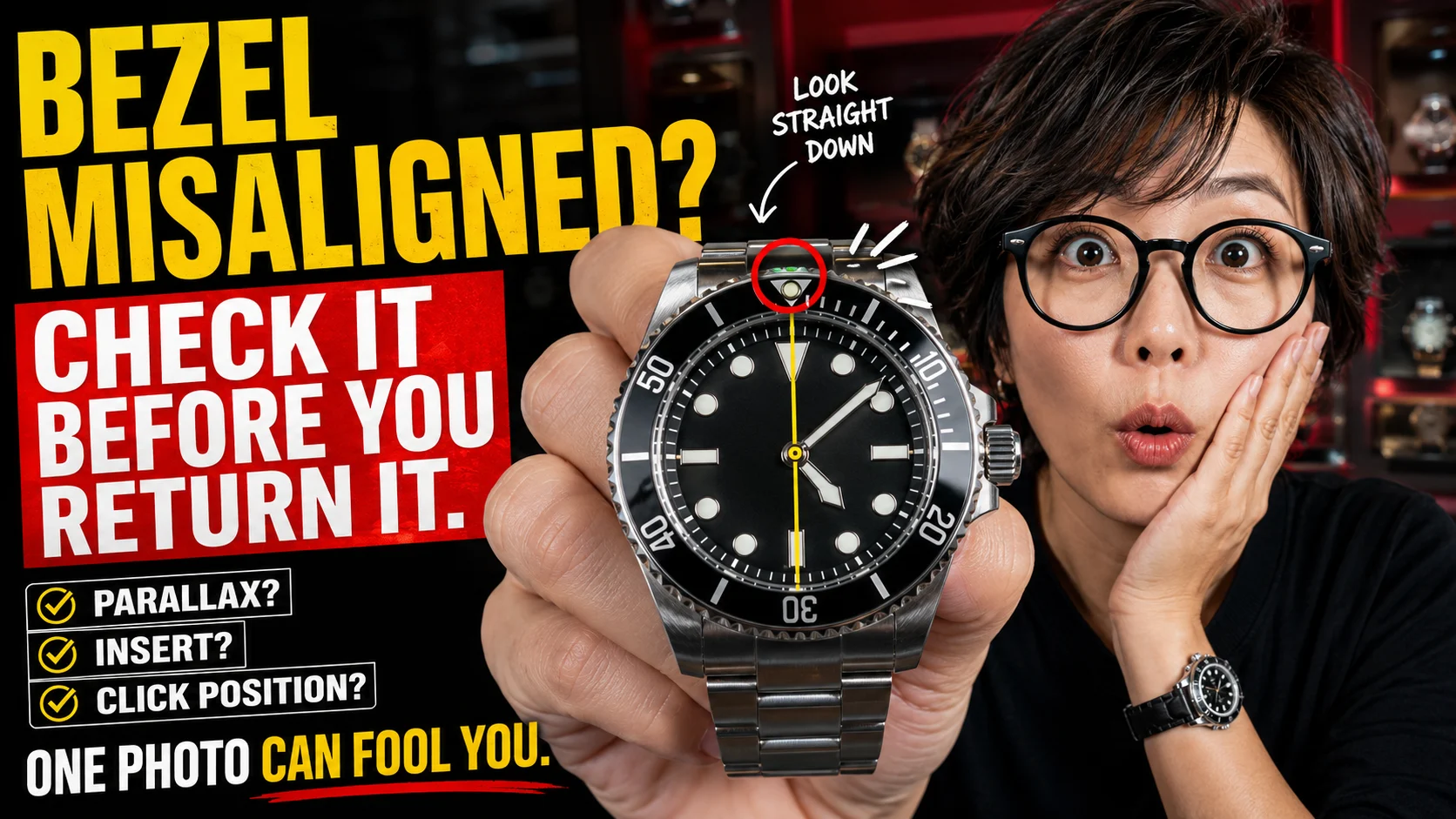
If your rotating bezel appears misaligned, do not judge it from one angled photograph. Put the watch flat, view the dial directly from above, move the bezel to the nearest intended position and check whether the bezel zero marker, dial center and 12 o’clock reference fall on the same visual line. If the marker remains consistently off from a straight-on view, the issue may be the bezel insert, the indexing mechanism, rotational play or another component such as the dial or chapter ring.
A new watch that is clearly misaligned is usually better handled through its return or warranty route before anyone removes the bezel or insert. Small apparent offsets can be caused by viewing angle, a domed crystal or camera position, so confirming what is actually crooked is more useful than immediately trying to fix the bezel.
| What you see | Possible explanation | Best check |
|---|---|---|
| Looks off only from some angles | Parallax, camera angle or crystal distortion | Take a centered straight-on photograph |
| Zero marker always sits between two dial positions | Indexing or insert-position issue | Compare both adjacent bezel positions from directly above |
| Marker moves when the bezel is lightly touched | Rotational play or backplay | Observe movement without forcing the bezel backward |
| Bezel looks straight but dial markers do not | Dial or chapter-ring alignment may be the real problem | Compare several dial markers with the case centerline |
| Problem appeared after impact or service | Insert, bezel assembly or another component may have shifted | Document it and use professional inspection |
First Rule Out Parallax
Parallax occurs when two objects that sit on different physical planes appear to shift relative to each other as your viewing angle changes. A bezel insert is above or outside the dial, while the dial markers sit deeper inside the watch, so even a modest viewing angle can make the zero marker appear left or right of the 12 o’clock index. A thick or domed crystal can make the effect even harder to judge visually.
This explains why many online alignment arguments become impossible to settle from one photograph. A current Grand Seiko owner described an apparent alignment problem that changed depending on viewing angle, while commenters examining other recent watches disagreed over whether photographed offsets were real or caused by perspective.
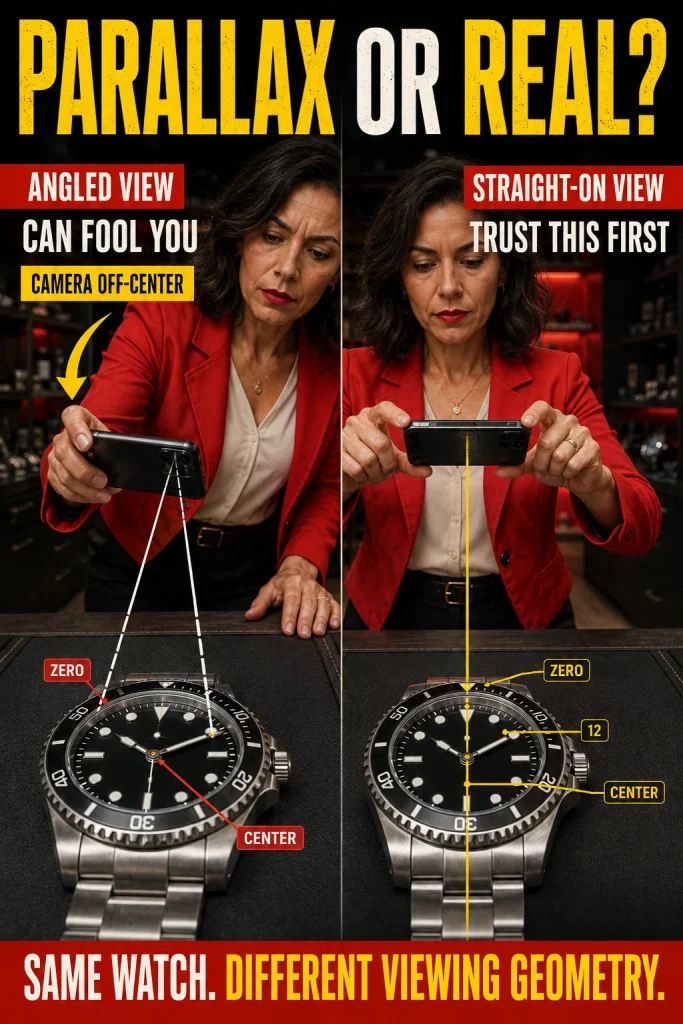
Take a Better Alignment Photo
Use a simple controlled setup:
- Place the watch flat on a level surface.
- Keep the dial approximately parallel with the camera sensor.
- Position the camera directly over the center of the hands.
- Move slightly farther away and zoom modestly instead of using an extremely close wide-angle view.
- Keep the full bezel visible so you can detect camera tilt.
- Photograph the closest bezel position on both sides of the suspected alignment point.
- Compare the zero marker against the dial center and 12 o’clock marker rather than the edge of the photograph.
A transparent straight line drawn from the center pinion through the 12 o’clock index can make the comparison easier. If the bezel marker sits on that same line only when the photograph is taken correctly, the original problem was probably viewing geometry rather than the watch.
ZeroLine Check
Standardize the photo, mark the center, dial 12 and bezel zero, then combine that geometry with what the bezel actually does. The result helps separate parallax from a repeatable alignment concern before you return or service the watch.

1. Make the photo useful
For the strongest check, lay the watch flat and photograph it directly above the center of the dial. Your image stays in your browser.
2. How was the watch viewed?
These answers tell the assessment how much to trust the visual offset.
3. What does the bezel actually do?
Describe the nearest normal indexed position. Do not force a one-way bezel backward.
4. Watch status
Purchase and service status changes the least-destructive next step.
5. Location for service help
Optional. Used only to build one-click Google Search and Google Maps queries after the result.
Know Which Part Is Supposed to Line Up
A rotating dive bezel is an operating component rather than a decorative ring. Seiko’s official rotating-bezel instructions show the bezel’s reference marker being aligned with the minute hand to establish the starting point for elapsed-time measurement, while Citizen’s rotating-bezel guidance describes the same basic operation.
Neither of those instructions creates a universal consumer-visible manufacturing tolerance for every watch brand. They do establish the more useful practical point: the reference marker needs to be positionable predictably relative to the watch’s time display if the bezel is going to perform its intended job.
A bezel that cannot be placed anywhere close to the intended reference because its click positions fall on either side deserves more attention than a marker that merely looks one pixel off in an angled smartphone photograph.
Four Different Things Can Look Like a Misaligned Bezel
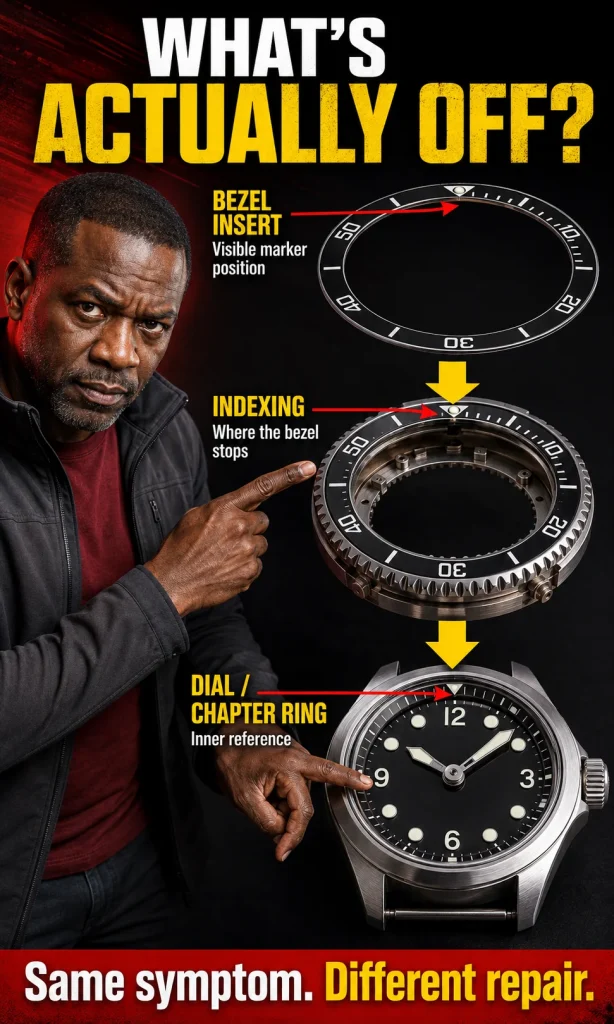
The term “misaligned bezel” is often too vague to diagnose the watch. Several independent components can produce a similar visual result.
1. The Bezel Insert Can Be Shifted
The printed or engraved insert may not be positioned perfectly within the rotating bezel carrier. In that case, the bezel’s mechanical indexing can be correct while the visible triangle, pip or zero marker is offset.
This distinction is particularly easy to understand when looking at replacement-bezel installation. Current bezel-insert fitting guidance from Assemble Watches treats insert alignment as a separate installation checkpoint: the 12 marker must be aligned before the insert is permanently seated.
If the visible zero marker looks crooked relative to obvious geometric features on the bezel carrier itself, the insert becomes a stronger suspect. Not every bezel has a useful carrier reference, however, so this check cannot be applied universally.
2. The Click Position Can Be Off
A rotating bezel normally indexes through a series of defined positions. If the nearest click leaves the marker slightly to one side and the next click moves it an equal or larger amount to the other side, the visible alignment point may fall between available mechanical positions.
That does not automatically reveal which component was manufactured incorrectly. The click mechanism, bezel ring and insert orientation interact, so the consumer-level diagnosis is simply that the intended reference cannot be reached cleanly.
3. The Bezel May Have Rotational Play
A small amount of movement between mechanical interfaces can exist without the bezel being loose enough to fall off. The important question is whether the zero marker changes position substantially under very light finger pressure after the bezel has settled into a click.
Do not force a one-way dive bezel clockwise to test this. Both Seiko’s instructions and Citizen’s diver-watch guidance explain that one-way dive bezels are intended to rotate counterclockwise for safety.
If significant play is the only reason you can make the marker appear aligned, the issue is different from a permanently misplaced insert.
4. The Dial or Chapter Ring May Be Crooked
Sometimes the bezel is blamed because it forms the obvious outside reference. The dial, chapter ring or printed minute track can also be rotated slightly, which means the bezel marker may be perfectly consistent with the case while the inner references do not agree.
Compare more than the 12 o’clock point. Look at 3, 6 and 9 as well, and use the center of the hands as your central reference. If multiple dial markers appear consistently rotated relative to the case, the bezel may be innocent.
The 60-Second Bezel Alignment Check
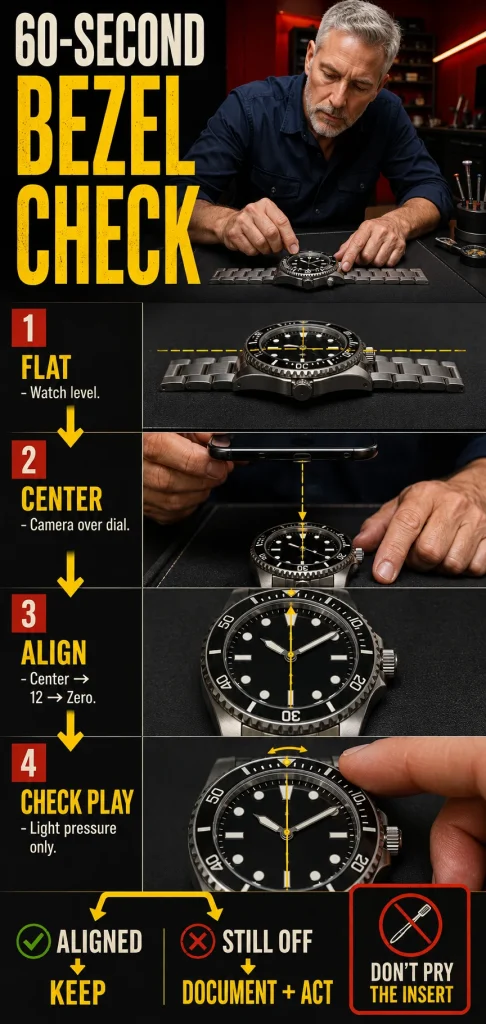
You can usually determine whether the problem deserves further action without disassembling anything.
Check 1 – Center the Watch
Lay the watch flat and establish a visual line from the hand stack through the 12 o’clock dial marker. Avoid judging alignment while the watch is on your wrist because the case will naturally tilt.
Check 2 – Set the Nearest Bezel Position
Move the rotating bezel normally to the closest intended alignment position. For a one-way dive bezel, rotate only in its designed direction rather than trying to force it backward.
Check 3 – Photograph Straight Down
Take a centered photograph with the entire dial and bezel visible. If moving the camera slightly changes the apparent offset dramatically, perspective is contributing to the problem.
Check 4 – Compare More Than One Reference
Look at the zero marker, several bezel graduations, the dial’s 12 o’clock marker and the case centerline. One isolated visual mismatch points toward a different component than an entire scale that appears consistently rotated.
Check 5 – Check Play Gently
With the bezel sitting in its normal indexed position, apply only very light pressure in each rotational direction. You are checking whether the visible marker wanders noticeably, not trying to overpower the click mechanism.
Check 6 – Decide Before Modifying
If the watch is new, stop here. Save the photographs and decide whether the misalignment is enough to justify a return or warranty discussion before allowing anyone to remove the insert or bezel.
Should a Bezel Align Perfectly at 12?
There is no useful universal answer such as “every bezel may legally be off by X amount.” Manufacturing specifications vary, and public owner manuals usually explain the function of the bezel rather than disclose visual assembly tolerances.
The more practical test is whether the bezel can be positioned consistently for its intended use and whether the visual result is acceptable for a new watch at the price and quality level you purchased. If its zero marker clearly falls between usable positions or a visible defect bothers you immediately, there is little advantage in convincing yourself that you will stop noticing it later.
A current Orient owner returned one example and then encountered the same alignment concern on another, while an Omega owner recently asked whether a visible offset warranted warranty service. Those discussions illustrate why this is a purchase decision, not merely an abstract debate over manufacturing precision.
New Watch: Return or Repair?
If you are still inside a straightforward return or exchange period, exchange is usually the cleaner first option for an obvious cosmetic assembly issue. Opening or modifying a new watch creates unnecessary complexity when another untouched example may solve the problem immediately.
This is particularly true when you bought online and have not resized, scratched or modified the watch. Photograph the defect before contacting the seller, explain that the bezel reference cannot be aligned correctly from a straight-on position, and ask what return or warranty route applies to that transaction.
Return policies differ by seller and jurisdiction, so do not rely on a generic internet rule about how much misalignment must be accepted. Your purchase terms and the manufacturer’s warranty determine the formal remedy.
What If the Watch Is Already Out of the Return Window?
The repair depends on which layer is actually wrong. A shifted insert may be corrected differently from a bezel whose indexing mechanism has excessive play, and neither repair is the same as rotating a dial or chapter ring.
A watchmaker may need to inspect:
- bezel insert position;
- bezel carrier;
- click spring or indexing components;
- retaining ring;
- contamination underneath the bezel;
- case damage after impact;
- dial or chapter-ring alignment.
A competent inspection is preferable to assuming that every visible offset can be solved by simply prying up the insert and gluing it back down.
Be Especially Careful With Ceramic Inserts
Ceramic bezel inserts combine high scratch resistance with brittleness compared with flexible metal inserts. A repair that requires lifting or removing the insert should therefore be approached differently from casually repositioning an inexpensive aluminum part.
For a new watch, there is little reason to take that risk yourself. Preserve the return or warranty route rather than turning a small visual defect into a cracked insert, scratched bezel or damaged gasket.
What If the Bezel Became Misaligned After an Impact?
A new misalignment following a knock deserves inspection because the cause may no longer be simple factory positioning. The insert can move, the bezel assembly can be damaged or other case components can shift enough to change how the bezel sits.
Check whether the bezel now feels different as well as looking different. New looseness, uneven resistance, scraping, unusual vertical movement or loss of positive indexing makes professional inspection more important.
Do not try to hammer, press or bend the bezel back into place while it remains on the watch. The crystal and case sit immediately beside the component you are trying to move.
What If It Came Back Misaligned After Service?
Document the watch before and after service whenever alignment matters to you. Current owner discussions include watches returned from service with a new bezel or date-alignment concern, showing why a post-service visual inspection is worthwhile before leaving the retailer or accepting shipped work.
If the misalignment appeared only after service, contact the service provider before another shop opens the watch. The original provider needs the opportunity to inspect work that may fall within its service warranty.
Bezel Misalignment vs Backplay
These are related but different problems.
| Problem | What you observe | Diagnostic clue |
|---|---|---|
| Fixed visual misalignment | Marker remains in the same wrong position | Likely insert/index/component alignment issue |
| Backplay | Marker shifts within one indexed position | Light finger pressure changes visible alignment |
| Parallax | Offset changes with camera or eye position | Centered photograph largely removes it |
| Dial/chapter-ring error | Bezel is consistent but several inner markers are rotated | Other dial references disagree with the case centerline |
Does Slight Misalignment Affect Dive-Bezel Safety?
The safety design of a conventional diver’s bezel is mainly about direction and elapsed-time indication. Seiko and Citizen explain that their dive bezels rotate counterclockwise so accidental movement cannot indicate less elapsed time than has actually passed.
A tiny visual offset is therefore not automatically equivalent to a failed safety mechanism. However, if the zero marker cannot be placed reliably where you need it, the bezel is loose, indexing is inconsistent or you intend to depend on the watch for actual diving, have the watch checked rather than treating an internet photograph as a functional inspection.
Not Every Watch Uses the Same Bezel System
Some watches use fixed tachymeter or 24-hour scales, while others use external rotating dive bezels or crown-controlled internal rotating bezels. Longines, for example, describes the Legend Diver’s internal bezel as being placed inside the case partly to protect it from accidental manipulation and shock.
That means the troubleshooting method must match the design. A fixed bezel that looks rotated involves a different assembly question from a clicking external diver’s bezel, while an internal rotating bezel introduces its own crown and locking mechanism.
If you are still learning which designs perform which jobs, the ExpertsGuys guide to different types of watches provides the broader context before you diagnose an individual component.
When to Keep It, Return It or Service It
Keep it when the apparent offset disappears from a proper straight-on view, the bezel operates consistently and you genuinely do not see a defect during normal use.
Return or exchange it when the watch is new, the alignment problem is obvious and repeatable, and you are still entitled to a straightforward return. There is little value in opening a brand-new watch to repair something another example may not have.
Use warranty service when the return window has closed but the watch remains covered and the defect is clear enough to warrant inspection.
Use an independent watchmaker when the watch is older, outside warranty or has been modified, and you specifically need the bezel insert, click mechanism or related case hardware inspected.
Do not DIY first when the watch is valuable, the insert is ceramic, the failure appeared after impact or you do not yet know which component is actually misaligned.
Frequently Asked Questions
Is slight bezel misalignment normal?
Small visual differences can occur between watches, but first rule out camera angle and parallax before deciding that the bezel is mechanically misaligned. There is no useful universal visible tolerance that applies to every manufacturer and bezel design. If a new watch is clearly and consistently off from a centered view and the defect bothers you, use the seller’s return or warranty process rather than assuming you have to accept it.
How can I tell if bezel misalignment is just parallax?
Place the watch flat and photograph it directly above the center of the dial with the entire bezel visible. If the apparent offset changes significantly as the camera moves left, right or closer to the crystal, viewing geometry is contributing to what you see. A genuine fixed alignment problem should remain visible in a properly centered view.
Why does my bezel marker sit between two clicks?
The visible alignment point may not correspond perfectly with the available mechanical indexing positions, or the bezel insert itself may be positioned slightly off within the rotating carrier. Compare both neighboring positions from directly above and check whether light rotational play changes the result. A new watch with a repeatable visible problem is better returned or inspected than disassembled at home.
Can a misaligned bezel insert be realigned?
In many bezel designs the insert is a separate component, so repositioning or replacement may be possible. The exact procedure depends on the watch, insert material and attachment method. Ceramic inserts and new watches are poor candidates for casual DIY experimentation because damage can turn a minor alignment issue into a much more expensive repair.
Should I return a new watch with a misaligned bezel?
If the misalignment is clear from a controlled straight-on view, bothers you and you are still within a straightforward return or exchange period, returning or exchanging the watch is usually cleaner than repairing a brand-new example. Document the problem before resizing or modifying the watch. Return rights and warranty coverage depend on the seller, manufacturer and location.
Is bezel backplay the same as bezel misalignment?
No. Misalignment describes the reference marker consistently sitting in the wrong visual position, while backplay means the bezel can move within or around an indexed position. A bezel can have one problem, both problems or neither. Check them separately because their repairs may involve different components.
Action Checklist
- Put the watch on a flat surface.
- Inspect it directly from above.
- Take a centered photograph before judging the alignment.
- Set the bezel to the nearest intended position using its normal direction of travel.
- Draw an imaginary or digital line through the hand stack and 12 o’clock marker.
- Compare more than one bezel and dial reference.
- Determine whether the offset changes with viewing angle.
- Check light rotational play without forcing a one-way bezel backward.
- Decide whether the insert, indexing or inner dial reference appears to be the actual problem.
- Photograph the issue before contacting a seller.
- Prefer return or exchange before repair on a brand-new watch when possible.
- Do not pry out a ceramic insert simply to experiment.
- Have new looseness, scraping or post-impact alignment changes professionally inspected.
- Check a serviced watch before accepting it back.
- For actual diving, do not rely on a bezel whose indexing or retention is questionable.