

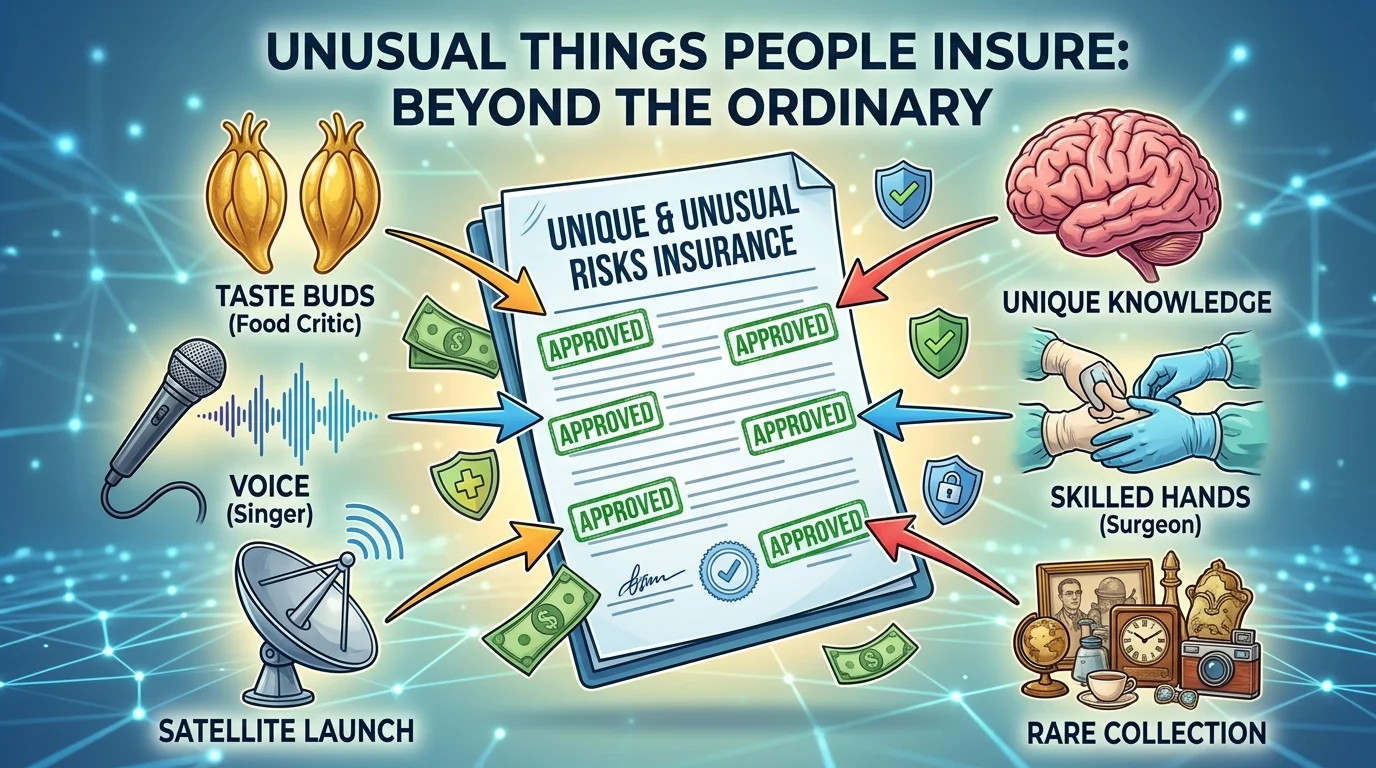

People can insure surprisingly unusual things, from a performer’s earning ability and a golf tournament’s hole-in-one prize to satellites, rare collections, and kidnapping or extortion exposures. The key is not how strange the subject sounds; insurers need a legitimate financial interest, a definable loss, an uncertain event, and policy wording that makes the claim trigger provable.
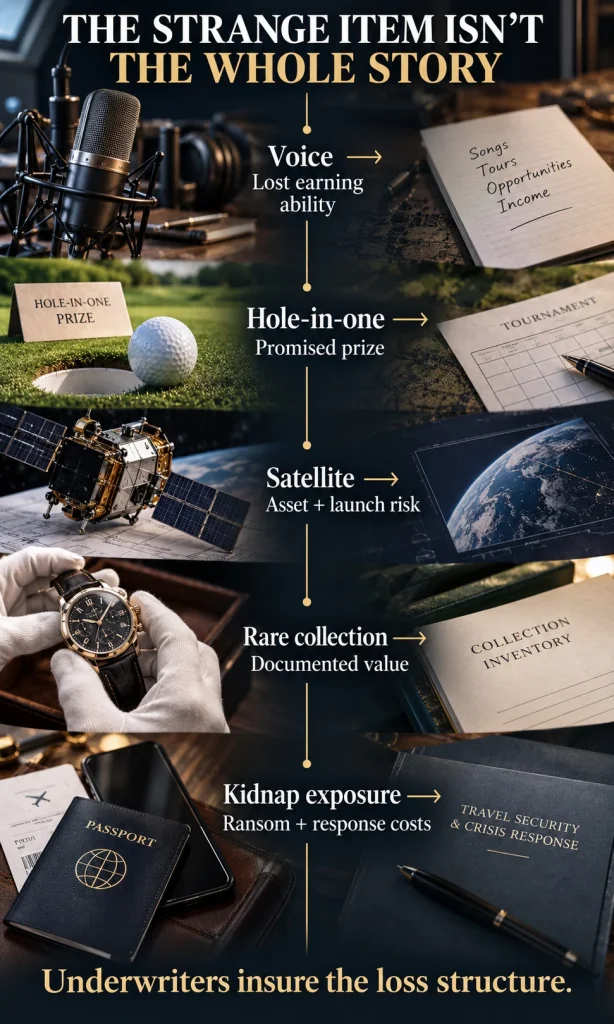
That distinction matters because many famous “weird insurance” stories blur the line between publicity and real risk transfer. A specialty underwriter is usually protecting the financial consequence of something going wrong, not assigning a magical cash value to an odd object simply because it is interesting.
What actually makes an unusual risk insurable?
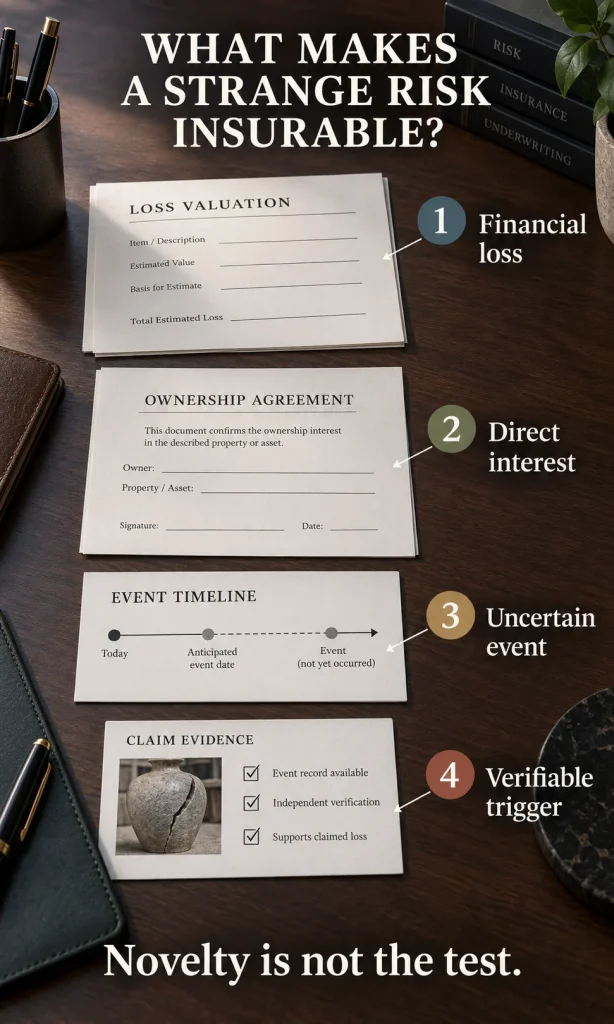
Specialty insurance starts with the same basic logic as ordinary insurance. The buyer has something real to lose, the loss is not already certain, the event can be described in a contract, and an underwriter can price the exposure with enough confidence to offer terms.
| Unusual example | What is really at risk | Typical specialty route |
|---|---|---|
| A singer’s voice or an athlete’s legs | Income, contractual obligations, or career value after disability or loss of use | Personal accident, disability, contingency, or bespoke specialty cover |
| A car offered for a hole-in-one | The sponsor’s obligation to fund the promised prize | Prize indemnity |
| A satellite launch | Physical asset value, launch failure, in-orbit failure, liability, or lost revenue | Space insurance |
| A rare collection | Documented replacement, restoration, transit, theft, or damage exposure | Fine art, specie, scheduled valuables, or specialty property |
That is why the Lloyd’s market lists specialty classes ranging from fine art and bloodstock to space, contingency, terrorism, and other complex risks. Lloyd’s itself is a marketplace rather than a single insurer, so individual policies are underwritten by insurers and syndicates operating in that market.
UNUSUAL INSURANCE, MADE PRACTICAL
Odd Risk
Reality Check
See whether an unusual risk has the basic features insurers need before you call a specialty broker.

11 unusual things people insure
1. A performer’s voice, hands, legs, or other career-critical ability
“Body-part insurance” is the headline-friendly label, but the commercial logic is usually much less bizarre. If a singer, athlete, surgeon, model, or other professional depends on a particular physical capability to earn income, a serious injury can create a measurable financial loss tied to disability, lost appearances, cancelled contracts, or reduced earning ability.
The wording matters more than the body part. A buyer needs to know what counts as loss of use, how long the impairment must last, which medical evidence is required, what pre-existing conditions are excluded, and whether the payout is a fixed benefit or reimbursement of an actual loss.
2. Hole-in-one prizes and other improbable promotions
A tournament sponsor may want to promise a car, cash award, or another large prize without keeping the full value of that prize in reserve. Prize-indemnity insurance transfers the payout risk to an insurer if a contestant wins under the stated rules.
This is an established contingency product rather than a novelty policy. Tokio Marine HCC describes prize indemnity for promotions including hole-in-one contests, sports predictors, and other defined prize events. Underwriting can depend on the prize value, number of attempts, participant skill, distance, event rules, and independent verification.
3. Kidnap, ransom, and extortion exposure
Businesses with executives, employees, or family members exposed to kidnapping, extortion, wrongful detention, or related threats may buy specialist coverage that combines financial protection with crisis-response services. The risk sounds dramatic, but the loss is concrete: ransom or extortion payments, response expenses, legal liability, business interruption, and expert negotiation costs can be substantial.
Chubb’s kidnap, ransom and extortion coverage, for example, describes protection for covered kidnapping, extortion, wrongful detention, disappearance, hijacking, and hostage-crisis events, subject to policy terms and applicable law.
4. Satellites before launch, during launch, and in orbit
Space insurance is a clear example of an extraordinary object being handled with ordinary insurance principles. A satellite has an identifiable value, a known operating purpose, distinct phases of risk, engineering data, testing history, and specific failure modes that underwriters can study.
The Lloyd’s space market describes cover across manufacturing, pre-launch, launch, in-orbit testing, and commercial operation. Policies can also address third-party liability or revenue loss depending on the structure of the risk.
5. Fine art, rare watches, wine, antiques, and unusual collections
A collection may sit inside a home, but a standard homeowners policy can be a poor fit when individual items have high values, fragile materials, unusual transit exposure, changing market values, or specialist restoration needs. Specialty property or fine-art coverage can use scheduled values, appraisals, security requirements, storage conditions, and transit terms that match the actual collection.
The practical lesson is simple: the stranger or more concentrated the value, the more important documentation becomes. Photographs, appraisals, serial numbers, provenance records, purchase documents, security controls, and storage information can determine whether underwriting and claims work smoothly.
6. Racehorses, breeding stock, and other high-value animals
Bloodstock and livestock insurance may cover mortality, theft, transit, infertility, surgery, or other defined losses depending on the animal, use, and jurisdiction. A high-value racehorse is not insured because it is unusual; it is insured because ownership, valuation, health history, and the financial consequences of loss can be documented.
Underwriters may require veterinary examinations, identification records, usage details, travel information, and strict care conditions. The policy can become very specific because a breeding animal, competition animal, and ordinary pet create different financial exposures.
7. Event cancellation and non-appearance
A concert, conference, wedding, sporting event, or production can create large non-refundable costs before anyone arrives. Contingency insurance can be structured around cancellation, abandonment, postponement, or a key person’s non-appearance when those events cause documented financial loss.
This is where an apparently odd policy becomes straightforward business protection. The insured is not “betting” on a celebrity failing to show up; the buyer is protecting committed expenses or revenue that depends on the event proceeding.
8. Weather-sensitive promotions and events
Weather risk can be insured in several ways. Traditional event-cancellation wording may respond when covered weather makes an event impossible, while parametric or promotional structures can pay when a measurable trigger such as rainfall, temperature, snowfall, or another agreed index crosses the policy threshold.
These policies depend heavily on the data source and trigger definition. “Bad weather” is too vague; a contract needs to say which measurement station or dataset counts, the observation period, the threshold, and what payout follows.
9. A celebrity endorsement campaign
Brands sometimes spend heavily on advertising tied to a public figure. Specialty contingency coverage can be written around death, disability, non-appearance, or certain reputation-related events when those events cause an insured financial loss for the campaign owner.
The underwriting challenge is separating a real loss from subjective disappointment. A well-constructed policy therefore needs precise wording around the covered event, campaign costs, timing, exclusions, and evidence of loss.
10. Prototypes and one-off technology
A company testing a unique prototype may have a risk that does not fit neatly into a standard property form. The asset may be irreplaceable, difficult to value, exposed during testing, or dependent on a narrow set of components and contractors.
Specialty markets can sometimes build coverage around physical damage, transit, testing, liability, or business interruption, but underwriters will want engineering detail. “It is worth a lot” is not enough; the buyer needs to show how value was calculated and what failure scenarios the policy is expected to address.
11. Intellectual property, cyber incidents, and other intangible losses
Not every unusual insured interest is a physical thing. Cyber, technology errors, intellectual-property disputes, data incidents, media liability, and other intangible risks can be insured when the policy defines the covered event and resulting loss clearly enough.
This is a useful reminder that insurance is fundamentally about financial consequences. The object can be a server, an event, a contractual promise, a person’s earning ability, or a satellite; the underwriter still asks how a loss happens, how it is measured, and how a claim can be proved.
What usually cannot be insured?
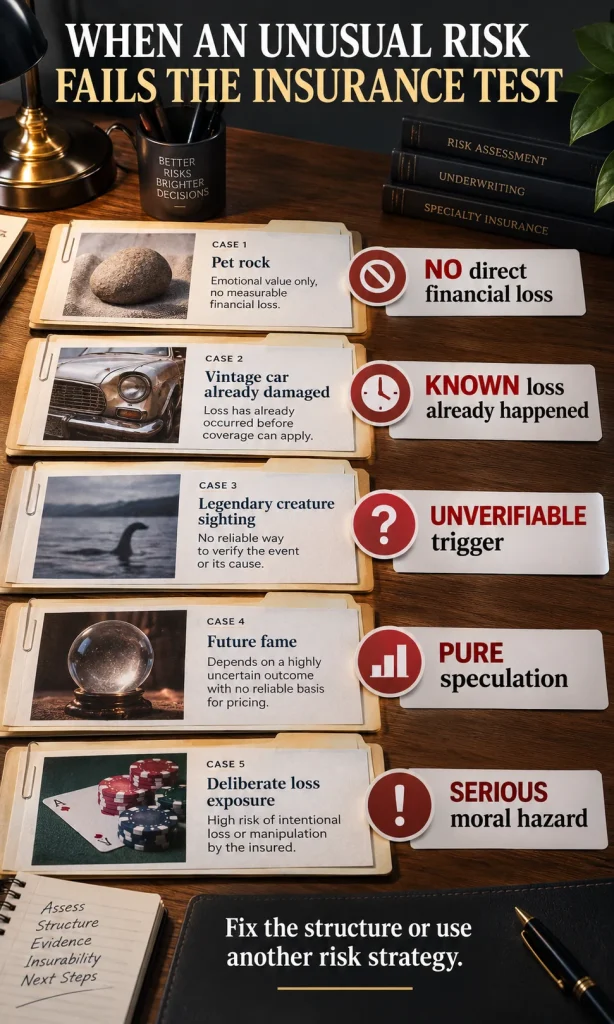
Specialty markets are flexible, but they are not unlimited. A strange idea becomes difficult or impossible to insure when the basic structure of risk transfer breaks down.
- No insurable interest: you would not actually lose money or incur a legal obligation if the event happened.
- The loss has already happened: insurance is generally designed for uncertain future events rather than known losses.
- The trigger cannot be verified: a claim based only on an unverifiable story is difficult to price, police, and settle.
- The arrangement is mainly a wager: a payout designed around pure speculation rather than indemnifying a legitimate loss may not qualify as insurance.
- The purpose is unlawful or against public policy: legality and enforceability depend on jurisdiction and policy wording.
- The buyer can easily cause the loss: severe moral hazard can make an exposure uninsurable or lead to strict exclusions and controls.
How specialty underwriters decide whether to quote
Unusual underwriting is less about finding a list of “allowed weird things” and more about turning the exposure into a contract that both sides can understand. The broker and underwriter need enough structure to answer six questions.
- What exactly is the financial loss? Replacement cost, lost income, promised prize, contractual liability, restoration cost, business interruption, or another measurable amount.
- Who bears that loss? The policyholder needs a legitimate interest in the person, property, event, or obligation.
- What triggers payment? Injury, cancellation, a verified contest win, physical damage, launch failure, theft, weather threshold, or another defined event.
- How is value proved? Appraisals, contracts, invoices, medical evidence, engineering data, revenue history, or another credible valuation method.
- What controls reduce the chance of loss? Security, maintenance, safety procedures, witnesses, storage, medical checks, testing, or operating rules.
- What must be excluded? Known defects, intentional acts, pre-existing conditions, prohibited conduct, unapproved uses, or other exposures the insurer cannot price responsibly.
When unusual insurance is worth considering
Specialty coverage makes the most sense when one unusual exposure could create a loss large enough to hurt the buyer’s finances, operations, or contractual commitments. The premium is buying balance-sheet protection, not novelty value.
Before asking for a bespoke policy, compare the gap with your existing insurance. A rider, scheduled item, higher sublimit, event extension, disability policy, or commercial endorsement may solve the problem more simply. If you need a wider grounding in ordinary protection first, see our guide to common insurance types and benefits.
How to shop for an unusual policy without getting distracted by the story
Start with the financial exposure, not the headline. A specialty broker can place a much better submission when the buyer explains the maximum loss, trigger, value, controls, and evidence rather than simply asking, “Can I insure this weird thing?”
| Before you request a quote | What to prepare |
|---|---|
| Define the loss | A realistic maximum amount and how you calculated it |
| Define the trigger | The exact event that should create a valid claim |
| Show your interest | Ownership, contract, income dependency, or other financial stake |
| Show the evidence | Appraisals, engineering reports, contracts, medical records, rules, or loss history as appropriate |
| Read the exclusions | Confirm the policy still responds to the scenario you are actually worried about |
For a genuinely unusual placement, ask the broker for specimen wording or a clear summary of coverage before relying on a quote. Confirm who the insurer is, how claims are reported, what evidence is required, which jurisdiction governs the policy, and whether the insured value is fixed, scheduled, agreed, or subject to proof at claim time.
Frequently Asked Questions
Can almost anything be insured?
No. Specialty insurers can be creative, but a workable policy still needs a legitimate insured interest, a definable financial loss, an uncertain event, lawful purpose, and claim terms that can be verified and enforced.
Is celebrity body-part insurance real?
Specialty markets do insure career-critical physical abilities and have a long history of unusual personal-accident and contingency risks. The useful question is not the celebrity headline but what financial loss, impairment, benefit, exclusions, and medical evidence the actual policy defines.
How does hole-in-one insurance work?
The tournament organizer or sponsor pays a premium so an insurer takes on the financial obligation of a covered prize if a qualifying contestant wins. The policy normally specifies the prize, hole, distance, player eligibility, number of attempts, witness requirements, and claim evidence.
Can you insure a satellite?
Yes. Space insurance can cover different phases such as manufacturing, pre-launch, launch, testing, and in-orbit operation, depending on the policy. Operators may also need liability or revenue-protection structures for specific exposures.
Why would an insurer cover something unusual?
Because novelty does not automatically make a risk uninsurable. If the exposure can be valued, the trigger can be defined, the buyer has a real financial interest, and the insurer can price the chance and severity of loss, a specialty policy may be possible.
Do I need a specialty broker?
Often, yes, when standard insurers or agents do not have a product that fits the exposure. A specialty broker can help turn the unusual risk into an underwriting submission and approach markets with the relevant appetite, subject to local licensing and availability.
What is the biggest mistake when buying unusual insurance?
Focusing on the headline instead of the wording. The insured should verify the exact trigger, exclusions, valuation method, evidence requirements, policy limit, deductible or retention, claims process, and whether the policy addresses the loss that actually matters.
The practical takeaway
Unusual insurance is not proof that “anything can be insured.” It shows how flexible insurance becomes when a strange exposure can be translated into a legitimate financial interest, a measurable loss, a verifiable trigger, and clear contract terms.
If the risk is real but standard insurance does not fit, define the loss before looking for a specialty market. That one step makes it easier to separate a serious coverage problem from a publicity story, a speculative bet, or a risk that is better handled outside insurance.