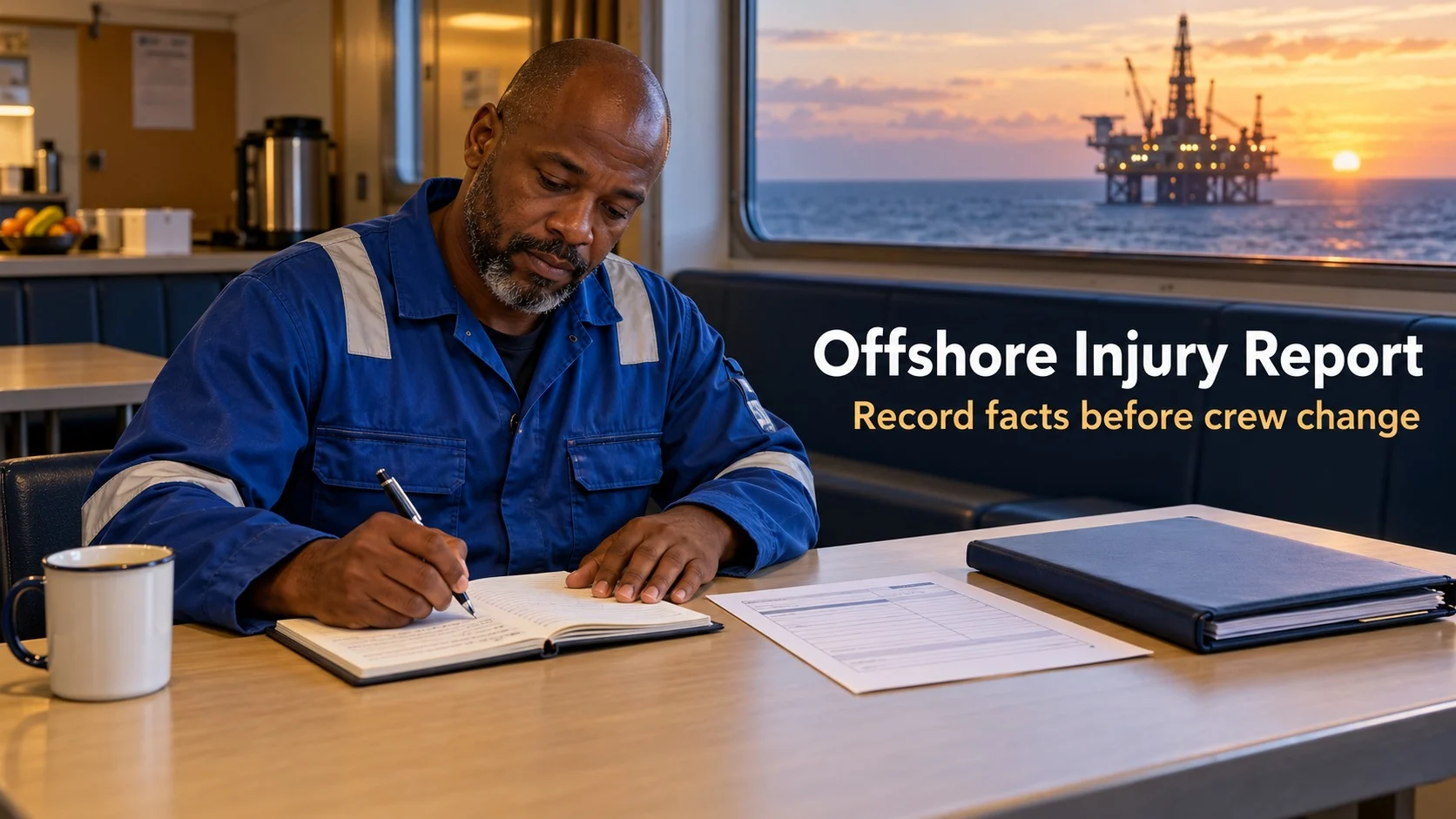
What is the most important thing you need to do?
Of course, write the date, time, location, task, what happened, symptoms, and witness details in an offshore injury report, separating what you observed from anything you cannot confirm. Get urgent medical care first, and seek independent maritime legal advice if the paperwork includes a release or you are unsure what your signature means. Keep your own dated note and a copy of the company form before crew change makes the record harder to reconstruct.
This is an educational recordkeeping guide for U.S. offshore work, including the Gulf of Mexico. ExpertsGuys is not a law firm, and this page is not legal advice or a decision about whether you should sign. It cannot identify your governing law, confirm a filing deadline, or determine whether you have a claim.
What to write on an offshore injury report before you sign it
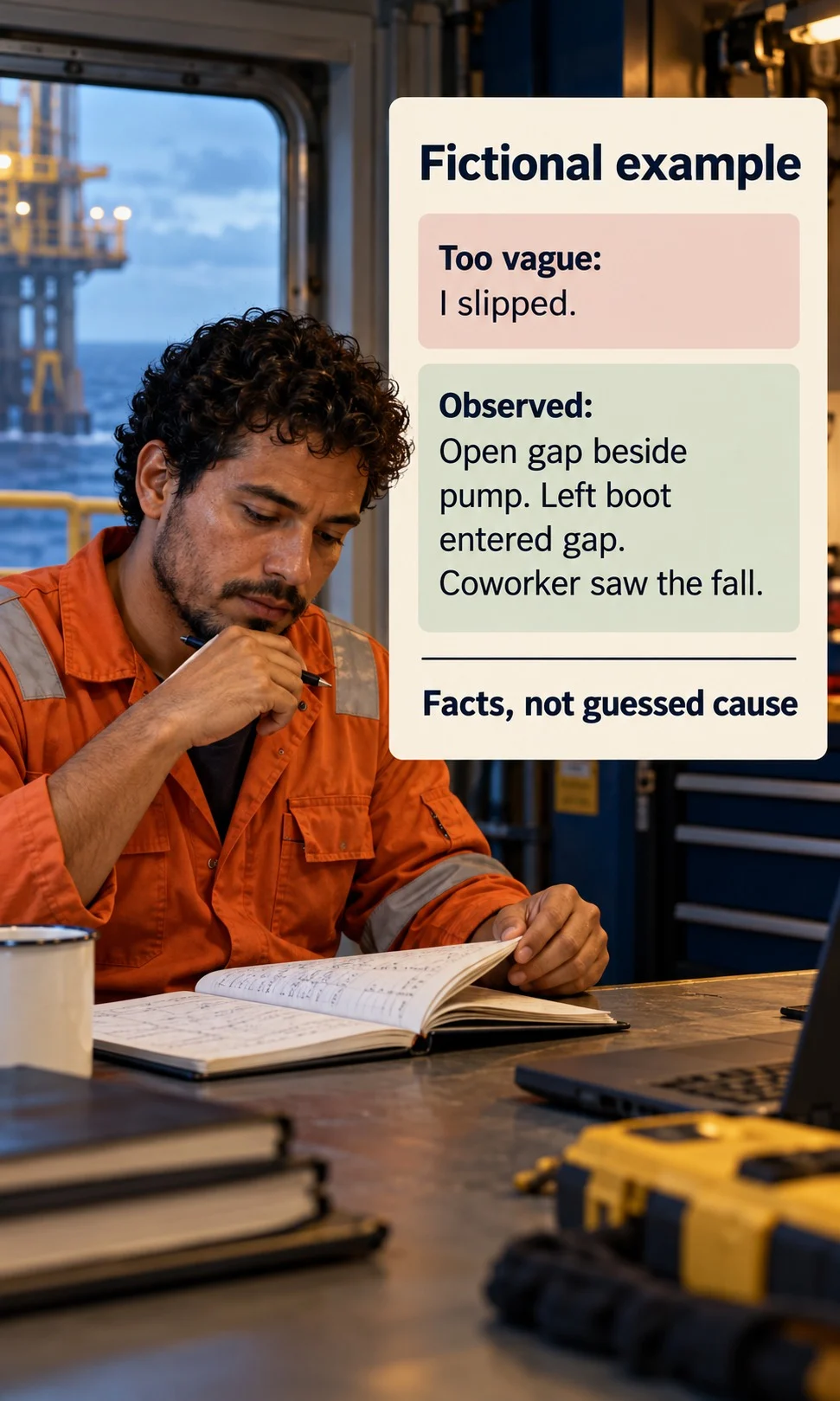
A useful report lets someone who was not there understand the sequence. “Slipped on deck” says very little about the task, the deck area, or the condition you actually saw. Record those details while keeping uncertain points expressly uncertain; a report is an account of events, not a verdict about fault.
- When: incident date, approximate or exact time, time zone, shift, and hitch day if known.
- Where: vessel or structure name, work area, and operating condition you personally know.
- What: task, equipment, sequence, observed conditions, and symptoms noticed at the time.
- Who: people who saw the event, people told afterward, and who took the report.
- Record trail: when you reported it, who received it, and whether you received the completed form.
The company form and your own note are not the same record
The company incident form belongs to the employer’s reporting process. Your own dated note preserves your recollection, including details that did not fit the form, while medical records document assessment and treatment. Keep all three; none automatically replaces a formal notice or claim required under the law that applies to you.
A family member can help organize dates and documents when the worker is unable to do so. Identify who wrote the note and distinguish the worker’s account from the helper’s observations. Do not make the helper’s words look like something the worker personally witnessed or signed.
Write these fields before crew change
Use clear descriptions rather than filling a box with a guess. If the exact time is uncertain, an approximate time plus the shift and sequence is more useful than an invented minute. Record the note’s creation date separately from the incident date, especially if you are writing after leaving the vessel.
| Field | Details to record |
|---|---|
| Date, time, and hitch | Incident date; clock time and zone if known; whether approximate; shift and day of hitch. |
| Vessel or structure | Name, structure type, work area, and whether underway, alongside, moored, or jacked up, if known. |
| Employer and task | Employer, job role, assigned task, and the equipment or item being handled. |
| Observed conditions | Lighting, weather, surface condition, guards, grating, and motion you actually noticed. |
| Event and symptoms | Sequence of events; body areas affected; symptoms noticed then; later symptoms in a separately dated addition. |
| Witnesses | Who saw which part; role or employer if known; contact details already lawfully available to you. |
| Notification and treatment | Who was told, when and how; first aid or clinic visit; copies of instructions and restrictions. |
| Document trail | Who wrote or took the statement; pages or attachments; when a copy was requested and received. |
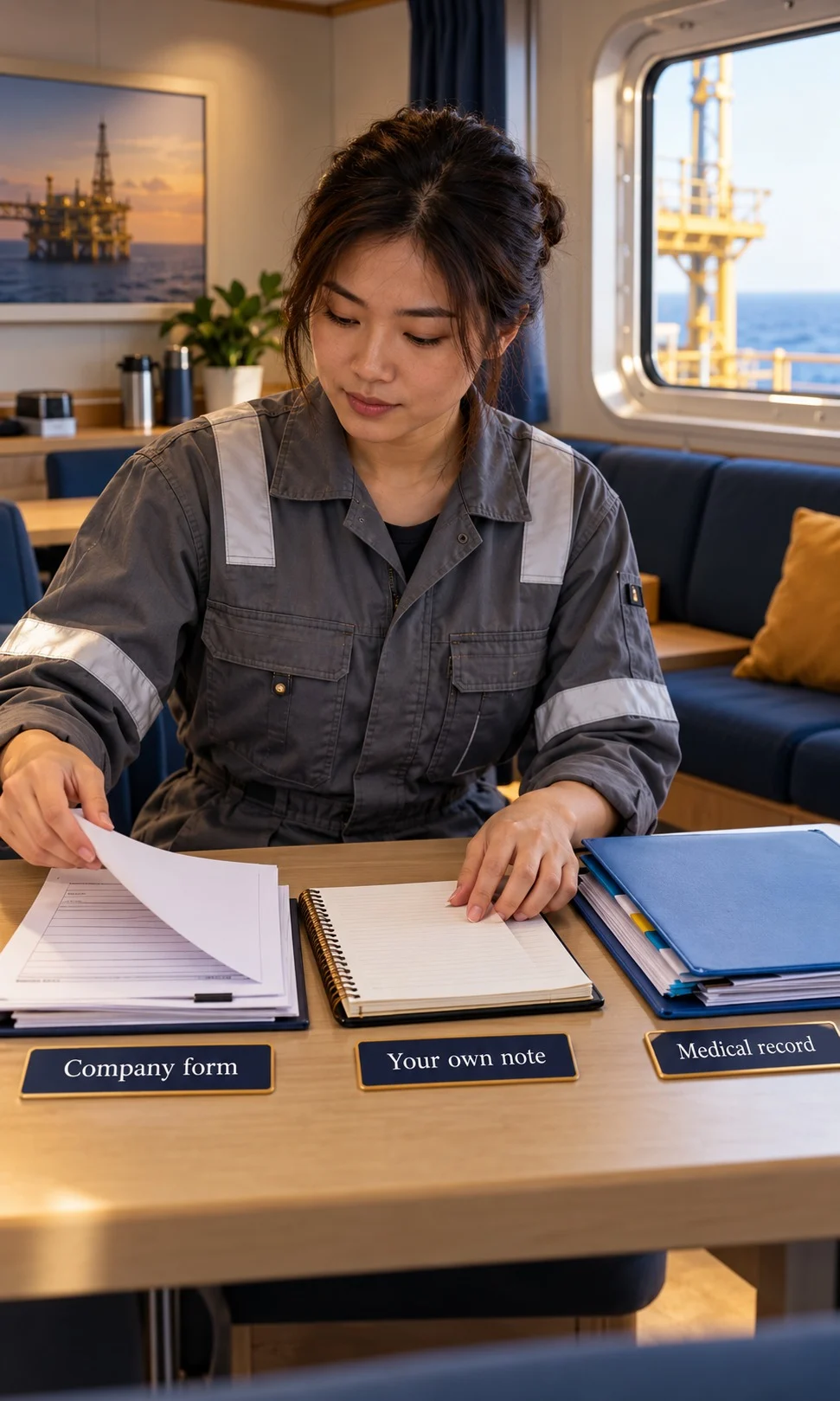
Witness identification matters because a person may leave the hitch that evening. Ask how they can be contacted and note what they actually saw, without telling them what to say. If you do not have their name, record their role, employer, shift, and location, then let the uncertainty remain visible.
Structure type is a fact, not a legal conclusion
Write “jack-up,” “fixed platform,” “drillship,” or another description you know to be accurate, and add the structure’s name. Record whether it was moving or jacked up if you know; do not convert that description into “I am a Jones Act seaman.” The Jones Act concerns qualifying seamen injured in the course of employment, and the status question needs more than a workplace label.
In Chandris, Inc. v. Latsis, the Supreme Court explained that duties must contribute to a vessel’s function or mission and that the vessel connection must be substantial in duration and nature. Its roughly 30% duration guideline is not a universal eligibility switch. Preserve assignment and work-history records rather than using a percentage to announce a legal result.
A stationary structure is not automatically excluded from vessel status, as Stewart v. Dutra Construction Co. illustrates. Conversely, floating alone does not settle the question; Lozman v. City of Riviera Beach examined physical characteristics and practical transportation design. This is why the report should preserve observable facts and leave classification to qualified advice.
What not to write in the narrative line
Avoid guessed causes, blanket fault admissions, and medical conclusions you cannot support. That does not mean withholding facts: describe your actions honestly, including anything relevant to the sequence. “I do not know why the panel was absent” is clearer than inventing who removed it or why.
Symptoms also need a time reference. If you noticed soreness but had not yet been examined, record that rather than treating “I’m fine” as a diagnosis. If symptoms emerge later, make a separately dated addition describing when you first noticed them; do not rewrite the earlier account to imply you knew them at the time.
| Record | Example |
|---|---|
| Vague company-form line | “Slipped.” This does not identify the work area, condition, sequence, or witness. |
| Separate personal note | Fictional example: 5 October 2026, about 18:20 CDT, day 9 of the hitch, on the fictional Bay Example jack-up, jacked up. While walking to the pump station, my left boot entered an open gap in the grating beside the pump. I fell onto my left knee. I noticed the gap after the fall; I do not know when it appeared. |
| Witness and reporting trail | Witness name redacted: coworker standing by the pump saw the fall and was due to crew-change that night. Supervisor name redacted: told at about 18:30. Copy of company form requested; not yet received. |
| Medical record kept separately | Knee pain reported to the medic that evening. Any examination findings, diagnosis, or restrictions belong in the clinical record, with the visit date. |
This example is fictional and has no client, employer, or case result behind it. The difference is the specificity of the record, not a suggestion that the longer account proves negligence. Use only details that match your own knowledge, and mark information learned from another person as such.
Organize your own note with Offshore Record Studio
Offshore Record Studio provides a separate personal-note draft and a consultation checklist. It highlights empty fields and document concerns, without deciding fault, seaman status, benefits, or deadlines. Download the TXT record before leaving the page; the experience does not save it automatically or submit anything to an employer or government agency.
Ask for a copy, then preserve the whole page
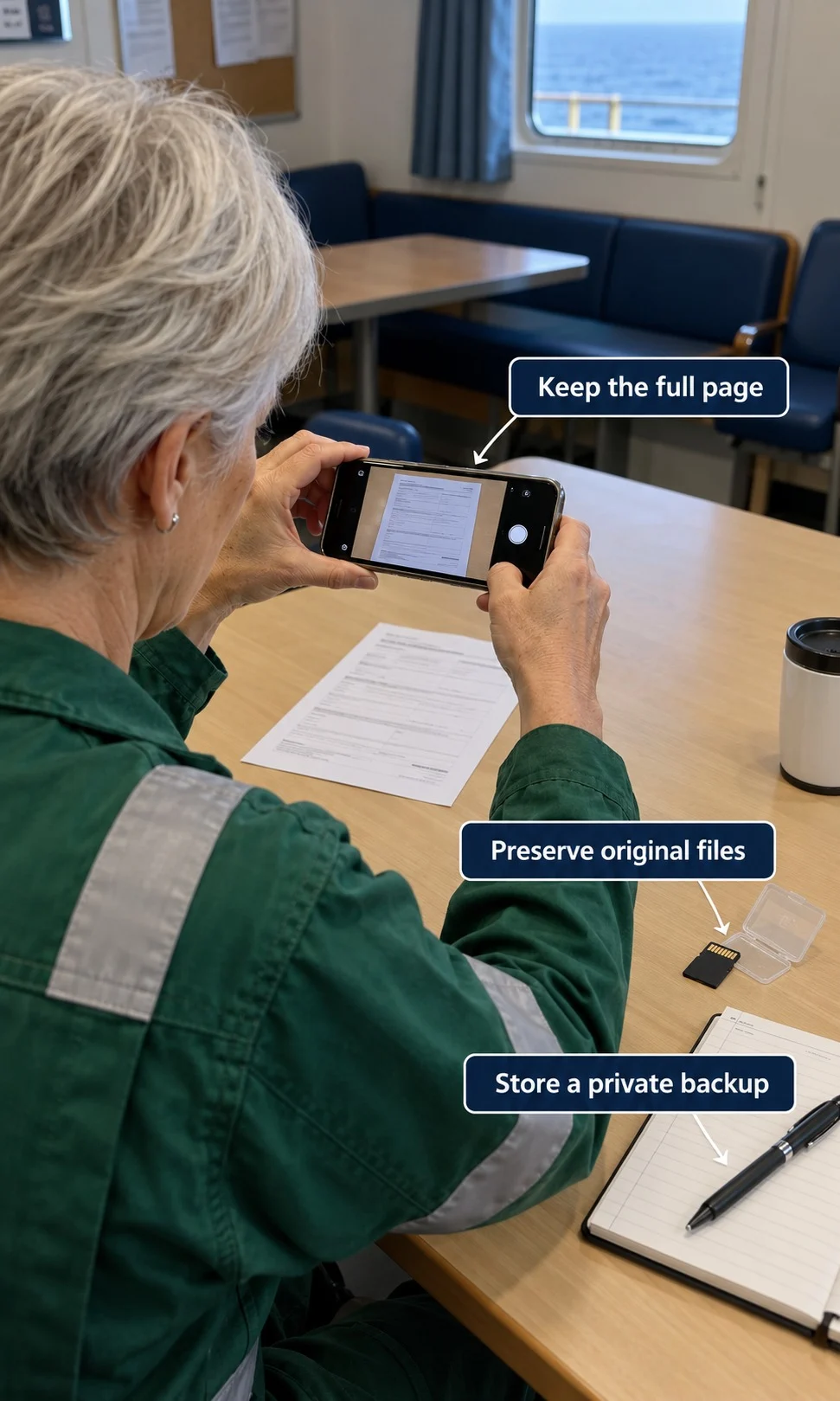
Ask for a completed copy that includes every page and attachment. Where photographing the document is permitted and safe, capture the full page so the surrounding wording, date, and signature area remain readable. If copying is refused, note who refused, when, and what document was involved rather than describing a copy as received.
Keep original photo files and messages alongside a private backup. Do not alter the only copy, strip useful file information, or overwrite an earlier note when adding new details. Phones and cameras may be restricted in hazardous offshore areas, so record an inaccessible scene in words and ask a lawyer about obtaining other evidence; do not enter a restricted area to collect it.
The company doctor’s note does not close the incident record
The incident form records what happened; a clinician’s note addresses health findings at a particular visit. Keep the visit date, provider, written restrictions, referrals, and instructions separately. New symptoms or changed findings should be documented at their actual later dates rather than folded into the first account.
Maximum medical improvement or maximum cure does not necessarily mean full recovery or fitness for the previous job. Farrell v. United States addresses the maintenance-and-cure endpoint even where disability remains. A disputed cutoff requires review of the medical evidence and applicable law; the company form does not decide it.
If maintenance-and-cure payments stop, preserve the notice, stated reason, payment history, and medical correspondence. Vaughan v. Atkinson concerns consequences of a shipowner’s failure to meet its obligation in that case. It is not a promise that your circumstances produce damages, fees, or continued benefits.
Deadlines to ask a lawyer about, not to calculate here
An employer’s reporting policy, a statutory injury notice, and a lawsuit deadline serve different purposes. A company form does not automatically satisfy every required notice or claim, and sending it does not necessarily stop a filing clock. Record the incident, awareness, reporting, and payment dates so a maritime lawyer can assess the relevant requirements promptly.
| Issue | Primary-source orientation |
|---|---|
| Maritime tort lawsuit | 46 U.S.C. § 30106 generally provides three years after the cause of action arose, except as otherwise provided by law. This is not a personal deadline calculation. |
| Longshore injury notice | 33 U.S.C. § 912 generally requires notice within 30 days, with awareness rules and exceptions. Applicability and whether notice was effective need individual review. |
| Longshore compensation claim | Notice and claim filing are separate. 33 U.S.C. § 913 generally provides one year, with awareness and payment-related qualifications; some occupational disease claims have a two-year rule. |
| Operator reporting | BSEE reporting duties are the operator’s regulatory obligations. They do not replace the worker’s personal notices, claim filing, or legal advice. |
Read the maritime tort limitations statute and the Longshore notice statute as starting points, not permission to wait. The Department of Labor’s Longshore guidance separates injury notice from claim filing and describes qualifications. Government-vessel claims, occupational disease, delayed awareness, and coverage disputes may require different analysis.
There is no seven-day Jones Act reporting statute in the cited Jones Act provisions. That does not eliminate employer reporting policies or the need to notify the appropriate person promptly. If reporting was delayed, preserve an honest chronology and seek advice rather than assuming either that the claim is lost or that nothing is affected.
BSEE’s incident-reporting explanation describes operator duties for specified offshore events, including certain injuries requiring evacuation. An operator’s regulator report is a different process from your own account and any personal notice or claim. Save what you have, but do not assume someone else’s filing completed your obligations.
When to stop and get independent maritime advice
A release, settlement agreement, or waiver may ask you to surrender claims, while a recorded interview may become evidence. Before signing a waiver or release, or giving a recorded statement, get independent maritime legal advice about the request. If you cannot tell what the paper authorizes, ask for clarification and advice rather than treating its title as the answer.
- A release, waiver, settlement, or broad authorization is attached to the incident form.
- Someone asks for a recorded statement or pressures you to sign wording you dispute.
- A completed copy is refused, important facts are missing, or the form has already been signed.
- Benefits or treatment authorization stop, or there is a dispute about symptoms, work status, or coverage.
- The report is delayed, illness appears after the hitch, or a witness has already left.
For a New Orleans or Gulf incident, look for an independently chosen lawyer who handles maritime injury matters and can explain the relevant jurisdictions. Verify current licensing through the appropriate state bar and ask about experience with your work setting, fees, and who would handle the matter. This publication does not rank firms, recommend a particular attorney, or offer representation.
Offshore injury report questions
Do I have to sign the company incident report?
This page cannot decide your contractual duties or the effect of signing a particular form. Read all pages and attachments, ask what the signature confirms, and get independent advice if wording is inaccurate or unclear. A release or waiver needs legal review; its effect is different from simply acknowledging receipt.
What if I already signed a form that left out the witness?
Keep the signed version and make a separately dated note identifying the omitted detail and how you know it. Do not alter the original or backdate an addition. Ask a maritime lawyer how to address the omission and any supplementary report.
Does a late report erase a Jones Act claim?
There is no universal answer from the fact of lateness alone. Employer policies, evidence problems, statutory requirements, and the law governing the claim need separate review. Preserve the true chronology and obtain advice promptly rather than assuming the claim is automatically lost or unaffected.
Is the company doctor the only doctor I can see?
The answer depends on the applicable legal regime and treatment arrangements. For covered Longshore injuries, the Department of Labor explains physician-choice and authorization rules, including emergency treatment provisions. Get urgent care when needed, then ask the appropriate claims contact and independent counsel about authorization and further assessment.
What should I save if the witness crew-changes off tonight?
Save the witness’s name, role, employer if known, and contact details they are willing to provide. Record which part they saw and when you spoke, without coaching their account. Preserve related messages and original files privately, and tell your lawyer if contact is lost.
Is a fixed platform the same as a jack-up for this form?
They describe different structures, but the form should record facts rather than decide legal status. Write the name, type, location, and operating condition you know, marking unknowns clearly. Vessel status and worker coverage require review of the structure, duties, work history, and applicable law.
Before leaving the hitch
The useful outcome is a clear record you can find again: dated facts, identified uncertainties, a document trail, and separate medical information. It should be accurate enough to help a clinician or lawyer ask the next question without pretending to answer it already. Before crew change, check the record and preserve it securely.
- Get needed medical care and keep treatment instructions.
- Write known facts and label estimates, unknowns, and later additions.
- Ask for the complete company form and record the response.
- Preserve witness details and original evidence without unsafe collection.
- Get independent advice on disputed wording, releases, benefits, notices, and deadlines.