
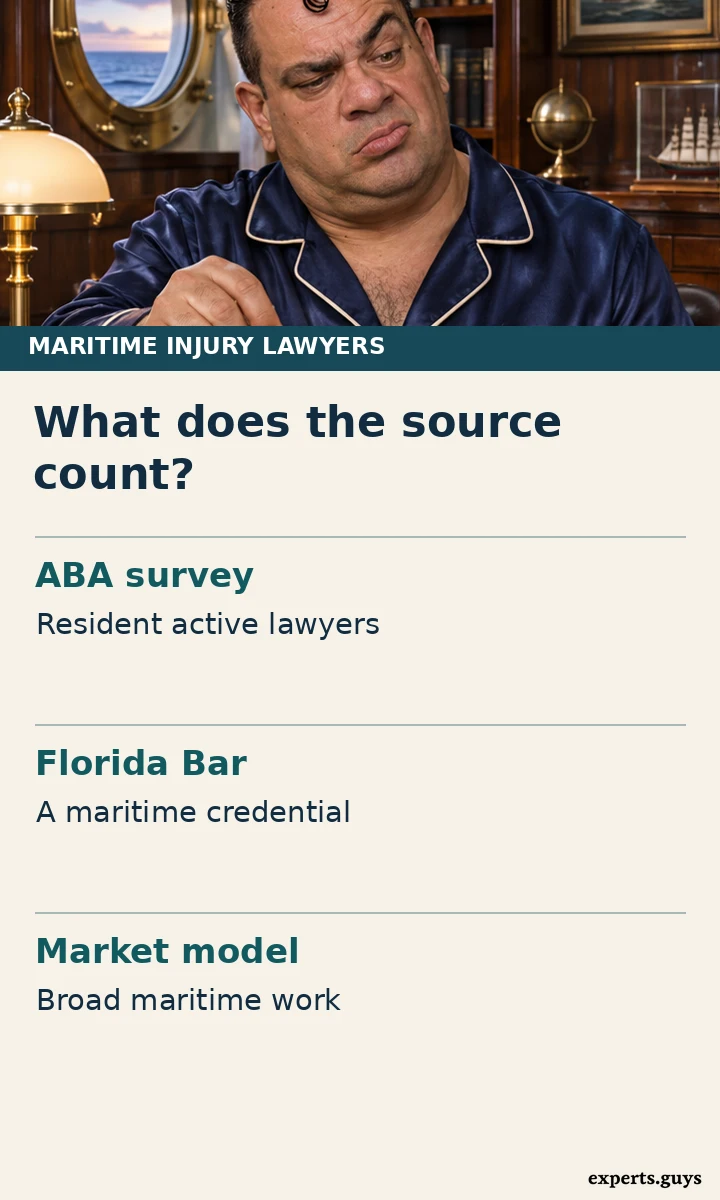
A maritime injury lawyer handles matters involving people hurt in connection with vessels or maritime work. How many practice in the United States? The public sources reviewed for this article do not establish a national headcount. The American Bar Association counts active resident attorneys. Florida identifies lawyers holding a particular maritime credential. Neither source tells us how many individual U.S. lawyers currently represent injured people in maritime matters.
The closest widely quotable number has a different meaning. LAW.co estimates roughly 7,200 U.S. attorneys participate materially in maritime and admiralty work. Its market model includes work beyond injury cases. Quoting 7,200 as the number of maritime injury lawyers would quietly change both the source’s definition and its degree of certainty.
What would one maritime injury lawyer count as?
Imagine a port with one law office above a chandlery. Three names appear on the door. One attorney negotiates vessel purchases, another defends an operator in injury litigation, and the third represents injured crew members. There are three maritime practitioners in this example, two who handle injury disputes, and one who fits a search specifically for representation of injured people. The address and the lawyers have stayed the same throughout.
For someone researching the size of the legal profession, both sides of a dispute may belong in the population. For an injured worker looking for representation, client side changes the usefulness of every name on the list. A source that never identifies the client cannot answer the second question, even if it counts the first population perfectly.
“Currently practices” needs a meaning too. A lawyer who handled a vessel injury case ten years ago and now works exclusively on cargo contracts has relevant experience. Counting that person as currently available for injury work requires further evidence. A past case, a current practice description and an offer to discuss a new matter establish different facts about the same person.
Geography introduces a third choice. Residence, office address and the place where a lawyer serves clients are separate fields. A count by residence can assign a lawyer to one place. A search by service area can display the same person in several places. Both arrangements serve a purpose. Only the first is naturally suited to an unduplicated geographic headcount.
| Source | Unit | Question it can answer |
|---|---|---|
| ABA population survey | Resident active attorney | How large is the wider legal profession? |
| Florida maritime certification roster | Individual credential holder | Who holds this Florida credential? |
| LAW.co market model | Estimated broad-field practitioner | What assumption underlies this market model? |
| Public directory | Listing | Which names or practices does this source surface? |
What the public numbers actually measure
A dated national figure makes the scale of the distinction visible. The ABA reported 1,322,649 active lawyers as of January 1, 2024. The state tables in its National Lawyer Population Survey tell a reader what population was measured. There is no injury-practice field in that table from which to extract a national maritime injury subtotal.
The Bureau of Labor Statistics offers another tempting number. Its occupational profile for lawyers describes employment and the work lawyers do. A licensing count and an employment count can differ even when both are accurate. Subtracting one from the other cannot isolate a specialty neither series measures.
A credential answers a narrower question. The Florida Bar’s admiralty and maritime certification standards include sustained participation in the field, continuing education, peer review and an examination. Its public roster is valuable precisely because the credential has a defined meaning. The specialty covers more than injury work, and the roster selects people who obtained the credential through that program.
Consider what happens if you treat that roster as a national minimum. Before calling it a lower bound, you would need to establish that every person counted belongs to the target population. A certified attorney whose practice concerns vessel finance could fail the injury criterion. Some injury practitioners could also be absent. Those two errors point in opposite directions. There is no sound reason to assume they cancel out.
A commercial estimate occupies another category. The LAW.co market report uses 7,200 attorneys in a model of the broader maritime legal market. A market researcher can accurately attribute that assumption when describing that report. Someone looking for a count of lawyers acting for injured passengers would still need a measure of that much narrower practice.
It is possible to multiply 7,200 by a guessed injury share and obtain a tidy integer. The arithmetic would only restate the guess. A defensible share would need a defined sample of practitioners and reliable information about which work each person does. Revenue shares would introduce a different problem: one large commercial engagement can generate a great deal of revenue for a small team.
The useful answer depends on the sentence you want to finish. “The ABA counted…” calls for the population and observation date. “One commercial report estimated…” calls for the report’s scope and the word estimated. “I found…” calls for the names, criteria and source behind your own result. Each sentence can be true without yielding the same number.
Reading a directory without mistaking pages for people
Start with the noun next to the search result. One result might be a person profile; another might be a firm page listing a dozen people across several departments. A third might be a location page that routes enquiries to the same office. The headline on each page can contain the exact phrase “maritime injury lawyer.” The noun tells you whether you have a person to count.
Suppose your search returns an office landing page, an attorney biography and a news item about the attorney joining that office. You have three pages with different jobs. Only the biography directly supplies a named individual and a description of their work. The other two may help corroborate details. Counting them as three attorneys turns corroboration into duplication.
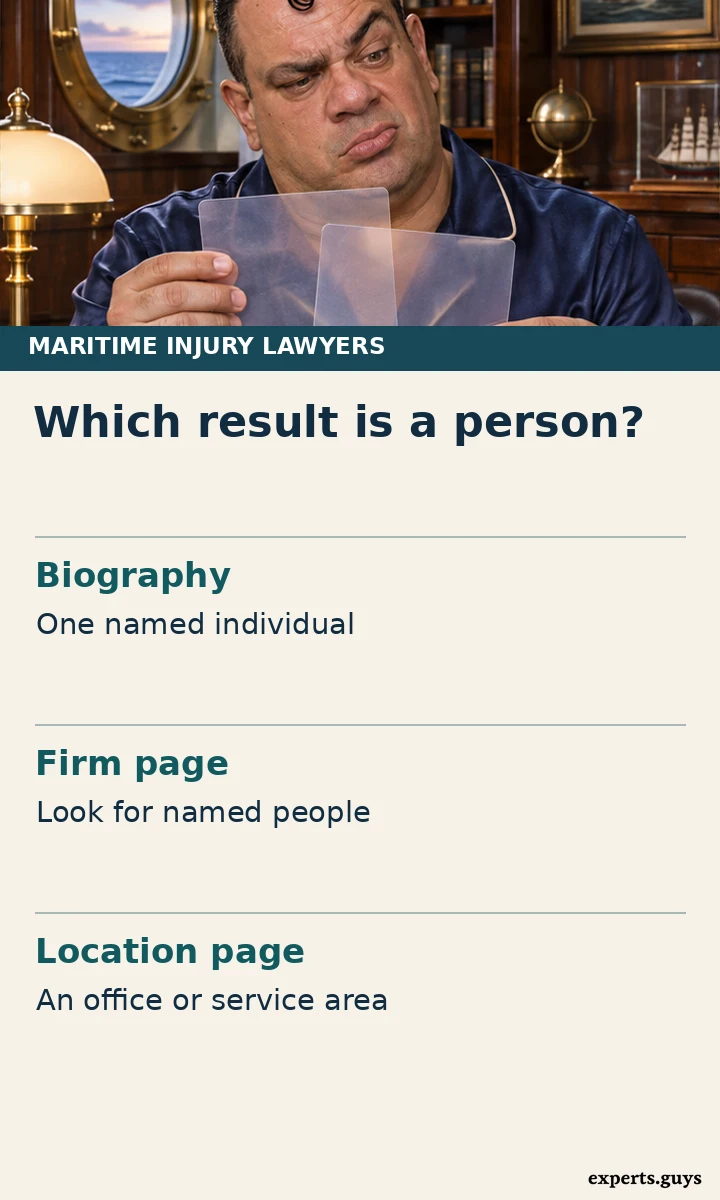
A useful first pass through a small result set takes three decisions. Keep a person entry for examination, use a firm entry to locate names, and set an unattributed landing page aside. If a firm entry names two relevant people, review each biography separately. This preserves information that would disappear if you simply deleted every firm page or counted every result once.
If a search result labels itself “attorneys near this port,” open the destination before classifying it. A team page can name several people even when its search snippet names none. The evidence belongs to the page you actually inspected.
- Biography with a named lawyer — assess the practice description.
- Firm team page — follow the individual names.
- City page without a name — keep it outside the person count.
When two profiles may describe the same lawyer
A person may have a biography on a firm website and a separate profile in a bar directory. Compare a public professional identifier within the same issuing jurisdiction when one is available. The combination of issuer and identifier matters. An identifier from one state cannot be matched to another state’s record by number alone.
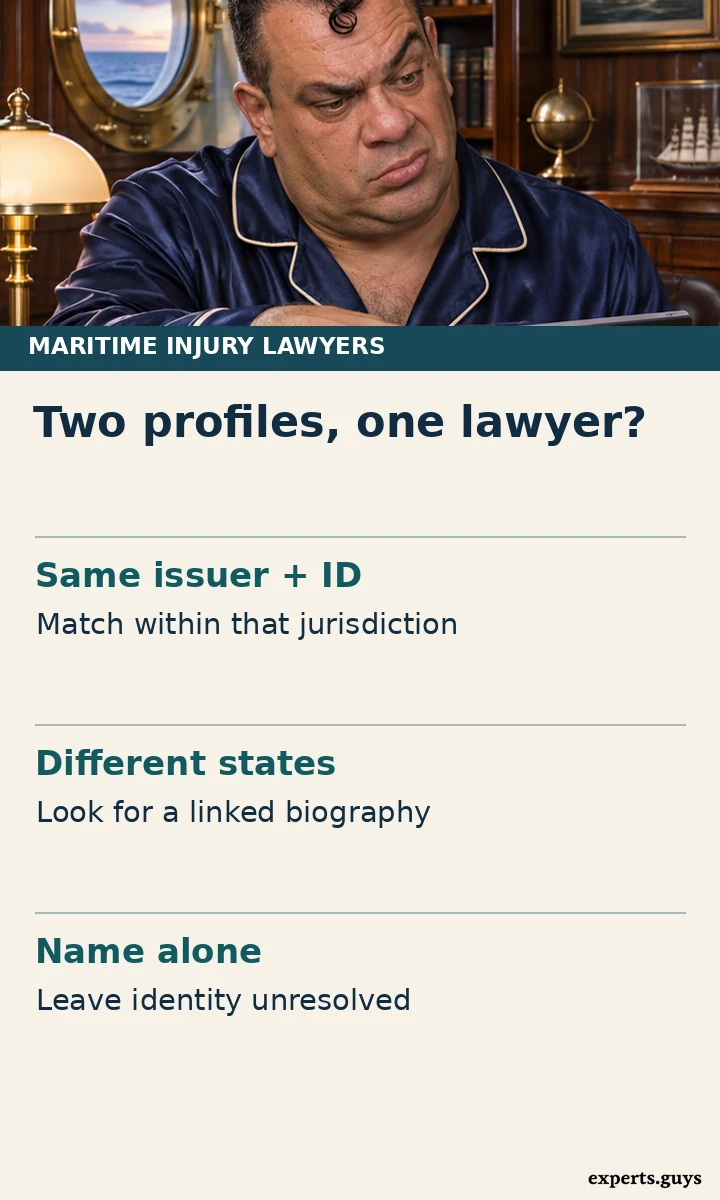
A matching name is a lead. A middle initial, firm move or changed surname can make the same person look different across sites. Conversely, two lawyers can share a name and work in the same city. Where identity is uncertain, keep the entries unresolved. Removing one on a hunch understates the search; counting both with confidence overstates what you know.
Cross-state records are particularly easy to mishandle. A biography that explicitly links both bar admissions can connect two records for one individual. Two similar profiles that merely mention the Gulf Coast leave the connection unclear. The outcome of a careful comparison may be “identity unresolved.” That is meaningful information to keep alongside the confirmed total.
The firm field does a different job. Three distinct attorneys at one firm are three practitioners if the research question is about workforce. They may provide one intake route if the immediate question is how many separate offices a reader can approach. Counting the people correctly does not establish how many independent teams, appointments or choices are available.
Does the profile establish injury work and client side?
Read the verb and its object together. “Represents injured crew members” identifies a service and client. “Defends vessel operators against personal injury claims” establishes experience with injury disputes on the other side. “Advises maritime clients” leaves both questions open. A search engine can surface all three descriptions under the same topic.
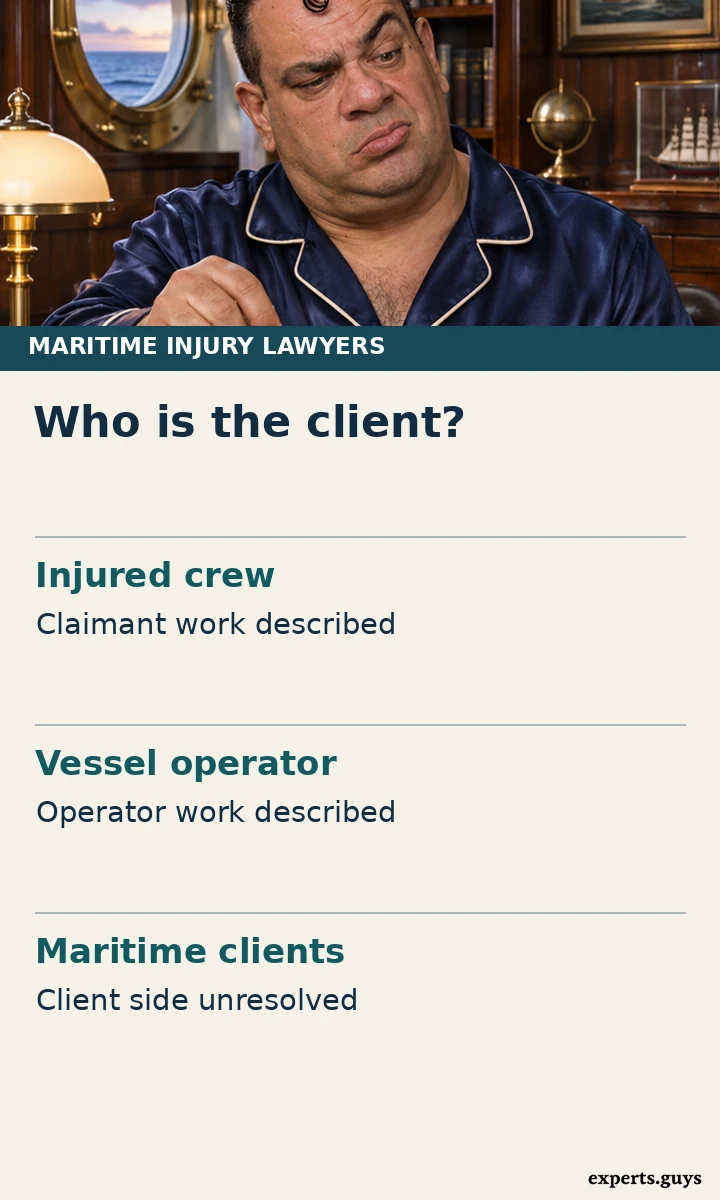
Read the statement at the level at which it was made. If a firm says its practice includes cargo, casualty and personal injury work, you know something about its services collectively. Attaching all three practices to every person on its roster would create individual specialisms the firm never claimed. Follow the named attorney’s biography or seek clarification before including that person.
An illustrative classification helps. A named attorney with an explicit, current claimant-side maritime injury description qualifies for a list defined that way. An attorney described only as a maritime litigator remains unresolved. An attorney described exclusively as handling ship mortgages falls outside that definition on the evidence available. The labels describe what the source supports; they are not assessments of anyone’s ability.
A lawyer may represent different types of client in different matters. If the source explicitly describes work for injured people as well as work for businesses, a claimant-side research list can include the person once. Whether that lawyer could act in a particular new matter is a separate enquiry. A public profile cannot establish availability or resolve a potential conflict.
A worked count you can reproduce
Take a fictional one-port search with six entries. A is a claimant lawyer’s biography. B is the same lawyer’s directory profile, linked by a matching state and bar number. C is a different lawyer whose biography explicitly describes representing injured passengers. D identifies a defense-only practice. E is a firm landing page with no additional names. F names a maritime litigator but gives no client side.
| Illustrative entry | What the entry establishes | Count decision |
|---|---|---|
| A | Named claimant lawyer | Include |
| B | Same state and identifier as A | Merge with A |
| C | Different passenger-injury lawyer | Include |
| D | Defense only | Outside scope |
| E | Firm page only | No new person |
| F | Client side unknown | Unresolved |
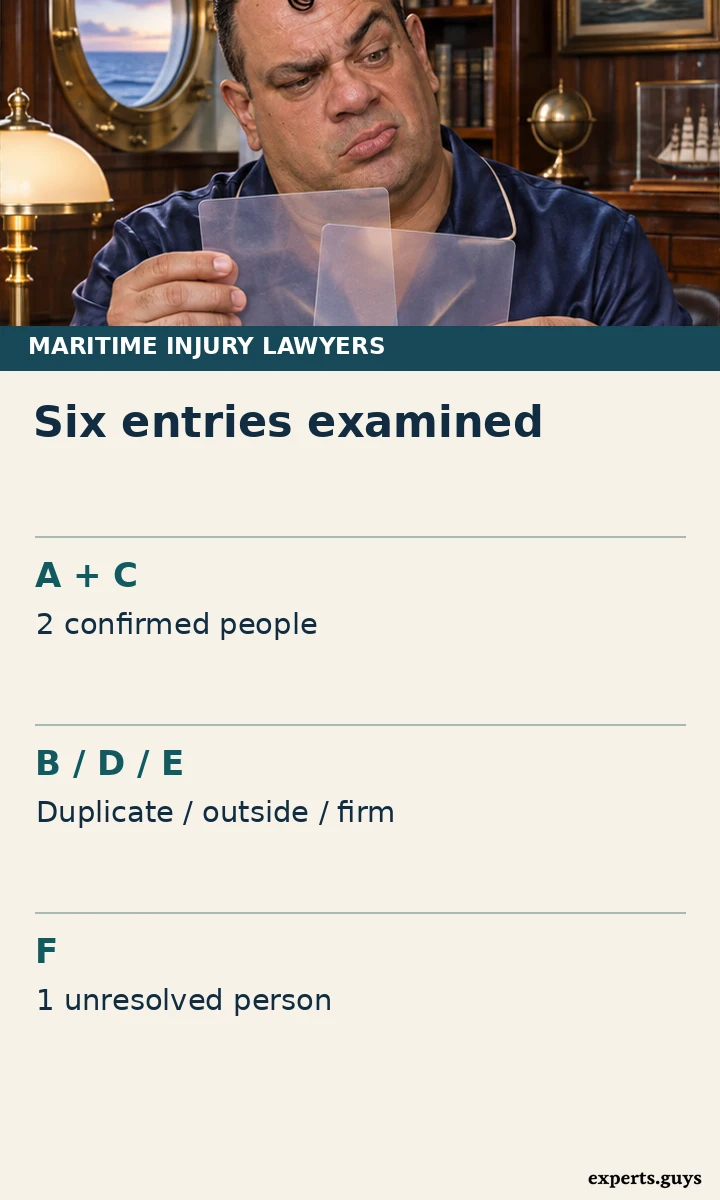
There are two confirmed people who fit the stated search, A and C. F is one unresolved person. B adds evidence about A but no person. D supplies a named person outside the chosen client-side definition. E supplies neither a person nor a reason to infer an additional lawyer. Report “two confirmed in these six entries, one unresolved.” Calling the result three would fill an evidence gap with an assumption.
Change just the question to “Who handles maritime injury disputes on either side?” D now qualifies too. Nothing about D’s work has changed. The list has grown because the inclusion rule has changed. If you are comparing two ports and quietly use the broader rule for one, the apparent difference between them will partly be a difference in your method.
A second change illustrates why even a careful result has limits. Imagine finding a seventh entry for a new person who meets every criterion. Your observed total becomes three under the original rule. The previous result was accurate as a description of six entries; it would have been inaccurate as a claim that only two such lawyers worked in the port.
Why port totals cannot be added into a national estimate
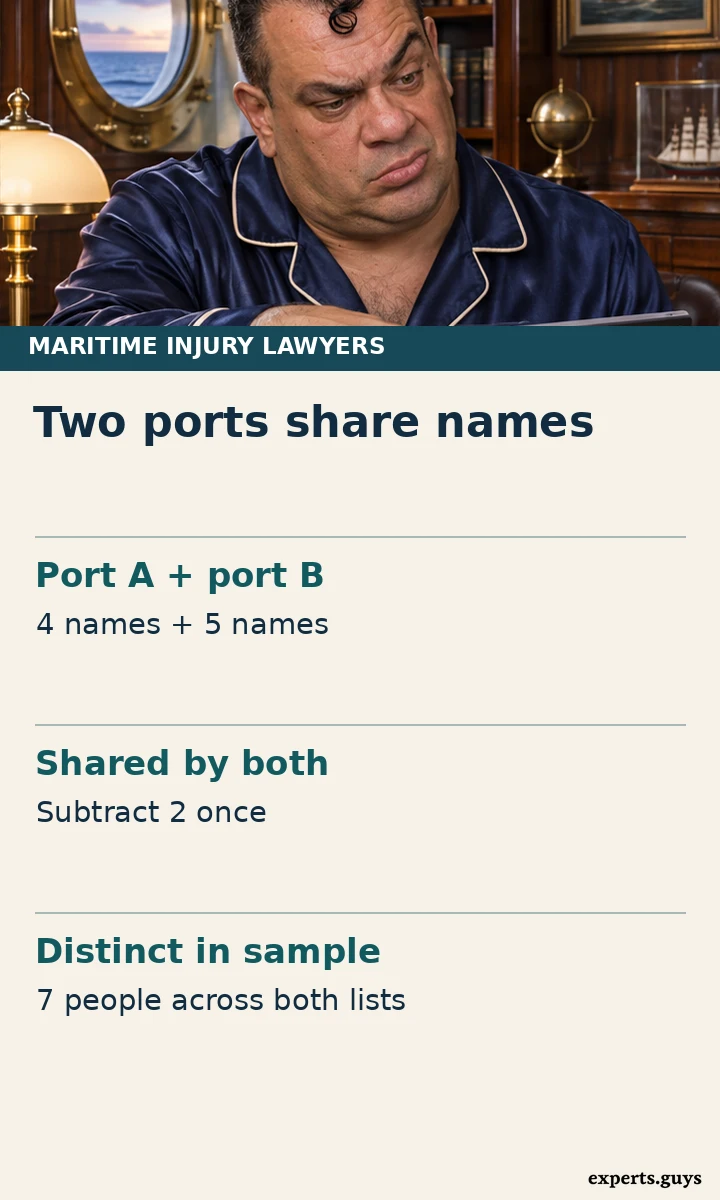
Two illustrative port lists contain four and five confirmed names. Two people appear on both lists. Together the lists identify seven distinct individuals: four plus five, less the two shared people. Seven describes the union of those two lists. Nine describes appearances across the two lists. Either number can be useful if its label travels with it.
Suppose the lists come from the same directory, which displays lawyers wherever they say they serve clients. The overlap then reflects something about directory design as well as about geography. If the lists instead come from two different publishers, differences in editorial selection or profile coverage can change the overlap. You cannot recover everyone absent from both lists by inspecting the shared names.
A high count in one port can also obscure the question a resident cares about. Several named attorneys may work through a single intake team. A sparsely listed inland practice may represent people whose injuries occurred elsewhere. Map pins can help you locate an office. They do little to establish the size of the national workforce unless the collection method explicitly ties each pin to one distinct person.
This matters when a headline ranks cities. A defensible comparison would use the same directory, dates, definition and geographic field for every city, and disclose how shared names were treated. Even then it would describe visibility in that source. A city ranking based on visibility cannot establish where an individual should seek representation.
How to quote a count so it can be checked
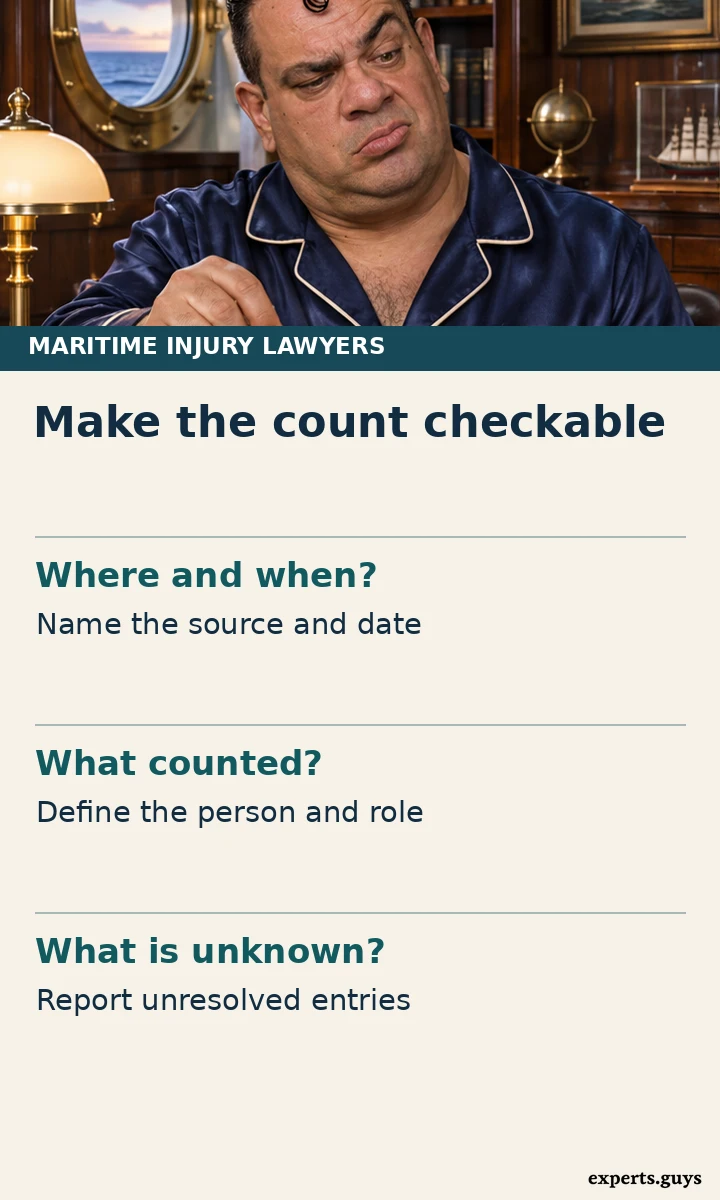
For a directory result, publish a short sentence with four details: the source, the date viewed, the unit counted and the inclusion rule. A second sentence can carry unresolved cases. For the fictional example, that becomes “The six entries examined yielded two distinct lawyers explicitly described as representing injured maritime clients. One additional lawyer’s client side was unclear.” A real observation also needs its actual source and date.
Keep the date attached to the fact it dates. A web page updated this month may cite a survey from several years earlier. Giving the page’s update date to the survey would make an older observation look new. Likewise, the day you opened a biography dates your observation of the page; it does not automatically date the work described there.
A range needs equally careful wording. In the six-entry example, two people qualify and a third might qualify if more evidence appears. “Two confirmed, one unresolved” is more informative than a bare “two to three.” Neither endpoint accounts for people outside the searched entries. A national confidence interval cannot be derived from uncertainty about one biography.
For a reader researching a specific port, the next question may concern access rather than statistics. A direct enquiry such as “Who in this office currently represents injured crew members?” resolves the person and client-side questions together. Once a named contact is available, the site’s New Orleans offshore injury lawyer guide covers the local search in more detail. The national count has no bearing on whether a specific matter can be accepted.
Three real listings that answer different questions
A public example makes the distinction between topic and client easier to see. The Maritime Legal Aid & Advocacy directory describes its selection as worldwide and oriented toward injured seafarers and other affected people. Its United States nationwide entry for Justice4Mariners names Ryan Melogy and lists New York. That single entry supplies a firm or project name, an individual, an office location and a service-area label. Those are four fields attached to one listing.
A query for New York and a query for nationwide representation could both bring someone to that entry. Treating the two search paths as independent evidence that two attorneys exist would double the person. Treating “nationwide” as fifty separate offices would multiply a service description into physical premises. The useful observation is modest: the directory names a U.S.-based individual in an entry addressing the relevant client group.
The same directory includes an entry for a practice in Panama City, Panama. A reader looking for help internationally has good reason to see it. A researcher seeking U.S.-based lawyers should preserve the geographic distinction. In particular, text matching on “Panama City” without the country risks putting the entry in Florida. Keeping the country beside the city resolves the ambiguity without guessing where the lawyer is admitted.
Now consider an individual profile. The Phelps biography for Colin Cambre describes work for vessel owners and operators and mentions investigations involving personal injury. Both “maritime” and “personal injury” are relevant to the page. Yet the cited passage identifies the companies he advises. It supports inclusion in a search for operator-side work; that passage alone would not establish that he takes enquiries from injured crew members.
Finally, a firm’s maritime practice overview can describe transportation, towage, offshore operations and salvage in a single place. That breadth explains why a business researching maritime legal services would value the result. A journalist counting named injury practitioners needs a different unit of evidence. Even an accurate summary of everything a firm’s practice group can do leaves open who within it does which work.
These examples also explain why a smaller directory is sometimes a better starting point for a person seeking a contact. A curated selection with an explicit client orientation may reduce irrelevant results. The same curation makes it unsuitable as a census unless its publisher documents complete coverage of the population in question. Relevance to a reader and completeness as a data source are independent properties.
Can court records settle the headcount?
A court record can resolve a specific historical question. If an appearance clearly identifies a named attorney and the party represented, it is evidence of that lawyer’s role in that proceeding. A count of case records, however, begins with disputes. Converting the result to a count of people requires examining the appearances associated with each dispute and the identities shared across them.
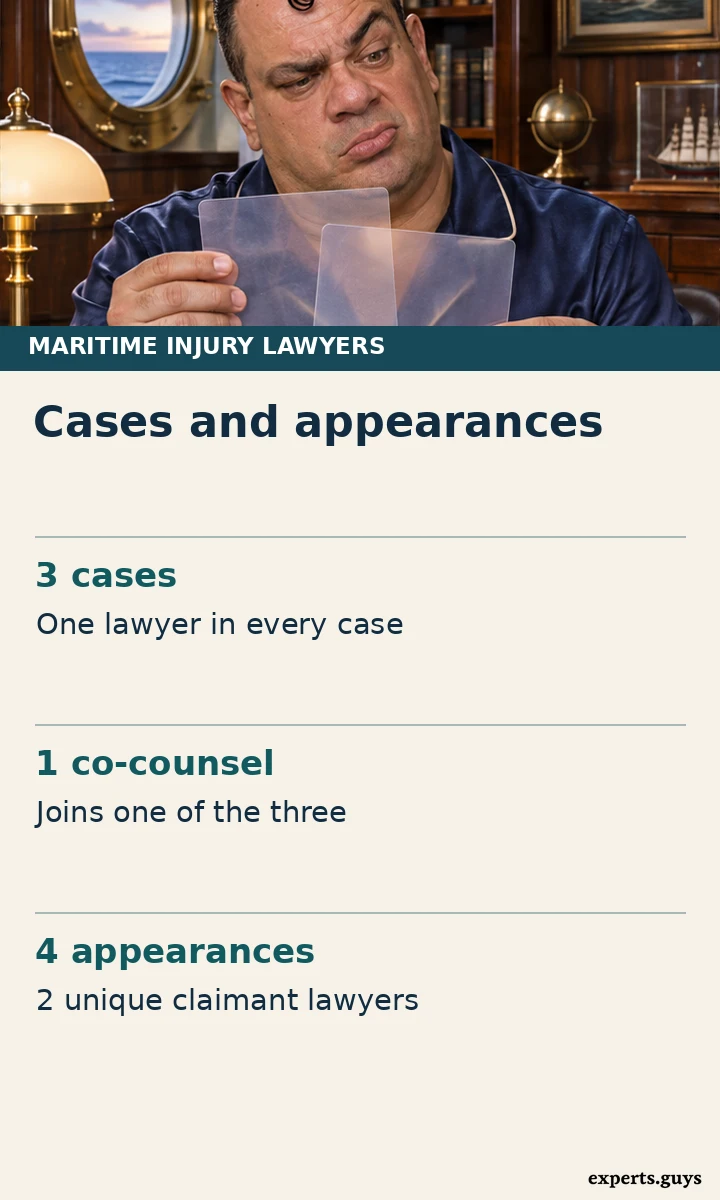
Consider an example with three cases. The same attorney appears for injured clients in all three, while a second attorney joins just one. Three cases would produce four attorney-case appearances and two unique claimant lawyers. Dividing four by three gives the average number of appearances per case in this tiny example. It says nothing about how many other people practice in the wider region.
The choice of time window changes what the records can tell you. A single old appearance can be strong evidence of what someone did then and weak evidence of their current work. A short recent window may miss a lawyer whose matters did not produce a filing during that period. Extending the window can add historical participants who have since changed practices. There is no single window that resolves both problems.
A docket-based study also inherits the coverage of the proceedings searched. The lawyer who advises an injured client on a matter resolved before a lawsuit would have no appearance to find for that engagement. Even a complete search of the selected cases could therefore miss real work. An honest description would refer to attorneys observed in those proceedings over the stated period. That wording makes the result reproducible and protects readers from interpreting absence as inactivity.
What would make a national estimate credible?
A credible estimate would begin with a way to reach the target population. Imagine sending a survey only to people attending a maritime law conference. A high response rate would tell you a great deal about the people who attended and responded. It would reveal little about practitioners who did not attend, including lawyers with mixed practices who occasionally handle maritime injury matters.
Sampling from a wider lawyer register poses a different challenge. If relatively few sampled people meet the target definition, estimates for the group may be unstable. A researcher might deliberately sample more heavily from places with maritime activity. To move from that designed sample to a national estimate, the analysis would need to account for the chance each person had of selection. Simply adding all the responses would give extra influence to the heavily sampled places.
The questionnaire would matter as much as the selection. “Do you work in maritime law?” admits cargo contracts, vessel transactions and many disputes. “Did you personally act for an injured maritime client during the stated period?” identifies an individual, a client side, an activity and a period. Even that wording needs a published definition of what counts as maritime. Otherwise two respondents doing similar work may answer differently.
Silence from a respondent also has more than one meaning. Someone might decline the survey, miss the invitation, or be unable to classify a mixed practice. Treating each unanswered invitation as a definite no would push the estimate downward. Treating all unanswered invitations as if their recipients resembled the respondents would introduce another assumption. A useful research report would state how much information was missing and how the estimate changes under plausible alternatives.
For a nationwide headline, look for enough detail to reconstruct the route from sample to published total: who could enter the sample, what respondents were asked, how many supplied usable answers and how the authors handled uncertainty. A precise number without that route may still be a business planning assumption. The amount of precision printed beside it does not improve the underlying evidence.
What a change in directory numbers really means
A publisher may compare this month’s directory with a copy from last year and find ten more entries. That increase could represent new practitioners. It could also reflect a new practice-area filter, a directory importing existing profiles, or lawyers adding another office to their profiles. The comparison establishes growth in entries under the observed conditions. It does not, by itself, measure workforce growth.
Names moving in opposite directions can hide behind an unchanged total. If two established profiles disappear and two new ones appear, the directory remains the same size. A reader searching for a particular contact experiences a real change. A researcher tracking turnover would need to compare identities between the two observations, while a researcher tracking the number of entries would correctly report no net change.
Consider a firm merger. If two lawyers move into one combined practice, the number of firms can fall while the number of lawyers stays constant. Old biographies can remain searchable alongside new ones. For a brief period, a poorly maintained list could show more profiles at precisely the moment the market has fewer independent offices. The apparent contradiction disappears when each number has its proper unit.
For someone citing an earlier count, the most useful update is often a change in evidence quality. A previously ambiguous person may now have a biography that describes the relevant client work. Moving that name from unresolved to confirmed improves the count in your sample. Calling it a newly qualified lawyer would go beyond the evidence. The change you observed occurred in what you could establish, regardless of when the person began doing the work.
Frequently asked questions
How many maritime injury lawyers are there in the United States?
The sources reviewed do not establish a national total for this specialty. An exact answer would require a common definition of injury practice, individual-level records, a reference period and a way to account for practitioners missing from the data. A search can still yield a defensible count of the people found within its stated scope.
Does the 7,200 estimate include only injury lawyers?
No. It is a commercial estimate for the broader U.S. maritime and admiralty field. Its scope extends beyond injuries and beyond representation of injured people. Anyone quoting the figure should preserve the attribution and scope alongside it.
Can I use a Florida certification roster to find maritime lawyers?
Yes. It can identify people holding the specific credential. To determine whether a named person handles a particular kind of injury work, look for an individual practice description that identifies both the work and the client. A credential alone leaves the client side open.
Does a nationwide listing count as a lawyer in every state?
A nationwide service label can describe the geographic reach of a listing. It does not identify fifty people or establish fifty offices. Count each verified person once if the question concerns individuals. Keep office location and service area in separate fields when geography matters.
Is zero search results evidence that a port has no injury lawyers?
Zero describes what that source returned for that query. The directory may use a different label or omit practitioners who do not maintain profiles there. Cite the empty result as a search observation. A claim that no one serves the port requires much broader evidence.
Do larger directory counts mean faster access to a lawyer?
A directory measures visible entries. Available appointments depend on who can take a particular matter and when. Several profiles may share an intake team. Ask the named office who handles that type of work and whether it is currently considering new enquiries.
Next steps
If you need a national statistic for publication, cite the population your source actually measures and leave the injury subtotal open. If you need a local contact, begin with the Florida maritime certification roster for a Florida search, or the claimant-oriented directory above for a wider search. A named person whose public profile describes the relevant work is a more useful result than an impressive page total.