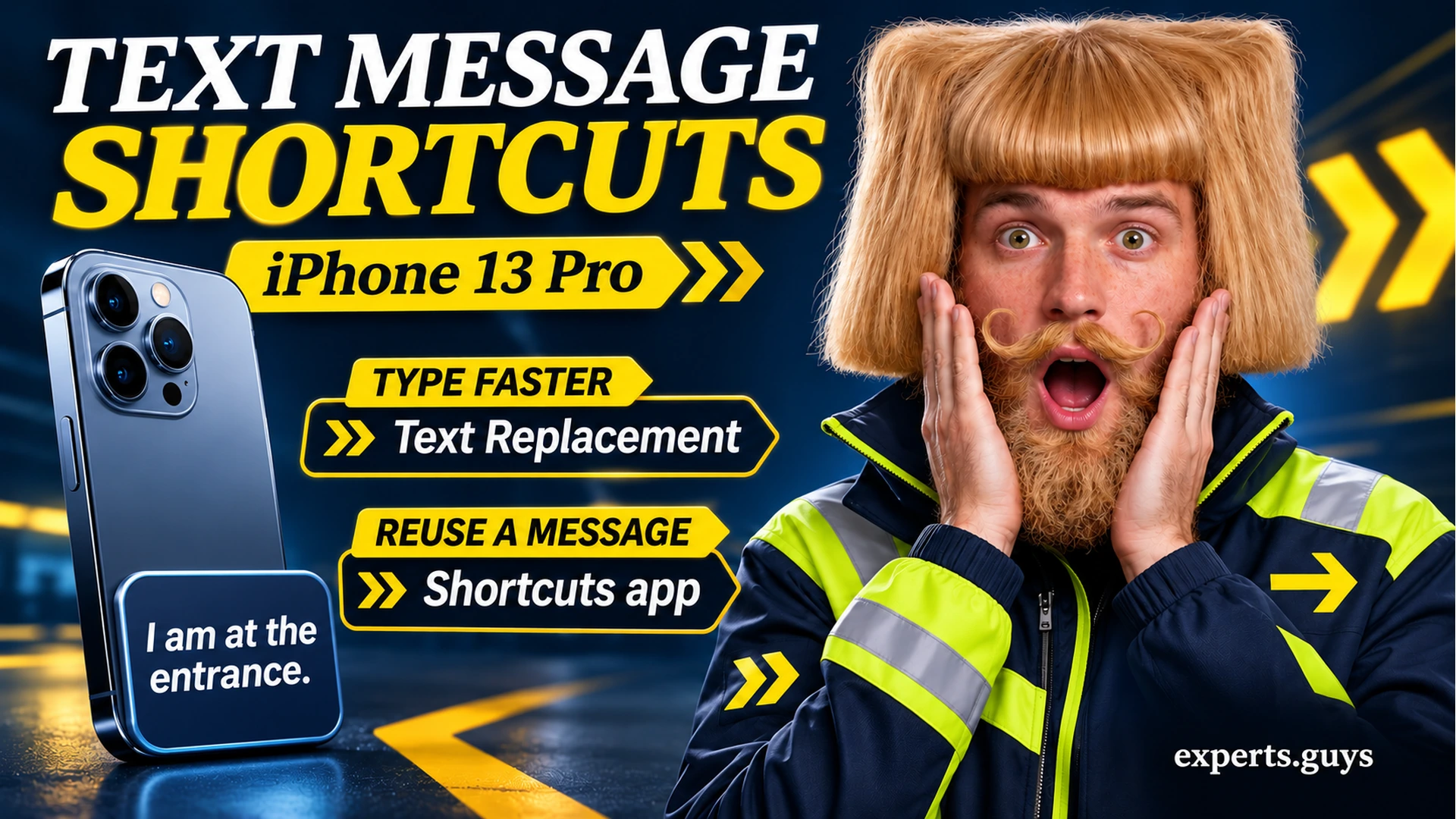
Text message shortcuts on iPhone 13 Pro let you reuse wording without typing the same sentence each time. Start with Settings > General > Keyboard > Text Replacement for abbreviations that expand into text; use the Shortcuts app when you also want to prepare a message for a particular recipient. Neither choice should be confused with scheduling a future delivery.
Which kind of text message shortcut do I actually need?
Choose by the part of messaging that slows you down. If the wording repeats but the recipient changes, a keyboard replacement is usually the simpler fit. If the wording and recipient stay together, a manually run message shortcut can save repeated setup. If the problem is timing, you need a scheduling feature instead.
Swipe horizontally to compare on a narrow screen.
| Your repeated task | Best starting point | What remains your responsibility |
|---|---|---|
| Type a familiar sentence in different conversations | Text Replacement in Keyboard settings | Choose the conversation, check the expanded wording, and send. |
| Prepare the same message for the same person | A Send Message action in Shortcuts | Check the saved recipient and keep a review step. |
| Send a message at a future time | Send Later in a supported iMessage conversation | Confirm the date, time, recipient, and scheduled wording. |
| Correct an unexpected word suggestion | Inspect the replacement or keyboard behavior | Identify the cause before changing unrelated settings. |
For most people looking for a “text shortcut,” start with one replacement rather than building an automation. It has fewer moving parts: a small trigger and the phrase it expands into. That is an editorial recommendation about setup and maintenance, not a claim that one method is always faster for every person or task.
Separate wording, recipient, timing, and delivery
A useful way to evaluate any messaging shortcut is to separate four decisions: what the message says, who receives it, when it is submitted, and whether the messaging service can deliver it. A typing shortcut answers only the first. A reusable action may also store the recipient. A scheduler adds a future time. Delivery still depends on the service used.
This separation prevents a common mistake: treating a sentence that appeared on screen as a message that has already gone somewhere. The visible checkpoint for Text Replacement is a completed draft. For a manually reviewed shortcut, it is the preview with the intended recipient. A scheduled message has its own future-delivery state. These are different outcomes even when the words are identical.
The phone model alone does not tell you which menus are available. iPhone 13 Pro can be running different iOS versions, and labels can vary with software and language. The Text Replacement route is the dependable starting point for this article; newer messaging features should be used only when they are present on your installed version. These methods do not require Apple Intelligence.
- Different people, same wording: keep the phrase independent of a contact.
- Same person, same wording: consider saving the recipient in a reviewed shortcut.
- Different day or time: treat timing as a separate decision rather than assuming the shortcut remembers it.
Suppose you often message “I am at the entrance.” At a clinic you send it to a family member; at a building you send it to a colleague. A keyboard replacement fits because the sentence can travel between conversations. Saving it in a shortcut addressed to one particular contact would add a recipient assumption that is wrong in half of those situations.
By contrast, a message you send only to one household member may justify a dedicated action. The benefit comes from keeping two stable choices together, not from making the workflow more elaborate. Avoid adding a location trigger, a repeating schedule, or extra permissions simply because the app offers them. Each addition creates another condition you will need to understand later.
Think about the cost of a wrong assumption as well as the number of taps saved. Reusing an acknowledgement usually carries little context; reusing an arrival claim or a request to collect someone carries more. The more a sentence depends on the present situation, the more useful it is to preserve an obvious moment for checking. Convenience is worthwhile when you can still see what you are asking the phone to do.
The same distinction helps with work and personal conversations. A phrase suitable for a close friend may sound abrupt to a customer, even if every factual detail is correct. A keyboard replacement does not know which tone you intended. Choose wording that is broadly appropriate for its intended use, and keep narrowly personal language out of a trigger you plan to use across many recipients.
Messaging appearance is a separate topic. If you want expressive features rather than reusable wording, the related iMessage shortcuts guide covers that adjacent area. Here, the goal is a reusable draft that still says what you mean today.
How do I set up phrases that stay useful?
Save the stable part of the message and leave changing details for the draft. This works especially well for short arrival notices, polite requests, and acknowledgements. A replacement becomes less dependable when it quietly includes a time, place, promise, or personal detail that may be wrong the next time it expands.
Create one replacement first
Use a harmless example while learning the feature. The phrase below deliberately avoids a person’s name or exact location, so you can try it without building a private detail into the keyboard. Apple’s text replacement instructions confirm the Keyboard settings route and the separate phrase and shortcut fields.
- Open Settings > General > Keyboard > Text Replacement.
- Tap + to add an entry.
- In Phrase, enter I am at the entrance.
- In Shortcut, enter zzgate. This is an example trigger, not a reserved command.
- Tap Save. Check the entry so that the short trigger and full sentence are in the intended fields.
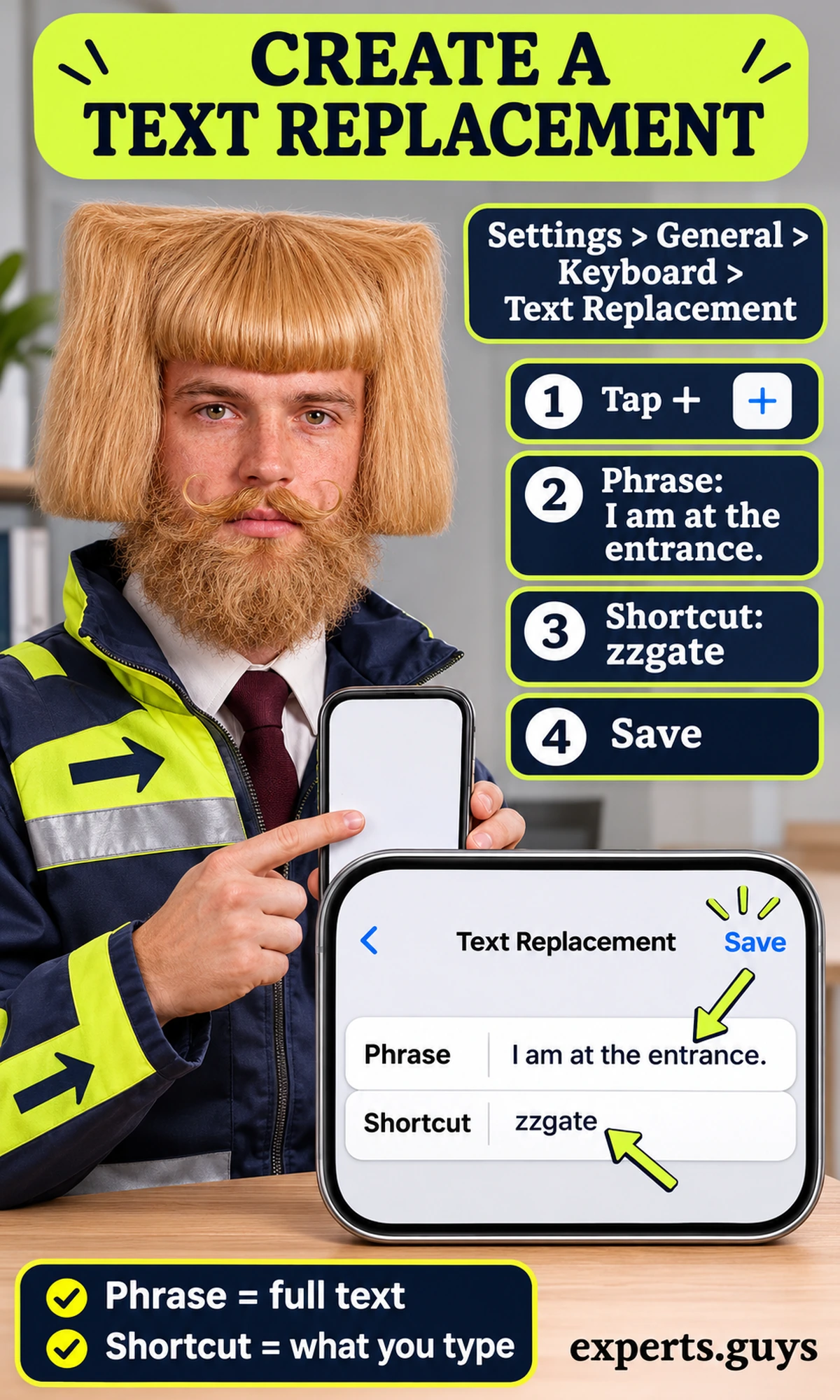
The field names describe opposite sides of the same relationship. Phrase is the finished wording you want to appear; Shortcut is what you type to request it. Reversing them does not create a clever reverse shortcut. It creates a different mapping, which is why checking the saved pair is more useful than repeatedly typing a trigger that was never stored correctly.
Start with a single entry you genuinely need. A large collection of speculative shortcuts creates a memory task before it creates a benefit. Once one phrase works in an ordinary conversation draft, you have a pattern you can reuse for another sentence. There is no requirement to create a signature or attach a contact to a keyboard replacement.
Use the phrase, then add what changes
Try the saved trigger in an unsent draft. You are checking what appears in the message field, so there is no need to send a test message to someone. If selecting a real conversation could cause confusion, use a blank compose screen and leave it unsent.
- Place the cursor in the message text field and type zzgate.
- Accept the offered replacement; with the standard keyboard, a word boundary such as a space commonly commits it. If a suggestion appears, select the full phrase.
- Read the expanded sentence. Change it to I am at the east entrance. if that is the detail the recipient needs today.
- Check the recipient and wording, then tap Send only when you intend to send. Leave the draft unsent if you are just checking the setup.
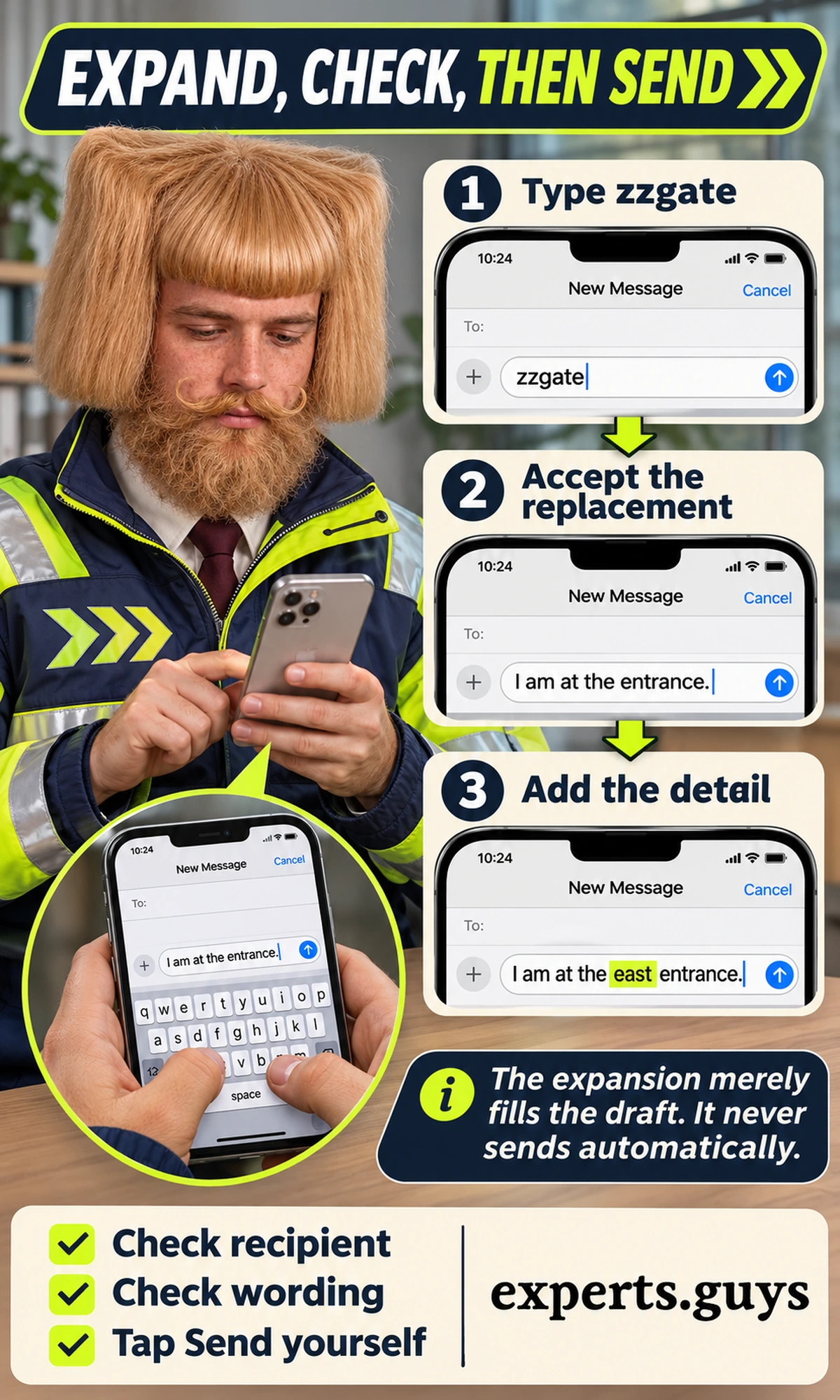
The useful saving is the wording you did not have to reconstruct. The final edit remains valuable because a familiar sentence can hide an outdated assumption. “The entrance” may be enough at a small shop and too vague at a hospital. The shortcut cannot decide which entrance you mean unless that information is actually supplied.
For a lower-effort version, keep the saved phrase short and finish the detail in the conversation. You do not have to build separate triggers for every gate, building, or visit. A small reusable core is often easier to maintain than a family of almost identical messages with slightly different place names.
Do not confuse this with filling a template. Text Replacement stores text; it does not turn words in brackets into questions or automatically update a date. If a saved phrase contains a placeholder such as “at TIME,” those characters can remain in the draft. For ordinary messages, a complete neutral sentence is less likely to leave an unfinished instruction visible to the recipient.
Choose triggers that do not interrupt ordinary typing
A trigger should be memorable to you and unusual in ordinary conversation. In the illustrated comparison, at is a poor choice because it is a normal word, whereas zzgate is deliberately distinctive. The doubled prefix is an example convention you may choose, not an iPhone requirement or a guarantee against every keyboard conflict.
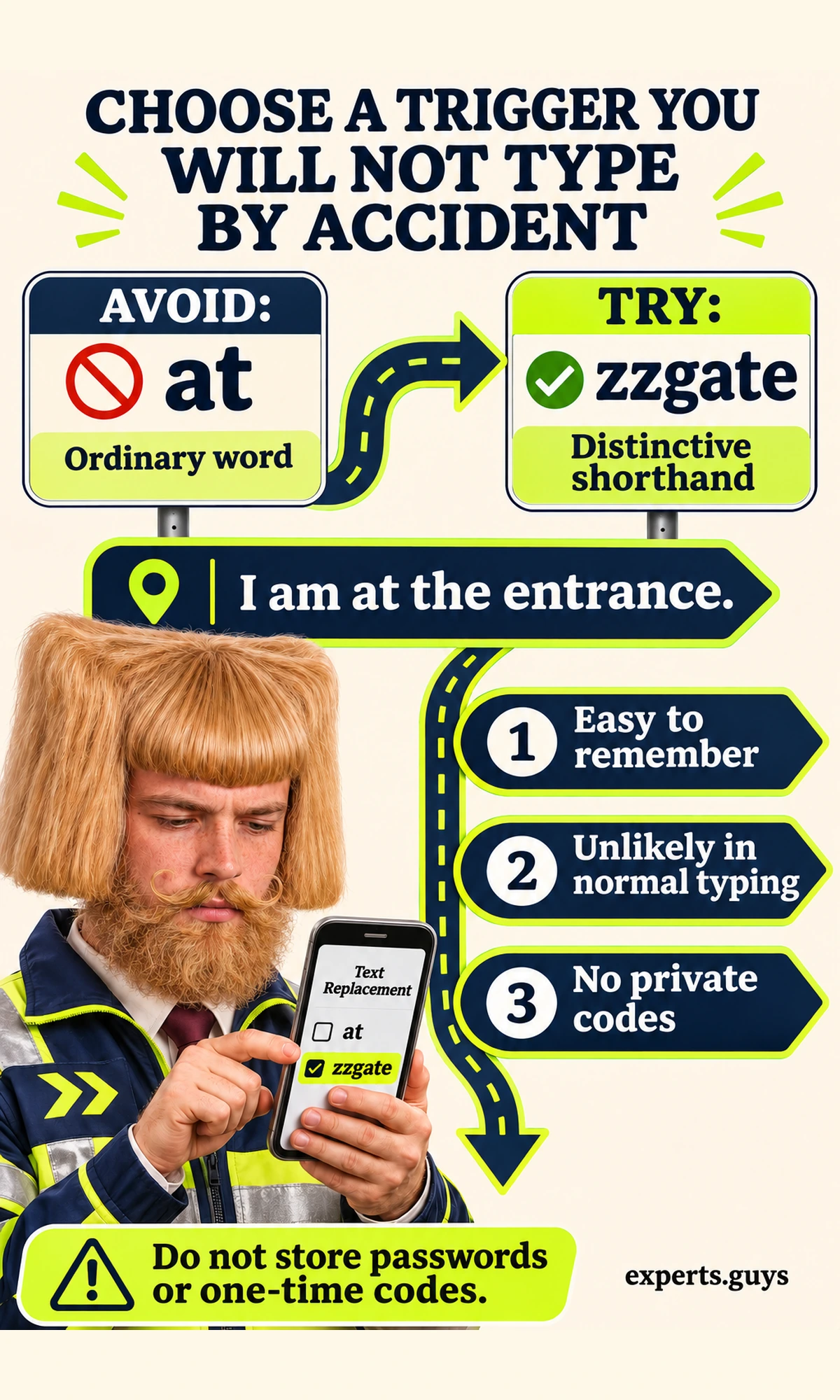
Choose a convention that suits the language and keyboard you actually use. A short trigger that saves two taps but repeatedly interrupts normal typing is a bad trade. A slightly longer trigger may be easier to recall because it names the topic of the phrase. Test the trigger as part of an ordinary draft rather than judging it only by how compact it looks in Settings.
Swipe horizontally to compare on a narrow screen.
| Message purpose | Useful reusable wording | Detail to supply in the draft |
|---|---|---|
| Arrival notice | I am at the entrance. | Which entrance, if there is more than one. |
| Request for directions | Could you send the exact entrance location? | Any context the recipient needs to identify the place. |
| Acknowledgement | Thanks, I have received your message. | A specific next step only if you can actually commit to it. |
| Request for clarification | Could you confirm which item you mean? | The relevant topic or item when the conversation is ambiguous. |
These are illustrative wording choices, not a ready-made phrase library you must install. Keep only messages that match your own communication. In particular, avoid storing a sentence that promises an arrival time, a payment, or a completed task when those facts change from one use to another. Reusing the wrong commitment can cost more effort than typing a fresh reply.
A useful phrase is complete enough to make sense but limited enough to remain true. “Thanks, I have received your message” acknowledges receipt without promising agreement or a deadline. “I will finish this today” makes a commitment that may need reconsidering every time. The distinction is about meaning rather than length: a short sentence can carry a large obligation, while a longer neutral sentence may be safe to reuse in its intended context.
Be equally careful with names and pronouns. A message that refers to “he,” “she,” or “that one” may be clear in one conversation and ambiguous in the next. A neutral request for clarification is often more reusable than a sentence built around yesterday’s exchange. If removing the old context leaves the message confusing, the sentence probably belongs in a fresh reply rather than a permanent shortcut.
Treat stored phrases as ordinary text, not secure storage. Passwords, door codes, payment details, and one-time verification codes do not belong in a convenience shortcut. A harmless phrase can also become sensitive when it includes a private address or routine, so consider where it might appear if typed into the wrong conversation or on another synced device.
Accuracy also includes what the sentence leaves out. An arrival message may need an accessible entrance rather than the nearest entrance; a request may need the building name rather than a vague reference to “here.” Supply those details from the actual situation. Reusable wording reduces transcription, but it does not replace the knowledge needed to make a message useful.
When is the Shortcuts app worth using?
Use the Shortcuts app when you want to reuse an action as well as text. A basic Send Message action can associate a sentence with a selected recipient. The most useful beginner version is manually run and includes a review step, so the saved setup helps you prepare the message without removing your final decision about sending it.
Build a manually run message shortcut
The following is a simple illustrative build using Alex as an example contact. Choose your intended recipient carefully, including the correct number or address if the contact has several. Apple’s custom shortcut guide explains adding actions and running a shortcut; the exact editor controls depend on your installed software.
- Open Shortcuts and tap + to create a shortcut.
- Search for and add Send Message. Enter I am at the entrance. in its message parameter.
- Set the recipient to the intended contact. In this example it is Alex; use a contact you have checked rather than assuming the first matching name is correct.
- Expand the action’s options and keep Show When Run enabled where that control is available. The goal is a message review before sending.
- Give the shortcut a descriptive name such as Arrival message to Alex, save it, and run it manually. Inspect the preview; cancel if you are only checking.
- Send only after confirming the actual recipient and wording. If your version behaves differently or does not offer a dependable preview, stop and use Text Replacement in an ordinary draft instead.
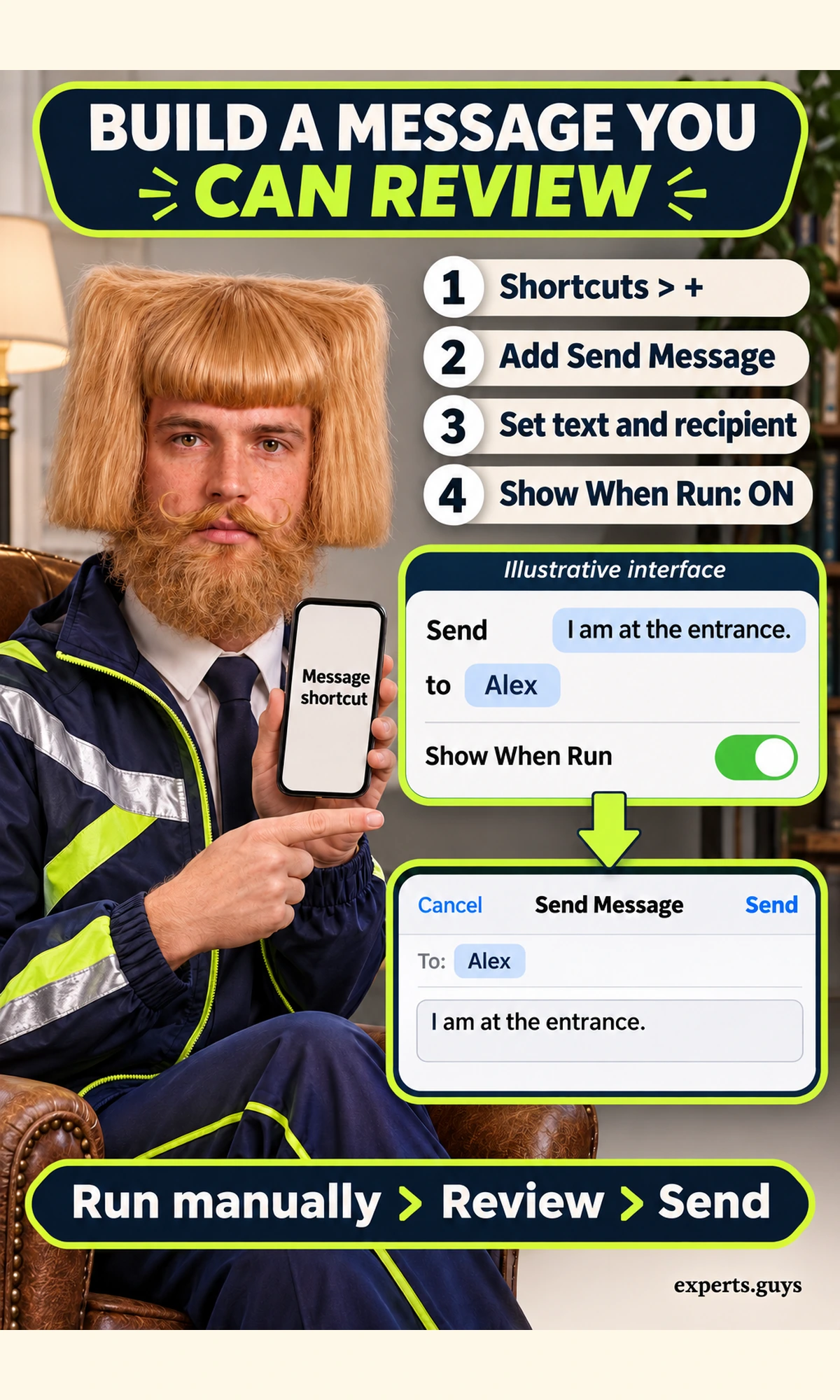
The review behavior is the checkpoint, not an optional detail to overlook. The Send Message action can have different behavior when its display option is disabled. Do not assume that closing the editor or tapping the shortcut merely opens a harmless draft. Read the action options before the first run, and do not remove a review step just to imitate a “one-tap” claim.
There is no advantage in hiding a decision you still need to make. For example, if you sometimes need to say “east entrance” and sometimes “main entrance,” a fixed sentence remains a starting point. The preview lets you notice that difference before sending. If changing the saved action is more work than composing the reply, return to a keyboard phrase or ordinary text; the shortcut should serve the task rather than become another task to manage.
Give the name enough context to distinguish it from another shortcut. “Message” tells you little; “Arrival message to Alex” tells you both the content and destination. That matters when shortcuts are launched from a small tile or a list in which several similar names appear together. Names should help you identify an action, not conceal its consequences.
A fixed recipient is helpful only while it remains correct. If a family member changes number, or a contact record contains both personal and work details, the shortcut needs attention. A correct-looking name is not a substitute for checking the chosen destination. The first preview should make the recipient visible enough for you to verify it.
This guide deliberately stops at a manually run action. Event-triggered and repeating automations introduce separate questions about permissions, confirmation, and conditions. The related Ask to Run and automation overview is the adjacent topic; do not treat its automation discussion as a requirement for a basic reusable message.
Keep reusable messages separate from scheduled delivery
A shortcut named “Tomorrow” does not gain a timer because of its name. Reuse concerns saving the setup; scheduling concerns submitting a message for a specific future time. If you need a one-off future message in a supported iMessage conversation, the built-in Send Later feature is the more direct place to start.
- Open the intended conversation in Messages.
- Tap +, then choose Send Later if available.
- Choose the delivery date and time, enter the message, and check the recipient.
- Tap Send to submit the scheduled message, then verify the displayed schedule rather than assuming it is an ordinary immediately sent message.
Send Later was introduced with iOS 18 and requires iMessage; it is not a general scheduler for SMS, MMS, or RCS. Apple documents a limit of up to 14 days ahead in its Send Later instructions. If the feature is absent for the conversation or software you are using, Text Replacement does not provide an alternative delivery timer.
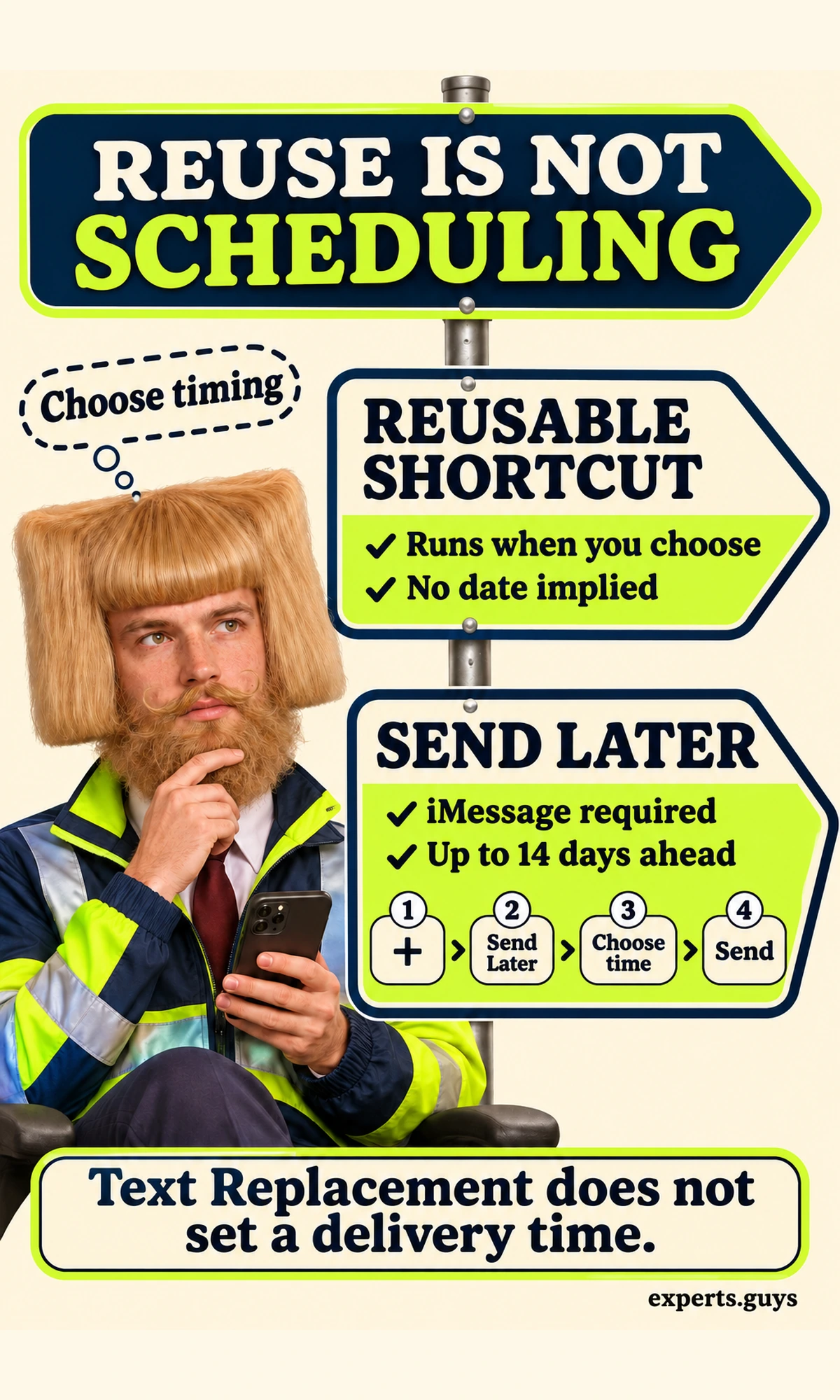
For a future message, stable wording becomes even more important. “I am at the entrance” describes a present condition and is usually a poor sentence to schedule in advance. A reminder such as “Please bring the documents to our meeting” has a different time relationship. Choose wording that will still be true when the message is delivered.
Do not assume that every scheduling app offers the same delivery model. A reminder that asks you to send, a cloud service that sends through another channel, and a native scheduled iMessage are different products. The useful question is what actually happens at the scheduled time and which service carries the message. An app’s name or a notification permission alone does not establish unattended SMS delivery.
Why does a text shortcut fail or behave unexpectedly?
Find the failed stage before changing settings. Unchanged letters point toward the trigger, keyboard, or text field. A wrong expanded sentence points toward saved wording. A completed draft that has not been sent may be working exactly as designed. A message that fails after sending belongs to the delivery path, not the text-expansion path.
Swipe horizontally to compare on a narrow screen.
| What you see | First useful check | What that check tells you |
|---|---|---|
| The shorthand stays unchanged | Compare the exact trigger with the saved entry and try the standard keyboard in an ordinary draft. | Whether the problem follows the entry or a particular keyboard or field. |
| A replacement appears but says the wrong thing | Read the stored Phrase and Shortcut pair. | Whether the mapping or wording needs an individual correction. |
| The phrase is ready but no message has gone out | Identify whether you used Text Replacement or a reviewed shortcut. | Whether you are simply looking at the expected unsent draft. |
| A sent message fails | Check the conversation destination and messaging service. | Whether this is a recipient or connection issue rather than a typing issue. |
| Another device has a different entry | Compare the account and iCloud Drive sync setup. | Whether the devices share the intended dictionary configuration. |
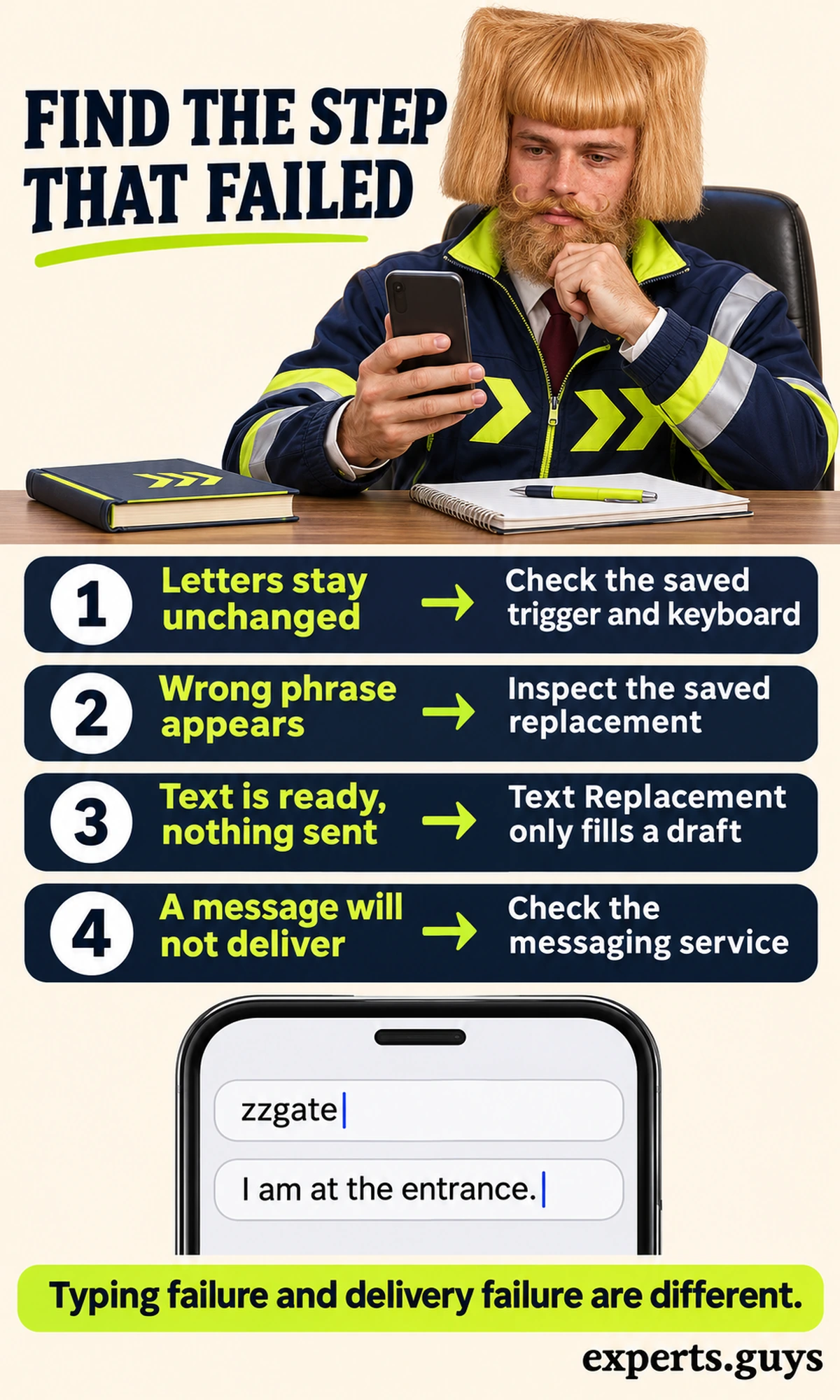
Use a controlled comparison instead of changing everything
Keep the saved trigger fixed while you compare where it works. The setup and draft sequence above provides the useful check: the same letters, the same intended phrase, and a plain text field. If you change the phrase, trigger, keyboard, and app together, a successful result will not tell you which change mattered. Change only the setting implicated by the symptom.
A replacement that appears in one ordinary field but not in another suggests a field or keyboard difference; it does not prove that all replacements are broken. Password fields and specialised editors are poor places to judge ordinary text expansion. Use a normal message draft for the comparison, and keep private values out of the example.
Autocorrect and saved replacements can feel similar because both alter what you type. Their purposes differ: a replacement is a deliberate stored mapping, whereas a correction or prediction responds to keyboard behavior. For the wider explanation, see how smartphone autocorrect works. Inspect the saved entry before disabling helpful keyboard features across the phone.
The color of a message is another separate clue. Blue indicates iMessage; green can indicate SMS, MMS, or RCS, so green does not identify one single service. The expanded sentence does not select a transport by itself. A change in delivery options therefore does not mean the abbreviation has stopped working.
If the words are correct but delivery fails, stop rebuilding the keyboard entry. Recipient details, the selected service, and connectivity are the relevant branch. Our phone basics guide provides broader device and connectivity context. A typing improvement cannot fix a destination that is wrong or a service that is unavailable.
Remove obsolete wording without clearing everything
For an entry you no longer want, open Text Replacement, tap Edit, use the remove control beside that entry, confirm Delete, and finish with Done. This is a targeted cleanup: it removes the obsolete mapping while leaving the rest of your collection available.
For cross-device differences, compare whether the devices use the same Apple Account and whether iCloud Drive syncing is enabled. Then verify the actual entry on the other device rather than assuming a setting change has already arrived everywhere. Apple’s personal dictionary guidance covers iCloud use and warns that Reset Keyboard Dictionary deletes all custom words and shortcuts. A full reset is a much broader action than deleting one entry.
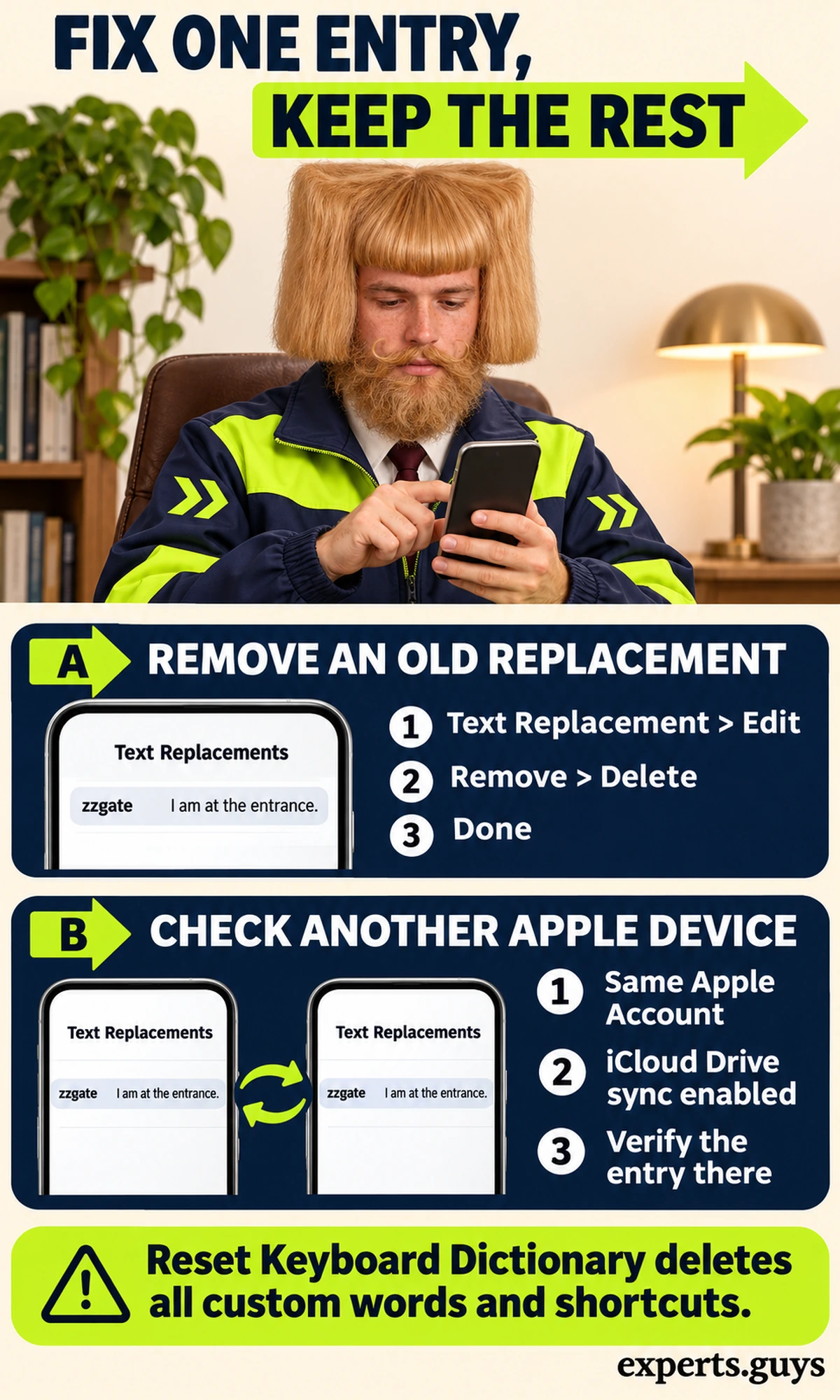
Clean up when the meaning changes, not just when a list becomes long. An old office entrance, a discontinued contact method, or a promise you no longer make is a reason to remove or revise a phrase. Keeping an obsolete entry because it took time to create adds a future checking burden each time it expands.
Shared devices deserve particular care. A phrase collection built around one person’s routine may be confusing when another person uses the same setup. Keep the account and audience assumptions visible to the people involved, and avoid treating cross-device availability as proof that every saved sentence is suitable everywhere. The maintenance question is whether an entry still belongs in that context, not simply whether it can be made to appear on another screen.
There is also no requirement to automate every recurring message. If the wording changes enough that you must rewrite most of it, a saved phrase may no longer help. If the recipient is uncertain, a fixed-recipient action may be the wrong fit. Retiring a shortcut that no longer saves useful effort is a successful maintenance decision.
Frequently asked questions
Do I need a separate app or a paid subscription for Text Replacement?
No. Text Replacement is part of the iPhone keyboard settings. The basic abbreviation-to-phrase setup does not require a scheduling app or subscription. A separate service may have its own features and charges, but that is a different decision.
Can I use a replacement in messages to someone with an Android phone?
The replacement prepares wording on your iPhone before sending, so the recipient does not need to share your keyboard setup. The available messaging service and its features are a separate matter. A saved phrase does not make an SMS or RCS conversation eligible for iMessage-only Send Later.
Will the other person receive my abbreviation?
The recipient receives the text you actually send. If the trigger expanded and you sent the full sentence, that sentence is the message. If it did not expand and you sent the abbreviation, the recipient can receive those letters instead. Read the composer before tapping Send.
Can I use the same trigger for two different meanings?
That is a poor design for a dependable shortcut. Give each intended phrase a distinct trigger so you do not have to guess which sentence will appear. If two phrases differ only in a detail that changes today, keep a neutral reusable core and edit the draft instead.
Does a keyboard shortcut automatically add my signature to every text?
No. A replacement is wording you request by typing its trigger; it is not a rule that appends a signature to every outgoing message. If you create a signature phrase, insert it deliberately and check that it belongs in that conversation.
Should I create these shortcuts while travelling?
Set up and review them while stationary in a safe place. A shorter message workflow still requires attention to the screen and recipient. Do not create or operate these touch-based steps while driving; the road-direction styling in the illustrations does not change that requirement.
Next steps
Choose one sentence you genuinely repeat, save its stable wording, and check it in an unsent draft. Add a recipient-specific shortcut only when that recipient is reliably part of the task. You have a useful setup when the correct text is easy to reach and the final sending decision remains clear.