“Ask to run” on an iPhone 13 Pro usually means a Shortcuts automation is waiting for confirmation before it starts. Change the automation’s run setting when that is the prompt you see; a request for data access, a menu choice or an unlock belongs to a different part of the workflow. Match the prompt first so you change the setting that actually controls it.
What is your iPhone actually asking you to approve?
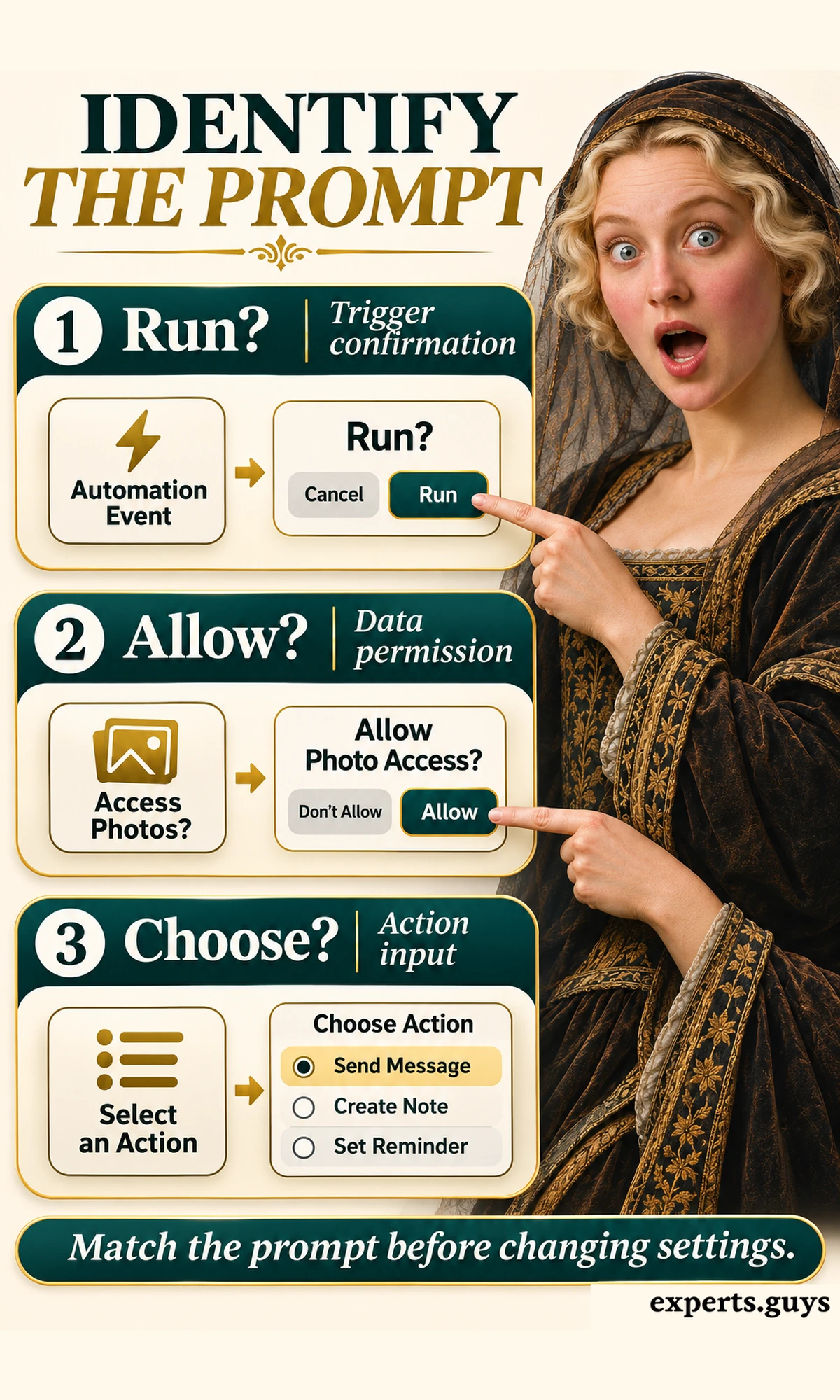
Read the words in the prompt and notice when it appears. An invitation to run after a charger connection or scheduled event points toward the automation trigger. A request to access photos or another data source concerns privacy. A text box or list of choices means the shortcut has reached an action that needs your answer. These can happen during the same run, so removing the first interruption does not necessarily remove the next one.
The useful distinction is between starting a workflow and finishing its actions. A trigger supplies the occasion: an event happened. The actions supply the work: show a notification, process text or ask an app to do something. Permissions determine which data the workflow can use. Authentication and app requirements may impose further limits. There is no single “never ask anything” switch that makes all those decisions for you.
On a narrow screen, swipe horizontally inside the table to compare all columns.
| What appears | What it means | Where to investigate |
|---|---|---|
| An invitation to run after an event | The automation is waiting to start. | Its trigger or execution setting. |
| Allow access to photos, location or other data | A data permission is needed. | The shortcut’s requested access and Privacy details. |
| A question, keyboard, menu or picker | An action needs a value or selection. | Ask for Input, Ask Each Time, menu or picker actions. |
| Unlock, authenticate or finish in an app | The action needs a permitted device or app state. | The requested action, its app and lock-state requirements. |
| A banner that reports something happened | It may be information rather than a request. | Whether any button or answer is actually required. |
Consider an illustrative charging announcement. Connecting the cable is the trigger; speaking “Charging started” is the intended result. If a Run request appears immediately after connection, the trigger is waiting. If a question asks what to say, the action is waiting for text. Both delays can feel like “the shortcut asks again,” but they require different changes. This example will also provide a harmless way to understand the checks later in the guide.
A notification can also be the intended output. A banner saying “Charging started” does not necessarily mean you have to tap it. Watch whether the workflow has already produced its result before treating every banner as an approval request. Otherwise, it is easy to remove useful feedback while leaving the real input dependency untouched. The relevant question is whether execution needs your response, rather than whether something appeared on screen.
The timing of the interruption is useful evidence even when the wording is vague. A dialog shown before any action begins points to the start boundary; a question shown after part of the work has happened points farther into the chain. This is a diagnostic clue, not a guarantee, because an action can itself request confirmation. Combine timing with the named action or data source. The goal is to locate the earliest unresolved decision rather than assume every pause originates in the automation tab.
Start with the narrowest diagnosis supported by what you can see. A prompt that names Photos gives you a concrete permission to inspect. A menu with several destinations tells you a choice is unresolved. A run invitation names an automation or event. You do not need to reset the phone, delete your shortcuts or grant broad access merely to classify these differences. First identify the layer; then use the corresponding procedure below.
Manual shortcuts and automatic triggers have different jobs
A normal shortcut can be launched deliberately, while a personal automation connects work to an event. Saying a shortcut’s name to Siri is another deliberate launch; it does not change a charger trigger’s confirmation policy. Likewise, putting a shortcut on a convenient launch surface cannot supply missing data inside the workflow. Choose a manual launch when you want to decide the moment of execution, and an automation when the event itself should decide that moment.
Keep this page’s scope separate from shortcuts that change a particular setting. The iPhone 13 Pro brightness shortcut guide covers building and using a display preset. Here, the task is to understand why an existing workflow pauses and whether its decisions can sensibly be made in advance. You can apply that diagnosis to a preset without rebuilding the preset itself.
Where is the run-confirmation setting on your version of iOS?
Use the controls actually displayed on your phone. Shortcuts interfaces have changed: some show Run Immediately and Run After Confirmation, others show Ask Before Running, and the newer integrated editor attaches an automation to a shortcut. An old screenshot can be accurate for its software and still be the wrong route for your device. The iPhone 13 Pro name alone does not identify the installed interface.
Check the software before looking for an old switch
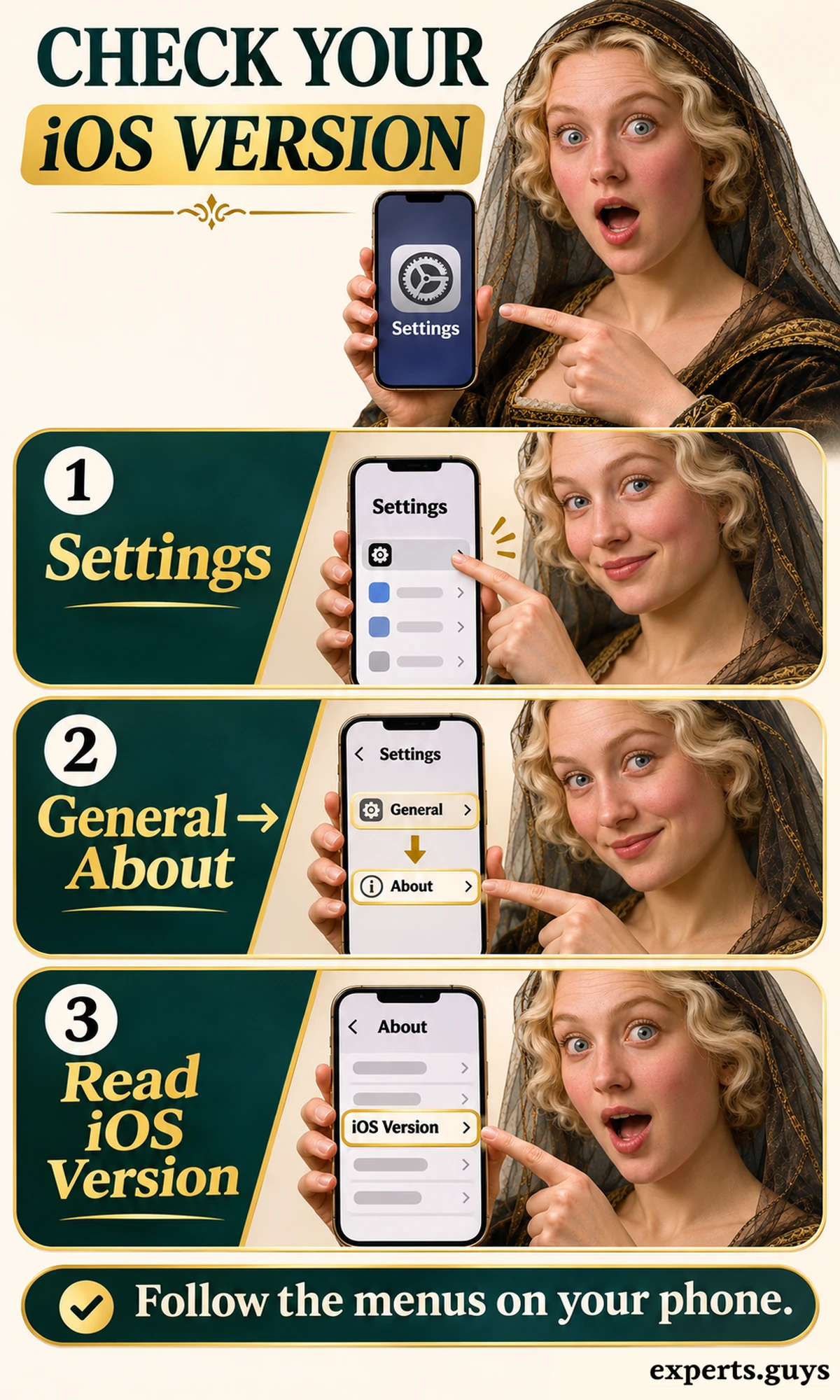
- Open Settings on the iPhone.
- Go to General → About.
- Read iOS Version, then return to Shortcuts and match the route below to the controls you see.
This is an identification check, not a requirement to install an update. The result is knowing which instructions you are comparing with your own screen. Apple’s iPhone compatibility and version guidance includes the iPhone 13 Pro and explains where to identify its software. If you are already using a working version, a missing old toggle is not by itself evidence that the phone needs repair.
When you see Run Immediately or Ask Before Running
- Open Shortcuts → Automation and select the automation that produces the invitation. Read its event and conditions so you do not edit a similarly named workflow.
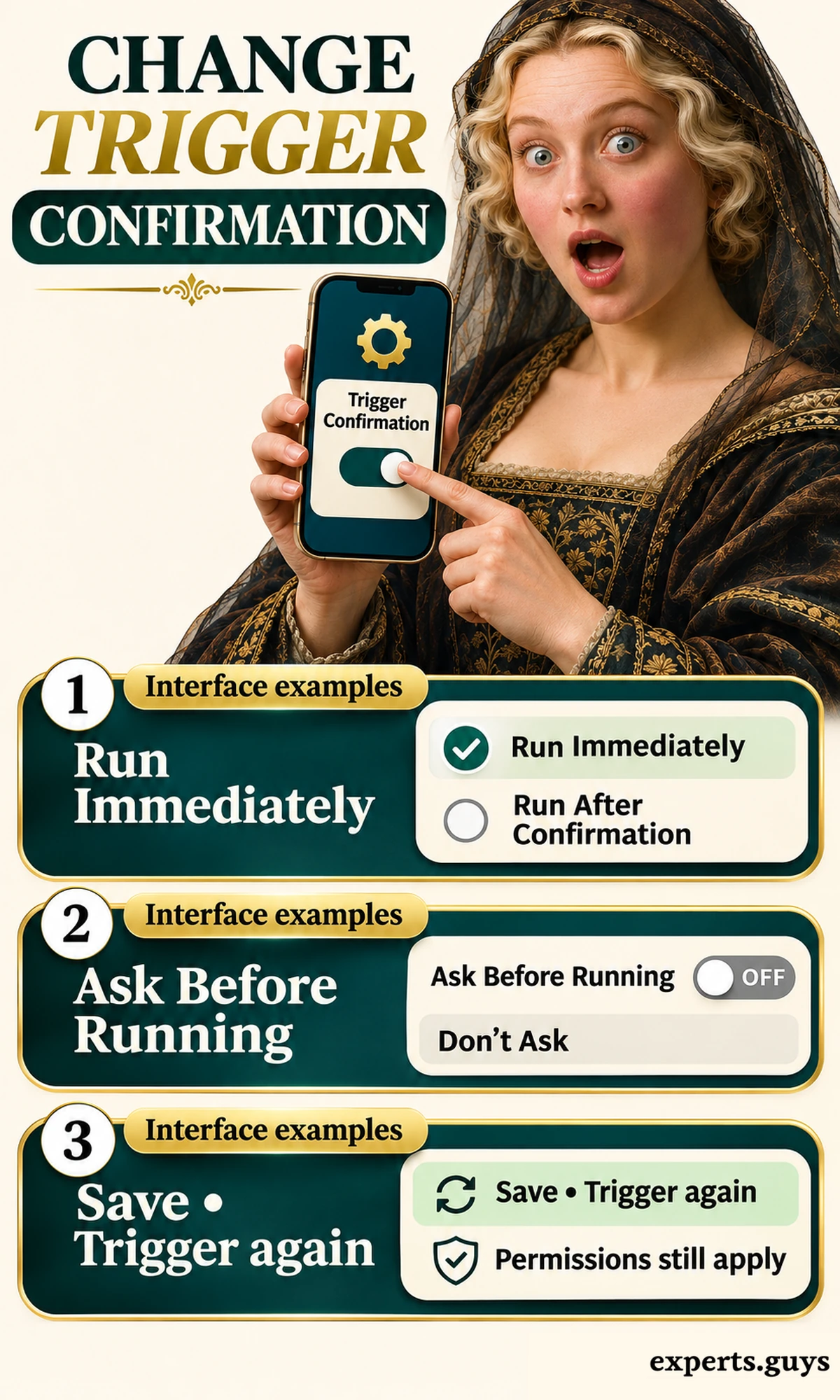
- If the execution choices include Run Immediately, select it instead of Run After Confirmation. If the interface instead has Ask Before Running, turn that off and confirm Don’t Ask when offered. These are alternative interfaces.
- Save with the completion control shown, commonly Done. Produce a fresh trigger event and check whether the original run invitation still appears.
This change answers one question in advance: may this event start the automation? It does not answer questions embedded in the actions. Do not infer success solely from seeing the new selection in the editor. The useful checkpoint is a new event that starts the intended work without the former run invitation. If the next screen asks for a photo or a typed value, continue with that specific diagnosis rather than repeatedly changing the trigger setting.
Make the run policy fit the consequence of the event. A charger connection is easy to repeat unintentionally while moving a cable, so an automatic task should tolerate another connection. A brief announcement is an appropriate illustrative example because another announcement is easy to understand. A workflow that changes or shares important content deserves a more deliberate design. Choosing immediate execution is therefore partly an editorial decision about the task, not merely a way to make a warning disappear.
The old Ask Before Running wording remains in Apple’s personal-automation confirmation guide. Its important limitation is that individual actions can still require attention. Apple’s iOS 17 release notes also document expanded immediate-running support for Bluetooth, Wi-Fi, Arrive and Leave triggers. Avoid old blanket advice that those event categories can never run automatically; actual options depend on the software and the chosen workflow.
When the automation is attached inside the shortcut editor
- Open the existing shortcut in Shortcuts, choose Edit, then open Automation to inspect or choose its trigger. Set the actual event conditions you intend to use.
- For the lock-related option documented in Apple’s integrated workflow, open Edit → Info → Privacy and inspect Allow Running When Locked. Enable it only when you want that shortcut eligible to run while the phone is locked.
- Finish editing and test a new event in the state that matters to you. If an action still asks for permission, input or authentication, investigate that action separately.
Apple’s versioned iOS 27 automation instructions describe this integrated route. A lock-state allowance is not a universal replacement for every confirmation or security control. It changes the permission to run in that device state, while individual actions retain their requirements. If your phone still has a separate automation editor, use its visible controls instead of trying to find a screen it does not contain.
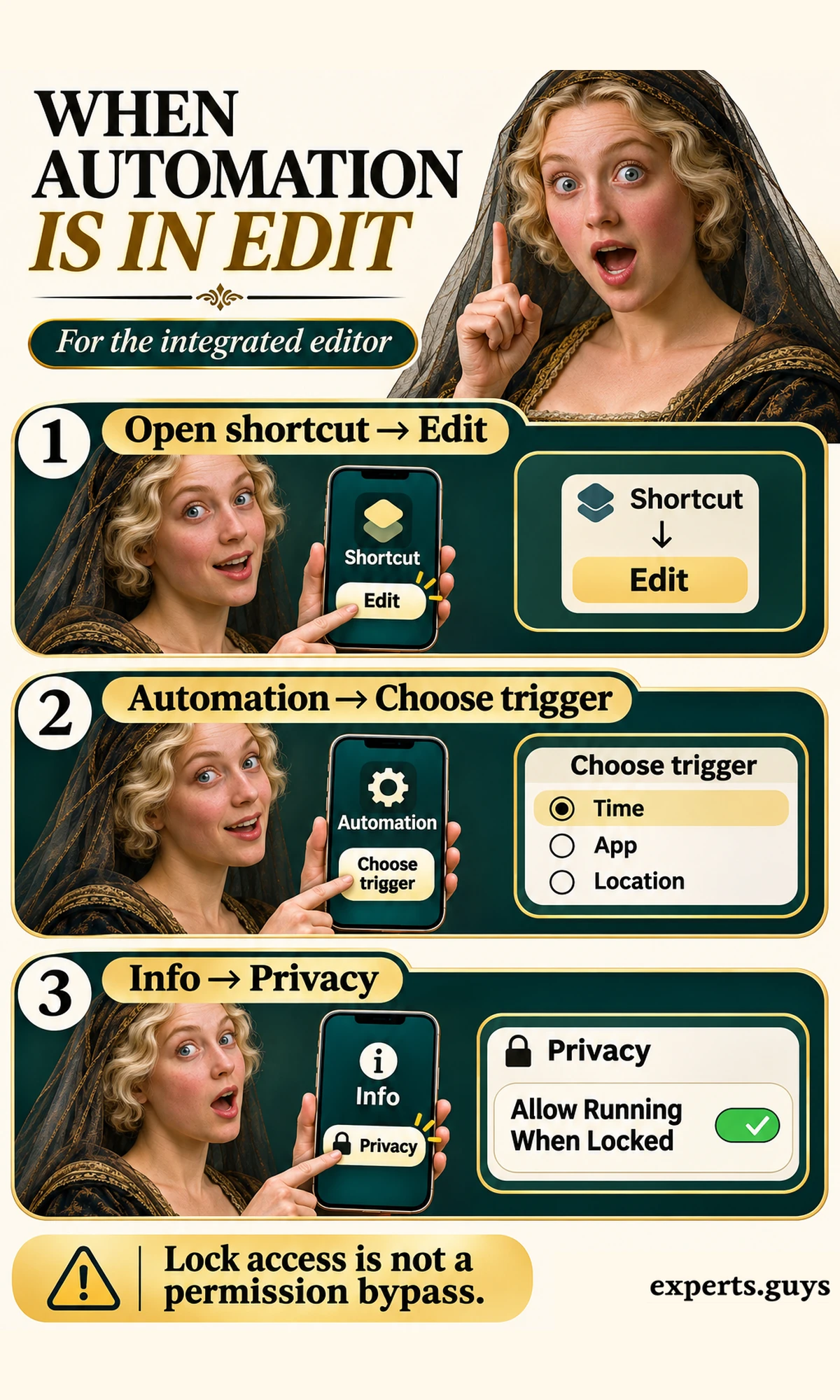
The distinction matters most when the phone is left unattended. A workflow can be allowed to start while locked yet contain an action that cannot complete without interaction. Conversely, a manually launched shortcut may work while you are looking at the phone because you supply that interaction naturally. Design around the actual unattended task. A fixed announcement has fewer unresolved decisions than choosing a file, checking its contents and deciding where to share it.
The launch context can supply information without you noticing. When you deliberately choose a photo and then invoke a shortcut, your selection tells it what to process. An event-triggered run may have no equivalent selection available. Giving it permission to start does not recreate that context. When a workflow depends on content selected in another app, decide whether its automatic version has a valid source for that content. If it does not, the manual version may be the clearer and more reliable design.
For ordinary device concepts behind these differences, the phone basics guide explains the relationship between the operating system, apps and hardware. On this page, the practical takeaway is narrower: choose the interface route you have, save the intended run policy and test a new event. Repeating a legacy route after finding a different editor rarely provides more information.
Why can a shortcut still ask after you allow automatic running?
Automatic starting does not supply missing values or grant every data permission. Inspect what the new prompt requests, especially if its wording differs from the first interruption. A workflow that moves from “Run?” to “Allow access?” has progressed to another decision. Treating both prompts as the same failure can lead to unnecessary changes and make it harder to tell which part is now working.
Approve only the data the shortcut actually needs
- Run the shortcut manually while you can read the screen. For an unfamiliar shortcut, inspect its actions before approving access.
- When a privacy dialog appears, read which data or service it requests and compare that request with the intended job. Choose Allow Once, Always Allow or Don’t Allow where offered.
- Use Always Allow only for an access decision you want retained. If you later want to reconsider retained access, open the shortcut’s details, choose Privacy and use the relevant control or Reset Privacy.
Apple’s Shortcuts privacy guidance distinguishes temporary and retained data access and documents resetting a shortcut’s privacy decisions. Always Allow addresses that access request on subsequent runs; it is not a promise that the entire workflow will become silent. Reset Privacy also has a specific scope: it clears the shortcut’s retained data-access decisions rather than repairing an automation trigger or supplying a menu choice.
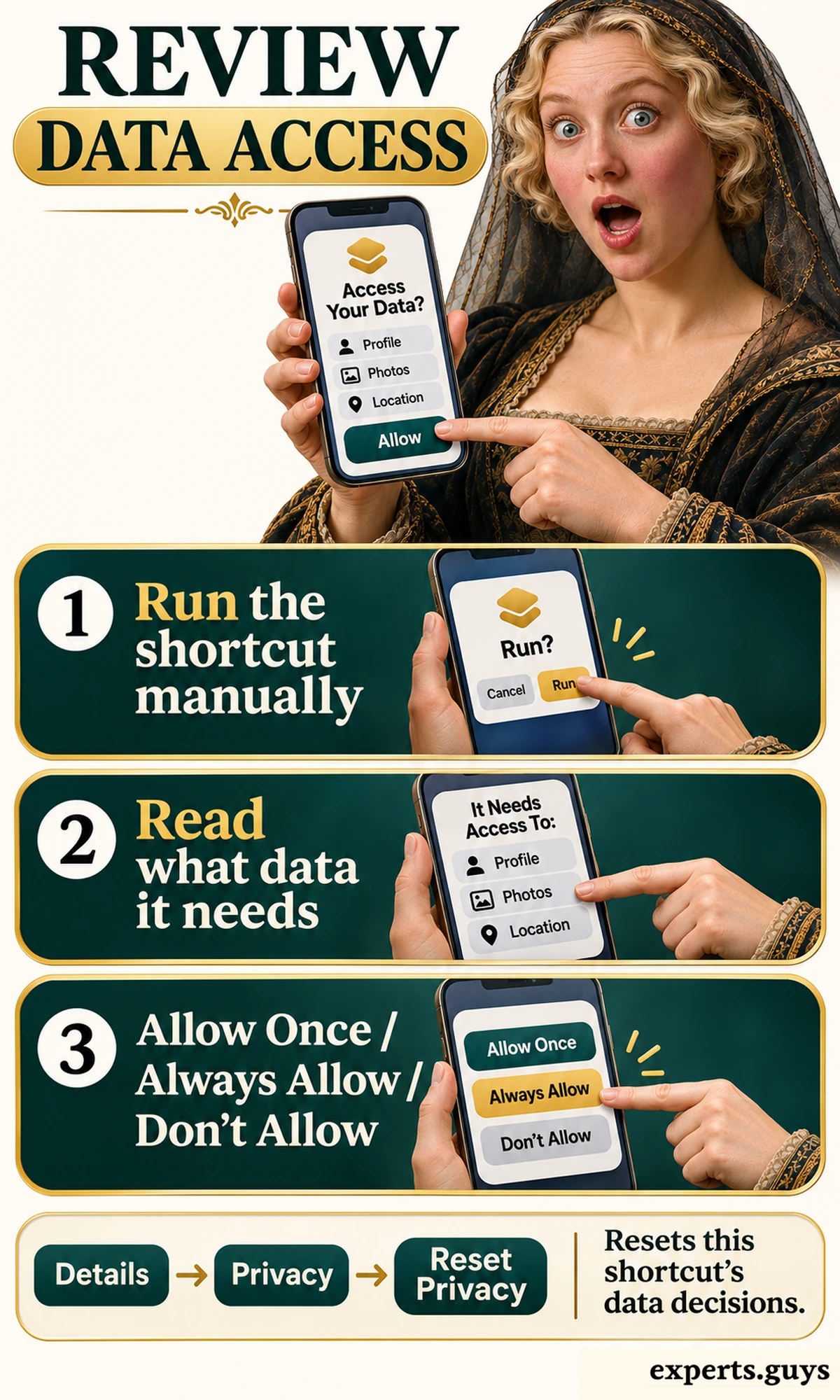
A missing Privacy tab can simply mean that the shortcut has not been given data access. Do not use its absence as proof that privacy restrictions are disabled. Separately, an action provided by another app may depend on that app’s own permissions or signed-in state. The useful test is whether the requested access matches the action’s purpose. A basic charging announcement has no obvious need to browse your photo library, so a Photos request would deserve examination before approval.
Choose the smallest durable permission that fits the task, rather than granting everything to remove friction. Allow Once is useful when you want to examine a single run before making a lasting decision; its temporary nature also means later access can ask again. Always Allow is convenient for a trusted routine that genuinely needs the same data repeatedly. Neither choice is an assessment of a downloaded shortcut’s overall trustworthiness, and the source of the shortcut still matters.
Permission and selection are also separate. Permission to use photos does not identify which particular photo should be used. A shortcut can legitimately have retained photo access and still display a picker because selecting an item is part of its design. In that situation, repeatedly resetting privacy sends you back through access decisions without resolving the missing selection. Decide whether choosing an item is essential to the task before looking for a way to make that step unattended.
Replace an unnecessary question with a fixed value
Some actions deliberately stop for an answer. Ask for Input presents a question; Ask Each Time leaves a parameter to be supplied at runtime; a menu or picker waits for a selection. Those are useful design choices when the answer changes. They are poor fits for an unattended task whose answer is already known. Apple’s Ask for Input explanation makes clear that the answer is passed onward to the next action. Removing the question without supplying a replacement can leave that next action without the value it needs.
- Open the shortcut in its editor and locate the action asking the question. In the illustrative charging announcement, the chain is Ask for Input → Speak Text.
- If the spoken words should always be identical, replace that question with a Text action containing Charging started.
- Connect Speak Text to the output of that Text action. Inspect its input after editing so it is using the replacement text rather than an old variable.
- Run the shortcut manually. The checkpoint is that it speaks the fixed words without asking what to say. Keep the interactive version instead if you genuinely want different words each time.
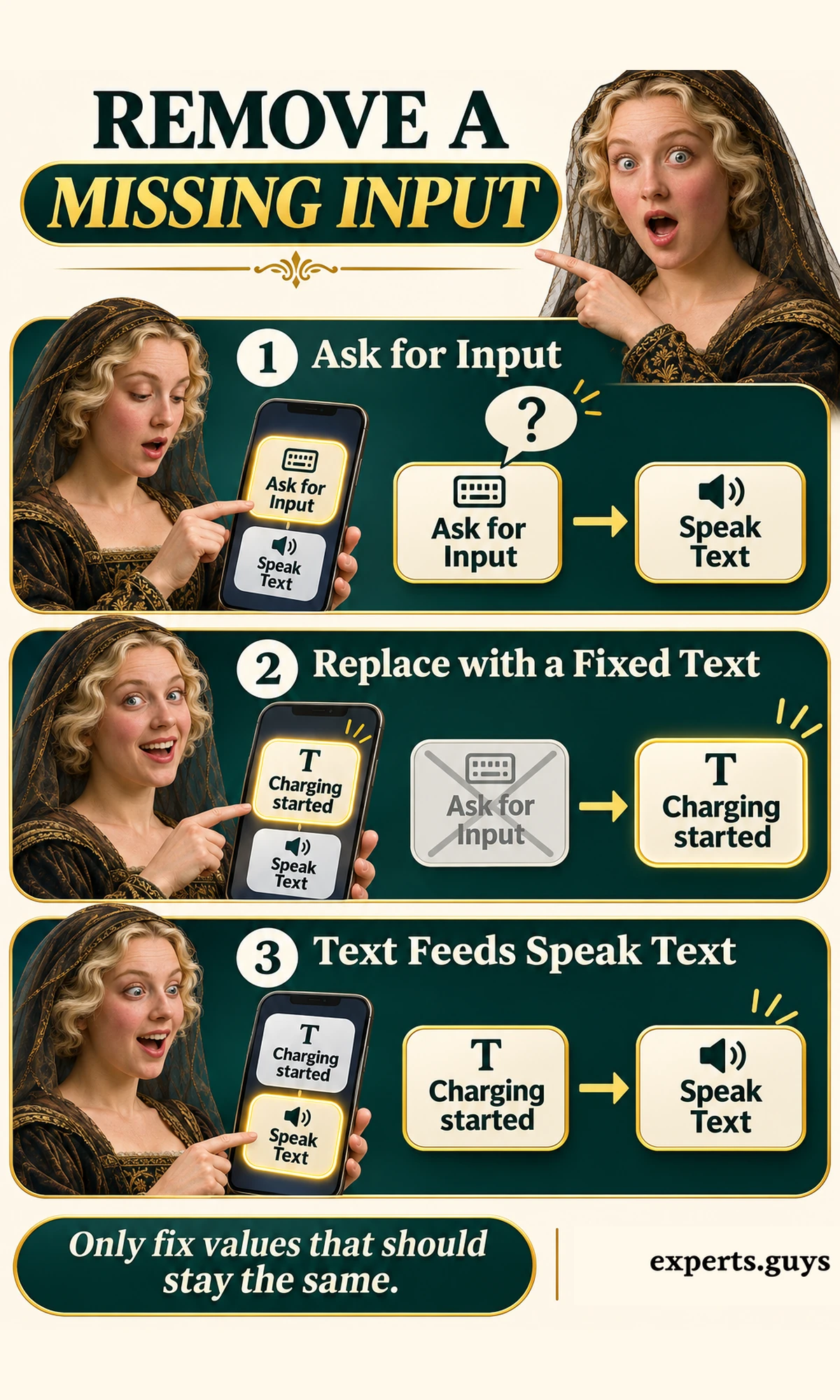
This is a design change, so preserve the meaning of the task. Replacing a variable greeting with fixed wording may be reasonable. Silently fixing a recipient, payment-related choice or file destination can have consequences that outweigh the convenience. If the decision should remain yours, keep the prompt and use a manual launch. A shortcut is still useful when it reduces several actions to one deliberate decision; unattended execution is not the only successful outcome.
A default answer is also different from a supplied answer. Prefilling a question can make an interactive shortcut faster, but the dialog may still wait for confirmation. For an unattended workflow, provide the value directly to the action that needs it. In a menu-driven workflow, eliminating the menu also requires choosing which branch should execute. Do not delete control steps simply because their labels look like interruptions; understand what information they contribute first.
Keep the input and output relationship visible when changing a chain. In the charging example, the next action must receive the words from the new Text action. Merely placing a Text action somewhere in the editor does not express which value the later action should use if it still references an old answer. The meaningful check is the input shown on the consuming action. This avoids a common design mistake: removing the visible question while retaining a dependency on the answer that question used to provide.
Separate a run notification from an action that pauses
An automation’s status notification, a Show Notification action and a Show Alert action are different controls. Apple documents that Show Notification continues to the next action, whereas Show Alert pauses the workflow. If the shortcut contains an alert deliberately asking you to acknowledge something, suppressing a trigger notification will not remove that pause. Match the behavior to the action’s job before deciding whether its interaction is unnecessary.
The same distinction helps with apparently unrelated shortcut problems. A flashlight that comes on from a Lock Screen control has a different cause from a shortcut waiting for an answer. The guide to removing the iPhone 13 Pro flashlight shortcut owns that control-removal task. This confirmation guide does not need to repeat the Lock Screen editing procedure to explain why changing an automation setting would leave the built-in control unchanged.
How do you test the trigger and undo changes safely?
Separate the event test from the full workflow test. First establish whether a harmless action starts after the chosen event. Then establish whether the intended actions complete. Testing both at once with a long chain can leave you guessing whether the event was missed, a permission was refused or a later step paused. A short test makes the first boundary observable, while a second test checks the real outcome.
Use a charger event with a harmless notification
- Use a separate test shortcut or automation so the experiment does not send messages, change important files or repeat an unwanted action. Choose the Charger event and Is Connected. In a separate-automation interface, begin in Automation; in the integrated editor, attach the trigger through Edit → Automation.
- Add Show Notification with the text Trigger reached. Select the available automatic-running option for your interface and finish saving.
- Disconnect the charging cable, then connect it again. Connecting is the fresh event; leaving the phone continuously connected does not recreate that transition.
- Look for the test notification. If it appears, the event reached that action. Then test your intended shortcut separately, checking its actual result and any new prompt.
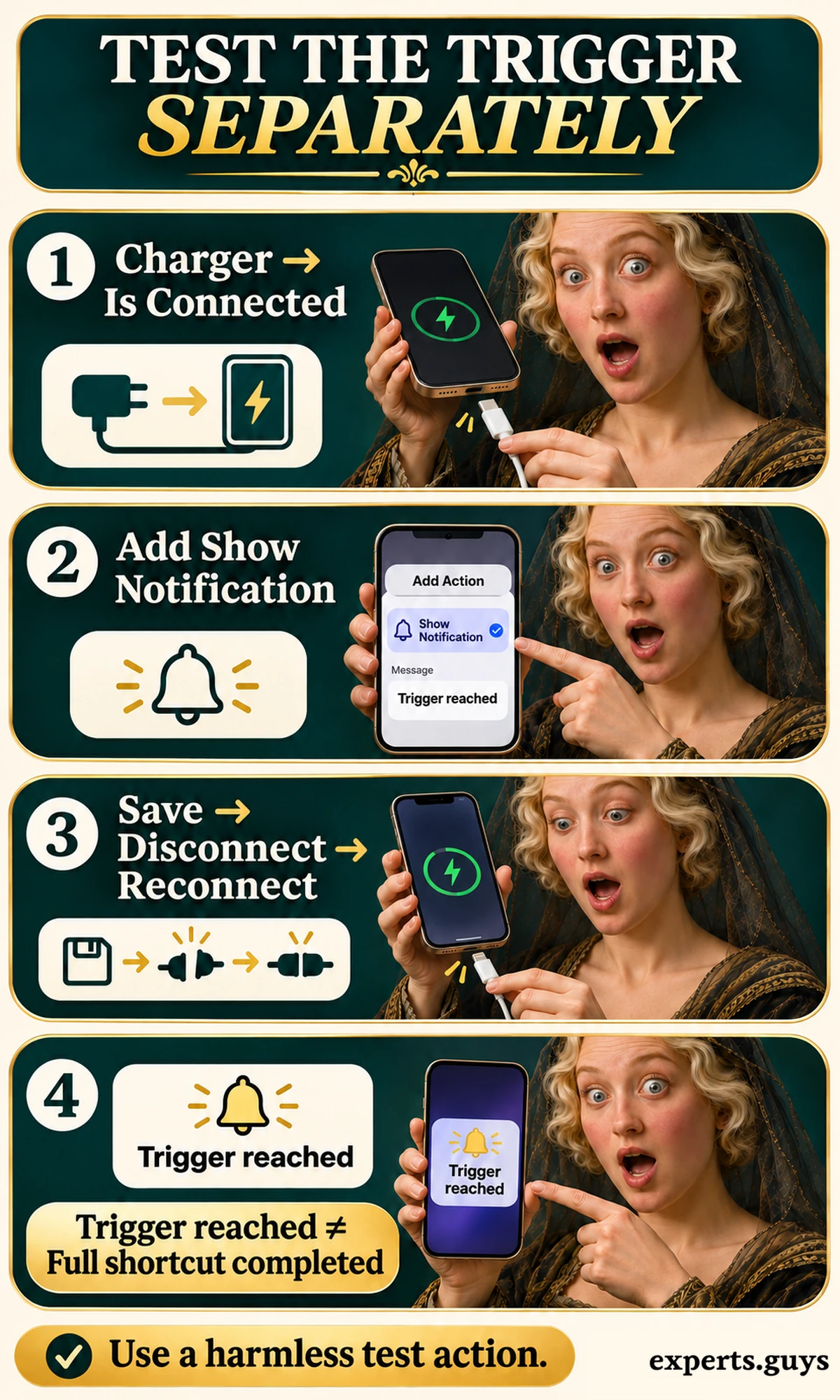
A successful notification test is deliberately a small conclusion. It shows that the trigger reached Show Notification under those conditions. It does not prove that a photo selection, network request or another app’s action will finish. Conversely, a missing visible banner does not prove that no action ran, because notification presentation can affect what you see. Keep the phone unlocked for the first diagnostic run and inspect its notification area before drawing a broad conclusion.
If a complex routine works manually but the simple event test does not, return to the event definition and run policy. Check the selected direction: Is Connected and Is Disconnected are opposite transitions. If the simple event test works but the real routine pauses, inspect the real routine’s action sequence. If it works while unlocked and fails only when locked, investigate that state and the actions’ requirements. Each comparison changes one meaningful condition instead of mixing several possible causes.
Several workflows can respond to similar events, so an unexpected result may come from a different automation than the one you just edited. Compare the name, trigger and output of the selected workflow with what actually happened. This is especially useful when an old test routine remains alongside the everyday one. Do not interpret an unrelated banner as proof that your latest change was ignored. The diagnosis needs a connection between one specific event, one intended workflow and its expected result.
On a narrow screen, swipe horizontally inside the table to compare all columns.
| Observed result | What it supports | Useful next decision |
|---|---|---|
| A fresh event produces “Trigger reached” | The trigger reached the test action in that state. | Examine the real workflow’s actions and final result. |
| A manual run asks for a value | An action still expects interaction. | Supply a fixed value only if that fits the task. |
| The real result occurs but a banner remains | The banner may be feedback rather than a blocker. | Decide whether the feedback is useful before removing it. |
| The workflow works unlocked but not locked | Device state changes the outcome. | Check lock allowance and the specific action’s limits. |
| Nothing changes after editing | The event, saving or execution path needs checking. | Reopen the intended workflow and produce the actual event. |
For a more complicated routine, the completion check should describe what the routine was meant to do, not simply that its icon animated. A spoken announcement should contain the expected words. A workflow intended to hand content to an app should reach that app with the expected content. If the operation would have external consequences, use a harmless substitute while diagnosing its trigger, and keep the consequential step deliberate until its behavior is understood.
Pause the event without deleting the useful shortcut
- Open the workflow that responds to the unwanted event. In an interface that offers Do Not Run, select that choice. In an older interface with Enable This Automation, turn that switch off.
- If your integrated editor instead attaches a trigger to the shortcut, open the shortcut’s automation trigger and remove that trigger. Keep the shortcut’s actions if you still want to run them manually.
- Finish editing. Repeat the same event and check that it no longer starts the workflow. A manual shortcut can remain available after its automatic trigger is removed.
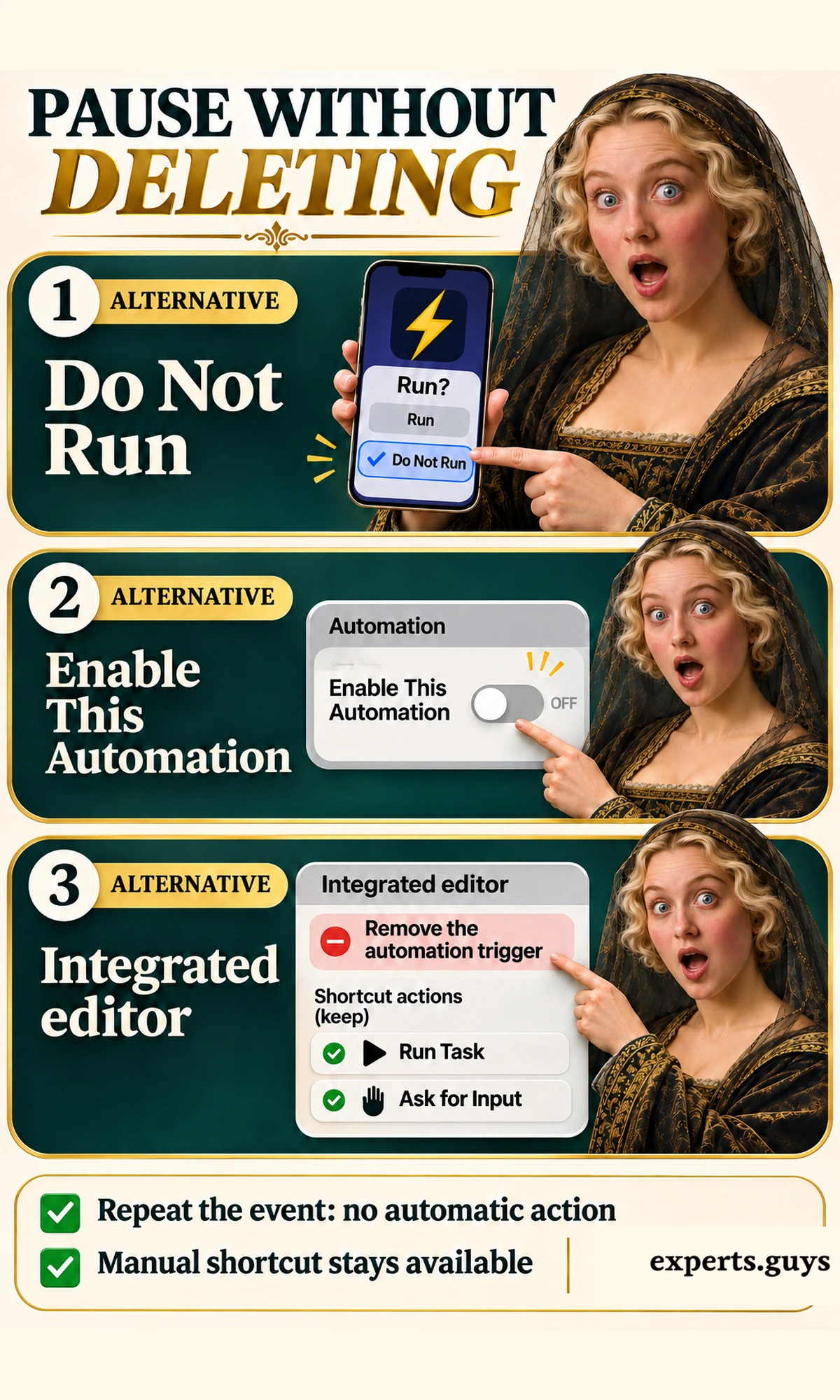
Disabling and deleting solve different problems. Pausing an event lets you stop automatic execution while retaining the work you may want to use deliberately. In the integrated editor, removing the trigger is the relevant separation; deleting the whole shortcut would also remove the action sequence. If you later decide to restore automation, choose its event again and recheck the run behavior. Do not assume a prior successful manual run proves the newly attached event is correct.
A pause test also needs the correct success condition. If you disabled a charger trigger, a manual launch of the retained shortcut can still work normally; that does not mean the trigger remains active. Conversely, a quiet screen after the event is insufficient if the workflow performs an invisible change. Check the particular effect you were trying to stop. In the harmless example, absence of the automatic announcement is useful evidence, while the shortcut remaining available in your collection is an intended result.
The best stopping point is a workflow whose decisions match its use. Leave a personal choice interactive, supply genuinely constant inputs in advance, and allow an event to start automatically only when that is the behavior you want. An occasional prompt is not automatically a defect. The improvement is removing an unnecessary interruption while preserving the decisions and protections that still serve the task.
Frequently asked questions
Do I need to download an “Ask to Run” shortcut?
No. The phrase usually describes how an automation asks for confirmation, rather than the name of a required download. Start with your existing shortcut or automation. A third-party download is unnecessary just to inspect its run policy, and adding one can introduce actions and access requests unrelated to the task you wanted.
Will an automation copy to my other iPhone automatically?
Apple describes personal automation as device-specific: it can be backed up to iCloud without syncing as an automation to your other devices. A shortcut appearing elsewhere does not prove that the same event trigger is installed there. Check the automation on the phone where you expect the event to occur.
Why is there no Ask Before Running switch?
Your installed Shortcuts interface may use different execution choices or the integrated shortcut editor. Match the controls you actually see to the routes in this guide. The absence of that older label does not mean every action can run unattended, and it does not justify changing unrelated privacy settings.
Can a Siri request avoid every unlock or app prompt?
No universal bypass is provided by launching a shortcut with Siri. The launch method does not remove the individual actions’ data, input or authentication requirements. If a task inherently needs your choice or authentication, keep that part interactive and use automation only for the portion that can complete appropriately without you.
Choose the next check from the prompt
Use the words on the next interruption to choose your next action. A run invitation belongs to the trigger; a data request belongs to access; a question or picker belongs to an action’s input. Once the intended workflow completes after a fresh event, stop changing unrelated settings. Keep a deliberate choice deliberate, and pause the event if the automatic behavior is no longer useful.