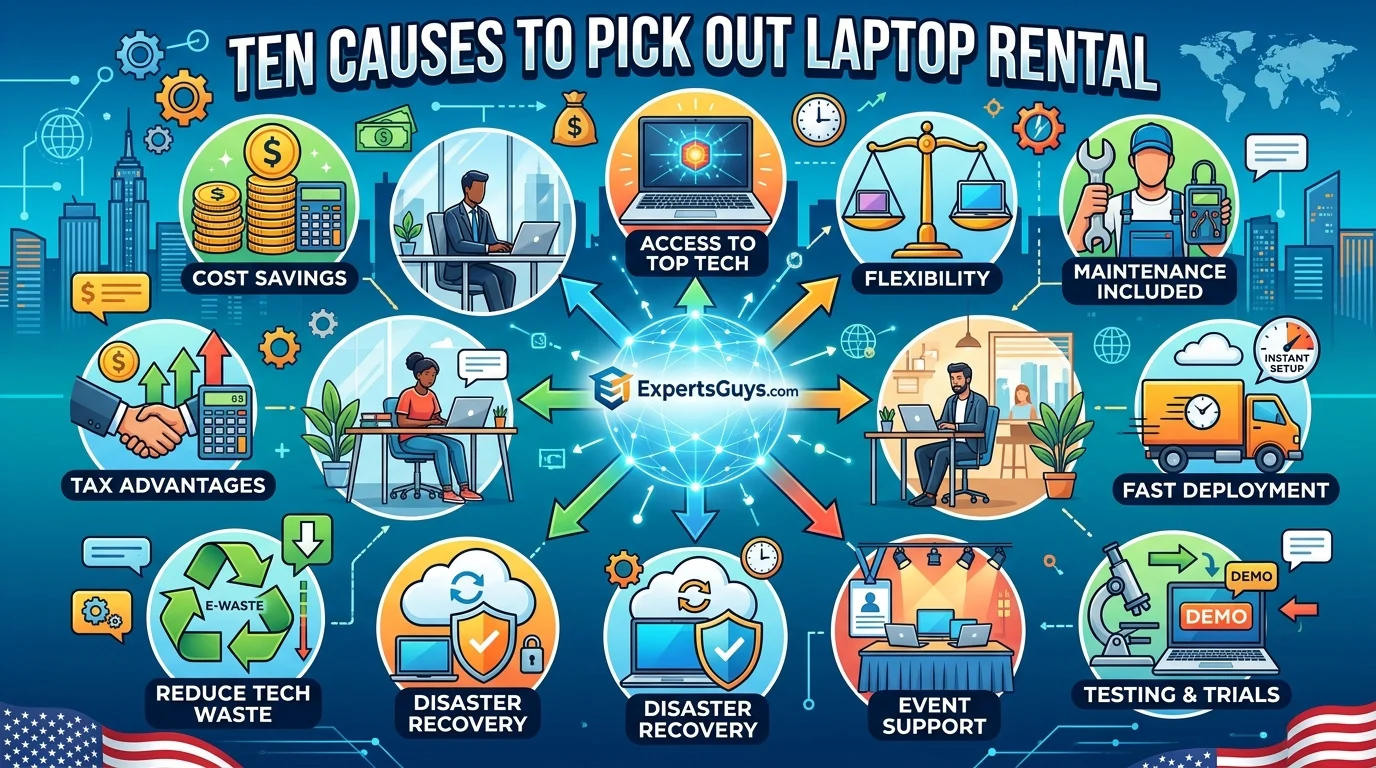

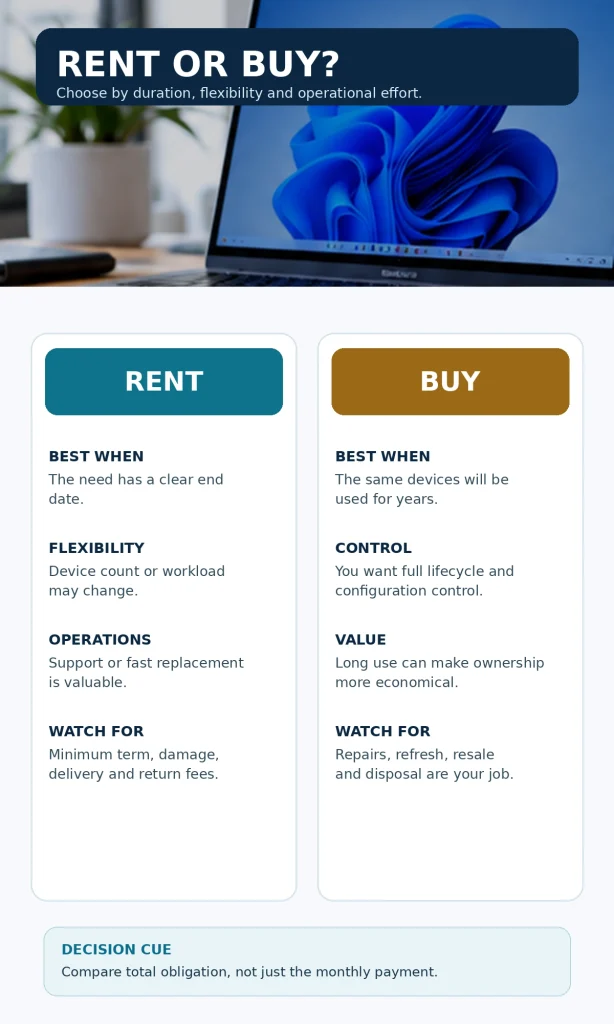
Renting laptops makes the most sense when the need is temporary, the number of devices may change, or support and fast replacement matter more than owning the hardware. Buying usually becomes stronger as the expected use period gets longer, especially when the same people will keep the devices for years and your team can handle setup, repairs, security, and eventual disposal. The real decision is not “renting is cheaper”; it is whether flexibility and lifecycle support are worth more than long-term ownership.
The old version of this page treated rental as broadly advantageous in almost every temporary situation. That is too simple. Rental can solve procurement and operational problems very well, but minimum terms, delivery fees, accidental-damage liability, limited inventory, return conditions, and data-handling requirements can erase the benefit if they are not checked before signing.
Laptop rental vs buying: the quick decision
| Reader condition | Rental usually fits better | Buying usually fits better |
|---|---|---|
| Expected use | Defined short or medium period | Stable multi-year use |
| Device quantity | Headcount may rise or fall | Team size is predictable |
| Support | Replacement/support is valuable | In-house IT can support the fleet |
| Hardware control | Standardized available models are fine | Exact build, upgrades, and ownership matter |
| End of use | You want collection and handback | You want to keep, resell, or redeploy the asset |
For a three-month project with twelve contractors, rental may be attractive even if the monthly rate looks higher than the monthly equivalent of a purchase. The rental may also remove the need to source twelve units, configure them, manage break/fix issues, store them afterward, and find a second use for them when the project ends.
For a permanent team that will use the same laptops for three or four years, the opposite can happen. Once cumulative rental payments, extensions, and fees approach or exceed the cost of buying and supporting the machines, ownership can become the more sensible choice.
Laptop Rental
Fit Studio
Match duration, team size, workload, support needs and return risk to the right procurement direction - without pretending one option is always cheaper.
Build your decision
Choose the conditions that actually change the answer. The result is a direction and quote checklist, not a fake precision score.
-
Why this direction
Performance class
Contract checks
Security & return
Find and compare laptop-rental providers
No API key is required. Search your location, then compare the quotes you actually receive.
| Candidate | Total quote | Replacement / support | Return / damage terms |
|---|---|---|---|
10 reasons laptop rental can be the right choice
1. The project has a clear end date
A temporary need is the strongest rental case. If a client engagement, training program, relocation, pilot, event, or seasonal workload ends on a known date, you can match device access to the project instead of buying hardware that may sit unused afterward.
2. You need to deploy a temporary team quickly
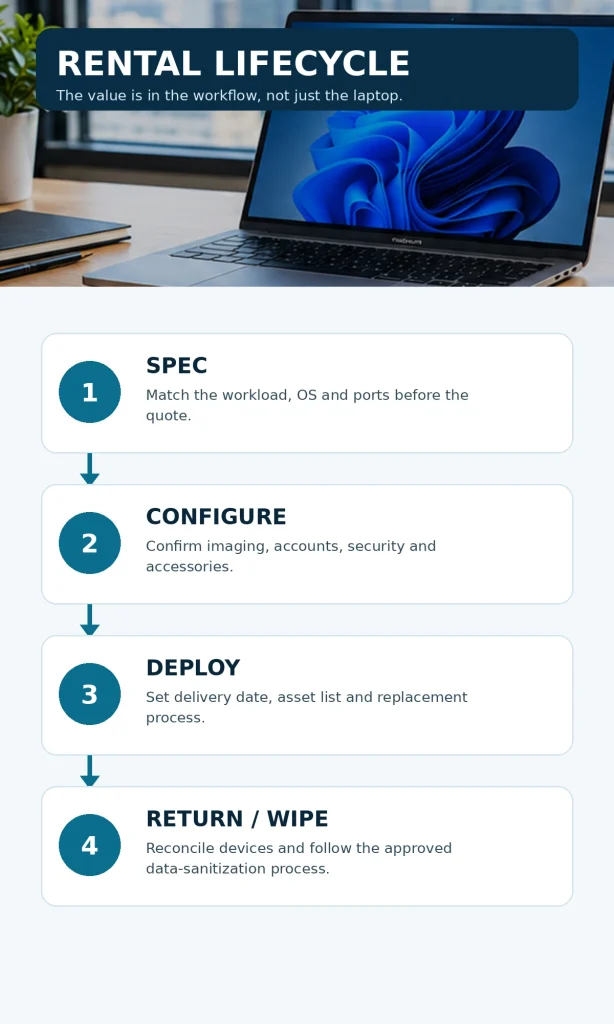
Rental can reduce the procurement work around onboarding contractors, interns, short-term hires, field teams, and temporary offices. The useful question is not simply how quickly a vendor can deliver, but whether the machines arrive with the right operating system, chargers, adapters, security configuration, applications, and asset list.
3. Headcount may change during the assignment
Buying for the highest possible headcount can leave you with spare machines; buying for the lowest possible headcount can leave people waiting. A rental arrangement can be easier to scale when the contract allows additions, returns, and extensions without punitive fees.
4. You want to avoid a large upfront hardware purchase
Rental spreads the cost over the period of use instead of requiring a large purchase at the start. That may help a small company, event team, or project budget preserve cash for payroll, travel, software, production, or other immediate needs, but it does not automatically mean the total cost is lower.
5. Support and replacement can be bundled
A strong rental contract can include hardware support, replacement units, configuration help, and collection. That matters when downtime is expensive or the organization has limited IT capacity. Never assume these services are included, though; replacement time, exclusions, delivery charges, and responsibility for accidental damage should be written into the agreement.
This is one place where rental overlaps with, but is not identical to, Device as a Service. Both Dell APEX PC as a Service and Lenovo Device as a Service show how business device programs can bundle hardware with lifecycle services, but DaaS and leasing usually involve different terms, service scopes, and commitment periods from short-term rental.
6. You need specialized hardware only for one job
Some teams need higher-performance laptops for a short burst of video work, CAD, 3D, data processing, software testing, or a specific client environment. Rental can make sense when that performance tier would be excessive for normal day-to-day work after the project is over. Before ordering, verify the processor class, memory, GPU, display outputs, ports, operating system, and administrator rights rather than accepting a vague “high-performance laptop” label.
7. Events and training need a standardized fleet
Conferences, examinations, workshops, sales roadshows, temporary classrooms, and registration desks often work better when every machine has the same setup. Standardized rental units can simplify instructions, troubleshooting, spare-device planning, and teardown because staff do not have to support a mixture of personal machines.
8. You want to test hardware before making a larger purchase
A short rental can be a practical pilot when a team is unsure whether a device class actually fits the workload. Test the screen, keyboard, battery behavior, thermals, docking, external displays, software compatibility, and employee acceptance before committing to a larger fleet. If you are evaluating permanent hardware, the same criteria used in our guide to the five attributes of a good laptop can help structure the trial.
9. You want a simpler end-of-project handback
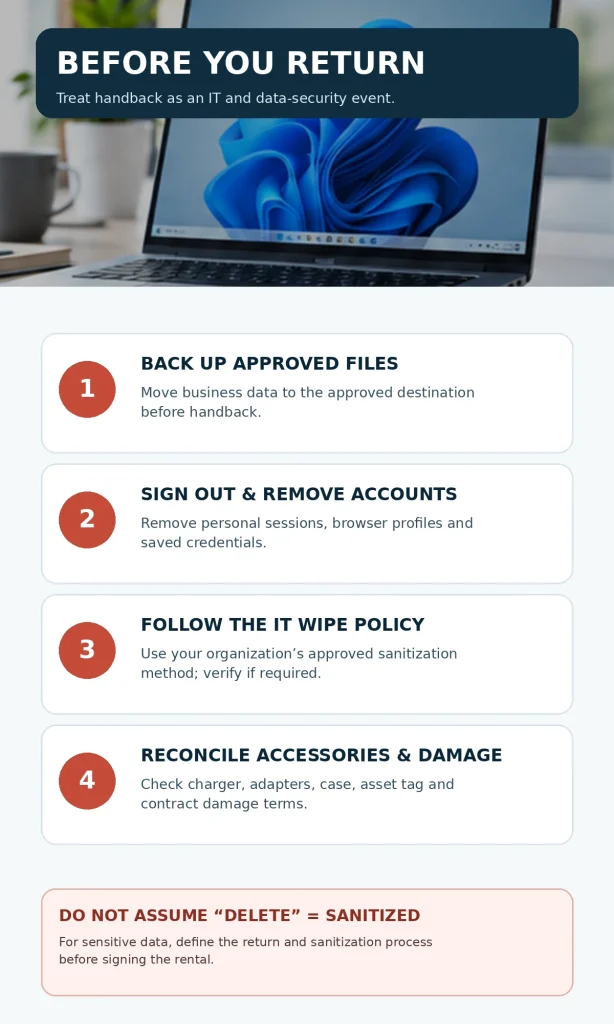
Rental can remove the later question of where surplus laptops should be stored, reassigned, sold, or recycled. The convenience only holds if the return process is defined: who packages the devices, who pays for shipping, how accessories are reconciled, how damage is assessed, and how data is removed before the equipment leaves your control.
10. You need continuity while owned devices are repaired or refreshed
Rental units can act as bridge devices during repairs, office moves, refresh projects, insurance claims, supply delays, or staged migrations. This is especially useful when a business cannot pause while waiting for a permanent replacement, although short emergency rentals can carry premium delivery or daily rates.
What the old “travel” reason got wrong
Renting a laptop at your destination can reduce the amount of equipment you carry, but it should not be justified by a claim that airlines generally require laptops to be checked. Current IATA guidance on portable electronic devices recommends keeping laptops and other electronic devices in carry-on baggage, with airline-specific rules checked before travel. If a battery-powered device is placed in checked baggage where permitted, it must be completely powered off and protected from damage and accidental activation; spare lithium batteries and power banks belong in carry-on baggage.
The hidden costs that can make rental a bad deal
The headline rental rate is only one part of the obligation. Ask for a quote that makes every charge visible so you can compare the rental against the real cost of buying, supporting, and eventually disposing of the same number of machines.
- Minimum term: A “monthly” rate may still require several months.
- Delivery and collection: Fast or multi-site delivery can be extra.
- Deposit or credit requirements: These affect cash flow even if refundable.
- Damage liability: Screen, keyboard, liquid, cosmetic, and theft rules can differ.
- Replacement terms: “Support included” does not necessarily mean same-day replacement.
- Accessories: Docks, chargers, adapters, cases, mice, and displays may be separate line items.
- Extensions: The rate can change if the project runs longer.
- Early returns: You may still owe the full contracted period.
- Software: Licenses and imaging are not always included.
- Data handling: Security requirements can add configuration or sanitization work.
Security matters more when the laptop will be returned
A rented machine should be treated as a temporary endpoint, not as a disposable personal computer. Define account setup, encryption, endpoint protection, administrator rights, local-data storage, remote management, and handback steps before the device is issued to a user.
For organizations handling confidential information, the return stage needs a documented sanitization process. NIST SP 800-88 Revision 2 frames media sanitization as a program with techniques and controls selected according to the sensitivity of the information; that is a much stronger standard than assuming that deleting files or resetting an account automatically makes data inaccessible.
What to put in a laptop-rental quote request
A precise request produces a more comparable quote. Give every vendor the same workload, duration, quantity, service, and return assumptions so you are not comparing one bare device price with another provider’s fully managed package.
- Number of laptops and expected rental dates.
- Primary workload: office, development, creative, CAD/3D, event, training, or other specialist use.
- Required operating system and any application or image requirements.
- Minimum memory, storage, display, ports, GPU, or docking needs where they materially affect the job.
- Delivery locations and dates.
- Spare-device requirement and replacement response time.
- Accessories required with each unit.
- Security, encryption, MDM, EDR, account, and data-handling requirements.
- Damage, theft, loss, and insurance terms.
- Extension, early-return, and cancellation terms.
- Return shipping, collection, inspection, and sanitization procedure.
Rental, lease, or DaaS?
These terms are often mixed together even though they solve different procurement problems. Short-term rental is usually optimized for temporary access; a lease is generally a financing arrangement over a fixed term; DaaS combines devices with a broader service and lifecycle package. Contract details vary widely, so the label matters less than the actual term length, services, exit rules, ownership position, and total obligation.
Frequently Asked Questions
Is renting a laptop cheaper than buying one?
How long should I rent before buying makes more sense?
Can I rent laptops for CAD, video editing, or other heavy work?
What happens if a rental laptop fails?
Are rented laptops secure?
Is laptop rental good for students?
Can I take a rental laptop on a flight?
Next step
Do not ask a rental vendor only for “ten laptops for three months.” Send the same workload, quantity, dates, support expectations, security requirements, accessories, replacement target, and return assumptions to each provider, then compare the total obligation. The Laptop Rental Fit Studio on this page is designed to turn those details into a quote-ready brief before you contact suppliers.