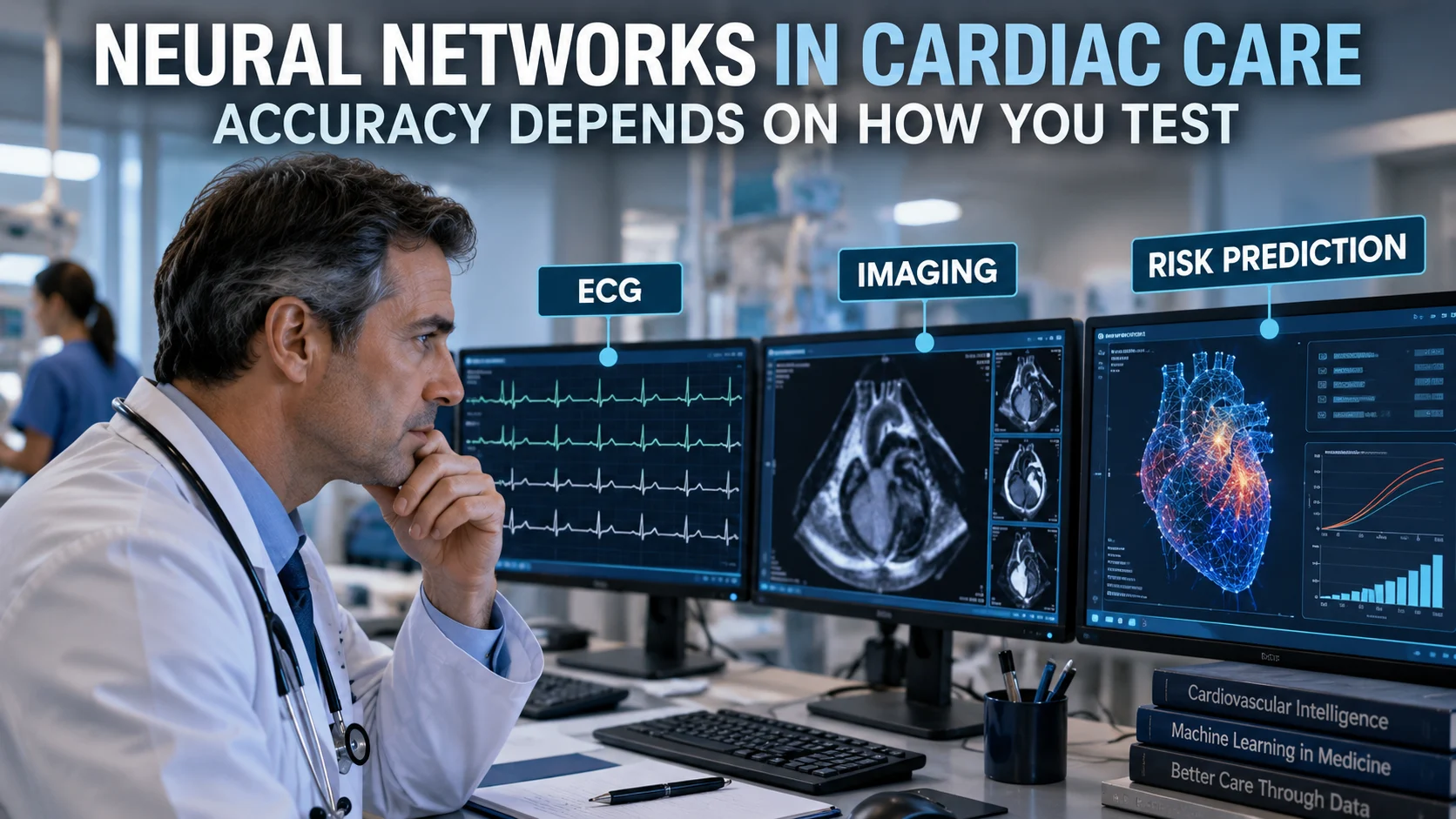

A cardiac neural network can post an impressive accuracy number and still be unready for routine patient care. The result depends on what the model was asked to do, how patients were separated between training and testing, which metric was chosen, whether performance held up outside the original dataset, and whether using the system improved a clinically meaningful outcome. The safest way to read a cardiac-AI claim is to inspect the validation design before trusting the largest percentage in the abstract.
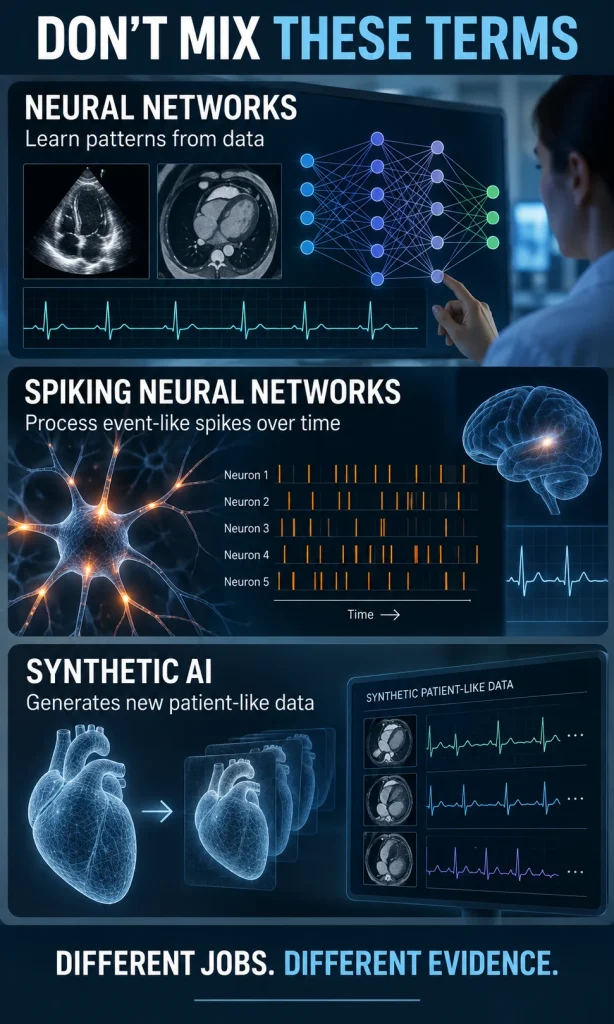
The phrase “synthetic neural networks” also needs clarification because it is not one standard technical category. Depending on the source, a reader may actually be looking at an artificial or deep neural network, a spiking neural network (SNN), or synthetic AI that generates new ECG signals, cardiac images, virtual patients or simulated cohorts. Those technologies can overlap in a research project, but they perform different jobs and require different evidence.
Three cardiac-AI terms that should not be mixed together
Artificial neural networks learn statistical patterns from examples. In cardiology, they are used for tasks such as ECG classification, cardiac-image interpretation, automated measurements, risk prediction and decision support. The American Heart Association’s scientific statement on AI in cardiovascular care describes applications across electrocardiography, imaging, hospital monitoring, wearables and electronic health records while also emphasizing the need for representative data, reliability, accountability and evidence that clinical use helps patients.
Spiking neural networks are a more specialized architecture inspired by event-based signaling in biological neurons. Instead of processing every input in a conventional continuous way, SNNs can represent information as spikes over time, which makes them attractive for ECG and wearable applications where low-power, event-driven processing may matter. A review of SNN-based ECG classification found that published SNN performance can approach deep-neural-network performance while offering a possible computational-efficiency advantage for low-power environments.
Synthetic AI is different again. It creates new patient-like information rather than merely classifying an existing ECG or image. A state-of-the-art review of synthetic AI in cardiology describes generative adversarial networks, variational autoencoders, diffusion models, transformers, digital twins and synthetic cohort simulators being explored for synthetic ECGs, imaging, virtual populations and clinical simulation. A synthetic output can look realistic without proving that it preserves every clinically important distribution, so downstream utility and validation against real data still matter.
What “accuracy” actually means in cardiac AI
Accuracy is the proportion of predictions that are correct, but that simple ratio can hide the error that matters most. If a dataset contains many more normal rhythms than abnormal rhythms, a model can look strong overall while missing a clinically important share of the abnormal class. That is why sensitivity, specificity, precision, F1 score, discrimination and calibration may be more informative than accuracy alone.
- Accuracy: useful as a broad summary when classes are reasonably balanced and the cost of different errors is similar.
- Sensitivity: asks how often the model catches the condition or event of interest.
- Specificity: asks how often it correctly recognizes the comparison or non-condition group.
- Precision: asks how often a positive prediction is actually positive.
- F1 or macro-F1: can be more informative when classes are imbalanced because it combines precision and recall.
- AUROC or AUPRC: summarizes discrimination across thresholds; precision-recall performance is especially useful when positive events are uncommon.
- Calibration: asks whether predicted probabilities correspond to observed risk, which is essential when a model is used to estimate individual risk.
The metric must match the clinical job. A rhythm classifier used to flag potentially dangerous events needs careful class-specific error analysis, while a probability model used to estimate future cardiovascular risk also needs calibration. A model can have an attractive AUROC but produce poorly calibrated probabilities, and a well-calibrated model can still be clinically unhelpful if its thresholds do not improve decisions.
Why the way you split patients can change the headline result
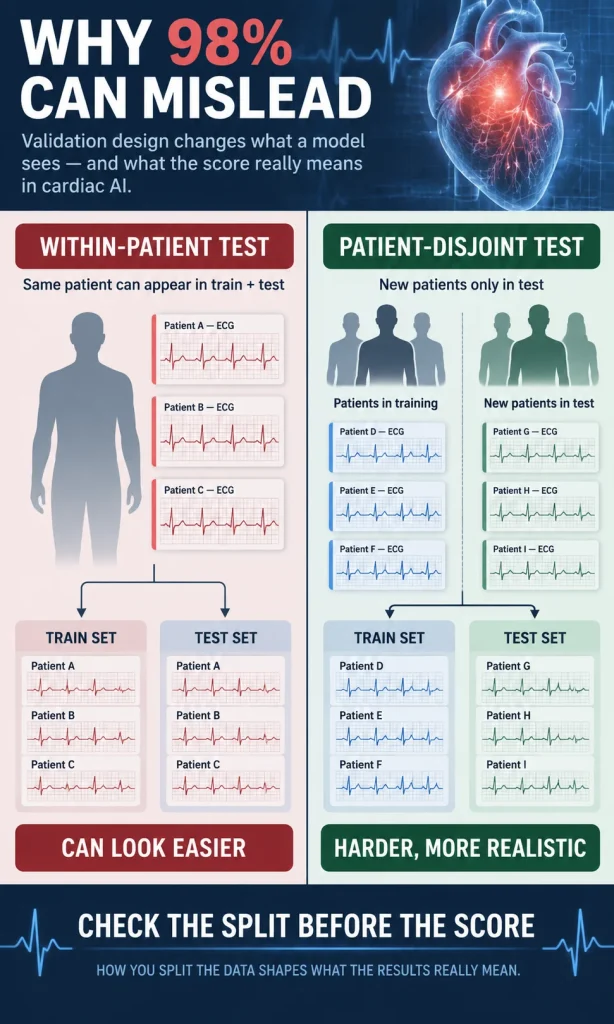
One of the easiest ways to misread a machine-learning paper is to ignore how the data were split. If recordings from the same patient can appear in both training and testing, the model may benefit from person-specific features that will not be available when it encounters a completely new patient. A patient-disjoint test, where people in the test set are absent from training, is harder but usually gives a more realistic measure of cross-patient generalization.
| Validation design | What it can tell you | What it still cannot prove |
|---|---|---|
| Internal random split | Whether the model can reproduce patterns inside a development-like dataset. | Generalization to new patients, hospitals, devices or workflows. |
| Patient-disjoint test | Whether performance holds when test patients were not represented in training. | Performance at a different institution or in routine care. |
| External validation | Whether performance transfers to another dataset, site, device or population. | Whether using the model improves decisions or patient outcomes. |
| Prospective workflow study | How the system behaves when introduced into the intended clinical process. | A patient benefit unless a meaningful outcome is actually measured. |
| Randomized outcome trial | Whether an AI-enabled strategy changes a specified outcome compared with a control strategy. | Automatic transfer to a different population, indication, workflow or later model version. |
Why 98% can be weaker evidence than 86%
The number itself cannot tell you how difficult the test was. A recent SNN study of ECG classification reported markedly stronger performance in an intra-patient setting than in inter-patient evaluation. That drop should not automatically be treated as failure: the lower inter-patient result addresses the harder question of whether the model can generalize to people it has not already seen.
This issue appears across medical AI, not only SNNs. A model evaluated on carefully curated records from one source can outperform the same model when it is moved to new hospitals, different ECG hardware or a population with different disease prevalence. External validation therefore adds information that another internal split cannot. A large external validation of an ECG-AI system across a U.S. healthcare dataset, for example, was specifically designed to test transfer beyond the environment in which the system had already been deployed.
Where neural networks are useful in cardiac care
The most mature applications are narrow enough to define the input, target and error clearly. AI-assisted ECG interpretation can flag arrhythmias or patterns associated with ventricular dysfunction; echocardiography systems can automate view recognition and measurements; CT and MRI systems can help with reconstruction, segmentation and quantitative analysis; and predictive models can combine large numbers of clinical variables for risk stratification. These systems are usually better described as decision support, detection or measurement systems than as autonomous treatment systems.
That distinction matters because the original phrase “cardiac treatment” can make the technology sound more autonomous than it normally is. The AHA recommends that AI augment clinical decisions rather than replace them, and a newer AHA advisory on real-world AI evaluation and monitoring emphasizes continuous evidence generation after deployment. A model may remain technically accurate while becoming less useful if patient populations, devices, workflows or clinical practice change around it.
From model accuracy to clinical value
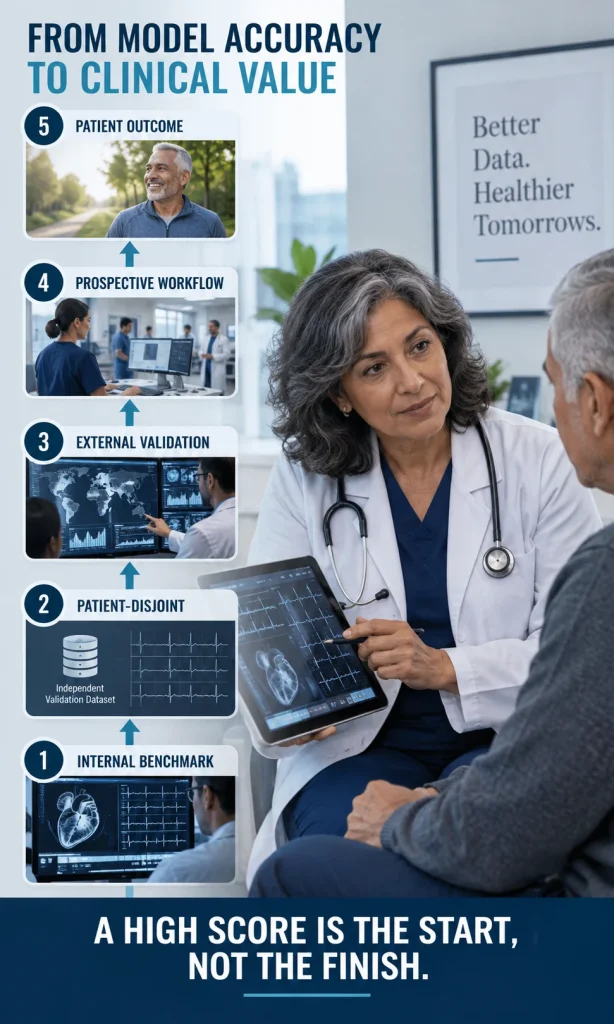
Clinical usefulness requires progressively stronger evidence. A high test-set score first shows that the model can perform a defined analytical task; external validation asks whether that performance survives a change in setting; prospective implementation asks how the model behaves inside a real workflow; and outcome studies ask whether using the system actually improves something that matters to patients or clinicians. Each step answers a different question, so one should not be substituted for another.
Evidence has begun to move beyond retrospective benchmark studies. A systematic review and meta-analysis of randomized trials of AI-enabled cardiovascular care identified dozens of trials across multiple regions. Many reported improvements in primary endpoints, but those endpoints were often intermediate process measures, follow-up was frequently short, and the certainty of evidence varied. The review’s broader message is more useful than a single pooled number: some AI-enabled workflows are promising, but hard clinical outcomes and generalizability still need stronger evidence.
What regulatory clearance does – and does not – tell you
Regulatory authorization is evidence about a specific device and its intended use, not a blanket endorsement of an architecture or every future update. The U.S. Food and Drug Administration’s AI-enabled medical device resources describe products reviewed under applicable device pathways, while the FDA’s guidance on predetermined change control plans for AI-enabled device software explains how certain planned modifications can be described, validated and controlled through the product lifecycle.
For readers, the practical lesson is to match the claim to the authorized intended use. An AI system cleared for a defined screening, image-analysis or decision-support task should not be assumed to work for a broader treatment decision simply because the underlying neural network is technically similar. Model version, input type, population and workflow all remain part of the evidence boundary.
Use the Cardiac AI Evidence Check before trusting a headline score
Research papers, product pages and news coverage often present the largest performance number before explaining how it was produced. The experience below helps you classify the validation design, match the metric to the job and identify the next piece of evidence to look for. It does not evaluate a patient, diagnose a condition, recommend treatment or determine whether a device should be used.

Cardiac AI Evidence Check
See what a headline performance number actually supports - and which validation step is still missing.
Describe the claim
Choose the study details
Results will explain what the claim supports, the main weakness to check, and the next evidence step.
What this evidence can support
Complete the fields and select “Review evidence.”
Metric check
Metric guidance will appear here.
What to look for next
- Validation design
- Population match
- Clinically meaningful outcome
Eight checks to make before accepting a cardiac-AI claim
- Define the job first. Is the system classifying ECGs, segmenting an image, predicting risk, generating synthetic data, or supporting a treatment-related decision?
- Check the unit of splitting. Verify whether patients were kept separate between training and test sets.
- Match the metric to the consequence. Accuracy alone can be misleading when classes are imbalanced or false negatives are more costly than false positives.
- Look for external validation. A second site, device, dataset or population is more informative than repeated testing on the development source.
- Check calibration when probabilities are used. A risk percentage is only useful if predicted risk corresponds reasonably to observed risk in the intended population.
- Separate technical performance from clinical impact. Better classification does not automatically mean fewer admissions, better survival or safer treatment.
- Confirm the intended-use boundary. Population, input type, workflow and regulatory status should match the claim being made.
- Ask how performance is monitored after deployment. Data drift, workflow changes and model updates can alter real-world performance.
What this means for patients and nontechnical readers
You do not need to become a machine-learning specialist to read a cardiac-AI claim sensibly. Start by asking whether the model was tested on new patients, whether it worked outside its original dataset and whether the study measured something clinically meaningful. If a product page gives only one accuracy percentage without explaining those points, the number is incomplete rather than automatically impressive.
AI output also should not replace medical assessment when symptoms or treatment decisions are involved. For general health information, the site’s separate article on physical symptoms that should not be ignored addresses symptom-oriented reader questions, while its coverage of exercise and heart-disease research in older adults covers a different prevention-focused decision. Those are distinct jobs from evaluating the evidence behind a cardiac-AI model.
Frequently Asked Questions
Are synthetic neural networks the same as spiking neural networks?
No. “Spiking neural network” is a specific technical term for event-driven neural models that communicate with spikes over time, while “synthetic AI” usually refers to generative systems that create new data such as synthetic ECGs, images or virtual cohorts. “Synthetic neural network” is ambiguous, so the architecture described in the original source should be checked before interpreting the claim.
Is 95% accuracy good enough for a cardiac AI model?
Not by itself. A 95% result may be strong or weak depending on class balance, sensitivity, specificity, patient separation, external validation and the clinical consequence of false positives and false negatives. The intended use determines which metrics and validation design matter most.
Why can patient-disjoint accuracy be lower than within-patient accuracy?
Patient-disjoint testing requires the model to work on people who were not represented in training, so it removes some person-specific familiarity that can make a within-patient task easier. A lower patient-disjoint score can therefore provide stronger evidence of real generalization than a higher score from an easier split.
Can a neural network choose cardiac treatment on its own?
Most current systems are better described as detection, measurement, prediction or decision-support systems rather than autonomous treatment systems. Clinical use depends on the specific model, intended use, validation, regulatory status and clinician oversight.
Does FDA authorization mean a cardiac AI model is accurate for every patient?
No. Authorization applies to a specific device and intended use based on the evidence reviewed for that product. Performance can still vary across populations, sites, devices and future operating conditions, so appropriate use and post-deployment monitoring remain important.
The evidence matters more than the headline percentage
Neural networks can perform very well on defined cardiac tasks, and spiking neural networks are particularly interesting for event-driven ECG and low-power wearable applications. The strongest interpretation comes from combining the performance metric with patient-disjoint testing, external validation, prospective use and clinically meaningful outcomes. For readers evaluating a new claim, the test design is often more informative than the largest number on the page.