



The Silent Anchor of Global Valuation
The risk-free rate is often presented as a simple reference point in finance textbooks, yet it functions as the foundational anchor of required return across global capital markets. Every valuation model, whether applied to equities, real estate, private capital, or infrastructure assets, begins with the assumption of a baseline return available without credit risk. That baseline is the risk-free rate.
Despite its name, the risk-free rate does not imply absence of volatility. It represents the theoretical return on a sovereign instrument considered free from default risk within its currency domain. Government bonds issued by advanced economies typically serve as proxies. These yields reflect expectations regarding inflation, monetary policy, sovereign creditworthiness, and macroeconomic stability.
When sovereign bond yields move, they transmit through every valuation denominator in financial markets. The risk-free rate forms the first component of required return. Changes in this anchor ripple outward into equity risk premium calculations, dividend yield competitiveness, and capital allocation decisions.
Understanding the structural role of the risk-free rate requires examining how it is formed, how it interacts with inflation expectations, how it influences discount rates, and how its shifts reprice equities across cycles. This analysis focuses on transmission mechanisms rather than directional forecasts.
Defining the Risk-Free Rate – Beyond Textbook Simplicity
The risk-free rate is typically approximated by yields on government securities with minimal perceived default risk. In practice, different maturities serve different modeling purposes. Short-term treasury bills may represent immediate liquidity preference. Long-term sovereign bonds often anchor equity valuation models due to duration alignment.
The risk-free rate incorporates several embedded components:
- Expected inflation
- Real interest rate
- Term premium
- Liquidity premium
These components evolve with macro conditions. When inflation expectations rise, nominal bond yields typically increase. When central banks tighten monetary policy, short-term rates adjust upward. When uncertainty regarding fiscal sustainability increases, term premium may expand.
Thus, the risk-free rate is not static. It reflects collective expectations about macro stability and monetary credibility. Because it underpins required return, even modest shifts can materially alter valuation.
Required Return Framework – The Structural Formula
The foundational equation governing equity valuation is:
The structural interaction between baseline rate and compensation premium is examined in detail in Equity Risk Premium – Valuation Mechanics.
Required Return = Risk-Free Rate + Equity Risk Premium
This formula integrates two distinct drivers. The risk-free rate reflects baseline time value of money. The equity risk premium reflects compensation for uncertainty. Together they determine the denominator in discounted cash flow models.
When the risk-free rate rises while equity risk premium remains constant, required return increases. Present value of future cash flows declines. Multiples compress. This mechanical process explains why equities often fall during rapid yield increases even without earnings deterioration.
Conversely, when the risk-free rate declines due to monetary easing or falling inflation expectations, required return decreases. Valuation multiples expand, assuming premium remains stable.
The risk-free rate therefore functions as the gravitational anchor of valuation across markets.
Yield Curve Structure – Short Rates vs Long Rates
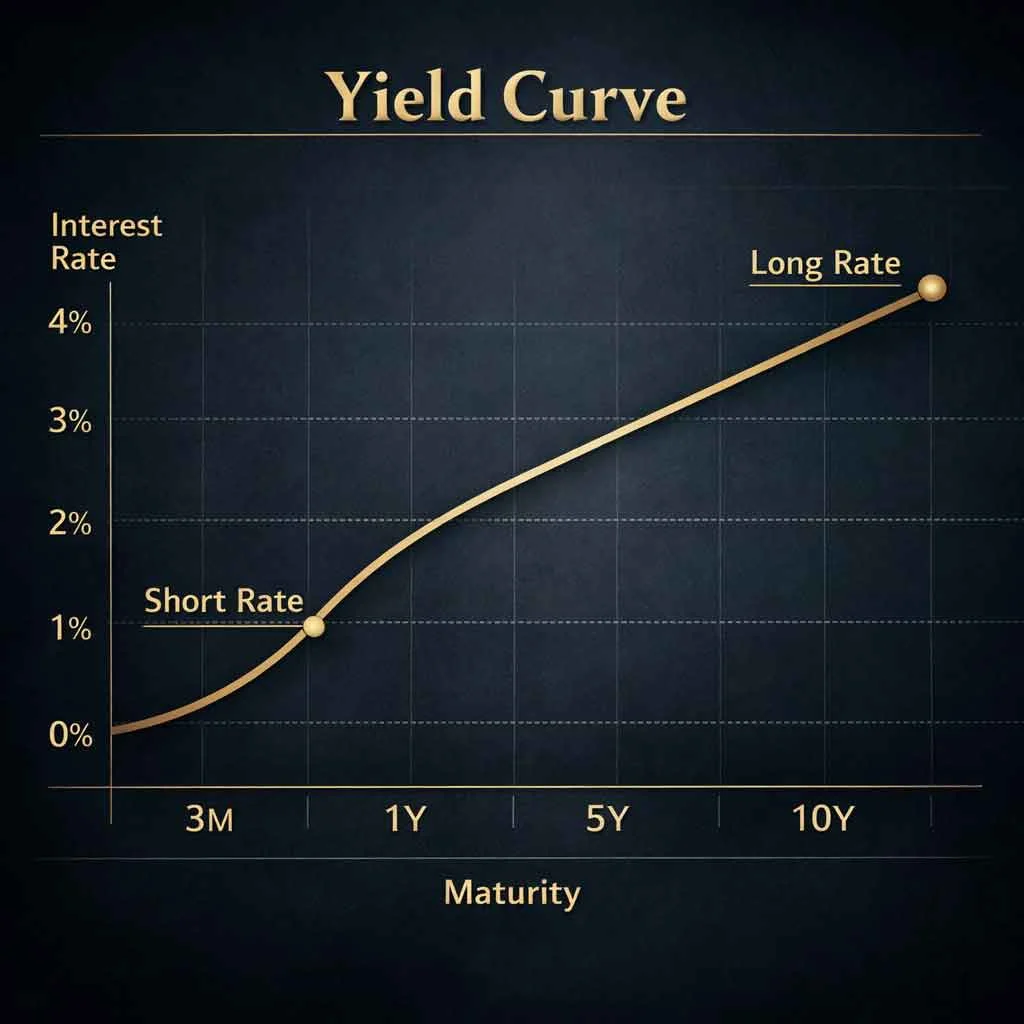
The risk-free rate is not a single number. It exists across a maturity spectrum known as the yield curve. Short-term rates reflect immediate monetary policy stance. Long-term rates reflect expectations about future inflation, growth, and policy credibility. The slope and shape of the yield curve influence how the risk-free rate transmits into asset pricing.
When short-term rates rise rapidly due to policy tightening, the front end of the curve adjusts first. If long-term yields remain anchored, the curve flattens. A flattening curve can signal slowing growth expectations. If long-term yields rise alongside short-term yields, the curve steepens upward, often reflecting persistent inflation expectations.
Equity valuation models typically reference medium to long-duration yields, such as 10-year sovereign bonds, because corporate cash flows extend over multiple years. When long-term yields move materially, required return calculations adjust immediately. This explains why equity markets often react more strongly to movements in 10-year yields than to overnight policy rate adjustments.
The yield curve therefore determines which segment of the risk-free rate exerts dominant influence over valuation denominators.
Real vs Nominal Risk-Free Rates
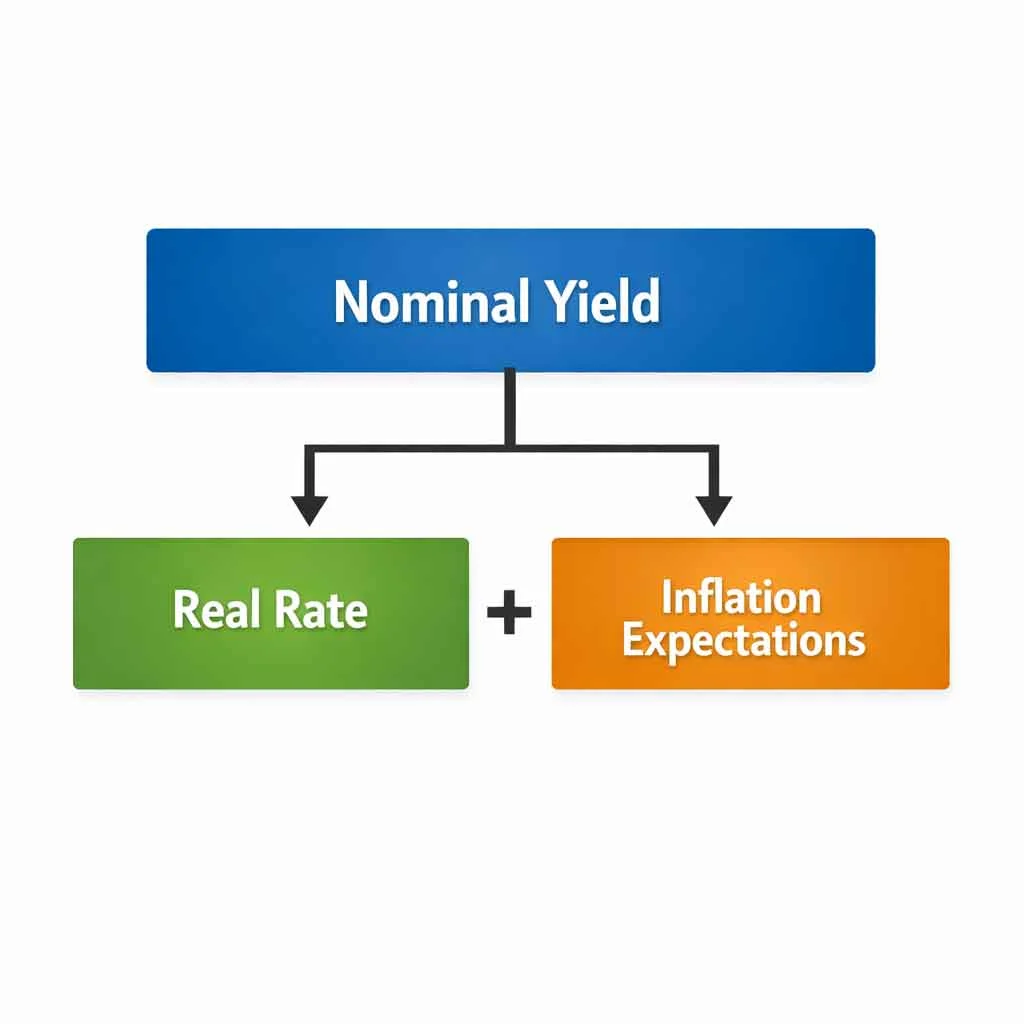
Nominal bond yields include inflation expectations. Real yields strip out expected inflation and reflect the real return investors demand for deferring consumption. The distinction is crucial for equity pricing.
If nominal yields rise solely due to higher inflation expectations while real yields remain stable, equities may not compress proportionally, particularly if firms can pass through price increases. However, if real yields rise, the true discount rate applied to future cash flows increases. This exerts direct compression pressure on valuations.
Real yield movements often explain pronounced equity repricing episodes. When central banks tighten aggressively to restrain inflation, real yields tend to rise. Required return increases from a real basis. Growth-oriented equities, with extended cash flow duration, become especially sensitive.
Monitoring real yields provides deeper insight than nominal yield movements alone.
Inflation Expectations and the Risk-Free Anchor
Inflation expectations are embedded within sovereign bond yields. When inflation expectations rise, nominal risk-free rates increase. However, the effect on equity depends on corporate pricing power and margin stability.
In moderate inflation environments with strong pricing power, companies can increase revenue in line with inflation. Dividend growth may adjust upward. Required return increases may be partially offset by nominal earnings expansion. In contrast, in stagflationary environments characterized by weak growth and rising costs, both real and nominal yields may rise while earnings weaken. Valuation compression becomes more severe.
The risk-free rate therefore transmits inflation expectations into equity denominators. Its interaction with earnings resilience determines ultimate price adjustment magnitude.
Term Premium and Uncertainty
Long-term bond yields include a term premium component representing compensation for holding longer-duration instruments. During stable macro conditions, term premium may compress. When fiscal uncertainty or supply imbalances increase, term premium can expand independently of inflation expectations.
Term premium expansion raises long-term yields even if short-term policy rates remain stable. This increase elevates required return for equities. Because term premium reflects uncertainty regarding fiscal sustainability and policy credibility, its expansion often coincides with rising equity risk premium.
Simultaneous expansion of term premium and equity risk premium amplifies valuation compression. The risk-free rate does not operate in isolation from broader uncertainty.
Risk-Free Rate Transmission to Equity Multiples
Equity multiples such as price-to-earnings ratios are sensitive to discount rate assumptions. When the risk-free rate rises by 100 basis points and equity risk premium remains unchanged, required return increases by the same magnitude. In discounted cash flow models, this shift can reduce fair value estimates meaningfully, particularly for long-duration growth firms.
This mechanical denominator effect explains episodes where equity markets decline sharply during yield spikes even without immediate earnings deterioration. The numerator remains stable while the denominator increases.
Conversely, declining risk-free rates can support multiple expansion, particularly when equity risk premium compresses simultaneously.
The relationship between bond yields and equity multiples is therefore structural rather than psychological.
Interaction With Dividend Yield
Dividend yield competes directly with sovereign bond yields. When risk-free rates rise, bond income becomes more attractive relative to equity income. If dividend yields do not adjust upward through price decline or payout growth, capital may rotate toward fixed income instruments.
The structural yield competition dynamic is expanded further in Dividend Yield Risk – Structural Analysis.
This competitive mechanism creates structural pressure on dividend-paying equities during tightening cycles. Yield may rise due to price compression. However, if rising risk-free rates coincide with equity risk premium expansion, required return may increase more than dividend growth can offset.
Understanding this interaction links directly to dividend yield risk analysis explored in:
Dividend Yield Risk – Structural Analysis
The risk-free rate anchors that dynamic.
Duration Sensitivity – Why Growth Shares React Disproportionately
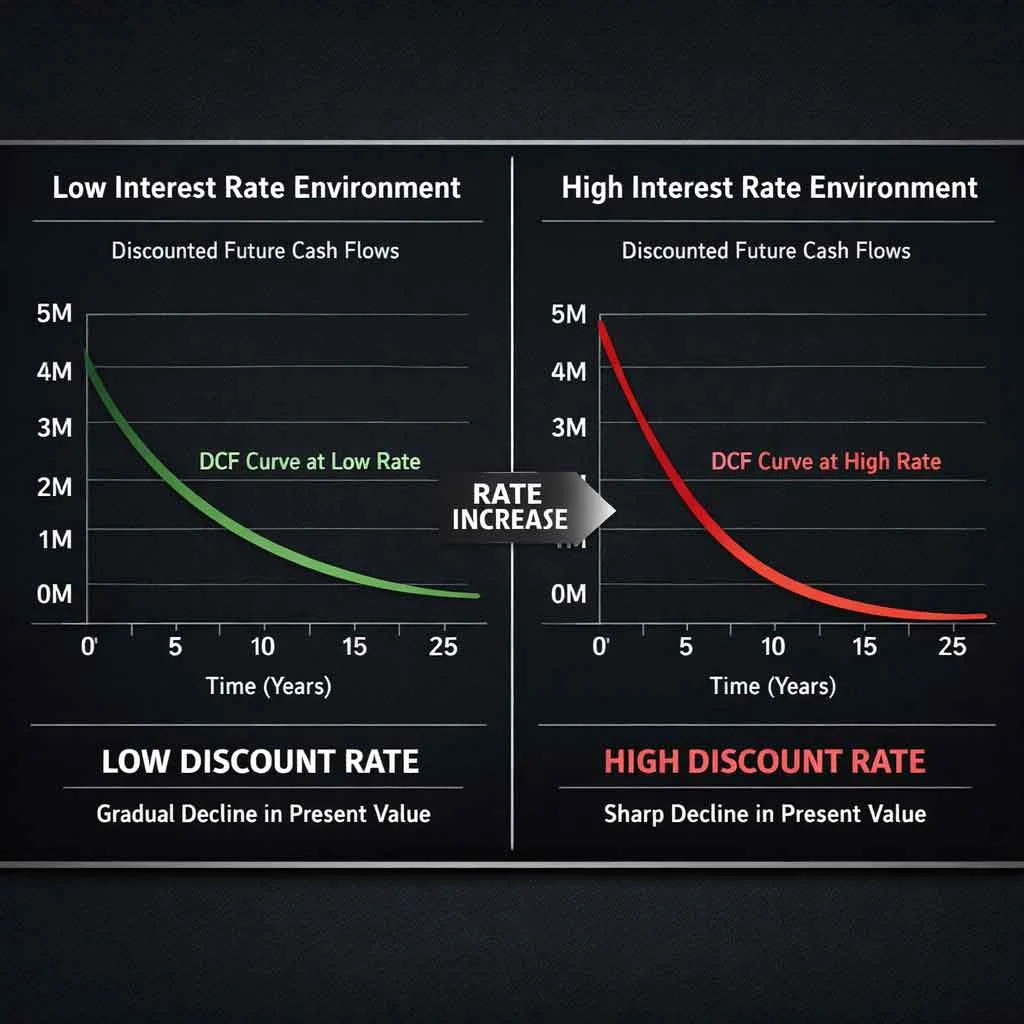
Duration in equity markets refers to the weighted timing of expected cash flows. Companies whose valuation depends heavily on earnings far in the future exhibit long-duration characteristics. Growth-oriented firms often fall into this category. Mature firms with near-term cash distributions typically exhibit shorter duration.
When the risk-free rate rises, the discount factor applied to future cash flows increases. The present value of distant earnings declines more sharply than near-term earnings. As a result, long-duration equities experience amplified compression relative to shorter-duration firms.
This duration asymmetry explains sector rotation during tightening cycles. Technology and innovation-heavy sectors often compress more severely when long-term yields rise. Defensive sectors with stable current cash flow may show relative resilience.
The transmission is mechanical. Required return increases uniformly across the formula, yet the valuation impact differs based on cash flow timing distribution. Duration sensitivity therefore magnifies the effect of risk-free rate shifts.
For a deeper modeling illustration, see the Duration Sensitivity tool within the Finance Tools suite.
Liquidity Conditions and Funding Transmission
The risk-free rate influences funding costs across the financial system. When sovereign yields rise, corporate borrowing costs generally increase. Even firms issuing investment-grade debt reference government benchmarks when pricing new bonds. Higher funding costs reduce net income and constrain free cash flow.
Liquidity contraction often accompanies rising rates. As central banks withdraw liquidity through balance sheet reduction or rate hikes, funding spreads can widen. This amplifies the impact of the risk-free anchor on overall required return.
Liquidity-sensitive sectors such as real estate investment trusts, leveraged utilities, and capital-intensive infrastructure projects become particularly vulnerable. Their valuation depends not only on earnings but also on the cost of rolling debt. Rising risk-free rates can compress multiples through both discount rate and refinancing channels simultaneously.
Thus, rate transmission occurs through two primary pathways:
- Discount rate increase affecting valuation denominator.
- Funding cost increase affecting earnings numerator.
When both channels operate concurrently, repricing accelerates.
Credit Spread Interaction – Dual Expansion Pressure
The risk-free rate forms the baseline for credit pricing. Corporate bond yields equal sovereign yield plus credit spread. When sovereign yields rise and credit spreads widen simultaneously, corporate financing conditions tighten materially.
Dual expansion of risk-free rate and credit spread often occurs during late-cycle tightening or stress events. Required return rises not only because the baseline increases but also because perceived default risk grows.
This dual pressure impacts equities through three mechanisms:
- Discount rate increases.
- Earnings decline due to higher interest expense.
- Equity risk premium expands due to uncertainty.
The compounding nature of these mechanisms explains why some tightening cycles produce gradual compression while others trigger abrupt repricing.
Monitoring sovereign yield movements without considering credit spreads provides incomplete insight into equity risk transmission.
International Sovereign Rate Divergence
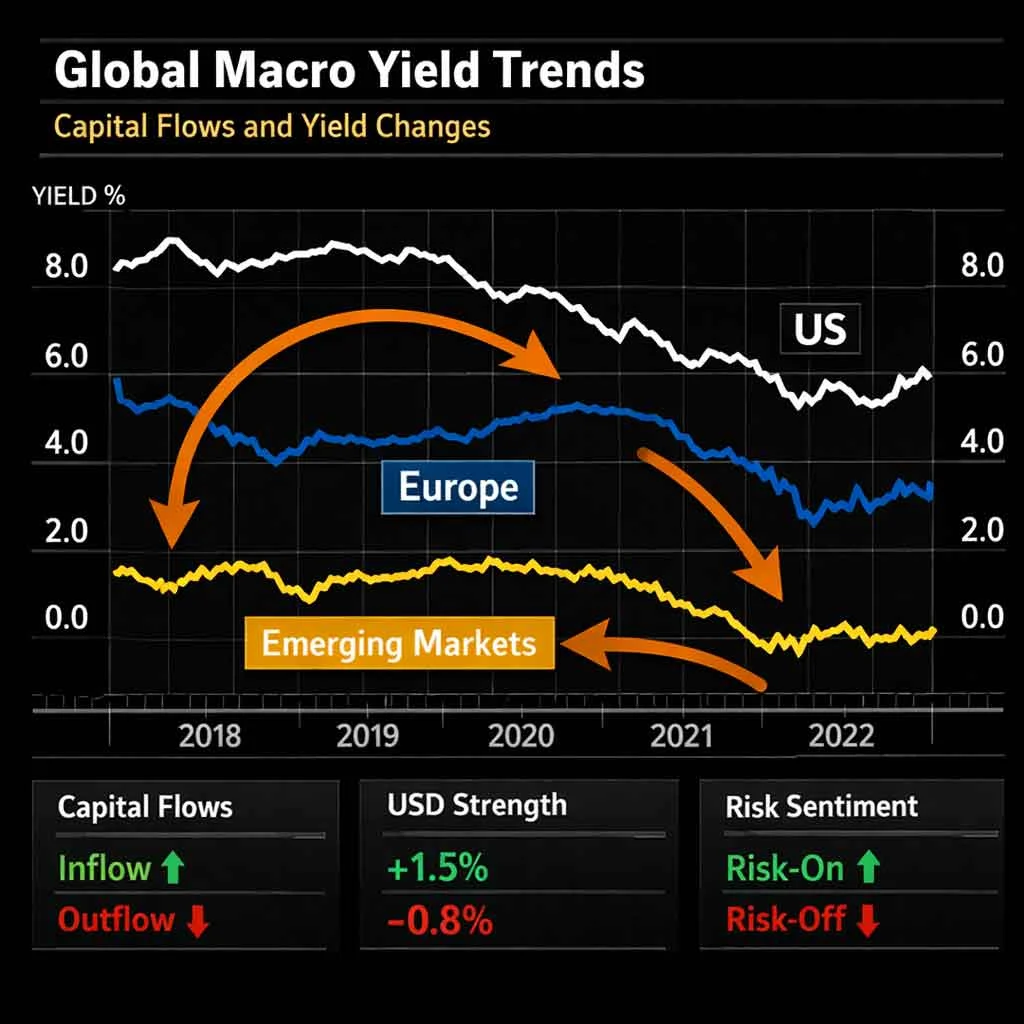
Risk-free rates vary across currencies and jurisdictions. United States Treasury yields often serve as global benchmarks due to reserve currency status and market depth. However, European, Japanese, and emerging market sovereign yields reflect distinct macro regimes.
When major sovereign yields diverge, global capital flows respond. Higher relative yields can attract capital inflows, strengthening currency. Currency appreciation influences multinational earnings and commodity pricing.
For multinational corporations, revenue streams span jurisdictions with different rate environments. A rise in domestic sovereign yields may strengthen currency, compressing translated foreign earnings. Thus, risk-free rate shifts have indirect earnings effects through exchange channels.
Emerging markets often face amplified transmission. Rising US yields can trigger capital outflows from higher-risk jurisdictions, elevating their sovereign yields and local equity risk premium simultaneously. This feedback loop magnifies equity volatility globally.
Risk-free rate analysis therefore requires global perspective rather than isolated domestic evaluation.
Risk-Free Rate and Long-Term Regime Shifts
Rate regimes evolve across decades. Extended periods of declining sovereign yields supported multiple expansion in equities. Conversely, secular rising rate environments historically corresponded with multiple contraction phases.
Regime shifts may be driven by demographic changes, fiscal expansion, productivity trends, or structural inflation. When long-term equilibrium real rates rise, baseline required return increases persistently. Valuation models must adjust accordingly.
Identifying regime transitions is complex. However, structural analysis recognizes that the risk-free rate sets the gravitational baseline for asset pricing. Secular changes alter valuation equilibrium across asset classes.
Case Cycle Illustration – Rate Shock Scenario

Consider a scenario in which 10-year sovereign yields rise by 200 basis points over twelve months due to persistent inflation and fiscal expansion. Equity risk premium remains stable initially. Required return increases materially. Price-to-earnings multiples contract from 22 to 17. Growth equities compress more severely due to duration sensitivity.
Simultaneously, credit spreads widen by 100 basis points as liquidity tightens. Corporate refinancing costs increase. Earnings guidance moderates. Equity risk premium begins expanding. Required return rises further. Dividend yields increase mechanically through price adjustment.
This simplified cycle illustrates layered transmission:
Sovereign yield shock → Discount rate increase → Valuation compression → Credit tightening → Earnings pressure → Premium expansion → Further repricing.
The risk-free rate initiates the chain reaction.
This transmission explains broader market volatility patterns described in Why Shares Reprice Violently.
Risk-Free Rate Dominance vs Equity Risk Premium Dominance Cycles
Not all market cycles are driven primarily by equity risk premium. Some cycles are dominated by movements in the risk-free anchor. Distinguishing between these dominance regimes clarifies valuation behavior.
Risk-Free Rate Dominant Cycles
In these environments, sovereign yields move materially due to inflation shifts, monetary tightening, or fiscal supply expansion. Equity risk premium may remain relatively stable. Valuation compression occurs mainly through discount rate increase rather than rising uncertainty.
Typical features include:
- Rapid central bank tightening
- Persistent inflation
- Rising real yields
- Broad multiple contraction across sectors
Equity Risk Premium Dominant Cycles
In contrast, during systemic stress or crisis events, equity risk premium may expand sharply even if sovereign yields decline. Required return rises because uncertainty increases, not because baseline time value of money shifts.
Typical features include:
- Financial instability
- Liquidity shocks
- Credit spread widening
- Flight to safety into sovereign bonds
In such cycles, sovereign yields may fall while equity markets decline due to premium expansion. Understanding which component drives required return clarifies why markets behave differently under superficially similar rate environments.
The risk-free rate does not always move in tandem with equity risk premium. Dominance alternates across cycles.
Fiscal Sustainability and Structural Yield Anchoring
Sovereign bond yields incorporate expectations regarding fiscal credibility. When government deficits expand persistently without credible long-term adjustment, investors may demand higher yields to compensate for inflation risk or debt sustainability concerns.
Fiscal supply dynamics can elevate long-term yields independently of monetary policy. Increased issuance of sovereign bonds raises term premium if demand does not fully absorb supply. This phenomenon influences the risk-free anchor directly.
Higher sovereign yields increase required return baseline across asset classes. Unlike temporary cyclical movements, fiscal-driven yield increases may persist if structural imbalances remain unresolved.
Thus, fiscal sustainability becomes a long-horizon determinant of valuation equilibrium. Persistent upward drift in sovereign yields can compress valuation multiples even in stable growth environments.
Inflation Persistence and Real Yield Regimes
When inflation expectations become unanchored, real yields may rise structurally. Persistent inflation erodes purchasing power and raises uncertainty regarding future monetary tightening. Investors demand higher real compensation for holding long-duration assets.
Equities, particularly growth-oriented firms, become vulnerable when real yields increase structurally rather than temporarily. Because real yields represent inflation-adjusted time value, their rise exerts direct compression pressure on discounted cash flow models.
In contrast, declining real yields during stable deflationary or low-inflation regimes support valuation expansion. Secular bull markets often coincide with falling real rates.
Understanding real yield regime transitions is essential for interpreting long-term equity valuation shifts.
Inflation-Adjusted Long-Horizon Valuation Math
Over multi-decade horizons, small shifts in risk-free rate assumptions materially alter valuation outputs. A 100 basis point change in discount rate applied over extended time horizons compounds significantly.
For long-duration equities, a persistent increase in required return reduces terminal value assumptions disproportionately. This explains why secular increases in real yields often coincide with prolonged valuation normalization phases.
Even if earnings grow steadily, higher baseline discounting reduces present value accumulation. Therefore, the risk-free rate influences not only cyclical volatility but also structural long-term return expectations.
Policy Credibility and Market Stability
Central bank credibility anchors inflation expectations and therefore stabilizes sovereign yields. When monetary authorities maintain confidence in long-term inflation control, term premium remains contained. Stable risk-free rates support predictable valuation environments.
When credibility erodes, volatility in sovereign yields increases. Unstable yield environments raise uncertainty across asset classes. Equity risk premium may expand in response to policy ambiguity.
Thus, policy stability influences both components of required return. The risk-free rate and equity risk premium interact through credibility channels.
Global Capital Flows and Benchmark Effects
Because major sovereign markets serve as global benchmarks, shifts in one jurisdiction can transmit internationally. Rising US yields often influence global funding conditions due to reserve currency status and capital mobility.
Emerging markets frequently experience amplified volatility during US rate increases. Capital outflows elevate local sovereign yields and widen spreads. Required return increases both through baseline rate and premium expansion simultaneously.
Global capital integration ensures that the risk-free anchor cannot be analyzed purely domestically. International spillovers shape valuation equilibrium worldwide.
Final Structural Synthesis
The risk-free rate is the foundational anchor of required return. It reflects inflation expectations, real rate equilibrium, fiscal sustainability, and policy credibility. Changes in this anchor propagate through:
- Discount rate adjustment
- Funding cost transmission
- Credit spread interaction
- Duration sensitivity
- Currency channels
- Global capital flows
Equity valuation compression often begins with sovereign yield movement before uncertainty amplifies through premium expansion.
Understanding the risk-free rate requires viewing it not as a static number but as a dynamic macroeconomic signal. Its movement reshapes valuation baselines across sectors and cycles.
In the required return framework:
Required Return = Risk-Free Rate + Equity Risk Premium
the risk-free rate provides the gravitational baseline. When it shifts structurally, the entire valuation landscape adjusts.
Interactive modeling of discount rate sensitivity and liquidity transmission can be explored inside the Finance Tools suite.
Frequently Asked Questions
What is the risk-free rate in simple terms?
The risk-free rate represents the return on a sovereign instrument considered free from default risk. It forms the baseline component of required return in valuation models.
Why do rising bond yields affect stocks?
Rising sovereign yields increase the required return used to discount future cash flows. Higher discount rates reduce present value estimates, leading to valuation compression in equities.
Is the risk-free rate the same as inflation?
No. The risk-free rate includes expected inflation, real interest rate, and term premium components. Inflation is one driver embedded within nominal sovereign yields.
How does the risk-free rate interact with equity risk premium?
Together they form required return. The risk-free rate anchors time value of money, while equity risk premium compensates for uncertainty. Movements in either component influence valuation.