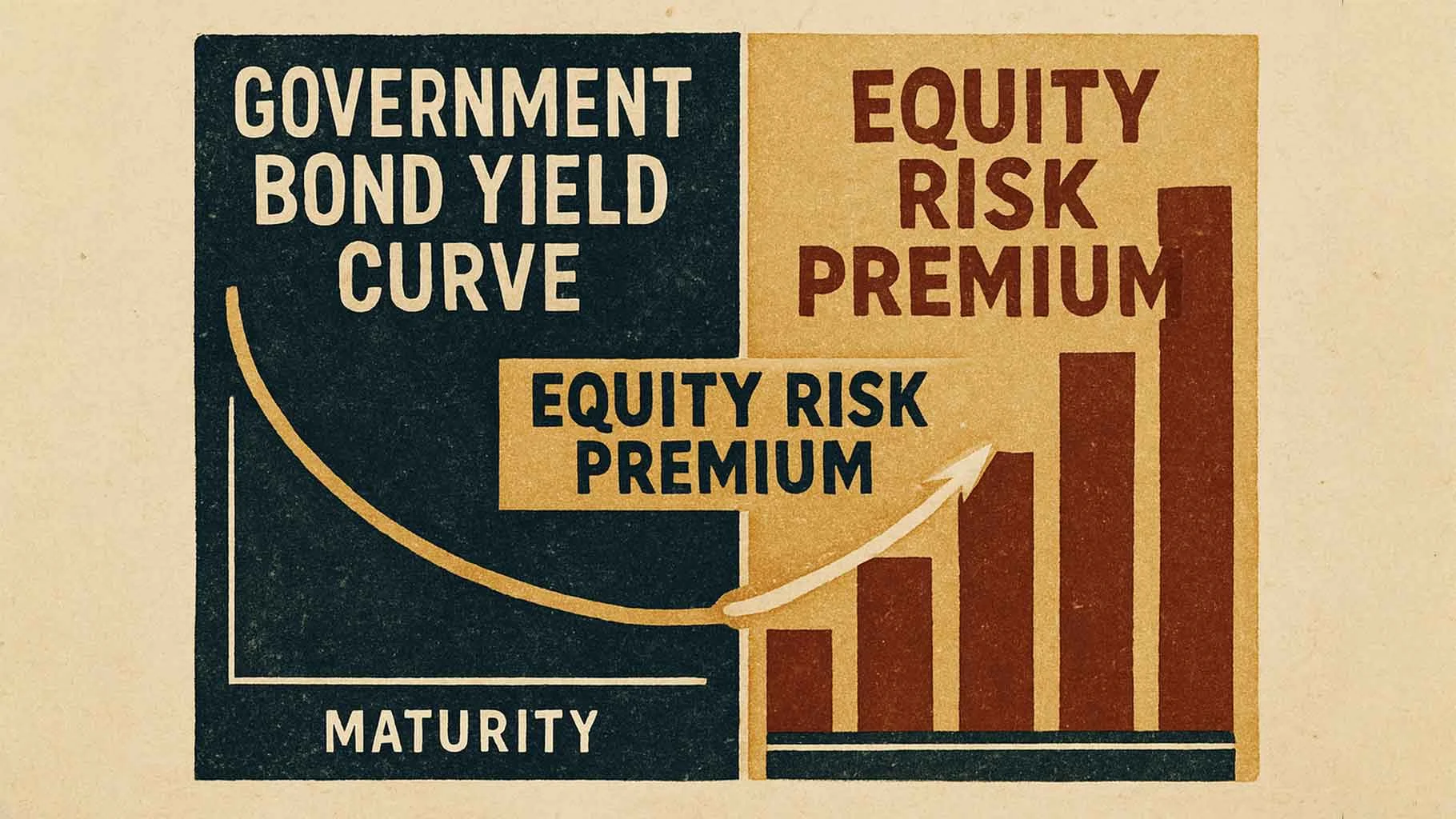

The Invisible Premium That Moves Markets
Equity risk premium is rarely visible on financial news banners, yet it silently governs how global shares are priced, repriced, compressed, and expanded across market cycles. Investors often focus on earnings, revenue growth, or interest rates in isolation, but beneath those variables lies a structural force that determines how much compensation capital demands for bearing uncertainty. That force is the equity risk premium. It is not a company metric. It is not a balance sheet item. It is a systemic expectation embedded within discount rates across global markets.
When analysts discuss valuation compression during tightening cycles, they are implicitly describing changes in the equity risk premium. When growth shares fall more than defensive shares during risk-off periods, equity risk premium expansion is often the underlying driver. When markets rally despite flat earnings growth, equity risk premium contraction frequently explains the multiple expansion. It is therefore not simply a theoretical concept from finance textbooks. It is a structural transmission mechanism between macro uncertainty and equity pricing.
At its simplest level, equity risk premium represents the additional return investors require above the risk-free rate to compensate for the uncertainty of owning shares. However, this definition alone fails to explain its dynamic role in shaping valuation regimes. The premium is not static. It expands during stress, compresses during optimism, and interacts with liquidity, monetary policy, and behavioral shifts. It acts as a bridge between macroeconomic risk and micro-level valuation.
Understanding equity risk premium requires moving beyond formula memorization. It requires examining how discount rates are constructed, how capital allocators price uncertainty, and how required returns influence valuation denominators. Markets do not merely rise or fall because earnings change. They reprice because the required compensation for uncertainty shifts.
The purpose of this analysis is to explain the structural mechanics of equity risk premium, how it is calculated, how it interacts with the risk-free rate, how it expands and contracts across cycles, and why it acts as a dominant driver of long-term valuation movement. This is not a forecast of market direction. It is an explanatory framework designed to clarify how systemic repricing occurs.
What Is Equity Risk Premium – Beyond The Textbook Definition
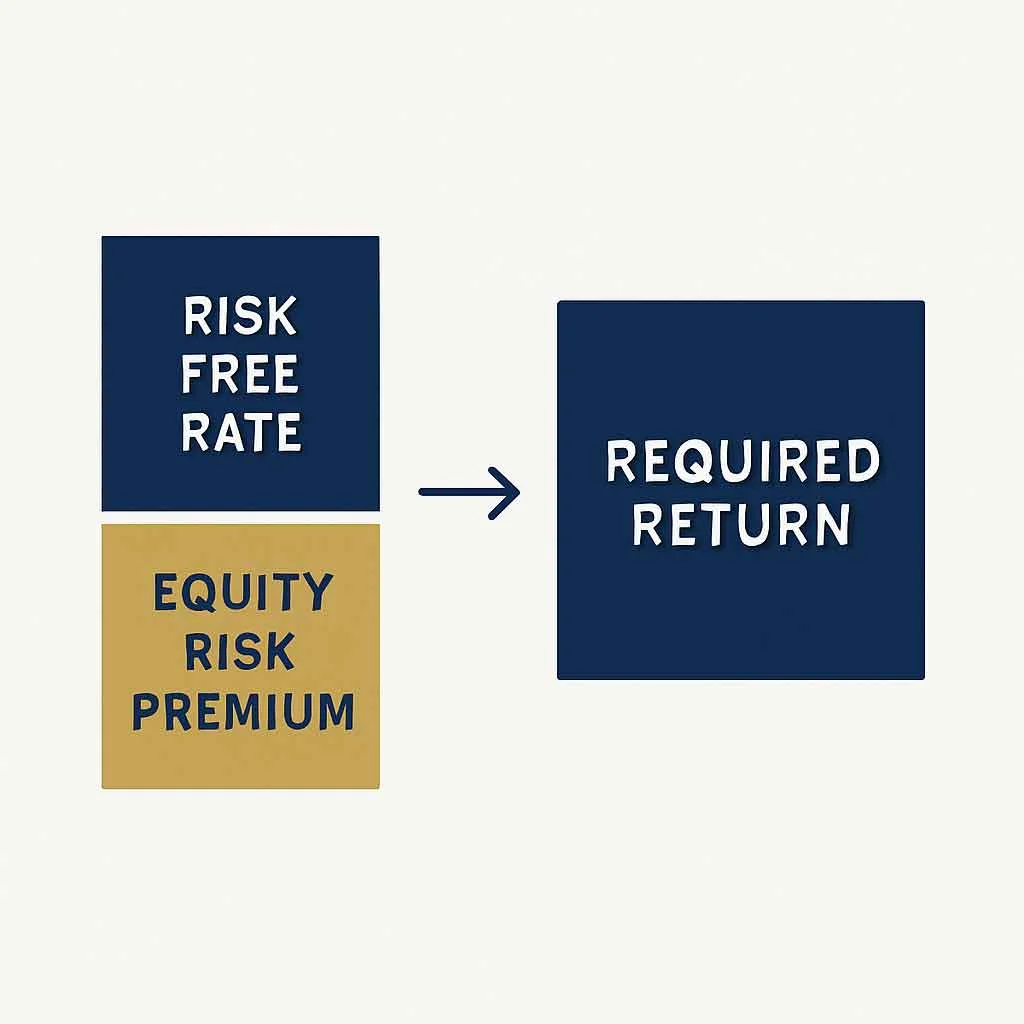
Textbooks define equity risk premium as the expected return on equities minus the risk-free rate. While mathematically correct, this framing oversimplifies its structural importance. The risk-free rate typically reflects sovereign bond yields, often derived from government securities considered default-free within their currency domain. The equity risk premium represents compensation for uncertainty in corporate cash flows, economic cycles, liquidity disruptions, and behavioral volatility.
In valuation modeling, the equity risk premium feeds directly into the cost of equity. The cost of equity is often expressed as:
Cost of Equity = Risk-Free Rate + Equity Risk Premium
This formula is deceptively simple. Yet its implications are profound. Because valuation models discount future cash flows by required return, even small changes in equity risk premium can produce large changes in present value calculations.
If the risk-free rate remains stable but the equity risk premium expands by one percentage point, the denominator in valuation models increases. The present value of future earnings decreases. Multiples compress. The magnitude of compression depends on growth duration and terminal value sensitivity.
This is why equity risk premium behaves as a structural multiplier rather than a marginal variable.
How Equity Risk Premium Alters Discount Rates
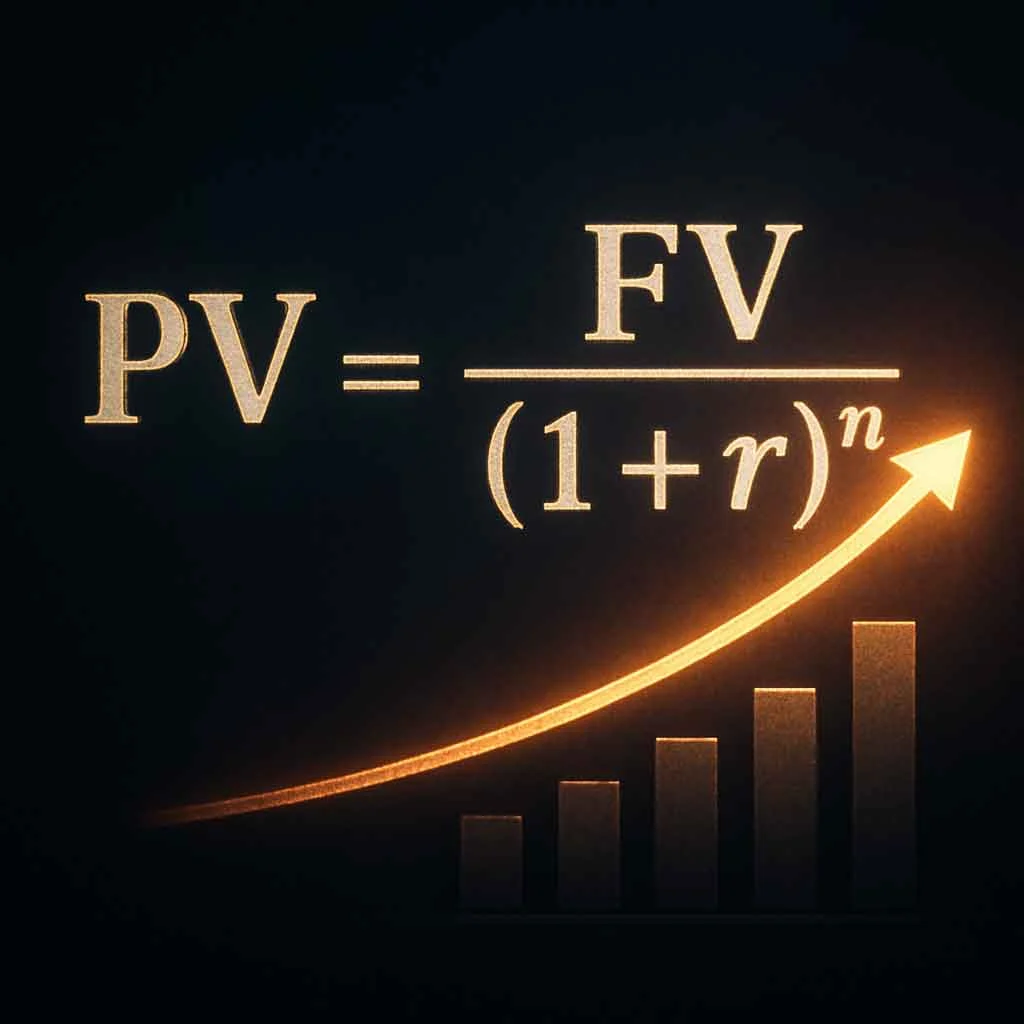
Valuation is often described through discounted cash flow models. In simplified form:
Present Value = Future Cash Flow / (1 + Required Return)^n
Where required return includes the equity risk premium. When the premium expands, the denominator increases. When it contracts, the denominator shrinks.
Unlike earnings, which change gradually through operational performance, the equity risk premium can shift rapidly due to macro events. Geopolitical tension, monetary tightening, credit stress, or volatility spikes can elevate perceived uncertainty. Investors demand higher compensation. Required returns rise. Valuations adjust downward even if earnings remain stable.
This mechanism explains why shares sometimes fall sharply without any change in corporate fundamentals. The numerator remains constant. The denominator moves.
Historical Behavior – How Equity Risk Premium Expands and Contracts Across Cycles
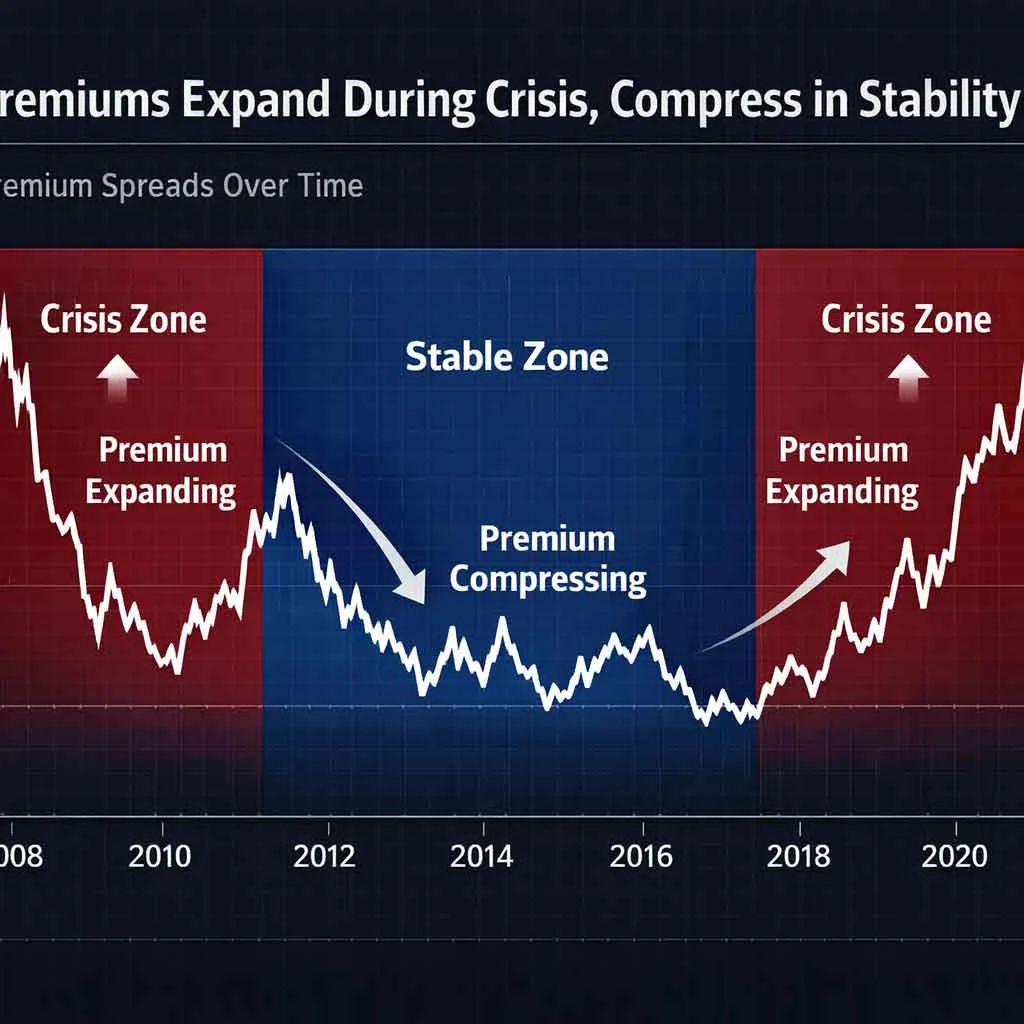
Equity risk premium does not move randomly. It expands and contracts in response to changes in perceived uncertainty, liquidity conditions, and macroeconomic stress. During stable economic environments characterized by predictable earnings growth and accommodative monetary policy, the premium often compresses. Investors require less additional compensation above the risk-free rate because volatility expectations decline and liquidity remains abundant. This compression supports higher valuation multiples and sustained bull market phases.
In contrast, during tightening cycles or periods of financial stress, the premium expands. Expansion reflects heightened uncertainty surrounding corporate earnings durability, funding conditions, geopolitical stability, and credit markets. The shift is often abrupt. Required returns increase not because earnings deteriorate immediately, but because risk tolerance declines and uncertainty becomes more expensive.
Historical crises illustrate this behavior clearly. During severe stress periods, equity risk premium can widen substantially within weeks. The repricing mechanism transmits through discount rates rather than earnings. This explains why markets can fall sharply before earnings data confirms deterioration. Valuation adjusts first. Fundamentals follow.
This cyclical expansion and contraction create structural regimes in equity markets. Low premium environments tend to coincide with elevated valuations, strong momentum, and extended duration exposure. High premium environments coincide with defensive positioning, compressed multiples, and heightened volatility.
Understanding where markets sit within this premium cycle is therefore critical to interpreting valuation levels. It is not the absolute level of earnings alone that determines share prices, but the compensation investors demand for uncertainty surrounding those earnings.
Equity Risk Premium vs Risk-Free Rate – Two Separate Drivers
A common misconception is that equity risk premium and the risk-free rate move together. While they both influence required return, they respond to different forces. The risk-free rate primarily reflects monetary policy expectations, inflation outlook, and sovereign credit dynamics. It is anchored in bond markets. The equity risk premium reflects compensation for corporate and macro uncertainty. It is anchored in equity markets.
There are periods when both rise simultaneously, such as during inflationary tightening cycles where bond yields increase and risk aversion also rises. In these environments, valuation compression can be amplified because both components of the required return expand together. The denominator in valuation models increases from two directions.
However, there are also periods when the risk-free rate declines while equity risk premium expands. This frequently occurs during recessions. Central banks cut rates, reducing sovereign yields, yet investors simultaneously demand higher compensation for corporate risk. In such cases, lower bond yields do not necessarily support equity valuations because the premium expansion offsets the risk-free decline.
This interaction explains why simplistic statements such as “rates are falling, so stocks should rise” often fail. Required return is a composite variable. Equity risk premium can dominate movements in the risk-free rate, especially during stress regimes.
Equity Risk Premium and Liquidity Conditions
Liquidity is a central but often underestimated driver of equity risk premium behavior. Abundant liquidity lowers perceived systemic risk. When credit flows freely, refinancing conditions remain stable, and volatility remains contained, investors reduce required compensation. The premium compresses. Valuation multiples expand.
When liquidity tightens, the opposite dynamic unfolds. Credit spreads widen. Funding conditions deteriorate. Margin requirements rise. Even if earnings projections remain unchanged, perceived fragility increases. Investors demand greater compensation. The equity risk premium widens.
This mechanism connects directly to liquidity feedback loops discussed in structural repricing analysis. Premium expansion is not merely psychological. It reflects rational adjustment to increased funding risk and volatility expectations. In severe liquidity contractions, premium expansion can become self-reinforcing. Falling asset prices reduce collateral values, which further restrict liquidity, which increases uncertainty, which raises required returns.
The premium therefore acts as both a reflection of systemic stress and an amplifier of it.
Measuring Equity Risk Premium – Practical Approaches
Although conceptually straightforward, measuring equity risk premium in practice involves estimation rather than direct observation. Two primary approaches are commonly used: historical premium estimation and implied premium estimation.
Historical estimation calculates the long-term average excess return of equities over government bonds. While useful for contextual understanding, historical averages may not reflect current market conditions. Structural shifts in monetary policy, globalization, or technological productivity can alter baseline expectations.
Implied equity risk premium attempts to reverse engineer the premium embedded in current market prices. By observing current equity valuations and expected earnings growth, analysts can infer the discount rate implied by prices and subtract the prevailing risk-free rate. This method attempts to capture real-time investor expectations.
Implied premium estimation connects directly to valuation models. It recognizes that market prices already incorporate collective expectations. However, it depends heavily on growth assumptions and earnings forecasts, which introduces uncertainty.
Regardless of method, the purpose of measuring equity risk premium is not to predict market direction but to assess structural valuation positioning relative to risk compensation.
Why Equity Risk Premium Dominates Long-Term Valuation
Over long time horizons, changes in equity risk premium can exert more influence on valuation levels than incremental earnings growth. Earnings growth contributes gradually. Premium shifts can reprice entire markets rapidly.
Consider two identical firms with stable earnings. If one operates in an environment perceived as stable and predictable, the required premium will be lower, supporting higher multiples. If the same firm operates in an environment characterized by regulatory unpredictability, funding fragility, or macro instability, the premium will be higher. The valuation difference can be substantial despite identical fundamentals.
This structural reality explains why geopolitical shocks, credit crises, and policy uncertainty often drive broad market movements. They alter compensation expectations. Markets are forward-looking discounting mechanisms. Equity risk premium is embedded in that discounting process.
The long-term valuation floor of equity markets is therefore not determined solely by earnings trajectories. It is determined by the equilibrium level of compensation investors require for uncertainty.
Equity Risk Premium and Growth vs Value Rotation

Growth and value rotations across market cycles are frequently interpreted as shifts in earnings momentum or sector leadership. While those elements matter, a deeper driver often lies in equity risk premium dynamics. Growth shares are structurally more sensitive to changes in required return because a larger proportion of their valuation derives from distant future cash flows. When the premium compresses, extended-duration assets benefit disproportionately. When the premium expands, those same assets experience amplified compression.
Value-oriented shares, by contrast, tend to derive a greater share of their valuation from near-term cash flows and tangible asset backing. Their duration profile is shorter. As a result, premium expansion affects them less severely in percentage terms, although absolute declines may still occur.
This interaction explains why tightening cycles often coincide with growth-to-value rotations. It is not merely a narrative about sector preference. It is a structural repricing response to denominator risk. When investors demand higher compensation for uncertainty, long-duration cash flows become more heavily discounted. When investors accept lower compensation, long-duration cash flows reprice upward more rapidly.
The equity risk premium therefore acts as an invisible switch that alters relative performance dynamics between growth and value styles.
Equity Risk Premium Regimes and Market Structure
Markets tend to operate within identifiable premium regimes. In low-premium regimes, volatility remains contained, liquidity is abundant, and risk appetite is elevated. Valuation multiples expand. Duration exposure increases across portfolios. Capital flows favor innovation and long-horizon projects.
In high-premium regimes, volatility rises, credit conditions tighten, and capital becomes selective. Multiples compress. Defensive positioning strengthens. Balance sheet durability becomes more important than distant growth narratives.
These regimes are not binary states but spectrum conditions. However, transitions between regimes can occur quickly when macro shocks alter perceived uncertainty. Policy tightening, inflation surprises, credit stress events, or geopolitical escalation can trigger rapid repricing of compensation expectations.
Understanding equity risk premium as a regime variable allows analysts to interpret market movements more coherently. Rather than viewing declines purely as earnings deterioration, they can be understood as structural shifts in required compensation. This framing reduces confusion when markets fall despite stable earnings projections.
Integrating Equity Risk Premium With Structural Modeling Tools
The structural models available within the Finance Tools suite are designed to illustrate how equity risk premium shifts translate into valuation effects. The Rate Shock Impact Simulator demonstrates how changes in required return influence implied multiples. The Duration Sensitivity Calculator highlights how extended projection horizons amplify discount rate sensitivity. The Liquidity Stress Visualizer models how funding contraction can accelerate premium expansion effects.
These tools do not forecast outcomes. They illustrate transmission mechanisms. By adjusting equity risk premium inputs within these models, readers can observe how small shifts in compensation expectations influence valuation levels. The objective is to reinforce structural understanding rather than predict directional movement.
For interactive modeling, explore the complete Finance Tools suite available here:
https://www.expertsguys.com/tools/finance/
Behavioral Misinterpretation of Equity Risk Premium
Retail market commentary often attributes equity declines to sentiment alone. While sentiment influences pricing, equity risk premium provides a more structural explanation. When uncertainty rises, investors rationally demand higher compensation. This increase is reflected in expanded premium estimates. The resulting valuation compression may appear emotional, but it often reflects systematic repricing of risk.
Conversely, during prolonged bull markets, premium compression may be interpreted as confidence or exuberance. However, it also reflects a rational decline in perceived systemic risk. When volatility remains low and liquidity is stable, required compensation naturally decreases.
Distinguishing between structural repricing and behavioral overshoot is essential. Equity risk premium acts as a bridge between macro fundamentals and psychological interpretation.
Long-Term Implications for Structural Equity Analysis
Equity risk premium is not a tactical trading signal. It is a structural valuation variable. Over long horizons, its average level influences baseline multiples across markets. Countries with stable institutions and predictable regulatory environments tend to exhibit lower equilibrium premiums. Economies characterized by political instability or volatile monetary policy tend to exhibit higher baseline premiums.
This framework explains persistent valuation differences across global markets. It also explains why sudden macro shocks can alter long-term valuation baselines. Premium expansion during crises may not fully reverse if systemic confidence remains impaired.
Therefore, understanding equity risk premium allows analysts to interpret valuation levels in context. High multiples in low-premium regimes may be structurally consistent. Low multiples in high-premium regimes may reflect rational compensation for uncertainty.
The premium is not a headline figure. It is a structural equilibrium variable embedded within required return calculations across global equity markets.
Frequently Asked Questions
What is equity risk premium in simple terms?
Equity risk premium is the additional return investors require above the risk-free rate to compensate for the uncertainty of owning shares. It reflects compensation for earnings variability, economic cycles, and market volatility.
How is equity risk premium calculated?
It is commonly defined as the expected return on equities minus the risk-free rate. In valuation models, the equity risk premium is added to the risk-free rate to form the required return used to discount future cash flows.
Why does equity risk premium change over time?
Equity risk premium changes when perceived uncertainty changes. It tends to expand during stress periods as volatility and funding risk rise, and it tends to compress during stable conditions when liquidity is strong and risk tolerance improves.
Is equity risk premium the same as interest rates?
No. Interest rates reflect sovereign bond yields and policy expectations. Equity risk premium reflects the additional compensation investors demand for corporate and systemic uncertainty. Together they form the required return that influences valuation multiples.
Does a higher equity risk premium always mean markets will decline?
A higher equity risk premium indicates investors require more compensation for risk, which can contribute to valuation compression. Market outcomes still depend on interacting variables such as earnings expectations, liquidity conditions, and risk-free rate shifts.