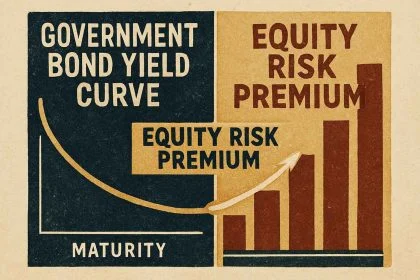
When High Yield Signals Risk Instead of Safety
Dividend yield is often perceived as a measure of stability. A higher yield appears attractive because it implies steady income relative to share price. However, dividend yield is not simply an income metric. It is a structural signal embedded within valuation mechanics, payout sustainability, and market expectations.
A dividend yield rises when either the dividend increases or the share price declines. In stable conditions, rising yield due to dividend growth may indicate operational strength. In stressed conditions, rising yield caused by falling share prices may reflect increasing risk. The distinction is structural rather than cosmetic.
Investors frequently interpret high yield as opportunity. Yet in many cases, elevated yield reflects heightened equity risk premium, deteriorating cash flow durability, or anticipated payout stress. Yield does not exist independently of required return. It is embedded within the same valuation framework that governs discount rates.
Understanding dividend yield risk requires examining three structural dimensions: payout sustainability, valuation denominator effects, and interest rate competition. These variables interact across macro cycles and determine whether yield represents compensation or warning.
This analysis explores how dividend yield behaves during tightening cycles, liquidity contraction, and risk premium expansion. It does not recommend dividend strategies. It explains the mechanics underlying dividend risk exposure.
Dividend Yield Formula – Beyond Surface Interpretation
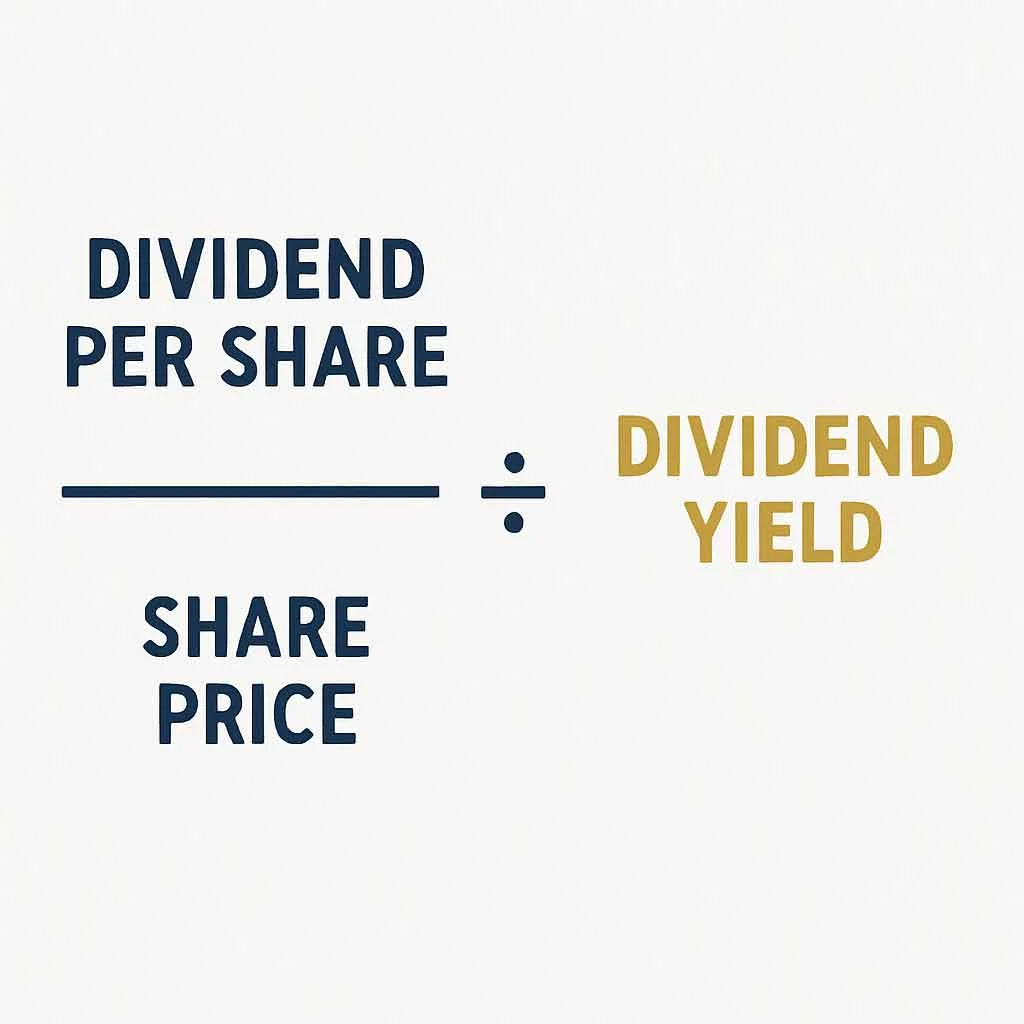
Dividend yield is calculated as:
Dividend Yield = Annual Dividend per Share / Current Share Price
The formula appears straightforward. However, its structural implications depend on which variable is driving the ratio. If dividends increase while share price remains stable, yield rises because earnings support higher payouts. If share price declines sharply while dividends remain unchanged, yield also rises. The latter scenario may signal deteriorating market confidence.
Because yield is inversely related to price, rising yield during market stress often reflects valuation compression rather than income expansion. When equity risk premium expands, required return increases. Share prices adjust downward. Yield rises mechanically, even if the dividend itself has not changed.
This mechanical relationship can create yield traps. A stock that appears attractive due to high yield may in fact be experiencing structural repricing driven by deteriorating fundamentals or elevated uncertainty. Yield alone does not reveal sustainability.
To evaluate dividend yield risk, one must analyze payout ratio, cash flow coverage, leverage levels, and macro sensitivity. Yield without context is incomplete.
Payout Ratio and Sustainability Mechanics
Payout ratio measures the proportion of earnings distributed as dividends. When payout ratios approach or exceed sustainable levels, dividend cuts become more probable during earnings contractions. High yield combined with elevated payout ratio often reflects structural vulnerability.
In stable growth environments, moderate payout ratios support durable yield. In cyclical industries, elevated payout ratios can signal vulnerability to earnings volatility. During downturns, companies with stretched payout ratios may reduce dividends to preserve liquidity. When dividend cuts occur, share prices often adjust further to reflect lower income expectations.
Dividend yield risk therefore depends not only on current yield but on sustainability of underlying cash flow. Markets anticipate this risk. In many cases, yield rises before formal dividend reductions occur, reflecting forward-looking discounting of potential payout stress.
Dividend Yield vs Interest Rates – Competitive Yield Dynamics
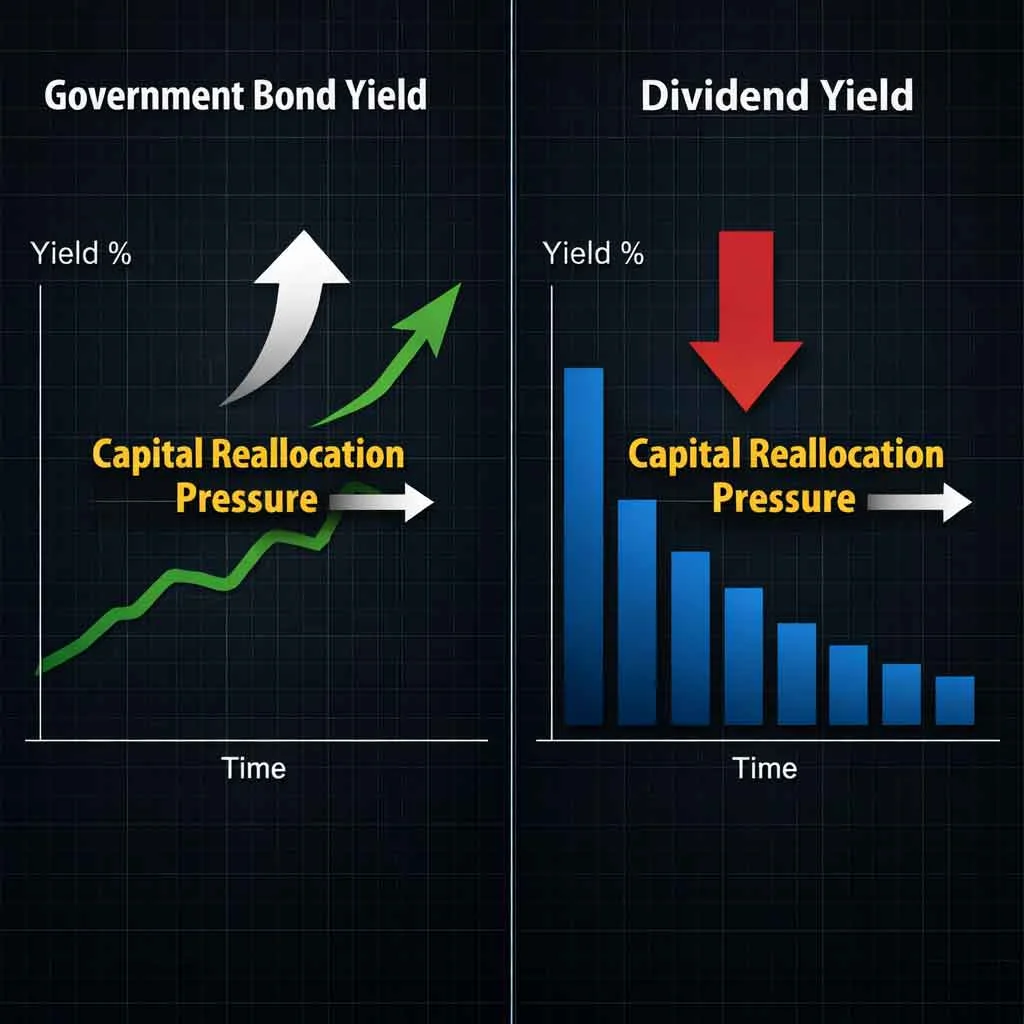
Dividend yield does not exist in isolation. It competes directly with sovereign bond yields and other income-producing assets. When risk-free rates rise, the relative attractiveness of dividend yield changes. Investors evaluate equity income against government bond income adjusted for uncertainty. If bond yields increase meaningfully, equities must either offer higher yield or stronger growth prospects to remain competitive.
This competitive dynamic creates structural pressure during tightening cycles. As risk-free rates rise, required return increases. Equity valuations compress. In many cases, dividend yields rise mechanically because share prices decline. However, this adjustment may not fully offset rising bond yields, particularly when equity risk premium simultaneously expands.
In low-rate environments, dividend yield often appears attractive because bond yields remain suppressed. This can support equity demand and compress the equity risk premium. In rising-rate regimes, dividend-paying shares must justify risk through sustainable growth or strong balance sheet durability. Yield alone is insufficient when alternative risk-free income rises.
Therefore, dividend yield risk increases during tightening cycles not only because valuations compress, but because competitive income benchmarks shift.
Equity Risk Premium and Dividend Yield Compression
Dividend yield reflects a balance between required return and expected growth. When equity risk premium compresses during stable macro periods, valuation multiples expand. As share prices rise faster than dividend growth, dividend yield may decline. This yield compression does not necessarily signal deteriorating income prospects. Instead, it may reflect reduced required compensation for uncertainty.
Conversely, when equity risk premium expands, share prices decline, pushing dividend yields higher. Elevated yield in such regimes may signal rising compensation for risk rather than improved income opportunity. Without analyzing the premium environment, yield alone cannot distinguish between structural repricing and income stability.
This interaction explains why high yield frequently coincides with heightened volatility. Markets demand greater compensation for uncertainty. Yield becomes a visible manifestation of required return expansion.
For a deeper structural explanation of how compensation expectations influence valuation denominators, see:
Equity Risk Premium – Valuation Mechanics
Liquidity Conditions and Dividend Vulnerability

Liquidity contraction can significantly alter dividend sustainability dynamics. During credit tightening or funding stress, companies face higher refinancing costs and reduced access to capital markets. Even firms with historically stable dividends may reassess payout policies to preserve cash buffers.
Dividend reductions often occur not solely because earnings decline, but because management prioritizes balance sheet strength amid uncertainty. Liquidity stress can elevate equity risk premium while simultaneously pressuring payout sustainability. Share prices may decline before dividend cuts are formally announced, reflecting forward-looking expectations.
This feedback loop reinforces dividend yield risk. As share prices fall, yields rise. Rising yields may attract income-focused investors, yet underlying liquidity fragility may persist. Without analyzing funding conditions and leverage exposure, yield can misrepresent underlying resilience.
The structural mechanics of liquidity amplification are explained in greater detail here:
liquidity feedback loops
Yield Traps – When High Income Masks Structural Weakness
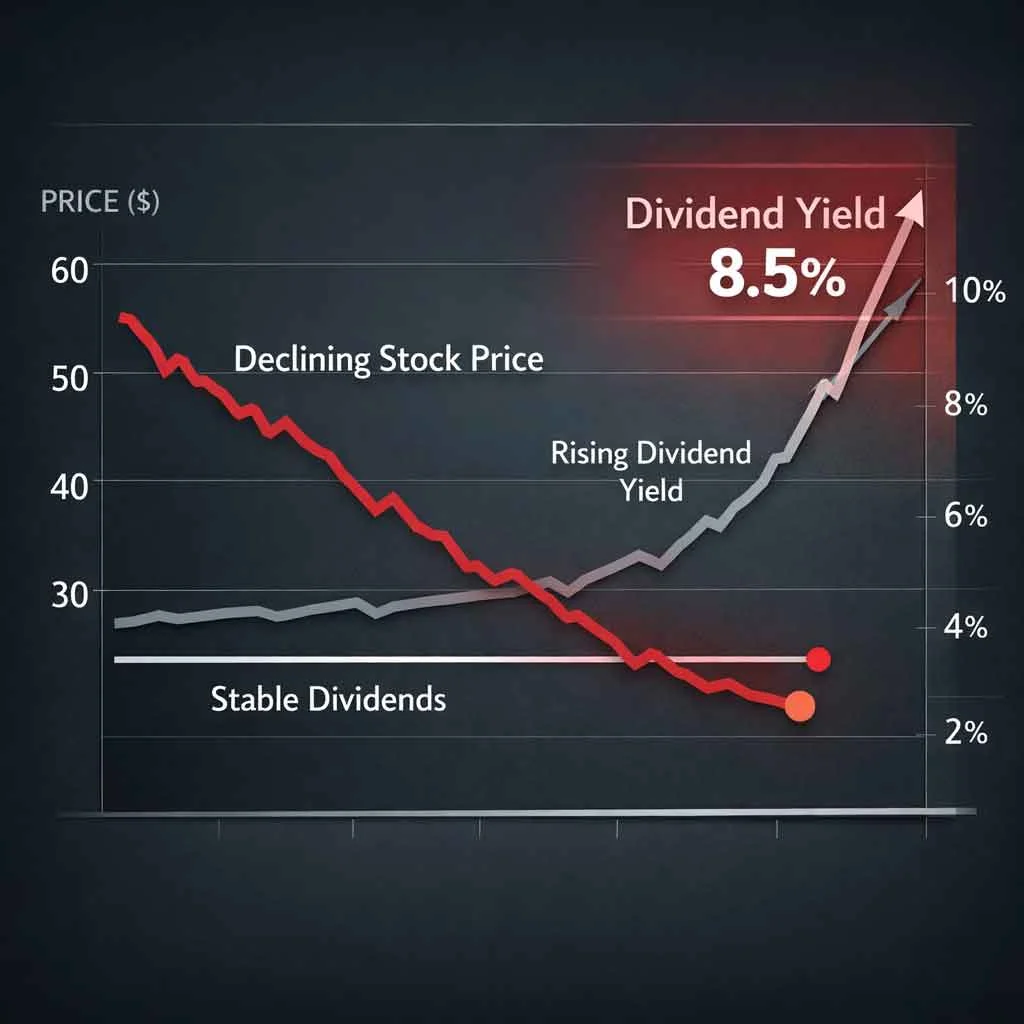
A yield trap occurs when elevated dividend yield reflects declining price due to deteriorating fundamentals rather than sustainable income strength. Structural indicators of potential yield traps include:
- Rising payout ratios without earnings growth
- Elevated leverage relative to cash flow
- Sector exposure to cyclical downturns
- Increasing credit spreads
- Premium expansion across the broader market
Yield traps often emerge during late-cycle tightening phases when earnings momentum slows but dividends remain temporarily unchanged. Markets anticipate potential payout stress and reprice shares accordingly. The resulting high yield may appear attractive, yet risk-adjusted return deteriorates.
Structural analysis therefore prioritizes balance sheet durability, earnings resilience, and macro positioning over headline yield percentages.
Dividend Yield in Low Premium Regimes
In environments characterized by compressed equity risk premium and stable liquidity, dividend yield risk tends to decline. Valuations expand, credit spreads narrow, and funding conditions remain supportive. Companies can sustain payouts with greater confidence. Yield compression during such periods reflects price appreciation rather than payout stress.
However, excessively low yields can also signal stretched valuations. When multiples expand aggressively, dividend yield declines as price outpaces payout growth. While this may reflect optimism, it reduces margin of safety should required return expectations shift.
Thus, dividend yield risk exists at both extremes. Extremely high yield may signal stress. Extremely low yield may signal valuation expansion vulnerability.
Integrating Dividend Yield Analysis With Structural Modeling Tools
Dividend yield interacts directly with required return mechanics. When evaluating yield sustainability, it is helpful to examine how changes in required return influence valuation compression and funding stress. The Rate Shock Impact Simulator demonstrates how required return expansion can reduce implied multiples. The Liquidity Stress Visualizer illustrates how funding contraction can accelerate drawdowns.
For interactive modeling, explore the Finance Tools suite:
https://www.expertsguys.com/tools/finance/
These models do not forecast dividend outcomes. They illustrate structural transmission mechanisms between macro shifts and equity valuation.
Credit Spreads and Dividend Risk Transmission
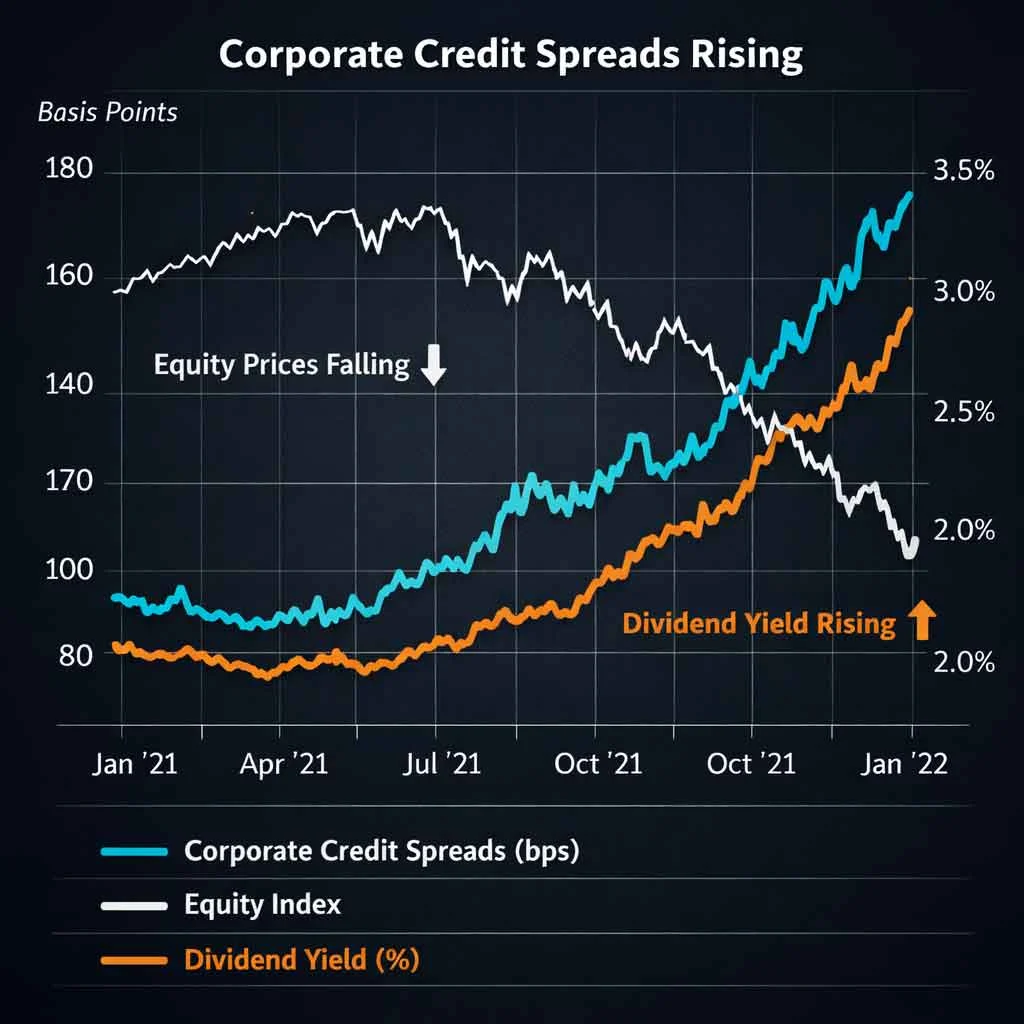
Dividend sustainability is frequently evaluated at the equity level through payout ratios and earnings coverage. However, a deeper structural signal often appears first in credit markets. Credit spreads represent the additional yield corporate borrowers must pay above sovereign benchmarks. When spreads widen, funding conditions tighten. This tightening influences dividend stability even before earnings decline.
Companies that rely on periodic refinancing face increased cost of capital when spreads expand. If refinancing costs rise materially, free cash flow available for dividends declines. Even firms with stable operating performance may reduce payout growth or suspend buybacks to preserve liquidity buffers.
Credit spread widening therefore acts as an early warning mechanism for dividend risk. It signals rising equity risk premium indirectly through funding stress. When spreads widen across sectors, investors reassess sustainability assumptions. Dividend yields may rise due to falling share prices even before formal payout adjustments occur.
This interaction reinforces a key structural principle: dividend yield cannot be evaluated independently from capital structure. Firms with elevated leverage and narrow interest coverage ratios are more vulnerable to spread expansion. In such cases, high dividend yield may compensate investors for structural refinancing risk rather than stable income generation.
The transmission mechanism follows a predictable sequence:
- Macro uncertainty rises.
- Credit spreads widen.
- Required return increases.
- Equity valuations compress.
- Dividend yield rises mechanically.
- Payout sustainability is reassessed.
Dividend risk therefore begins in funding markets before it becomes visible in income statements.
Inflation Regimes and Real Dividend Sustainability
Nominal dividend growth does not guarantee real income preservation. Inflation alters the purchasing power of dividend payments and reshapes required return expectations. During moderate inflation regimes, companies with pricing power can increase dividends in line with nominal revenue growth. Yield risk remains contained if earnings growth offsets discount rate increases.
However, in high inflation regimes accompanied by tightening monetary policy, risk-free rates often rise rapidly. As sovereign yields increase, required return for equities rises. Even if dividends grow nominally, valuation compression may dominate. Dividend yield may rise due to falling price rather than sustainable income expansion.
Real dividend sustainability depends on three variables:
- Earnings growth relative to inflation
- Capital expenditure requirements
- Debt servicing burden
In inflationary tightening cycles, capital-intensive sectors may face rising input costs and higher refinancing rates simultaneously. This combination pressures free cash flow available for dividends. Yield spikes in such sectors may reflect deteriorating real income capacity rather than attractive opportunity.
Structural dividend analysis must therefore incorporate inflation regime assessment rather than relying on historical yield averages.
Sector Fragility Matrix – Dividend Risk Across Industries
Dividend sustainability varies structurally across sectors. Defensive industries such as utilities and consumer staples often exhibit stable cash flows but may carry high leverage due to capital intensity. Cyclical sectors such as energy and materials experience volatile earnings tied to commodity cycles. Financial institutions depend on credit conditions and regulatory capital requirements.
Yield risk must be evaluated within sector-specific fragility frameworks.
Utilities:
- Stable revenue
- High leverage
- Sensitive to interest rate shifts
- Yield risk tied to refinancing conditions
Energy:
- High yield during commodity peaks
- Vulnerable to price collapses
- Cyclical payout volatility
Financials:
- Dividend linked to credit cycle
- Regulatory capital constraints
- Sensitive to spread widening
Technology:
- Lower yield baseline
- Growth reinvestment focus
- Yield less central to valuation
When macro tightening occurs, sectors with high leverage and cyclical earnings face amplified dividend vulnerability. Yield comparison without sector context obscures these structural differences.
Dividend Cuts – The Structural Chain Reaction
Dividend reductions often occur after prolonged price declines. However, price adjustment frequently anticipates payout revision. Markets incorporate forward-looking expectations of earnings contraction, refinancing stress, or regulatory changes.
The structural chain reaction typically unfolds as follows:
- Earnings outlook weakens.
- Credit spreads widen.
- Equity risk premium expands.
- Share prices decline.
- Yield rises sharply.
- Dividend cut becomes probable.
- Formal announcement confirms market pricing.
By the time dividend reduction occurs, yield may have already reflected anticipated adjustment. Investors who interpret high yield at late stages of this chain risk entering yield traps.
Understanding this transmission sequence is critical to interpreting yield spikes during downturns.
Dividend Yield and Equity Duration Interaction
Dividend-paying shares are sometimes perceived as lower-duration assets because they return capital earlier through cash payouts. However, duration sensitivity depends not only on payout frequency but also on growth expectations embedded in price.
High-growth dividend payers with modest payout ratios may still exhibit long duration characteristics if valuation assumes future expansion. Conversely, mature firms with stable payout and limited growth may exhibit shorter duration sensitivity.
When required return increases, long-duration components compress more severely. Dividend yield may rise, but capital loss may outweigh income. Therefore, dividend income does not automatically immunize against discount rate sensitivity.
Duration mechanics must be integrated into dividend risk assessment.
International Dividend Risk Considerations
Dividend culture differs across regions. Some markets emphasize stable payout policies with incremental annual increases. Others adopt flexible payout ratios tied to earnings volatility. Regulatory frameworks also influence payout decisions.
Emerging markets may exhibit higher baseline yields due to elevated equity risk premium and macro uncertainty. However, currency volatility, political instability, and capital flow sensitivity increase structural risk.
International dividend yield comparison without adjusting for baseline premium and governance risk can misrepresent relative safety.
Dividend vs Share Buybacks – Capital Allocation and Risk Signaling
Dividend policy does not operate in isolation. It competes internally with share repurchases, debt repayment, and reinvestment. Capital allocation choices signal management confidence and liquidity posture. When firms increase dividends while simultaneously expanding leverage or reducing investment flexibility, structural risk may rise despite stable yield.
Buybacks are more flexible than dividends. Dividends create recurring expectations. Once established, reductions are perceived negatively. Buybacks, by contrast, can be paused with less signaling impact. During tightening cycles, firms often suspend repurchases before adjusting dividends. Observing this sequence provides early insight into payout vulnerability.
If buybacks decline sharply while dividend remains unchanged, management may be conserving liquidity ahead of potential stress. Yield may appear stable, yet internal capital allocation decisions signal elevated caution. Structural dividend analysis must therefore consider total shareholder return policy rather than dividend alone.
High dividend yield combined with declining buybacks can reflect transition from growth posture to defensive liquidity preservation. That transition frequently occurs during late-cycle tightening phases.
Long-Term Yield Compression Regimes
Over extended bull market cycles characterized by low inflation and abundant liquidity, dividend yields often trend downward. This compression reflects valuation expansion rather than payout deterioration. Investors accept lower yield because required return declines and risk tolerance increases.
Yield compression regimes can persist for years. During such periods, total return is driven more by multiple expansion than income growth. However, compressed yields reduce income buffer against valuation shocks. When required return expectations shift upward, compressed yields can expand rapidly through price adjustment.
Historical observation shows that extremely low aggregate market yields often coincide with stretched valuations and elevated duration exposure. Yield compression therefore contains embedded vulnerability should macro conditions reverse.
Dividend yield risk is not confined to high-yield environments. It also exists in compressed-yield regimes where margin of safety narrows.
Advanced Sustainability Metrics – Beyond Payout Ratio
Basic payout ratio compares dividends to earnings. However, earnings can include non-cash components or cyclical fluctuations. Advanced sustainability assessment incorporates:
- Free cash flow coverage ratio
- Net debt to EBITDA
- Interest coverage ratio
- Capital expenditure requirements
- Cyclicality of revenue
Free cash flow coverage offers clearer insight than earnings payout alone. Firms with stable cash conversion and moderate leverage exhibit lower structural dividend risk. Firms with high capital intensity and volatile margins face greater vulnerability during tightening cycles.
Interest coverage becomes critical when risk-free rates rise. Even if earnings remain stable, rising refinancing costs can erode free cash flow available for dividends. Sustainability must therefore be evaluated within broader capital structure context.
Dividend yield without examining leverage metrics provides incomplete risk assessment.
Macro Scenario Modeling – Tightening, Recession, Recovery
Dividend yield risk evolves differently across macro phases.
Tightening Phase:
Risk-free rates rise. Equity risk premium may expand. Valuations compress. Yields rise mechanically. Firms with high leverage face refinancing stress.
Recession Phase:
Earnings decline. Credit spreads widen further. Dividend cuts become more probable. Yield spikes can precede formal payout reductions.
Recovery Phase:
Liquidity stabilizes. Equity risk premium compresses. Valuations expand. Dividend reinstatements occur selectively. Yield may compress as price recovery outpaces payout growth.
Modeling dividend risk requires situating current yield within macro phase rather than viewing it statically. Structural context determines whether elevated yield represents compensation or fragility.
Case Cycle Illustration – Hypothetical Stress Transmission
Consider a firm with 6 percent dividend yield during stable conditions. Risk-free rate increases by 150 basis points during tightening. Equity risk premium expands by 100 basis points due to volatility spike. Required return rises materially. Share price declines by 20 percent. Dividend remains unchanged initially. Yield increases to 7.5 percent.
Credit spreads widen. Refinancing cost increases. Management reassesses payout sustainability. Earnings soften due to slower demand. Dividend growth pauses. Eventually, payout is reduced by 25 percent. Share price adjusts further. Yield normalizes at lower sustainable level.
This simplified sequence illustrates how yield spikes often precede structural adjustments rather than represent final equilibrium.
Dividend Yield and Behavioral Anchoring
Income-focused investors often anchor to nominal yield thresholds. Anchoring bias can obscure structural changes in required return or credit conditions. When yield rises above historical norms, it may appear attractive relative to past averages. However, if macro risk regime has shifted, historical comparisons may be misleading.
Structural analysis prioritizes forward-looking risk assessment over backward-looking yield averages. Dividend yield is not a fixed income instrument. It reflects equity risk exposure subject to macro uncertainty.
Integrating Dividend Risk With Required Return Framework
Dividend yield should be interpreted within the broader required return formula:
Required Return = Risk-Free Rate + Equity Risk Premium
When either component increases, valuation compression can occur even if dividend remains unchanged. Yield therefore interacts directly with denominator mechanics explored in:
Equity Risk Premium – Valuation Mechanics
And rate sensitivity can be modeled using:
These structural models reinforce how required return expansion influences yield behavior across regimes.
Regulatory and Policy Constraints on Dividend Stability
Dividend sustainability is not determined solely by corporate cash flow and leverage. Regulatory frameworks can materially influence payout decisions. Financial institutions, utilities, and certain infrastructure firms often operate under capital adequacy requirements or regulated return structures. During systemic stress, regulators may restrict dividend distributions to preserve capital buffers.
This dynamic became evident in multiple historical downturns where regulators temporarily halted dividend payments for banks despite earnings resilience. In such cases, dividend risk emerged from policy intervention rather than operational collapse. Yield may have appeared attractive prior to restrictions, yet regulatory risk was embedded within systemic stress signals.
Policy risk therefore forms a structural layer above firm-level fundamentals. Industries subject to regulatory oversight must be evaluated within capital adequacy and supervisory context. Elevated yield in such sectors may incorporate policy risk premium rather than simple earnings uncertainty.
International Dividend Structures and Cultural Differences
Dividend norms vary significantly across global markets. In some regions, companies maintain conservative payout policies with incremental increases over long periods. In others, dividends fluctuate in direct proportion to annual earnings volatility. Certain markets favor high payout ratios due to limited reinvestment opportunities, while others prioritize retained earnings for growth.
Emerging markets frequently exhibit higher baseline dividend yields. However, these yields reflect elevated equity risk premium due to macro instability, currency volatility, and governance risk. Comparing yield levels across regions without adjusting for baseline premium differentials can distort perceived attractiveness.
Currency risk further complicates international dividend analysis. Even if nominal dividend remains stable in local terms, currency depreciation can reduce real income for foreign investors. Structural dividend risk therefore includes exchange rate exposure and sovereign stability considerations.
Inflation-Adjusted Yield Modeling
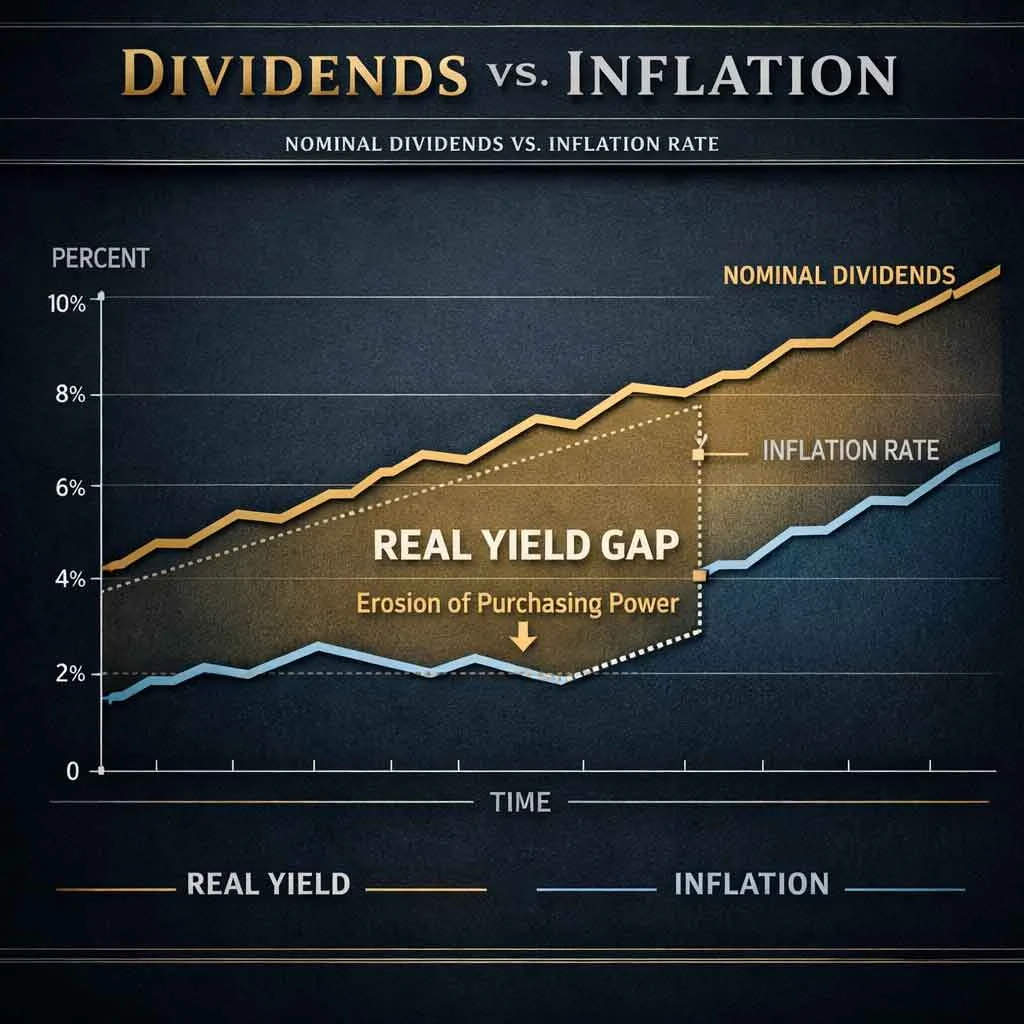
Nominal dividend yield does not equal real income preservation. Inflation-adjusted yield measures purchasing power stability over time. During moderate inflation with pricing power, companies can increase dividends in line with cost growth. Real yield remains stable. However, in high inflation combined with tightening liquidity, nominal dividends may lag cost escalation.
If inflation exceeds dividend growth for extended periods, real income declines even if nominal yield appears stable. Simultaneously, rising risk-free rates elevate required return. Valuation compression may reduce capital value while inflation erodes purchasing power of income.
True dividend sustainability must therefore incorporate real growth capacity rather than headline payout figures. Structural analysis extends beyond nominal yield toward real return durability.
Long-Horizon Income Stability and Reinvestment Assumptions
Dividend risk is often evaluated within short-term yield context. However, long-horizon stability depends on reinvestment discipline and earnings resilience. Firms that consistently generate excess free cash flow beyond dividend requirements maintain flexibility to sustain payouts across cycles. Firms that distribute most earnings with limited reinvestment capacity may struggle during downturns.
Reinvestment supports future earnings growth, which stabilizes dividend progression. Over-distribution in expansion phases can impair resilience in contraction phases. Therefore, dividend yield must be interpreted relative to retained earnings capacity and long-term capital allocation policy.
High initial yield without reinvestment support can mask structural fragility over extended horizons.
Synthesis – When Dividend Yield Reflects Compensation Versus Vulnerability
Dividend yield operates as a structural signal rather than a standalone metric. It reflects interaction between payout policy, required return, macro regime, liquidity conditions, credit spreads, and policy risk.
Yield may represent compensation when:
- Payout ratio remains moderate
- Free cash flow coverage is strong
- Leverage is controlled
- Credit spreads remain stable
- Equity risk premium is not expanding aggressively
Yield may represent vulnerability when:
- Share price declines due to required return expansion
- Credit spreads widen
- Leverage increases
- Earnings visibility weakens
- Regulatory constraints emerge
Interpreting yield requires embedding it within required return framework. The formula:
Required Return = Risk-Free Rate + Equity Risk Premium
remains central. When required return rises due to either component, valuation compression may elevate yield mechanically. Without examining structural drivers, yield alone cannot distinguish between compensation and fragility.
Dividend yield risk analysis therefore integrates:
Macro regime
Funding conditions
Capital allocation
Duration sensitivity
Policy constraints
Real income sustainability
This structural approach reduces reliance on surface metrics and emphasizes systemic context.
Final Structural Perspective
Dividend yield is neither inherently safe nor inherently risky. It is an output variable reflecting equilibrium between income distribution and market-required compensation for uncertainty. Elevated yield may reward risk-bearing when fundamentals remain durable. It may also signal embedded stress when funding and macro conditions deteriorate.
Understanding dividend yield risk requires shifting focus from headline percentages to structural drivers. Yield is a visible symptom of deeper mechanisms operating within valuation models and capital markets.
Frequently Asked Questions
Is a high dividend yield always a good sign?
Not necessarily. A high dividend yield may result from declining share prices rather than increasing dividend strength. Elevated yield can sometimes reflect rising equity risk premium or concerns about payout sustainability.
How does interest rate movement affect dividend stocks?
Rising interest rates increase competition from risk-free income assets and can raise required returns for equities. This may lead to valuation compression in dividend-paying shares, particularly those with extended duration characteristics.
What is a dividend yield trap?
A dividend yield trap occurs when a stock’s yield rises due to falling share price driven by deteriorating fundamentals. The elevated yield may not be sustainable if earnings or cash flow weaken.
Does a low dividend yield mean a stock is safer?
A low dividend yield may reflect valuation expansion or reinvestment of earnings rather than reduced risk. Yield alone does not determine safety; sustainability and macro conditions are critical.