



Mood issues are changes in how you feel, such as irritability, sadness or emotional ups and downs, that become difficult to manage or disrupt daily life. Start by separating immediate safety, changes from your usual pattern and the next manageable action; the phrase itself does not identify a diagnosis.
If anyone is in immediate danger, cannot stay safe, has taken an overdose or has seriously injured themselves, use local emergency services or an emergency department now. Do not wait to work out whether the problem is depression, bipolar disorder, stress or something else.
For a difficult but safe moment, put down anything you are holding, create a little comfortable space and postpone the reply that feels likely to make things worse. Once the moment is less pressured, the more useful question is what has changed around it: sleep, energy, judgment, enjoyment or the ability to manage ordinary responsibilities.
What makes a mood change worth attention?
The strongest clue is a meaningful change from your own usual functioning, especially when several things change together. A feeling can be intense without identifying an illness, while a quiet, persistent loss of interest can be serious even when nobody sees an outburst. Compare the surrounding pattern rather than judging the importance of the problem by how dramatic it looks.
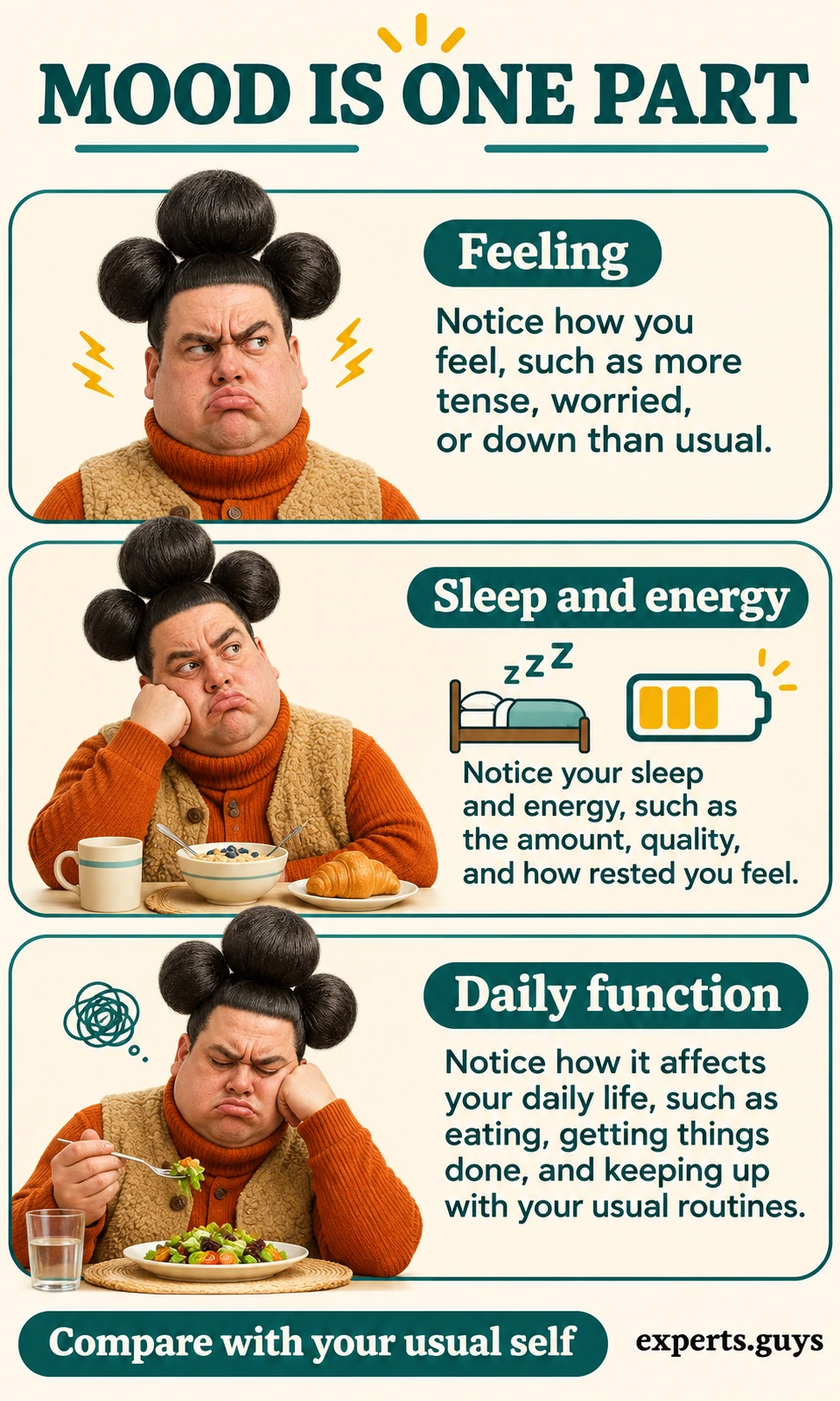
- Feeling: What is different – a shorter temper, sadness, anxiety, emptiness or feeling unusually elevated?
- Capacity: Are eating, working, concentrating or maintaining relationships becoming harder?
- Context: Did the change follow poor sleep, pain, a stressful event, substance use or a medication change?
- Course: Does the difficulty pass with the situation, keep returning or continue across settings?
These questions organize what you already know. They are not a score, a diary assignment or a test you must complete before you deserve help. If the answer is simply “this is getting harder and I cannot manage it,” that is useful information too.
| What you notice | What it may mean | Useful response |
|---|---|---|
| A difficult mood after a recognizable frustration | A reaction to the situation; other contributors may still matter. | Use a safe pause, then address the actual problem. |
| Low mood or reduced enjoyment keeps interfering | A broader mental or physical health problem may need assessment. | Arrange care; seek help sooner when symptoms are severe. |
| Much less sleep with unusual energy or risky decisions | An activated pattern needs prompt attention; irritability alone does not explain it. | Seek prompt assessment rather than treating it as extra productivity. |
| Threats, serious injury, overdose or inability to stay safe | The immediate issue is safety, whatever the cause. | Use emergency help now. |
A practical judgment follows from this distinction: choose your next step by consequence before choosing a label. You can prevent an argument from escalating without deciding what diagnosis applies. You can also arrange assessment because your daily life is changing without proving that your symptoms match a particular condition.
Why the same feeling can have different explanations
Irritability is a description, not a cause. Someone in pain may have less tolerance for interruptions; someone under sustained stress may feel constantly braced for another demand. Anxiety, depression, sleep problems, substance effects and some medicines can also be relevant. Several contributors may operate together, so discovering one plausible explanation does not automatically settle the others.
That uncertainty matters when an apparently small event produces a large response. The event might be the final demand on an already difficult day, but it might also reveal an unresolved practical problem or relationship conflict. Explaining the response does not excuse hurtful behavior, and recognizing symptoms does not mean every complaint is unreasonable.
An illustrative example is snapping when a family member asks what you want for dinner. The visible event is a sharp reply. If you have also lost interest in eating, struggled to decide throughout the day and stopped enjoying familiar activities, the wider difficulty deserves attention; if the conflict is about unfairly shared responsibilities, that problem deserves attention too. Both can be true.
Why sleep and energy belong together
Sleeping less and needing less sleep are different experiences. Poor sleep followed by exhaustion suggests a different account from much less sleep accompanied by unusual drive, faster thinking or impulsive activity. Neither a single night nor a single facial expression determines what is happening.
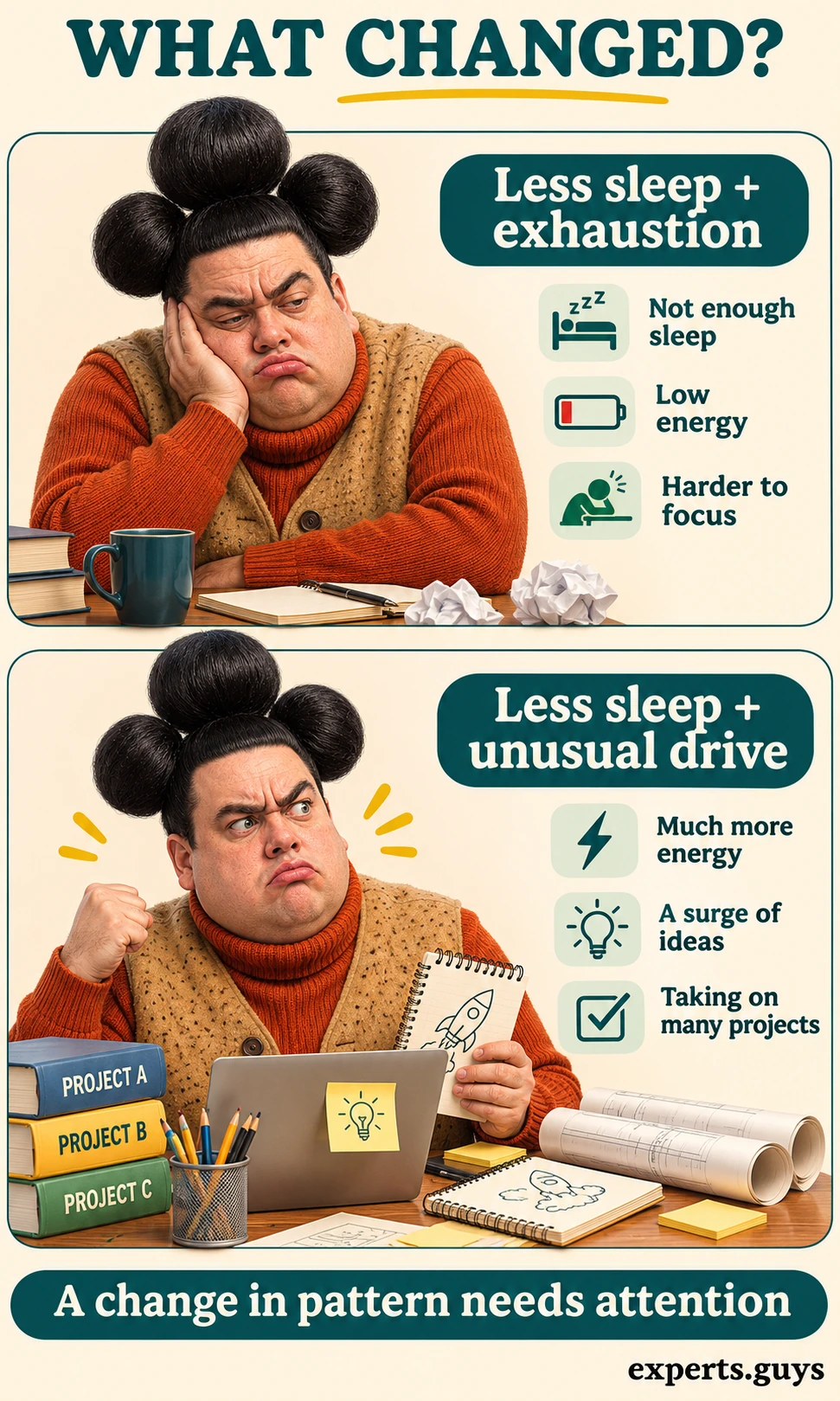
The NIMH explanation of bipolar disorder describes episodes through changes in mood, energy and activity together. That is why an unfamiliar combination matters more than the word “moody.” Do not deliberately miss sleep to test the distinction, and do not wait for a diagnostic duration threshold if behavior is becoming dangerous or rapidly escalating.
This page does not need to repeat a full diagnostic comparison. If your main question is how long-standing emotional difficulties differ from distinct mood episodes, the guide to BPD and bipolar patterns develops that question. Here, the practical task is deciding what the current change calls for while its cause remains uncertain.
What can you do during a difficult mood moment?
Choose an action that reduces the chance of an impulsive response and is physically manageable where you are. The aim is a safer interval between feeling and acting, not forcing yourself to feel cheerful. A pause counts when it changes what you do next, even if the emotion remains strong.
Put the object down, create space, delay the reply
Use this sequence in an ordinary, safe disagreement when you notice that you are gripping an object, leaning into the conversation or preparing a cutting reply. It is an editorial adaptation of the NHS recommendation to give yourself time before reacting. The household demonstration is not a tested treatment protocol.
- Put down what you are holding. Rest a cool mug or other harmless object on a stable surface within easy reach. If you are handling something hot, sharp or otherwise hazardous, make that task safe first.
- Create comfortable space. If the floor is clear and moving is comfortable, take one ordinary step back. Keep your hands to yourself and leave the other person’s exit clear.
- Delay the reply. Say, “I need a pause before I answer.” Stop debating the point while you arrange when or whether it is appropriate to continue.
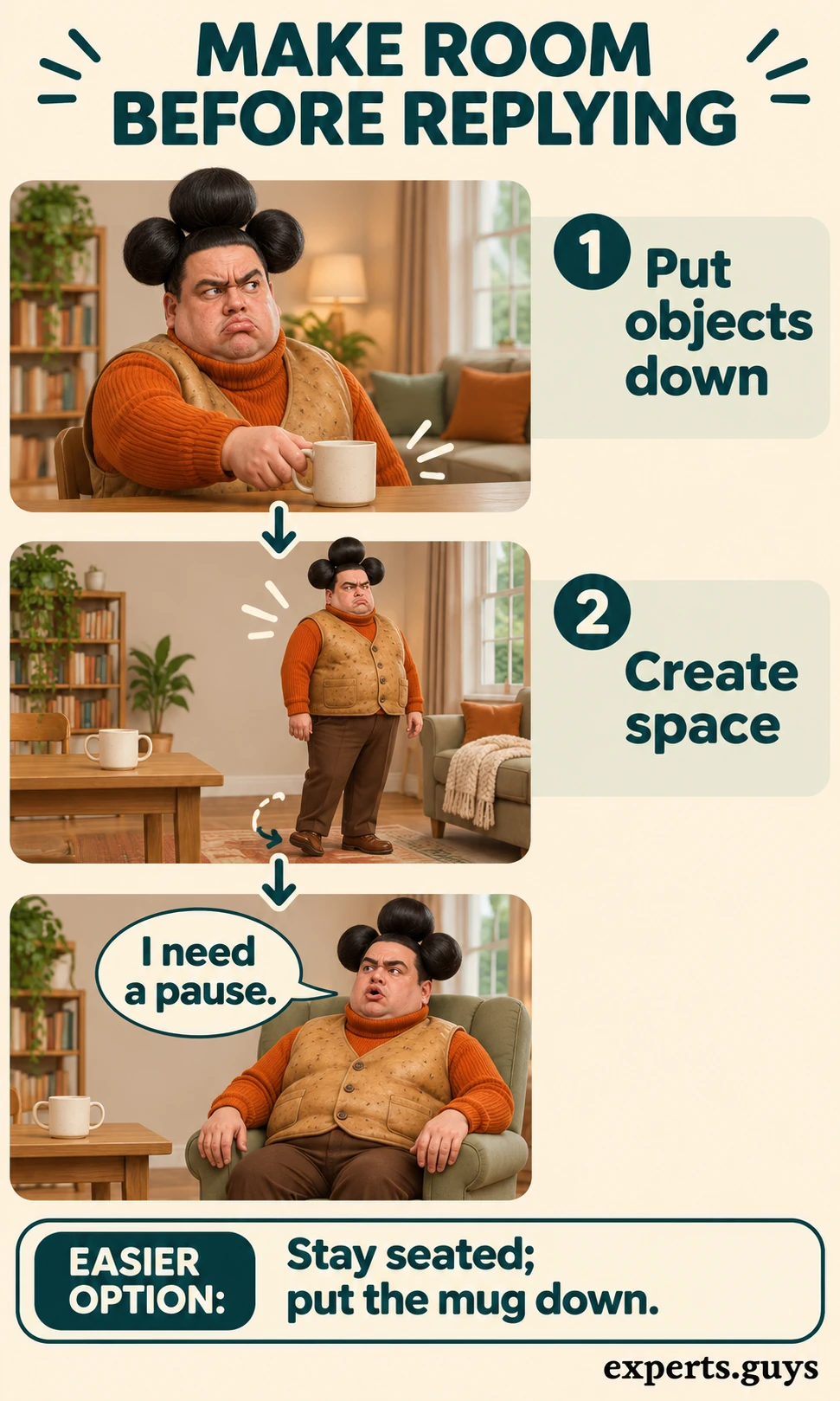
The illustration shows a cool mug because the critical action is releasing your grip on a harmless object before answering. In an illustrative kitchen conversation, you set the empty mug down, step back from the table and use the pause sentence. Completion is the sequence itself: the object is safely down, space is available and the immediate reply has stopped.
The common mistake is turning the pause into one more accusation: “I have to leave because you always do this.” That keeps the argument moving. Use a short statement about your own next action instead. If moving is difficult, stay seated and set the mug down; the distance does not need to change for you to stop answering.
A pause should not become a threat, punishment or unexplained disappearance. In a safe relationship, a simple agreement such as “Let’s check whether we can talk after dinner” can preserve the intention to return without promising that a fixed number of minutes will settle your mood. If the conversation remains heated, postpone the disputed decision rather than restarting solely because time has passed.
Do not use this as a negotiation exercise during intimidation or violence. If the other person blocks your exit, threatens you or makes taking a pause unsafe, prioritize getting help and a safer situation. Nobody has to demonstrate a calming skill before their safety matters.
Let supported hands open without forcing them
When tension is noticeable in your hands, a small physical adjustment may be easier than trying to argue yourself into calm. Use the supported-hand sequence only if it is comfortable and movement is safe for you. It illustrates noticing and easing a tense posture; it does not establish that muscle tension is the cause of your mood.
- Support your forearms. Rest them on a comfortable stable surface or your lap, without pressing on a sore area.
- Let the fingers uncurl gently. Do not pull them open with the other hand, squeeze harder first or stretch through pain.
- Rest the hands. Leave them in a comfortable position while you decide whether to keep pausing. An open palm is optional if another relaxed position suits you better.
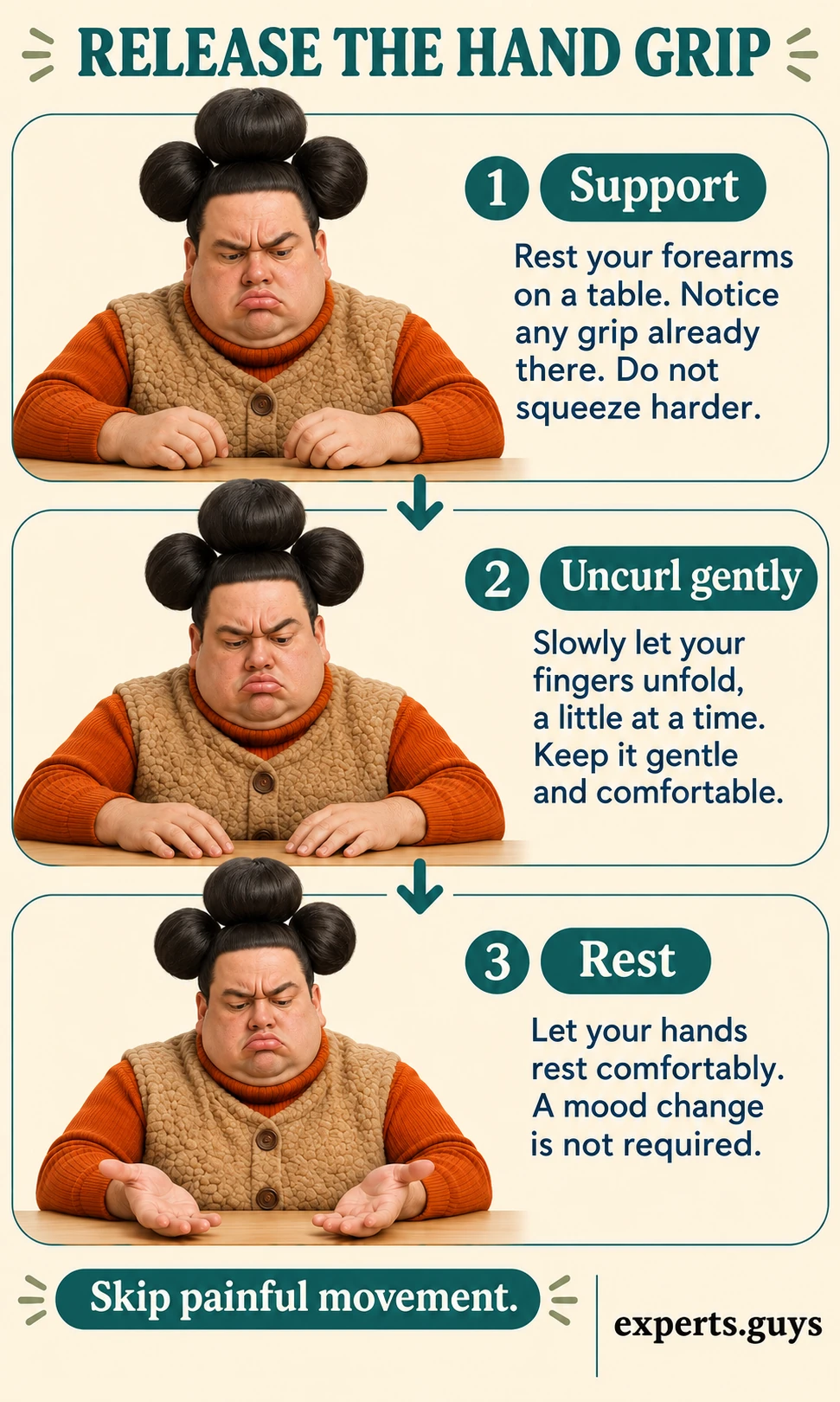
For example, you may notice clenched hands during a tense seated conversation. You support your forearms, allow the fingers to loosen and leave them resting while the discussion pauses. The observable result is a less forceful grip or a more comfortable position; the exercise is complete without a lower mood rating.
This small adaptation draws on the tension-and-release principle in NHS inform’s quick muscle relaxation guidance, while omitting deliberate squeezing. The source describes a fuller exercise; the supported, release-only version here is an everyday adaptation. It has not been clinically validated as a stand-alone mood intervention. Skip it if you have hand pain, injury, numbness or a movement condition that makes the position unsuitable; simply supporting your arms comfortably is an alternative, and no movement is required.
Trying too hard is the main failure mode. Holding a perfectly flat hand or repeatedly checking whether you are calm can become another demand. Let the position be ordinary, stop if it hurts and choose the next practical action on the basis of safety and the situation rather than whether the exercise “worked.”
What if the mood is low rather than heated?
An anger-focused pause is useful only for the problem it addresses. If the main difficulty is emptiness, loss of interest or feeling unable to manage ordinary tasks, repeatedly relaxing your hands will not answer the larger need. Identify which responsibility is becoming difficult and make support fit that obstacle, rather than adding an unrelated exercise.
For instance, someone who is missing meals because every choice feels exhausting needs a workable way to obtain food and appropriate help with the wider change. Someone who is irritable only while dealing with severe pain needs the pain taken seriously. These examples illustrate matching support to function; they do not identify a diagnosis or show that a simple lifestyle adjustment will resolve it.
If low mood is already part of bipolar disorder, the separate article on irritability during bipolar depression addresses that specific context. This article keeps its practical focus on the immediate response when the explanation has not yet been established.
How can you repair an interaction without dismissing yourself?
Name the behavior you want to change without treating the underlying feeling as illegitimate. “I was upset” and “I should not have insulted you” can both be accurate. Repair is more useful when it identifies one observable action and one realistic change than when it turns into a sweeping judgment about your personality.
Use a specific repair statement
Try this after an ordinary disagreement when both people are safe and willing to talk. The aim is to reopen communication, not obtain immediate forgiveness or persuade someone that their experience was wrong. The wording below is an editorial communication example, not a clinical protocol. The NHS-hosted anger self-help guide supports concise, assertive communication; these particular repair sentences are examples rather than a validated formula.
- Name the action: “I raised my voice.” Choose something the other person could have observed, rather than “I was terrible.”
- Own the impact: “That was unfair.” Do not attach “but you made me” to the acknowledgement.
- Offer a change you control: “I will speak more slowly.” Keep the proposal small enough to demonstrate in the next exchange.
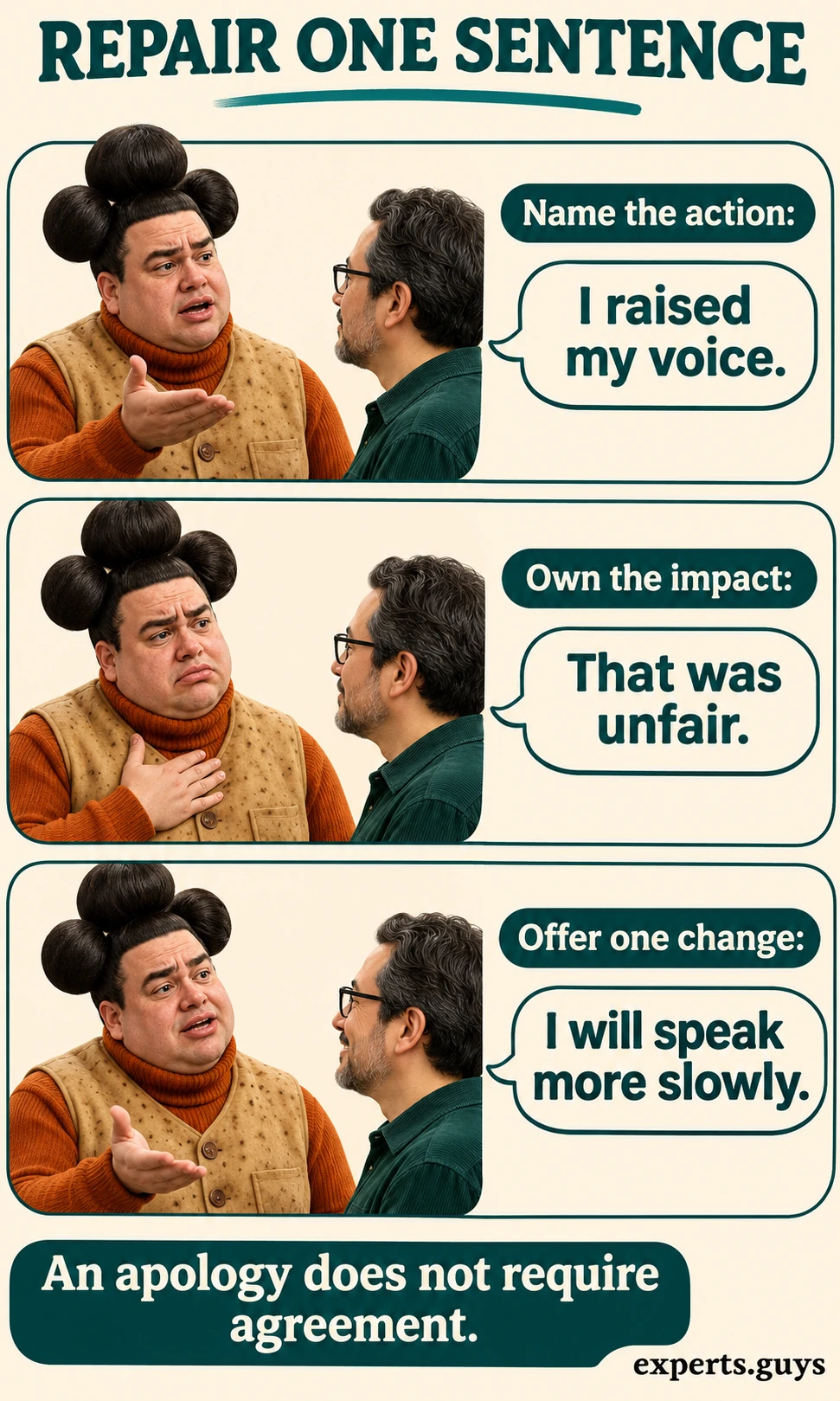
A complete illustrative repair might be: “I raised my voice. That was unfair. I will speak more slowly. I still want to discuss how we divide the evening tasks.” The last sentence preserves the real issue without using it to cancel the acknowledgement. You can change your manner of speaking and continue to disagree about the solution.
If a longer conversation is too much, use the shorter version: “I spoke sharply. I want to try that again.” Completion means making an accurate acknowledgement and offering a different response. The other person may need time, may decline the conversation or may see the disagreement differently; their immediate reassurance is not a required outcome.
Watch for promises that exceed your control. “I will never be irritable again” is difficult to keep and makes future emotion seem like another failure. A commitment to stop an insult, lower your voice or postpone a disputed conversation is more concrete. Repeated harm, however, needs more than increasingly polished apologies.
Keep a boundary around harmful behavior
Feelings and behavior have different roles in a conflict. A feeling provides information about distress or a concern; it does not grant permission to threaten, intimidate or hurt someone. A boundary identifies what conduct is acceptable and what you will do to protect yourself, without requiring an argument about whether the person is “really” unwell.
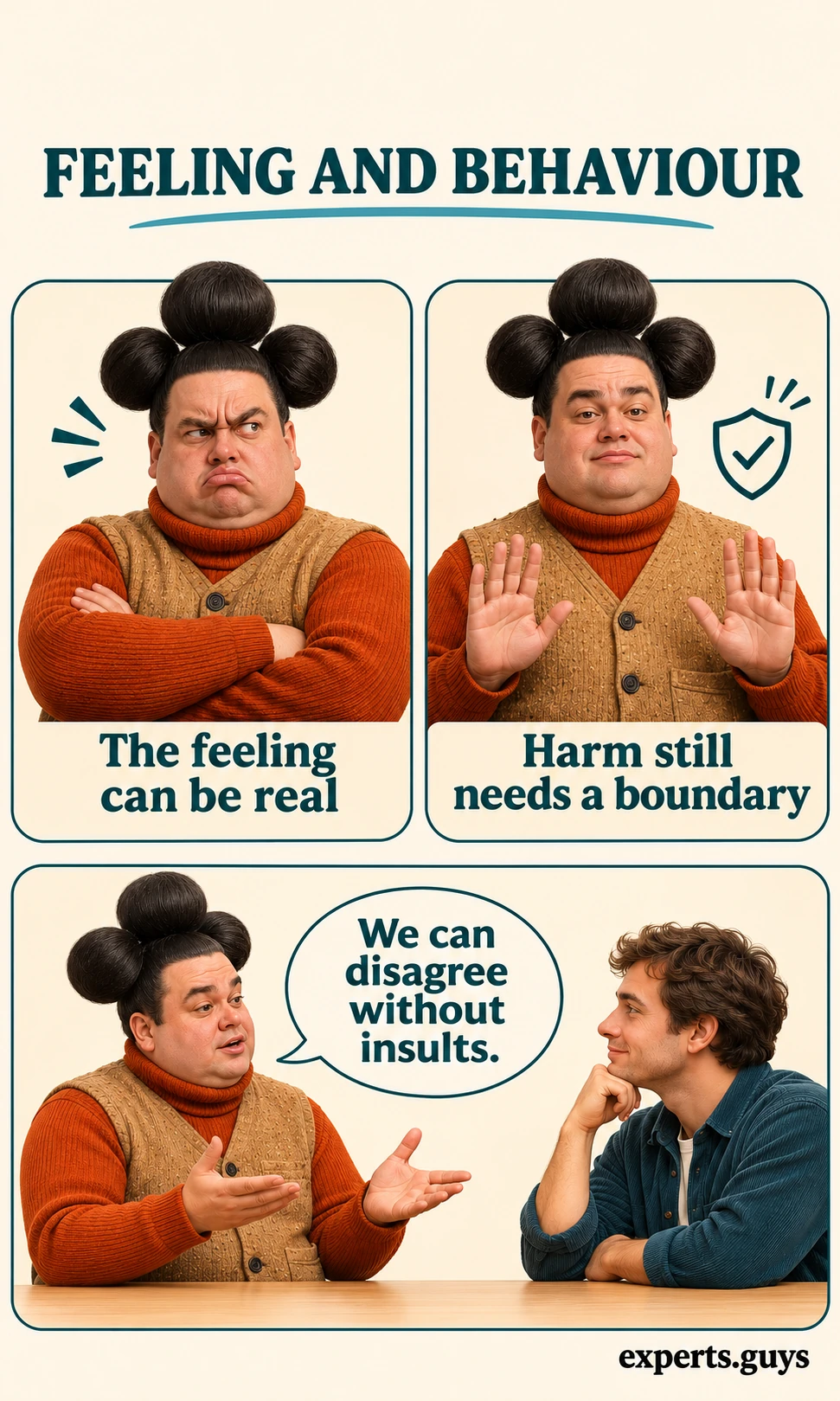
In a safe conversation, “We can disagree without insults” keeps the limit visible while allowing the topic to remain open. It does not require you to diagnose the other person or prove who started the dispute. If saying a boundary would increase danger, do not rely on a better sentence to fix an unsafe situation; seek outside support and prioritize safety.
The opposite mistake is using a mental-health label to end every disagreement. “That is just your mood” can dismiss a valid concern about workload, money, pain or how someone is being treated. Address the actual issue when the conversation is workable. If a broader pattern also needs care, those are parallel responsibilities rather than competing explanations.
Someone supporting you can acknowledge distress without agreeing with a harmful demand: “I can see this is difficult, and I will not stay in a conversation with threats.” Support does not require accepting abuse. Equally, having a mood-related diagnosis does not mean a person is dangerous; behavior and the immediate circumstances determine the boundary.
When does the wider pattern need assessment?
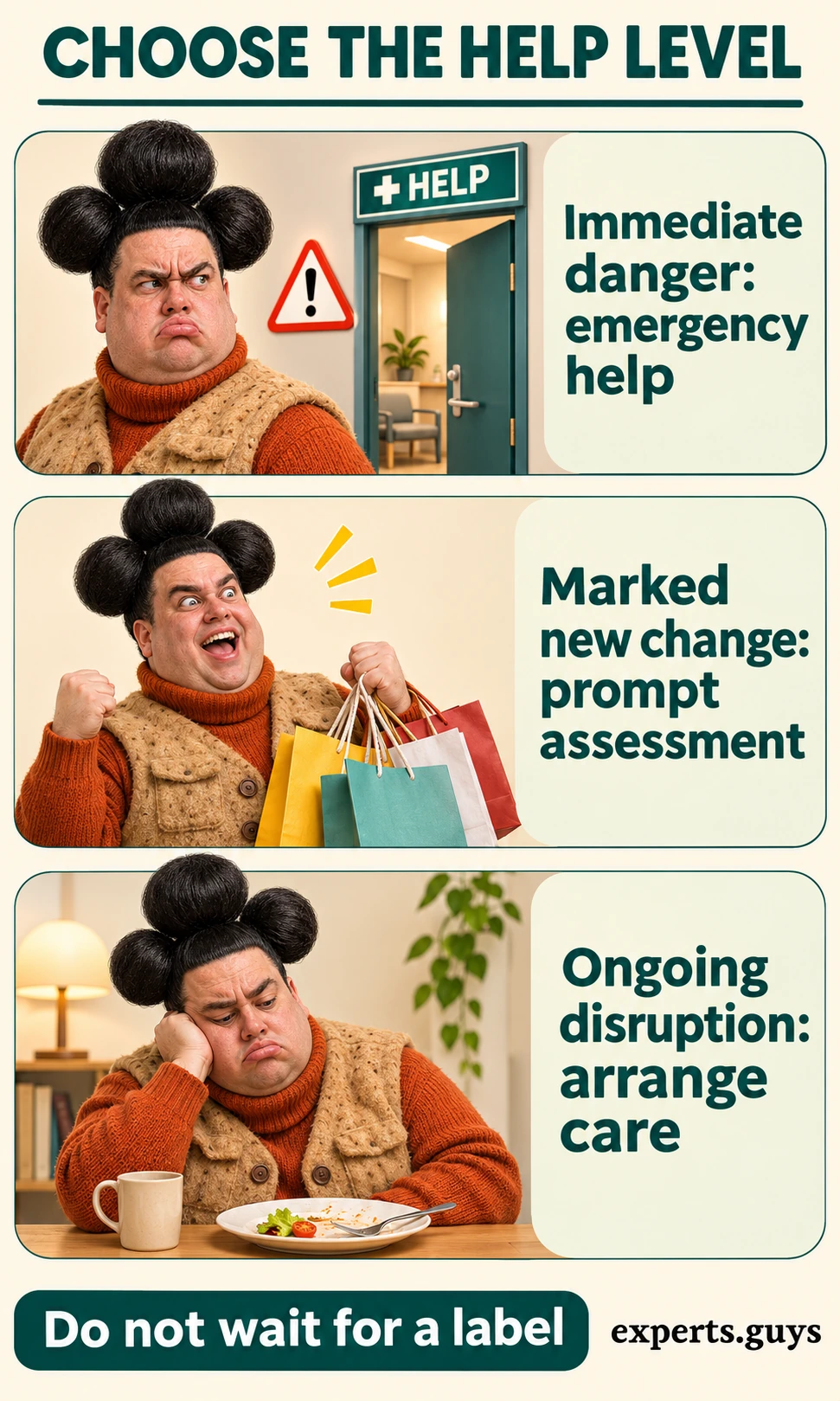
Arrange assessment when changes persist, worsen, repeatedly disrupt life or involve an unfamiliar combination of sleep, energy and judgment. Seek help sooner when the consequences are severe; a duration guideline is not a requirement to endure symptoms until the calendar catches up. Emergency risk takes priority over every other distinction.
Persistent difficulty deserves more than repeated coping attempts
The NIMH guide to depression describes sustained low mood or loss of interest alongside changes in daily functioning. Most of the time for at least two weeks is part of the usual description of major depression, but assessment considers a fuller pattern. Irritability, fatigue or poor concentration alone does not establish the diagnosis.
You do not need a written symptom history to begin a useful conversation. A concrete spoken example can be enough to explain the problem: “I keep missing meals because deciding feels impossible,” or “I am sleeping much less and committing to things that are unlike me.” Add any medication or substance change that may be relevant, without assuming that timing proves cause.
If you already receive care, contact the appropriate service about a significant change rather than trying to manage it only through a newly discovered exercise. Do not stop, restart or change prescribed medicines based on this article. A possible medication effect calls for advice about the medicine, dose and timing in the context of your own treatment.
Prompt help and emergency help are different
Prompt assessment is appropriate for a marked new change such as much less sleep with unusual drive, escalating impulsivity, or new hallucinations or delusions. If there is dangerous behavior, severe confusion, an inability to meet essential needs safely or uncertainty about immediate safety, use urgent or emergency care. There is no benefit in waiting to find the exact label before seeking help.
A person who is severely confused or intoxicated may be unable to follow a multi-step coping exercise. Keep the immediate message simple and seek help appropriate to the risk. Do not attempt to restrain someone, take objects from them or handle a dangerous confrontation on the assumption that staying calm will make it safe.
For a non-emergency appointment, the relevant starting point may be primary care, an existing mental-health team or a qualified mental-health professional, depending on your local care system. Physical symptoms, new medicines, substance use and sleep changes belong in that discussion because mood-related complaints can have several contributors. This is a reason for a broad assessment rather than a prescription for a particular test.
What if you feel better before the appointment?
Feeling better is welcome, but it does not erase a recurring disruption or make the earlier difficulty unreal. Keep an appointment when the reason for arranging it still matters, such as repeated loss of function or a striking departure from your usual behavior. You can describe the change and the improvement together without treating either as proof of a diagnosis.
If your question has shifted from an unexplained mood change to a possible bipolar pattern, the guide to bipolar symptoms at work explains that narrower recognition task. Avoid using a list to reinterpret every ordinary emotion; the goal is a useful account of a meaningful change, not a label for each day.
Questions that often remain
Does feeling angry mean I am an aggressive person?
No. Anger is a feeling; aggression describes behavior. What matters is how you respond and whether anyone is being harmed or intimidated. If you repeatedly lose control, take that seriously and seek support without turning it into a permanent judgment about your identity.
Should I make a major decision when my mood changes?
If a decision can safely wait and you feel unusually impulsive, overwhelmed or unlike yourself, postponing the commitment can protect your options. Urgent safety decisions cannot always wait. For an important unavoidable choice, involve an appropriate trusted person or professional rather than assuming either confidence or distress makes the answer reliable.
What if I cannot identify a trigger?
An obvious trigger is not required for a mood problem to deserve attention. Focus on what changed, its impact and any accompanying sleep or energy differences. Avoid repeatedly searching for a hidden cause when that search is preventing a useful practical response.
Can an apology solve repeated outbursts?
An apology can acknowledge a particular incident, but repeated outbursts need a change in behavior and attention to their causes. Threats or violence require safety measures and appropriate support. The person affected is not responsible for making the apology successful or tolerating further harm.
Choose the next step you can actually use
In a safe but heated moment, use the object-down pause before answering. After a strained interaction, make one specific repair while keeping the real issue available for discussion. When the concern is a persistent or marked change in everyday functioning, move beyond repeated coping attempts and arrange an assessment; immediate danger always calls for emergency help.









