
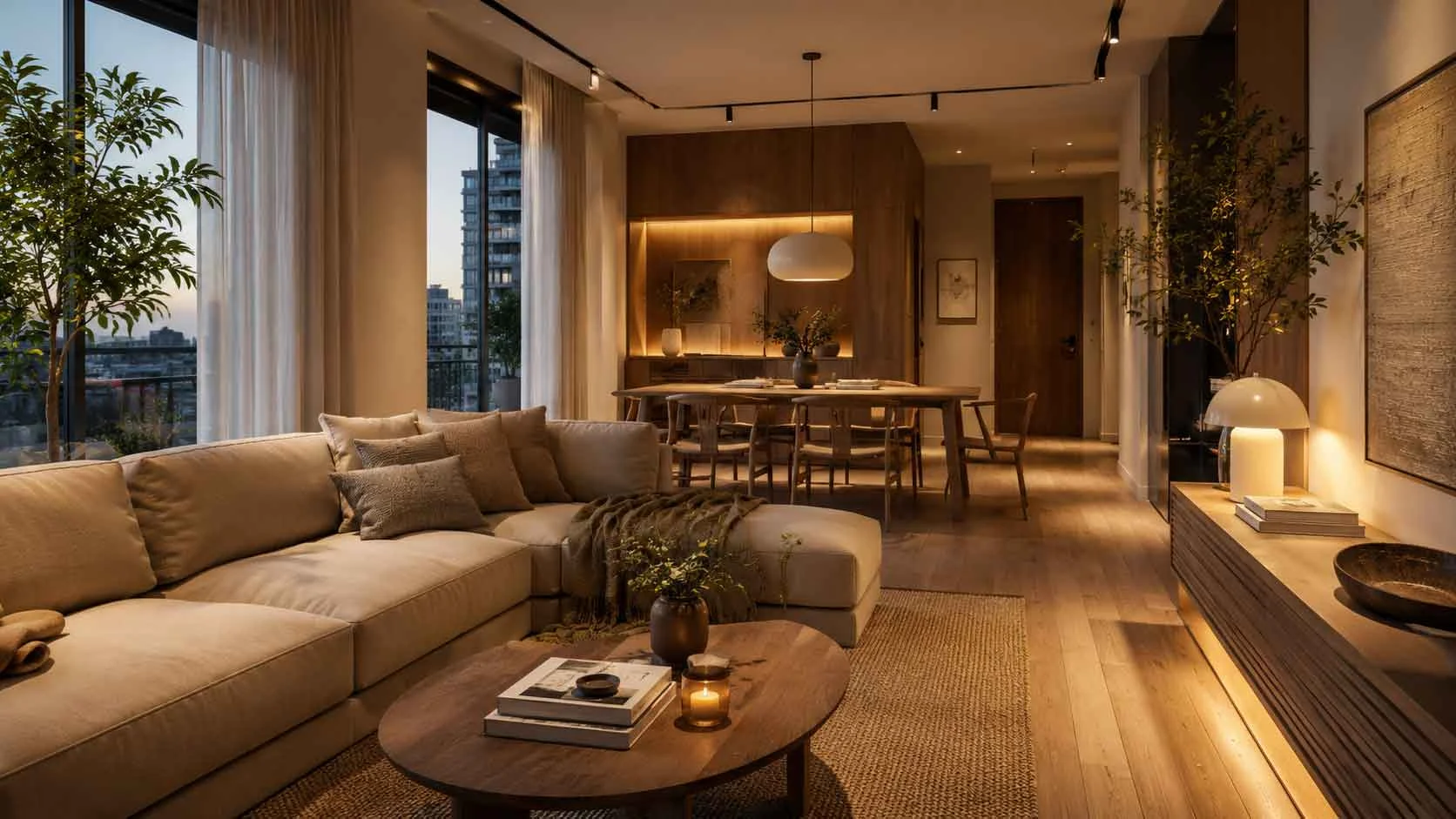

Many interiors look expensive but still feel forgettable after a few minutes.
The furniture may be luxurious.
The materials may be premium.
The lighting may be technically correct.
Yet the environment feels strangely generic.
This usually happens because the room was designed around visual consumption instead of lived experience.
The apartment looks styled.
But it does not feel behaviorally distinctive.
Some interiors rely heavily on:
- trend replication
- showroom symmetry
- decorative layering
- viral design aesthetics
- excessive focal points
The room becomes visually impressive at first glance but emotionally flat during long-term exposure.
A memorable interior usually behaves differently.
The uniqueness comes from atmosphere rather than decoration alone.
Many people assume unique interiors require:
- unusual furniture
- bold color palettes
- expensive customization
- dramatic architecture
- luxury materials
But some of the most distinctive homes are visually restrained.
The atmosphere feels different because:
- lighting behaves softly
- textures feel grounded
- movement flows naturally
- objects feel intentional
- the environment reflects actual living patterns
The room develops personality without constantly demanding attention.
Why Many Modern Interiors Start Feeling Identical
Modern design trends spread extremely quickly online.
A single viral apartment style may appear thousands of times across:
- TikTok
- interior blogs
- furniture catalogs
Eventually many homes begin copying the same visual formula repeatedly.
The layouts become predictable.
The lighting feels standardized.
The decorative objects repeat across different apartments.
The environment loses individuality even when the styling remains attractive.
Some apartments become so trend-focused that the room no longer reflects the people living inside it.
The space behaves more like a temporary showroom.
Every surface feels curated for photography.
Very little feels emotionally rooted.
This is one reason highly copied interiors often feel visually complete but psychologically empty.
The room contains:
- visual styling
- decorative consistency
- aesthetic coordination
But very little environmental identity.
Why Uniqueness Usually Comes From Environmental Behavior
Distinctive interiors often succeed because the apartment behaves differently throughout the day.
Morning light moves softly across textured walls.
Evening shadows create calmer visual pacing.
Furniture placement supports real movement patterns.
Storage systems reduce interruption naturally.
The atmosphere changes gradually instead of remaining visually static.
This kind of uniqueness is harder to copy because it depends on environmental coordination rather than decorative objects alone.
Two apartments may use similar furniture while feeling completely different emotionally.
The difference often comes from:
- light behavior
- spatial rhythm
- texture softness
- visual breathing space
- lived-in balance
Some homes feel memorable not because they are dramatic, but because the environment responds naturally to daily life.
The apartment feels quieter at night.
Movement feels smoother.
The room becomes easier to mentally settle inside.
These subtle behavioral details often create stronger identity than expensive decoration.
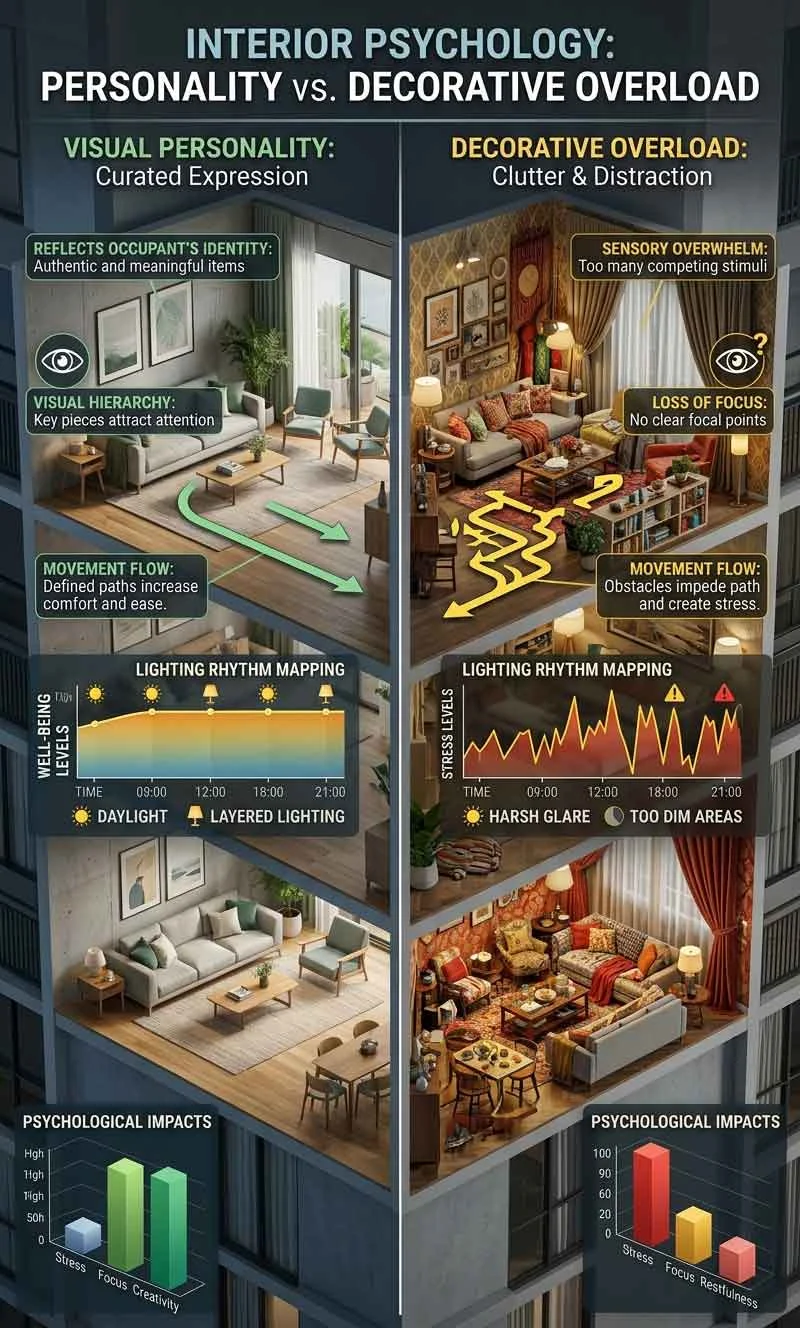
Why Overdesigned Rooms Often Feel Emotionally Exhausting
Many interiors accidentally create constant visual stimulation.
Large feature walls.
Aggressive contrast.
Heavy decoration.
Too many statement objects.
Oversized lighting fixtures.
The eye keeps processing information continuously.
The environment becomes mentally tiring over time.
This does not mean decorative interiors are automatically bad.
The issue usually comes from visual competition.
Too many objects try to dominate the room simultaneously.
Nothing is allowed to rest quietly in the background.
The atmosphere loses pacing.
Some evenings make this problem very obvious.
Bright reflective surfaces under harsh lighting create continuous visual exposure.
The apartment feels alert instead of restful.
Even expensive furniture cannot fully soften the environment once visual intensity becomes excessive.
Distinctive interiors usually understand restraint better.
Many calming apartment concepts today are heavily influenced by softer environmental styles such as Japandi minimalist interior design, where lighting, texture, spacing, and movement flow work together to reduce visual stress naturally.
Not every object needs to become the focal point.
Negative space matters.
Softer transitions matter.
The room feels more grounded because the eye can move naturally without constant interruption.
Why Texture Often Creates More Identity Than Color
Many people focus heavily on color palettes while ignoring texture behavior completely.
But texture changes how interiors feel much more deeply over time.
Matte oak behaves differently from glossy laminate.
Linen absorbs light differently from polished leather.
Textured stone creates softer visual depth than reflective marble.
Wall surface behavior also changes over time depending on humidity, lighting exposure, and paint quality. Some glossy coatings may gradually become chalky, sticky, or visually uneven under environmental stress. Related: Why wall paint becomes powdery.
These surface behaviors shape environmental personality continuously throughout the day.
Morning sunlight interacts differently with brushed wood compared to polished surfaces.
Evening shadows become softer on textured walls.
The atmosphere gains depth naturally without requiring excessive decoration.
Some apartments use very neutral palettes but still feel highly distinctive because the material coordination creates subtle environmental richness.
The uniqueness comes from tactile layering rather than dramatic styling choices.
Why Real Homes Feel Different From Showrooms
Showrooms are designed for immediate visual impact.
Real homes are experienced repeatedly over time.
This changes everything.
An apartment may look impressive during a short visit but exhausting during daily exposure.
Real environmental comfort depends on:
- movement flow
- lighting softness
- emotional pacing
- storage behavior
- material warmth
- sensory balance
Some homes become memorable because they support ordinary routines beautifully.
A reading corner feels calm at night.
Morning light reaches the dining area softly.
The pathways remain open during daily movement.
Storage reduces visual stress naturally.
The apartment starts feeling emotionally intuitive instead of visually staged.
This is often where authentic interior personality appears.
The room reflects behavioral life patterns rather than pure decoration strategy.
The environment begins feeling human instead of performative.
Why Lighting Creates Interior Identity Faster Than Furniture
Many people try to make interiors feel unique by changing furniture styles first.
But lighting usually changes environmental personality much faster.
The same apartment can feel:
- calm
- dramatic
- cold
- welcoming
- intimate
- overstimulating
depending entirely on how light behaves across the room.
Lighting affects:
- shadow softness
- material warmth
- visual pacing
- emotional atmosphere
- spatial depth
- reflection intensity
This means lighting often controls the emotional identity of the apartment more than decorative styling alone.
Some interiors technically contain beautiful furniture but still feel uncomfortable because the lighting exposes every surface too aggressively.
Bright ceiling downlights flatten texture.
Glossy materials become louder.
Shadows disappear completely.
The room begins feeling visually overprocessed.
Distinctive interiors usually allow light to behave more naturally.
The environment changes gradually throughout the evening.
Warm ambient lighting softens edges instead of aggressively defining them.
The apartment gains personality because the atmosphere evolves rather than remaining visually static.
Why Indirect Lighting Feels More Human
Indirect lighting usually creates calmer environmental transitions.
Walls glow softly instead of receiving direct exposure.
Shadows layer more gradually.
Textures appear deeper and more tactile.
The room begins feeling emotionally quieter even when very little furniture changes.
This softness matters because harsh direct lighting repeatedly restarts visual attention.
The eye stays more alert.
The apartment feels mentally active for longer periods.
Distinctive interiors often reduce this environmental tension intentionally.
Some evenings reveal this clearly.
A warm lamp beside textured fabric creates localized calmness.
The surrounding apartment remains softer and dimmer.
The atmosphere feels grounded without requiring dramatic styling.
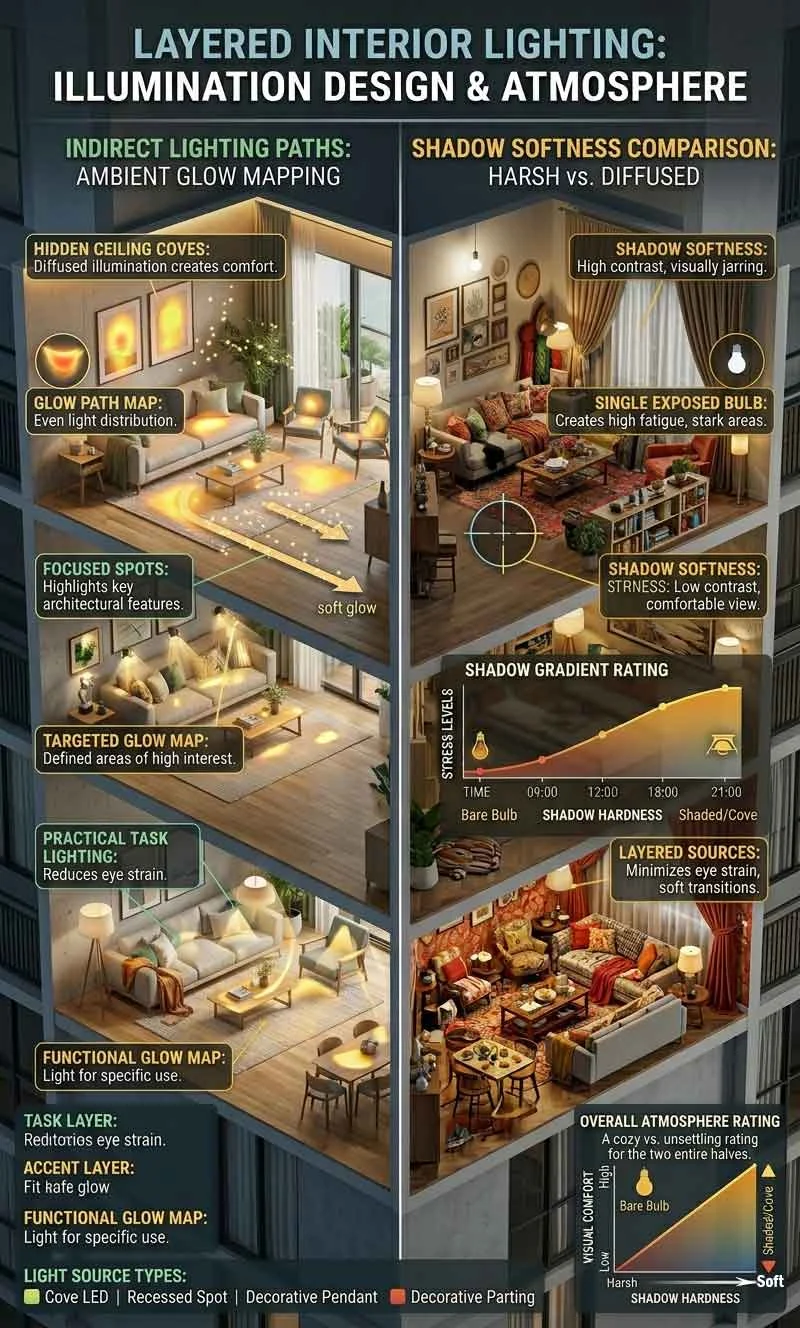
Why Shadow Behavior Creates Emotional Depth
Many modern interiors accidentally remove too many shadows.
Every corner becomes equally bright.
Every wall receives identical exposure.
The environment loses depth because visual hierarchy disappears completely.
Distinctive interiors usually preserve shadow variation more carefully.
Soft shadows help the eye slow down naturally.
The room gains environmental rhythm.
Some areas feel calmer and more intimate because they are not fully exposed visually at all times.
This subtle pacing helps interiors feel emotionally richer without requiring visual clutter.
Shadow softness also affects how materials behave.
Wood grain appears deeper.
Stone surfaces gain dimensionality.
Fabric textures feel warmer.
The apartment becomes visually layered instead of flat.
Why Reflective Surfaces Often Reduce Interior Personality
Highly reflective interiors frequently feel generic because reflections overpower material character.
Glossy flooring.
Polished cabinetry.
Mirror-heavy walls.
Reflective furniture finishes.
The environment becomes visually louder.
Light bounces aggressively across surfaces instead of settling softly.
Distinctive interiors often reduce reflection intensity intentionally through:
- matte finishes
- textured materials
- softer lighting
- layered shadows
- restrained gloss usage
This allows textures to develop personality naturally.
Some apartments become more memorable simply because materials absorb light gently instead of reflecting everything equally.
The atmosphere feels calmer and more believable.
The environment gains visual depth without needing excessive decoration.
Why Movement Flow Changes Interior Personality
A unique interior is rarely created by isolated objects alone.
The experience of moving through the apartment matters equally.
Tight pathways.
Furniture collisions.
Blocked circulation.
Abrupt layout interruptions.
These details quietly increase environmental stress.
Distinctive interiors often feel smoother because movement behaves naturally.
The body moves comfortably through the room without constant adjustment.
Open sightlines reduce visual compression.
Furniture spacing supports everyday routines instead of fighting them.
This movement softness creates emotional identity over time.
The apartment feels easier to inhabit daily.
That usability becomes part of the room’s personality itself.
Why Lived-In Imperfection Often Feels More Memorable
Perfectly staged interiors sometimes feel emotionally distant because nothing appears genuinely used.
Every object is symmetrical.
Every surface is untouched.
Every cushion sits perfectly aligned.
The apartment begins feeling more like a catalog image than a living environment.
Distinctive homes usually contain subtle irregularity:
- books resting naturally
- slightly folded fabric
- uneven shadow variation
- chairs gently angled after use
- objects positioned around actual routines
These details create environmental authenticity.
The uniqueness comes from behavioral traces.
The room reflects human presence quietly without becoming cluttered.
That balance is difficult to manufacture artificially.
Why Some Interiors Stay Memorable For Years
Trend-heavy interiors often lose emotional impact quickly because they depend heavily on novelty.
Distinctive interiors usually depend more on atmosphere.
The apartment remains recognizable because:
- the lighting feels soft
- the textures feel grounded
- the pacing feels calm
- the environment supports daily living naturally
The identity stays emotionally stable instead of trend-dependent.
This is one reason some apartments feel unforgettable despite using relatively simple materials and restrained decoration.
The uniqueness comes from environmental coordination rather than visual performance alone.
The room does not constantly try to impress.
It simply feels deeply comfortable to remain inside over time.
The Difference Between Visual Noise and Visual Personality
Many people confuse visual complexity with uniqueness.
A room filled with:
- decorative objects
- strong contrast
- layered colors
- oversized artwork
- dramatic furniture
may initially appear distinctive.
But over time the environment can become mentally exhausting because every element competes for attention continuously.
Visual personality behaves differently.
The room still feels recognizable, but the identity comes from atmosphere instead of constant stimulation.
The apartment develops rhythm.
Some surfaces stay quiet.
Lighting transitions feel gradual.
Objects support the environment instead of fighting for dominance.
This difference becomes especially important inside modern apartments where sensory overload already exists daily through:
- screens
- notifications
- compressed layouts
- appliance sounds
- urban density
- bright artificial lighting
An overstimulating interior adds even more environmental pressure.
Distinctive interiors often reduce that pressure instead.
Why Too Many Focal Points Break Environmental Rhythm
Many interiors accidentally create visual competition everywhere.
Large feature walls.
Statement lighting.
Bold shelving.
High-contrast materials.
Heavy decoration.
The eye keeps restarting attention repeatedly.
The apartment feels visually loud even when individual elements are attractive on their own.
Distinctive interiors usually control focal hierarchy more carefully.
One area becomes dominant.
The surrounding environment softens naturally around it.
The room gains pacing because visual intensity is distributed unevenly instead of aggressively everywhere at once.
Some evenings reveal this very clearly.
A softly lit oak dining table may become the quiet center of the apartment while surrounding walls remain dimmer and less visually active.
The environment feels emotionally grounded because attention no longer fragments continuously across the room.
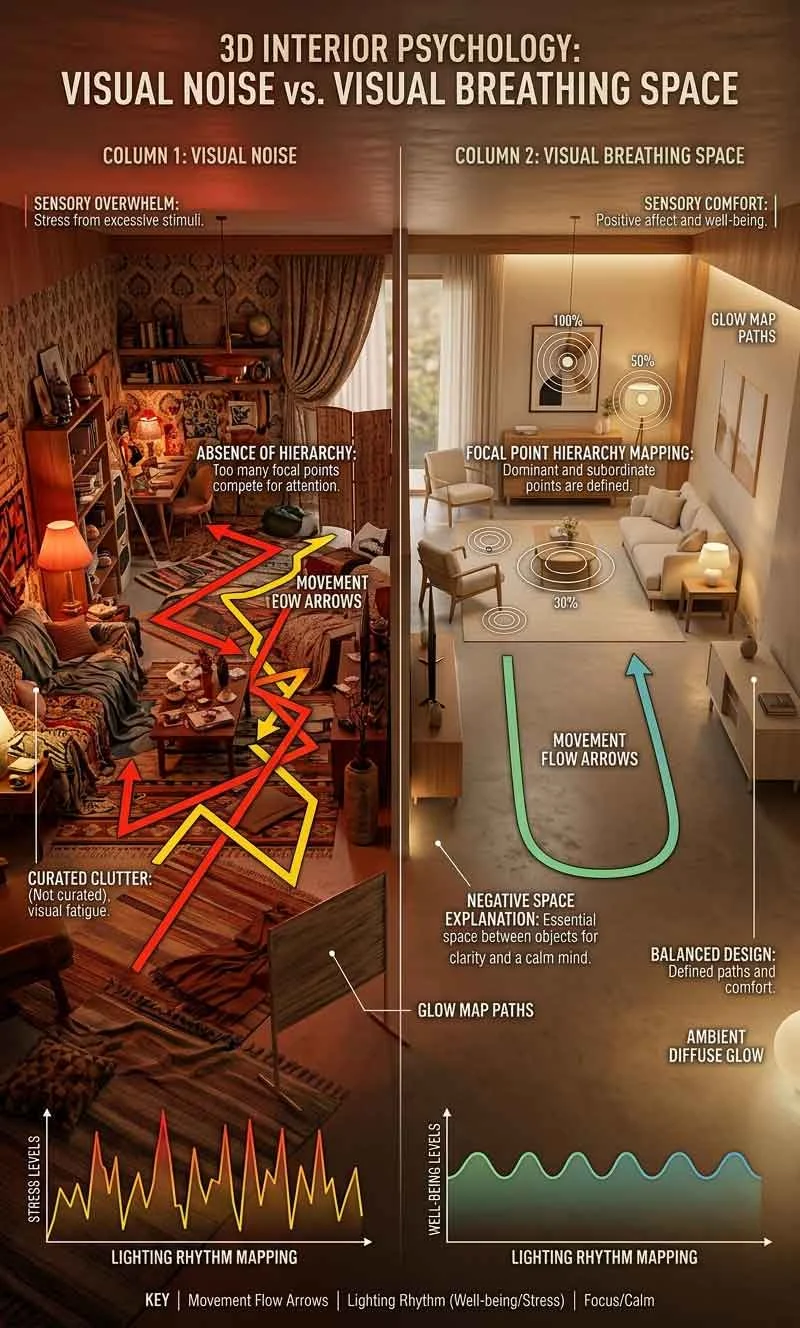
Why Negative Space Creates Interior Identity
Many people see empty space as unfinished design.
But negative space often allows the environment itself to become visible.
Light movement becomes easier to notice.
Shadow transitions feel calmer.
Material texture gains importance.
The room begins breathing visually.
Without negative space, every surface becomes crowded with information.
The apartment starts feeling compressed regardless of actual room size.
Distinctive interiors often understand restraint better than decoration overload.
Some apartments become memorable because they allow certain areas to remain visually quiet.
A clean wall beside textured wood.
Soft shadow movement across linen fabric.
Open flooring beneath low furniture.
These calmer areas help the stronger details feel more intentional.
Why Environmental Consistency Matters More Than Trend Mixing
Many interiors try combining too many unrelated design trends simultaneously.
Industrial lighting.
Luxury marble.
Minimalist furniture.
Bohemian decoration.
Ultra-modern cabinetry.
The room may feel visually fragmented because the environmental logic keeps changing.
Distinctive interiors usually maintain stronger behavioral consistency.
The lighting supports the materials.
The textures support the atmosphere.
The furniture supports movement flow.
The environment feels cohesive because the systems reinforce each other naturally.
This does not mean every object must match perfectly.
Real personality often comes from subtle variation.
But the room still needs an overall environmental direction.
Without that direction, the apartment feels assembled rather than lived-in.
Why Sensory Reduction Often Feels Luxurious
Some of the most expensive-feeling interiors are actually visually restrained.
Not because the materials are necessarily rare.
But because the environment removes unnecessary pressure.
Softer lighting.
Cleaner spacing.
Lower object density.
Reduced reflection intensity.
Calmer movement pathways.
The apartment begins feeling psychologically expensive because the room no longer overwhelms the senses continuously.
This kind of luxury feels different from decorative excess.
The calmness itself becomes part of the value.
Many trend-heavy interiors initially appear more exciting in photos.
But quieter interiors often feel significantly better during long-term daily exposure.
The environment supports mental recovery instead of constant stimulation.
Why Apartments With Personality Often Reflect Daily Rituals
Real interior identity often develops around behavior patterns.
Morning coffee near soft daylight.
Warm lighting beside a reading chair at night.
Shoes stored quietly near the entry path.
Objects positioned around actual routines instead of purely decorative symmetry.
These behavioral traces create emotional familiarity.
The apartment feels believable because the layout reflects lived experience naturally.
Distinctive interiors often reveal how people actually move through the environment daily.
Some homes feel memorable not because they are perfectly styled, but because the atmosphere feels deeply connected to ordinary life.
The room supports habits instead of visually interrupting them constantly.
Why Quiet Interiors Often Feel More Unique Over Time
Very loud interiors reveal everything immediately.
There is little left to discover emotionally after repeated exposure.
Quieter interiors behave differently.
The atmosphere unfolds gradually through:
- lighting changes
- material aging
- shadow movement
- environmental rhythm
- texture variation
The apartment develops familiarity slowly instead of demanding instant reaction.
This slower emotional pacing often creates stronger long-term attachment.
People remember how the apartment felt rather than only how it looked.
That distinction becomes extremely important over years of living inside the environment.
Real Interior Personality Usually Feels Natural, Not Forced
This is important.
Distinctive interiors rarely feel unique because they aggressively try to be different.
The strongest spaces usually feel:
- grounded
- coherent
- behaviorally natural
- visually calm
- emotionally believable
The identity develops from environmental coordination rather than decorative performance.
A memorable apartment does not need constant visual intensity.
Sometimes the most distinctive interiors are simply the ones that feel easiest to live inside every day.
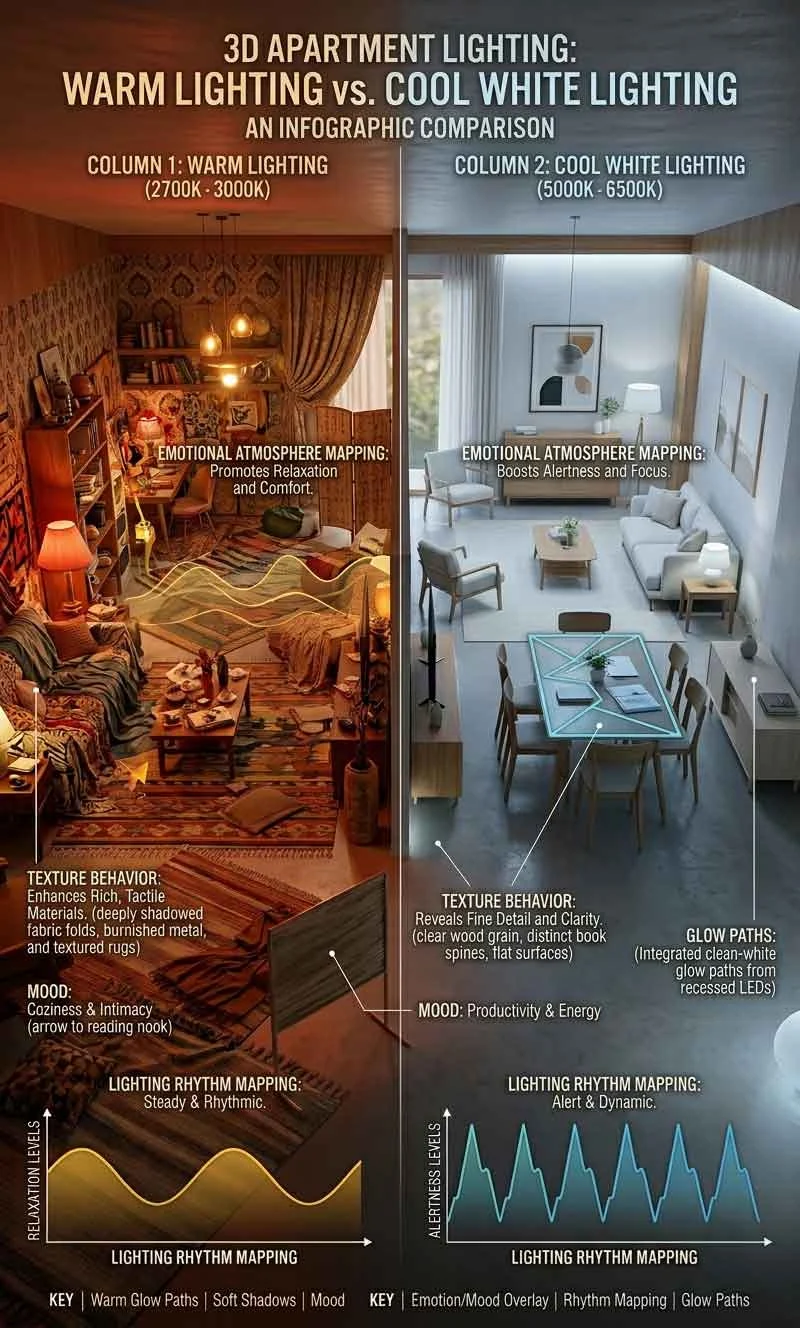
Why Lighting Temperature Quietly Controls Emotional Atmosphere
Most people focus on furniture first.
But emotional atmosphere inside an apartment is often controlled more heavily by lighting behavior than by decorative objects.
The same room can feel:
- emotionally cold
- visually stressful
- cozy
- grounded
- luxurious
- mentally exhausting
simply from lighting temperature changes.
Cool white lighting often increases surface clarity and sharpness.
This can feel useful during:
- cleaning
- working
- task-heavy environments
But excessive cool lighting inside residential interiors may create subtle emotional fatigue over time.
Especially at night.
Warmer lighting behaves differently.
Textures soften.
Shadows blend more gradually.
Wood materials appear deeper.
Fabric surfaces feel calmer.
The apartment begins feeling emotionally slower.
This becomes especially noticeable during evening transitions.
A softly illuminated dining area with muted reflection often feels dramatically different from the same room under bright overhead white lighting.
The physical layout stays identical.
But the emotional interpretation changes completely.
Why Texture Often Matters More Than Decoration
Many apartments try creating personality through decoration quantity.
But memorable interiors often rely more heavily on tactile variation.
Natural oak grain.
Linen texture.
Stone imperfections.
Soft matte walls.
Brushed metal finishes.
These quieter surface behaviors create environmental depth without requiring visual overload.
Highly reflective interiors sometimes appear luxurious initially.
But excessive reflection creates constant visual activity.
The eye keeps processing movement from:
- lighting bounce
- reflective cabinets
- polished flooring
- mirrored surfaces
This can gradually increase environmental fatigue.
More grounded interiors usually balance reflection carefully.
Some surfaces absorb light.
Others diffuse it softly.
A few reflective areas create contrast intentionally.
The apartment gains texture rhythm instead of continuous visual sharpness.
Why Human Scale Is Important in Interior Design
Some apartments feel uncomfortable because the proportions disconnect from natural human behavior.
Oversized furniture inside compact spaces creates movement friction.
Tiny furniture inside large rooms creates emotional emptiness.
Ceiling features placed too low may generate subconscious compression.
Good interiors usually align with body movement naturally.
Walking paths feel intuitive.
Seating height feels relaxed.
Visual sightlines stay open while seated.
The room supports physical behavior without demanding constant adjustment.
This is one reason low-profile furniture often feels calmer psychologically.
The eye maintains longer uninterrupted sightlines across the apartment.
The environment feels more open even when the square footage remains unchanged.
Why Material Aging Creates Long-Term Personality
Some interiors look impressive only when newly completed.
Over time the environment loses emotional character because the materials age poorly.
Cheap glossy surfaces scratch visibly.
Artificial textures flatten visually.
Trend-heavy finishes become emotionally dated quickly.
More timeless interiors often use materials that age gradually instead of collapsing visually.
Natural wood darkens softly.
Stone develops variation.
Leather gains patina.
Matte textures retain depth longer.
The apartment slowly develops environmental memory.
Small imperfections become part of the atmosphere rather than visual damage.
This creates attachment because the environment evolves alongside daily life.
Some of the most emotionally memorable homes are not perfect.
They simply age honestly.
Why Calm Interiors Often Improve Social Interaction
Environmental pressure changes human behavior more than many people realize.
Overstimulating interiors may subtly increase:
- conversational fatigue
- distraction
- restlessness
- sensory tension
People talk differently inside calmer environments.
Movement slows slightly.
Attention stabilizes longer.
Silence feels less uncomfortable.
This is why certain cafes, lounges, and homes feel emotionally easier to remain inside for long periods.
The environment reduces subconscious sensory competition.
The room supports presence rather than constantly demanding attention.
Why Real Luxury Often Feels Effortless
Many people associate luxury with visible expense.
But emotionally convincing interiors often feel luxurious because the environment behaves naturally.
Nothing fights aggressively for attention.
Lighting transitions feel smooth.
Movement paths feel effortless.
Textures coordinate quietly.
The apartment feels stable instead of performative.
This creates a different form of status.
Not decorative intensity.
Environmental confidence.
The room no longer tries to prove itself constantly.
That restraint often feels significantly more sophisticated over time.
Why Memorable Interiors Usually Prioritize Feeling Over Display
This is where many interiors separate emotionally.
Some spaces prioritize photography.
Others prioritize daily experience.
The difference becomes obvious after extended exposure.
Photo-focused interiors often rely heavily on:
- immediate contrast
- trend-heavy visuals
- dramatic staging
- aggressive focal points
These environments may perform well visually online.
But long-term living comfort sometimes weakens.
Experience-focused interiors behave differently.
The apartment supports:
- mental recovery
- environmental calmness
- movement ease
- lighting comfort
- emotional grounding
The room feels increasingly better the longer someone lives inside it.
That long-term emotional compatibility is often the real reason certain interiors become unforgettable.
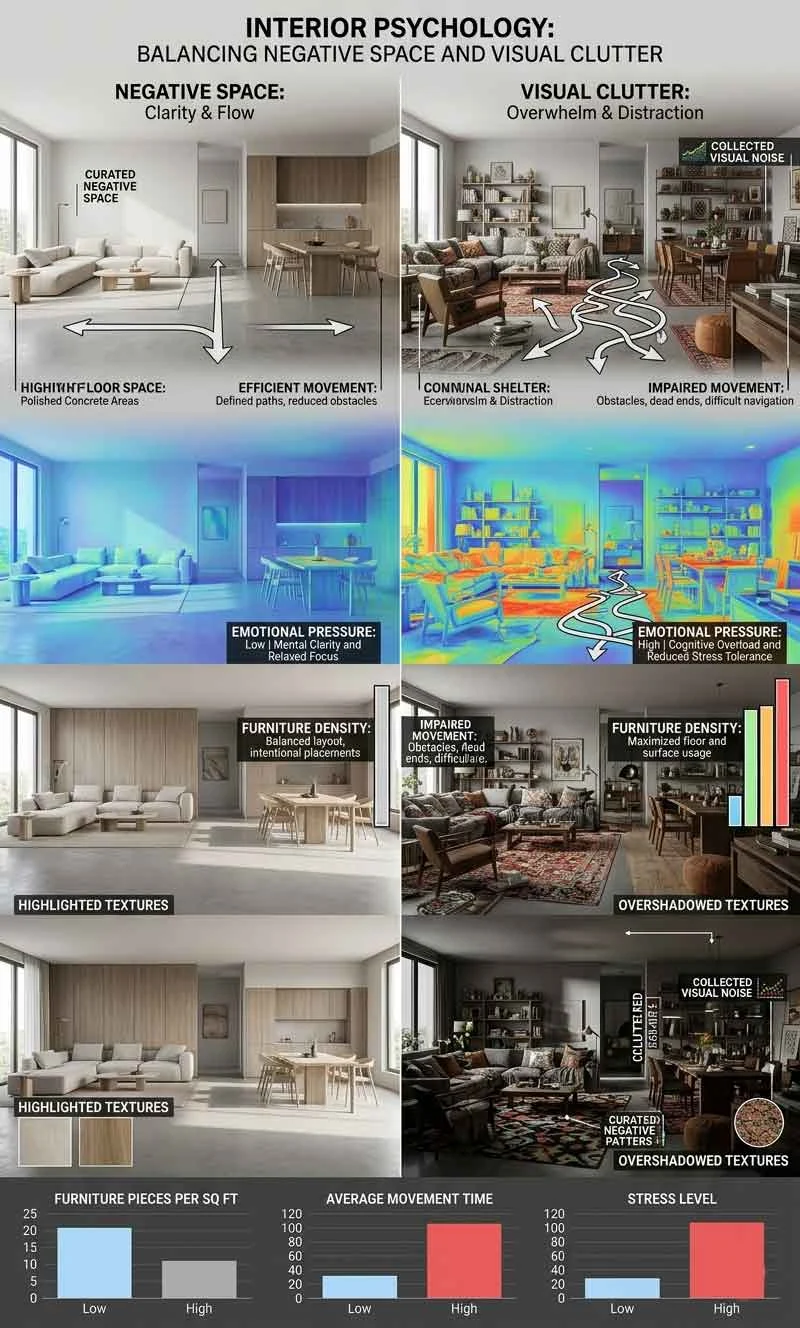
Why Empty Space Is One of the Most Powerful Interior Elements
Many people assume a room feels incomplete when there is visible empty space.
But excessive object density often creates the opposite effect.
The eye loses recovery zones.
Movement becomes visually interrupted.
The apartment begins feeling mentally crowded even when physically organized.
Strong interiors usually understand spatial breathing.
Not every wall requires decoration.
Not every corner needs furniture.
Not every shelf needs styling objects.
Empty space acts like silence inside music.
It allows:
- textures to become noticeable
- lighting to expand naturally
- furniture proportions to breathe
- emotional calmness to increase
Without negative space, even expensive interiors can feel visually exhausting.
This is especially important inside smaller apartments.
Trying to maximize every centimeter visually often creates environmental pressure instead of functionality.
The apartment may technically hold more objects.
But psychologically it feels smaller.
Why Ceiling Design Quietly Changes Emotional Weight
Most people look horizontally inside a room.
But ceilings heavily influence subconscious emotional interpretation.
A ceiling that feels too visually heavy can create compression.
A ceiling with excessive detail may generate constant upward visual distraction.
Low ceilings combined with dark overhead structures often increase environmental pressure.
Especially inside compact apartments.
Meanwhile lighter ceiling behavior can create:
- openness
- vertical breathing
- visual relief
- softer environmental rhythm
This is why many calming interiors avoid aggressive ceiling complexity.
The ceiling becomes supportive instead of dominant.
Lighting recesses stay subtle.
Lines remain clean.
Transitions feel continuous.
Even small adjustments can significantly alter emotional perception.
A softer cove light.
Reduced ceiling segmentation.
Less visual interruption above eye level.
The room immediately feels less stressful.
Why Flooring Creates Invisible Environmental Continuity
Flooring is one of the largest uninterrupted surfaces inside any apartment.
Modern flooring systems now influence not only durability but also emotional perception, movement continuity, reflection softness, and environmental pacing inside apartments. Related: Flooring developments to check out.
Yet many interiors underestimate how strongly flooring affects spatial continuity.
Frequent flooring changes break movement psychologically.
Every material transition creates visual interruption.
The apartment starts feeling segmented rather than connected.
More cohesive interiors often reduce unnecessary flooring variation.
Continuous flooring allows:
- longer visual flow
- cleaner sightlines
- smoother movement perception
- larger spatial interpretation
This becomes especially powerful in:
- open-plan apartments
- smaller condominiums
- compact HDB layouts
Large-format flooring materials also influence perception.
Fewer grout lines reduce visual fragmentation.
The floor behaves more like a continuous environmental surface instead of multiple small divisions.
This is one reason minimalist interiors often feel larger than their actual dimensions.
The visual system encounters fewer interruptions while processing the environment.
Why Sound Behavior Changes Interior Experience
Interior design is not only visual.
Acoustic behavior changes emotional comfort dramatically.
Hard reflective environments often amplify:
- echo
- sharp footsteps
- appliance noise
- conversational harshness
The apartment may appear visually beautiful but emotionally tiring during extended exposure.
Soft materials reduce this effect naturally.
Curtains.
Fabric seating.
Textured rugs.
Wood surfaces.
Layered upholstery.
These materials absorb portions of sound energy and soften environmental sharpness.
This creates a calmer psychological atmosphere.
The apartment feels quieter even when actual sound levels remain similar.
Good interiors often balance:
- visual texture
- lighting softness
- acoustic softness
Together.
Not independently.
Why Transitional Spaces Affect Daily Emotion
Many apartments focus heavily on feature areas:
- living room
- kitchen
- master bedroom
But transitional zones often control emotional continuity.
Hallways.
Entry paths.
Kitchen transitions.
Bathroom approaches.
Abrupt transitions create environmental disconnection.
Meanwhile smoother transitions create rhythm.
Lighting gradually changes.
Materials shift naturally.
Movement feels uninterrupted.
This is why some homes feel emotionally coherent even without expensive decoration.
The transitions support behavioral flow.
The apartment feels intentionally connected instead of visually assembled piece by piece.
Why Scent and Airflow Quietly Influence Interior Quality
People often underestimate non-visual environmental layers.
But airflow and scent heavily influence perceived interior quality.
Poor ventilation creates:
- stagnant atmosphere
- trapped humidity
- heavier environmental feeling
- subconscious discomfort
Even beautiful interiors lose emotional comfort when airflow behaves poorly.
Natural airflow changes environmental freshness continuously.
Cross-ventilation.
Window orientation.
Air movement paths.
Ceiling fan placement.
These factors influence how alive the apartment feels daily.
Scent behaves similarly.
Wood materials.
Natural fabric.
Fresh airflow.
Dry surfaces.
Clean ventilation.
These create subtle atmospheric calmness without requiring artificial fragrance intensity.
Some apartments feel emotionally relaxing before a person consciously understands why.
Environmental airflow is often part of that hidden mechanism.
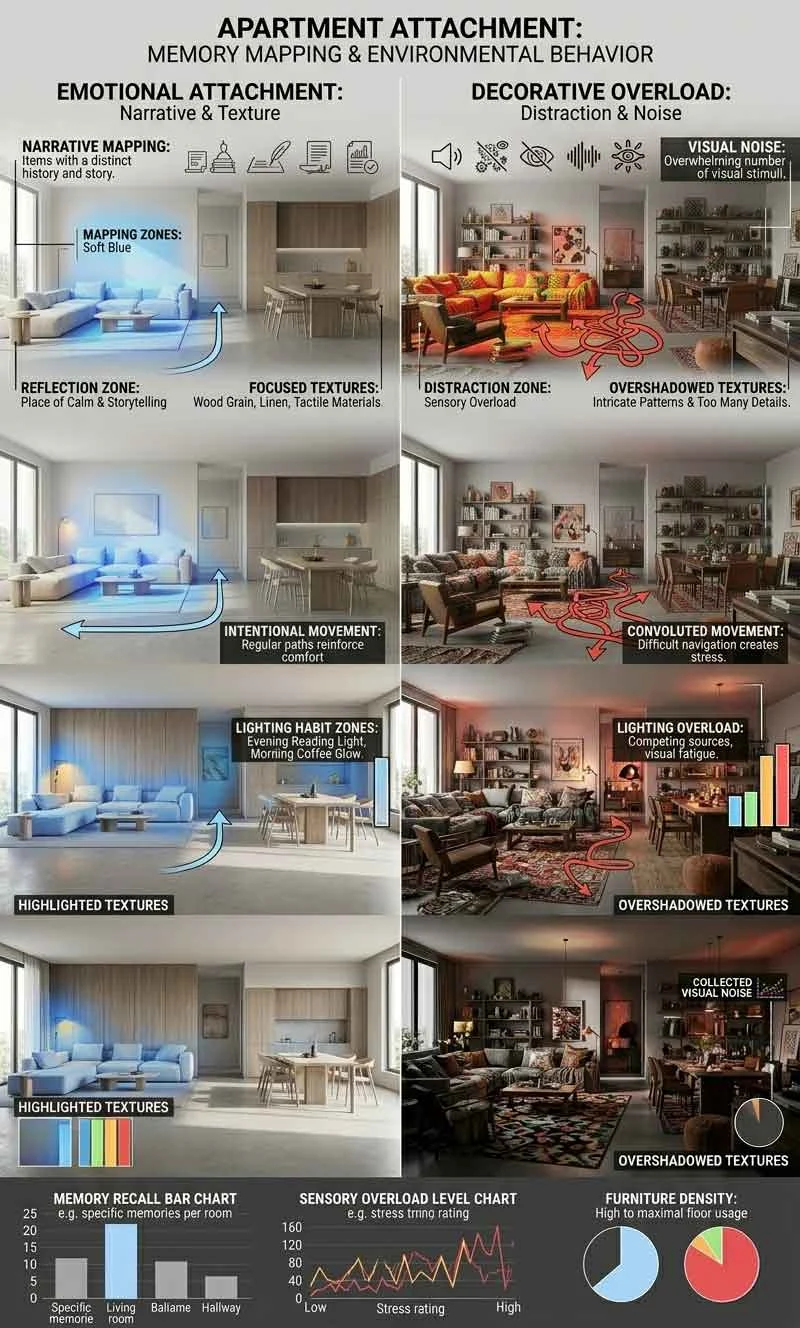
Why Personal Memory Creates Stronger Interior Identity
Some interiors feel emotionally powerful not because they are visually perfect, but because they contain personal memory.
A chair placed near a window where morning coffee happens daily.
A reading lamp that stays on quietly every evening.
A dining table marked softly by years of ordinary conversations.
These details create attachment because the apartment becomes connected to lived experience.
Many trend-heavy interiors struggle emotionally because the environment feels replaceable.
The room could belong to anyone.
Very little reflects actual behavioral life.
The apartment looks curated but not inhabited.
Distinctive interiors usually reveal traces of repeated routines naturally.
Not through clutter.
But through environmental familiarity.
Objects feel positioned around life instead of photography alone.
This is one reason some older apartments continue feeling emotionally memorable even after design trends change completely.
The personality comes from accumulated environmental experience rather than trend novelty.
Why Trend Chasing Often Weakens Interior Personality
Rapidly changing trends create pressure to constantly update environments.
Many furniture trends rise quickly because they perform strongly on social media visually, but long-term environmental comfort often behaves very differently after daily exposure. Related: Top furniture trends.
New furniture styles.
Viral color palettes.
Social-media-driven aesthetics.
The apartment may temporarily feel current but emotionally unstable.
Trend-heavy interiors often lose coherence because the environment keeps changing faster than daily routines can emotionally attach to the space.
The apartment becomes visually reactive instead of behaviorally grounded.
Distinctive interiors usually evolve more slowly.
Changes happen gradually around:
- comfort
- usability
- environmental behavior
- material aging
- emotional familiarity
This slower pacing creates stronger long-term identity.
The apartment begins reflecting actual life progression rather than online trend cycles.
That stability often feels calmer psychologically.
Why Imperfection Often Feels More Luxurious Than Precision
Perfect symmetry may initially appear visually expensive.
But excessive perfection can also feel emotionally sterile.
Real environments naturally contain:
- uneven shadows
- softened materials
- slight irregularity
- behavioral traces
- environmental aging
Distinctive interiors often allow these qualities to remain visible.
A linen curtain folding naturally near sunlight.
Wood grain variation across flooring.
A chair angled slightly after use.
These imperfections create atmosphere because they feel authentic instead of manufactured.
Some of the most luxurious interiors feel effortless precisely because they do not aggressively control every visual detail.
The environment appears settled rather than staged.
Why Emotional Comfort Eventually Matters More Than Visual Novelty
Many people initially prioritize interiors that look visually exciting.
But after months or years of daily living, emotional behavior becomes more important.
Harsh lighting starts feeling tiring.
Overdecorated rooms become visually noisy.
Trend-heavy spaces lose emotional freshness.
Calmer interiors often improve over time because they continue supporting:
- rest
- focus
- recovery
- conversation
- routine
- environmental softness
The apartment becomes emotionally dependable.
This reliability creates stronger attachment than constant novelty.
People often remember homes based on how they felt inside them rather than how dramatic they appeared visually.
Why Real Interior Personality Usually Feels Quiet
Strong interior identity rarely needs to announce itself aggressively.
The apartment simply feels coherent.
Lighting supports texture.
Movement supports comfort.
Objects support behavior.
The environment feels emotionally believable.
This quietness often creates deeper memorability than highly performative design.
The apartment leaves a psychological impression gradually through repeated exposure.
Not instant visual shock.
Some homes remain unforgettable because:
- evenings felt calm there
- movement felt effortless
- lighting felt soft
- conversations lasted comfortably
- the atmosphere supported ordinary life naturally
These emotional traces become part of the interior itself over time.
How To Create A Unique Interior Without Following Trends
Creating a memorable apartment usually starts by observing environmental behavior instead of chasing decoration immediately.
Watch how light moves during different parts of the day.
Notice where movement feels blocked.
Pay attention to areas that create visual fatigue.
Observe which materials feel calming during long exposure.
Distinctive interiors often improve through:
- softer lighting
- calmer spacing
- reduced visual competition
- stronger material consistency
- quieter storage systems
- more intentional movement flow
These changes affect emotional atmosphere more deeply than trend-heavy decoration alone.
A unique interior does not necessarily need:
- expensive furniture
- rare materials
- dramatic architecture
- luxury styling
Sometimes the strongest personality comes from environmental honesty.
The apartment reflects how people genuinely live inside it.
The Most Memorable Interiors Usually Feel Human
This is important.
The strongest interiors rarely feel memorable because they aggressively try to become unique.
They feel memorable because the apartment:
- supports real life naturally
- reduces environmental friction
- allows emotional calmness
- reflects human behavior honestly
- balances softness with identity
The atmosphere develops quietly through repeated daily experience.
Over time, the apartment stops feeling like a styled environment.
It simply begins feeling deeply familiar, emotionally grounding, and difficult to replace.
Conclusion
Many interiors become visually impressive very quickly.
But truly memorable interiors usually work more quietly than that.
The atmosphere develops gradually through:
- lighting softness
- movement flow
- material behavior
- shadow pacing
- environmental consistency
- lived-in familiarity
The apartment begins feeling emotionally recognizable instead of simply decorative.
This is why some homes remain unforgettable even without dramatic architecture or expensive furniture.
The environment supports ordinary life naturally.
Morning light reaches the dining table softly.
Movement paths feel effortless.
Textures age honestly.
Evening lighting slows the atmosphere gently instead of overstimulating it.
These smaller behavioral details often create stronger identity than decorative intensity alone.
Many trend-heavy interiors eventually feel emotionally temporary because the environment depends heavily on novelty.
But calmer interiors often become more meaningful over time.
The apartment develops memory.
Objects settle naturally around daily routines.
Materials gain depth through use.
The room reflects real living patterns instead of constant visual performance.
Distinctive interiors also understand restraint.
Not every surface needs decoration.
Not every corner requires a focal point.
Negative space allows:
- textures to breathe
- lighting to soften
- movement to flow naturally
- emotional pacing to stabilize
The apartment feels calmer because the environment stops competing constantly for attention.
This is one reason authentic interior personality is difficult to copy perfectly online.
Real uniqueness rarely comes from buying identical furniture or following viral styling trends exactly.
The atmosphere usually depends on:
- environmental rhythm
- sensory softness
- behavioral flow
- material coordination
- emotional usability
These qualities develop through lived experience rather than decoration alone.
Some of the strongest interiors are not the loudest ones.
They simply feel deeply comfortable to remain inside for long periods.
Conversations last naturally.
Lighting feels softer at night.
Movement feels intuitive.
The apartment quietly supports rest, focus, routine, and emotional recovery every day.
In the end, unique interiors rarely succeed because they aggressively try to look different.
They succeed because the environment feels believable, grounded, and emotionally human over time.
That quiet emotional compatibility is often what makes a home truly unforgettable.
Readers exploring more apartment psychology, calming interior concepts, lighting behavior, and environmental design ideas can continue browsing the Interior Design section for additional guides.
Frequently Asked Questions
Why do some interiors feel unique even without expensive furniture?
Some interiors feel unique because of environmental behavior, not luxury spending alone. Softer lighting, natural textures, calmer layouts, and smoother movement flow often create stronger atmosphere than expensive decoration.
Why do some beautifully designed rooms still feel uncomfortable?
A beautiful room can still feel uncomfortable when harsh lighting, excessive reflection, cluttered layouts, poor movement flow, or too many focal points create constant sensory pressure.
What makes an interior emotionally memorable?
Emotionally memorable interiors usually support daily life naturally. Lighting feels softer, movement feels effortless, textures age gracefully, and the apartment reflects real routines instead of only decorative styling.
Why does lighting affect interior personality so much?
Lighting affects interior personality because it changes how materials, shadows, reflections, and textures behave. Warm layered lighting usually feels calmer, while harsh direct lighting increases visual exposure and tension.
Why do overdecorated interiors feel tiring over time?
Overdecorated interiors feel tiring because too many focal points, strong contrasts, decorative objects, and reflective surfaces force the eye to process visual information continuously.
What is visual breathing space in interior design?
Visual breathing space means calmer empty areas inside a room that allow the eye to rest. Negative space helps lighting, textures, and furniture feel more balanced while reducing environmental pressure.
Why do minimalist interiors sometimes feel cold?
Minimalist interiors may feel cold when too much warmth, texture, shadow variation, or lived-in softness is removed. Calm interiors still need emotional grounding through lighting, materials, and tactile surfaces.
Why do natural materials feel more calming inside apartments?
Natural materials such as wood, linen, stone, and matte surfaces absorb and diffuse light more softly than highly reflective synthetic materials, creating gentler visual behavior and calmer atmosphere.
Why do some apartments feel larger even when they are small?
Small apartments often feel larger when visual interruption is reduced. Cleaner sightlines, softer lighting, continuous flooring, lower furniture, and reduced clutter help the eye move more naturally across the space.
How can I make my apartment feel more unique without following trends?
Improve environmental behavior first. Softer lighting, better spacing, reduced visual clutter, natural textures, calmer storage systems, and stronger material consistency usually create more authentic interior personality over time.