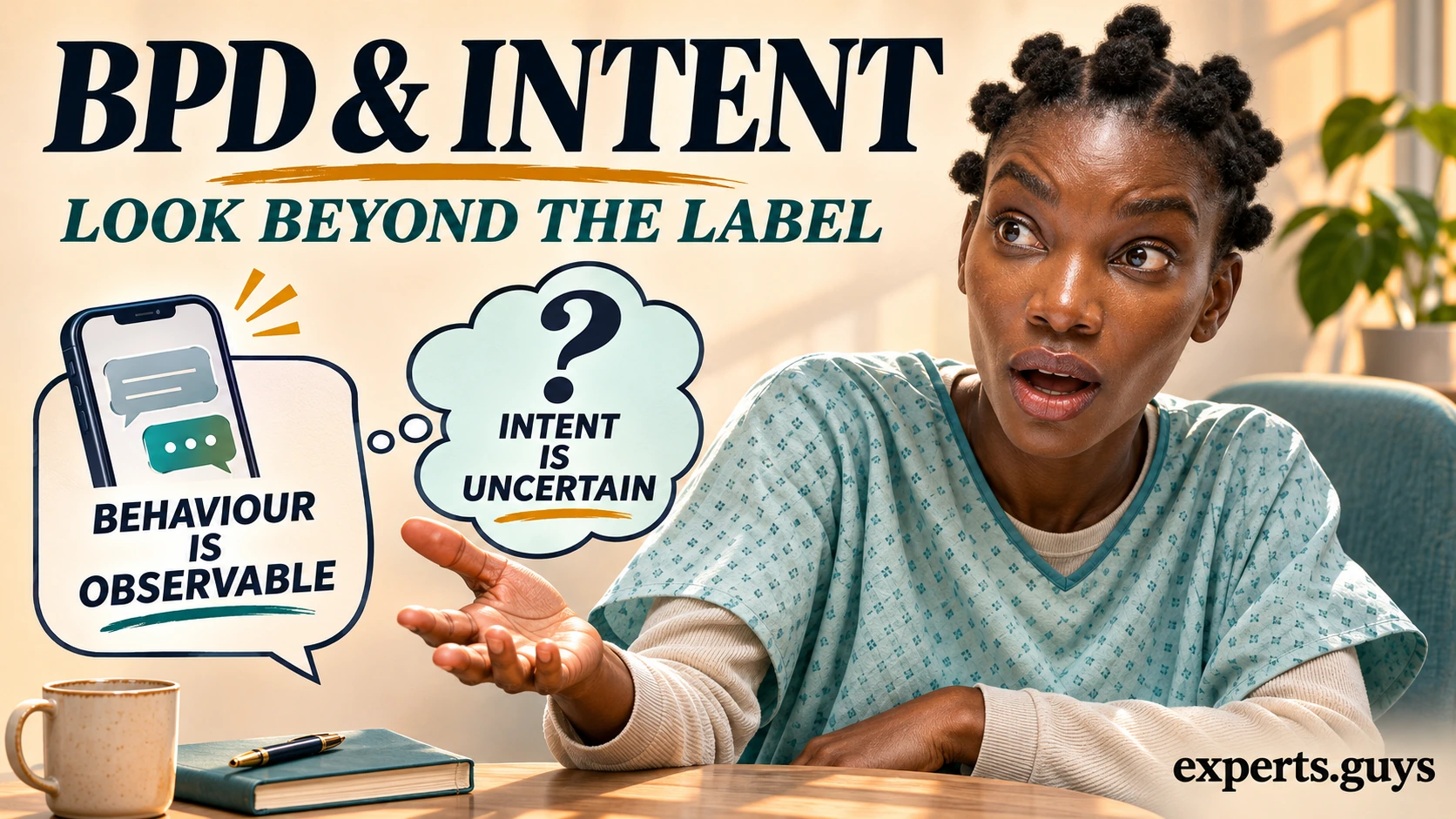
Borderline personality disorder (BPD) does not tell you why someone sent a message, became upset or acted hurtfully. Start with the behaviour you can describe, take distress seriously, and set limits around harmful actions without treating a diagnosis as proof of manipulation. A safer response can acknowledge a feeling while leaving both the facts and the boundary clear.
Consider two sentences: “You called repeatedly after I said I was unavailable,” and “You called because you wanted to control me.” The first identifies something that can be discussed. The second adds a conclusion about another person’s mind. That conclusion might feel obvious when you are exhausted or frightened, but the behaviour and its explanation are still different questions. You can address the calls without winning an argument about motive.
This guide develops three practical communication skills: separating an observation from an interpretation, combining validation with a clear limit, and repairing your own contribution to a difficult exchange. The examples are fictional and apply only where communicating is safe. If there is immediate danger, serious injury, an overdose or an inability to stay safe, contact local emergency services or an emergency department; do not wait to settle an argument about intent.
Why the manipulation label can hide the useful question
“Manipulative” can describe a person’s impression of an interaction, a deliberate attempt to influence someone, or a sweeping judgment about character. Those meanings are easily mixed together. When someone says “That was manipulative,” it helps to identify the actual concern: Was there a threat? Was information withheld? Was a request repeated after a clear refusal? Was someone made responsible for another person’s safety? Specific conduct is easier to address than an argument over a label.
Influence also exists in ordinary communication. Asking for company, explaining disappointment and negotiating a different plan can all influence another person. The presence of influence does not by itself show deception or coercion. Conversely, genuine distress does not make every way of expressing it acceptable. The useful distinction concerns what happened, what effect it had, and what conditions are needed for further contact—not whether one person can prove that the other is entirely innocent or entirely bad.
Our editorial recommendation is to begin with the smallest claim that is both accurate and useful. If you know that a boundary was crossed, say which boundary. If you do not know the motive, leave that uncertain. This is a communication choice, not a finding that intent never matters. An admission of deliberate intimidation, a credible threat or a sustained pattern of coercive conduct changes what you know and what protection you may need.
What BPD can explain—and what it cannot establish
The National Institute of Mental Health overview of BPD describes difficulties regulating emotions, an unstable sense of self and troubled relationships. Sensitivity to rejection and efforts to avoid real or perceived abandonment may be part of the clinical picture. Experiences vary, and the diagnosis requires an assessment rather than an inference from one disagreement. These features can provide context; they cannot reveal the intention behind a particular action.
A person may be frightened, angry, confused, trying to get reassurance, acting deliberately, or experiencing more than one of those things. The diagnosis alone cannot select the explanation. Nor does a person need a diagnosis for their distress to deserve a fair hearing. If the question is whether mood episodes and BPD describe different patterns, the separate BPD and bipolar comparison addresses that issue. Here the narrower question is how to respond to behaviour without inventing a motive.
There is a second limit: understanding context does not determine what you must tolerate. You can accept that someone feels abandoned and still decline to share your passwords. You can recognise intense anxiety and still refuse threats or insults. A clinical explanation and a personal boundary answer different questions. Keeping them separate leaves room for compassion without making one person responsible for meeting every request.
Separate the observation, interpretation and unknown
The first skill is a brief language check you can use mentally or in an ordinary conversation; no diary or worksheet is necessary. Start with the action you could describe without explaining someone’s mind. Next notice the story you have added about why it happened. Finally identify what remains unknown. The point is not to make yourself doubt a clear event. It is to avoid letting an uncertain explanation become the only possible starting point.
For example, “Three messages arrived while I was in a meeting” is an observation. “They wanted to control me” is an interpretation. “I have not asked whether they knew I was unavailable” identifies missing information. You might still decide that repeated messaging is disruptive. The distinction simply lets you discuss availability without presenting an untested conclusion as a fact about the other person.
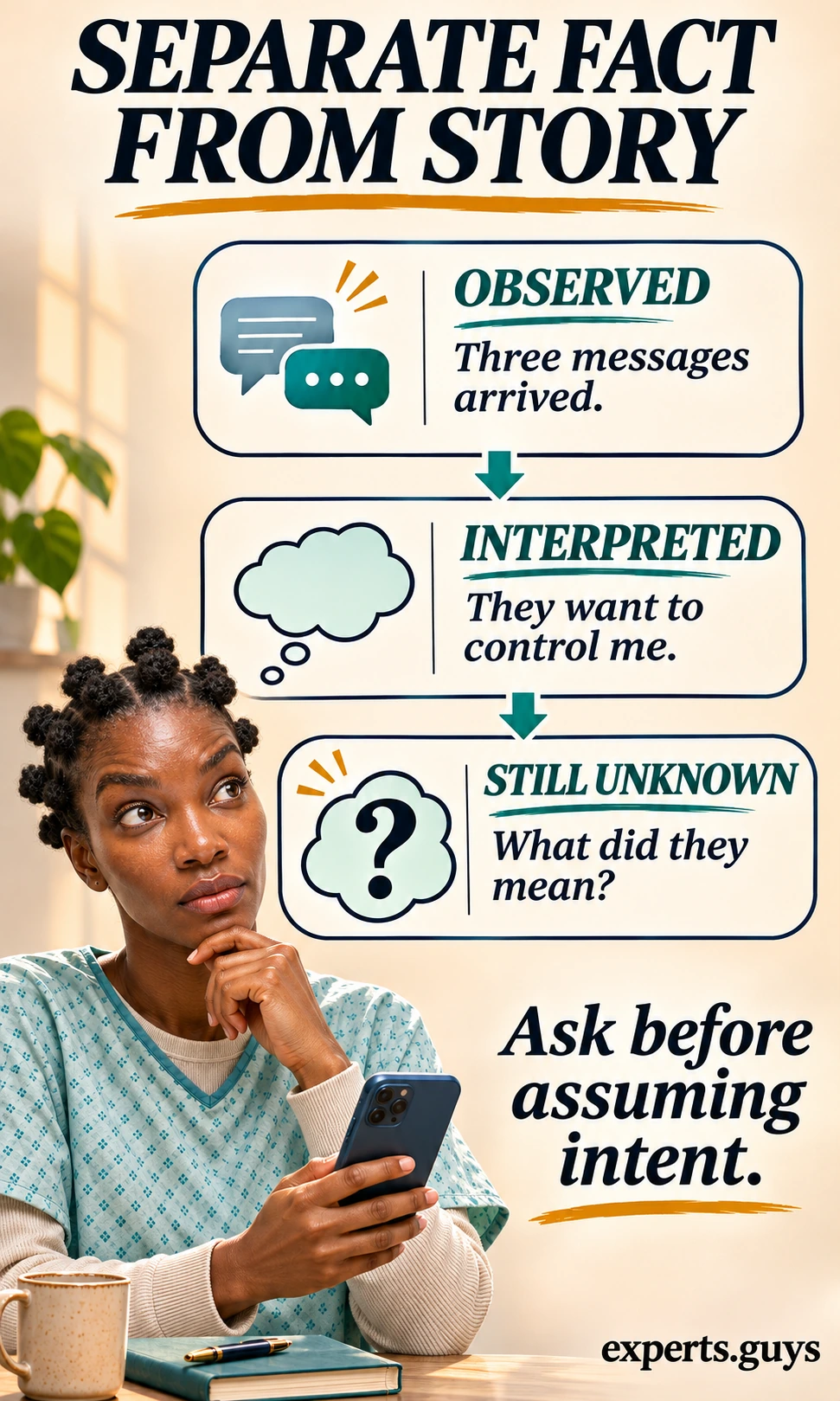
When a conversation is safe, a short question can clarify the gap: “What were you hoping I would understand from those messages?” That invites an explanation without supplying one. “Were you trying to manipulate me?” does the opposite: it places an accusation inside the question and makes a defensive answer more likely to dominate the exchange. Neither question guarantees honesty or understanding; the first is simply more closely matched to the information you actually need.
The observable result of this skill is modest and concrete: you have a sentence about conduct, a clearly identified interpretation and a question that could clarify something. You have not established a diagnosis, verified a motive or resolved the relationship. That smaller result is still useful. If you cannot safely ask a question, you can retain the distinction privately and act on the boundary or safety concern you already know about.
| Language | What it identifies | Useful limit |
|---|---|---|
| Three messages arrived during my meeting. | An observable event in the fictional example. | Does not establish why the messages were sent. |
| They wanted to control me. | An interpretation of intent. | May need evidence; the diagnosis is not proof. |
| I felt pressured by the messages. | The recipient’s reported experience. | Can matter even when motive remains uncertain. |
| I cannot reply while I am in a meeting. | A statement of availability. | Must fit the actual arrangement and any separate safety responsibilities. |
A worked example: the unanswered message
Imagine Leah tells Sam she will be in a meeting until the afternoon. During the meeting, Sam sends three messages asking whether their evening plan is still happening. Leah sees them later and feels pressured. Sam says the silence felt like rejection. This invented example assumes there were no threats, no immediate safety concern and no agreement that Leah would respond during work. Those assumptions matter: changing them could change the appropriate response.
Leah could begin, “I saw three messages during the meeting. I felt pressured because I had already said I could not answer.” That names the action and its impact without declaring Sam’s motive. Sam’s explanation—“I thought you had changed your mind”—adds information, but it does not erase Leah’s experience. The useful question becomes how to handle uncertainty about the evening plan while respecting a period of unavailability.
An ordinary agreement might be, “The plan remains in place unless one of us says otherwise. During work, a delayed reply is not confirmation that the plan has changed.” This is an example of an arrangement these fictional people could choose, not a universal rule for couples or a treatment for BPD. A different arrangement may fit people who work irregular shifts, have caring responsibilities or cannot predict when they can check a phone.
Now change the example: Sam threatens Leah’s job unless she answers, or Leah is afraid to say no. The issue is no longer merely how to interpret a delayed reply. Threats and fear require attention in their own right. The observation-versus-interpretation distinction must never be used to minimise known intimidation. You do not have to prove a person’s hidden intention before deciding that a situation is unsafe or seeking support outside the relationship.
Validate a feeling without agreeing to a claim
Validation means acknowledging an experience as real or understandable; it does not require endorsing every interpretation or action attached to it. The NHS explanation of BPD psychological treatment describes validation alongside change in dialectical behaviour therapy. The everyday examples here borrow that distinction for communication; they are not a DBT programme and do not replace structured treatment.
Compare “That sounds upsetting” with “You are right; everyone is against you.” The first recognises distress. The second confirms a broad claim you may not know to be true. Similarly, “I can see that waiting felt frightening” can sit beside “I was in a meeting and could not reply.” You are allowed to recognise the emotion while keeping a different understanding of the event. Agreement about every detail is not a prerequisite for care.
If you cannot honestly understand the feeling yet, do not perform certainty. “I want to understand what was upsetting about that” is more accurate than “I know exactly how you feel.” Ask one manageable question and allow an answer. Avoid turning the exchange into an interrogation about whether the emotion is proportionate. You can remain curious about an experience without promising to agree with the requested response.
Validation also needs to fit the relationship. A manager, friend, partner and treating professional have different responsibilities and degrees of access. A colleague can acknowledge that a conversation was difficult without discussing private diagnoses. A friend can offer company without agreeing to be continuously available. Choose wording that reflects what you can actually offer, rather than a reassuring phrase that creates an obligation you cannot sustain.
Pair care with a clear, workable limit
The second skill combines three parts: acknowledge the feeling, state the limit, and describe a possible next step. For example: “That sounds upsetting. I cannot keep talking while I am being insulted. We can return when it is safe and calmer.” The purpose is to make your position understandable. It is not a phrase that controls another person’s reaction, proves good intentions or guarantees that the conversation will settle.
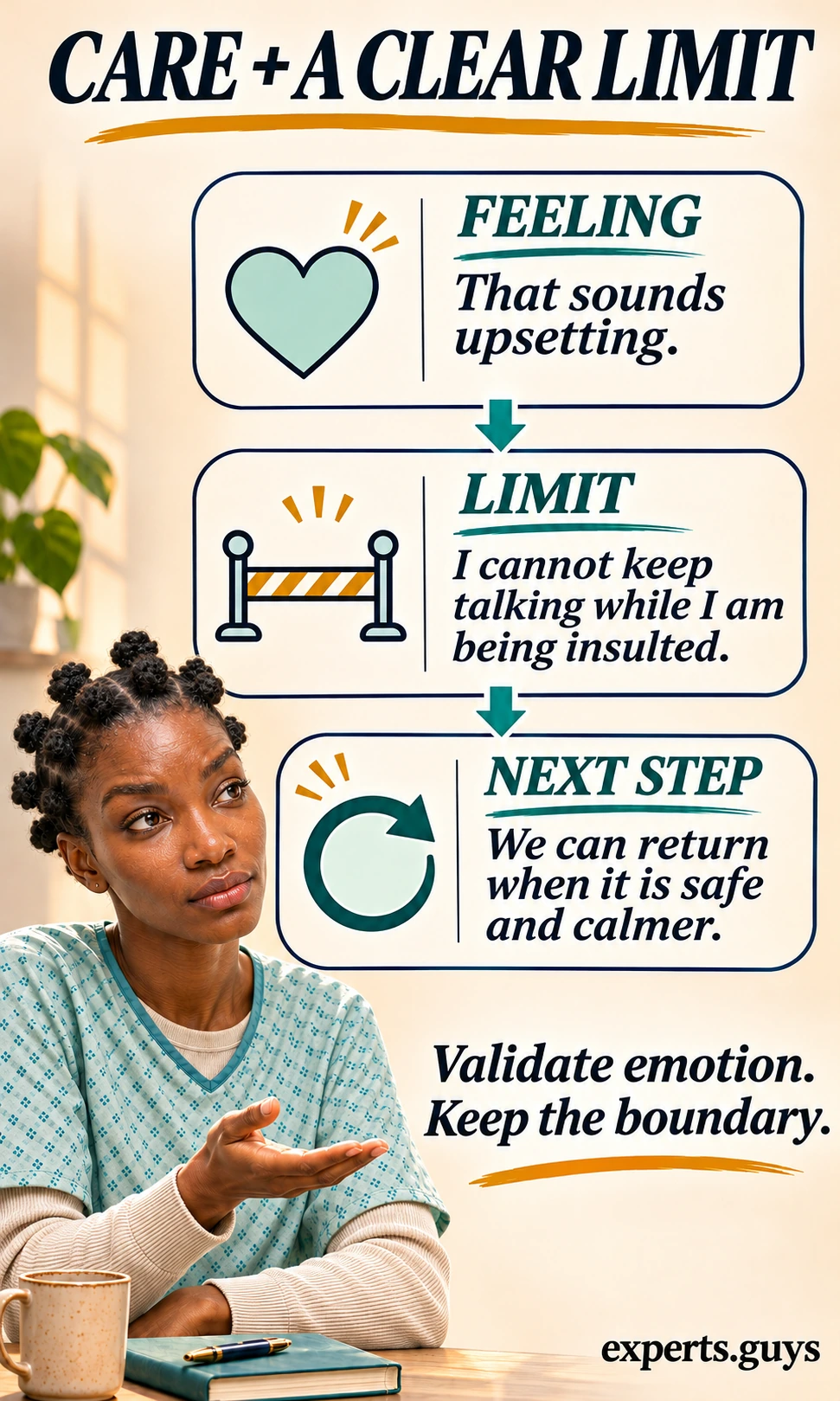
The limit should describe conduct or availability, rather than demanding a feeling. “I am not available to answer during this meeting” is clearer than “Stop being insecure.” “I will end the call if the insults continue” describes your action; “You are not allowed to feel angry” attempts to prohibit an internal experience. A workable boundary identifies something you can do and a condition the other person can understand.
The next step must be honest. If you can offer another time, name an appropriate window without inventing a promise merely to end the exchange. If you cannot commit, say what is uncertain. If you do offer to return, follow through or explain that the arrangement has changed. Reliability matters to the meaning of the words: repeated promises that disappear can make a technically polite script less trustworthy than a straightforward limit.
Do not attach a threat disguised as a boundary. “Agree that I am right or I will punish you” seeks compliance with your account. “I will stop this conversation if shouting continues” concerns participation in the interaction. Context still matters: leaving a call, leaving a room and leaving a shared home are different actions with different practical consequences. Choose a safe response suited to the actual circumstances, especially when children or dependent adults are involved.
When a pause helps—and when the script is insufficient
A pause may be an option when both people can disengage safely and the conversation is becoming unproductive. The relevant part of the boundary skill is clarity about stopping and returning, not a prescribed number of minutes. “I need to stop this discussion. I can try again after dinner if we are both able to speak without insults” supplies more information than disappearing and expecting the other person to infer what happened.
There is no universal waiting period that makes a discussion safe or productive. Returning should not be treated as a debt that overrides a continuing risk. If the conditions are still unsuitable, say so where safe and consider a different setting or additional support. Equally, repeatedly postponing every difficult topic can leave the underlying problem untouched. A pause is a way of changing the conditions of a conversation, not automatically a resolution.
The NICE BPD recommendations advise clinicians managing a crisis to use a calm, non-threatening approach, understand the person’s perspective and avoid minimising the stated reasons for distress. Those are professional recommendations within a broader care framework. They do not assign friends or partners responsibility for providing crisis treatment, and they do not mean that calm wording is enough when there is serious risk.
If someone cannot safely disengage, is being prevented from leaving, or fears retaliation, a conversation script is insufficient. The practical priority is access to safety and outside help, using a route that does not increase danger. The same applies when there is urgent risk of harm. You can care about the person’s distress while recognising that the situation exceeds what an ordinary discussion between two people can manage.
Repair your action without surrendering the boundary
The third skill is repair: name your own action, acknowledge its effect, and state a specific change you can attempt next time. For example, “I raised my voice. That made this harder. I will ask without shouting.” The sentence does not decide who caused the whole disagreement. It identifies the part you can own. You can apologise for shouting and still maintain that you cannot answer messages during work.
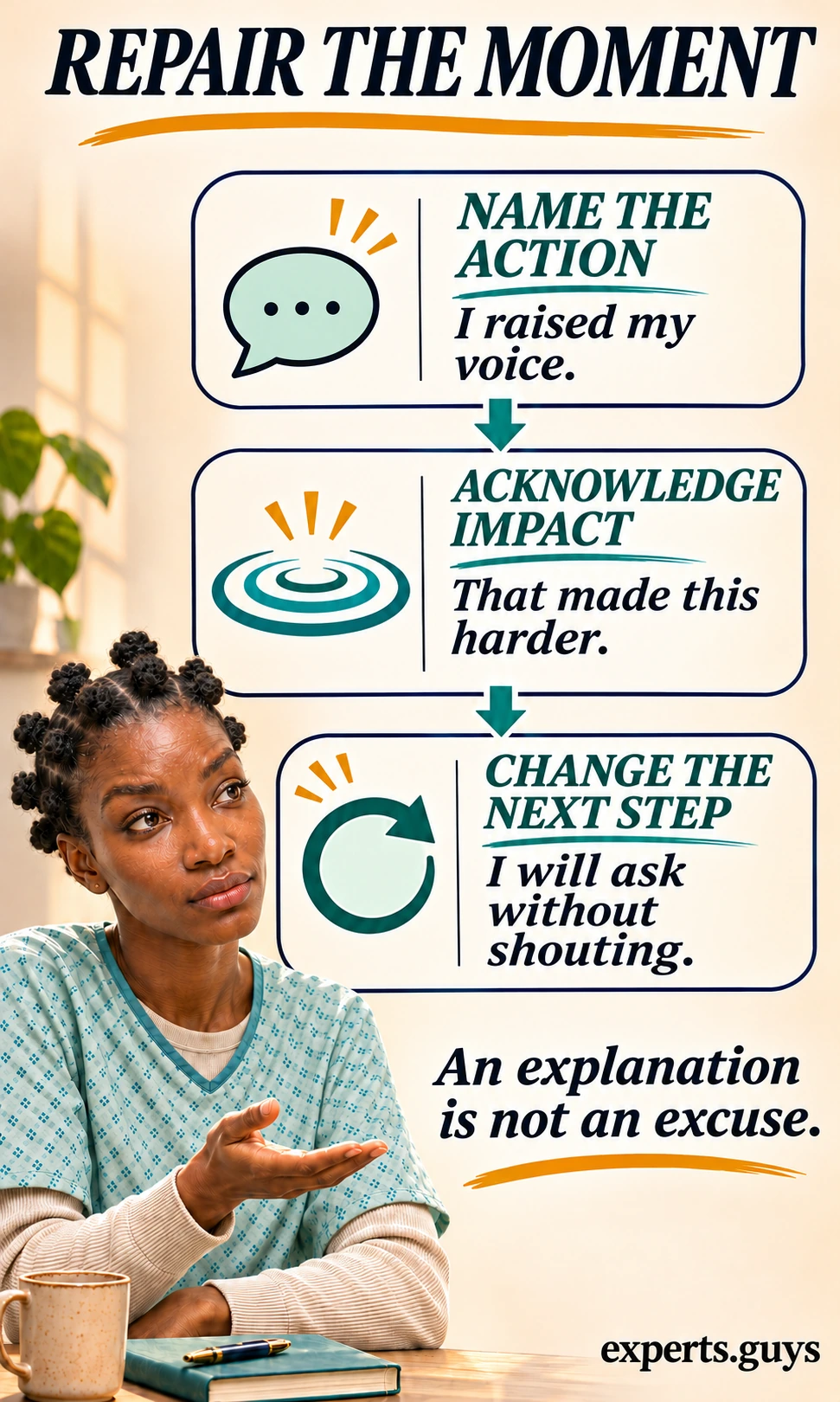
A repair becomes less useful when the acknowledgment immediately turns into an accusation: “I am sorry I shouted, but you made me.” An explanation can provide context later, but it should not erase responsibility for the action being named. A more coherent version is, “I was overwhelmed, and I shouted. I want to handle that differently.” That leaves room to discuss the original concern after addressing the way it was expressed.
The promised change should be within your control and small enough to mean something. “I will never feel threatened again” is not a workable promise. “I will say I need to stop rather than insult you” identifies an intended action. A repair may also involve correcting a false claim or respecting a refusal that was previously ignored. Words alone do not establish that a repeated problem has changed; subsequent conduct remains relevant.
An apology does not require immediate forgiveness, physical closeness, restored access to private information or a return to the relationship. The other person can acknowledge the apology and still need distance. If you are receiving a repair, you are allowed to consider whether it addresses what actually happened and whether the proposed change is credible. Compassion for the explanation does not remove your ability to decide what contact is safe or acceptable.
Accountability does not require a character verdict
Accountability is more useful when attached to an action and a repairable responsibility. “You shared something I told you in confidence; I need that information kept private” identifies a concern. “You are incapable of caring about anyone” makes a global claim about the person’s character. The first can support a decision about future disclosure. The second may communicate hurt, but it does not specify what would need to change.
The same principle applies to self-description. “I handled that badly” leaves room for a specific correction; “I ruin everything” expands one event into an identity. This is not a requirement to use cheerful language or deny serious consequences. An action may have caused substantial harm. Precise language makes it possible to acknowledge that harm without assuming that a diagnosis or one event supplies a complete account of the person.
You do not need an agreed psychiatric explanation to decide how to handle shared responsibilities. Two people can disagree about why a payment was missed and still arrange how an essential bill will be paid. They can disagree about an argument and still agree not to discuss it in front of children. Such arrangements depend on the actual obligations and available resources. They should not become a way of pressuring someone to remain in an unsafe relationship.
| Less useful wording | More specific wording | What changes |
|---|---|---|
| You never care about anyone. | You shared something I told you in confidence. | Names an event rather than claiming to know a whole character. |
| You made me shout. | I shouted, and I want to handle that differently. | Owns an action without deciding the entire disagreement. |
| If you cared, you would answer immediately. | I want to understand when you are available. | Turns a character test into a practical question. |
| I apologised, so you must trust me now. | I understand that you may still need distance. | Leaves the recipient free to decide what contact is acceptable. |
Adapt the wording when conversation itself is difficult
An emotionally demanding exchange is not the best place for a long lecture. Use the same three skills with fewer words: one observation, one clear limit, or one repair. A concise statement can be easier to understand than a complete explanation of your reasoning. This is an adaptation of the existing skills, not an additional exercise. It should reduce the demand of the exchange without hiding the meaning of the boundary.
If spoken conversation is difficult, written wording may be an option where it is safe and welcome. The advantage is time to choose a precise sentence; the disadvantage is the absence of tone and immediate clarification. Do not assume that a brief message will communicate warmth by itself. Avoid sending repeated paragraphs to force a response, and do not use a written explanation to bypass a request for no contact.
Language, disability, sensory demands and privacy can affect which channel is workable. Ask about an accessible way to communicate rather than treating hesitation as evidence of dishonesty or indifference. At work, keep the discussion tied to conduct and practical arrangements within the relevant role. A colleague does not need to disclose a diagnosis to discuss a communication difficulty, and you should not announce a suspected diagnosis as an explanation for their behaviour.
Do not turn serious risk into a test of sincerity
A statement about self-harm or suicide should be taken seriously without making help conditional on deciding whether the person “really means it.” The immediate question is what support and safety response are needed. If there is an existing care or crisis plan, use its agreed routes; immediate danger needs emergency help. Avoid bargaining over a relationship decision as the price of safety or promising secrecy that prevents necessary assistance.
Someone can be distressed and also place another person under unacceptable pressure. Recognising risk does not oblige a partner or friend to meet every demand, remain alone with the situation or provide round-the-clock supervision. Where possible, involve appropriate professional or emergency support rather than making the disagreement itself the mechanism for keeping someone safe. If you are also at risk, your safety matters within that response.
After an urgent episode, ordinary communication questions can still matter, but they belong in a setting suited to the level of risk and the person’s care plan. The purpose of the distinction is practical: do not use a boundary script as a substitute for crisis support, and do not use uncertainty about motive as a reason to dismiss a serious statement. These are different responsibilities even when they arise in the same exchange.
When both accounts contain something true
Suppose one person says, “You cancelled at the last minute,” and the other says, “I had no choice because my shift changed.” Both statements could be accurate. The practical difficulty is that each person may be using one truth to cancel the other: the unavoidable shift is treated as proof that disappointment is unreasonable, or the disappointment is treated as proof that the cancellation was deliberately hurtful. The factual overlap is lost in a contest about whose experience counts.
Applying the same observation-and-validation skills changes the discussion. The shift change can explain the cancellation while the short notice can still have caused inconvenience. Neither fact automatically settles what arrangement would be fair next time. That decision might concern whether tickets can be transferred, whether the plan should be flexible, or whether one person is repeatedly bearing a cost. The circumstances determine which practical question matters; the BPD label does not answer it.
This distinction also prevents an unfair standard of proof. Someone should not have to reveal all their private messages, medical information or location history merely to demonstrate that they had a legitimate reason to be unavailable. A request for explanation can become a demand for access. You can discuss an event without agreeing that unlimited disclosure is the price of being believed. If trust cannot be maintained without surveillance or coercion, the problem exceeds a choice of reassuring words.
Sometimes there will be no shared account. One person remembers an agreement differently, or information is unavailable. A fair conversation can acknowledge that limit and still identify the current decision. You might be able to agree on future availability while remaining uncertain about the earlier exchange. That is different from pressuring someone to deny a clear event. The purpose is to avoid manufacturing certainty, not to make conflicting accounts equally credible regardless of evidence.
What this approach can reasonably achieve
The aim is a clearer conversation and a more defensible decision, not perfect agreement. You may understand an action differently after asking about it. You may keep the same boundary. You may discover that the other person is unwilling to respect it. Each outcome provides different information. A respectful sentence is valuable because it communicates your position accurately; its success cannot be measured solely by whether the other person becomes calm or agrees.
BPD is treatable, and structured psychological care can support improvement. Everyday communication suggestions are only a small part of that wider picture. They cannot assess a person, deliver a full therapy programme or make another person change. The practical standard here is narrower: describe what you know, leave uncertain motives uncertain, acknowledge feelings honestly, and make your own responsibilities and limits understandable.
Frequently asked questions
Can I use the word manipulative if someone admits a deliberate attempt to pressure me?
You can describe the evidence and the specific conduct, including an admission. The caution is against using BPD itself as proof of motive, not against recognising deliberate pressure. Concrete wording also makes it easier to explain your concern to someone outside the situation without relying on a label that different people may interpret differently.
What if a validating phrase sounds patronising?
Use ordinary wording that fits how you actually speak, and avoid presenting yourself as an expert on the other person’s feelings. “I can hear that you are upset” may fit better than a formal script. If the person says the wording feels dismissive, consider that feedback without assuming you must agree with every claim or abandon the boundary.
Should I mention a suspected BPD diagnosis during a workplace disagreement?
Keep the conversation about conduct, impact and work arrangements rather than announcing a suspected diagnosis. A workplace disagreement is not an assessment. If there is a formal support or accommodation process, use the appropriate confidential route. The need for a practical arrangement does not give colleagues unrestricted access to someone’s health information.
Can I apologise while still disagreeing about what started the argument?
Yes. You can acknowledge a specific action, such as an insult, without declaring that every account of the earlier event is correct. Be precise about what you are apologising for. A repair is less clear when it becomes either a demand that the other person accept all the blame or a promise that you cannot realistically keep.
Do I owe another conversation after someone has asked for no contact?
No script should be used to override a clear request for no contact. A wish to explain, apologise or understand does not automatically create a right to access another person. Any necessary shared responsibilities may need an appropriate agreed or formal channel. A communication guide cannot decide legal obligations or the safest arrangement for an individual situation.
Would a manipulation score help me decide what is happening?
A score built from a few descriptions would create false certainty about intent and context. The relevant information concerns specific actions, evidence, impact, safety and practical responsibilities. This guide therefore offers illustrated examples rather than a diagnostic quiz or relationship rating. Uncertainty can remain visible while you decide what conduct you will accept.