
Depressive psychosis is another term for depression with psychotic symptoms, such as delusions or hallucinations. When treatment is underway and home support is appropriate, you can help by reducing everyday demands, preserving choice and making basic tasks easier. Start with the practical difficulty causing the most strain today rather than attempting all seven approaches at once.
What can practical home support change?
Home support changes the demands around a person; it does not establish a diagnosis or replace treatment. Depression can make getting started, choosing and managing ordinary tasks difficult, while psychotic experiences can add fear or mistrust. A manageable environment gives the person fewer practical problems to navigate at the same time.
The cause of psychotic depression is not fully understood, and a difficult household interaction does not prove that a family caused the illness. Treatment may include medication, psychological care and social support, with the setting chosen according to clinical need. The NHS overview of psychotic depression explains the condition and treatment options.
This guide is for adults receiving care and the people supporting them, especially when the immediate question is how to make daily life more manageable. For recognition, assessment and treatment discussions, use the companion psychotic depression guide. Here, each approach addresses a different household difficulty rather than repeating a symptom checklist or an appointment worksheet.
| Today’s difficulty | Start with | Useful checkpoint |
|---|---|---|
| Too much noise or activity | One quieter place | The setting feels more tolerable |
| Even simple questions feel demanding | One small choice | A preference can be expressed |
| Preparing meals is too much | Mealtime assistance | Food and drink are easier to access |
| The day feels shapeless | A few daily anchors | The next activity is predictable |
| Household jobs are piling up | One agreed task | A manageable first step is completed |
| Visits are draining | A visitor boundary | A break can be requested |
| Support is disorganised | A practical handover | Each essential job has an owner |
These are practical examples of supportive care, not seven clinically validated treatments for depressive psychosis. They should fit the person’s wishes and any existing care plan. The aim is to reduce avoidable strain while preserving dignity, not to measure compliance or promise faster recovery.
Create one quieter place without isolating the person
Use this when television, visitors or several conversations make an ordinary room hard to tolerate. A less demanding setting removes avoidable distractions; it does not switch off hallucinations. Ask what feels comfortable before moving furniture or changing the room.
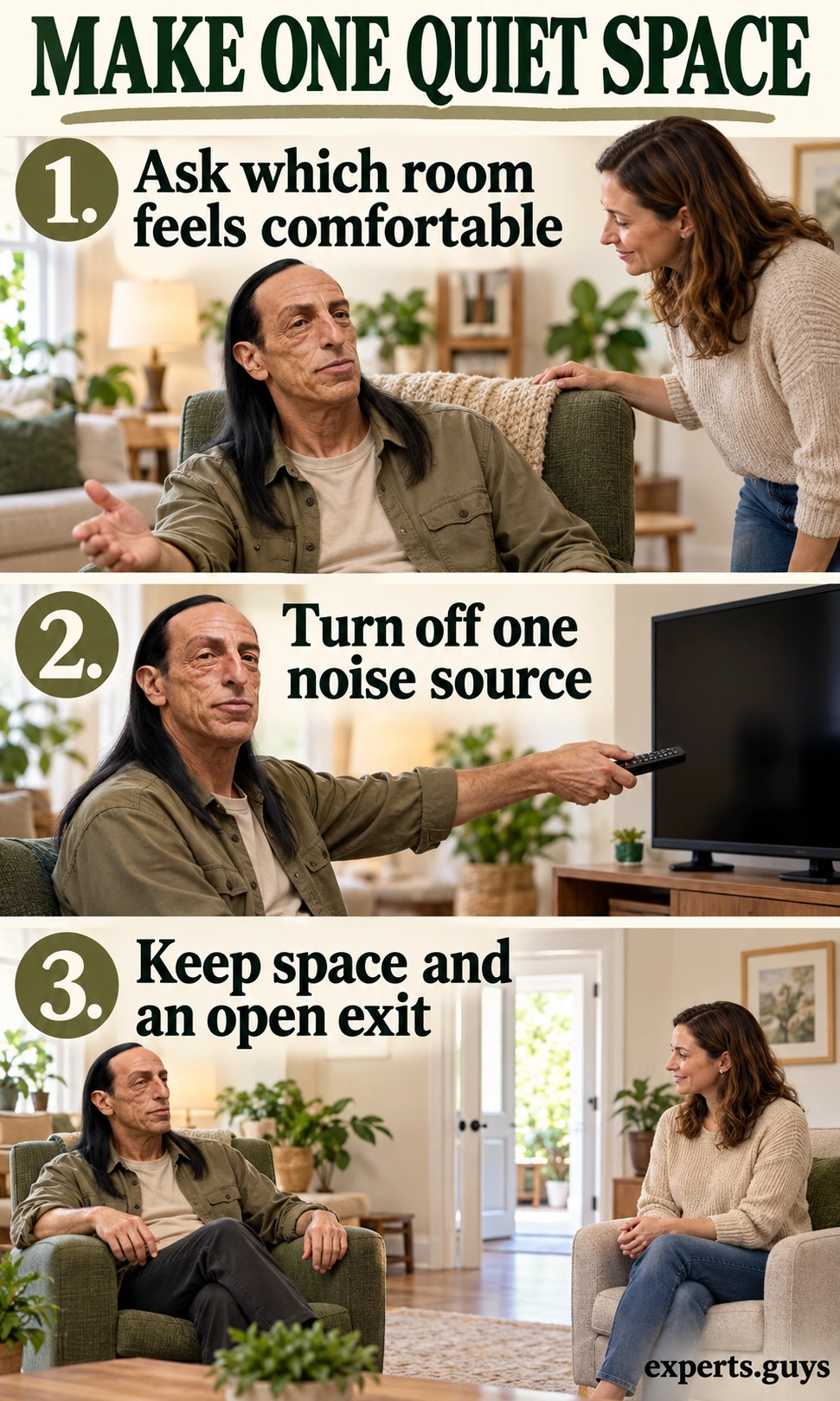
- Offer a choice of two familiar places, such as the living-room chair or kitchen table. Keep the route out clear.
- With permission, turn off one competing sound source and ask others to give the person some space. Keep ordinary, comfortable lighting.
- Sit at a respectful distance if company is welcome. Ask whether the change helped, rather than assuming that silence must be better.
For example, turn off the news while keeping a lamp on and the door open. This is an environmental adjustment, not a test of whether an experience is real. If the person prefers familiar low-volume music, let that preference guide the setting.
Locking the door, surrounding the person or repeatedly checking on them can make the arrangement feel controlling. In a shared home, try a quieter corner rather than insisting on a separate room. Stop rearranging things if it increases distress; success is a more tolerable setting, not complete calm.
Offer one small choice when decisions feel exhausting
Use this for ordinary preferences when an open-ended question produces frustration or no answer. Two concrete options can make the request easier to understand, although any question may still feel difficult. Prepare choices you can actually provide, with an option to decline both.

- Show or name two simple options: “Would you like tea or water?” Avoid adding several more possibilities.
- Ask once in a calm voice, then allow time for an answer. A gesture or pointing is enough.
- Accept “neither” or a pause. If the choice is non-urgent, leave it for later rather than turning it into a test.
A supporter can set a cup and a glass on the table so the person does not have to hold both choices in mind. Pointing to the glass completes the decision. There is no need to explain or defend that preference.
Do not disguise a demand as a choice or keep asking until you obtain the answer you want. If speech is tiring, offer a picture or a simple yes-or-no invitation. The checkpoint is whether the person could express a preference without added pressure, not how quickly they answered.
Reduce the effort around food and drink
Use this when shopping, preparation or a full plate feels overwhelming and the person can eat and drink safely. Practical help can remove work from mealtimes, but it cannot resolve a belief that food is harmful. Follow any existing swallowing, allergy, diabetes or fluid advice rather than replacing it with a generic menu.

- Ask which familiar food sounds manageable and prepare a small amount. Put the meal and a usual drink within easy reach.
- Offer quiet company if welcome, without watching every mouthful or bargaining over portions. Let the person set an ordinary pace.
- Notice what was manageable and offer practical help again later. Share a sustained decline in intake with the treating team rather than treating a few bites as proof that everything is fine.
For example, a bowl of familiar soup with toast may involve less effort than choosing and cooking a full dinner. “A few bites and some water” describes what happened without awarding a pass or fail. This is an illustrative serving, not a nutrition prescription.
If a belief about poisoning is involved, do not agree that the food is poisoned, secretly change it or force eating. Ask what feels difficult and use the existing urgent-care route when intake is persistently inadequate. Very little fluid, faintness, severe weakness, confusion or inability to swallow needs urgent medical attention; do not keep retrying this routine while health deteriorates.
Use a few daily anchors instead of a strict timetable
Use this during recovery when days have lost their structure and the person is willing to try a simple routine. Predictable activities can make the next part of the day easier to anticipate. The goal is a flexible rhythm, not sleep restriction, a productivity target or a deadline for recovery.

- Choose one realistic morning anchor together, such as opening the curtains after getting up. Work around the agreed treatment schedule.
- Add a familiar meal and one quiet, optional activity. Keep the sequence short enough to remember.
- Make the evening less demanding and review whether the routine was tolerable. Adjust the amount of activity to the person’s current capacity.
A workable day might be curtains, breakfast, a little drawing, and a quieter evening. A difficult morning does not invalidate the rest of that sequence. Return to the next manageable anchor rather than trying to catch up on everything missed.
A rigid wake-up rule can become another source of conflict, particularly when medication causes drowsiness. Do not change doses or use alcohol to force sleep; report troublesome sedation or a marked sleep change to the care team. If the whole sequence feels too much, keep only one anchor and judge it by tolerability rather than perfect attendance.
Help with one household task while preserving control
Use this when mail, laundry or basic tidying has accumulated and the person wants assistance. Sharing the work can lower the effort required to begin without handing over every decision. Choose a low-risk task, agree what you may touch, and leave private documents alone unless invited.
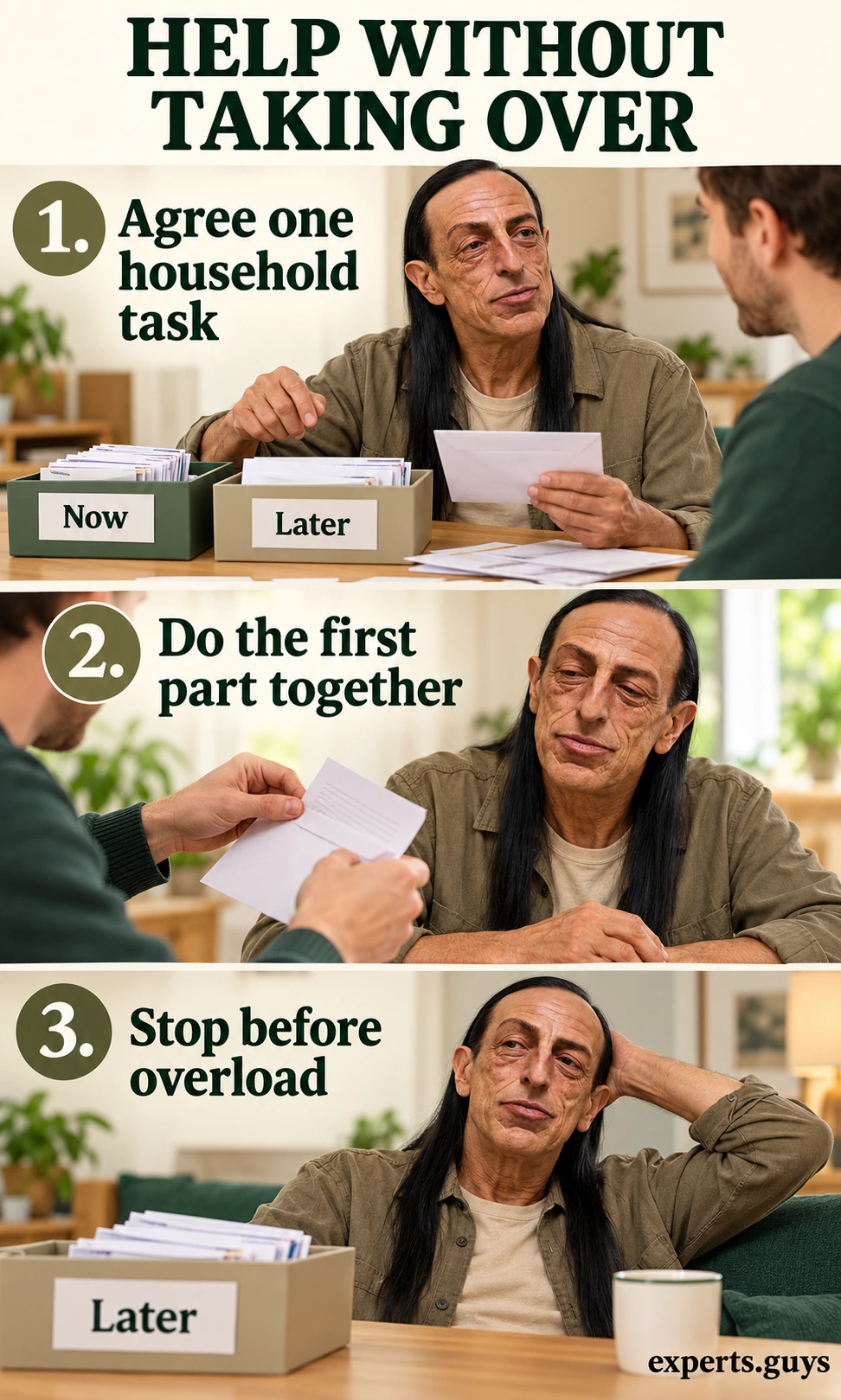
- Name one job and ask what kind of help is welcome: doing it together, preparing the materials, or handling it on their behalf.
- Complete only the agreed first part. For mail, identify one envelope that needs attention and put the rest aside.
- Pause before starting another job. Ask whether to stop, continue briefly or leave the remainder for a different day.
For example, “Shall we look at this one envelope together?” is more specific than “You need to sort your life out.” The person may choose a Now pile and a Later pile without opening anything yet. That still establishes a next step while preserving ownership.
Do not discard possessions, open private messages or take over finances without permission or a lawful agreed arrangement. If sorting is too demanding, offer to clear a small working space instead. A useful outcome is one agreed task made easier; exhaustion, suspicion or rising distress means stop and reassess.
Agree a simple boundary for visitors
Use this when company is welcome in principle but visits become tiring or intrusive. Advance agreement can remove the burden of negotiating a break while already exhausted. Prepare a simple invitation and a phrase the person feels comfortable using to end the visit.

- Ask who they would like to see, if anyone. Offer one familiar visitor rather than arranging a group surprise.
- Agree that the visit will be brief and flexible. Tell the visitor to avoid demanding explanations about the illness.
- Choose a stop signal, such as “I need a break now,” and agree that the visitor will respond without debate.
The person might welcome a friend for tea but not questions about what happened in hospital. A supporter can explain that boundary beforehand with permission. When the stop phrase is used, the visit ends kindly rather than becoming a discussion about whether the person should try harder.
Cancelling every visit indefinitely can remove wanted companionship, while insisting on visitors can feel overwhelming. Offer a brief message or a later invitation if an in-person visit is too much. Judge the arrangement by the person’s comfort and wishes; they do not owe a cheerful performance.
Share practical support without creating a surveillance system
Use this when several trusted people want to help or one supporter is becoming stretched. A clear division of ordinary jobs can prevent repeated calls, missed errands and contradictory promises. Start with the person’s permission about who is involved and what information can be shared.
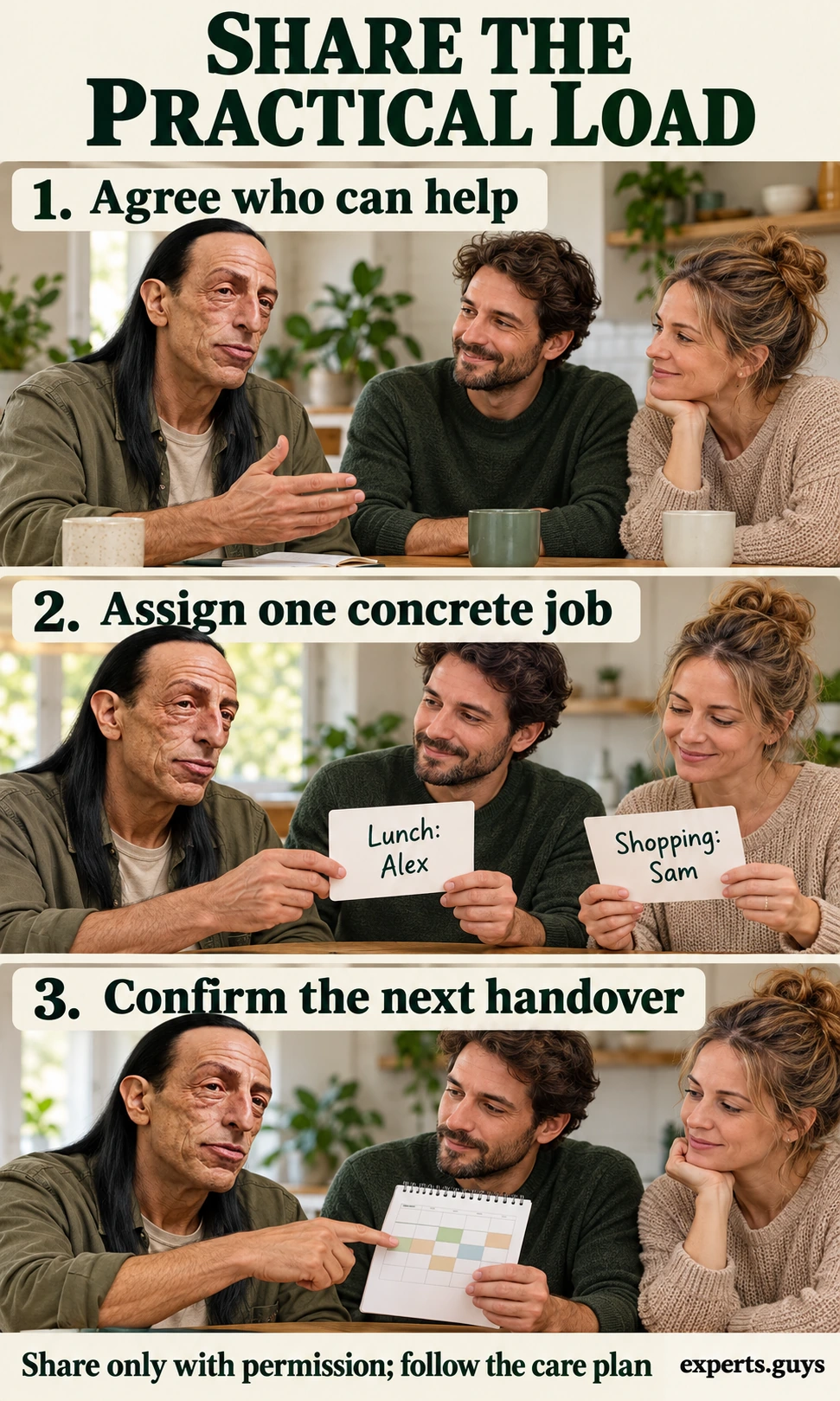
- List the practical jobs that actually need help, such as lunch, shopping or transport to an agreed appointment. Do not assign clinical supervision informally.
- Give each job to one willing person and name a backup if needed. Keep the plan somewhere the person receiving support can also access.
- Confirm when responsibility passes to the next helper. Use the existing care plan for urgent concerns; a household rota does not replace professional support.
An illustrative handover could read: “Alex brings lunch; Sam buys the groceries; Alex confirms delivery with Sam.” It does not need a running account of private conversations. Share the minimum information needed to complete the job.
A group chat full of symptom speculation can feel invasive and can spread inaccurate conclusions. If only one supporter is available, reduce the job list and tell the care team which practical needs remain unmet. The checkpoint is whether essential tasks have a reliable owner without exhausting the supporter or removing the person’s voice.
How do you tell whether support is helping?
Look for the outcome of the particular change: a tolerable room, an expressed preference or an agreed task made easier. Those outcomes show practical usefulness; they do not prove that psychosis has resolved. If an approach makes the person more uncomfortable, stop that approach rather than increasing the pressure.
A calmer manner does not reliably show that someone is safe or that frightening experiences have stopped. New deterioration belongs with the care team, especially when sleep, intake or everyday functioning changes markedly. Keep the emergency threshold near the top of this page available, and follow the person’s own care instructions when they are more specific.
Support should be collaborative rather than corrective. Mind’s guidance for supporting someone with psychosis underpins the principles of calm communication, space and respect for the person’s wishes. The household examples here are editorial applications of those principles, not evidence of individual treatment results.
Frequently asked questions
Is depressive psychosis different from psychotic depression?
The terms generally refer to depression accompanied by psychotic symptoms. This page uses the former term to focus on practical home support during care. The name alone does not tell you which treatment or care setting a person needs.
Should I promise to keep everything secret?
Respect privacy, but do not promise secrecy if someone may be in immediate danger. Explain that urgent safety concerns may need to be shared with the appropriate emergency or care service. For routine household help, agree what information may be shared and with whom.
What if the person does not want these suggestions?
Do not turn optional home-support ideas into an argument or a condition of receiving help. Ask which practical difficulty they would like help with, or offer to return later. Refusal of an optional activity is different from a situation involving immediate danger or serious deterioration.
Does a quiet day mean the person is ready to return to work?
A quiet day at home does not establish readiness for work, driving or other demanding responsibilities. Those activities introduce different demands and safety considerations. Discuss the particular role and any restrictions with the treating team rather than using household progress as a clearance test.
Can I use a chatbot to check whether a belief is a delusion?
A chatbot cannot assess the full clinical and cultural context or establish that someone is safe. Repeatedly testing a belief online can also turn support into a debate. Use the existing clinical route for new or worsening experiences rather than treating an online answer as a diagnosis.
Summary: make one part of today easier
Choose the practical problem that is causing the most strain, ask permission and try one small change. Keep it only if it is useful and tolerable, and let the person’s wishes guide ordinary decisions. Effective support makes daily life more manageable while treatment and safety remain in place.
Educational information, not an individual treatment plan. All pictured people and scenes are AI-created illustrations; they do not document patients, clinical outcomes or the health of a reference person.