Depression and pain can reinforce each other, and both deserve assessment and treatment. Improving mood does not automatically resolve pain, while persistent pain should not be dismissed as “just depression.” The useful next step is to describe each problem separately and build a care plan that also considers daily function.
For pain that is new, worsening or interfering with ordinary activity, arrange a medical assessment rather than assigning a cause yourself. Persistent low mood or loss of interest also deserves assessment, especially when it lasts around two weeks or affects daily life; severe symptoms warrant help sooner. The NIMH depression overview explains these features, while NHS guidance details chest-pain emergencies and back-pain warning signs.
| What you notice | What it means for the next conversation |
|---|---|
| Pain improves; mood remains low | Keep the depression assessment or treatment review active. Pain relief alone does not settle mood symptoms. |
| Mood improves; pain persists | Review the remaining pain and functional limits without assuming the pain is imagined. |
| Daily activity improves; pain is unchanged | Describe the gain and remaining difficulty separately. Participation is useful information, not proof of recovery. |
| New symptoms or rapid deterioration | Reassess the change and its urgency instead of simply extending the old explanation. |
Why can depression and pain make each other harder to manage?
The broader relationship between illness and emotional health is covered in depression and chronic illness. This page concentrates on the practical problem of reviewing pain and mood together. The NIMH chronic illness guidance supports assessment of both rather than treating depression as an inevitable consequence of illness.
Pain processing involves overlapping brain systems for sensation, attention and emotion, rather than one isolated “pain center.” This helps explain why mood can influence the experience of pain without making the symptom imaginary or voluntary. The NINDS pain overview describes this overlap; it does not provide a test that can assign an individual symptom to depression.
Describe a change without deciding its cause
Pain is real whether its main driver is tissue injury, a nerve problem, altered pain processing or a combination. Depression can coexist with these problems and add difficulty with sleep, attention and everyday participation. The relationship runs both ways: persistent pain can also burden emotional health, so a mood diagnosis should never become a reason to stop assessing physical symptoms.
Use this approach when explaining an unfamiliar symptom or a change in an established problem. A short description gives the clinician something more specific to assess than “everything is worse.” Open a private phone note or use voice dictation; this is a communication aid, not a diagnostic test.

- Name the location and sensation in ordinary language, such as burning in the forearm or an ache across the shoulders.
- Add when it began, whether it is new or familiar, and what makes it different from your usual pattern.
- Give one concrete consequence, such as difficulty holding a cup, and mention accompanying symptoms.
Illustrative example: “My forearm has a new burning feeling, and holding a cup is harder than last week.” Do not replace that description with “my depression is causing it,” because that closes the question before assessment. If typing is difficult, say the sentence aloud at the appointment or ask a trusted person to help; completion means communicating the change, not proving its cause.
Compare pain and mood separately
A shared burden does not mean pain and depression are the same condition. Poor sleep and reduced participation can complicate both, but an association does not establish what is causing a particular person’s pain. Separate observations help avoid the mistaken conclusion that improvement in one area settles the other.
This check fits someone who already has a care plan and needs to explain progress. Use the same comparison period for both questions, such as since the last appointment, rather than comparing today’s pain with last month’s mood. A few words are enough; frequent checking is unnecessary.
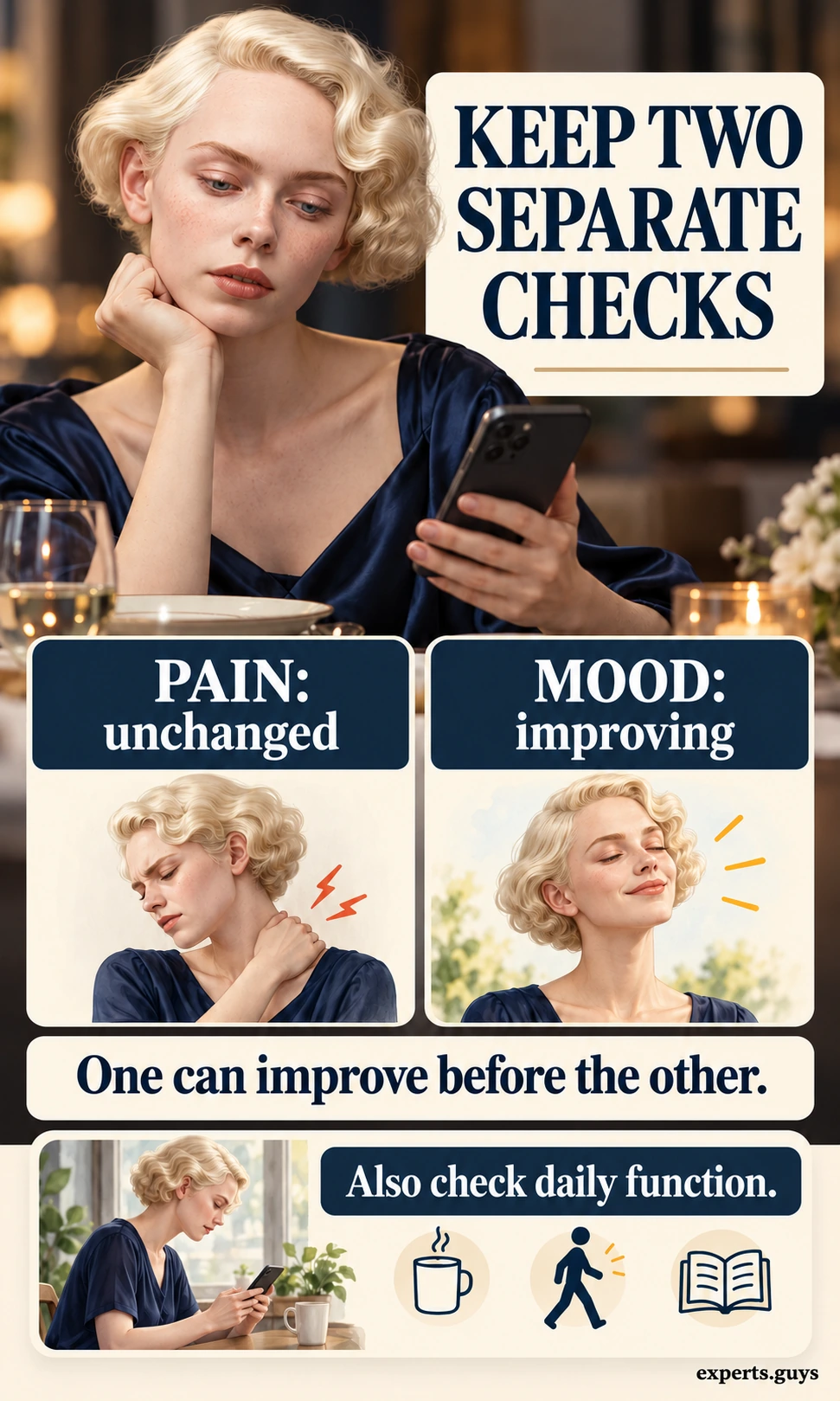
- Compare pain with your previous usual pattern: better, unchanged or worse, plus the main change.
- Separately compare interest, low mood and ability to connect with daily life. Do not use pain intensity as the mood answer.
- Add one daily-function example and take the two observations to the planned review.
Illustrative example: “Pain is unchanged, but I am more interested in seeing friends.” That is useful partial progress, not proof that the pain is psychological or that treatment is complete. If tracking increases worry, make the comparison only before review; worsening mood or function calls for an earlier conversation instead of waiting for the next entry.
How can you protect daily life without pushing through pain?
The VA overview of cognitive behavioral therapy for chronic pain describes a treatment focused on reducing pain’s negative impact. The dinner example below is a practical adaptation, not a full course of CBT or a substitute for individualized rehabilitation. When sleep is the main barrier, see depression and sleep problems rather than adding another routine here.
Choose one participation goal
A function goal describes a part of life you want back, rather than setting “no pain” as the only acceptable result. Pain-focused psychological treatment can address how pain affects activity and distress without denying physical causes. A personal goal helps the care team understand which limitation matters most to you.
Choose an activity compatible with your existing medical advice and current ability. Dinner with a friend is an example, not a prescribed exercise or a test of determination. The goal should remain adjustable if your symptoms change.

- Choose one meaningful activity, such as joining a meal or taking part in a family conversation.
- Define a smaller version you could reasonably attempt, including a seating option, help or permission to leave early.
- Afterward, consider what you managed and how you felt later, not just whether you completed the invitation.
Illustrative example: join part of dinner while a friend handles serving. The common mistake is making the whole evening a pass-or-fail challenge; shorten the visit or arrange a brief video call if that fits better. Judge the attempt by useful participation and tolerability, and adjust with your care team if it repeatedly causes substantial worsening.
Divide effort before overload
Pacing means breaking a demanding activity into manageable parts and balancing activity with recovery. It can be useful when a good spell leads to doing everything at once, followed by a long setback. It does not mean ignoring a new symptom or pushing through a predetermined amount regardless of the consequences.
Start with an ordinary task you already understand, within any restrictions you have been given. Identify which part tends to exceed your current tolerance, then change the amount, timing or help available. There is no universal number of minutes that is safe for everyone.

- Choose a smaller portion of the task based on what is usually manageable for you.
- Build in a pause or change of activity before your usual point of overload, rather than waiting until the task is finished.
- Share the demanding part where possible and notice whether the arrangement is tolerable later as well as during the activity.
Illustrative example: set one place, sit down, and let someone else carry the serving dish. A frequent mistake is using an unusually good day to double the workload; return to a repeatable amount instead. If even the smaller version causes marked or delayed worsening, stop increasing it and seek an individualized approach, particularly when another condition affects exertion tolerance.
The Royal National Orthopaedic Hospital pacing guide explains balancing manageable activity and rest. Here, sharing serving and shortening preparation are examples of applying that principle to a social activity. They are not fixed activity targets, and they should be adapted to your condition and response.
What should a treatment plan address when both problems are present?
The NHS antidepressant guidance explains uses, side effects and the need for supervised changes. Prescribing decisions differ by condition and country, so a general article cannot select a medicine or dose for you. The purpose of the following steps is to make the review specific enough to support a shared decision.
| Care component | What to clarify |
|---|---|
| Pain assessment | Which diagnosis or symptom is being addressed, and what change requires reassessment? |
| Psychological treatment | Is the focus depression, pain-related distress, participation, or more than one of these? |
| Medication | What is the intended benefit, what are the risks, and who reviews it? |
| Rehabilitation | Which activities fit the diagnosis, restrictions and current tolerance? |
Prepare a medicine review
Some antidepressants are used for certain pain conditions as well as depression, but the right choice depends on the pain diagnosis, other medicines and personal risks. A medicine prescribed for nerve pain is not evidence that a clinician thinks the pain is imagined. Treatment for depression and treatment for pain can overlap without being interchangeable.
Use a medicine review when the purpose of a prescription is unclear, benefit is uncertain or side effects interfere with life. The preparation is information gathering, not permission to adjust treatment yourself. Include prescribed medicines, nonprescription products and supplements so the reviewer can assess the whole combination.
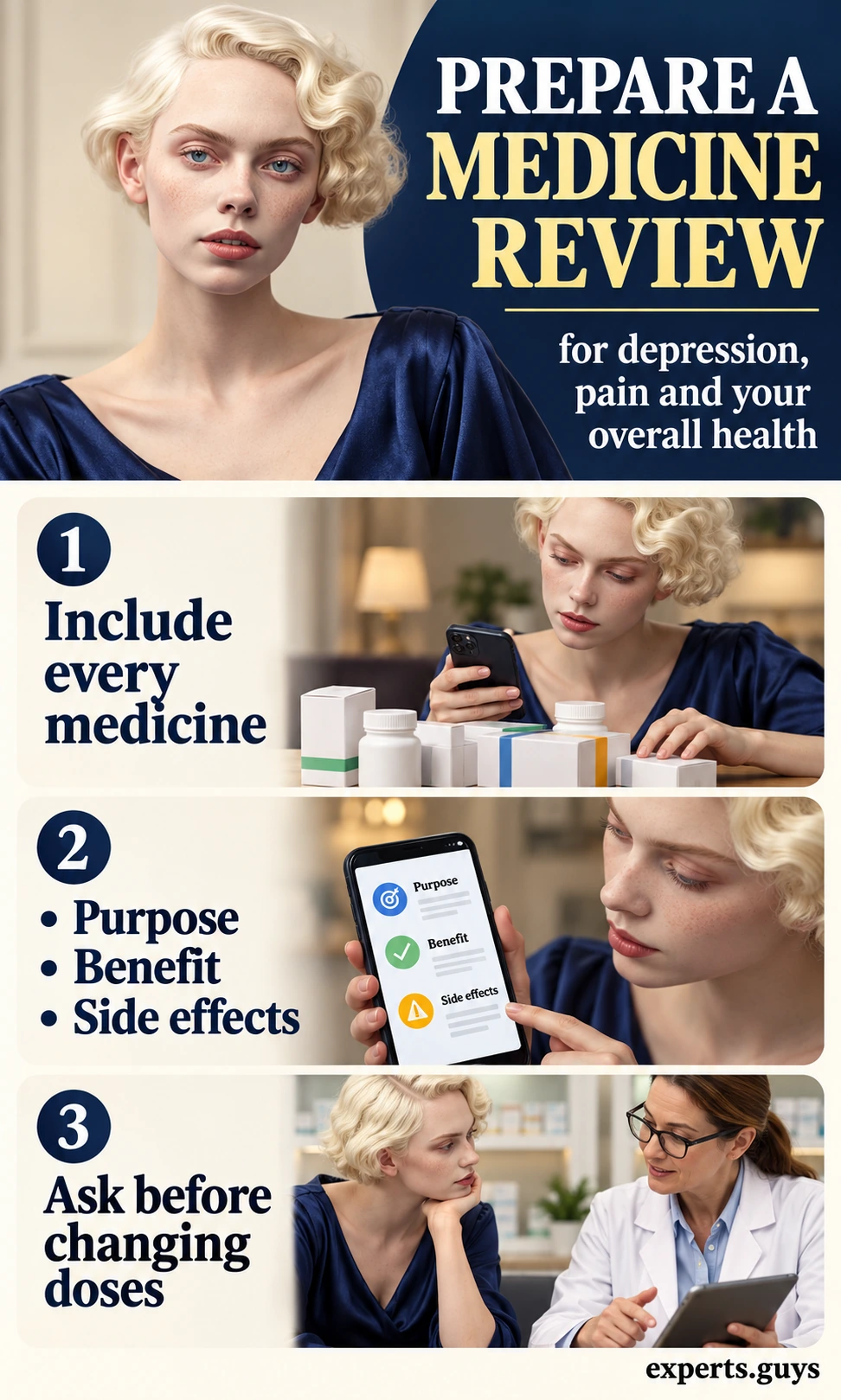
- Bring the current medication list from your patient portal, or photographs of the packaging and directions.
- For each medicine, identify the intended problem, any benefit you notice and unwanted effects or practical difficulties.
- Ask the prescriber or pharmacist what should be reviewed, when benefit will be assessed and what to do if problems develop.
Illustrative question: “This was prescribed for pain; what change are we looking for, and could it be contributing to my daytime sleepiness?” Do not judge every medicine by mood alone or stop an antidepressant abruptly. If the list is overwhelming, ask the pharmacy to help reconcile it; the useful outcome is a clear purpose and follow-up plan, not a self-selected dose change.
Connect the people providing care
Pain services and mental health services may work on different parts of the same daily difficulty. Collaborative care can bring physical and mental health treatment together, although access and service arrangements vary. Even where a formal program is unavailable, identifying who coordinates follow-up can make the plan easier to understand.
This step is useful when appointments leave you with separate instructions or uncertainty about whom to call. Use your existing patient portal or ask the practice how to share a concise care summary securely. You do not need a new app or an account with a commercial symptom service.

- Ask the primary-care practice which clinician is coordinating pain, mood and medication follow-up.
- With your consent, request that relevant care summaries reach both services, especially after a treatment change.
- Confirm who will contact you, what the next appointment is for and whom to reach if the plan is not working.
Illustrative example: a pain clinician focuses on activity limits while a therapist works on distress; ask how both will review the same participation goal. The mistake is assuming every service can already see the same record. If portals do not connect, request a patient copy to share; completion means knowing who owns the next step, not becoming your own medical coordinator.
How do you judge progress and respond when symptoms change?
A disappointing week cannot by itself establish that a treatment has failed. Equally, a favorable mood change should not conceal a new physical problem or a troublesome adverse effect. Compare the pattern with the treatment goals and seek reassessment when it has meaningfully changed.
Separate a familiar flare from a new change
A flare of an established problem and a new symptom require different questions. Familiar pain can vary, but a previous diagnosis does not explain every future episode automatically. A flare plan is most useful when it includes both agreed actions and clear reasons to seek reassessment. NICE chronic-pain guidance recommends reassessment when symptoms change, including a flare-up.
Use this comparison only alongside the urgent warning signs near the beginning of this article. For familiar symptoms, consult the plan already agreed with your clinician instead of improvising medicine changes. If you do not have a plan, ask for one at review rather than assuming all increases are harmless.

- Compare the location, sensation and accompanying symptoms with your usual pattern.
- For a familiar fluctuation without warning signs, use the agreed plan and reduce optional demands as needed.
- Seek reassessment for a new, substantially different or persistent worsening pattern; emergency warning signs need immediate help.
Illustrative example: the usual ache after a demanding day may fit your existing plan, while new weakness needs a different response. The common mistake is treating every change as either a catastrophe or “just depression.” If you cannot decide, contact an appropriate clinical service for advice; completion means choosing the right route, not diagnosing the flare yourself.
Review benefit across four areas
Treatment progress is easier to discuss when pain, mood, function and unwanted effects remain separate. Better participation may matter even when pain has not disappeared, while persistent depression still deserves treatment when pain improves. A review should clarify both what is helping and what still needs attention.
Before the planned appointment, choose one example for each area rather than collecting a long diary. Your phone note can be a few headings or a voice memo for your own use. This is an editorial conversation format, not a validated scale or a treatment score.

- Compare pain, mood and one meaningful activity with the previous review period.
- Add unwanted effects, access problems or instructions that have been difficult to follow.
- Ask what to continue, what needs reassessment and when the next review should happen; confirm who will arrange it.
Illustrative example: “I can stay for part of dinner and feel more interested in conversation, but the pain is unchanged and I am sleepy in the afternoon.” Avoid collapsing that mixed result into “working” or “failed.” If concentration is limited, bring one priority and a support person with your consent; leave knowing the next action and seek earlier help for significant deterioration.
Frequently asked questions
Does being prescribed an antidepressant mean my pain is psychological?
No. Some antidepressants are used for conditions such as nerve pain, including in people who are not depressed. Ask which symptom the prescription targets and what benefit should be reviewed; the medicine name alone does not establish the cause of pain.
Does a normal test result prove depression is causing the pain?
No. A test answers particular clinical questions, and a normal result does not establish a mood-related cause. Ask what has been ruled out, what remains possible and which changes should prompt another assessment.
Do I need a symptom-tracking app?
No. A brief private phone note, voice memo or spoken summary is enough for the examples here. If recording makes you more preoccupied with symptoms, stop routine tracking and prepare only the key points for your review.
Should pain treatment wait until depression improves?
Usually the useful discussion is how to address both, rather than requiring one to disappear first. Urgent symptoms, a specific diagnosis and treatment risks can change priorities. Ask who will coordinate the plan and how progress in each area will be reviewed.
Keep both problems visible
Describe pain and mood separately, choose one meaningful daily activity, and bring the remaining limitations to a coordinated review. The goal is a clearer plan that acknowledges both improvement and unresolved symptoms. New warning signs take priority over any routine tracking or self-management step.