



Bruce Springsteen described depression that made him not want to get out of bed in a 2016 interview, a historical account rather than a report of his health today. For a reader facing a similar morning, the useful distinction is between needing more sleep, struggling to begin an activity, and being physically unable to move safely. When it is safe to do so, reduce the first activity to one manageable action rather than treating getting up as a promise to manage the whole day.
What did Springsteen actually say about getting out of bed?
In an interview with Anthony Mason for CBS Sunday Morning, Springsteen said, “I got to where I didn’t want to get out of bed.” The broadcaster’s September 2016 interview announcement places the remark within a discussion of prolonged depression and support from his wife, Patti Scialfa. It was a personal description of a difficult period, not a clinical definition of everyone who stays in bed.
The wording matters. He described not wanting to get up; the interview announcement does not establish a physical inability to stand, an exact sleep disorder, or the mechanism behind that particular symptom. A responsible explanation can connect the remark to common difficulties associated with depression while leaving his undisclosed medical details alone. There is no basis here for saying what his mornings, symptoms or treatment are like now.
An old headline can feel immediate when it appears in a new search result. Keep the date attached to the account, especially before describing a celebrity as currently unwell. The historical interview is enough to answer the factual question behind this page; a new health claim would require new reliable evidence. The pictures accompanying this article use an illustrative presenter, not Springsteen or a reconstruction of his private life.

The more practical question is what that sentence means to someone reading it from bed. Perhaps the person is fully awake but cannot face choosing clothes, finding food and dealing with messages. Perhaps they are repeatedly falling asleep, or standing makes them feel faint. Those experiences can sound similar in ordinary conversation, yet the next useful step is different. Start with the actual difficulty rather than deciding that every version must be the same symptom.
- Awake but overwhelmed: identify one ordinary activity and make its first action concrete; there is no need to agree to a whole morning routine.
- Repeatedly falling asleep: describe the sleepiness and any change in sleep, medicines or health rather than treating it as an effort problem.
- Unable to move safely or acutely unwell: stop the task attempt and obtain help appropriate to the physical problem.
- Essential needs or safety are at risk: get timely support; optional self-help is not the priority.
You do not have to settle the cause before making a safe task less demanding. Equally, a small task should not be used to test whether your distress is real: doing it does not disprove depression, and being unable to do it does not establish a diagnosis. A useful morning adjustment changes one immediate obstacle. It does not turn the person into an experiment or require proof of a better mood.
The broader significance of the disclosure is covered in what Springsteen’s public account of depression shows. Here, the focus is narrower: how to understand the gap between waking and starting, and how to make the first everyday action more accessible without borrowing a celebrity’s treatment story. That keeps recognition connected to something useful in the reader’s own circumstances.
Why can waking up and starting the day feel like different tasks?
Depression can affect energy, interest, concentration and sleep, so opening your eyes does not necessarily bring the capacity to organize a morning with it. The NHS description of depression symptoms includes low motivation, decision difficulty, reduced energy, disturbed sleep and slower movement or speech. These possibilities help explain the experience; they do not identify which one is operating in an individual or establish why Springsteen felt that way.
Think of the first routine as a chain rather than a single command. Getting dressed can involve choosing an outfit, locating it, moving to it, managing the garment and deciding what happens afterward. When each part takes more effort, “get ready” becomes a much larger instruction than it sounds. This is a practical way to inspect the task, not a claim about a specific brain circuit or an undisclosed medical condition.
There can also be a mismatch between being able to move and being able to initiate an open-ended activity. A person might walk to the bathroom when necessary yet remain stuck when asked to get ready for an undefined day. The bathroom task has a clear reason and endpoint. The larger instruction may contain several uncertain demands. This difference can guide a smaller request without making assumptions about laziness or intent.
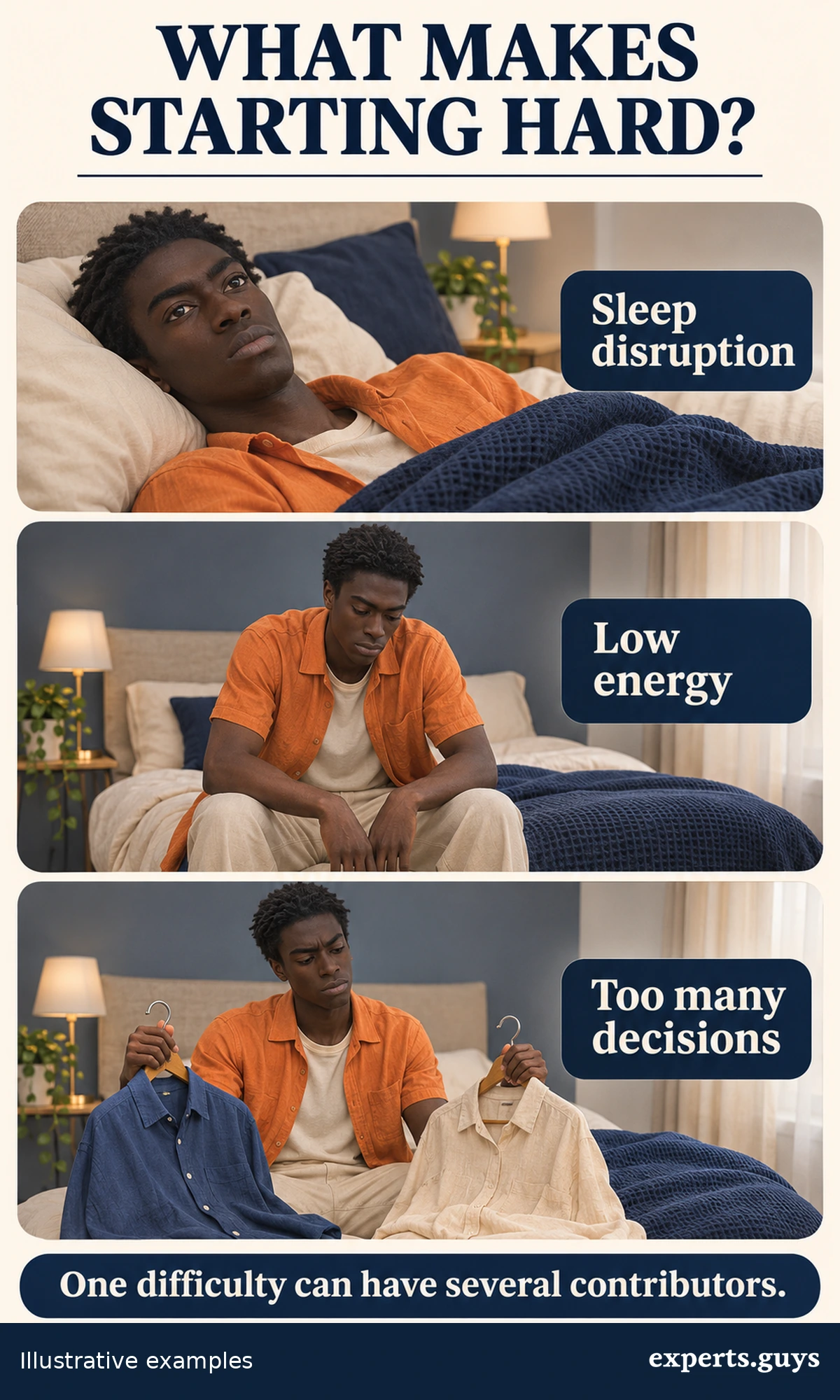
Sleepiness, fatigue and dread need different questions
Sleepiness means a tendency to fall asleep; fatigue is a lack of energy or a sense of exhaustion. Dread describes the emotional difficulty of facing what comes next. They can overlap, but substituting one word for all three makes help less precise. Someone nodding off needs a different discussion from someone who is awake and frightened of the day’s demands. Both deserve to be taken seriously.
Ask yourself one plain question: what happens when I try to begin? “I keep drifting back to sleep” supplies different information from “I am awake, but choosing the first task feels impossible.” Neither answer needs a rating scale. A short verbal description can help you choose whether a task adjustment fits or whether sleepiness, symptoms or physical safety need attention first.
Persistent tiredness has several possible causes. The NHS guide to tiredness and fatigue discusses sleep loss, illness, medicines and health conditions as well as stress and depression. For example, loud snoring with gasping during sleep and marked daytime sleepiness raises a sleep-related question; it should not automatically be explained away as lack of motivation. A previous depression diagnosis does not remove the need to consider other causes.
Swipe horizontally to compare on a small screen.
| What you notice | Question it raises | Useful next response |
|---|---|---|
| Awake, but the routine feels enormous | Which first action is hidden inside “get ready”? | Reduce searching and choices around one activity. |
| Drifting back to sleep | Is this a change in sleepiness, sleep quality, medicines or health? | Discuss persistent or marked sleepiness; do not drive or use dangerous equipment while drowsy. |
| Pain, faintness or unsafe movement | Is attempting the task physically safe? | Stop the optional task and obtain appropriate help. |
| Basic needs repeatedly unmet | Is everyday care becoming unreliable? | Arrange prompt support and assessment rather than expanding the exercise. |
The table is a conversation aid, not a sorting test. There is no rule that a person must fit one row, and choosing a task adjustment does not rule out a medical contributor. Its value is that it prevents an irrelevant response: another motivational speech will not resolve unexplained sedation, and a demand to sleep longer may not address an overwhelming first task. Choose the next question that matches what is happening.
If rest and exhaustion are the main uncertainty, the fuller comparison of depression fatigue and ordinary tiredness belongs alongside this discussion. If sleep itself has changed, the different sleep patterns associated with depression provides the deeper explanation. Neither topic needs to be turned into a complete sleep programme on this page.
A morning difficulty is not automatically a morning-only illness
The first part of the day may be where the problem becomes most visible because it contains a transition from rest to several demands. That observation does not establish a particular depression subtype, a hormone explanation or a universal pattern of morning worsening. Some people struggle more at another time. The useful question is what the transition requires and whether the difficulty is new, persistent or spreading into other areas of life.
Consider an illustrative situation: someone wakes before an appointment and thinks getting up means showering, dressing carefully, preparing food and leaving on time. They remain in bed, although they can manage some of those actions individually. The practical bottleneck may be the whole sequence arriving at once. Reducing the first instruction to a garment already within reach changes that immediate demand; it does not explain or treat every reason for the person’s depression.
How can you make the first morning activity smaller without a diary or a timer?
Choose one ordinary activity and prepare only what its first action needs. For this article’s worked example, that means putting one easy-to-wear clean shirt at a comfortable, reachable place and making picking it up the agreed starting point. Use this only when moving and handling the item are safe for you. If you are acutely unwell, faint, confused or unable to move safely, practical setup gives way to appropriate help.
This approach adapts the principle of beginning with achievable activities in CCI’s guidance on behavioural activation. The shirt arrangement and stopping points below are everyday editorial examples, not a separately validated treatment. They make an action concrete without claiming that a particular garment, bedroom setup or sequence changes depression itself. Treatment and daily-life support can coexist.
Prepare one reachable starting point
Use a time when you have enough capacity, or ask someone you trust to help with the setup. Choose a lightweight shirt that is comfortable and easy for you to handle. The goal is to avoid a morning search and an outfit decision; it is not to build a perfect routine. If a shirt is irrelevant to your life, keep the same principle and select the first item genuinely needed for your own ordinary activity.
- Select one clean, easy-to-handle shirt before the difficult morning, when you have enough capacity or with help. Leave outfit alternatives out of this task.
- Put it at a place you can comfortably reach using your usual safe movement. Keep the floor and access route clear; do not place it where you must lean or stretch.
- When ready, bring the shirt onto your lap or another accessible working place. That is the starting action; getting fully dressed is a separate decision.
- If preparation or reaching is too much, ask someone to place the item for you. Pause if movement feels unsafe or symptoms make the attempt unsuitable.
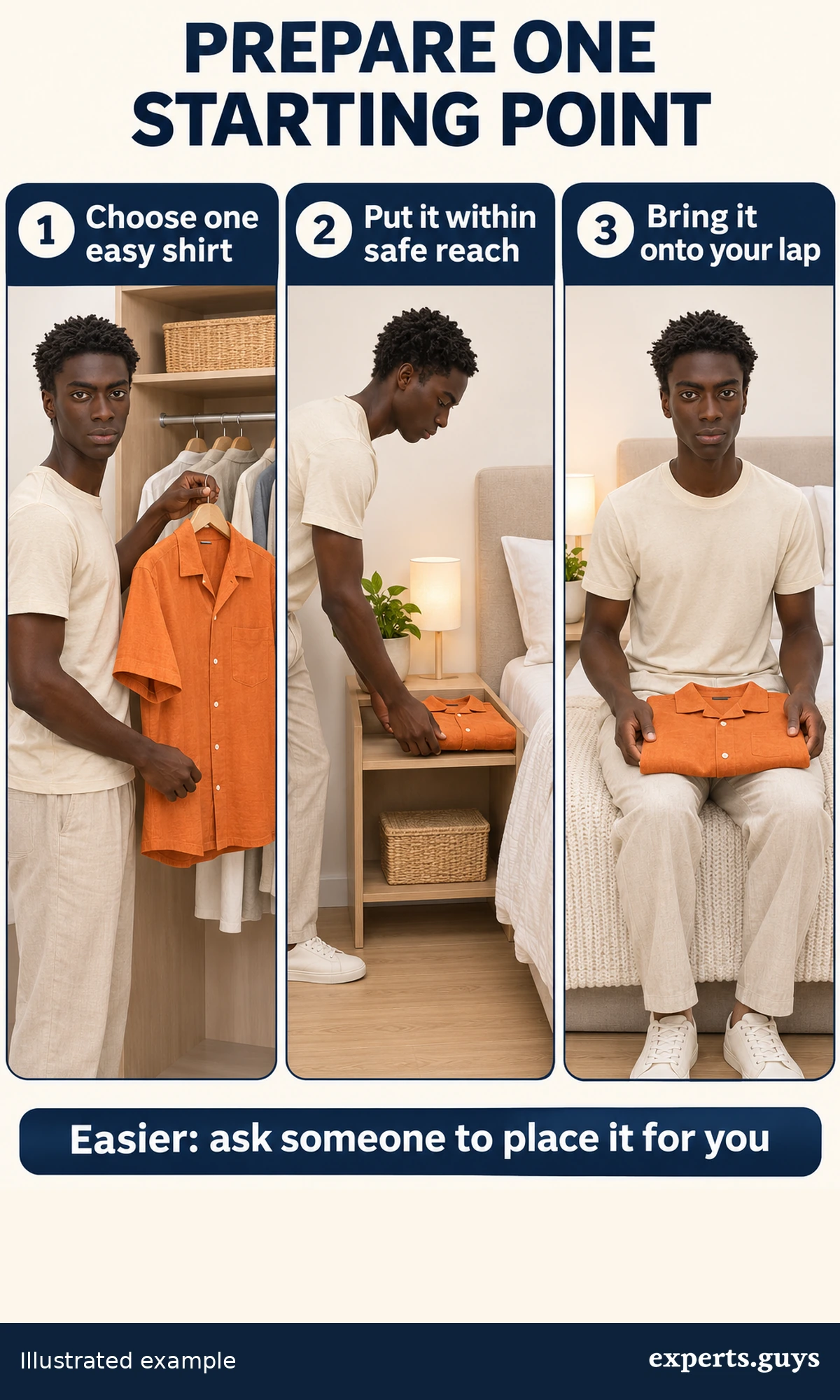
An illustrative example: the night before, a person puts a clean loose shirt on a bedside shelf they can comfortably reach from their usual seated position. In the morning they bring it onto their lap. They have completed the starting action without having to open a wardrobe, compare outfits or commit to leaving home. They can decide separately whether putting it on is manageable. No mood change is required for the action to count.
The common mistake is making the setup into another project: arranging several outfits, clearing the whole bedroom or preparing a complete daily schedule. That recreates the workload the example is meant to reduce. Correct it by keeping one item and one stopping point. If reaching even that item is difficult, have someone put it where you can safely access it; do not lean, stretch or balance precariously to maintain the exercise.
Reduce the dressing task instead of adding a new routine
If clothing is the first obstacle, remove unnecessary garment handling. Choose something familiar that you can already put on safely, and use your usual stable seated position if that is comfortable and appropriate. This is not a lesson in transferring out of bed or adapting to a disability; use your established assistance and equipment where needed. The action being simplified is finding and beginning to handle clothing.
- Begin with the selected shirt ready at your usual safe dressing place. Use your established seating, assistance or equipment as needed.
- Handle the garment in your familiar way and continue only if putting it on is manageable. There is no target speed or requirement to stand.
- If continuing is too difficult, leave the shirt ready and pause. Count preparation as preparation, with any remaining dressing need still acknowledged.
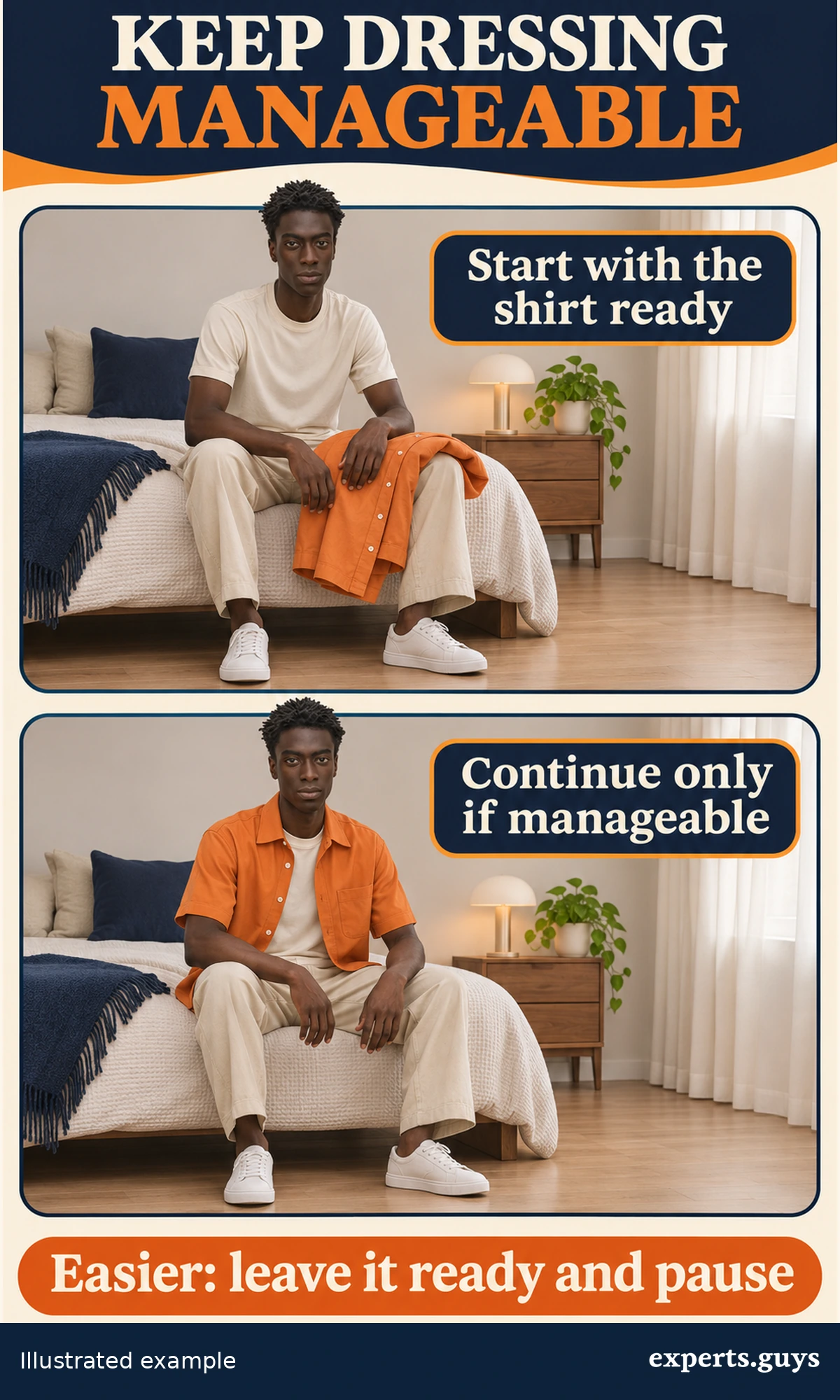
For example, someone who normally gets stuck comparing two tops can use the clean shirt they selected in advance. With it on their lap, they can begin the familiar dressing action without returning to the wardrobe. The easier version is simply having the shirt ready for later. If putting on clothing causes pain, severe fatigue or requires unsafe movement, stop the attempt and use assistance appropriate to that problem rather than turning persistence into a requirement.
Changing the endpoint is useful only if the endpoint stays honest. Picking up a shirt is preparation; it is not the same as getting fully dressed. Both can be meaningful, but calling them the same makes it harder to see what support is still needed. Describe the actual result: the item is ready, one part of dressing is completed, or dressing still needs help. Specific outcomes are more informative than deciding that the entire morning was a success or failure.
Keep the next demand separate
Once the starting action is done, resist immediately attaching the rest of the day’s obligations to it. A supporter might say, “Good, now shower, eat and answer those messages,” turning a small agreement into an expanding assignment. The person then has a reason to distrust the next small invitation. Keep the original endpoint intact; any further activity should be another manageable choice rather than an automatic escalation.
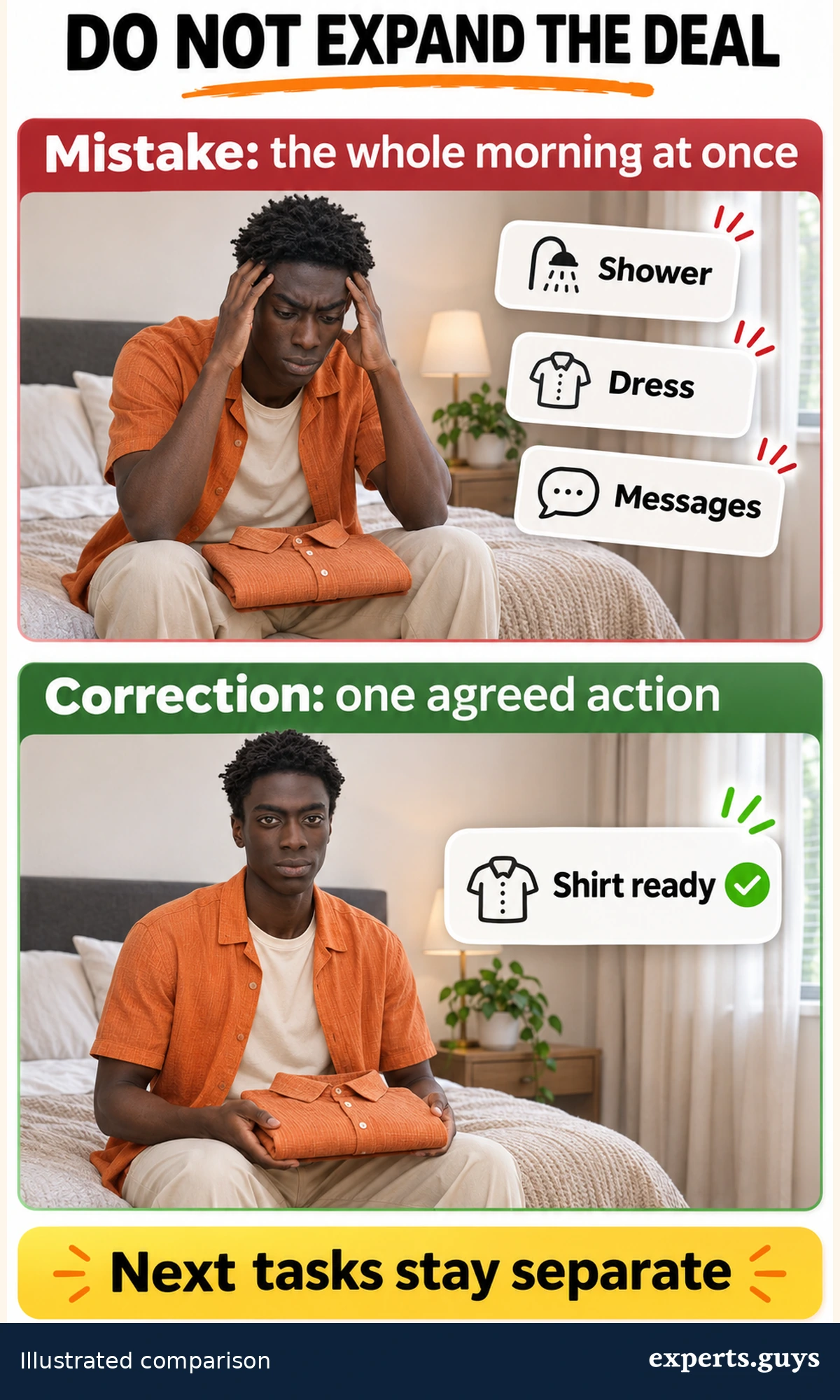
Imagine that the shirt is now on the person’s lap but they remain uncertain about continuing. One possible response is to leave it ready and pause. Another is to choose the familiar next dressing action if it feels manageable. What is unhelpful is adding a deadline solely because the first step was possible. Completion shows that one demand was manageable under those conditions. It does not measure the person’s total energy or predict what the rest of the day will allow.
This is the trade-off in deliberately small actions: they may restore access to an ordinary activity, but they leave much of life unfinished. That is acceptable for a starting strategy, provided urgent needs are not ignored and the small step does not become a substitute for addressing persistent impairment. The editorial recommendation is to reduce the immediate burden first, then address the remaining practical and clinical needs at their actual level of urgency.
Adapt the setup to the real constraint
A person with limited movement may need an assistant to bring the item; a person sharing a room may need a reachable storage place that preserves privacy. Someone without clean clothing needs help obtaining it rather than a lecture about choices. If another person controls access to belongings or the home feels unsafe, a bedroom routine cannot resolve that problem. The context changes what support is useful, even when the visible task looks identical.
Do not make an alarm, an app or a written plan a prerequisite. This example works through the actual item and a visible endpoint. If you already use assistive technology or reminders that help, there is no reason to discard them; they simply are not the core exercise. Likewise, an accessible communication method is appropriate when asking for assistance. The point is to reduce demands, not to forbid something that makes daily life possible.
What if the item is ready and starting is still hard?
A useful setup removes searching and some choice; it cannot remove every obstacle. If the shirt is already at hand and the person still cannot begin, repeating the instruction more loudly adds no new help. The relevant information is that the difficulty remains after this particular demand was reduced. Sleepiness, pain, distress, severe loss of energy or another problem may still need attention. A failed fit between a strategy and a difficulty is not a character verdict.
There is an important difference between simplifying a task and making an essential need disappear. Leaving clothing ready may be a reasonable pause when there is no immediate consequence. Repeatedly missing food, fluids or essential treatment is a different situation. A small starting point is useful only within a wider response that protects those needs. It should not give supporters a reason to ignore worsening function because an exercise has technically been attempted.
Nor should this become an attendance test every morning. If someone repeatedly needs practical help, that is a support need to discuss, not an invitation to demand a longer streak. The purpose of an observable endpoint is to know what happened and what remains difficult. A shirt brought within reach is a concrete improvement in access; it says little about the person’s symptoms, independence in other activities or ability to cope without assistance tomorrow.
When there is a deadline, keep the trade-off visible
An appointment, a work shift or a caring responsibility can make an unfinished morning consequential. The small-step example does not guarantee that a deadline can be met, and pretending otherwise can add pressure. Separate the immediate starting difficulty from the practical consequence of being late. A person may need help with the consequence as well as the task; completing one piece does not settle both problems.
For instance, in an illustrative morning before a non-urgent appointment, someone has the shirt ready but remains unable to complete dressing. The useful conclusion is not that they should attempt every remaining task faster. The starting arrangement has reached its limit. Additional assistance, an accessible way of attending or a change to the arrangement may be needed. Which is appropriate depends on the appointment and the person’s circumstances; this example does not establish a reason to postpone essential care.
The same distinction matters after a better morning. If getting dressed becomes easier, the original setup may still be worth keeping without immediately making the standard harder. On the other hand, an activity that is consistently manageable may no longer be the part needing support. The useful criterion is whether the arrangement removes a real obstacle. Keeping a ritual merely to prove effort can turn a practical aid into another demand.
What should a supporter do, and when is a small step not enough?
Offer to do one agreed preparation task while leaving the person in control of their body and choices. Bringing the selected shirt within reach is different from pulling someone upright or insisting that they dress. The first reduces a practical obstacle; the second can introduce pressure, pain or risk. When help is wanted, make the offer specific enough that the person can accept or decline without explaining their whole mental health history.
The NHS guidance on helping someone with mental health difficulties recommends listening, avoiding force and finding practical help that works for the individual. Here, that becomes an agreed handoff of an ordinary task. The supporter is not diagnosing depression, providing therapy or taking responsibility for producing recovery. They are making a concrete part of the morning easier.
Use an agreed task handoff
Ask, “Would it help if I brought the shirt you chose?” Wait for an answer. If they agree, collect that item, ask where it should go and put it within comfortable reach without blocking a walking route or mobility aid. Say what you have done, then let the person decide whether to use it. Do not touch their body, lift them, remove bedding or open private belongings without permission.
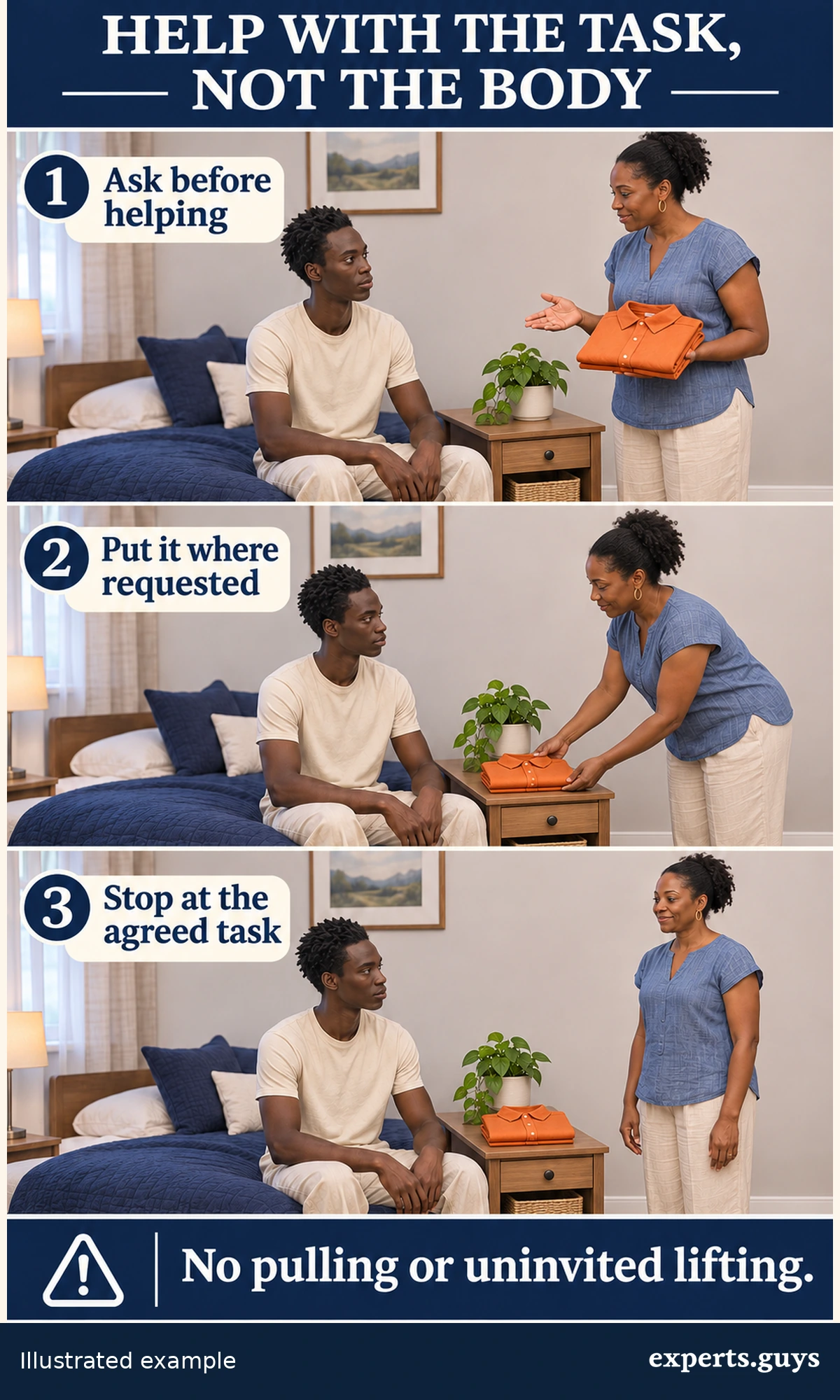
In an illustrative household example, a friend brings the requested shirt to a bedside shelf and returns to another task. There is no countdown and no inspection afterward. The preparation is complete even if dressing happens later. The easier version is offering to bring the item another time, or accepting that the person wants space. A declined offer is information about the person’s preference, not evidence that they do not want to get better.
The most common error is letting help expand without agreement. Bringing a shirt becomes sorting the wardrobe, commenting on the room and asking why everything has been left undone. Keep the handoff limited to what was requested. If food, fluids or another essential need is failing, raise that concern directly and separately rather than hiding it inside an ordinary favor. Necessary safety action should be clear about its purpose.
A supporter also needs limits. Say what assistance you can actually provide, especially if you cannot stay or repeat it every morning. An arrangement that depends on one exhausted person being constantly available is fragile. Where daily help is repeatedly necessary, discuss a wider support arrangement and assessment of the underlying difficulties. Do not infer that a partner must reproduce the role described in someone else’s public story.
Match the response to the consequence
Persistent trouble starting the day deserves attention when it repeatedly disrupts work, meals, hygiene, appointments or relationships. The NIMH depression overview describes depression as a condition that can impair ordinary activities and explains that assessment also considers medical conditions and medicines that may produce similar symptoms. Psychological treatment, medication or both may be appropriate, depending on the individual. A household adjustment is support alongside that process.
Swipe horizontally to compare on a small screen.
| Situation | Response | What the small task cannot do |
|---|---|---|
| One manageable obstacle, safe movement | Try the single starting point, with help if wanted. | It cannot diagnose the cause or promise relief. |
| Persistent, worsening or disabling difficulty | Arrange a health assessment; describe the activity that has become difficult. | It cannot replace assessment or individualized treatment. |
| Food, fluids or essential treatment are not maintained | Seek prompt help matched to the unmet need and symptoms. | It cannot make an urgent basic need optional. |
| Immediate danger or inability to remain safe | Contact local emergency services or attend the nearest emergency department now. | It is not an emergency response. |
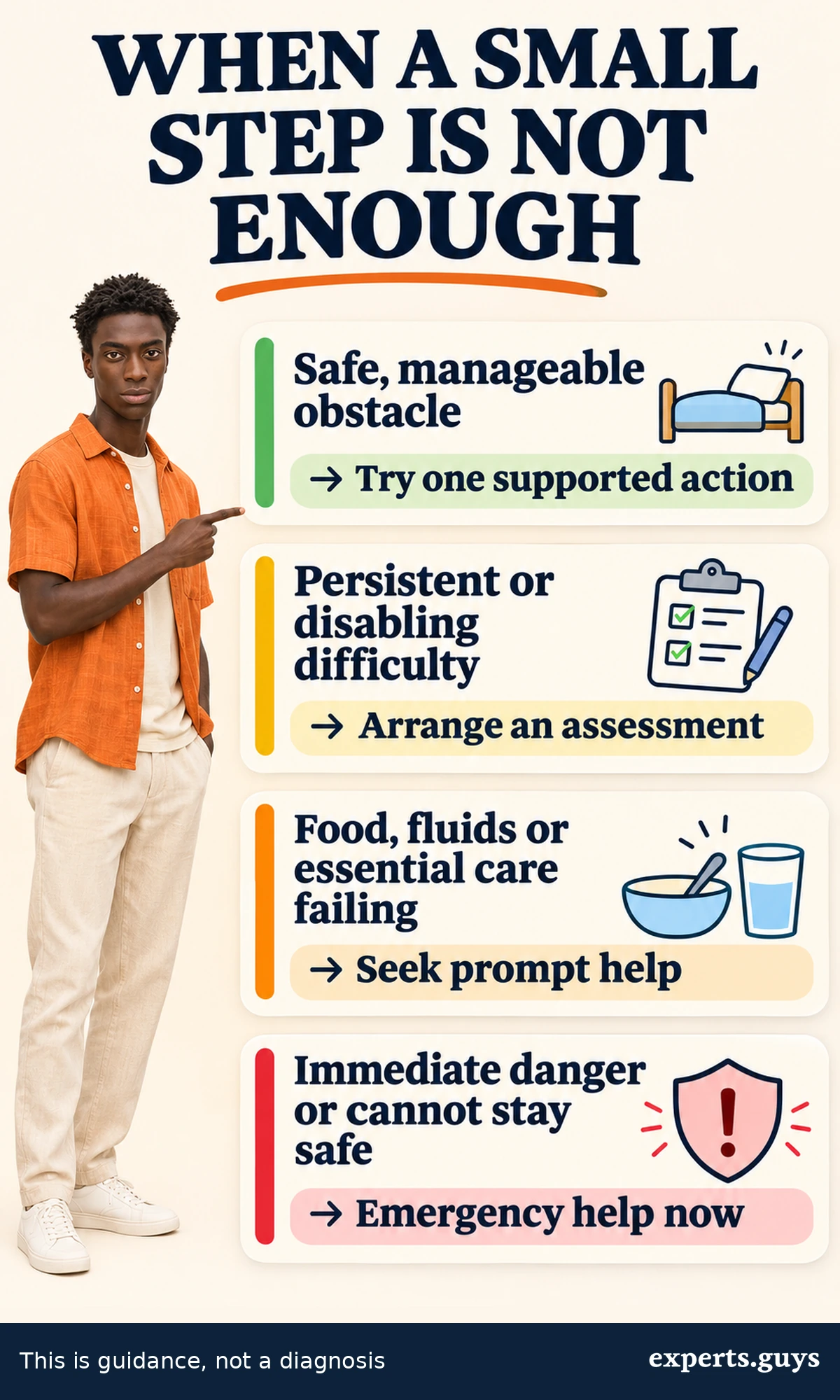
When asking for an assessment, ordinary language is enough: “I am awake, but I have been unable to start getting dressed most mornings, and I am missing meals.” Say approximately when it began, whether sleep or medicines changed, and which essential activities are now difficult. You do not need to create a written record before asking for help. Functional examples make the concern understandable without requiring you to choose a diagnosis first.
Symptoms present most days for about two weeks are a reason to arrange an assessment; this is not a waiting rule when the change is severe or rapidly worsening. If you cannot maintain food or fluids, cannot manage essential prescribed treatment, or are becoming unable to remain safe at home, seek prompt help appropriate to the immediate problem. If there is immediate danger or you cannot keep yourself safe, contact local emergency services or go to the nearest emergency department now; a trusted person can help you access care.
If several areas of daily care are breaking down together, depression-related self-neglect addresses that broader pattern. It is a different concern from one difficult morning and should not be reduced to an untidy bedroom. The important distinction is whether basic needs remain supported, not whether someone looks presentable or manages one visible task.
Questions readers also ask
Does the phrase “bed rotting” mean clinical depression?
No. It is an informal phrase, not a diagnosis. Time in bed can reflect rest, sleep loss, illness, distress or many other circumstances. What matters for assessment is the wider pattern, change from usual functioning and consequences, rather than a social-media label.
Should I copy a treatment mentioned in a celebrity interview?
No. An interview does not supply the assessment, medical history or treatment considerations that guided care. Do not start, stop, share or change prescribed medication to imitate someone else. A familiar story can help you explain what resonates when discussing your own needs.
Is making the bed a required part of getting started?
No. A tidy bed is not the outcome of this example. The aim is access to one ordinary activity, using a safe reachable item. Adding bed-making or bedroom cleaning changes the task and may add effort without addressing the original obstacle.
Can someone help if they do not live with me?
They may be able to help arrange the practical assistance you want, but an offer should match what they can actually provide. Accessibility needs can justify using a phone or another communication aid. The core task remains preparing the real item, rather than completing an app or written exercise.
Choose a first action that stays small
If the immediate barrier is an overwhelming morning routine and movement is safe, prepare one item for one ordinary activity and agree where the first action ends. Leave further demands separate, and accept assistance when preparation itself is too much. If the difficulty persists, worsens or leaves essential needs unmet, the next step is help matched to that impairment—not a more elaborate morning challenge. Springsteen’s historical remark can make the experience recognizable; your own needs should determine the response.









