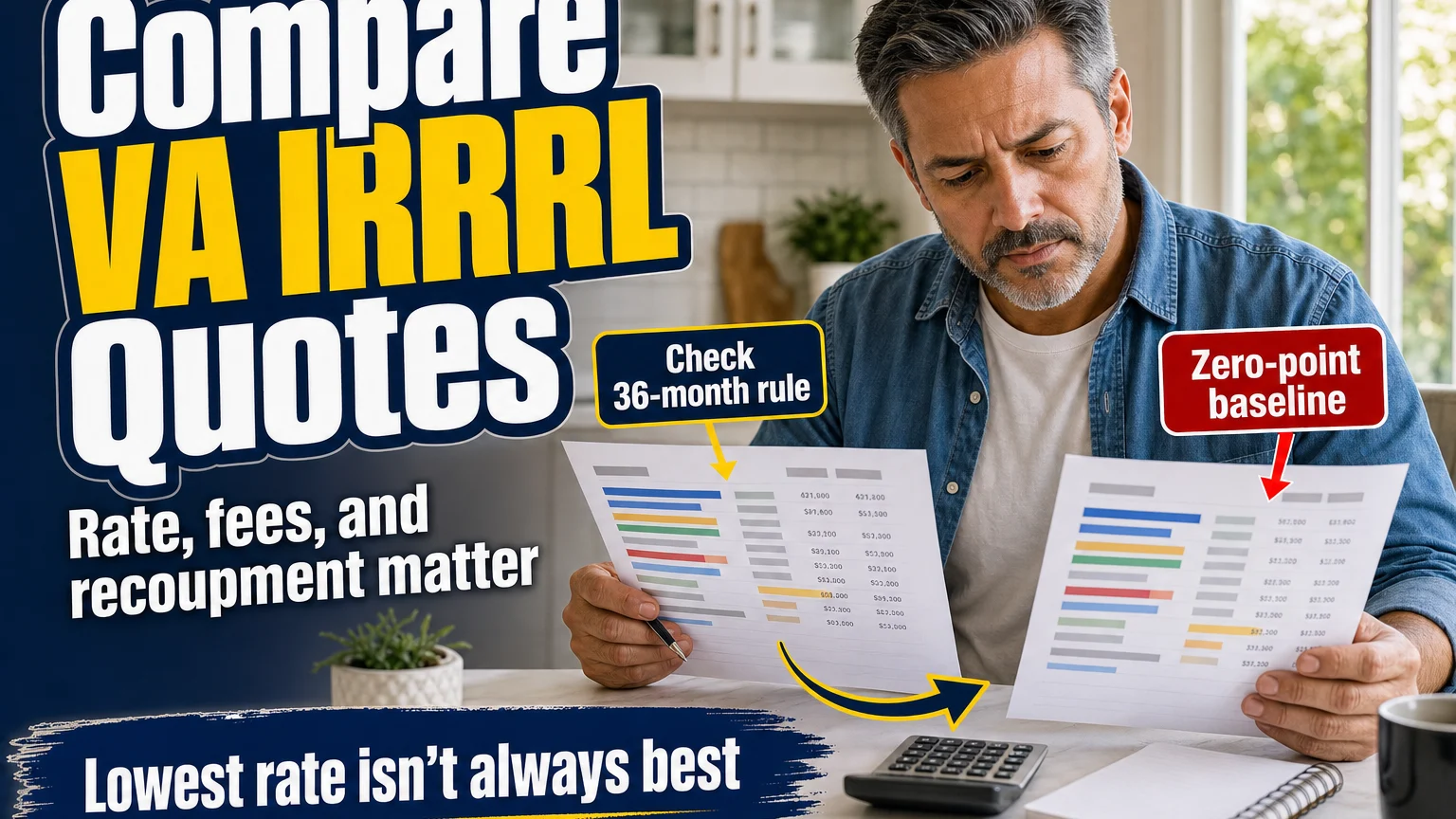

The best VA streamline refinance rate is not automatically the lowest number in an advertisement. A strong IRRRL offer combines a competitive interest rate with reasonable points and lender fees, a payment reduction that satisfies VA recoupment rules, and a new loan balance and term that still make sense for the years you expect to keep the mortgage.
The practical way to find it is to request comparable Loan Estimates from several VA lenders on the same day, keep the loan type, term, points and rate-lock period as similar as possible, and compare the full cost rather than the rate alone. If you need the program basics first, start with our VA streamline refinance and IRRRL guide.
The Best VA IRRRL Rate Is the Quote That Survives the Full Comparison
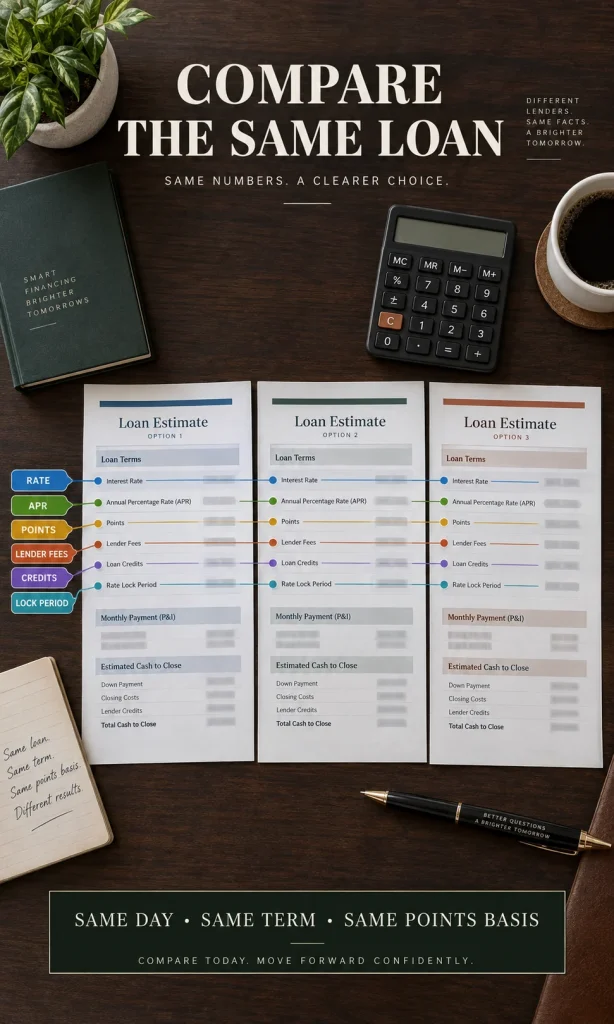
Mortgage rates can change daily, and lenders can price the same underlying loan differently through points, credits and origination charges. The Consumer Financial Protection Bureau recommends comparing multiple Loan Estimates because that standardized form lets you compare lender costs and loan terms on the same framework. Its guidance also separates the interest rate from APR: the interest rate is the cost of borrowing, while APR incorporates the rate plus certain additional charges.
That distinction matters more than it first appears. One lender may advertise a lower rate only because the borrower is paying one or two discount points at closing, while another lender may quote a slightly higher rate with much smaller upfront charges. The right offer depends on how long you expect to keep the loan and how quickly those extra costs are recovered through lower monthly principal and interest.
| Quote item | What it tells you | What to watch |
|---|---|---|
| Interest rate | The percentage rate used to calculate loan interest. | A low rate may require expensive discount points. |
| APR | A broader measure that reflects the rate plus certain loan charges. | Useful for comparison, but it should not replace a review of actual cash costs and your expected holding period. |
| Points | Upfront money paid to reduce the rate. | Ask every lender for a zero-point version so you can see what the rate costs without buying it down. |
| Lender credits | A credit that can reduce cash due at closing. | The trade-off is commonly a higher interest rate. |
| Recoupment period | How long lower monthly P&I takes to recover qualifying refinance costs. | For IRRRLs with lower P&I, the statutory recoupment period generally cannot exceed 36 months. |
| New loan balance and term | Shows whether costs are being added to principal and whether repayment is being stretched out. | A payment can fall even when the lifetime cost rises because the loan term was reset. |
Check the VA Rules Before Chasing the Lowest Rate
An IRRRL is a VA-to-VA refinance. The Department of Veterans Affairs explains that you obtain an IRRRL through a private lender rather than directly from VA, and it specifically urges borrowers to contact several lenders because terms and fees vary. The program is designed to refinance a property where VA loan eligibility has already been used; it is not a general cash-out refinance.
The most important rate-shopping mistake is comparing offers that would not satisfy the federal refinance rules in the first place. Under the federal IRRRL framework and VA guidance, the main screening points include the following:
- Loan seasoning: the later of at least six consecutive monthly payments on the loan being refinanced and at least 210 days after the first payment due date.
- Fixed-to-fixed rate reduction: the new fixed rate generally must be at least 0.50 percentage point lower than the previous fixed rate.
- Fixed-to-ARM rate reduction: the new initial adjustable rate generally must be at least 2.00 percentage points lower than the previous fixed rate.
- Fee recoupment: when the refinance lowers monthly principal and interest, qualifying fees, expenses and closing costs generally must be recovered through that lower P&I within 36 months.
- Same or higher P&I: VA guidance states that if an IRRRL results in the same or higher monthly P&I, the borrower cannot incur fees, closing costs or expenses that must be recouped, apart from excluded items such as taxes, escrow amounts and the VA funding fee.
- No ordinary cash-out: an IRRRL is not the product to use when you want to pull equity out as cash. Our VA cash-out refinance rate guide covers that different decision.
The VA funding fee for an IRRRL is currently 0.5% for borrowers who are not exempt. VA allows the funding fee and certain closing costs to be financed into the new loan, which can reduce cash due at closing while increasing the new principal balance. Borrowers who qualify for a funding-fee exemption should make sure the lender has applied it correctly.
How to Compare VA Streamline Refinance Rates Correctly
1. Ask several lenders for quotes on the same day
Do not compare a Monday quote from one lender with a Friday quote from another and assume the price difference came from lender competitiveness. The CFPB notes that mortgage interest rates can change daily. Request several Loan Estimates within a tight time window so market movement does not distort the comparison.
2. Keep the loan structure the same
Ask each lender to quote the same term, loan type, approximate lock period and points structure. If one offer is a 30-year fixed loan with 1.5 points and another is a 15-year fixed loan with zero points, the headline rates are answering different questions. A fair comparison needs the same basic product before you judge which lender is cheaper.
3. Get a zero-point quote even if you may buy points
Discount points are not inherently bad. They are a pricing choice: you pay more upfront in exchange for a lower rate. The CFPB recommends looking at alternatives with and without points or lender credits, especially when you are uncertain how long you will keep the mortgage. A zero-point quote gives you a clean baseline and makes aggressive advertised rates easier to interpret.
4. Compare APR and lender-controlled charges
APR helps expose some of the cost hidden behind a low rate, but it is not the only number to use. On the Loan Estimate, compare origination charges, services selected by the lender, lender credits, cash to close and the comparison figures on page 3. If two lenders quote the same rate, the one with lower lender-controlled costs may be the better deal.
5. Calculate the VA recoupment period
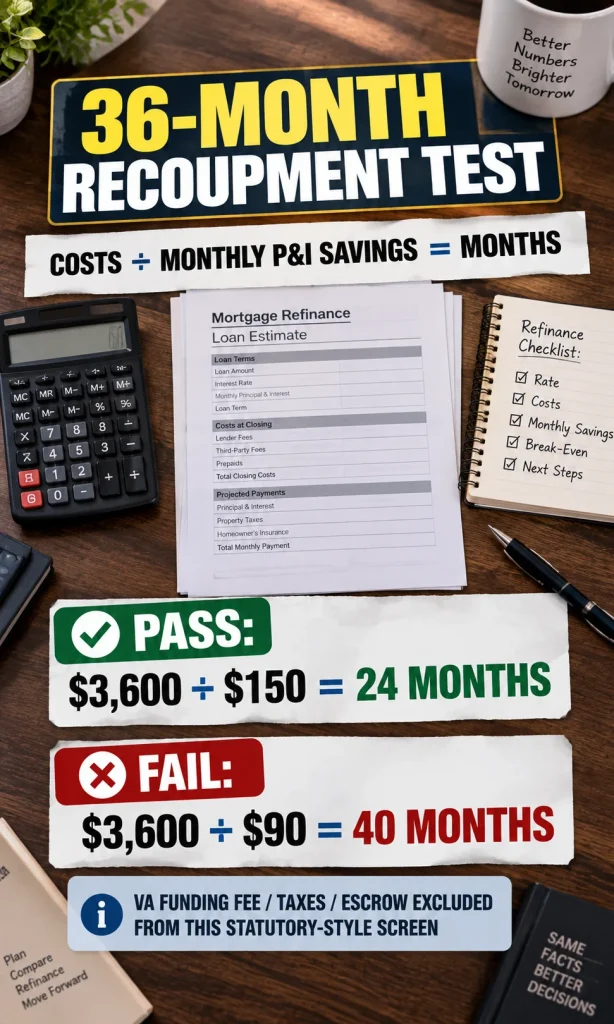
The basic statutory-style calculation is straightforward when the new loan lowers monthly principal and interest: divide the fees and costs that count toward recoupment by the monthly P&I reduction. VA recoupment guidance excludes the VA funding fee, taxes, escrow amounts and certain prepaid expenses from the statutory calculation. Your lender is responsible for the official figure, but doing your own screen makes it easier to spot a quote that needs explanation.
6. Look at what is being added to your principal
An IRRRL can be described as a low-cash-close refinance because allowable costs may be rolled into the new mortgage. That does not make those costs disappear. If your balance is $300,000 and several thousand dollars of fees are financed, you will pay interest on the larger principal unless you pay it down faster later.
7. Compare the cost over the years you realistically expect to keep the loan
A borrower who expects to sell or refinance again in three years should evaluate points differently from someone who expects to keep the mortgage for fifteen years. The lowest rate can eventually win over a long holding period, while a slightly higher rate with much lower costs can be better over a shorter one. That is why the best IRRRL rate is a holding-period decision rather than a single percentage.
Why the Lowest Rate Can Lose to a Slightly Higher Rate
Consider a simplified $300,000 fixed-rate example. Assume the existing loan is 7.00% with 30 years remaining, and the borrower is comparing two new 30-year fixed IRRRL quotes. The figures below are illustrative rather than live lender offers, and they assume the listed recoupable costs are paid rather than added to the principal.
| Illustrative quote | Rate | Recoupable costs | Approx. monthly P&I savings | Approx. recoupment |
|---|---|---|---|---|
| Offer A – lower rate, more points | 5.75% | $6,000 | About $245 | About 25 months |
| Offer B – slightly higher rate, low fees | 5.875% | $1,200 | About $222 | About 6 months |
Offer A saves roughly $23 more per month, but it requires about $4,800 more in upfront recoupable costs. A borrower keeping the loan for many years may eventually recover that difference and benefit from the lower rate. A borrower who expects to move or refinance again sooner may prefer Offer B even though its rate is higher.
Watch for the Term-Reset Trap
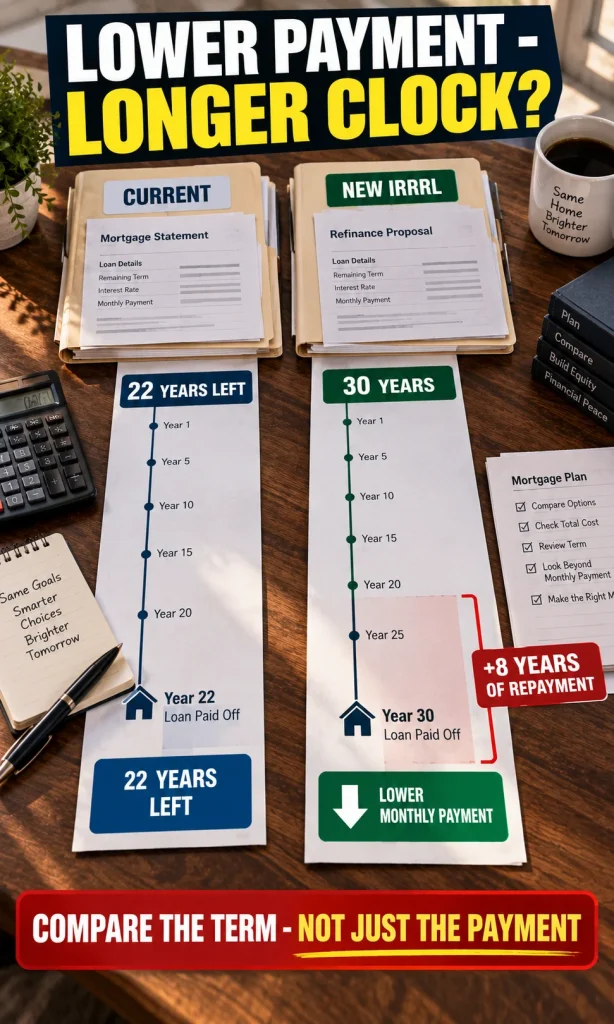
Lower monthly payments are attractive, but they can come from two different sources: a lower interest rate or a longer repayment period. If you have 22 years left on the current loan and refinance into a fresh 30-year term, the payment can fall partly because principal is now being repaid over eight additional years.
That does not automatically make the refinance a bad choice. It means the correct comparison should include the new principal balance, your expected holding period, and interest paid over that period. If your goal is to pay the home off sooner, ask the lender to quote a shorter term or compare the 30-year payment with a plan for making additional principal payments.
Be Careful With “No-Closing-Cost” IRRRL Offers
A no-closing-cost refinance normally means the costs are being handled somewhere else in the pricing. The lender may provide credits in exchange for a higher rate, or allowable costs may be financed into the loan balance. Our guide to no-closing-cost refinancing explains the broader trade-off.
Ask the lender to show the same IRRRL three ways when available: the lowest practical rate with points, a zero-point version, and a lender-credit version. Seeing the three side by side makes it much easier to understand what you are paying now versus later.
Use the Calculator Before You Lock a Rate
The calculator below is designed for the part of IRRRL shopping that headline rate tables usually miss. Enter your current balance, current P&I, new rate, points, recoupable fees, funding-fee status and expected holding period. It estimates the payment change, statutory-style recoupment period, financed-cost impact and several obvious VA rule-screen issues.
VA RateCheck
Compare the quoted rate, fees, monthly payment, VA recoupment test and loan-balance impact before you decide whether an IRRRL offer is actually improving your mortgage.

The result is a screening estimate rather than an underwriting decision. Your lender must complete the official VA calculations, disclosures and eligibility review. Use the output to know what to question, then compare the lender’s Loan Estimate and final closing documents against the numbers you entered.
Questions to Ask Every VA IRRRL Lender
- “Can you show me this exact quote with zero discount points?” This separates lender pricing from a rate you are buying down.
- “What is the official VA recoupment period on this quote?” Ask which costs are included in that calculation.
- “How much will be added to my principal?” Separate financed lender costs, other closing costs and the VA funding fee.
- “Is this rate locked, and for how long?” Ask what a lock extension would cost if closing is delayed.
- “Can you provide a lender-credit option?” This shows the trade-off between a higher rate and lower cash due at closing.
- “What lender or origination charges can you reduce?” The CFPB notes that borrowers can compare and negotiate offers.
- “If I have a second mortgage or HELOC, what do you need for subordination?” An IRRRL cannot use its proceeds to pay off another loan as though it were a cash-out refinance.
When Should You Lock the IRRRL Rate?
Trying to identify the perfect market bottom is usually less useful than building a quote that already works. Once the rate, fees and recoupment are acceptable and you are comfortable with the lender, ask for the rate-lock terms in writing. A slightly higher locked rate with reasonable costs can be a better outcome than waiting for a hypothetical lower rate while the market moves in the other direction.
If your main question is whether refinancing makes sense at all, our broader mortgage refinance guide covers break-even logic, term changes and alternatives. If your goal is to change the payment without replacing the mortgage, compare mortgage recasting versus refinancing before assuming a refinance is necessary.
The Practical Strategy for Getting a Better VA Streamline Refinance Rate
Start with the rules, then shop the price. Confirm that the loan is seasoned, request same-day Loan Estimates from several VA lenders, normalize the points and term, calculate the 36-month recoupment test, and inspect how much principal is being added. Only after those numbers line up should the lowest rate become the deciding factor.
That approach also protects you from the most common IRRRL sales tactic: focusing attention on the new monthly payment while leaving the borrower to discover the points, financed costs or term extension later. The strongest offer should be easy to explain in one sentence – lower borrowing cost, acceptable fees, compliant recoupment, and a repayment structure that fits how long you plan to keep the loan.
Frequently Asked Questions
What is a good VA IRRRL rate?
A good VA IRRRL rate is one that is competitive for your borrower profile and market on the day you request quotes, while also meeting VA requirements and coming with reasonable points and lender fees. Compare same-day Loan Estimates instead of relying on a fixed national number in an article because rates change frequently.
Do I need a rate that is 0.50% lower for a VA streamline refinance?
For a fixed-rate VA loan refinanced into another fixed-rate IRRRL, federal law generally requires the new rate to be at least 0.50 percentage point lower. Different rules apply to certain adjustable-rate combinations, so confirm the net tangible benefit test with your lender.
What is the 36-month VA IRRRL recoupment rule?
When an IRRRL lowers monthly principal and interest, qualifying refinance fees and costs generally must be recovered through the monthly P&I savings within 36 months. VA guidance excludes items such as the VA funding fee, taxes and escrow amounts from the statutory recoupment calculation.
Does a VA IRRRL require an appraisal?
An appraisal is often not required for a standard IRRRL, but there are situations where valuation can become relevant, including certain transactions involving financed discount points and loan-to-value limits. The lender determines what documentation the specific refinance requires.
Can I roll VA IRRRL closing costs into the loan?
VA allows certain closing costs and the VA funding fee to be included in the new IRRRL balance. Financing costs reduces cash due at closing but increases the principal on which you pay interest, so compare the new balance as carefully as the new monthly payment.
Is the VA IRRRL funding fee always 0.5%?
The standard VA funding fee for an IRRRL is 0.5%, but some eligible borrowers are exempt from paying the VA funding fee. Ask the lender to confirm your exemption status before relying on the final loan amount or cash-to-close figure.
Should I choose the VA IRRRL with the lowest APR?
APR is a useful comparison measure because it includes the interest rate and certain additional charges, but it should not be the only deciding number. Also compare points, lender fees, recoupment, cash to close, new principal balance, term and the years you realistically expect to keep the mortgage.