
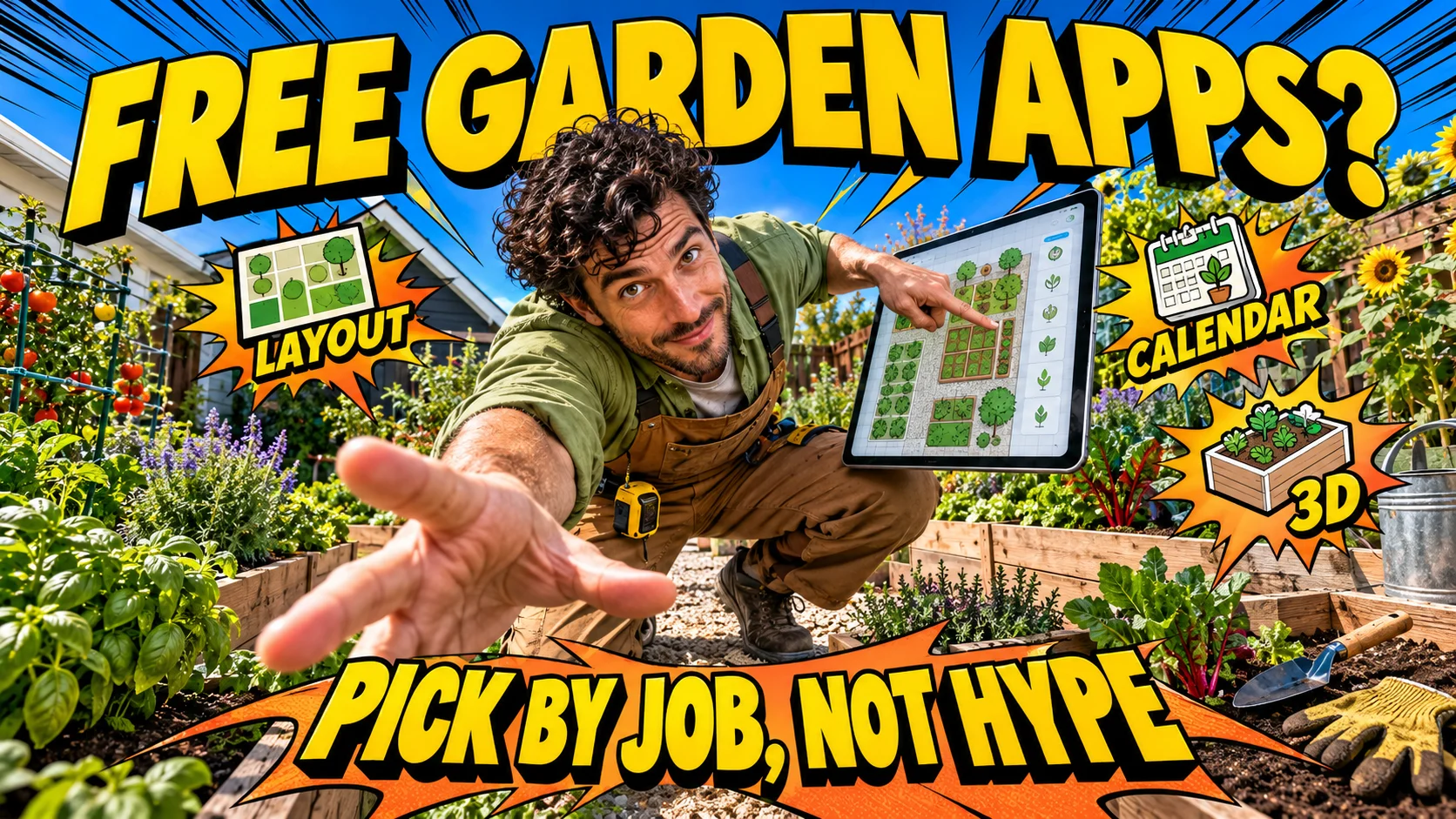

The best free garden planner is the one that matches the job you actually need to do: map vegetable beds, build a planting calendar, sketch a whole yard, plan irrigation, or model the space in 3D. The word free also needs checking, because some products are free forever with limits, some offer a restricted free tier, and others give only a short trial.
For this 2026 update, start with the workflow rather than the app name. A raised-bed gardener who needs sowing dates has a different problem from a homeowner arranging paths, sprinklers and a patio, so one universal winner would be misleading.
| Your main job | Start with | Free status | Main limitation to check |
|---|---|---|---|
| Raised beds + planting calendar | Seedtime | Free forever tier | Free layout is currently limited to one layout with up to eight rectangular beds. |
| Vegetable layout + rotation | VegPlotter | Ongoing free tier | Annual planting limits apply; confirm the current allowance before committing. |
| Phone-first single garden | Planter | $0 ongoing tier | The free plan currently covers one garden; the web app is listed under Premium. |
| Whole yard + sprinkler layout | GARDENA myGarden | Free online | It is oriented to yard layout and irrigation rather than crop scheduling. |
| Detailed 3D yard concept | SketchUp for Web | Free web access | It is not garden-specific, and some features require a paid subscription. |
Garden software chooser
Garden Fit Studio
Match the app to the job your garden actually needs - layout, planting timing, irrigation, mobile simplicity, or 3D yard design.
Measure the garden before choosing software
A garden app can organise information, but it cannot rescue wrong measurements. Before you drag a single bed onto a screen, record the usable dimensions, permanent structures, paths, hose or water access, major shade sources and the areas that receive enough sun for the plants you want to grow.
For a small space, this step matters even more because a path that is too narrow or a bed that is a little too deep can make the finished layout awkward to maintain. If space efficiency is the main problem, review these small garden designs before deciding what the digital plan should optimise.
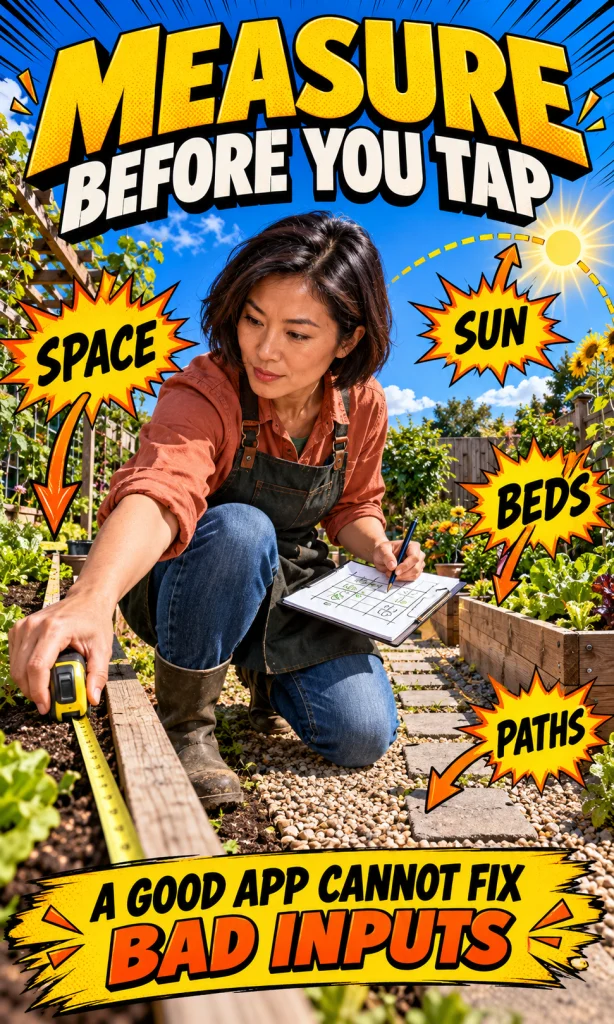
Write down these inputs first
- Overall dimensions: length and width of the usable garden, balcony, allotment or yard area.
- Fixed objects: house walls, fences, sheds, trees, drains, utility access, patios and existing beds.
- Sun pattern: where full sun, partial shade and deep shade fall during the growing season.
- Movement: realistic paths for watering, harvesting, wheelbarrows, pruning and maintenance.
- Water: tap locations, hose reach and whether irrigation is part of the project.
- Planting purpose: vegetables, herbs, flowers, screening, pollinator habitat, ornamental structure or a mix.
If your main uncertainty is bed arrangement rather than software, compare a few proven garden layouts on paper first. The app should help you test a layout, not decide your priorities for you.
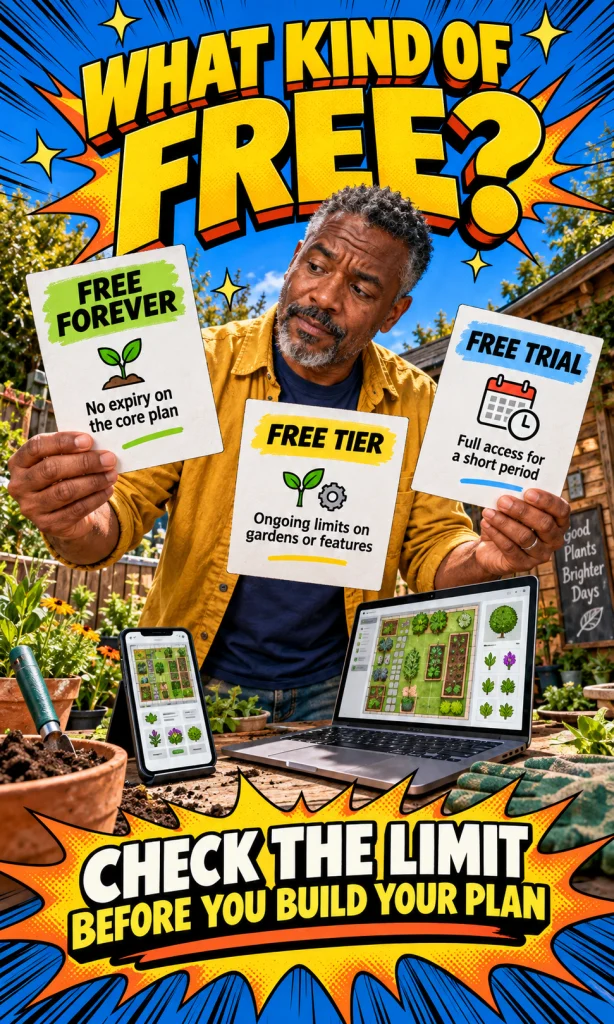
“Free forever,” “free tier” and “free trial” are not the same thing
The most common mistake in free-garden-app lists is treating every zero-dollar starting point as equivalent. An ongoing free plan may remain usable indefinitely but limit the number of beds, gardens or plantings; a freemium tier may reserve advanced features for subscribers; a free trial usually unlocks more features but stops after a fixed period.
That difference changes what happens to your work. If you want to maintain the same plan across several seasons, an ongoing free tier can be more useful than a richer seven-day trial, even if the trial looks more impressive on day one.
A quick free-status check
- Ask whether the free access expires.
- Check whether you can reopen and edit the same plan later.
- Look for limits on gardens, beds, plantings, exports or custom plants.
- Check whether the device you want is included in the free tier.
- Confirm whether printing, sharing or exporting requires payment.
Do this before you spend an hour building the plan. Pricing pages change, and marketing pages do not always explain the practical boundary of the free tier as clearly as the dedicated pricing page.
Best free garden planner apps for different jobs
1. Seedtime: best when timing and raised-bed layout belong together
Seedtime’s current pricing page describes a free-forever plan with one calendar, unlimited planting schedules, one visual layout with up to eight rectangular beds, unlimited tasks and journal entries, companion-planting guidance for the user’s zone and a limited monthly allowance of AI planning credits. That makes it useful for gardeners who need both where crops go and when they should be seeded, transplanted or harvested.
The main question is whether the free layout shape and bed limits fit your garden. If you are planning a compact raised-bed vegetable garden, they may be enough; irregular beds, multiple layouts or a larger operation may push you toward a paid plan.
2. VegPlotter: best for vegetable layout, rotation and month-by-month planning
VegPlotter’s free plan is designed around vegetable-garden organisation. Its current pricing information includes unlimited garden plans, local planting schedules, row or square-foot planting styles, monthly garden jobs, crop-rotation warnings, companion-planting suggestions and printing, while annual planting limits still apply.
That combination is useful when the plan needs to survive more than one season because crop rotation and month-by-month changes matter. One caution: VegPlotter’s public pages have described different free planting allowances, so check the current pricing page immediately before relying on a specific number.
3. Planter: best for one simple garden on a phone
Planter currently lists a $0 forever plan that can plan one garden and includes a growing calendar, custom plants and varieties, and a seed box. It is a strong starting point if you want a simpler mobile workflow and do not need to manage several separate gardens.
The trade-off is expansion. Unlimited gardens, notes and events, custom backgrounds and the web app are listed in Premium, so a gardener who expects the project to grow should compare that boundary with a browser-first free option before investing time in setup.
4. GARDENA myGarden: best for whole-yard layout and sprinkler planning
GARDENA myGarden is a free online garden designer built around drawing the yard and planning an irrigation system. It is the most natural fit in this group when the problem is not crop scheduling but the arrangement of lawn, beds, structures and watering coverage.
Use it when irrigation is part of the design decision, but do not expect it to replace a vegetable planting calendar. A homeowner planning beds around a patio has a different information need from someone scheduling successions of lettuce, beans and tomatoes.
5. SketchUp for Web: best for detailed 3D spatial work
SketchUp for Web can be used without a subscription and gives you a general-purpose 3D modelling environment in a browser. It becomes useful when dimensions, levels, structures, built elements and spatial relationships matter more than plant calendars or horticultural advice.
The learning curve is the price of that flexibility. It is not a garden-specific app, and some advanced functions are tied to paid SketchUp plans, so it is most useful for readers who genuinely need 3D rather than a quick planting layout.
What about GrowVeg?
GrowVeg currently offers a seven-day free trial with no payment information required, followed by paid subscription options. Its vegetable-garden planner includes layout, crop rotation, local planting times and other useful planning features, but it should be described as a trial rather than an ongoing free garden planner.
If you only need to create and print one plan, a trial may be perfectly reasonable. If “free” means you want to keep editing the same garden without a subscription, choose an ongoing free tier instead.
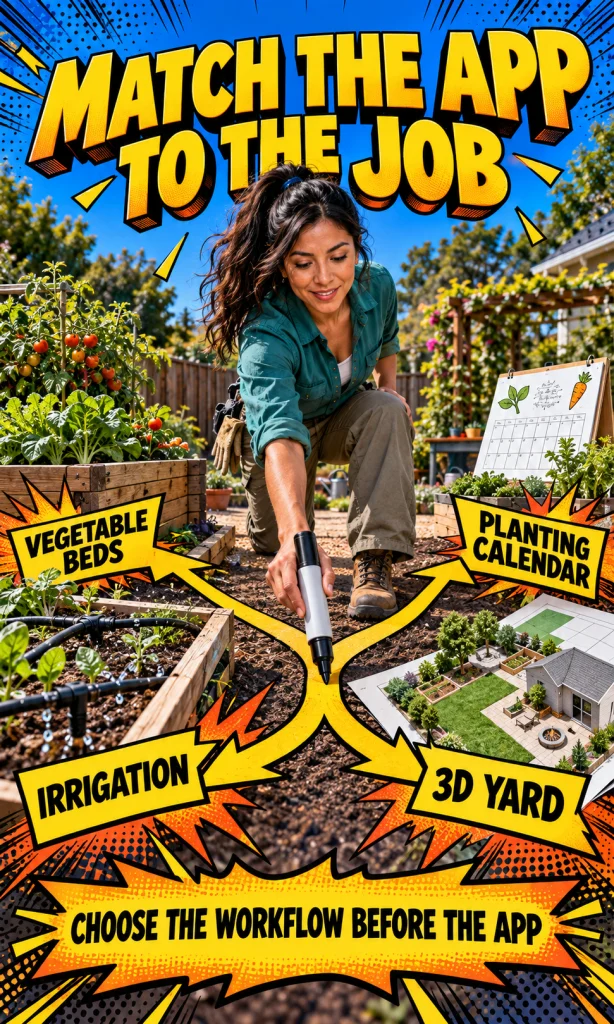
Match the app to the job, not to the longest feature list
Garden software becomes easier to choose when you name the decision first. A long feature list is not useful if most of the features solve problems you do not have.
| If your main problem is… | Prioritise… | Do not overvalue… |
|---|---|---|
| Fitting vegetables into beds | Spacing, bed layout, crop rotation, succession | Decorative 3D rendering |
| Knowing when to sow and transplant | Location-aware calendar and task workflow | Complex landscape drawing |
| Reworking a whole backyard | Paths, structures, bed zones, irrigation | Detailed vegetable scheduling |
| Visualising built elements | Scale, 3D geometry, levels and structures | Plant-reminder features |
Once the layout is stable, plant choice becomes the next constraint. If you are still deciding what belongs in the beds, use a garden planting design process rather than filling every empty digital square with the first plant that looks attractive.
A simple workflow that works with almost any garden app
- Measure the real site. Record dimensions and fixed objects before opening the software.
- Mark light and water. Separate full-sun, part-shade and shaded areas, and note the practical water source.
- Define the garden job. Decide whether you are solving layout, planting timing, irrigation, 3D design or record keeping.
- Choose the free model deliberately. Decide whether you need free forever, a limited free tier or only a short trial.
- Build the fixed structure first. Draw boundaries, beds, paths, sheds and trees before adding individual plants.
- Add plants only after access works. A visually full plan can still be impractical if you cannot reach the centre of a bed or move equipment through the path.
- Test the plan outside. Walk the proposed path, check hose reach and compare the digital assumptions with the real site.
If you are starting with food crops, planning a kitchen garden is a useful way to define bed access, crop groups and harvest priorities before software adds extra detail. New gardeners can also narrow the plant list with these best beginner plants rather than designing around difficult plants first.
Common mistakes garden planner apps cannot prevent
- Planning from a rough memory of the yard: a few incorrect dimensions can shift every bed and path.
- Ignoring seasonal shade: a sunny spring plan may be shaded later by trees, fences or buildings.
- Making beds too wide: the centre may become unreachable without stepping on soil.
- Forgetting maintenance access: mowing, pruning, compost movement and hose routing need space.
- Choosing plants before checking conditions: visual placement does not override light, soil, drainage or climate needs.
- Assuming “companion planting” is a guarantee: treat app suggestions as one input, not a substitute for spacing, light, water and crop-family management.
- Building a plan inside a trial you cannot keep editing: check export and long-term access before the trial ends.
Compatibility decisions deserve their own check. If the question is which crops can share the same space, compare the actual conditions and growth habits rather than trusting a simple green/red app icon; this guide to what plants do good together in a garden can help frame that decision.
Which free garden planner should you start with?
Start with Seedtime if planting dates and raised-bed layout need to work together, VegPlotter if vegetable layout and rotation are the core job, Planter if you want a simple one-garden phone workflow, GARDENA myGarden for yard and sprinkler planning, or SketchUp for Web for genuine 3D modelling. Use the free-access model as a second filter, because the app that fits your workflow is only useful if you can keep using the plan on terms that suit you.
The digital plan is not the garden. Treat it as a way to test decisions cheaply before you buy plants, move soil, lay irrigation or build structures, then validate the plan against the real site before committing money and labour.
FAQs about free garden planner apps
Is there a completely free garden planner?
Yes. GARDENA myGarden is currently offered as a free online planner, while Seedtime, VegPlotter and Planter offer ongoing free plans with specific limits. Check each provider’s current pricing page because free-plan boundaries can change.
Which free garden app is best for raised vegetable beds?
Seedtime and VegPlotter are strong starting points because both connect vegetable planning with timing or crop-management features. Choose between them by checking bed limits, planting limits and which calendar workflow feels easier for your garden.
Can a free app help plan garden irrigation?
Yes. GARDENA myGarden includes sprinkler-system planning alongside the yard layout. Still measure water-source location, hose or pipe routes and real site constraints before treating an automatic layout as final.
Is 3D garden design worth the extra complexity?
Use 3D when levels, structures, patios, walls or spatial relationships are part of the decision. For a straightforward vegetable bed or planting calendar, a simpler 2D layout is usually faster and easier to maintain.
Does “free to download” mean the garden app is free to use?
No. A free download can still lead to subscriptions, feature locks or trial limits. Read the provider’s pricing page and check which features remain available without payment.
What should I measure before using a garden planning app?
Measure the usable garden boundary, fixed structures, existing beds, paths and major obstacles. Also note sun patterns, water access and the clearance needed to move, harvest and maintain the garden.