
A swollen baseboard is often treated as a small painting job because the damaged strip is narrow. That can be an expensive mistake. The visible trim, the wall behind it and the floor beside it are different parts of an assembly. A replacement can make the room look finished while the source of water, a wet wall edge or an affected floor remains unresolved. Start by deciding what the damage means for the repair scope, then choose the finish.
The practical distinction is between a surface defect and a damaged material. A scuff on otherwise sound trim is not the same as a lower edge that has expanded, softened or lost its original profile after wetting. Paint and filler can change the appearance of either one, but appearance is not evidence that the material has recovered. The decision needs the trim type, its condition and the condition of the surrounding assembly.
This guide is a repair-decision framework, not a home experiment or a demonstration that a particular board was restored. Its teaching photographs illustrate observations and planning. It does not prescribe cutting open a wall, sanding unidentified coatings or testing an electrical area by touching it. Where the problem extends beyond accessible trim, the next step is a properly scoped assessment rather than a more aggressive cosmetic technique.
Put safe access before the close-up
Do not approach standing water, wet electrical fittings, an unstable floor or damaged materials that may conceal a hazard simply to get a better photograph. Suspected sewage or other contaminated water changes the cleanup requirements. Keep people clear and arrange appropriate help. A small piece of trim does not make the incident a small cleanup, and an apparently dry face does not establish the safety of nearby wiring.
If access is safe, look along the entire visible run rather than concentrating only on the largest bubble. Notice whether the change occurs at one joint, beneath a window, near a plumbing fixture or across a wider area. These are observations to communicate, not proof of a particular leak. Avoid repeatedly pressing, scraping or pulling at a soft edge to see how bad it is; that can disturb material without answering the source question.
Keep three questions separate: what supplied the water, which materials were affected and what condition is required before closing the repair. A board can be replaceable while the source remains unknown. A leak can be repaired while a wall still needs drying assessment. A room can feel dry while a distorted board remains unsuitable to retain. Separating those questions makes it harder for a clean paint line to stand in for missing work.
| Question | What can answer it | What does not settle it |
|---|---|---|
| Where did the water come from? | Source-specific assessment and repair | A new board covering the mark |
| Can this trim stay? | Material identification and condition assessment | A smoother filler surface |
| Is the assembly ready to close? | Relevant affected-layer assessment | Dry room air or touch alone |
| How should the repair be finished? | Compatible product and junction plan | A general instruction to caulk every gap |
Identify the material without damaging it
Use the product record, an existing spare piece or an already exposed accessible edge when available. Do not cut or break an installed board just to identify it. Painted trim can conceal its core, and assumptions based on color or price are unreliable. If the material cannot be established safely, describe it as unknown and include identification in the assessment rather than selecting a treatment for a guessed substrate.
MDF is a manufactured wood-fiber product. The European Panel Federation's technical explanation of MDF swelling distinguishes normal moisture response from excessive thickness swelling that can leave permanent defects and reduce strength. That is why drying and restoring the original profile are separate questions. A piece can lose water without returning to its pre-damage condition.
The IICRC's consumer care sheet on MDF baseboard swelling specifically describes water entering an unprotected lower edge and causing swollen, damaged trim. For genuinely expanded or softened MDF, plan around replacement rather than promising that sanding the bulge flat restores the board. This is different from repairing a shallow dent in sound material; the word repair should not hide that distinction.
Solid wood, finger-jointed wood, MDF and polymer trim can look similar after painting but do not have identical recovery or installation requirements. A solid wood piece may be assessed for retention if it remains sound and suitable after the incident. A polymer face may show little change while the adjoining wall is affected. None of those descriptions gives a blanket permission to keep every board made of that material.

The visible damage has a boundary; the moisture may not
A swollen section marks a place where something happened to the trim. It does not draw a reliable map of every affected layer. Water may have reached the wall edge, floor perimeter or concealed surfaces differently. Avoid measuring the visible stain and treating that length as the guaranteed limit of work. The question for the assessor is how the repair boundary was established, not whether the replacement piece covers the most obvious mark.
The site’s separate guide to hidden water damage inside walls owns the broader concealed-layer investigation. Use it when the concern extends beyond the trim. Here, the narrower decision is whether the baseboard can stay, which part must be replaced and what must be resolved before that decision becomes a finished installation.
A moisture meter can contribute evidence, but its display is not a universal repair verdict. Different materials, modes and reference conditions matter. A low reading on the front face of one board does not certify the wall behind it; a high reading is not a mold diagnosis. Use the dedicated moisture-meter readings guide for interpreting those measurements instead of applying an invented percentage to every trim material.
Likewise, a dehumidifier in the room is evidence that equipment is present, not that all affected materials have reached a suitable condition. Ask what was assessed, what reference was used where appropriate and what remains inaccessible. That conversation is more useful than asking how many machines were left running. The quantity of equipment and the condition of a concealed joint are different kinds of information.
Decide between retaining, replacing and investigating
Retaining a piece means more than deciding it is not worth buying another. The material must remain fit for its role, and the surrounding repair must be ready for it. A stained but sound piece may present a finishing question; a soft, crumbling, distorted or separating piece presents a material question. The same coating cannot resolve both. If the existing profile no longer meets adjacent trim properly, appearance alone may also make retention impractical.
Replacing the trim is appropriate when the affected material cannot be restored to a sound, serviceable condition by a suitable method. With swollen MDF, removing the visible bulge can disguise the change without rebuilding the original fiber structure or profile. Filler over a softened edge is similarly an appearance treatment. Do not let a smooth final photograph become the evidence that the underlying material is sound.
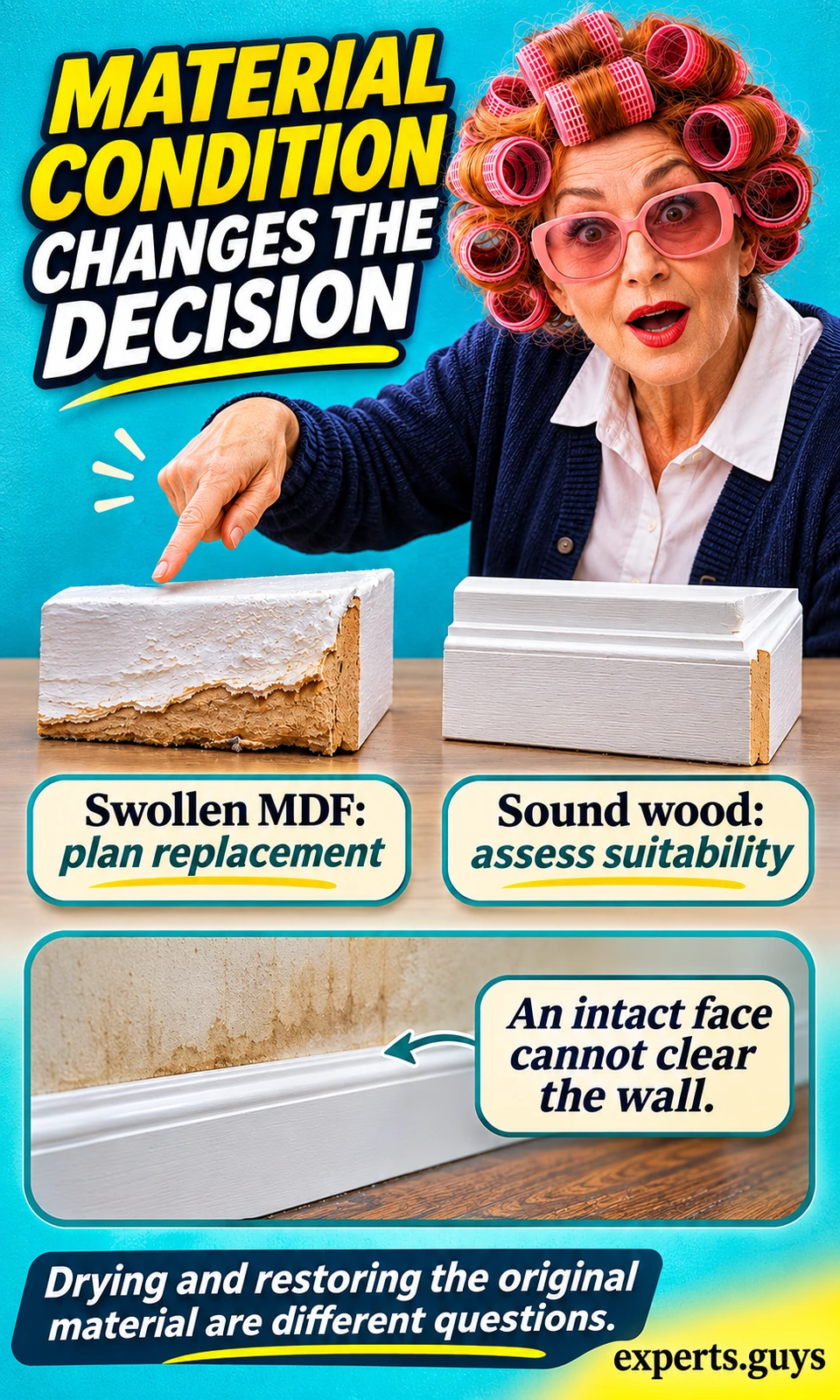
Investigating is the next step when the source, extent or safe work method remains uncertain. That does not necessarily mean dismantling an entire room. It means the unresolved question should determine a controlled scope. If the concern is a localized accessible trim defect, the scope may remain narrow. If the wall, flooring, contamination or electrical area is involved, the appropriate assessment may need other expertise before finish work starts.
- Resolve unsafe access and contamination concerns first.
- Identify the trim material as far as safe evidence allows.
- Separate the source repair from the damaged-material decision.
- Establish affected-layer readiness before closing the work.
- Agree the finish scope and its follow-up conditions.
A clear proposal should distinguish these outcomes. “Replace baseboard” does not explain whether the price includes identifying the water source, assessing adjacent materials, managing removal risks or returning to check a repair. Ask what the proposed work actually resolves. A low trim price can be reasonable for a ready-to-finish room and inadequate for a room whose moisture problem has never been established.
Do not sand first and ask about coatings later
Older paint and unknown coatings change the preparation decision. The EPA's lead-safe renovation guidance explains the risk of creating lead-contaminated dust when disturbing affected painted surfaces, particularly in older US housing. A home’s location and history determine the relevant assessment and work requirements. Do not treat a general sanding tutorial as clearance for an unidentified coating.
If lead paint, asbestos-containing materials, contamination or mold may be involved, establish the appropriate assessment and work method before scraping, cutting or removing trim. This guide does not provide a do-it-yourself containment recipe. The safe scope needs the actual material and setting, not a photograph that happens to show only a few centimeters of peeling paint.
Drying does not reverse every kind of damage
The NIH's facilities guidance on moisture remediation emphasizes prompt source control and material-specific assessment after water intrusion. Its institutional procedures are not a universal homeowner cutting guide. The useful principle here is narrower: stop ongoing wetting, establish which materials are affected and assess readiness rather than assuming every damp component can simply be covered.
Elapsed time alone cannot answer whether the board should stay. An incident may be brief but cause permanent deformation in a vulnerable edge. Another piece may remain dimensionally acceptable while hidden layers take longer to assess. Avoid promises that any baseboard can be saved if dried within a fixed interval. Prompt action improves the situation; it does not grant every material the same recovery behavior.
The room’s normal operating condition also matters for replacement materials. Woodgrain's storage and handling instructions explain how wood products respond to moisture and require protection and appropriate acclimation. Follow the instructions for the actual chosen product. Do not borrow a fixed acclimation period from another brand or assume that a freshly delivered board is automatically ready to install.
A practical readiness discussion names what is ready and what is not. For example, “the leak has been repaired, but the wall edge has not yet been assessed” is an honest partial result. “Everything is dry now” may be too broad if it rests only on touch. The purpose is not to demand a laboratory certificate for every scuff; it is to avoid closing a known water-damage repair on evidence that does not address the affected layer.
Plan the replacement as part of the assembly
Match the height, thickness and profile deliberately. A taller board can hide an old paint line, but it should not be chosen to hide an unresolved moisture mark. A thicker board changes how it meets door casing and other returns. Look at those junctions before ordering a long run. A cheap profile mismatch can turn a limited repair into a second round of finish changes.

Consider the floor system as well as the trim. Some floor installations require an expansion space that should not be filled indiscriminately. Do not use a general instruction to seal every gap as a substitute for the floor and trim manufacturers’ installation details. The aim is compatible assembly, not simply eliminating every visible opening with whichever sealant is nearby.
A moisture-resistant product is not a repair for a leak. It can be a sensible material choice within its rated use, but it does not make the wall behind it waterproof. Ask what the designation actually permits, which faces and cut ends need treatment and what installation conditions apply. A label such as suitable for humid interiors is not the same as permission for recurring liquid-water exposure.
Keep new material protected while the room work is underway. Stacking replacement boards against a damp wall or on a recently affected floor can undermine the purpose of replacing them. Follow the product’s storage and handling requirements and avoid closing packaging around trapped moisture. Buying a better-suited material does not remove the need to look after it before installation.
For a partial run, agree where the new piece will terminate and how the finish transition will be handled. The most obvious stain is not necessarily the best join location. A competent finish plan considers the profile, adjoining pieces and surface condition while the remediation scope determines what material must come out. Those two boundaries can differ and should be discussed rather than silently substituted for each other.
Treat paint and caulk as finishing decisions
Once material and assembly readiness are established, finishing can be planned around the selected substrate and coating system. Follow the product instructions for surface preparation, primer, topcoat and curing conditions. A paint labeled for bathrooms does not restore swollen MDF or determine whether a wall edge is dry. Choose finishes for a ready substrate; do not ask them to perform the work of source control.
A stain-blocking primer can address certain finish problems when specified for the situation. It is not proof that the source of staining has stopped. The same distinction applies to a neat caulk line. A continuous bead may make a photograph look complete while concealing a joint that has not been assessed. The repair should earn the finish rather than use the finish as its explanation.
Avoid sanding, filling or coating material that has already been judged unsuitable to retain. That work can consume time and obscure the evidence without changing the replacement decision. If a repair proposal relies on extensive filler over a visibly expanded lower edge, ask what sound material the filler will be bonded to and what condition is expected after normal use. A specific answer is more useful than a promise that the painter can make anything look good.
For suitable retained trim, agree the cosmetic endpoint separately from the moisture outcome. Will a stain shadow remain? Will the whole run be painted for a uniform sheen? Will the old profile and new profile meet acceptably? These are legitimate finish questions once the underlying conditions are resolved. They should not become reasons to rush past the material decision or assume a coat of paint closes the incident.
Use the cause to choose the follow-up
Follow-up should test the concern that prompted the repair. If wetting appeared after rain, the relevant question is what happens under the conditions associated with that route, subject to a safe assessment plan. If a plumbing leak was repaired, the repair and affected assembly need their own appropriate checks. A dry afternoon after a rain-related problem is not the same evidence as a successful follow-up under relevant conditions.

An example helps separate the jobs. Imagine that a short MDF run below a window has expanded. Replacing it resolves the distorted trim, but not whether the window or another route supplied water. Repairing the water route resolves that source, but not whether the old board can regain its profile. Assessing adjacent layers resolves a further question. One invoice line called touch-up can conceal all three omissions.
A different example is repeated wet mopping against an unprotected edge. The appropriate prevention discussion involves the actual floor-care and trim instructions, along with any damaged material. It is not evidence that every wall needs waterproof paint. Match the change in routine to the observed source and material vulnerability. Do not make the repair broader simply because a different article describes a more dramatic flood.
These examples are illustrations of scope, not diagnoses of a reader’s room. Several sources can coexist, and a visible pattern can mislead. The useful handover is a concise description of the location, timing, visible change and unresolved questions. A few clear digital photographs can help communicate an accessible condition, but they do not replace an assessment of concealed materials or establish a precise moisture value.
Compare proposals by what they close out
When requesting a quote, describe the unresolved job rather than asking only for a price per length of trim. Does the work begin after source repair and drying assessment, or does the contractor propose to handle those stages? Who is responsible for determining the affected material boundary? What would change the scope after safe removal? A clear answer prevents a finish-only quote from being mistaken for a complete restoration proposal.
Ask how unsuitable material and existing coatings will be handled within the appropriate work practices. The answer should fit the actual assessment, not a generic promise to be careful. Also establish what is excluded: flooring, wallboard, insulation, plumbing, painting beyond the repaired run or other affected finishes. An exclusion is not automatically a defect, but it must be visible so the household can arrange the remaining work.
The completion description should distinguish source work, material work and finishing. A signed receipt for new boards does not establish the outcome of the source repair. A normal room-humidity reading does not establish the condition of every affected layer. A clear closeout gives the owner the relevant next step if the original symptom returns, rather than leaving them to decide whether any future swelling is simply a paint problem.
Make the handover specific enough to use
Consider two proposals for the same short damaged run. The first says remove and replace the board, prime and paint. The second begins only after a separate moisture assessment and includes replacing the same run. Those prices are not necessarily competing offers for an identical job. The second may be explicitly excluding investigation while the first is merely silent about it. Ask both providers to identify the starting condition they assume. That question can reveal a missing stage without assuming that either contractor has acted improperly.
Now consider a proposal to keep solid wood trim after assessment. Retention should identify the piece being kept and the basis for finding it suitable, rather than relying on a general statement that wood is repairable. It should also explain the finish expectations. If an old piece will show a minor visual difference beside new material, the household can decide whether that is acceptable once the material and moisture questions are answered. A cosmetic preference can justify replacing more sound trim for a uniform appearance; it should be described as that preference, not as newly discovered water damage.
At the room handover, keep the remaining tasks visible. A household may have a repaired leak and new trim while a separate painter is still due. Another may have a sound retained board while a floor specialist is still addressing the adjoining system. Neither situation is automatically a failed repair, provided the division of work is clear and the room is suitable for its intended use. The problem arises when a photograph of finished trim is treated as evidence that every excluded stage happened.
If a further check is pending, name who will arrange it and what finding would change the next step. “Monitor the area” is vague when nobody knows whether to look after rain, normal plumbing use or a specific completed repair. Follow the assessor’s safe plan and report a recurrence without reopening or sanding the surface yourself. A phone photograph can communicate the visible change when access is safe. It should be accompanied by the relevant condition, rather than a guessed cause.
Keep product details for future maintenance too. The replacement profile, material, coating system and applicable care instructions are useful digital handover information. They help the next person distinguish a routine finish touch-up from a new material problem and avoid repeating an unsuitable floor-cleaning practice against a vulnerable edge. There is no need for a complicated application: the information should be easy to find when the room is cleaned, repainted or assessed again.
Compare Local Home Specialists Near You
Tell us what kind of help you need, then compare nearby businesses by location, Google rating, review volume and contact options.
HomeFix Local Match
Turn a home problem into a practical local hiring decision. Check the clues, see the specialist types that fit, open focused surrounding-location searches, then compare the strongest three before you call.
 YOUR PROBLEM
YOUR AREA
COMPARE 3
✓ Ready to compare
What is happening?
Choose the closest problem type, then check every clue that applies. Your selections change the specialist order.
Where should the search focus?
Use Google’s “near me” context or enter the area you actually want a specialist to serve.
Simple local search: open nearby Google results, choose the businesses that look suitable, then compare your best three here before you call.
Problem snapshot
Who should you call first?
These are the specialist types most likely to fit the clues you selected.
Search around your location
Compare your top three
Use the same factors for each option so a high star rating does not hide a weak scope, poor diagnosis, missing credentials or unclear aftercare.
Comparison result
Your result combines the Google signals you entered with the practical hiring checks you completed.
Questions to ask every finalist
Use the same questions with each shortlisted business so the comparison stays consistent.
Frequently asked questions
Can swollen MDF shrink back enough to keep?
Drying can remove moisture without reversing excessive thickness swelling or restoring a damaged profile. If the lower edge is expanded, softened or breaking apart, plan for replacement rather than treating sanding and filler as a restoration of the original material. Have the actual condition assessed; do not confuse a shallow cosmetic dent in sound MDF with water-damaged fibers.
Does a sound-looking polymer baseboard mean the wall is dry?
No. The trim face and the wall or floor behind it are different materials and may respond differently to the same incident. An intact face can remain useful, but it cannot certify concealed layers. Let the source and affected-layer assessment determine what must be checked before the repair is closed, regardless of the material selected for replacement.
Should I remove the trim myself to check behind it?
Do not begin removal before resolving safe access, coatings, contamination, concealed-service and material concerns. The appropriate work method depends on the actual setting. This guide deliberately does not provide a universal pry-and-cut procedure. Ask for an assessment scope that explains which question requires access and how that access will be managed safely.
Can I paint over a dry stain if the board is still sound?
Possibly, once the source is resolved, affected layers are appropriately assessed and the substrate is suitable for the specified finish system. The remaining stain may then be a cosmetic issue. Paint selection alone cannot establish those conditions. Agree any primer, preparation and finish requirements for the actual material rather than assuming any stain-blocking coating closes a water-damage incident.
Is moisture-resistant MDF waterproof?
Do not treat those descriptions as equivalent. Use the actual manufacturer’s product classification and intended conditions. A moisture-resistant trim choice cannot repair a leaking window, prevent every cleaning-water exposure or make the wall behind it waterproof. Product selection belongs alongside compatible installation and source control, rather than replacing either one.
Should every gap between the floor and baseboard be sealed?
No universal gap-filling instruction fits every floor and trim system. Some installations need movement space or particular junction details. Follow the actual manufacturers’ requirements and the repair design. A bead of sealant is not evidence that affected layers are ready, and eliminating a visible gap should not create an incompatible floor installation.
How can I tell whether a quote is only cosmetic?
Read what it promises to resolve. A scope that lists filler and paint may be appropriate for sound trim after other work is complete, but it does not automatically include source investigation, drying assessment, damaged-material removal or adjacent-wall work. Ask for those boundaries to be stated clearly. Compare proposals by the unresolved job they cover, not only by the replacement length.
What if the baseboard swells again after replacement?
Treat recurrence as a reason to reassess the original source and repair scope. Do not assume the new board was merely a poor paint job or that a more resistant product will settle the issue. Describe where and under what conditions the change returned, then use the agreed follow-up route. A repeat cosmetic patch can hide the same unanswered moisture question.
Does a small damaged area mean the cleanup is simple?
Not necessarily. Visible size, water quality, electrical conditions, coating hazards and concealed extent are separate considerations. A small swollen edge can be the visible part of a wider incident, while another localized defect may remain narrow after proper assessment. Avoid making the work larger or smaller solely from a close-up photograph. Establish the condition that actually controls the safe scope.
Action checklist
First decide whether it is safe to approach the area. Then establish the trim material and separate the damaged-board decision from the source and affected-layer questions. Do not sand unknown coatings, bury a distorted edge in filler or close a repair whose moisture condition remains unresolved. If assessment is needed, define the question it must answer rather than asking for indiscriminate demolition.
Once the assembly is ready, select a compatible replacement or a suitable retained-material finish, following the actual product instructions. Agree what completion means and which follow-up condition matters. A successful baseboard repair is a sound material in a ready assembly with an explained water problem—not merely a fresh white line at the bottom of the wall.