


Yes, a $20 balance can be enough for a small manual investment on eToro when the specific asset and account entity allow an order at that size, but $20 is not enough for every eToro feature. The important distinction is that the amount needed to fund an account, the minimum size of a trade, and the minimum required for features such as recurring investments, CopyTrader and Smart Portfolios are separate numbers.
That distinction matters because eToro says its first-time deposit minimum varies by country, while its current stock pages advertise fractional-share investing from relatively small amounts. A reader with $20 already sitting in a funded account may therefore have more options than a brand-new user who only has $20 available to deposit.
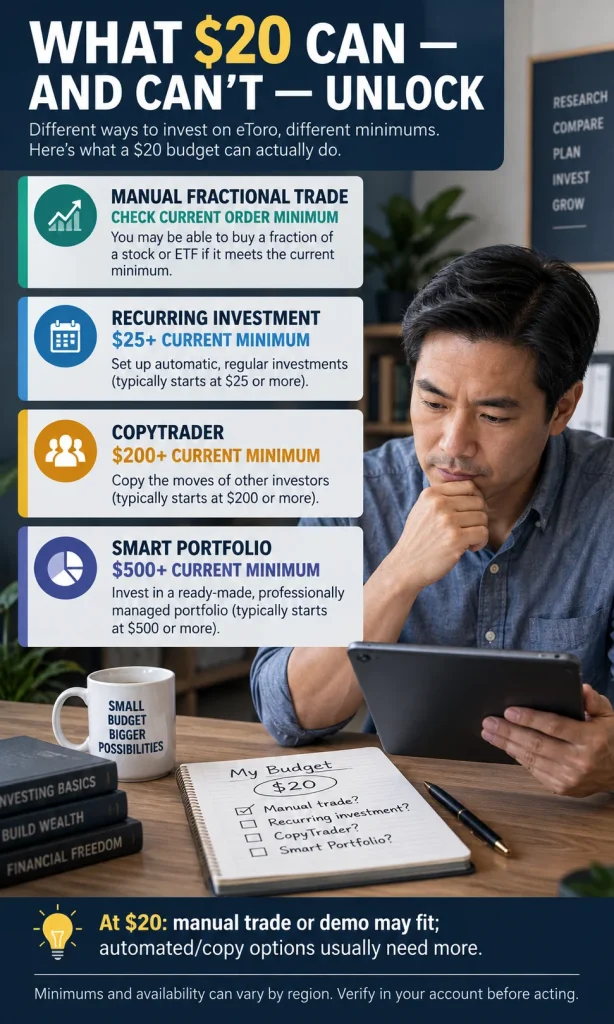
The quickest way to think about a $20 eToro budget is to separate the platform into the actions that may fit now and the actions that clearly require more capital:
- One small manual stock position: potentially possible when the live order minimum is within your budget.
- Two $10-sized positions: only possible if both assets permit that minimum and fees do not make the split uneconomic.
- Recurring investing: eToro currently publishes a $25 minimum for recurring stocks, ETFs and crypto.
- CopyTrader: eToro currently publishes a $200 minimum to copy a Pro Investor.
- Smart Portfolios: eToro currently advertises a $500 starting investment.
- Virtual Portfolio: available for practice without risking the $20 at all.
Those thresholds should be treated as current platform reference points rather than permanent rules. eToro itself tells users to rely on the up-to-date amounts shown inside the app because product availability, minimums, fees and regulatory treatment can change by jurisdiction.
$20 can be enough to invest, but not always enough to open and fund the account
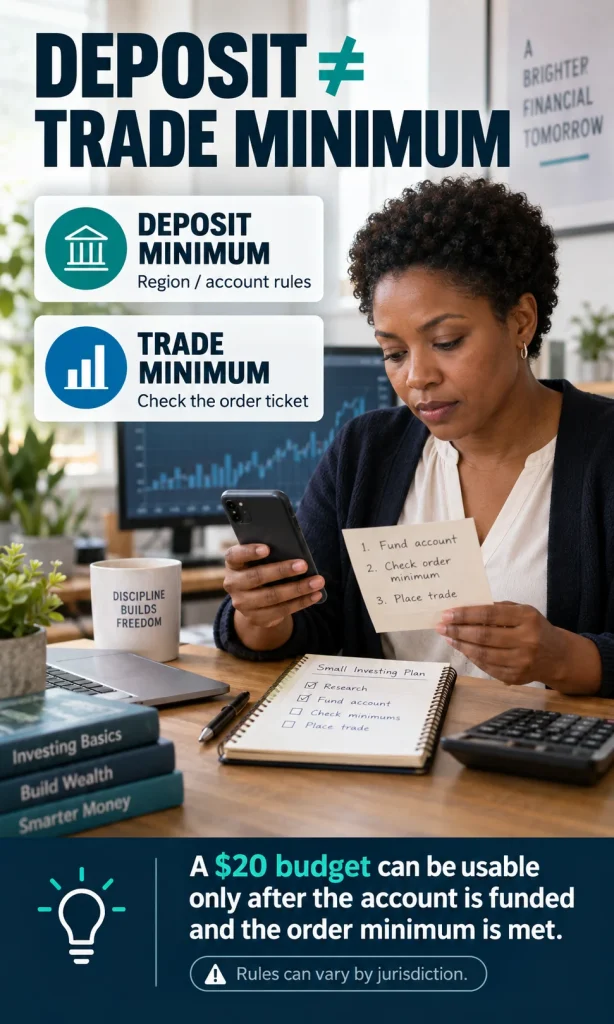
The old version of this article treated “minimum deposit” and “minimum trade” as if they were the same thing. They are not. eToro’s current deposit guidance says first-time deposits can vary substantially by country and regulatory entity, so a $20 investment budget does not automatically mean a new account can be funded with $20.
Once an account is funded, the trade ticket becomes the more useful number. eToro’s current stock investing page promotes fractional-share access from small dollar amounts, which is what makes a $20 position possible in the first place: you do not necessarily need to buy one whole share of an expensive company.
What a $20 eToro budget can and cannot unlock
The most useful comparison is not “Is eToro cheap?” but “Which eToro action am I trying to perform?” A $20 balance may clear the threshold for one manual fractional position while falling short of the minimum for automated or copy-based features.
| Action | Current reference point | Does $20 fit? | What changes the answer |
|---|---|---|---|
| Manual stock / fractional-share order | Small-dollar investing is advertised; verify the live order minimum | Possibly | Asset, account entity, fees and the exact trade ticket |
| Recurring stock / ETF / crypto investment | $25 published minimum | No | Minimums may change; selected assets must support recurring orders |
| CopyTrader | $200 published minimum | No | Jurisdiction and feature availability |
| Smart Portfolio | $500 starting investment | No | Portfolio availability and local account rules |
| Virtual Portfolio | $100,000 in virtual funds | Yes – without using the $20 | Simulated results do not reproduce the emotional or execution effects of real money |
eToro’s recurring-investment page currently lists $25 for recurring stocks, ETFs and crypto, $200 for copying a Pro Investor and $500 for Smart Portfolios. The same platform can therefore feel “low minimum” at the manual-trade level while still requiring much more capital for its automation and copy features.
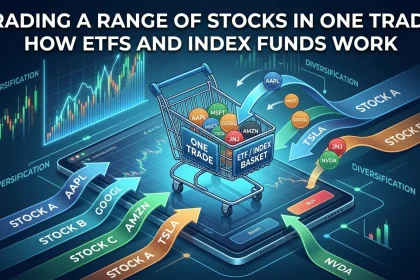
If your real goal is broad diversification rather than simply opening the smallest possible trade, $20 also creates a practical limitation: splitting a small balance across too many positions can make each holding too tiny to matter and can magnify the impact of fixed fees. Readers who want to understand the difference between a single security and a broader basket can continue with our guide to trading a range of stocks in one trade.

Before you place the order
Small-Budget
Reality Check
See what a small balance can realistically support after minimums, fees and feature thresholds.
Your result
Feasibility first. Investment choice remains yours.
What may fit
Manual investing may be possible if your live order minimum is no more than your budget.
What can block it
A separate deposit minimum, a higher product minimum or fees can change the answer.
Next check
Review the live order ticket, product label and estimated cost before confirming.
Educational decision support only. This does not recommend eToro, any asset, any trader, or any investment strategy. Investments can lose value, and platform availability, minimums and fees can change.
Why $20 can be enough for one action but not another
Reference values are editorial context, not guarantees. eToro states that first-deposit minimums vary by country and that minimums may change. Always use the live values shown in your account.
Fees matter more when the trade is tiny
A $1 charge does not look large in isolation, but on a $10 position it represents 10% of the amount being invested. eToro’s current fee schedule says a $1 or $2 stock commission may apply in some countries and on some exchanges, while ETFs may have different treatment and crypto uses percentage-based charges; the platform also tells users to review estimated costs in the trade screen before execution.
That is why a $20 account should not be judged only by whether the “Buy” button accepts the order. The relevant question is how much of the small balance is exposed to market returns after commissions, percentage fees, spreads, currency conversion and any other product-specific cost that applies to the account.
For example, if a hypothetical $20 stock order carries a $2 commission to open and another $2 to close, those fixed charges alone equal 20% of the original $20 before considering any price movement. That example is not a prediction of your fee; it shows why the exact estimated-cost line deserves more attention on a small account than it would on a much larger position.
Do not confuse a low-cost entry with a low-risk trade
Fractional shares solve a sizing problem, not an investment-risk problem. Owning $20 of a volatile stock can still produce a large percentage loss, and an account with only one or two positions can be far more concentrated than the small dollar amount makes it feel.
The same caution applies to social investing. CopyTrader is one of the platform’s best-known features, and current independent brokerage reviews still identify eToro’s social layer and easy-to-use interface as distinctive strengths, but copying another investor does not turn that person’s past performance into a reliable forecast. If you are still learning how to evaluate a position yourself, our guide to free stock analysis tools for beginners provides a better next step than choosing a trader based only on recent returns.
What reviewers like about eToro is not the same as what makes a $20 account useful
Current broker reviews commonly praise the clean interface, social features, virtual trading and beginner accessibility. Those are real usability advantages, but they do not change the math of a very small account: a smooth app cannot make a $20 balance diversified, erase a fixed commission, or make CopyTrader available below its required allocation.
This is the more useful way to read reviews in 2026. Look for the feature that solves your actual problem – practice, fractional access, research, social discovery or automation – and then check whether your budget and jurisdiction support that feature. If the objective is simply to compare mobile brokerage experiences, our article on stock trading apps for beginners gives the comparison a wider frame.
The Virtual Portfolio may be the highest-value feature when you only have $20
eToro’s Virtual Portfolio currently provides $100,000 in simulated funds and lets users practise with the platform without risking real capital. For someone whose main uncertainty is “Can I understand the order screen, watchlist, portfolio and research flow?”, the demo answers that question better than committing a $20 balance immediately.
The limitation is equally important: simulated trading cannot reproduce the emotional pressure of losing real money, and it does not make a profitable demo strategy predictive. Use the virtual account to learn the mechanics, not to convince yourself that a short winning streak proves an investment method.
A better five-step check before you invest a small amount
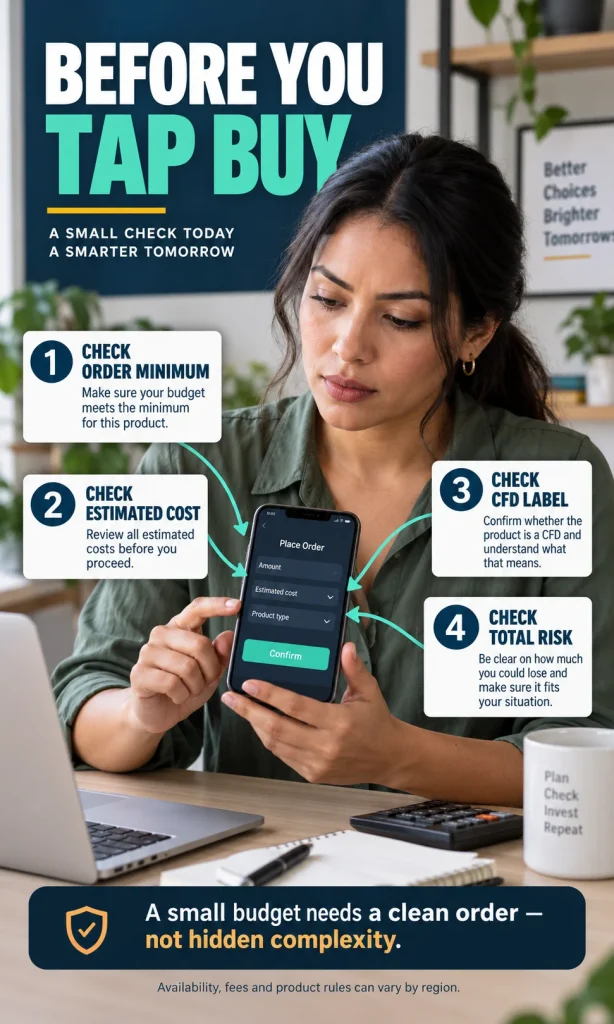
Small accounts benefit from a stricter pre-trade routine because one misunderstood minimum or fee can consume a meaningful share of the balance. Before you tap Buy, work through these five checks:
- Confirm the account is already fundable at your budget. If you are a new user, check the first-deposit minimum for your country rather than assuming $20 is enough.
- Read the live order minimum. Use the value shown for the exact asset, not a platform-wide number remembered from an advertisement.
- Open the estimated-cost disclosure. Look for commissions, percentage charges, currency conversion and any other line that changes the amount at work.
- Check whether the order is marked CFD. eToro says CFD positions are labeled in the trade window; leveraged or short positions can introduce additional fees and risk.
- Decide whether one concentrated $20 position actually solves your goal. A trade being possible is not the same as it being the right use of the money.
If chart reading is part of your reason for opening the account, learn the visual basics before relying on a chart to justify a trade. Our explanation of candlestick chart patterns is a better starting point than treating one chart formation as a standalone signal.
So, is eToro worth using with only $20?
It can be useful if your goal is narrow and realistic: learn the platform, place a small fractional position where the order minimum allows it, or use the account as a first step while you continue building capital. It is much less compelling if you expect $20 to unlock eToro’s full automation, copy and portfolio ecosystem, because several of those features currently require materially higher allocations.
The best decision is therefore not “eToro is good” or “eToro is bad.” Check the funding requirement, the live order minimum, the fee drag and the exact feature you want; if all four fit your budget without forcing you into a product you do not understand, then the platform is doing the job you actually need.
Frequently Asked Questions
Frequently Asked Questions
Can I start investing on eToro with $20?
Is the eToro deposit minimum the same as the trade minimum?
Can I use CopyTrader with $20?
Can I set up an eToro recurring investment with $20?
Are small eToro stock trades always commission-free?
Should I use the demo account before investing $20?
Action checklist: verify your local deposit minimum, read the live order minimum, open the estimated-cost line, confirm whether the position is a CFD, and only then decide whether the feature you want is worth using with a small balance.