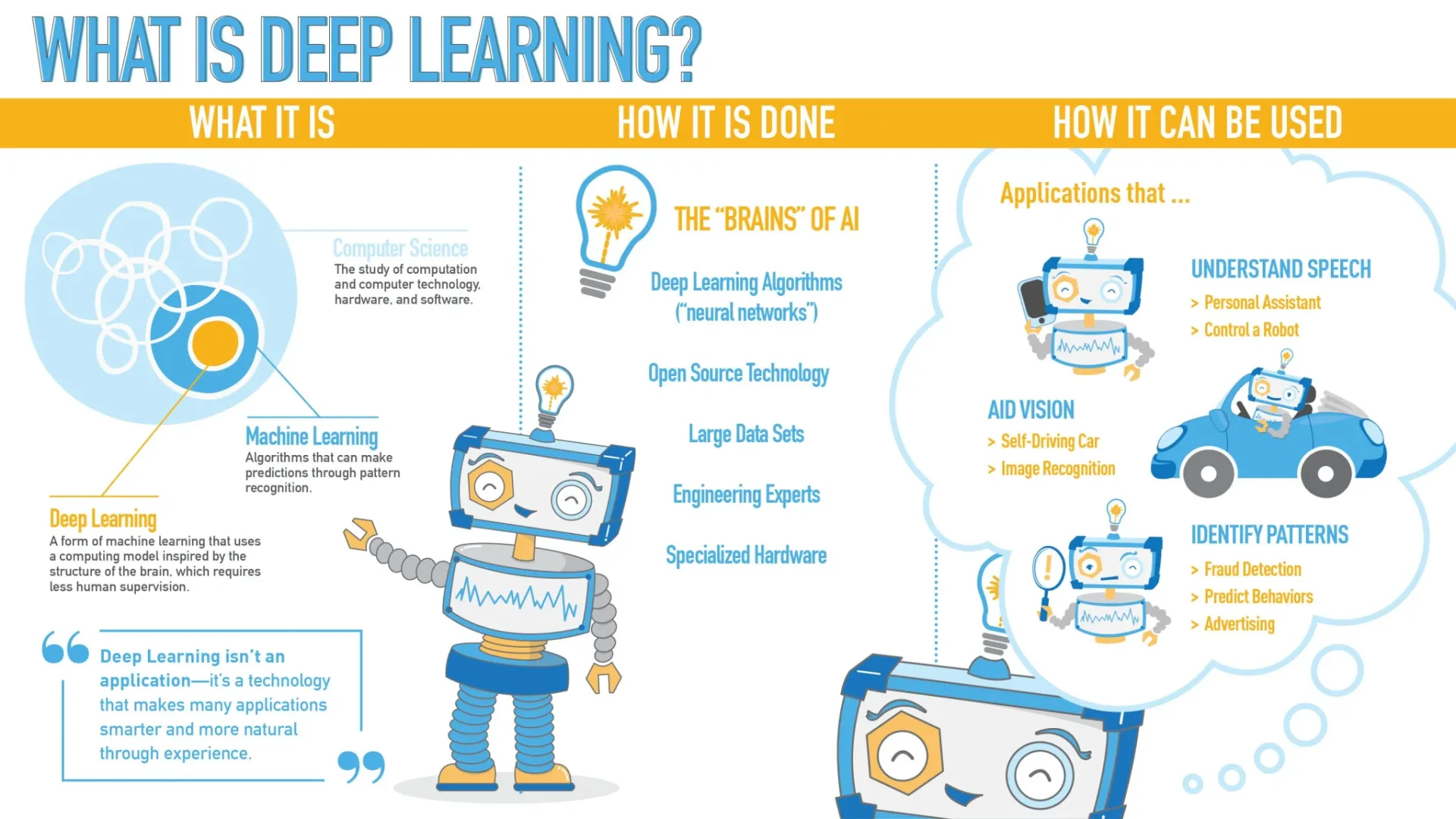

The fundamentals of deep learning are not new. In 1962, Frank Rosenblatt and other researchers published Principles of Neurodynamics: Perceptrons and the Theory of Brain Mechanisms. The feed-forward hierarchical convolutional approach was later expanded by Sven Behnke in Neural Abstraction Pyramid. By employing lateral and backward connections, the method has become increasingly powerful. The most common applications for deep learning include image processing, speech recognition, and drug discovery.
A good example of how deep learning can help improve healthcare is in the field of cancer research. Recently, a computer program developed by Google’s DeepMind beat a standing champion in the game of Go. WaveNet, a computer program built by DeepMind, is able to mimic human speech with more natural sound than current speech systems. Another example is the use of deep learning in applications like Google Translate and Google Planet. With Tensorflow, the company developed a deep learning database that is used to identify photos.
Deep learning is a powerful technology that can cope with unstructured data. Unlike structured data such as Excel, unstructured data is not neatly organized in rows. It’s usually a collection of files, audio clips, or text, with no clear structure. By analyzing this messy data, deep learning algorithms can create complex models that synthesize information about customers. And since these networks can handle large amounts of information, they can help companies analyze huge volumes of information.
A good example of the application of deep learning is in service bots. These automated chatbots provide intelligent answers to complex queries. This technology is constantly evolving, and a new version can be developed every year. This technology has made a big impact on our everyday lives. Once manual tasks were done by humans, we can now delegate them to computers. For example, computers can now color black-and-white images. The technology is advanced enough to place the contents of a picture in context and recreate it with the right colors.
An example ANN is composed of an input and an output layer. It also contains additional layers, which are called hidden layers. These extra layers do not appear in the training set. They are calculated values that the network uses to perform its magic. The more hidden layers an ANN has, the more advanced the model is, and the more features it can learn. This is a key benefit of deep learning. While it may seem a small difference, it is worth noting that deeper networks are often more accurate.
Several limitations of deep learning models have been identified. These include the size of the dataset and the complexity of the model. In general, high-performance GPUs are required for deep-learning models. However, these are expensive and occupy a lot of system resources. A GPU-based hard drive is the best choice for this process. If you want to use a powerful GPU, you’ll need a machine with high-speed graphics processors.
In addition to improving customer service, deep learning models are becoming increasingly important in the military and aerospace industries. For example, some types of chatbots will be able to automatically reply to messages with a simple question. Other applications involve text generation machines that will be able to generate new texts based on an algorithm. In the military, deep learning models are also used to recognize safe zones and areas of interest for troops. In short, deep learning can revolutionize our technology.
A variety of applications for deep learning are already being created. For example, automotive researchers are using it to detect pedestrians and objects, while military personnel use it to identify safe zones for troops. It is also used in speech translation and automated hearing. For instance, doctors will be able to use the results of deep learning models to determine the quality of medical images. If these applications become ubiquitous, however, they will probably not be able to replace radiologists.
In many ways, deep learning is already a part of everyday life. We use it to automatically tag pictures and video. Similarly, we use it to power our digital assistants. We use it to make decisions and recommend products based on our preferences. The most popular examples of this technology are Skype, digital assistants, and self-driving cars. If you’re interested in the science behind them, you should start reading more about this technology.
Did you miss our previous article…
https://expertsguys.com/what-ai-can-do-and-cant-do-in-the-workplace/