
Under general anesthesia, a trained anesthesia professional continuously watches your breathing, circulation, and response to medication while the surgical team performs the operation. You are meant to be unconscious and unaware, but the exact airway support, medicines, and monitoring depend on the procedure and your health. Ask your anesthesia team about the plan for you, especially if you have had a difficult anesthetic before.
Quick answer: The team verifies the patient and planned procedure, starts anesthesia, supports breathing as needed, monitors vital signs, adjusts medicines and fluids, and then supervises waking and recovery. General anesthesia differs from sedation or regional anesthesia: with those approaches you may remain partly or fully awake.
Before you go to sleep: checks and a tailored plan
Your anesthesia professional reviews your health history, medicines, allergies, previous anesthesia experiences, and the planned surgery. Staff confirm your identity, procedure, and other safety details before starting. Tell them about sleep apnea, breathing problems, a prior difficult airway, severe nausea after anesthesia, or any experience of awareness during surgery; these details can change the plan.
Monitors are applied and an intravenous line is commonly used to give medicines and fluids. General anesthesia is then started with medicine through the IV, inhaled medicine, or a combination; the sequence varies by patient and operation. Being awake in a holding area or receiving a calming medicine there is not itself the same as being under general anesthesia.
What happens once anesthesia starts?

As you become unconscious, the anesthesia professional manages your breathing and decides which airway approach is appropriate. Some patients breathe through a mask or supraglottic airway; others need a breathing tube in the windpipe and assisted ventilation. These are alternatives chosen for the situation, not devices every patient receives together, and the surgeon does not routinely place the airway.
Throughout the operation the anesthesia team tracks oxygen saturation, heart rate, blood pressure, breathing and other measures suited to the case. They adjust anesthesia and pain medicine while responding to changes in your condition; they may also manage temperature, IV fluids, blood loss, and other needs. Monitoring is active clinical care, not a guarantee that complications cannot occur.
The surgical team performs the procedure while staff maintain sterile technique and communicate when a change affects the operation or anesthesia. A patient receiving general anesthesia is not expected to be conscious throughout surgery. Sedation and regional anesthesia have different awareness goals, so it is worth confirming which type your team proposes.
What if someone says the anesthesia is “not affecting” the patient?

That phrase can mean several different things and needs clarification. A person may have been given sedation while remaining responsive, or a concern may arise that an intended general anesthetic is not deep enough. A person can also move or show a change in vital signs for reasons that require interpretation; a single sign does not by itself establish awareness.
Accidental awareness with recall during general anesthesia is uncommon, but it is a recognized event. If you recall sounds, sensations, or events from a time you expected to be unconscious, tell the anesthesia team promptly and describe what you remember. They can review the anesthetic record, assess your experience, and discuss support if it was distressing.
Waking up and the recovery room
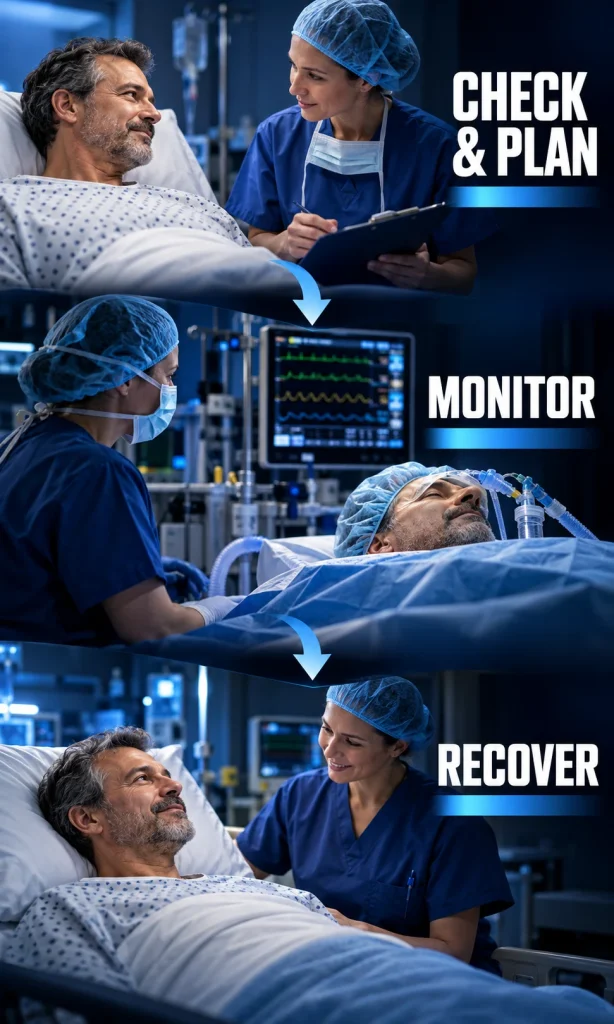
At the end of the procedure, the anesthesia professional reduces or stops anesthetic medicines, checks that you can breathe adequately, and removes airway support when appropriate. You may wake in the operating room or recovery area, where staff continue monitoring breathing, circulation, pain, and nausea. The length of recovery varies; a fixed six-to-eight-hour stay is not standard for everyone.
Before discharge or transfer, tell the staff if you have pain, nausea, breathing trouble, unusual confusion, or a memory of the operation. Follow the specific instructions given for your surgery and medicines. If a new severe breathing problem occurs after leaving care, seek urgent medical help.
Questions worth asking before your procedure
The useful question is what the team expects for your procedure and which details would change the plan. The interactive Anesthesia Conversation Studio below organizes what to discuss without estimating personal risk. Bring its one-page checklist to the preoperative conversation, and let your clinician interpret it in the context of your health.
Anesthesia Conversation Studio
Make a focused list of questions for your anesthesia team.

What would you like to clarify?
Your discussion checklist
Select your topics, then prepare your questions.
Educational checklist only. Your anesthesia team makes the clinical plan.
Frequently asked questions
Will I be aware during general anesthesia?
The goal is unconsciousness and no awareness of the operation. Accidental awareness with later recall is uncommon but possible. Tell your anesthesia professional about any previous experience so it can be considered in your plan.
Does everyone need a breathing tube and ventilator?
No. Airway and breathing support depend on the surgery, patient, and anesthetic technique. Ask which approach is expected for your procedure and whether that could change during surgery.
Who watches my vital signs while the surgeon operates?
An anesthesia professional remains responsible for monitoring and adjusting anesthetic care during the operation. The exact team roles vary by location and staffing model. Ask who will provide your anesthesia and who will be present throughout.
What should I do if I remember something from surgery?
Tell the anesthesia team what you recall as soon as you can, including whether it happened before going to sleep or while waking. They can discuss the timeline, review the record, and help arrange follow-up if the experience was distressing. Do not assume that every memory from around surgery means awareness during general anesthesia.