
The same home workout can feel easier because you have adapted to it, but it can also feel easier because your reps, rest or exercise setup changed. Compare the movement under the same conditions before increasing difficulty or replacing the routine. The useful next step is usually one controlled change, rather than a completely different workout.
Why an easier workout is not automatically a failed workout
Learning a movement removes some of the awkwardness that made it demanding at first. You may spend less effort finding your balance, arranging your hands or remembering the sequence. That makes an easier session encouraging, although the feeling alone cannot tell you how much strength has changed.
A familiar circuit can also become easier without the exercise becoming more effective. An incline push-up against a higher support, a shorter squat or a longer break changes the task. More completed reps only mean more when the movement and conditions remain comparable.
Start by separating the quality of the rep from the sensation of the workout. A rep should stay controlled through a range that is comfortable for you; there is no reason to force a universal depth through pain. Use that repeatable version as your reference, and write down any change that affects the comparison.
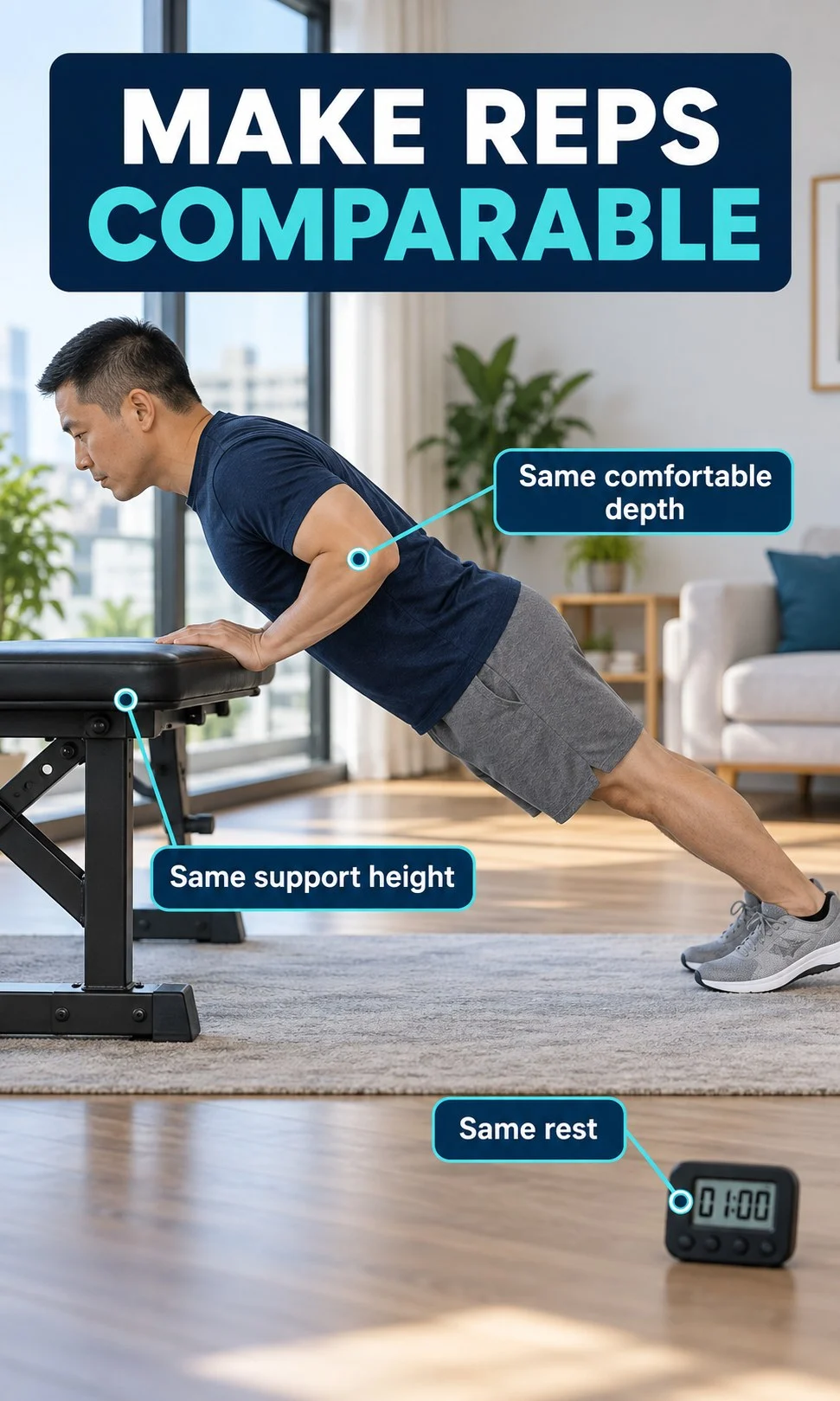
- Check that the exercise variation and support height stayed the same.
- Compare the same comfortable movement range and controlled technique.
- Record rest rather than assuming it was unchanged.
- Look for a repeated pattern across comparable sessions, not one unusually easy day.
What “hard” means when you train at home
Breathlessness tells you something about the demand of the whole circuit, but it does not measure the challenge of each strength exercise. Rapid transitions may leave you breathing hard even when the push-ups themselves are manageable. Judge the movement separately from the rush between stations.
A useful observation is how many additional good reps you think you could have completed when the set ended. This is often called repetitions in reserve, or reps left. Count only reps that would keep the same comfortable range and control, rather than repetitions you could finish by changing the movement.
Treat that number as an estimate. Research on repetitions-in-reserve estimation found that estimates became less dependable with lighter loads in the exercises studied. That evidence does not validate an exact cutoff for your home circuit, so an uncertain estimate is a reason to observe another session, not to test yourself to failure.
Several good reps repeatedly left over can be a prompt to consider a modest change if your goal is more strength challenge. It is not a diagnosis of a plateau, and easy movement can still serve practice or consistency. ACSM resistance-training guidance supports bodyweight and home-based training and does not make training to failure a requirement for the average healthy adult.
Find one next step with Next Rep Studio
Use the experience below for one familiar movement that you already repeat. It checks symptoms, recovery, form and comparable conditions before suggesting whether to observe, keep the current version or consider a small change. The result explains its reasoning, and the A4 note gives you a blank record for your own sessions.
HOME WORKOUT COMPARISON
Next Rep Studio
Understand an easier set. Leave with one clear next step.
Educational guidance for adults already repeating a familiar movement. No medical clearance, diagnosis, weight-loss forecast or diet prescription. Entries stay in this page's memory and are cleared on reload.
Start with a fair comparison
An easier workout can reflect improvement or a changed task. Check comfortable range, support height, variation and rest before increasing difficulty.
One next action
Repeat a familiar movement with the same setup and record what happened. If there is pain or a concerning symptom, stop the comparison.
Keep fixed
Movement, comfortable range, rest and the other exercises in your routine.
What this cannot establish
A plateau, injury, strength gain, diet adequacy or expected weight change cannot be confirmed from these answers.
Choose observations to receive an explained result.
Manual method and evidence
Compare the same comfortable movement under the same conditions. If form changed, restore the comparison first. If recovery feels unusual, do not increase the challenge today. If several good reps repeatedly remain and your goal is strength challenge, consider one small change that you can control. Keep rest unchanged for that comparison.
ACSM resistance-training guidance supports home-based training and does not require training to failure. Research on reps-left estimation shows limitations with lighter loads. The branching order here is editorial guidance, not a validated clinical assessment.
Make the log honest before making the exercise harder
A useful log records the exercise version, good reps completed, estimated reps left, rest and any form drift. Keep the order consistent if you are comparing a whole circuit, since an exercise done after other demanding movements may feel different. A brief note such as “support higher today” is more informative than a clean-looking rep total with no context.
The example below is an illustration of record keeping, not a workout tested by the writer or a recommended schedule. Its numbers exist only to show why a shorter movement should not be counted as straightforward progress. A real two-week record should contain your actual sessions, including the inconvenient ones.
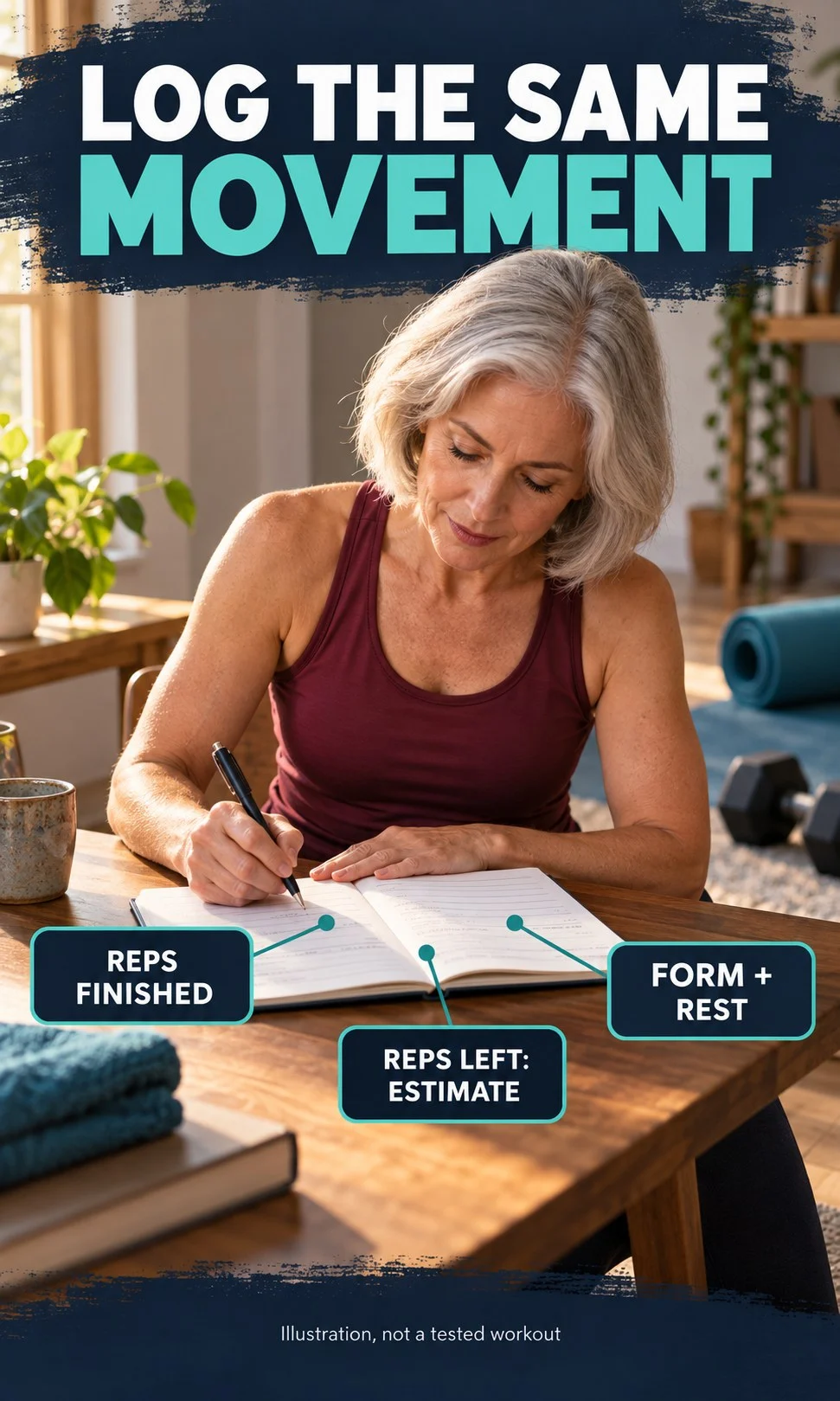
Suppose an incline push-up set rises from eight good reps to ten while the support, range and rest remain unchanged. That gives you a more useful performance comparison than a set of twelve reps with a higher support and shortened lowering. If the latter session happened, record the changed conditions and return to a comparable version before drawing a conclusion.
| Session observation | What the record means | Next comparison |
|---|---|---|
| 8 good reps; same support, range and rest | A reference set, not a target for everyone. | Repeat the familiar setup. |
| 10 good reps; same recorded conditions | More comparable reps were completed. | Observe whether the pattern repeats. |
| 12 reps; support higher and range shorter | The task changed; the total is not a direct comparison. | Restore the established comfortable version. |
| Usual setup feels easy once | One observation does not establish a trend. | Record another comparable session. |
Choose a change that matches the movement
Restore a controlled, comfortable range before trying to make a movement harder. After that, choose a small adjustment you can reverse if control deteriorates. Changing the variation, tempo, rep target and rest together makes it difficult to know what helped.
For an incline push-up, a slightly lower securely fixed hand support can increase the challenge, provided you can still control the movement comfortably. Use equipment intended to support exercise and check its stability; do not improvise with furniture that can slide or tip. If the new version changes your movement substantially, treat it as a new baseline rather than comparing its rep total directly with the old one.
For a bodyweight squat, a slightly slower controlled lowering can change the demand without adding equipment. Keep your established comfortable depth and rest steady while you try that single adjustment. Tempo and pauses are options for changing the task, not proof that a particular technique is superior for every goal.
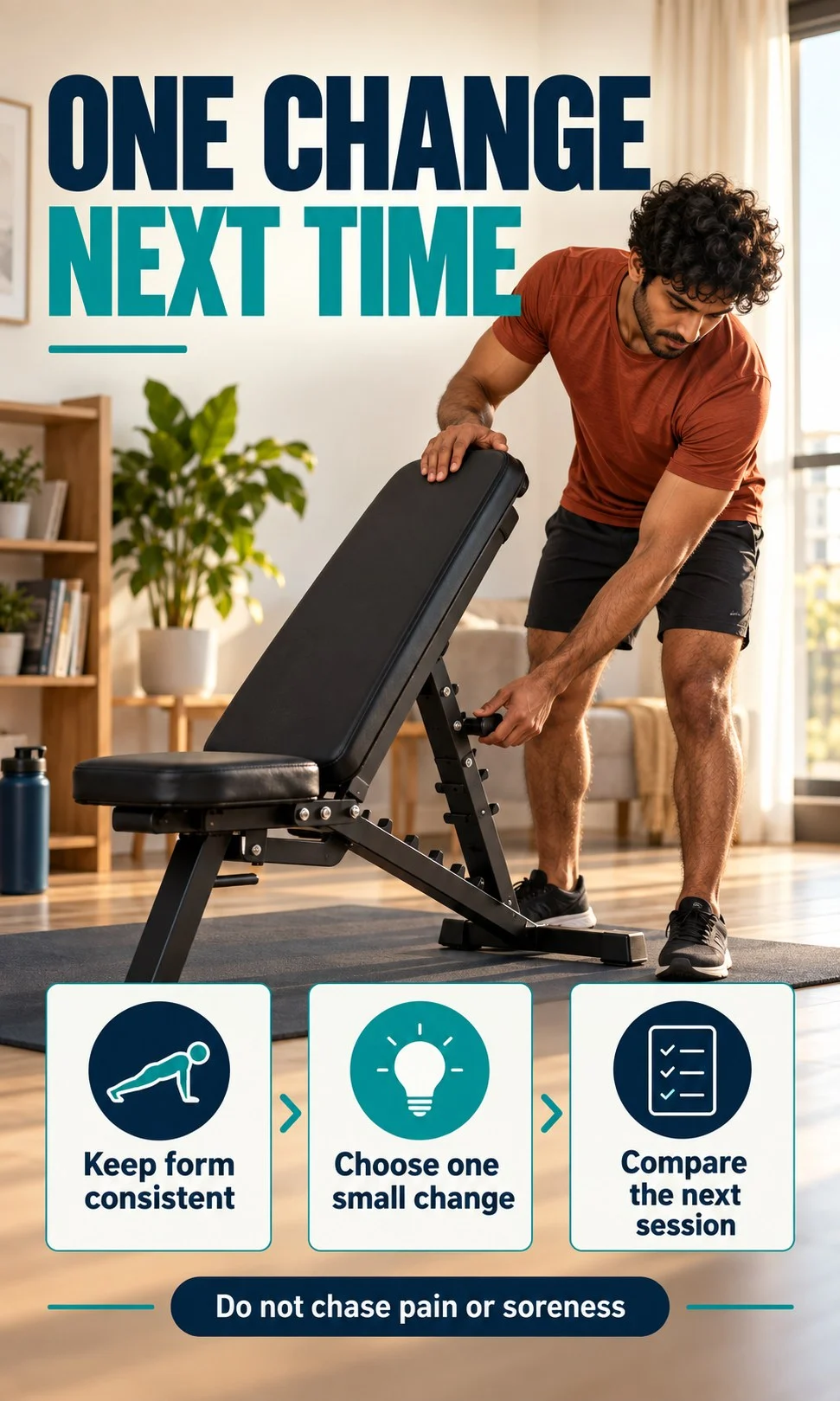
- Choose one adjustment: a manageable variation, a modest resistance change or a controlled tempo change.
- Keep the other conditions recorded and steady for the comparison.
- Return to the previous version if control deteriorates or discomfort appears.
- Ask a qualified exercise professional when you cannot identify a suitable progression.
Shortening rest can make a circuit feel harder, but it may also reduce the quality or number of reps you can complete. For a strength comparison, keep rest steady while you assess a movement change. Save deliberate rest changes for a separate decision about the session, rather than using breathlessness as evidence of better strength work.
When to keep the routine, and when to pause
You do not need to replace a routine simply because it has become familiar. Keep the movements if they remain manageable, serve your goal and let you compare performance. Change what needs changing, rather than following an arbitrary rule to replace everything every few weeks.
Less next-day soreness is not evidence that the workout stopped counting. The repeated-bout effect describes protection against muscle damage after repeated exposure to eccentric exercise. It helps explain why a familiar task may provoke less soreness, but it does not establish your strength gain or tell you to seek soreness with a new exercise.
An unusually tired or poorly recovered day is a poor time to increase difficulty. If bedtime stress is part of the problem, the guide to breathing exercises for better sleep offers a gentle wind-down option. Persistent sleep problems or unexplained fatigue need appropriate advice rather than a tougher circuit.
Pain during a movement needs a different response from ordinary delayed muscle soreness. NHS musculoskeletal guidance describes delayed soreness as an experience after exercise, which is not the same as clearance to work through sharp or joint pain. Stop the provoking movement and seek qualified advice for swelling, pain that changes how you move or symptoms that persist or worsen.
What the workout and diet label cannot tell you
This comparison cannot set your food intake or explain a change on the scale. An easier circuit does not show that you need to eat less, and a demanding circuit does not establish that you are eating enough. Keep diet prescriptions and expected weight loss out of the workout log; a registered dietitian can help when you need individual nutrition guidance.
For general activity context, CDC adult activity guidance includes at least 150 minutes of moderate aerobic activity, or 75 minutes of vigorous activity or an equivalent combination, plus muscle-strengthening activity on at least two days a week. Those are population-level health recommendations, not a personalized starting prescription or a fat-loss forecast. Your circumstances and current ability still matter.
Frequently asked questions
Why does the same home workout get easier so quickly?
You may be learning the movements and becoming more accustomed to the routine. The task may also have changed through shorter reps, a different support height or longer rest. Check those conditions before interpreting an easier session as a strength improvement.
Does a home workout still count if it feels easy?
Yes, an easier session can still serve movement practice, regular activity and consistency. Whether it provides the strength challenge you want is a separate question. Compare controlled reps and repeated observations rather than requiring every session to feel exhausting.
How often should I change my home workout?
There is no need to replace the whole routine on a fixed calendar. Keep movements that serve your goal, and adjust a variable when repeated comparable observations suggest a reason. A new exercise can create a new baseline, so record the change rather than treating every rep total as interchangeable.
Why am I not sore after home workouts anymore?
Familiar exercise can produce less delayed soreness as you adapt to repeated exposure. Soreness is not a reliable target for deciding whether the workout was useful. Evaluate the movement and your goal, and do not add difficulty purely to make yourself sore.
Should I add weights when bodyweight exercise gets easy?
Additional resistance is one possible progression, but it is not the only option. A manageable variation or controlled tempo change may also suit the movement. Choose one adjustment you can perform comfortably and safely; seek qualified help if you are unsure which fits.
Why does a hard circuit not necessarily mean I am getting stronger?
The circuit can feel hard because of short rest, rapid transitions or sustained breathing demand. That feeling does not establish improvement in a particular strength movement. Compare the same exercise under recorded conditions rather than using sweat or exhaustion as the measure.
Your decision for the next session
If the movement changed, restore the comparison before adding challenge. If the same comfortable version repeatedly leaves several good reps and you want more strength challenge, consider one small change while keeping the other conditions steady. If the session serves a practice goal, keeping it comfortable is a valid choice; concerning symptoms take priority over all of these comparisons.