

Being older does not automatically make you ineligible to donate blood. The American Red Cross currently has no upper age limit for donors who otherwise qualify, while the World Health Organization describes 18 to 65 as a common baseline and notes that some countries accept older regular donors. The useful question is not “Am I too old?” but “What does my local blood service require for someone with my age, health and donation history?”
Age is only one part of donor screening. Current health, hemoglobin, vital signs, medications or treatment, infection and travel history, recent procedures, and the date and type of your last donation can all affect whether you can donate today, which is why a person who was eligible last year can still be deferred temporarily at a later visit.
The four myths in 30 seconds
Myth 1: There is one fixed maximum age for blood donation
Blood donation age rules are set by individual blood services and national systems, so a number copied from one country may be wrong in another. In the United States, the Red Cross says donors can continue without an upper age cutoff as long as they are well and have no activity restrictions, while the WHO lists 18 to 65 as a common basic range and explicitly notes that national rules can extend beyond it.
| Myth | Reality | What to check |
|---|---|---|
| “I’m too old to donate.” | There is no single worldwide upper age limit. | Your local service’s rules for first-time and returning donors. |
| “Medication means an automatic no.” | Many medicines are compatible with donation; some require a wait or deferral. | The exact medicine, why you take it and your current health. |
| “A tattoo means I can’t donate.” | A tattoo or piercing may be accepted immediately or may trigger a temporary wait, depending on local rules and how it was performed. | Date, facility regulation and sterile single-use equipment. |
| “Only O negative blood really matters.” | O negative red cells are especially useful in emergencies, but all blood groups have clinical value. | Red-cell, platelet and plasma needs are not the same. |
England provides a useful example of how detailed those rules can become: NHS Blood Donation says first-time donors are generally 17 to 65, while returning donors can donate at older ages under its current criteria. That difference matters because “too old” can be false in one system, conditionally true for a first donation in another, and irrelevant for a healthy returning donor somewhere else.

Older donors should therefore check the same practical factors as everyone else rather than treating age as a stand-alone verdict. A collection service may look at how you feel that day, your hemoglobin result, pulse, blood pressure, relevant diagnoses and treatments, and whether staff believe the donation is safe for you and for the recipient.
- Check the local age rule first. Look specifically for different limits for first-time versus returning donors.
- Do not self-clear based on age alone. Passing the age rule does not override illness, low hemoglobin, medication-related restrictions or other deferrals.
- Do not self-disqualify based on age alone either. An older adult may still qualify where the blood service allows it.
- Bring uncertainty to the blood service. Eligibility teams are better placed to interpret a condition or treatment than a generic online cutoff.
Myth 2: Taking medication automatically disqualifies you
Medication is not a blanket “no.” The American Red Cross states that most medications do not automatically disqualify a donor; the underlying condition and certain specific drugs can matter more, and some medicines require a defined waiting period after the last dose.
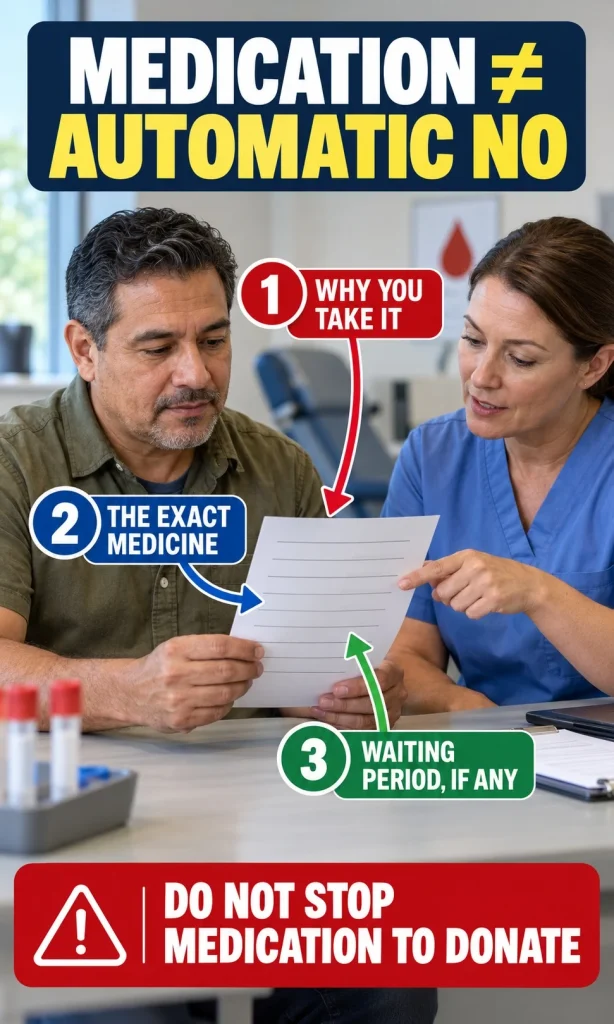
This is one reason a medication list is more useful than the sentence “I take tablets.” A person taking well-controlled blood-pressure medication may still be eligible under Red Cross criteria, while someone taking an anticoagulant or another medicine on a deferral list may need to wait or may not be eligible for a particular donation type.
Do not stop, skip or change prescribed treatment in order to donate. If a medicine creates a deferral, the correct next step is to ask the blood service when or whether you can donate safely, not to alter treatment that was prescribed for your health.
Myth 3: A tattoo or piercing means you cannot give blood
A recent tattoo or piercing can affect timing, but the rule is not universal and the procedure itself does not permanently disqualify most people. In the United States, the FDA lists recent tattooing as a possible temporary deferral, while current Red Cross guidance says many tattoos are acceptable immediately when they were applied by a regulated entity with sterile needles and non-reused ink.
If the tattoo was done where regulation or sterile practice cannot be confirmed, a waiting period may apply; the Red Cross describes a three-month wait in specified U.S. situations. Other countries use different rules, which is why a global article should not turn one U.S. waiting period into a universal instruction.
Myth 4: Only O negative blood is worth donating
O negative red cells are extremely useful because they can be transfused to patients of any ABO/RhD blood type in emergency red-cell situations, but that does not make other donations unimportant. The Red Cross blood-type guidance also explains that plasma compatibility runs differently and that AB is the universal plasma donor in the ABO system.
Hospitals need a mix of red cells, platelets and plasma, and matching requirements can become more specific than the familiar A, B, AB, O and Rh labels. If you do not know your blood type, that is not a reason to stay home; the donation service can determine it and decide how the collected component can be used.
Blood donation eligibility
Donation Readiness Check
Turn four common myths into the exact eligibility questions worth checking before you book.
Educational check only. Blood services make the final eligibility decision. Do not stop or change prescribed medication in order to donate.
Your next check
Verify local eligibility before booking
Reference framework: WHO global guidance plus current U.S. FDA/American Red Cross examples. Local blood-service rules control.
What actually decides whether you can donate today?
The safest mental model is a screen, not a single rule. The FDA’s basic U.S. donor criteria include being in good health, meeting the applicable minimum age, having acceptable hemoglobin and vital signs, and not presenting transfusion-transmitted-infection risks; the exact thresholds and deferral questions depend on the collection system.
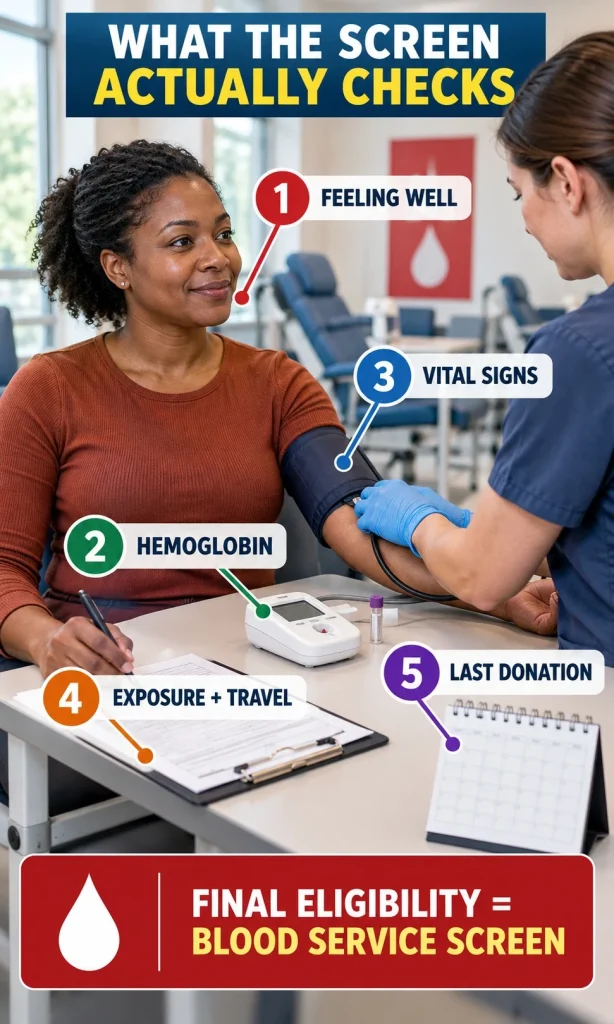
Your last donation also matters. For example, the American Red Cross requires at least eight weeks between standard whole-blood donations, while NHS Blood Donation uses different intervals in England, including different whole-blood schedules for men and women. That is another reason a single “how often can I donate?” answer should always name the blood service or country.
| Screening question | Why it matters | Best next step |
|---|---|---|
| Do I meet the local age rule? | Minimum and upper-age rules vary. | Check the collecting service, especially for first-time donation after 65. |
| Do I feel well today? | Active illness can trigger a temporary deferral. | Wait and ask the service when to return. |
| Am I taking medication or receiving treatment? | Some medicines and the conditions they treat change eligibility. | Check the exact medicine; do not stop treatment to donate. |
| Have I had a recent tattoo, piercing, travel exposure or procedure? | Temporary infection-risk deferrals may apply. | Use the current local deferral rules. |
| Was my last donation recent? | Donation intervals protect donors and vary by component. | Confirm the date and whether it was whole blood, platelets, plasma or red cells. |
Age matters less than the reason a service is screening you
A healthy 70-year-old may be accepted in one blood system while a 30-year-old is temporarily deferred because of illness, low hemoglobin, a recent exposure or a medication-related rule. That is the central correction to the age myth: eligibility is a structured safety decision, not a birthday test.
For older adults, that makes current health especially relevant. If you have new fatigue, unexplained shortness of breath or other symptoms, do not use a donation appointment as a substitute for medical evaluation; our guides to anemia and physical symptoms you should not ignore explain why symptoms deserve their own assessment.
Before you book: a five-minute verification routine
- Open the official eligibility page for the blood service you will actually use. Country and service rules outrank generic web advice.
- Check age as a local rule, not a universal number. Look for separate criteria for new and returning donors.
- Check your exact medication and the reason you take it. Do not rely on “prescription” versus “over the counter” as the only distinction.
- Check recent events. Illness, tattooing, piercing, travel, procedures, pregnancy, transfusion history and other exposures can change timing.
- Confirm your last donation date and type. Whole blood, platelets, plasma and automated red-cell donations can have different intervals.
That short routine prevents both kinds of error: eligible people unnecessarily ruling themselves out, and ineligible people assuming a myth-busting headline means every restriction has disappeared. Blood donation rules are designed to protect both the donor and the patient receiving the blood, so the final screen belongs with the collecting service.
Blood Donation Age and Eligibility FAQ
Can a 70-year-old donate blood?
Often, yes, but the answer depends on the local blood service. The American Red Cross has no upper age limit for otherwise eligible donors, while other systems use different rules for first-time, returning or older donors.
Can I donate blood for the first time after age 65?
It depends on where you donate. Some services permit first-time older donors, while others use a lower upper age for a first donation and allow older ages mainly for returning donors, so check the official local rule before booking.
Can I donate blood while taking blood-pressure medication?
Many people taking blood-pressure medication can donate if they otherwise meet the blood service’s criteria. The medication itself is not automatically disqualifying under current American Red Cross rules, but your measured blood pressure and overall health still matter.
Do I have to know my blood type before donating?
No. You can present for donation without knowing your blood type, and the blood service will determine the type as part of processing and matching.
Does a new tattoo always mean a three-month wait?
No. In the United States, current FDA and Red Cross rules can allow donation without that wait when tattooing was performed under qualifying regulated and sterile conditions, while other situations require a temporary deferral. Rules outside the United States can differ.
Can I donate blood if I feel slightly unwell?
Do not assume you should donate through an illness. Contact the blood service if you are unsure; temporary deferral is common when a donor is not feeling well on the day of donation.
The decision is local, but the age myth is easy to fix
There is no single worldwide age at which a healthy person automatically becomes “too old” to donate blood. Check your local service’s age rule, then let the normal health and safety screen decide the rest; that is more accurate than relying on a social-media cutoff, an old article or a rule borrowed from another country.